Webinar: Global Agriculture in Crisis – Envisioning a Just Transition

Webinar: Global Agriculture in Crisis - Envisioning a Just Transition

Watch the Webinar:


The Covid-19 crisis is revealing deepening systemic inequalities and injustices within the global food and agricultural systems, threatening people’s health, livelihoods and food sovereignty. However, social movements, activists and small-scale food producers are advocating for, and building, more just and sustainable food systems.

This webinar builds on discussions organised by AEPF in July as part of our “Food Producers Shall Not Go Hungry” series [Webinar 1, Webinar 2], with academics and activists more deeply exploring the root causes of the food crisis. Join as we discuss how people, from urban workers to small-scale food producers, are coming together to advocate for a just transformation of the food and agricultural systems.

This discussion will be followed by our next webinar in the series, “Fighting for Land Rights: Sharing Struggles and Strategies”, in which we look at active land struggles, with a focus on shared tactics and strategies.

Speakers:

Sandeep Chachra – Actionaid Association – India
Laksmi Savitri – FIAN Indonesia – Indonesia
Jan Douwe van der Ploeg – Wageningen University/China Agricultural University – The Netherlands
Herman Kumara – NAFSO/WFFP – Sri Lanka

Resources

  1. From biomedical to politico-economic crisis: the food system in times of Covid-19 by Jan Douwe van der Ploeg
  2. Choosing resilient food systems in the wake of Covid-19 by Jan Douwe van der Ploeg
  3. Download the presentation on Small-scale Fishing and Food Sovereignty by Herman Kumara, NAFSO and WFFP
Read More

Webinar: Progressive Policies during COVID-19 – Dialogue with Parliamentarians

WEBINAR: Progressive Policies during Covid-19 - Dialogue With Parliamentarians

Watch the Webinar: 

What could and should be the role of the parliaments and parliamentarians in saving lives, jobs and incomes of ordinary people? How can parliamentarians work to ensure that decentralization of power occurs during such times?

We believe the discussion on social justice delivery and parliaments’ role in ensuring social, civil and economic rights must be central to agendas.

In this AEPF “Dialogue with parliamentarians”, progressive parliamentarians from Asia and Europe share their specific experiences during the pandemic in their respective countries and regions.

Speakers:

Syed Naseer Hussain – MP (India)
Risa Hontiveros – Senator (Philippines)
Charles Santiago – MP (Malaysia)
Lotta Johnnson Fornarve – MP/Deputy Speaker (Sweden)
Tserenjamts Munkhtsetseg – MP (Mongolia)
Naz Shah – MP (UK)
Aida Kasymalieva – MP/Deputy Speaker (Kyrgyzstan)

Read More

Webinar: Militarised Geopolitics versus Sustainable Peoples’ Alternatives

Webinar: Militarised Geopolitics versus Sustainable Peoples’ Alternatives

Watch the Complete Webinar 

Links to resources from the speakers

Walden Bello’s presentation on Superpower Conflict in the South China / West Philippine Sea

Taking Back Control: The Future of Public Services by Lavinia Steinfort
Ecofeminism: fueling the journey to energy democracy by Lavinia Steinfort

 Concept Note 

Even as the world is caught in the multiple impacts of the Covid-19 pandemic, climate and ecological crises, recession, inequality, hollowing out of democracies, suppression of dissent and minorities by elected authoritarian regimes, geopolitics and a race for hegemony between  great powers, regional powers and power blocs continues.  These geopolitical rivalries are a variation of past ideological/ inter-imperialist confrontations with current neoliberal rivalries and the race for hegemony and influence. These geopolitical and geo-economic contradictions range from the play between the existing great power (USA) and rising powers power (China); to resurgent power Russia; to the assertions of the EU;  aspirations of Asian powers like Iran, India, Turkey;  to frozen conflicts like between North and South Korea, India-Pakistan, China, etc.    

These rivalries encompass the control /influence over territories, maritime routes, seas, outer space.  The race for influence includes control over financial flows, communications, new technologies, scientific and cultural competition. This competition is backed by trans-national capital and corporations that is willing to backs chauvinist/racist nationalisms, and turn a blind eye to disasters in the interest of profit. This is evident in the rise of conflict embedded and failed states, migration and refugee flows, suppression of dissent, crushing of labour rights, etc. This strategic competition has deep ecological consequences, negatively impacts the climate and damages people’s lives and livelihood. Europe and Asia are at the centre of this geopolitical pull and push. 

What is often hidden by dominant discourses and ignored by states and realist paradigms is the impact that such geopolitics has on people,  social relations, on climate and ecology and how people and their movements shape geopolitics too for example the Brexit movement, Black Lives Matter; peoples movement in Hong Kong are consequences of new geopolitics. 

The pillars of such destructive geopolitics are rooted in neoliberal capitalism that privileges capital over peoples’ lives and ecological survival; elitist, imperialist/racial narratives over social justice; national security regimes over people’s security; nuclear weapons and militarised force over peace and justice. These hegemonies (US) as well as conflicts had been simmering along, but what we have now is in a qualitatively different level of antagonisms.

In this webinar AEPF seeks to (1) analyse and question the hegemonic/militarised trends in global geo politics and contrast these with peoples’ security approaches, focussing on social and economic justice and equality. (2) Connect the disastrous impact that the world witnessed with the Covid-19 Pandemic and the inability of great, regional and small ‘powers’ to provide health and social security to their citizens. (3) Point to the false narratives that justify corporate led growth paradigms and trickle down security that prioritises increased spending on vanity projects, military industrial complexes and underfunds universal health, employment and other elements necessary for a sustainable life in peace and harmony with nature.

Panelists: 

(1) Marga Ferré (Tranform!; Spain)
(2) Tariq Ali (Activist/Writer; UK, Pakistan)
(3) Walden Bello (Activist/Writer/Former MEP; Philippines)
(4) Lavinia Steinfort (Transnational Institute; The Netherlands)

Moderators:

(1) Professor Anuradha M. Chenoy (AEPF; India)
(2) Kris Vanslambrouck (AEPF; Belgium)

Read More

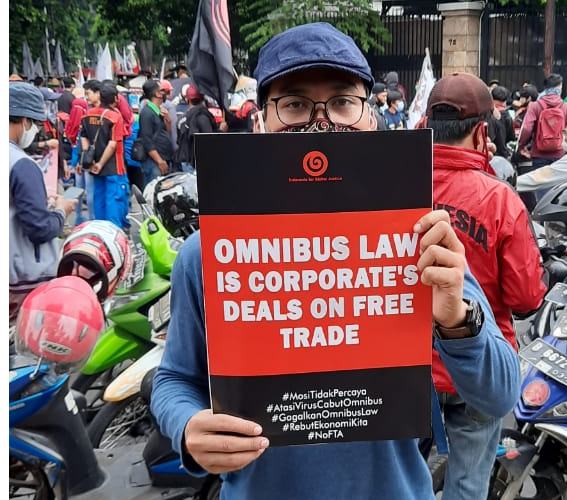
STATEMENT OF SOLIDARITY WITH THE INDONESIAN PEOPLE AGAINST THE ANTI-PEOPLE OMNIBUS LAW

STATEMENT OF SOLIDARITY WITH THE INDONESIAN PEOPLE AGAINST THE ANTI-PEOPLE OMNIBUS LAW

Signatories: 

Sl no. Name Organization Country Sign on as individual or organization
1 AEPF Asia Europe People’s Forum Organization
2 Global Justice Now (UK) UK Organization
3 11.11.11 Belgium Organization
4 Laban Ng Masa Philippines Organization
5 Kisan Rabita Commiittee Pakistan Organization
6 Asienhaus Germany Organization
7 Fresh Eyes UK UK Organization
8 Transnational Institute The Netherlands Organization
9 Parti Sosialis Malaysia (PSM) Malaysia Organization
10 Partido Lakas ng Masa (PLM) Philippines Organization
11 Transnational Palm Oil Labour Solidarity (TPOLS) Network Organization
12 Farooq Tariq Haqooq Khalq Movement (Peoples Rights Movement) Pakistan Individual
13 R. Jamal Tewary Worker’s Initiative – Kolkata, India India Organization
14 Francine Mestrum Global Social Justice Belgium Organization
15 Mohammad Amin Pakistan Kissan (Farmer) Rabita Comittee United Kingdom Individual
16 Marianne Klute Rainforest Rescue / Rettet den Regenwald Germany Organization
17 Willy Indian Social Action Forum India Organization
18 Anuradha Chenoy AEPF and professor (retired) India Individual
19 Kamal Chenoy Retired professor India Individual
20 Jaybee Garganera Alyansa Tigil Mina (ATM) Philippines Organization
21 Manjette Lopez SANLAKAS Philippines Organization
22 Renata Sandhi Libraswulan Verite Southeast Asia The Philippines Organization
23 Yogi Paramitha Independent Scholar Indonesia Individual
24 Aliyah Almas Sa’adah Students Indonesia Individual
25 Natalie Lowrey AidWatxh Australia Organization
26 Leody de Guzman BMP ( Solidarity of Filipino Workers) Philippines Organization
27 Ramadhani Ario Yudhanto Self-employed Indonesia Individual
28 jeevindran Gunarattnam Socialist party malaysia Malaysia Individual
29 Darmashakthini Arujunan Party Socialist Malaysia Malaysia Individual
30 Adrian Pereira North South Initiative Malaysia Organization
31 Hermann Klosius none Austria Individual
32 Martha Meijer Nederland Individual
33 Sivarajan Parti sosialis malaysia Malaysia Individual
34 Sanita Independent Indonesia Individual
35 Merck Maguddayao Solidarity of Unions in the Philippines for Empowerment and Reforms (SUPER) Philippines Organization
36 Daniel Ongd AFRICANDO Spain Organization
37 Daniel Perez Creus Private Senegal Individual
38 Wuri handayani Individual Indonesia Individual
39 Nestor Yaranon Kilos Maralita Philippines Individual
40 Muhamad Kosar Independent Forest Monitoring Network/JPIK Indonesia Organization
41 Prof B Gills Peoples Sovereignty Network United Kingdom Individual
42 Catherine Coumans MiningWatch Canada Canada Organization
43 Jane Byrne Unite Union United Kingdom Individual
44 Farooq Tariq Haqooq Khalq Movement (Peoples Rights Movement) Pakistan Individual
45 Matthew kelliher Self employed England Individual
46 Alvin Jimenez Bukluran ng Manggagawang Pilipino Philippines Individual
47 Nouval Murzita Perhati Indonesia Individual
48 Gerry Arances Center for Energy, Ecology and Development Philippines Organization
49 Arnold Tarrobago Active Citizenship Foundation Philippines Individual
50 Elizabeth Ibañez Sibuyanon Against Mining SAM Philippines Organization
51 Jean Enriquez Coalition Against Trafficking in Women – Asia Pacific (CATW-AP) Philippines Organization
52 Josua Mata Sentro ng mga Nagkakaisa at Progresibong Manggagawa (SENTRO)ng PHILIPPPINES Organization
53 Jean Enriquez Coalition Against Trafficking in Women – Asia Pacific (CATW-AP) Philippines Organization
54 Josua Mata Sentro ng Nagkakaisa at Progresibong Manggagawa (SENTRO) Philippines Organization
55 Yasmin Rizal Patti Sosialis Malaysia Malaysia Individual
56 Florencia Quesada University of Helsinki Finland Individual
57 Wilson Fortaleza Partido Manggagawa Philippines Organization
58 Florencia Quesada University of Helsinki Finland Individual
59 Elizabeth Ibañez BAYAY SIBUYANON INC. Philippines Organization
60 Oliver Corbito Alliance of General Union Institutions& Labor Associations, Aguila Rider’s & GUARDIANS PHILIPPINES Individual
61 Mar mercado BMP- Solidarity of pilipino workers Philippines Individual
62 Jusupta Tarigan NTFP EP Indonesia Indonesia Organization
63 Tony Salvador Third World Network Philippines Individual
64 Kathy Bernaerts 11.11.11. Belgium Individual
65 Apo Leong HKSSS (social security society) Hong Kong Individual
66 Devied Independent Indonesia Individual
67 ariefanto gevani pengangguran indonesia Individual
68 Mary Ann Manahan World March of Women-Philippines Philippines Organization
69 Judy Ann Chan Miranda Partido Manggagawa- Labor Party Philippines Organization
70 Marilou Verano Ang Aroroy Ay Alagaan. Inc/Marian Women Producers Cooperative/ Unified Civilian Society Incorporated Philippines Organization
71 Bart-Jaap Verbeek Centre for Research on Multinational Corporations (SOMO) Netherlands Organization
72 Mirjam van Rijn De Groenen The Netherlands Organization
73 Ryan Martinez n/a Philippines Individual
74 Rovik Santiago Obanil Freedom from Debt Coalition Philippines Organization
75 Rinda Amalia Dosen Indonesia Individual
76 Ely Guzman Bukluran ng Manggagawang Pilipino Southern Tagalog Chapter (Solidarity of Filipino Workers Sothern Tagalog Chapter) Philippines Organization
77 Rona Sutowo Local Authority worker United Kingdom Individual
78 Joanna Ewart-James Freedom United UK Organization
79 Celia Alejandra Mena González Individual Nicaragua Individual
80 Ananeza Aban UP CIDS Program on Alternative Development Philippines Individual
81 Femy Pinto NTFP EP Asia Philippines Organization
82 Stephanie Joubert Individual Nederland Individual
83 Ana Maria R. Nemenzo WomanHealth Philippines Philippines Organization
84 Ana Maria R..Nemenzo WomanHealth Philppines Philippines Individual
85 Maria Carmina Alba None Philippines Individual
86 Joseph Purugganan Trade Justice Pilipinas Philippines Organization
87 Heity Ariaty Nonr Indonesia Individual
88 Vincent Alex Mukhari DENOSA South Africa Individual
89 Rena Herdiyani Kalyanamitra Indonesia Organization
90 Robin Averbeck Rainforest Action Network United States Organization
91 Oyette Zacate Oriang Philippines Organization
92 Jericho J. Roblss SPARK(Samahan ng Progresibong Kabataan) and Bukliran Student Alliance – Integrated Student Organization Philippines Individual
93 Jones Toh Bukluran ng Manggagawang Pilipino Philippines Individual
94 Patricia Justine Celemin Racca Samahan ng Progresibong Kabataan Philippines Individual
95 Patricia Justine Celemin Racca Samahan ng Progresibong Kabataan Philippines Organization
96 Justin Klayne B. Dizon SPARK – Samahan ng Progresibong Kabataan Philippines Individual
97 Red Ligot Samahan ng Progresibong Kabataan Philippines Organization
98 Aira V. Delfin Bukluran Students’ Alliance- Integrated Students’ Organization Philippines Individual
99 Aira V. Delfin Bukluran Students’ Alliance- Integrated Students’ Organization Philippines Organization
100 Princess Mae Bartolome None Philippines Individual
101 Ferdinand Salazar Stewards and Volunteers for the Earth – Philippines (SAVE Philippines!) Philippines Organization
102 Sophia Gaton Save PH Philippines Organization
103 General Du Alliance of General Unions, Institutions and Labor Associations (AGUILA) Philippines Organization
104 Christine Joyce Samonte SAVE PH & PLM SAVE Philippines Individual
105 Jeraldine Cabawatan SAVE PH Philippines Organization
106 Cindy Mae Delegencia SAVE PH Philippines Individual
107 Daphne Pia Bacsafra SPAEK SPARK Individual
108 Jailouise A. Perez Bukluran Student Alliance Philippines Individual
109 Kate Li-Anne E. Gonzalo BUKLURAN Philippines Organization
110 Jonathan Correa Bukluran Student Alliance Philippines Organization
111 Michaela Alicia Eola Bukluran Students’ Alliance- Integrated Students’ Organization Philippines Organization
112 Henny Saptatia Drajati Nugrahani European Studies Master Program Indonesia Individual
113 Fiana Isnaeni Maheda Ronie Universitas Indonesia Indonesia Individual
114 Indira Rahma None Indonesia Individual
115 Mahesa Ulung Individual Indonesia Individual
116 Obert Masaraure ARTUZ ZIMBABWE Organization
117 Obey Manayiti Non Zimbabwe Individual
118 JAPHET MOYO ZCTU- zimbabwe Zimbabwe Organization
119 Simon NA Zimbabwe Individual
120 Simon NA Zimbabwe Individual
121 Japhet Moyo ZCTU Zimbabwe Individual
122 Roselilly Ushewokunze Artuz Zimbabwe Individual
123 Learnmore Magorimbo Zimbabwe Youth Alliance Zimbabwe Organization
124 Margaret Mutsamvi Economic Justice for Women Project Zimbabwe Organization
125 Elvis Mugari STATE 55 AFRICA Zimbabwe Organization
126 Kudakwashe Munengiwa Zimbabwe Urban Councils Workers Union Zimbabwe Organization
127 Kudakwashe Munengiwa Zimbabwe Urban Councils Workers Union Zimbabwe Organization
128 Janneke Bazelmans Milieudefensie/Friends of the Earth Netherlands The Netherlands Organization
129 M Hendriks Both ENDS Netherlands Organization
130 Tayyaba haq None Pakistan Individual
131 Warren McGregor ZACF South Africa Individual
Read More

Violating Human Rights Legally: Pakistan’s new Bill to curbs freedom of Expression

Violating Human Rights Legally: Pakistan’s new Bill to curbs freedom of Expression

Many populist authoritarian regimes in the Third World have been violating human rights, clamping down on protests, charging intellectuals, journalists and poets by misusing anti-terror and sedition laws. Recently we witnessed the murder of a peasant leader in Philippines. India’s majoritarian and Islamphobist Parliament  passed discriminatory citizenship laws in 2019. Now the Punjab Assembly in Pakistan has passed a bill that legally promises to not only curb freedom of expression but is set to raid, and confiscate any publication if they deem it against the interest of the nation. Clearly, the interest of an anti-democratic regime has been claimed as the ‘nation’. 

We are giving below a statement signed by Pakistan’s civil society that expolains this draconian legislation. 

Tahaffuz-e-Bunyad-e-Islam Bill; an invasion on freedom of expression and critical thinking

Publishers, booksellers, writers, lawyers, students’ collectives, teachers’ collectives and human rights and grassroots organisations in Pakistan are extremely concerned about the Tahaffuz-e-Bunyad-e-Islam Bill passed by the Punjab Assembly on July 23, 2020. 

We believe the Bill is an invasion on freedom of expression and critical thinking and will also spell disaster for the printing and publishing industry in Punjab that employs tens of thousands of people.

 The Bill gives a bureaucrat, the Director General Public Relations (DGPR), in section 7, the powers to raid a publishing house, book store or printing press and confiscate copies of material the authorities deem “violatory”. The DGPR or his/her authorised officers will also have the power to “inquire into, investigate, assess or ascertain any act or omission”.

In section 8 called ‘Regulation of national and foreign books’, the Bill goes even further and in an unprecedented manner make it mandatory for all books (local or foreign; first editions or reprints) to seek the approval of the DGPR before they can see the light of the day. Section 8(3) enunciates that that the DGPR has the power to “refuse permission to import, print or publish a book” if it is “prejudicial to the national interest, culture, religious and sectarian harmony.” The same powers will be exercised by the Muttahida Ulema Board (MUB) for books concerning religion, according to sub-section 8(4).

 It is clear that disguised as a law protecting the foundations of Islam, the Bill is an attack on freedom of expression and is in conflict with constitutional provisions protecting the same freedoms. We are concerned that the DGPR/MUB does not have the intellectual and physical capacity to evaluate book manuscripts. 

We are also in principle fundamentally opposed to the very idea of seeking approval from a bureaucrat/MUB prior to publishing or selling a book. Equally, we are fully opposed to the confiscatory spirit of the Bill sanctioning the DGPR to raid offices and stores. This kind of power has no place in a democracy.  

 We believe the Bill is a ferocious attack on the already-dwindling publishing industry of Pakistan, of which Punjab is a major part. In a province where bookstores are fast turning into stationary shops and publishers are decreasing in number, the Punjab government should devise policies supporting the publishing industry by helping create cheap paper locally, incentivising local publishers and booksellers, encouraging public libraries to procure locally-produced books and creating public events to showcase local writers’ and publishers’ works to both the local and international audiences. 

Instead, the Punjab government has passed a Bill that will suffocate the already-diminishing reading culture in Punjab. The publishing industry in Punjab is finding it incredibly hard to sustain beyond the textbook sphere; this law is an attempt to pave the way for its extinction.

 Although the Bill has gone back to the Assembly for discussion, as publishers, book sellers, writers, academics, lawyers, students and human rights activists, we want to send a strong message to the legislators that we will not accept this Bill in any form. 

Even after the legislators address the concerns of the Shi’a community, the repressive and confiscatory character of the Bill will remain intact in sections 7(1), 7(2), 8(1), 8(2), 8(3), 8(4) and 8(12), devised to isolate progressive and critical voices and push publishers out of business. If the Bill is not scrapped, we reserve our rights to protest, agitate and challenge its constitutionality in order to preserve our right to freedom of expression.

Signed by:

Folio Books (Publisher, Lahore)
Vanguard Books (Publisher, Lahore)
Readings (Bookstore, Lahore)
Mr Books (Bookstore, Islamabad)
Books and Beans (Bookstore, Lahore)
Fiction House (Publisher, Lahore)
Mavra Books (Publisher, Lahore)
Jamhoori Publications (Publisher, Lahore)
Sanjh Publications (Publisher, Lahore)
Ilmi Book House (Bookstore, Lahore)
Mashal Books (Publisher, Lahore)
Dogar Publisher (Publisher, Lahore)
Auraq Publications (Publisher, Rawalpindi)
Beacon Books (Publisher, Multan)
Maktaba Daniyal (Publisher, Karachi)
Welcome Book Port (Bookstore, Karachi)
Gosha-e-Adab (Publisher, Quetta)
Roshni Publication (Publisher, Hyderabad)
Shah Latif Kitab Ghr (Publisher, Hyderabad)
Humsari Magazine (Publisher, Hyderabad)|
Indus Academy (Publisher, Hyderabad)

The following human rights and research organisations, teachers’ and students’ collectives, academic platforms, democratic fronts, alternative media and movements also signed the statement

 Human Rights Commission of Pakistan
Haqooq-e-Khalq Movement
Democratic Commission for Human Development
National Commission for Justice and Peace
Progressive Academics’ Collective, Lahore
Progressive Academics’ Collective, Karachi
ASR Resource Centre
Centre for Social Justice
Aurat March, LahorE
Afkar-e-Taaza
Women Democratic Front
Women Action Forum
Pakistan Kissan Rabta Committee
Daily Jeddojehad Online
Voicepk.net
Progressive Students’ Collective
Authors’ Alliance
Lahore Education and Research Network

Farooq Tariq
General Secretary,
Pakistan Kissan Rabita Committee

Read More

WEBINAR: FOLLOW THE (Peoples’) MONEY – How the Governments of the world’s biggest economies are spending Public Funds in response to the Multiple Crisis: COVID19, Economic Crisis, Climate Crisis”

WEBINAR: FOLLOW THE (Peoples') MONEY - How the Governments of the world's biggest economies are spending Public Funds in response to the Multiple Crisis: COVID19, Economic Crisis, Climate Crisis

AEPF joined Asia People’s Movement on Debt and Development (APMDD), Fight Inequality Alliance Asia and ActionAid to co-host an online event titled FOLLOW THE (Peoples’) MONEY: How the Governments of the world’s biggest economies are spending Public Funds in response to the Multiple Crisis: COVID19, Economic Crisis, Climate Crisis 

The webinar was held Live on 17 July 2020, and is available to view on the AEPF website and on Facebook.

Speakers of this webinar included a number of researchers and activists from both Asian and European countries.

Lidy Nacpil is a member of AEPF’s Climate Justice cluster, cofounder of the Fight Inequality Alliance, and coordinator of Asian Peoples’ Movement on Debt and Development. She is also co-coordinator of the Global Campaign to Demand Climate Justice, serves on the coordinating committee of the Financial Transparency Coalition, and is Vice President of the Freedom from Debt Coalition based in the Philippines. Lidy began by offering a general overview of these multiple and overlapping crises, and the role that our governments, financial institutions and corporations are playing to largely exacerbate these crises. 

Tim Jones was the second speaker on the panel. Tim is head of policy at the Jubilee Debt Campaign UK, a UK based organization that campaigns for cancellation of unjust debts in solidarity with campaigners in the global South and for households affected by debt in the UK. Tim spoke about discussed the Fiscal Response Measures to the COVID19 crisis taken by governments in the UK, US, Japan, Germany and elsewhere, as well as the current role of international financial institutions including the IMF and WB.

The next speaker was Iolanda Fresnillo, senior policy and advocacy officer at Eurodad – the European Network on Debt and Development, which works for debt justice. She is also active in the Spanish Citizens Debt Audit Platform and other local and international social movements. Iolanda worked for over a decade as a researcher at Debt Observatory in Barcelona and as a research consultant at MSF France International Institute, as well as several local authorities in Catalonia and Spain. She discussed the Debt Service Suspension Initiative of the UN.

Claire Miranda is senior policy and program officers of the Asian Peoples’ Movement on Debt and Development. She’s worked with the secretariat at APMDD for 11 years under several campaigns and programs. She’s currently leading APMDD’s work on the Green Climate Fund, monitoring both meetings and decisions, providing relevant updates and analysis. Claire spoke about the G20 government’s commitments and the failure to deliver climate finance given the climate crisis.

Alex Doukas is the Stop Funding Fossil Fuels Program Director at Oil Change International. His work focuses on ending international subsidies and public finance for fossil fuels and shifting public resources towards building a clean energy future, including funds for access to energy. Alex spoke about the continued public subsidies for fossil fuels into the year 2020, at a time when GHGs are supposed to be peaking globally.

The webinar and lively Q&A sessions were moderated by Vidya Dinker of INSAF and Kris Vanslambrouck, member of AEPF CJ cluster and 11.11.11.

This event was designed for researchers and advocates to share knowledge and concerns with a wider audience regarding how public funds are being used in response to the COVID19, economic and climate crises. The webinar was strategically held the day before the July 18 and 19 G20 preparatory ministerial meetings of the Finance Ministers and Central Bank Governor in the lead up to the G20 Leaders Summit scheduled in Saudi Arabia in November this year. 

As governments of the world’s biggest economies,  their policies and actions – individually and as the G20 – have huge impacts globally.  As we brace ourselves for the further worsening of the COVID19 pandemic, the deep economic crisis it has spawned, and climatic changes that threaten the entire planet   —  we are spotlighting how these governments are responding across these multiple crises, in particular their use of public funds.  

This webinar looks at and compares the following:

 The 90-minute webinar provides information, analysis and perspectives on the general landscape on these issues and is the kick off to a series that will delve deeper in specific topics in the coming weeks.

Also read:
The G20 continues to ignore calls to cancel the debts of the world’s poorest countries and stop funding fossil fuels
(Dorothy Grace Guerrero on Global Justice Now)

Read More

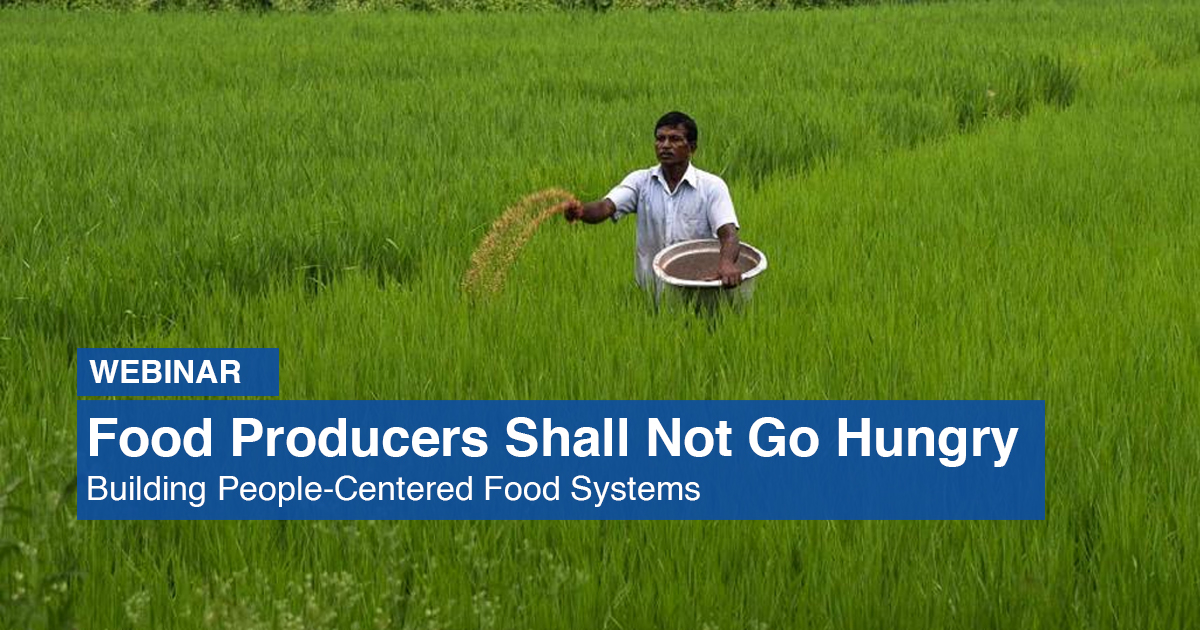
Webinar: Food Producers Shall Not Go Hungry – Building People-Centered Food Systems

Webinar: Food Producers Shall Not Go Hungry - Building People-Centered Food Systems

Watch the Complete Webinar:

This Webinar was also covered on Dawn: Pakistan’s oldest, leading and most widely read English-language newspaper.

Read the full coverage here

Webinar Report

“Strengthening solidarity among European and Asian farmers movements is key to survival of peasants hard hit by COVID-19. No one should go hungry, including food producers.” Paula Gioia, leader La Via Campesina – Europe

The Asia Europe People’s Forum, a network of progressive organisations across our regions, held its second webinar of a two-part series “Food Producers Shall Not Go Hungry”.

This all-female panel was comprised of peasant and rural workers speaking from The Philippines, India, Romania and Germany. The speakers included Filipino peasant organizer of PKKK, Amparo Miciano, organizer of Karnataka Rajya Raitha Sangha in India, India, Chukki Nanjundaswamy, worker of Ecoruralis in Romania, Ramona Duminicioiu and peasant organizer in Germany, Paula Gioia.

The insightful discussion covered the struggles of communities, particularly female food producers, for building people-centered food systems.

Paula Gioia from La Via Compisena Europe explained how the coronavirus pandemic proved that peasant agriculture can feed local populations with fresh, healthy food that doesn’t depend on long supply chains. In this context, much of society is realising the importance of localized, decentralised food systems, as well as of acknowledging the essential work of food producers. She said that strengthening solidarity among European and Asian farmers movements is key to the survival of peasants hard hit by COVID-19. “No one should go hungry, including food producers”, she said. She shared that more than 90 percent of farms in Europe are small, that the peasantry has been feeding people before, and that COVID19 lockdowns shortening supply chains led to local communities contributing labour, and farmers making direct sales through Community Supported Agriculture, direct sales, small shops and food boxes.

The pandemic showed the ugly face of the European food industry, deepening the historical exploitation of migrant seasonal workers, while at the same time turning supermarkets into Coronavirus transmission hotspots. Farmers markets and CSAs are simply much safer ways for people to get nutritious food. It is also important to understand that epidemics like COVID19 are direct products of the industrial agrifood systems.

Ramona Duminicioiu, a Romanian peasant of Ecoruralis, explained that as governments failed to coordinate with one another, there was a deepening fear by people that they would have to fend for themselves. Supermarkets that remained open did price gouging, while banks took advantage of poor countries unable to cope with the virus. She said that in Europe “governments haven’t responded to our demands. Everything migrant workers managed to do is due to themselves, their own hard work, and the solidarity of others… Yet our role in addressing the crisis became visible. Governments had to recognize our role as essential workers”. Ramona went on, “we produce food under very difficult conditions. Until now peasants and workers have received no support from governments. We survive because consumers recognise our contributions, but we still are forced to compete with powerful transnational companies for policy plus financial support.”

Amparo Miciano, a central organizer of PKKK, a rural women’s network in The Philippines, stressed, “We believe we have the capacity to feed ourselves, especially if we are guaranteed control over the resources and technology require to produce food. Hence, we continue to assert our rights for land and water resources, we assert agroecology as a suitable way in farming and protecting our environment.” Amparo  further argued that PKKK female food producers struggle to be recognised as farmers. Their work involves combining the crucial care work with food provision, where rural peoples barter with each other and fed people, which govts and corporations have failed to do.

According to Chukki Nanjundaswamy, from Karnataka Rajya Raitha Sangha in Karnakata, “Farmers are also getting organised and consumers also getting organised. We’re seeing initiatives. The 61 days of lockdown we saw in India was enough to show that the capitalist model is a failed model. Capitalist model just collapsed in our countries. What worked was a people to people initiative. What worked was solidarity between the people. These are the times of crisis and also the times of opportunities…. This situation taught the lesson that it’s better to grow diversified fruit for the local market. Those growing monocultures to sell at far away markets were hit the hardest. Those who did agroecological farming were able to build their own markets and sell directly.”

She said, “Lockdown period revealed to us that Capitalism is a failed system. A solidarity economy driven by people-to-people initiatives is what worked in this period”. The lockdown showed the capitalist model does not work for the majority, as many peasants died of malnutrition, poor health and debt-induced suicide during this time. It is people-to-people support that is helping the majority to survive the COVID19 crisis.

The viewers agreed that we must build solidarity with small scale food producers, organize against authoritarianism, resist transnational companies and industrial agriculture, amplify workers’ voices, elevate human rights for rural peoples, strengthen agroecological farming and organise for food sovereignty.

Viewers engaged in a question and answer session, facilitated by Farooq Tariq of the Pakistan Kissan Rabta Committee and Yinfang Tang from Fian International. This webinar was viewed by over 1300 people on Facebook in just the first few hours since the Livestream ‪on Friday afternoon‬, showing a great deal of interest about the question of food and peasants beyond the over 200 viewers who registered and participated in the  Zoom session from 33 different countries, with Live translations into Urdu and Bahasa. By the end of the weekend, the panel was viewed by approximately 2000 people.

Farooq Tariq
General Secretary Pakistan Kissan Rabita Committee
‪+92 03008411945

Read More

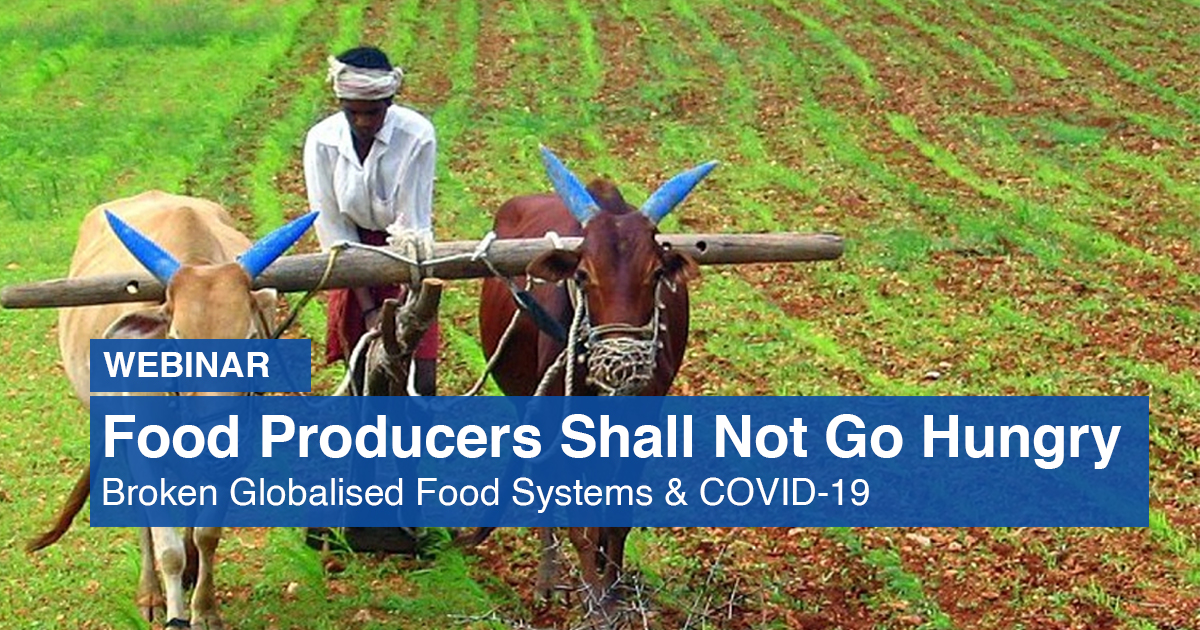
Webinar: Food Producers Shall Not Go Hungry – Broken Globalised Food Systems & COVID-19

Webinar: Food Producers Shall Not Go Hungry - Broken Globalised Food Systems & COVID-19

Asia Europe People’s Forum (AEPF) organised an international webinar titled “Food Producers Shall Not Go Hungry: The Broken Globalised Food System” in collaboration with Pakistan Kissan Rabita Committee. Over 600 viewers attended Live from different Asian and European countries, and hundreds more continue viewing the recording online.

The  webinar was moderated by Yifang Slot-Tang of Germany and Farooq Tariq from Pakistan. Speakers include Hashim Bin Rashid, a member of Pakistan Kissan Rabta Committee/La Via Campesina, Professor Felix Anderl from University of Cambridge UK and Asienhaus Germany, Arie Kurniawaty from Solidaritas Perempuan Indonesia and Ashlesha Khadse from LA Via Compesina South Asia, India.

The speakers explained that small farmers, landless peasantry, agriculture workers and the rural poor in Asia were badly affected by the COVID-19 pandemic. They spoke not only about the larger crisis in agriculture in the region, but also regarding agrarian visions in Asia of paths out of the current pandemic. The crisis is all due to uneven land distribution, ecological change, and the increased marketisation of agricultural markets, they argued.

The speakers shared that the COVID-19 lockdowns have resulted in food rotting in fields, leaving food producers, including peasants, farmers, and agricultural workers, to go hungry. The mass return of tens of millions of migrant workers, many walking hundreds of miles on foot, to their home villages has raised serious questions about the precarity of the lives of dispossessed and landless poor across rural and urban settings. The tragedy of many returning to their home villages is that they no longer have land to cultivate, nor subsistence crops to get through these difficult times.

They said that when the World Food Programme is warning of a ‘famine of biblical proportions,’ the situation in rural Asia is most worrying. The region has a long history of famines in the past. Small-scale food producers, including peasants and fisherfolk, have been particularly vulnerable to the external shock caused by the COVID-19 lockdown that has disrupted agricultural markets.

They said that this has exacerbated an already bleak situation for Asia’s peasants, small food producers and working poor. One of eight people in the world were facing malnutrition due to a lack of adequate and healthy food before the COVID19 pandemic. This global hunger is a product of landlessness, uneven social relations and capitalist imperatives underpinning relentless dispossession of people from land, as well as inadequate infrastructure and logistics of food provisioning. This has led to a global food system designed to fail to address the needs of the most hungry, instead increasingly supplying food grown in the global South to the global North and not the other way around.

The speakers explained that the policies that were promoted for growing cash crops on agricultural land, such as cotton and palm oil, have made agricultural producers particularly vulnerable in the face of the COVID-related economic crisis in the global North.

Outsourced factories in Asian countries, including Bangladesh, Vietnam, Pakistan, and Indonesia, which supply European markets have found themselves shut down in the face of canceled orders by fashion chains based in Europe. The dependence on European markets for exports of both food and finished products has continued to weaken the economies of many Asian countries.

Replying to a number of questions, the speakers explained why Asia is home to nearly half a billion people that go hungry every day. While UN bodies like the FAO, explain this ‘food insecurity’ through the causes of poverty, conflict, climatic and technological challenges, they say next to nothing about the colonial and neocolonial processes that dispossess peasants of their land.

This has created a situation where millions no longer earn enough to access adequate food, as food continues to be wasted to keep prices high. Moreover, this has meant that the poorest people must continue eating cheap, unhealthy food that leaves long-term health impacts, making them particularly vulnerable to infectious diseases such as the COVID-19 pandemic.

COVID-19 has exposed the authoritarian nature of the regimes in Asian countries. In Pakistan, several dozens of farmers were arrested this week who wanted to go to Islamabad to protest against growing electricity bills. The same pattern is seen in India, Philippines, Indonesia, Bangladesh and several other Asian countries. The regimes in Asia have continued with the old policies of neoliberalism, treating COVID-19 as an opportunity to exploit even more.

The COVID-19 pandemic has only deepened existing inequality and injustice in a food system that was already broken, panellists explained in response to viewer questions. Mass famine is a serious concern as the COVID-19 situation has been made worse by locust swarms, floods and cyclones in the region. Precarious migrant and agricultural workers, the fisherfolk, the landless and homeless, and women and youth engaged in care work are far more susceptible due to worsening conditions of hunger, disease and indebtedness, compared to national elites and their Western counterparts.

This webinar was Part I of a two part series. The following webinar will continue the conversation on July 10, particularly centring Asian voices on the active struggles for food, land, seeds and livelihoods within their own contexts.

At this critical time in human history, marked by the climate crisis, a global pandemic and rapidly increasing inequality, the utter failure of the industrial food system to meet nutritional requirements, particularly in the global South, makes understanding, linking and supporting these struggles all the more urgent.

The speakers said that our grassroots and local efforts in Europe and Asia are essential to invigorating our communities in crisis. The speakers stressed the need for land reforms in all South Asian countries as a first step to solve the agrarian crisis. The feudal call has become a real hurdle in the path of growth of agriculture production and access to food who produce then. They declared the aspiration to fight for the cause, “No food producer shall go hungry”.

The Asia Europe People’s Forum announced the next webinar on 10th of July at 3PM on the issue of presenting agrarian alternatives that would  help to end hunger and poverty among rural masses.
Read More

Regional Strategy Meeting Asia Task Force on Legally Binding Instrument on Business Activities and Human Rights

Regional Strategy Meeting Asia Task Force on Legally Binding Instrument on Business Activities and Human Rights

7th -8th January 2020 – Jakarta, Indonesia

This key conference brought together representatives of a range of organisations and movements from Indonesia and from across Asia who are working on the Legally Binding Instrument on Business Activities and Human Rights.

Participants included:  – Indonesia for Global Justice (IGJ);  KruHA; Walhi; Lokataru Foundation;  KIARA: INFID; FIAN Indonesia;  JATAM;  from Indonesia and Focus on Global South; Tebtebba; ATM; THIRD WORLD NETWORK; World March of Women Phillipine from other parts of Asia

We agreed a submission to the important ongoing negotiations.

The submission was sent to United Nations Secretariat in Geneva following the fifth session of the Open-Ended Intergovernmental Working Group (OEIGWG)

The annex responds to the discussion of the 2019 draft text from the fifth session of OEIGWG in Geneva. It paid special attention to the contribution made by Non-Aligned Movement (Grouping), and support the NAM Grouping in negotiation of the text of the Legally Binding Instrument

Please read the letter and the supporting annexe

In addition the conference has enabled stronger linkage between international, national and grassroots level organisations on these key issues. It has also enabled local issues to be ‘amplified’ within this global campaign.

Read More

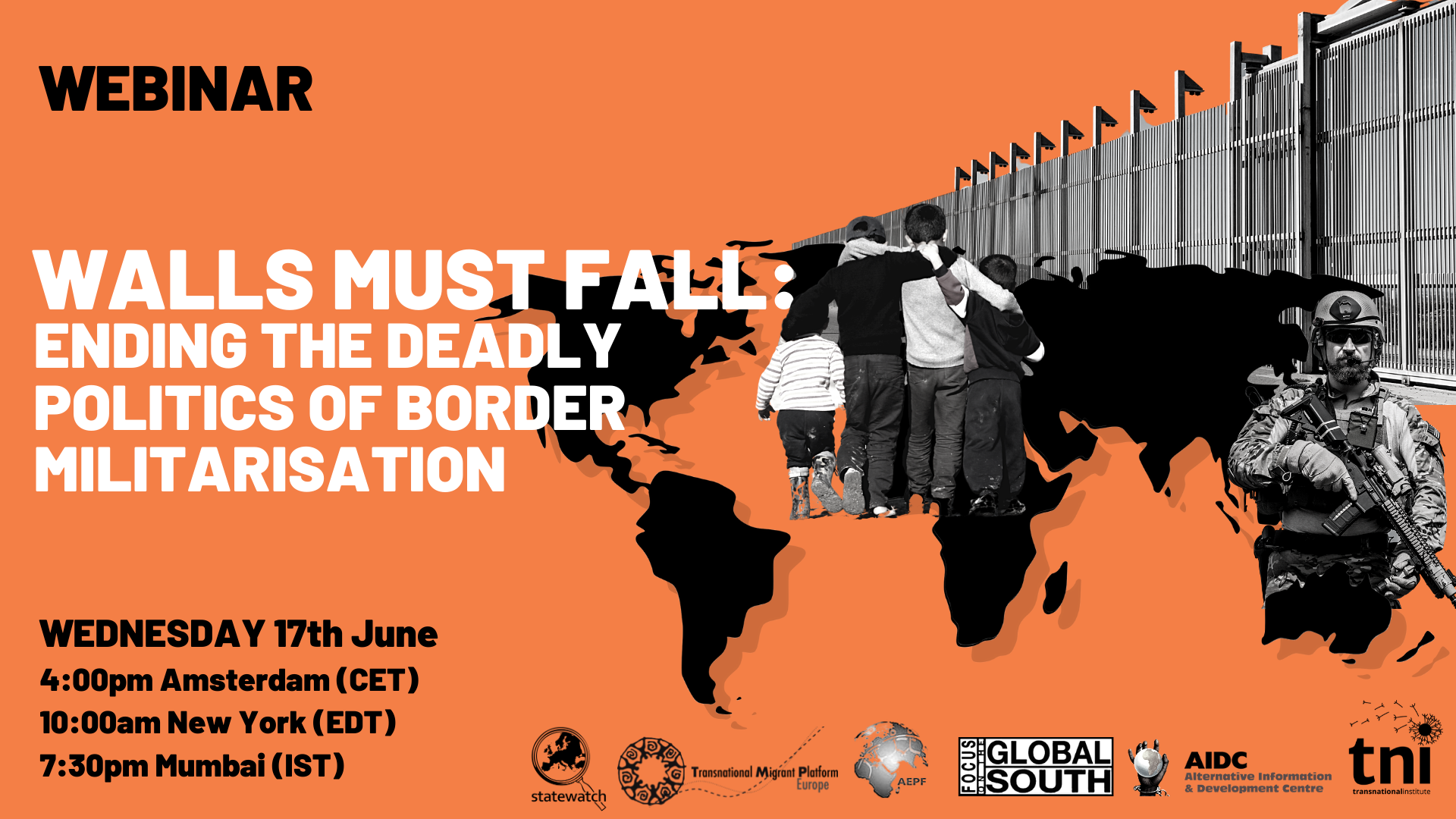
Webinar: Walls Must Fall – Ending the Deadly Politics of Border Militarisation

Webinar: Walls Must Fall - Ending the Deadly Politics of Border Militarisation

AEPF Working Group on Democratisation and Human Rights
Webinar collaboration with Trans National Institute, AEPF, Focus on the Global South, Alternative Information and Development Centre (South Africa).

Watch the Webinar Live

Speakers:

(1) Harsha Walia, author of Undoing Border Imperialism (2013) 
(2) Jille Belisario, Transnational Migrant Platform-Europe
(3) Todd Miller, journalist and author of Empire of Borders (2020), Storming the Wall (2019) and TNI’s report: More than a Wall (2019)
(4) Kavita Krishnan, All India Progressive Women’s Association (AIPWA)

This webinar where AEPF collaborated was part of the TNI series around issues emerging from Covid-19, on issues not covered by the news with the aim of deepening action and understanding. The focus was to provide analysts and activists new ways of understanding. People from almost a 70-80 countries watch the TNI webinars and almost 1000+ people register. It was also translated into Spanish.

SUMMARY:

Harsha Walia, who is located in the indigenous territories of Ottawa, Canada spoke on border imperialism. When thinking of borders we tend to think of static external structures, however these are key methods of imperialism, militarism, xenophobic and elastic nationalism that keeps changing its site of control. Border governance is now both externalised and internalised. These border policies are used across the world and can exist anywhere. The key pillar is border imperialism. The narrative of border imperialism is that states (in the West but also India, Israel, Turkey, etc.) present themselves as victims and migrants have been made bargaining chips (Turkey etc.) And Colonialism and its history of making migrants and becoming settlers is erased. Further migrants are in many cases, being reorganised, into precarious labour and managed when required for capital generation and temporary farm workers.

During the Covid-19 Pandemic such border imperialism has increased as 57 countries have closed their borders. Harsha concluded by arguing for the freedom to return, to stay and move. 

Tod Miller spoke of how the military industrial complexes (MIC) the defence industry and private security have entered into border management and Homeland Security in the US and in many countries world over in huge way. He explained from his empirical study of how billions are being spent by states but especially by the USA on managing borders and new walls being constructed. This has increased exponentially in the Trump era. Tod showed how a key state- Israel is involved in developing these technologies of surveillance from drones, iris scans, towers etc. These surveillance and control technologies are then ‘tried and tested’ on the Palestinian (people)-Israel borders. These are then exported world over. 

Jille Bellisario presented a power point presentation that showed the externalization of borders. She used Europe as her case study. She said injustice for one is injustice for all. She presented slides to show how the Covid-19 virus has been used to end asylum policies and increase the harshness of border police.

Kavita Krishnan located her conversation in the context of South Asia and Asian migrations. She showed migration to be both a cross border as well as an internal rural to urban phenomenon, mostly by the most marginalised, landless peasantry and persecuted minorities in all of South Asia. Referring to how the Rohingyas had been harshly and forcefully pushed out of Myanmar and ethnic Tamils from Sri Lanka she showed the base of militarised politics against ethnic and religious minorities. Kavita dwelt on the issue of Bangladeshi refugees who had come into India since the Pakistan-East Pakistan conflict, when Bangladesh became a new state in 1971. This exodus from that time has been fuelled to an anti-Muslim phobia by the xenophobic forces in India. Currently this issue has morphed to create a chronology of citizenship laws that are exclusive and discriminatory towards Muslims in India. 

Kavita gave examples of the lockdown in India and world over and how harsh these policies were on workers and labour. She showed how a medical crises had been couched in militarised/ communalised language. 

All the speakers gave their support to the Black and indigenous liberation movements. And expressed solidarity with refugee and migrants movements as a step towards de-globalization.

All the speakers agreed that militarised border regimes and securitization of borders and both the external aspect as well as their internalization has only increased during the Covi-19 Pandemic. They all agreed on the need for freedom of movement and safeguarding rights of people impacted by this militarization and border control regimes. 

Read More