AEPF 12 Statement

AEPF 12 Statement

Message of the Asia Europe People’s Forum 12 to the Asia Europe Meeting 12
​Brussels 18th October 2018
Presented on behalf of the AEPF by Dorothy Guerrero a Filipina immigrant, working for a British civil society organisation Global Justice Now

We proudly share with you some key conclusions and recommendations from the twelfth Asia Europe People’s Forum, attended in Ghent by over 425 representatives of movements and organisations from 48 Asian and European countries.

In the spirit of collaboration, we hope to work with you, to effectively and responsibly address the current crises of climate, inequality and rise of authoritarian and excluding governments. Together we will build a Just, Equal and Inclusive Asia and Europe.

We present our People’s Agenda to you at a time when poverty persists, inequalities are growing, social tensions, racism and xenophobia are mounting, democratic spaces are shrinking and environmental devastation goes unchecked.

The AEPF is compelled to share these deep and urgent concerns with you, our elected representatives, and to demand that you address the following three areas:

First, Climate Justice and Just Transitions

Climate change jeopardises our lives, livelihoods, societies, and cultures, while the current extractive and exploitative fossil fuel economy drives global warming. It is killing our world. Every drop of oil we use is beyond safe limits.

We share, with urgency, 2 key initiatives

  1. COMMIT to 100% renewable energy for all with appropriate public finance and ensure just transitions while providing universal access to energy;
  2. AGREE to a global moratorium on new fossil fuel exploration and new coal projects, a ban on fracking and new gas projects.

​ASEM governments must work together to shift the systems of production and consumption away from ones based on the continuous expansion and appropriation of nature to more sustainable and environment-respectful ones.

Second, Social Justice

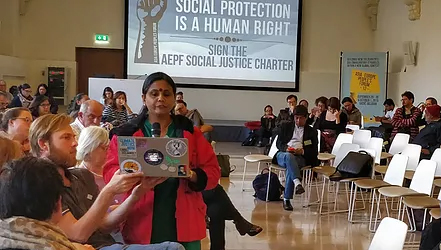
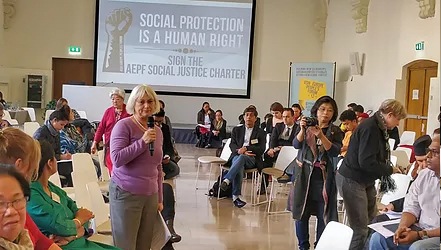
Comprehensive and universal social protection is fundamental to promote social justice, especially for vulnerable social sectors including migrants, women, people in the informal sector, those with disabilities and people in the rural sector.

Two key recommendations are:

  1. ENSURE decent work and sustainable livelihoods underpinned by living wages, employment guarantees, an end to contractualisation, and access to land for tillers and subsidies for small farmers;
  2. PROVIDE universal access to quality health care, free education at all levels, public housing, and living requirements for water and energy;

Third, an “Inclusive and Just” Asia and Europe.

ALL people, regardless of nationality and status, must be recognised and respected, treated equally, and enjoy the same basic human and labour rights.

We are deeply concerned by the closing of political spaces, the dramatic increase in extra judicial killings, forced migration and threats to civic and political freedoms. There are also discernible hostilities toward democratic norms, antagonism toward a free press and intolerance toward ethnic and religious minorities and migrants.

We sincerely urge you to promote substantive and participatory democratic processes by creating and expanding spaces for dialogue, interaction, and tolerance.

In particular,

  1. ​LEGISLATE to ensure that local and national governments are accountable to citizens, and guarantee genuine access to every stage of the decision-making processes;
  2. Uphold the primacy of human rights over trade and investment agreements and support the ongoing process of building a UN binding treaty on TNCs and other business enterprises;

​2050, 2030 or even 2025 are not soon enough. The time for profound change and action is NOW.

Please read our full Final Declaration and urgently adopt our recommendations.

Thank you
Download The AEPF 12 Declaration
Read More

Social Justice and System Change

Social Justice and System Change

October 13, 2018 | Francine Mestrum

What are the objectives of social justice cluster?

We want to develop a concept that is positive, creating hope, that is politically attractive and we also want to make it very concrete, by showing:

  • That social justice is central to the political, environmental and economic changes we desperately need and want – ‘erst das Fressen und dann die Moral’ (Bertold Brecht) – we want to point to the importance of economic security. We also do not want to forget the origins of socialism, in this city of Ghent, in which soup kitchens played an enormous role!
  • One of the major elements of social justice is social protection, this should and can be broadened – this social protection is based on economic and social rights and on solidarity.
  • Social protection means social security (insurances, unemployment benefits, sickness benefits and health care, pensions, care for young mothers and children …) but also social assistance (help for poor people so as to prevent and eradicate poverty), labour rights and also – very important – public services
  • We consider social protection to be an integral part of a social common – we may have time to discuss this further, during this meeting, but basically it means that we need a State to guarantee people‘s rights, whereas citizens have to be actively involved in the conceptualization, the implementation and the monitoring of social protection policies.
  • Social protection is closely linked to other sectors we are concerned about: climate change in the first place, but also trade and democracy, and in the end, obviously, peace. The Constitution of the ILO, which will celebrate its centenary next year, in 2019, explicitly states: peace is not possible without social justice.
  • In that way, if we consistently and coherently pursue our objectives, social protection can be transformative, that is directly contribute to economic and environmental system change.
  • Examples: housing for climate change ; mobility in cities, public transport, etc.
  • Democracy: discuss and decide on (social) policies – the core of social common
  • Economy : stop Monsanto/Bayer to produce (and use) pesticides if we want to have preventive health policies.
  • Trade: stop making huge profits on patents on pharmaceutical products etc

Let me briefly point to some other problems

1.The discourse on social protection is today dominated by the right and the multilateral institutions:

a. SDG’s and SPF’s are very important, but they do allow for privatisations, they will not stop land grabbing and corporate greed, on the contrary – read The Economist on how ‘liberalism’ is claiming to be the only progressive force today!

b. The World Bank has played a very important role these past thirty years in changing the meaning of ‘social protection’ from ‘poverty reduction’ to a totally eroded concept and finally targeted policies for the poor

c. Neoliberalism is not our only enemy anymore, because in the meantime, populist right-wing governments, in Europe, in Asia and in the Middle East are promoting ‘social protection’ that defends ‘traditional values’, that are non-emancipatory, etc.

2. What is happening today is this: as the German sociologist Claus Offe said: capitalism does not want welfare states, but at the same time it realizes that it cannot survive without welfare states. So what is happening today is that the World Bank and many governments, are trying to establish and to save these (minimal) parts of welfare states that capitalists need – and they talk of social investments. That is why we see that everywhere, they will cut on pensions and unemployment benefits, they cut on public health and subsidise private insurance; you do not invest in old people and everyone has to be part of the labour market. Today, social protection is at the service of markets.

3. As for right wing populism, its strategy is purely electoralist, while in the meantime keeping people away from emancipatory policies; they will defend and promote ‘traditional values’

4. That is why we have to defend our vision of an emancipatory, universal, comprehensive and transformative social protection.

And let me add one more argument:

We need to have our own agenda. For the reasons mentioned above we need to go beyond the currently existing international initiatives – which we support, they are good – but we, progressive social movements, we should develop our own agenda. We should not limit our fights for things that have already been given to us. Because that is what international organisations do : they decide on what our agendas should be. There we say: NO; We have our own agenda.

That is why in our Manila meeting in February of this year(2018), we discussed public services; and that is why we had a conference on social commons in Barcelona in June of this year. Our aim is to continue to search for theories and practices promoting social justice while contributing to system change.

That is why we drafted a Global Charter for Social Protection Rights, which goes indeed further, which does not have to be taken in all its details, but which can be a reference points for the social struggles and campaigns we have to organize.

Because yes, do not forget this: we have to organize, we have to coordinate, we have to work together. And we have to strategize.

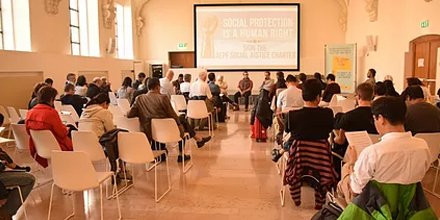
Here in this plenary meeting, speakers will tell you how social justice is linked to democracy, and how it is linked to the economy, and how through a reflection on social justice, we can, together, contribute to change.

Read More

AEPF 12 – Day 3

AEPF 12 - Day 3

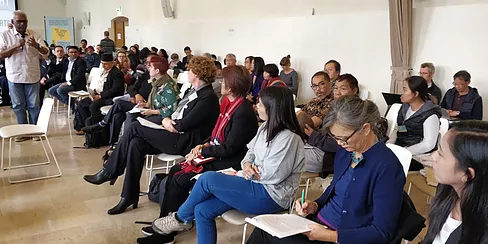
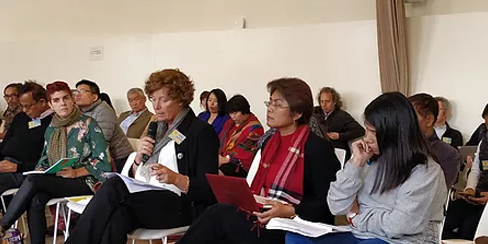
The concluding day of the AEPF that has been attended by over 400 participants from over 40 countries of Asia and Europe, several Members of Asian and European Parliaments; activists, academics, representatives of social movements, engaged in the democratic and collective process of making a Peoples Agenda that will be presented to the official ASEM on October 18, at Ghent.

This process of the Peoples Agenda as well as a ‘Road Map’, has been discussed for over a year by hundreds of activists in many meetings/ workshops organized by the AEPF, so as to make it truly representative voice from the people at the grass roots, especially the excluded, marginalized, and the many defenders of human rights, climate, trade economic and political and social justice. The final Peoples agenda, was passed in the last plenary session today, with many suggestions from participants.

This peoples’ agenda includes recommendations, suggestions, policy advice on the various intersecting themes of democratization, human rights, social justice, climate justice, fair trade, food sovereignty, peace and security. There are recommendations for the ASEM heads of state, parliamentarians, as also for civil society and organizations.

These recommendations are based on deep research, evidence based studies, comparative analysis, grass roots experience, historical research and impact analysis. They argue that regimes that practice deep and participatory democracy and are inclusive of all sections of society and citizens, and provide for economic, social and political equality and rights, and are based on providing social justice, are regimes that are not only successful in their governance, but are bound to last well, since they have popular support and legitimacy. Arguably, governments and states that do not abide by rule of law, procedural democracy, are authoritarian, deny rights, base themselves on militarism, force are brittle and witness everyday violence and a bitter end.

The Document on the Peoples Agenda, will be available on the AEPF website, once it is officially presented at the ASEM meeting.

Other important plenary documents are the ‘Statement by Parliamentarians Panel’. The parliamentarians who heard the thematic sessions, consulted together and have decided to create an ASEM for Human Rights Forum. They will be working with AEPF as ‘Friends of AEPF’ for putting pressure on key issues from human rights, democracy, just trade, climate justice. The Statement by Parliamentarians is attached.

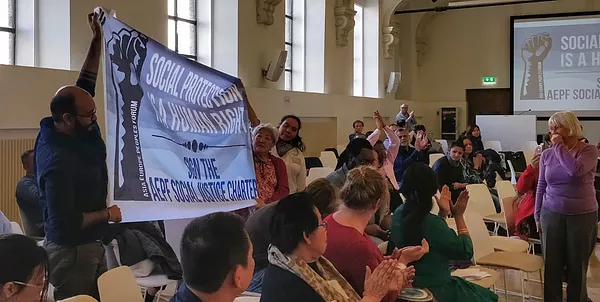
Another important document released is “Global Charter for Universal Social Protection: Rights by all for all”. This again is the outcome of many consultations and democratic process and calls for a universal social protection floor, without which global inequality and injustice and ecological damage is bound to grow. AEPF accepts this Charter, as do the parliamentarians present at this meeting.

The AEPF concluded with a special thanks to the Belgian 11.11.11. Their hard work over months enabled a smooth functioning and complex arrangement, which was meticulously planned. The people behind this functioning Kris Vanslambrouk and Kathy Bernaets worked behind the scenes for moths to make this come alive.

There was also much appreciation for all members of the AEPF IOC, that planned and worked together for months on skype and other meetings to make this a truly democratic process.

AEPF as a whole is grateful to the European Commission and Devco, for their generosity and support. AEPF is extremely grateful to the experts who came and all the participants who attended. AEPF would be grateful if you continued this support by regularly visiting our website and following us on social media. From our part, we will through the year be putting up the valuable ideas that this AEPF generated, on our website.

Lastly, do not forget the volunteers and others who worked to make this AEPF12 a memorable experience.

Read More

AEPF 12 Program

AEPF 12 Program

INTRODUCTION TO AEPF

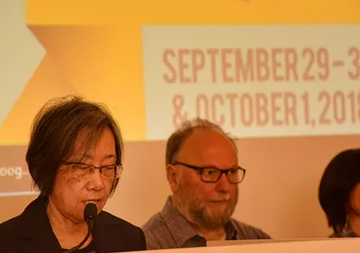
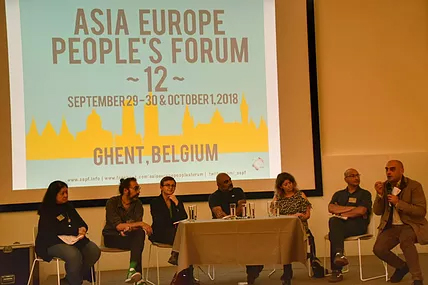
The Asia Europe People’s Forum (AEPF) has been holding the biennial People’s Forum since 1996 when it began as a parallel initiative to the first ASEM Summit held in Bangkok. It was established as a platform and Forum to amplify people’s voices on the need to respect and fulfill social, economic and human rights for all across Asia and Europe, and to highlight the importance of developing just, equal and inclusive approaches to regional integrations. For over twenty years, the People’s Forum has consistently worked for meaningful civil society, Trade Union and peoples’ movements’ participation in the discussions and processes of ASEM and its member’s countries. The 12th ASEM-summit, the Heads of State and Government meeting will be held in Belgium, on October 18 and 19, 2018. Following the positive practice since 1996, the AEPF will organize a parallel interregional civil society meeting from September 29 till October 1.

OBJECTIVES AND AIMS

The overall aim of the AEPF 12 is to understand and learn from struggles and resistance over the past two decades in Asia and Europe that have confronted and challenged neoliberalism, corporate-led globalization and global capitalism in its various phases. Peoples’ groups in many Asian and European countries have developed critiques, strategies, and actions to dismantle the power of corporations, realize and uphold the rights of people and communities, and reclaim the commons. They are at the forefront of movements for justice; equity; land and resource rights; peace; dismantling/ending nuclear and chemical weapons; working to fulfill the rights of migrants and other displaced peoples, defending rights, freedoms and democratic spaces. Our objectives are to analyze the challenges, the current socio-economic situations and develop and share people’s alternatives. Bringing together representatives from social/peoples movements, journalists, academe and elected bodies in Asia and Europe, this Forum will reinforce regional and international solidarities and move forward our collective agenda.

Having the Forum in the weekend will also allow us to realize one of our objectives, make a direct link with the public and citizens’ initiatives in Ghent. The discussions and exchanges will result in an AEPF-Statement to be presented by AEPF-representatives at the beginning of the 2018 ASEM-summit.

DATES AND VENUES

The Forum will be held in Belgium from Saturday, 29 September to Monday, October 1, 2018.
The main venue is in the city center of Ghent: Het Pand, Onderbergen 1, Ghent.
Some of the workshops will take place in venues within walking distance of Het Pand.

More details will follow.

PROGRAM

Game-changing Challenges in Our Global Context

Everyday millions of women, men and children across Asia and Europe are living in conditions of growing inequalities, and precarious livelihoods. They experience a more aggressive, divisive, exploiting and excluding neo-liberal globalisation that is systematically destroying livelihood and ecological systems. Forced migration is also a growing reality for millions of people.

Statistical economic growth has been founded on the growing desecration and destruction of our Commons, our resources, our environment, our climate. Our Climate crisis has demonstrated a quick destruction of many species, as historical injustices on climate policies continue. Our governments’ have erased progressive calls to protect the planet and protect the people. We expect an urgent and people centred collective and national responses for framing our futures.

The new phase of neo-liberal globalisation based on control of intellectual and material resources has hastened the pace of corporate capture of legal and political processes. ‘New technologies’, ‘new economics’ and ‘new ways of communicating’ are more of the same, marked by the continuous destruction of many public services and their privatisation. This has led to a crisis in the ability of elected representatives, governments, to fulfil their supposed responsibilities to their citizens, which has polarised people and created an atmosphere of partisan politics that threatened to tear societies apart.

We are in a world of insiders and outsiders, of a concentration of power and wealth and of the regime of the corporations. Divided and dividing economies have increasingly consolidated dividing and divisive politics.

A growing number of countries across Asia and Europe are experiencing more authoritarian and excluding politics. In many countries, the space and freedom of people to express their concerns to their elected representatives at local and national levels is being systematically limited, restricted and threatened. Summarised as shrinking democratic spaces, this translated as an exclusion and suppression of Fundamental Human Rights, Voices, and the Rights to organise, mobilise and demonstrate. This trend that already existed in some authoritarian states has now traversed into managed democracies.

AEPF12 provides a unique space to share and discuss these lived experiences and how people, communities and social movements are responding by developing and taking forward alternatives essential for more just, equal and inclusive communities, countries and even regions.

For more information about AEPF:

Website: www.aepf.info

Facebook: www.facebook.com/asiaeuropepeoplesforum
Twitter: https://twitter.com/_aepf

Read More

AEPF 12 – Day 1

AEPF 12: Day 1

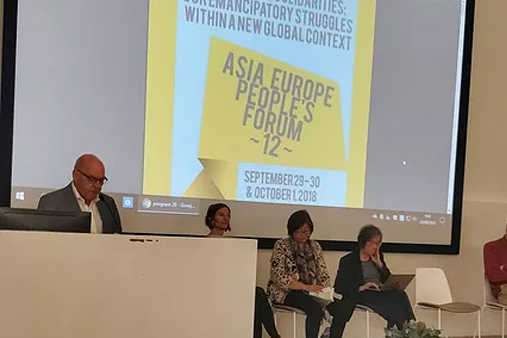
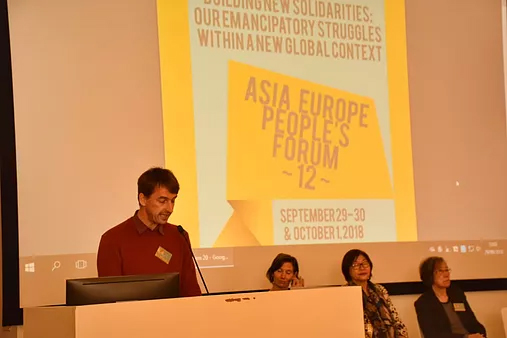
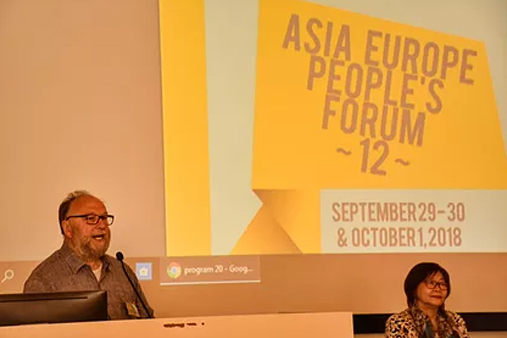
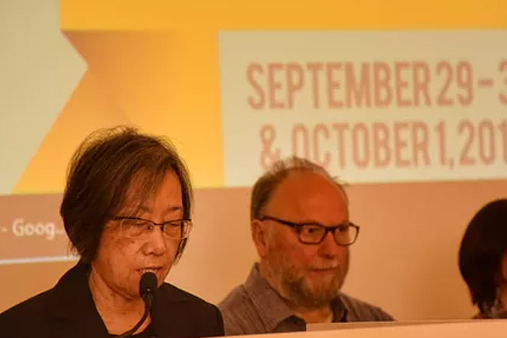
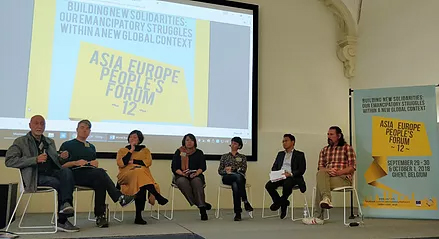
The AEPF opened this morning with Mayor of Ghent, Mr. Daniel Termont welcoming the participants with all their remarkable diversity, inclusivity and colours.He said that Ghent was happy to be chosen for this forum especially since learning from each other in this age is very important. He stressed that in Ghent people came before profits. He said that Ghent is known for its fair trade practices and the participation of its citizens in public affairs and services. He emphasised the role of local government in driving changes toward a just, sustainable world and noted the growing challenges of ethno-nationalism, state repression of activists. Serge Beel,who represented 11.11.11 welcomed the delegates stating that changing the current system was important to the world more than ever before. He said the many Belgian civil society organisations associated with 11.11.11 welcomed AEPF, and support the ideas, activities of AEPF.
AEPF IOC member Andy Rutherford recalled Sombath Somphone, a community worker and AEPF activist, abducted in Laos in 2012 who played a key role in AEPF 9 in Laos. Ms. Shui Meng, wife of Sombath Somphone made a passionate appeal that civil society should continue to fight for the disappeared, remain true to human rights and hold states responsible for their actions against activists. She said that she would not keep quiet until she gets the answer, and what happened to Sombath could happen to anyone.

The AEPF conducted the “Meet Ghent”, that saw 7 parallel meetings on issues ranging from the ongoing trade agreements and their impact on resources andlivelihoods; New migrants in the city; Climate Action now; the story of the refugees in Calais; and the digital economy and food. These events brought a combination of experts, survivors, activists and grass roots campaigners, all of whom told the stories from below that are not often heard in the dominant traditional media.Experiences that can change perspectives and evoke support for a more humane international society were expressed.

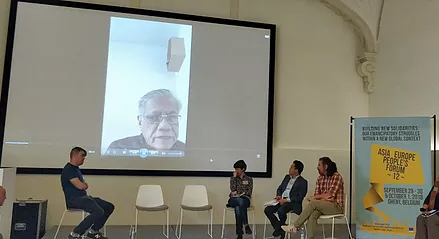
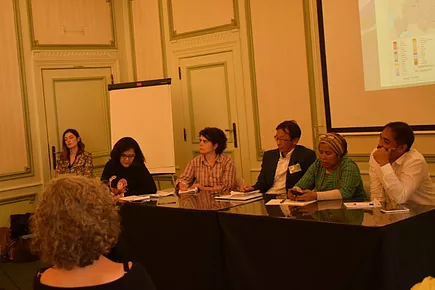
The plenary panel 1 analysed the challenges to democracy, whereby in country after country, right wing populists had been voted to power. Dr. Walden Bello, who could not make it to the forum, addressed the forum with a video message that highlights the threats of rising right wing politics and ideologies across the globe. James O’Nions, an activist from Global Justice Now spoke about the political circumstances that ultimately led to the Brexit and highlighted its demerits. Christos Giovanopoulos, an engaged grass root activist of Greece focused on building alternatives to the neo liberal system. He emphasized the importance to create our own narratives and fight the populist and authoritarian tendencies created due to the failure to effectively address globalization. Agnes Gagyi, analysed the alternative social movements to globalisation, as part of a civil autonomy. And showed how civil resistance was the way as countries, for example, in East European case integrated into globalisation. Bonn Juego, analysed the rise of right wing populisms, why they appeal to the masses and what is needed to counter them. He argued for reclaiming progressive discourse, rediscovering the strategy of linking most basic day to day work with the most fundamental issues, rethinking approach on law and on the importance of socio-economic reforms. Achin Vanaik, writer and activist from India spoke about the growth of right wing in India and what should be the responses to counter it. He pointed out that social media is an important tool in shaping opinions and mobilising people but working on the ground to bring changes is equally important.

The plenary panel 2 analysed game-changing challenges and implications for Our Visions and Alternatives. Matteo Gaddi spoke of Industry 4.0 with increasing delocalisation, control and defining labour organisations as a sustainable model. Daniela Gabor analysed the old and new economic policy regimes, as under the IMF and other multilateral institute to reveal the close linkages between capital markets and states and the deeply negative impact this has especially on countries like East Europe that are worst effected by the global financial crises. She showed that the current financial crises in states like Turkey would lead to further socio-economic turbulences. Her argument is that people have to struggle not just against populist regimes but also against neo liberal policies that lead to these. Sivan Kartha, Senior Scientist – Stockholm Environment Institute analysed the alarming climate change situation and the malpractices of lobbying and spreading misinformation by power companies. He emphasised that climate change is both a threat and opportunity. It could change the landscape of power if measures are taken. Asad Rehman, Director of War on Want explained how climate change is a product of the system and inequalities. He made the audience aware about the alarming situation emphasizing that by 2050, one in 30 people could be
displaced from homes due to Climate Change. Leida Rijnhout critiqued neo liberal models and spelled out the alternatives that would rise from peoples popular resistance. Marguerite Lopez told how AEPF cannot proceed in a business as usual manner and ideas have to bee translated into powerful people’s movements.

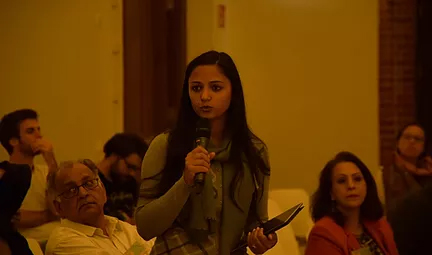
The first day concluded with conversations on New Narratives. This session was moderated by Hamid Mir, eminent Pakistani journalist, news anchor and author. Fiery student leader from Jawaharlal Nehru University, Shehla Shora Rashid, spoke on the impact of right wing ideas and practices on institutions, particularly on universities and the attempt to change the diiscourse.She shared the take aways of their student movement showing solidarities towards marginal sections of the society. Pierre Rousset focussed on empowering the poor in situations of distress as one of the major issues of our times. Achin Vanaik spoke about the need of more and more countries to address the issue of nuclear weapons. Prominent left wing politician from Pakistan, Farooq Tariq narrated the story of an inspiring movement against religiousfundamentalism led by young people in Karachi. The session ended with an interactive discussion on moving ahead with ideas and activism and bringing change on ground.

Read More

AEPF 12 – Day 2

AEPF 12 - Day 2

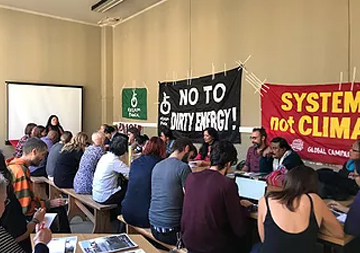
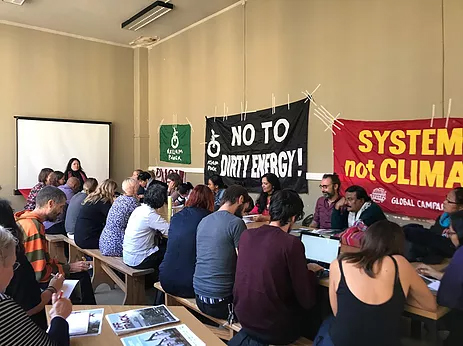
On Day 2 of the AEPF there was intense discussion in six thematic clusters. The background to all the discussion was the impact of policies Of the last two decades of neoliberal growth, growing inequality and growing power of trans national corporations. In addition there has been the rise of many extremist forces and national security obsessed policies of many governments. The cost of these policies on climate change and ecological damage as human security and well being formed the cross cutting concern.

Democracy and human rights

This cluster focussed on the ground reality, where in many Asian, European and other countries, thousands of activists and human rights defenders are struggling to survive the suspension of constitutional rights and rule of law, even as judicial processes become a means of punishing trials and tribulations. Further vigilante forces use mob violence and get impunity from ruling regimes.

This cluster had detailed discussions on the problems faced by migrants. They asked for just policies concerned with human dignity of migrants and refugees. This cluster did a analysis of fundamentalisms and all forms of violent extremisms, and also showed that hoe policies to counter these also violated rights.

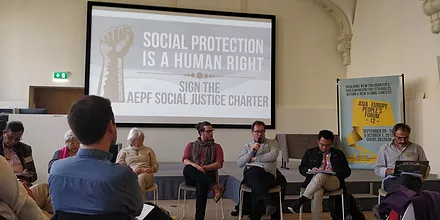
Social Justice

Experts and activists gave various arguments that disproved the rationale given by multilateral agencies and governments for the ongoing privatisation of social services, i.e., lack of funds, inefficiency, bureaucratization, government monopolization. Evidence on the contrary shows that that private public partnerships (PPPs) are more expensive, generate more profit, are more corrupt, less efficient and less sustainable than using public finance, co-operative holding, management and delivery.

Speakers showed that there were now thousands of examples where municipalities along with local people have effectively and collectively taken over basic public services from water, energy, transport.

The social justice cluster adopted a Charter That proposes to: “Work with social movements and workers’ organisations to develop a people-centred Global Social Protection Charter that will guarantee decent work, sustainable livelihoods, and universal and comprehensive social protection systems that include food, essential services and social security.”

This cluster proposed that all countries have legislation to ensure that people have a rights to public services that are institutionalized and insulated from market forces and political patronage. It was also proposed that:

The objectives of governments, should be universal, free and quality health care, free education up to the tertiary level, affordable decent public housing, a living requirement for water and energy, as well as affordable and reliable transport.

Public services should be financed by governments by building the political will to enforce real progressive taxation and abandoning unjust tax policies which allow the rich to hide their wealth through tax havens and illegal money flows.

PPPs should be abandoned in favour of public-poor-partnerships. Local communities should be encouraged to participate fully in the planning, implementation and oversight of projects.

Climate Justice and Just Transition

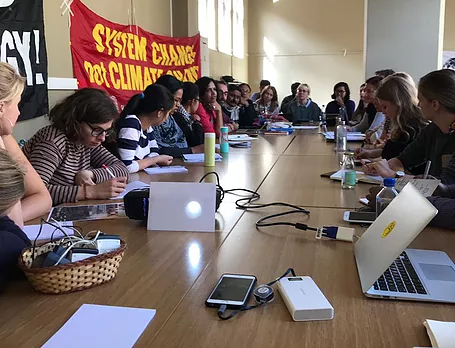
The speakers in the climate justice cluster, called for immediate and urgent action to stop global temperatures from rising. The crucial message from this cluster is that: “The climate crisis is escalating further and will reach catastrophic levels at a planetary scale unless urgent actions in every country and in a global scale are undertaken.” Speakers emphasised that these actions must lead to profound transformation of the global system which is the root cause of the climate crisis. They proposed that steps to be taken from transformation of energy systems – away from the production and consumption of fossil fuels; limit the rise of global temperature We are keen to follow and act with activists on related questions.

Trade Justice & Corporate Accountability

In this cluster, the speakers said that the huge power of TNCs has resulted in monopoly of control and exploitation of natural resources that impacts people’s access to land, water and sea as the source of their livelihood. This power is increasing through economic globalization and the vehicle of free trade and investments agreements.

The participants and speakers called for a conceptualisation and public action on: First, reclaim people’s rights (#ReclaimOurRights); and Second reclaim people’s economy sovereignty (#ReclaimOurEconomy) This involves reclaiming peoples’ rights, actions by generating knowledge and public action on (1) the free trade agenda and (2) corporate power and impunity.

The experts agreed that there were human rights violations in both politics and in the economy. In relation with FTAs implementation, it was proposed that Parliaments should have the power to assess the negotiation results on the bases of these impact assessments and these be framed within a human rights framework.

In relation with the Constitutional lawsuits over trade and investment agreements the experiences from the CSOs lawsuit against FTAs should be documented by the movements and CSOs and we can use these for advocacy and provide information to policy makers. We will work with AEPF on Trade and Investment and the Binding Treaty.

Food Sovereignty and Natural Resource Justice

The analysis and ideas proposed by AEPF were linked with the Emancipatory Rural Politics Initiative (ERPI) – that aims to encourage debate and action among scholars, activists, and policymakers concerned with issues related to rural and peasant distress and possible alternative policies are urgent and timely, especially because of exclusionary rural politics. It was decided to work with AEPF on these issues.

Peace and Security Cluster

Peace activists and speakers in this cluster, recognised that peace movements have had a positive input in the adoption of the legally-binding treaty to ban nuclear weapons (2017); the peace process in the Koreas; Mongolia accepting nuclear free status:and collaborating with civil society; Security Council Resolution 1325.

However the concerns were expressed about continuation armed conflicts, military interventions, proliferation of nuclear weapons; terrorism, politicized religious fundamentalism, enforced displacement; severe refugee crisis; xenophobia populisms and the rise of the militant right wing; militarization of land, seas and space.

Speakers agreed to continue to put pressure that nuclear-weapon states to immediately enter, sign, ratify and implement the Treaty on the Prohibition of Nuclear Weapons; take serious steps to cut military expenditures. The cluster asked for negotiations in major hot spots like West Asia; encourage peaceful resolution of disputes in the South China Sea in accordance with international law, notably the UN Charter and UNCLOS.

All the clusters showed that on all these issues concerning rights, democracy, climate, environment, protection of refugees, and all kinds of justice, there were peoples resistance. Despite the pressure and campaign to silence and suppress thousands of human rights defenders, students, activists and concerned citizens continue to stand their ground and continue to struggle to assert and protect inalienable rights and freedoms.

Read More

AEPF 12 Videos

AEPF 12 Videos

Vignettes of AEPF 12, September 29 – October 1, 2018

This presents an insight into the working and vision of AEPF 12 in Ghent, 2018. It has brief interviews with leading activists from Asia and Europe. Short clips from the meeting show the formulation of the People’s Agenda for ASEM Parliamentarians.

Interviews

Farooq Tariq – Interview at AEPF 12

Farooq Tariq, activist from Pakistan focuses on the solidarity between Asian and European people. He says sharing the problems faced by the people of Pakistan in the AEPF Forum, communicates to the people of Pakistan that they are not alone in their struggles. We also get solutions and ideas on alternative approaches from the AEPF.

Francine Mestrum – – Interview at AEPF 12

Francine Mestrum says people in Europe often talk of the South, but they need to meet people of the South to see the connections, and AEPF provides this space. What you discover is that the poor and excluded from the South and Europe have common problems especially of being denied social justice. Francine talks of the Global Universal Social Protection Charter launched in the AEPF. Adopting this will support climate justice, peace and a common economy as a whole.

Lidy Nacpil – – Interview at AEPF 12

Lidy Nacipil,says that our struggles for climate, social justice have are linked to global issues. She says movements have to worker harder as crises has peaked.

Serge Beel – – Interview at AEPF 12

Serge beel, of 11.11, host of AEPF talks of the opportunities and strategies that have come up during the AEPF Summit. The message to ASEM leaders gives the detail of the message of AEPF.

Shehla Rashid Shora – – Interview at AEPF 12

Shehla Rashid Shora, a youth activist and leader from Jawaharlal Nehru University, New Delhi, talks about the rise of right wing populists governments globally, and argues that people are actually looking for alternative politics that are based on people centric development that has environment, sustainability at the centre of politics. AEPF reminds us that an alternative is possible. She compares the system of local patronage in Indian grassroots politics with that of the practice of commons and municipalisation in the city of Ghent.

Shui Meng Ng – – Interview at AEPF 12

Shui Meng Ng who has launched a personal and collective struggle to hold the Laos Government accountable for the disappearance of her husband, Sombath Somphone, an AEPF activist. Shui Meng reminds governments that they represent the people and that they have to listen to the voices of their people.

Hamid Mir – Interview at AEPF 12

Hamid Mir, well known Pakistani journalist speaks on how important it was for him to understand the issue of human rights across countries and regions. The connections made in the AEPF Conference will help build long term solidarities and be part of our conceptualization and writing especially on human rights. A common narrative on human rights is necessary since many people cannot speak in their own countries.

David Boys, PSI Deputy General Secretary – Asia-Europe People’s Forum in Ghent, Belgium 2018

David Boys of the Public Services International (PSI), refutes the arguments of the International financial institutions (World Bank, IMF) that propose further financialiasation to fund the sustainable development goals (SDGs).

Read More

AEPF Study and Strategy Seminar on Fossil Fuel Finance

AEPF Study and Strategy Seminar on Fossil Fuel Finance

September 3 -7, 2018, Bangkok, Thailand

Vital meeting looking at trends in financing coal and fossil fuels and developing strategies to respond and change.

The conference had three main discussions:

  • Analysis of the current financiers of coal and fossil fuels
  • Common strategies to engage with and confront institutions as institutions, not just on a project by project basis
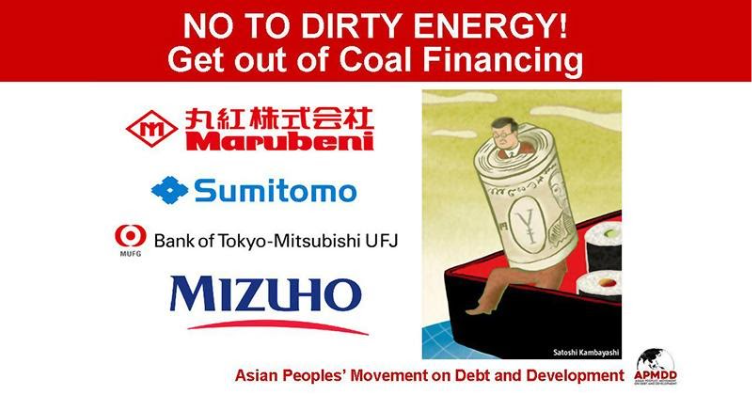
  • Challenging Asian financiers including some of the world’s biggest coal financiers specifically Japanese, Korean and Chinese financiers

Download:
Outcome Summary: AEPF Study and Strategy Seminar on Fossil Fuel Finance – September 3 -7, 2018, Bangkok, Thailand

Read More

Religious Fundamentalism and Terrorism

Religious Fundamentalism and Terrorism

July 15, 2018 | Farooq Tariq

With the fortunate exemption of Nepal, various forms and formations of religious fundamentalism is finding a considerable social and political support and space in all countries of South Asia. The rise of Muslim, Hindu and Buddhist religious fundamentalism have made the lives of the millions miserable and pushing them further to chronic poverty and ignorance. It has emerged as one of the major challenges confronting the governments and people in South Asia.

Religious Fundamentalism and terrorism has emerged as one of the most dangerous challenge to the progressive and democratic forces not only in Asia particularly, it has also taken grip on several European countries. The spread of fundamentalism has resulted in lynching religious minorities into death, mass migration and terrorist attacks on regular basis in Asia and Europe.

The pace of Islamist regression since 9/11 attacks on Afghanistan and Iraq has accelerated; extremism, fundamentalism and fanaticism increased immeasurably in the Indian sub-continent and Muslim countries.

During the cold war, the USSR was only an emblem of the enemy of the capitalist society. Nationalism, humanism, secularism, and socialism were also enemies. Muslim fundamentalists collaborated with the West because they too were scared of liberal and secular ideas and the West happily promoted these reactionary forces as a counter force to Socialism and progressive nationalism.

Breeding of religious fundamentalism in Muslim countries by the imperialist forces was their greatest political and organization blunder in forming strategies to safe capitalism from opposite ideologies.

Religious fundamentalism is not just a phenomena spread by individuals, groups, mosques, madrassas or cluster of these groups: they were able to use the state powers like Saudi Arabia, Iran, Sudan, Afghanistan, sometimes for a short period and in other cases, they have consolidated their grip on state structures. The aim is not to spread it to one continent or over the entire world, but they will continue the struggle for implementation of their political Islamic agenda till the “judgment day”.

Fundamentalism of whatever variety-Islamic, Hindutva, Christian or Jewish, is always a reactionary force. Fundamentalists are intolerant of everybody else. They reject evolution and theories on the origin of life.

Fundamentalism is counter-modernist, is generally assertive, clamorous, and often violent, is “the Chosen”, “the Elect”, “the Saved” and as such, they are “privileged” or “burdened” with a special mission on behalf of their God and for the benefit of the world.

Religious Fundamentalism is anti-science by nature or science is the outcome of materialist philosophy and the religion is outcome of idealism so there is historical contradiction between science and religion. Progress in science is the retreat of the religion.

Islamic fundamentalism is now a reactionary, nonscientific movement aimed at returning society to a centuries-old social set-up, defying all material and historical factors. It is an attempt to roll back the wheel of history. Fundamentalism finds its roots in the backwardness of society, social deprivation, a low level of consciousness, poverty, and ignorance.

Religious fundamentalism is a new form of fascism which has carried out some of the worst atrocities. Suicidal attacks have become the norm. Muslim Fundamentalist groups have a political agenda – a Muslim world. Fundamentalism is a deep-rooted philosophy that acts on the minds of its adherers. Its propaganda works through education and training.

The state is ambiguous when it accepts a state religion as well as adheres to secularism in the constitution as in Bangladesh. Pakistan and Maldives are Islamic republics. Sri Lankan constitution gives primacy to Buddhism above all other religions. India and Nepal are secular republics. However, secularism in India has been dealt a severe below by the rise of Hindutva.

Islamic fundamentalism and terrorism in shape of ISIS, Al-Qaida, Bokoharam, Taliban and many more are the examples of violent incident of unprecedented level. Rashtariya Swayamsevak Sangh (RSS), Vishva Hindu Parishad and Bajrang Dal are the major players of Hindu violent and nonviolent fundamentalism in India. This has resulted in increased violent action against Muslim minority and increased insecurity among the religious minorities in India.

Rohingya Muslim’s persecution by the Buddhist majority in Myanmar (Burma) is also another instance of violent Fundamentalism. Thousands have to migrate to Bangladesh in most inhuman conditions in one of the worst human migration crisis.

Though none of the eight south Asian countries have monarchy or military dictatorship today, however; there is growing militarization in the region. Religious fundamentalism and political use of religion have emerged as independent social and political forces with might of their own. They are in alliance with state apparatus rendering the functioning of non-party politics of secular and non-religious kind untenable.

The rise in relations between some countries are also matched by the souring relations between erstwhile neighbors. Afghan citizens who were once welcome in Pakistan as pilgrims, traders and students face severe restriction because the Pakistani state believes that Afghanistan is the breeding ground of terrorism and vice versa. A visa regime is been installed for the citizens of Pakistan, Bangladesh and India to restrict the social movements to flourish in these countries.

Countering Religious fundamentalism

The way out of the uneasy relation of state with religious fundamentalism is opening the borders to people, state freezing all relation with fundamentalists, nationalizing madrassas which were once centers of religious training and halt militarization of civilian life.

One way to counter the religious culture of fundamentalism is with a secular culture of solidarity. This is especially relevant since fundamentalism has an international angle to it. The use of a softer version of religion to counter a harder version is mistaken. We need to take up the issues of inequalities and exploitation. We should be able to say, a Muslim worker is being exploited by a Muslim Capitalist. So, it is not Islam we need to focus on. We are not against Islam or any religion but against the use of religion for political means. This is different from old Marxists approaches.

Fundamentalists are not anti-imperialists, hence no alliances with religious or religious extremist forces at any level.

The use of force to eliminate fundamentalism is a myth. There is no military solution to stop the rise of religious fundamentalism. It is a political struggle between the two rival camps. A whole package is needed. The state must break all links with fanatic’s groups. The mindset that religious fundamentalists are “our own brothers, our own people, our security line and guarantee against “Hindus”, some are bad and some are good” and so on must be changed. The conspiracy theories are most favorable arguments among the religious right wingers. They do not want to face the reality.

There is no short cut to end religious fundamentalism. It has to be a political fight with dramatic reforms in education, health and working realities in most South Asian countries. Starting from nationalization of madrassas, it must go on to provide free education, health, social security and transport as one of most effective means to counter fundamentalism.

We have reached a new maximum on military budgets in the world. SIPRI estimates that global military spending was 1,739 billion dollars in 2017. Year after year the main five military budgets are from USA, China, Saudi Arabia Russia, India, followed mainly by Western Europe (UK, Germany, France). Japan and South Korea close to the top ten list.

Farooq Tariq
General Secretary
Pakistan Kissan Rabita Committee
Spokesperson
Awami Workers Party Pakistan
farooqtariq@hotmail.com
www.farooqtariq.org
12/1/2018

Read More

Presentations for the event “Our common social future: Commoning and sharing for society, the environment, and the economy”

Presentations for the event "Our common social future: Commoning and sharing for society, the environment, and the economy"

Choose what presentation you wish to download –

Read More