For Peace and Security of a World without Nuclear Weapons

For Peace and Security of a World without Nuclear Weapons

May 13, 2018 | Yayoi Tsuchida

In the present world, we are witnessing fierce conflict over nuclear weapons: Whether we go forward to achieve a nuclear weapon-free peaceful world or we continue to remain living under the danger and threats of nuclear weapons?

Humanity is heading for a world without nuclear weapons

The adoption of the Treaty on the Prohibition of Nuclear Weapons on July 7, 2017 is a historic advance towards a world without nuclear weapons. With this treaty, nuclear weapons became illegal for the first time in human history and a basis for the elimination of nuclear weapons was established. The treaty prohibits all activities relating to nuclear weapons, including their development, testing, production, manufacture, acquisition, possession, and stockpiling. Please imagine how much safer the world would be if the treaty prevails in the world and, for instance, in the ongoing exchanges between US and North Korea and South Korea.

Reality and danger over nuclear weapons

Then, why did the international community move to the adoption of this treaty?

First, nuclear weapons are inhumane weapons inflicting enormous calamity on humankind. Since the 2010 NPT Review Conference, the humanitarian initiative of nuclear weapons to raise awareness of their inhumanity, promoted by many governments, the Hibakusha (A-bomb survivors) and civil society, has revealed that irrespective of the cause, any nuclear weapon explosion would bring the immediate, mid- and long-term catastrophic damage to human health, environment, infrastructure, food security, climate, development, social cohesion and the global economy beyond borders; and no national or international response capacity can adequately respond to the human suffering and humanitarian harm that this causes. It is common knowledge that for the very survival of humanity, nuclear weapons must never be used again under any circumstances; and the elimination of nuclear weapons is the only guarantee for avoiding the risk of nuclear weapons use.

In spite of such a conclusion about the inhumane nature of nuclear weapons, about 15,000 nuclear weapons still exist on earth. Thousands of these are put on the hair-trigger alert. Their existence entails risks and likelihood of the authorized or unauthorized use of nuclear weapons. We need to remember that there was a mistaken warning of an incoming ballistic missile attack in Hawaii; such a matter may lead to a possible breakout of nuclear war.

Second, because the current world is very dangerous. A grave example is the US-North Korea confrontation in which both sides do not rule out using nuclear weapons. Ex-Secretary of Defense of the US William Perry said that if military option was taken, “it could be the huge consequences of a war; as bad as the first Korean War was, a war in the Korean Peninsula that extends to Japan and that goes nuclear would be 10 times worse; and we’re talking about casualties that equal those of World War II.” Fortunately, at this moment, there are moves for dialogue between North and South Koreas and between North Korea and the US. Of course, we hope that they will open up the way for peaceful settlement. However, the situation is still unpredictable.

Since Trump took office, confrontation between US and Russia has intensified with the escalation of nuclear arms race. The US Nuclear Posture Review, released in February 2018, is a head-on challenge to worldwide efforts to proceed to a world without nuclear weapons. It sets out the blurring of the distinction between conventional and nuclear war; the development and deployment of low-yield nuclear weapons like Hiroshima-type bomb for their actual use in war; and even making preemptive nuclear strikes to conventional weapons attacks. In Europe, conflict between Russia and US-NATO has deepened over the encirclement of Russia by US missile defense system. To counter this, Russia has developed new modernized anti-missile system. In addition, there are the involvement of nuclear powers in Syrian and other disputes. In Asia, there are China, North Korea, India and Pakistan. They are involved in territorial disputes and confronting each other. Asia is also a region where a nuclear-free order should be established.

Nuclear possessing states and nuclear umbrella states are opposed to the prohibition treaty. The US has put strong pressure on its allies and aid receiving countries not to sign and ratify it. In spite of having experienced the A-bomb attack, Japan is opposed to it. Even among US allies, it stands out in subordination to the US. Japan only focused on provocations and military threats over the North Korean nuclear issue, trampling underfoot the peace Constitution.

From the prohibition treaty to the abolition of nuclear weapons

In order to ensure peace and security of the world, we have to overcome this reality, with confidence that people’s long-term persistent effort brought about the treaty; and as the treaty was adopted by the support of 122 states, the overwhelming majority of states support and are trying to go forward towards a peaceful world without nuclear weapons. Those opposing and resisting it are just about 30 countries. If they are broken down by region, they are only USA and Canada in North-South American continent, only South Korea and Japan in Asia and only Australia and Micronesian Federation in the Pacific.

There is also hopeful development over the North Korean issue, which shows that the argument of nuclear weapon states that nuclear deterrence ensures security does not hold water; like Japan, those obstructing peaceful settlement only get isolated.

We have to proceed to the abolition of nuclear weapons based on the achievement of the treaty. The key is to develop public support and people’s campaigns for banning and eliminating nuclear weapons worldwide. Because a nuclear explosion affects everybody in the world, we have to mobilize more than 7 billion world population to this task. Such action is most needed now and it will greatly contribute to the effectuation of the treaty leading to a world without nuclear weapons.

For this objective, I will propose the following people’s campaigns:

  • To carry out the Hibakusha Appeal signature campaign for the elimination of nuclear weapons. The signature campaign is an effective way to build up public opinion from grass-roots. This international campaign was launched by the Hibakusha in 2016 to build up support for their Appeal for the elimination of nuclear weapons in their lifetime. In Japan, more than 5 million signatures, including those of more than1000 mayors and governors, were collected in the past 2 years; the signature campaign promotion committee, consisted of wide range of local government heads, civil society organizations and individuals, was established in 24 prefectures, which accounts for more than half of all prefectures. The campaign has spread to 42 countries. And the collected petitions have been submitted to the UN, contributing to the adoption of the treaty.
  • To make known to people of your country the A-bomb damage of Hiroshima and Nagasaki. We the movement of A-bombed country will send out A-bomb photo sets and booklets/DVDs of testimonies of the Hibakusha abroad. Please hold A-bomb exhibitions and organize meetings to hear the Hibakusha’s stories at your communities and schools, etc. We will send the Hibakusha, too.
  • To urge your government to sign and ratify the prohibition treaty.

The Hibakusha wish to collect hundreds of millions of signatures worldwide. Let’s work together for achieving a nuclear weapon-free world.

*** PEACE AND SECURITY IN ASIA AND EUROPE: CHALLENGES AND PEOPLE’S VISION | Quang Ninh, Vietnam, 14-16 April 2018

Yayoi TsuchidaAssistant is the General Secretary Japan Council against A and H Bombs (Gensuikyo)
Read More

People’s Resistance Agenda Over FTAs and Corporate Impunity

People’s Resistance Agenda Over FTAs and Corporate Impunity

May 5, 2018

Jakarta Call
The AEPF Cluster on Trade Justice & Corporate Accountability

The AEPF week of actions in Jakarta (February 18-23, 2018) has become an important process to re-consolidate people’s proposals and strategies in both regions of Asia and Europe in the story of resistance against free trade agendas and domination of Transnational Corporations.

It has been realized that the control of transnational corporations on the agenda of economic globalization through the massiveness of free trade and investments has greatly contributed to the monopoly of control and exploitation of natural resources that impact on the loss of people’s access to land, water and sea as the source of their livelihood, and threaten their whole economic and life sustainability.

Transnational corporations are more powerful than many countries. They control a huge chunk of the world’s economy, and exert great influence on economic policies from trade to tax policies, and their operations across the globe have huge social, environmental and cultural impacts.

The state has become hostage to corporate influence to such an extent that the protection and fulfilment of Human Rights obligations are not implemented. People’s rights have been marginalized and set aside. Thus, the agenda of resistance on economic injustice over the Free Trade and Investment regime and corporate agenda needs to be re-formulated.

Two resistance agendas were therefore proposed and formulated in this conference, to strengthen joint followup actions: i.e: First, reclaim people’s rights (#ReclaimOurRights); and Second reclaim people’s economy sovereignty (#ReclaimOurEconomy)

1. People’s Agenda to #ReclaimOurRights

In the agenda to reclaim peoples’ rights, actions are cantered in the resistance towards (1) the free trade agenda and (2) corporate power and impunity.

On the Free Trade Agenda

FTAs are being aggressively pursued in the South East Asia region as well as globally. These are ‘new generation’ FTAs with serious problems: Investment chapter & ISDS, IPRs, Digital Trade, services, raw materials, covering non-trade regulations. No transparency in negotiations and no options for public participation – neither from Parliament or civil society. Corporate capture on the other hand gives access for corporate priorities to be carried on in the negotiations. Devastating impacts are experienced on the ground by way of violations of human rights, labour rights and environmental standards; land and sea grabs; de-forestation; toxifying land and water; denial of access to affordable medicines etc. We need more effective documentation on cases of impact and to popularise lessons from existing agreements.

We see human rights violations not only in politics but also in economy in relation with FTAs implementation. There are some strategies and campaigns where the civil society organisations (CSOs) are struggling to ‘Stop the FTAs’ which violate human rights, and these should continue.

First, in relation with Human Rights Impact Assessment (HRIAs). The EU trade policy always accompanies the proposed FTA with a sustainable impact assessment (SIA). However, the SIA only calls for flanking measures, to mitigate for negative impacts of the FTA. It does not change anything about the overriding agenda of liberalisation and de-regulation. The UN Special Rapporteur, indicated that SIAs are completely insufficient to map the human rights impacts of trade and investment agreements. To strengthen SIAs, the Un Rapporteur developed guidelines to address impact assessment that specifically looks at human rights violations.

The advocacy agenda on Human Rights Impact Assessment (HRIA) is necessary to be carried out before the start of the negotiations to make sure that sustainability and human rights are the overriding principles that guide the framework in which trade and investment can take place. Once the negotiations are completed, then the Parliament has to agree or disagree to the agreement and they should have the power to assess the negotiation results on the bases of these impact assessments.

Second, in relation with the Constitutional lawsuits over trade and investment agreements: There are some experiences from Indonesia, Philippines, and EU. Now, the Constitutional Court in Indonesia is examining the CSOs lawsuit about the international treaty law against the Constitution. The reasons for the CSOs challenge are because these investment and trade agreements have caused the loss of democracy where government power is too absolute, and to restore people’s sovereignty.

Like in Indonesia, there have also been legal challenges against the World Trade Organization and free trade agreements in the Philippines, with civil society and public interest groups filing petitions with the Supreme Court. Two such cases were filed against the Japan-Philippines Economic Partnership Agreement (JPEPA). The first petition sought the intervention of the Supreme Court for public disclosure of the negotiating texts and the request and offers made by the Philippine government. In 2008, another petition was initiated by various sectoral organizations against the ratification of the Senate in favour of JPEPA despite its constitutional infirmities. In both petitions however, the Supreme Court ruled in favour of the actions of the government. Despite these setbacks, Philippine civil society groups and social movements continue to demand transparency and public participation with regards to trade negotiations.

Therefore, the experiences from the CSOs lawsuit against FTAs should be documented by the movements and CSOs and become lessons learned for the ongoing campaigns and to strengthen the struggles.

On Corporate power and Impunity

There is widespread resistance to the operations of Transnational Corporations by affected communities. Criminalization of affected communities and workers as well as assassination of human rights and environmental defenders, including the shrinking space for CSOs activities. The human rights violation crisis and forestry fire cases are the results from the crimes and violations done by corporates. Legal instruments available today, both in national and international context, are unable to address the roots of the problems done by TNCs and other business enterprises. Trade and Investment agreements provide a legal architecture of impunity in which TNCs operate and access to justice is denied to affected communities and sectors. In the international context, even with certain certifications that claim to pursue human rights issues it is the TNCs that benefit in terms of their mode of operations and their accumulation of profit.

While efforts to hold corporations accountable have been in place for a long time – these have resulted only in soft law which is voluntary and based of TNC self-regulation. This critique towards soft law is that it is self-regulation and that in practice corporations are not held accountable for the violations that result from their operations. The experience from the implementation on UN Guiding Principles on Business and Human Rights (UNGP) for the past 5 years has not delivered effectiveness in relation to TNCs operations and impacts on communities and the environment. Similarly, the National Action Plans (NAPs) on the implementation of the UNGPs have not given positive results for affected communities or addressed the impunity of TNCs.

The experiences also from European countries have shown that NAPs are not effective. None of them comes with concrete plans to have legally binding and obligations on corporations. The Belgian government has drafted the NAP, but this is not resulting in binding obligations on TNCs. Belgium wanted to be one of the first to show their commitment of complying to human rights standards but this is on the level of recommendations. The NAP raises awareness but is not advancing obligations that are binding.

The same situation with NAPs in Indonesia where The NAP was drafted by the National Human Rights Committee (NHRC) and it was planned to be a Presidential Decree with legally binding power. However, when it was published, the Ministry of Foreign Affairs changed it into National Guidelines.

In the UN, due to persistent campaigns by affected communities, CSOs and responsiveness by some UN Member States, it was urged to develop a code and standards of conduct for TNCs that has a binding nature. In 2014, Resolution 26/9 raised in UN Human Rights Council (UNHRC) was supported by 20 countries in a vote and directed “to establish an open-ended intergovernmental working group with the mandate to elaborate an international legally binding instrument on Transnational Corporations and Other Business Enterprises with respect to human rights”. This was a historic resolution which for the first time raised the agenda of legally binding obligations for TNCs. The Resolution was voted positively by the following Asian countries – Indonesia, Philippines, Vietnam, India and China.

A very broad consolidation of movements, CSOs and affected communities is jointly campaigning for the Binding Treaty under the framework of the Global Campaign to Reclaim Peoples Sovereignty, Dismantle Corporate Power and Stop impunity (Global Campaign). The Global Campaign has developed the People’s Treaty which later became the basis for draft text on the Binding Treaty. This text Treaty on Transnational Corporations and their Supply Chains with regard to Human Rights was submitted to the IGWG last October 2017. The process of The IGWG so far has taken three Sessions 2015-2017 when the Ecuador Chair presented the “Elements” document as the basis for building the Zero Draft Binding Treaty for negotiation at the fourth Session in October 2018.

The negotiation process going forward throughout 2018 and into 2019 and 2020 will require a combination of public information work and advocacy with Parliamentarians and governments in the member states of the UN as well as concerted work with the Permanent Missions at the UN In Geneva.

Since we are members of the AEPF, which is a very important and fertile space to develop further strategies and discussion, and see how we can strengthen the synergy between the campaigns on Trade and Investment and the Binding Treaty.

2. People’s Agenda to #ReclaimOurEconomy

Restoring the sovereignty of people’s economy (#ReclaimOurEconomy) should become an important agenda against economic liberalization. One of the proposals is economic solidarity which in essence is generating the economic and political movements that encourages debate and exchanges of experiences on the hopes and possibilities of developing a more sustainable economy. It means strengthening the willingness and ability of the people to discuss their economic problems including technical start-ups (how to produce, how to manage consumption) how to deal with the current dominant economic framework including the FTA.

To reclaim people’s economic sovereignty, movements should start by discussing the solutions that can strengthen people’s sovereignty and their role in the economy. This can be achieved by three things: agrarian reform, industrialisation, and ecological justice. In relation with economic solidarity, it is key to start producing and empowering our own industry, and making sure the process both in upstream and downstream processes works well. At least there are specific steps to make this happen: first, consumption needs to be structured, then production, then distribution. The trade unions and cooperative institutions need to be strengthened.

The people’s movement must begin not only to criticize the existing FTAs, but it should begin to promote the model of the people’s economic sovereignty, both in practice and in legal recognition. There are similar narratives on this from Indonesia, Philippines, Myanmar, Vietnam, etc.

These dimensions of our resistance agenda should be followed up in every AEPF Forum.

Further Information:
Rachmi Hertanti rachmihertanti@gmail.com

Joseph Purugunan josephp@focusweb.org

Brid Brennan bridbrennan@tni.org

Read More

Stop Military Expenditure to Stop War

Stop military expenditure to stop war

April 30, 2018 | Jordi Calvo Rufanges

The military lobbies develop much of their activity in the field of military budgets and discourse. This is because this cycle is in the hands of states and is dependent on budgets approbation for military spending base in identified needs for defence and security. The Ministries of Defense, which mainly includes the maintenance of the armed forces, plays a huge role in this process. Yet the real beginning of the cycle to decide the militarization level of a country starts in the arguments and discourses that legitimize the need for arms and armies depending on the identification of threats to a country’s security and defense to justify high levels of militarization and armaments.

Thus, security doctrines developed by governments are directly influenced by research defense, security, conflict, and peace centers that often have close relations to military-industrial complexes. Numerous think tanks are related to the arms industry, as we can see in the European case, popularly known as think tanks, establish a certain level of armaments and militarization development of a given society.

European Defence Fund is a good example of this. It will channel to the military industry a total of 590 million euro from 2017 to 2020, and 1.5 billion per year from 2021 to 2027, plus the amount given by member states from their national budgets: 2 billion in 2017-2020 and 28 billion in 2021-2017 as it is stated by European Network Against Arms Trade (ENAAT):

“On 7 June 2017, the European Commission officially launched the European Defence Fund. This Fund will be made of different public funding tools in order to finance Research and Development (R&D) projects in technologies and goods for military purposes. The main recipients will be companies and applied research groups active in this domain. The main priorities will relate to “cutting-edge” technologies like autonomous systems (including drones), intelligence-surveillance, cybersecurity and maritime security.”

The objective of the European Defence Fund is supposed to be strengthening the military capabilities of the EU member states and the EU strategic autonomy, and on the other hand to contribute to growth and jobs in Europe by supporting the competitiveness and innovation of this industrial sector.

There is no big controversy, neither in EU Parliament or political parties nor in society. Besides the lack of knowledge and capacity to follow up military issues coming from EU, the acceptance of such a new approach of military in EU that will foster its capacities and increases notably its Defence budget is not casual.

Threats to security and military responses

Military industrial complex lobbies, including NATO as one of the most relevant and influential in its member states and in some kind in the rest of world deciding the path for peace, Defence and all aspects of security from a military point of view, have written the main threats in their strategies for Defence and security. Paying attention to the ones from EU, NATO, USA and Spain, we can identify that all of them have in common as main threat and risks to security:

Terrorism and violent extremism

  • Proliferation of weapons of massive destruction
  • Cybersecurity
  • Energy security
  • Organized crime
  • Climate change
  • Irregular migration flow
  • Economic crisis

All threats and risks included in Defence and military analysis offer serious doubts about the capacity of traditional military response to be the best way to face them. Terrorism used to have police and political responses, proliferation of weapons of massive destruction are managed through international treaties and diplomacy, cybersecurity doesn’t need strictly military structures to be managed, energy security and climate change has environmental policies response of reduction of energy consumption or use of renewables and sustainable sources, organized crime is in hands of police, or militaries with police functions, irregular migration and the management of the external borders, that is a key aspect in EU security and Defence strategy, is obviously a humanitarian and social related issue; finally economic crisis, that incorporates financial crisis in NATO Defence strategy, and economic slowdown in the case of USA, need social and economical policies as we saw in the last economic crisis.

We live in an era where there are many threats and risks to security but many of them do not need military structures as a response but political, diplomatic, social, environmental or humanitarian, among others. This fact is acknowledged by both military and arms industry. Military sector and arms –military business in particular are, thus, threatened by their lacks of capacity to be chosen by countries as the main way to deal with security and peace.

Nevertheless, reality shows how military budgets, arms trade and military industry business are growing year after year. It is result of the influence and lobby of all think tanks and organizations related to them to incorporate military discourses in all security and peace analysis, pushing peace culture and human security approaches into the background, when they should be the main answer to all identified threats in the world nowadays.

Peace culture and human security need lots of resources that are now used for militarization. More militarization has been the answer to security challenges up to know. The result and consequences are dramatic, more than thirty armed conflicts are active every year, extreme violence and terrorism is more likely than ever in any place of the world.

A more violent and insecure world is the result of militaries managing peace and security. Their capacity starts with Defence budgets and all military expenditure that fosters a sector conformed by more than 20 million personnel of militaries all around the world, thousands of arms industries that get from public money 1,7 billion dollars every year. It’s time to reverse the cycle. War starts when governments decide military expenditure. Let’s stop financing miltarization and war and transfer them to peace culture and human security activities.

*** Jordi Calvo RufangesGlobal, Campaign on Military Spending, International Peace Bureau, Delàs Center for Peace Studies

Read More

Statement on the 13th ASEM Finance Ministers’ Meeting

Statement on the 13th ASEM Finance Ministers’ Meeting

April 24, 2018 | ASIA-EUROPE PEOPLES’ FORUM

The 13th Asia Europe Finance Ministers’ Meeting convenes anew on 26 April in Bulgaria to discuss, among others, the all too real possibility of another global financial crisis. This time, it is feared, developing countries will experience greater difficulties than before, with their increasing integration in the global economy and greater vulnerability to economic crisis and downturns.

But there are more fundamental factors. The crisis will find peoples in Asia caught in ever-deepening poverty, deprivation and inequality, and facing intensifying climate events. As a tiny handful of elites and multinational corporations continue to amass immense wealth, around 1.2 billion people remain without the most basic necessities for a decent life. From food, water and electricity to shelter, health and education, significant gaps persist and widen as they remain largely unmet.

Developing countries’ increased risk to external shocks also comes from the huge loss of domestic financial resources in proportion to their GDP. More dependable than debt or aid, taxation ought to provide a predictable, sustained source of revenues for public, affordable, adequate provision of basic social services, which help strengthen peoples’ capacities to survive. Yet billions of dollars are relinquished and/or spirited away through various means, and with the impunity that can only come from the power to influence the highest levels of decision-making, circumvent the law or emplace loophole-ridden regulations, and evade public inquiry and accountability.

The UN Conference on Trade and Development estimated tax abusive behavior by multinational companies costs developing countries $100 billion a year in lost corporate income tax. IMF research pegged estimates even higher, at $213 billion/year lost to tax avoidance. Studies further indicate that what developing countries receive in foreign aid, they lose three to ten-fold in tax evasion. These are more than enough to bridge UNESCO’s calculation of $39 billion/year total domestic financing gap to ensure universal pre-primary to secondary education in low and lower-middle income countries and the $32 billion needed for basic healthcare to save the lives of 6 million children worldwide each year.

Tax dodging of such massive proportions cannot occur without channels that guarantee little/zero tax, and secrecy, to shield against scrutiny by tax authorities and citizens. Many of these are in Europe, such as the Netherlands, Switzerland, Luxembourg, Cyprus, Ireland, the UK and its crown dependencies, but Asia’s tax havens are also growing to include Indonesia, Taiwan, South Korea and Malaysia in addition to Hong Kong, Singapore, Macau and other long-standing financial secrecy jurisdictions. Not surprisingly, the OECD names and shames more non-member countries than the very large tax havens in its own backyard.

Furthermore, neither could corporate profits be so easily shifted, untaxed, from developing countries without governments themselves conceding a significant part of the sovereign authority granted them by citizens, such as by providing preferential tax treatment for foreign investors and failing to amend legal infirmities. Asian developing countries offer wide-ranging tax incentives in the unproven belief that these will attract investments for their development. In so doing, they lose the very wherewithal to make the public investments required for citizens to enjoy rights. Social service provision is opened instead to profit-driven private sector investment, which constricts access especially of the poor to water, healthcare, education, decent habitats and other needs. Consumption taxes are levied to recover forgone revenue, resulting in even greater financial burdens for those already barely surviving on low wages and insecure conditions of work, many of whom are women.

It is claimed that over the years millions of people have been taken out of poverty, but tragically, millions are also being pulled back into deprivation and impoverishment by inaction and inequitable policies. We urge finance officials in Asia and Europe alike to be guided by what they should already know – that public finance is a key instrument in fulfilling human rights, democratizing access to resources, advancing efforts to end poverty in all its dimensions and in building vibrant, resilient and sustainable economies and societies.

Read More

Public service economics and the growing rejection of privatisation in the UK

Public service economics and the growing rejection of privatisation in the UK

April 22, 2018 | David Hall

Visiting professor, Public Services International Research Unit (PSIRU)
University of Greenwich
AEPF Manila February 2018

1. Economics of public services

Public spending and public services are vital for social development. However, politicians and media and mainstream economists consistently say that they are an unaffordable luxury, which damages the market economy, because taxation is a drain on private enterprise, because universal public services distort the market, and because the public sector is less efficient than the private sector.

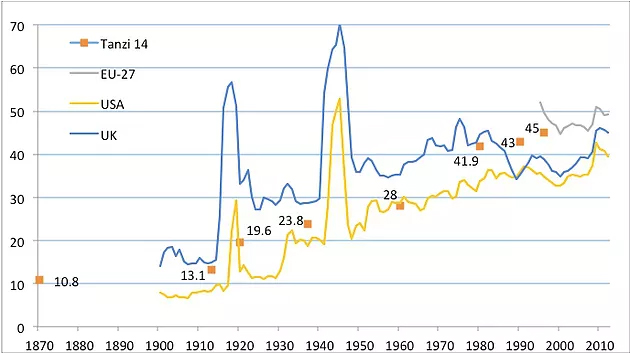
But public spending is not an economic liability. Far from being a burden on the economy, public spending has had a consistent positive effect for over a century. This positive link works in developing countries as well as high income countries. Public spending supports economic growth through investment in infrastructure, through supporting an educated and healthy workforce, through redistributing income to increase the spending power of poorer consumers, providing insurance against risks, providing direct support for industry, including through technological innovation, and increasing efficiency by taking on these functions.

Chart 1. Government spending as % of GDP 1870–2012, high income countries

Sources: see note [1]

Public spending supports employment, in both high income and developing countries, through: direct employment of public service workers; indirect employment of workers, by contractors supplying outsourced goods and services; employment of workers on infrastructure projects; extra demand and jobs from the spending of the wages of these workers and also of recipients of social security benefits (the ‘multiplier effect’); subsidies to support employment by private companies, or by providing employment guarantees; providing formal jobs with decent pay and conditions; government procurement is used to require ‘fair wages’ from private contractors, to reduce gender and ethnic discrimination, and strengthen formal employment of local workers. The combined effect of these mechanisms is to support half the formal jobs in the world.

The supporters of austerity programmes argue that government debt damages economic growth, but there is no evidence to support this – a Harvard University paper which claimed to find a connection has been discredited. Government borrowing is a key economic instrument for driving economic activity, and is much cheaper than borrowing by private companies, which have to pay much higher interest rates. Privatisation and PPPs are unnecessary, costly and damaging ways of raising money.
The purpose of public spending and public services is to achieve public objectives. These objectives include, for example, ensuring universal education and universal access to healthcare; environmental objectives such as the reduction of greenhouse gas emissions and management of waste; and economic objectives such as full employment. In a wide range of areas, these objectives are most effectively and efficiently achieved through public spending and public services. This section examines three policy areas where public spending and public services are key – healthcare; housing; and climate change.

Government revenues consist of taxes of various kinds and income from other sources. Countries with higher GDP have higher levels of taxation, so an increasing level of taxation is a key part of economic development. The total amount needs to be sufficient to pay for spending on public services and social security, and the burden of taxation should be fairly distributed. But neoliberal policies have attempted to reduce taxation, and have shifted the tax burden away from the rich, and corporate profits, on to ordinary people. All countries could increase their revenues substantially, just by increasing taxes on high incomes, property and corporate profits. This requires action to strengthen tax collection systems, and to deal with tax avoidance and the use of tax havens.

Changing current policies depends on political activity. Market mechanisms do not deliver the level of public services which countries need. The decisions which drive the development of public spending, or the imposition of austerity, are the outcome of political processes at national and international level.

2. Public services and equality

Equality is usually discussed in terms of people’s income, or the inequality suffered through systematic ethnic or gender discrimination. It is well recognised that public spending redistributes money income through social security benefits, but public services like healthcare, public education, child care, care for the elderly, and public housing also have a powerful redistributive effect, because they are equally available to everyone. Infrastructure like water, sanitation, electricity, roads and telecoms also improve equality because they make it possible for everyone to improve their livelihoods by using these services. As a result, cuts in spending on services have a disproportionate impact on households on lower incomes.

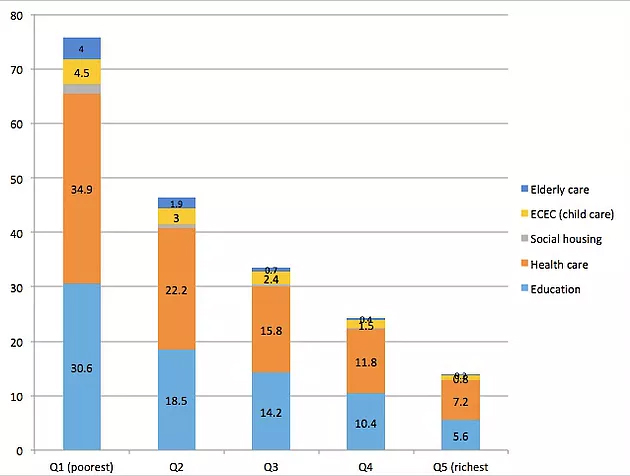
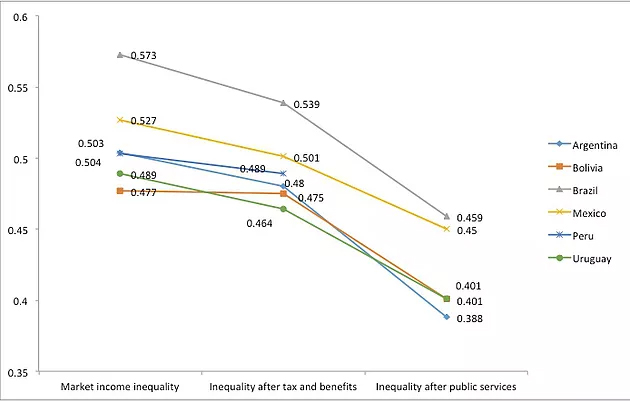
Recent studies in all high-income countries, and in 6 major Latin American countries, have shown that public services are relatively progressive in every country – the poor get a much higher proportion of the benefit of public services than they do of market income. And the value of these services, and the impact on equality, is at least as great as the impact of social security.

In OECD countries public services are equivalent to an extra 76% of the disposable cash income of the poorest 20%. In Latin America, public services have the same effect, making a greater impact on equality than social security benefits. Infrastructure for electricity, water and other services not only increases access for all, but improves employment opportunities, especially for women.

In addition, services such as child care, care for older people and education have a big impact on gender and ethnic equality, because they allow more women to get paid employment, and can be used to provide decent employment and career prospects for members of ethnic groups which have suffered discrimination. Other spending on public services takes the form of buying goods and services from private companies, and this too can be used to improve equality by making contracts conditional on positive discrimination in favour of women.

And through employing more people on better pay and conditions, with less differential between top and bottom, public services also improve income equality.

Chart 2. Value of public services as % of disposable income, 27 OECD countries

Source: calculated from Verbist et al p.35

Chart 3. Impact on inequality of taxes and benefits, and public services (Gini coefficient, 6 Latin American countries)

Source: Lustig et al 2012

3. The illusion of PPPs

Public–private partnerships (PPPs) are used as a way of raising money for expensive infrastructure projects through the private sector, to avoid any apparent increase in public borrowing. The private partner in the PPP raises the money, so the government does not have to – and the bridge, or tunnel, or motorway, or railway, or school or hospital – still gets built. PPPs are actively promoted by a range of international institutions and governments, including the World Bank, G20, EU and donors countries.

The first fundamental problem is the illusion that PPPs bring in private money to pay for the infrastructure, so the state can spend its money on something else. But the opposite is true. The great majority of PPPs rely on a stream of income from payments by government (for the hospital, school, railway, etc.) – i.e. public spending (with the exception of true concessions, where the private company makes all the investment “at its own risk”, expecting to get the necessary income from payments made by consumers (e.g. water charges or road tolls). PPPs do not supplement public spending – they absorb it.

The second problem is that governments can always borrow more cheaply than companies, so raising money through PPPs is always the worse option. This has been stated very clearly by the IMF: “… private sector borrowing generally costs more than government borrowing … This being the case, when PPPs result in private borrowing being substituted for government borrowing, financing costs will in most cases rise …”. (IMF 2004A, IMF 2004B) In 2011 a representative of the UK private companies involved in PPPs estimated that the average extra cost of private sector capital over conventional borrowing had been 2.2 per cent a year. The Financial Times calculated that this means that the UK taxpayer: “is paying well over £20bn in extra borrowing costs – the equivalent of more than 40 sizeable new hospitals – for the 700 projects that successive governments have acquired under the private finance initiative….”

Finally, when PPPs are used to finance public investment, the private investors naturally seek to protect themselves against risks and uncertainty. Governments therefore usually provide some form of guarantee, or agreement to carry risks, to provide greater security for the private investor. But, as the IMF again notes: “… resort[ing] to guarantees to secure private financing can expose the government to hidden and often higher costs than traditional public financing”. The further irony is that, since the financial crisis, state banks and institutions are actually lending money to PPPs, in order to borrow it back from them.

Despite the massive promotion effort, PPPs struggle to provide more than a tiny portion of the infrastructure investment in the world. Public finance remains the overwhelmingly predominant model worldwide, providing for well over 90% of infrastructure investment.

And many PPPs have been expensive failures. In the UK, the world leader in using PPPs, all the transport PPPs in London have been terminated – representing over 25% of the value of all the PPPs in the UK. The result has been a considerable saving in the cost of borrowing and in efficiency. (PSIRU 2014B)

4. Potential for more tax revenues

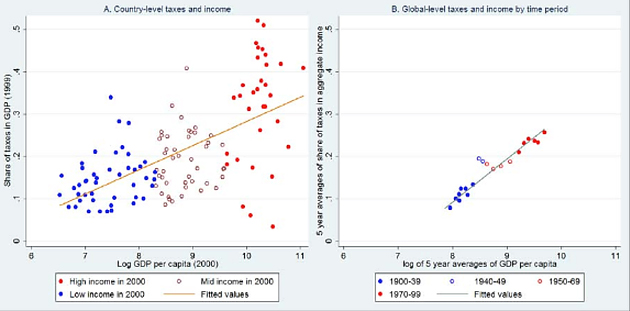
Taxation is not a burden but an essential part of economic , social and political development. As economies grow, tax revenues rise as a proportion of GDP:. “rich countries collect a much larger share of their income in taxes than do poor countries”, as the first chart shows. Higher tax revenues are a crucial part of development: “the power to tax lies at the heart of state development” – the second chart shows how the level of taxation has grown steadily for the last 100 years. (Besley and Persson 2013)

Chart 4. Higher GDP means higher taxation

Source: Besley and Persson 2013

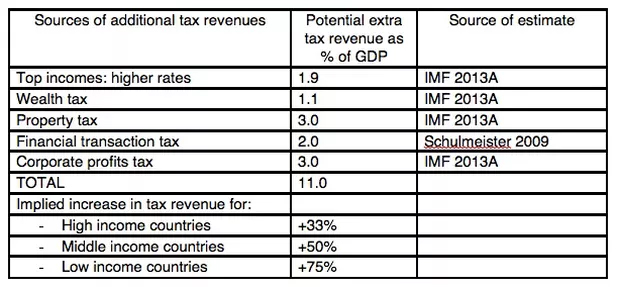
Far more tax revenues can and should be collected from taxes on high incomes, wealth, company profits, financial transactions, and from land and property. The table below shows estimates by the IMF and others of the potential extra revenues from some of these sources.

  • these add up to potential extra revenue equivalent to 11% of GDP.
  • they would represent a huge increase in tax revenues: an increase of 33% in high income countries, an extra 50% in middle income countries, and an extra 70% in low income countries.
  • the IMF estimates that the government debt of all countries could be restored to the levels of 2007 by a general tax of 10% on private wealth (IMF 2013A)

Chart 5. Potential extra revenues from taxing the rich and companies

Financial transactions tax

The proposal for a general tax on financial transactions is often called a ‘Tobin tax’ after the Nobel-prize-winning economist who advocated it as a way of deterring such transactions, to protect currencies from the volatility of speculative inflows and outflows. Many countries operate similar taxes successfully: China, Hong Kong, India, Indonesia, Italy, Singapore, South Africa, South Korea, Switzerland, Taiwan and the U.K. all tax the purchase and/or sale of company shares. If applied globally, a financial transactions tax could raise over USD $1trillion per year, or 2% of global GDP, even at a rate of 0.01%. A more limited currency transaction tax could raise between USD $25–33billion per year. (Taskforce 2010) Political support for the idea, in principle, has been growing for some years. In 2013 the EU proposed a directive to provide a framework for financial transaction taxes in Europe. (EU 2013, Thornton Matheson 2011)

Property and land taxes

The advantages of a property tax are that it is fair, hard to avoid, and impacts on people with assets whose value is increased by public services and infrastructure. There is wide variation between countries in taxes on property, and so considerable potential for collecting more from these sources.

A land tax is even broader, because it taxes all land, not just the buildings on it. It also taxes the value that landowners gain from economic growth and rises in property prices. Hong Kong uses a land tax to raise 38% of its revenues. A land tax has been supported by a wide range of people in the last 250 years, including Adam Smith, Tom Paine and Winston Churchill, who argued that infrastructure increases land values, but the landowner: “renders no service to the community, he contributes nothing to the general welfare, he contributes nothing to the process from which his own enrichment is derived.” (McLean 2004)

5. The remarkable turnaround in the UK

The underlying reasons for the opposition to privatisation in the UK are economic, as in other countries. People have experienced higher water and energy and rail prices, worse service, loss of jobs and pay, and loss of accountability, while the companies make large profits. Opinion polls suggested that the UK public never supported many of the privatisations, but since the 1990s, when the Labour party decided to drop opposition to privatisation, there has been no political force expressing that opposition.

The key factors in the change have been political. A new campaign group was launched in 2013, called We Own It, focussed simply on the demand to reverse all forms of privatisation – the sales of the water and electricity and rail companies, the various PPPs/PFIs that have been set up in the UK, and the whole area of outsourcing. This was the first anti-privatisation campaign in UK since the early 1990s, and it gained a lot of support from the public and significant publicity.

Then in 2015 Jeremy Corbyn, a longstanding left-wing MP, was elected leader of the Labour party, by a large majority. He was re-elected in 2016, again with a large majority, and the party’s membership grew to 500,000, making it the largest political party in Europe. In May 2017 a general election was called, and Labour produced a manifesto which included a commitment to bring back public ownership of water, energy and rail companies. These commitments played a large part in winning the support of over 40% of voters, and the Conservative government was left with no overall majority. The election made clear that ending privatisation was extremely popular.

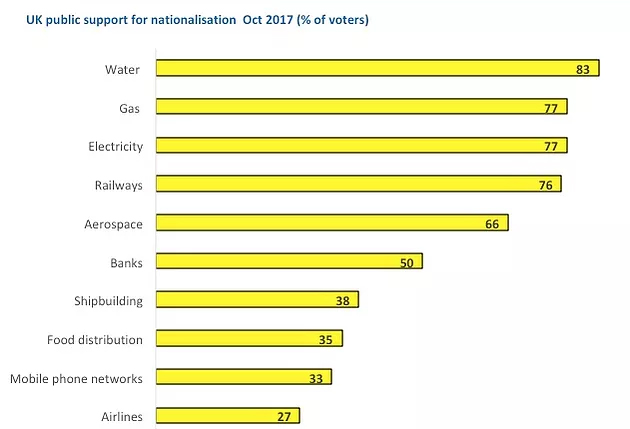
Since the election, this political process has accelerated. In October 2017 a survey conducted by a right-wing research group found that over three-quarters of the electorate wanted public ownership of water, electricity, gas and rail, and at least half wanted public ownership of the aerospace industry and the banks.

Chart 6. UK public support for public ownership, by sector, October 2017

Source: Legatum Institute Oct 2017 Public opinion in the post-Brexit era. www.li.com

At its annual conference in September 2017, the Labour party not only reiterated and maintained its commitment to public ownership of utilities, but also adopted radical policies in relation to outsourcing and PPPs. On outsourcing, the new policy is to hold a comprehensive review of all work outsourced by local and central government and health authorities, and introduce a new statutory rule that all work must be done inhouse by default unless a special case is made under strict criteria.

On PPPs, the party policy is now that there will be no new PPPs created, and that all existing PPPs will be nationalised. The party is extending this approach to its policy on international development, so that a Labour government will withdraw the UK’s support from policies encouraging the use of PPPs in developing countries.

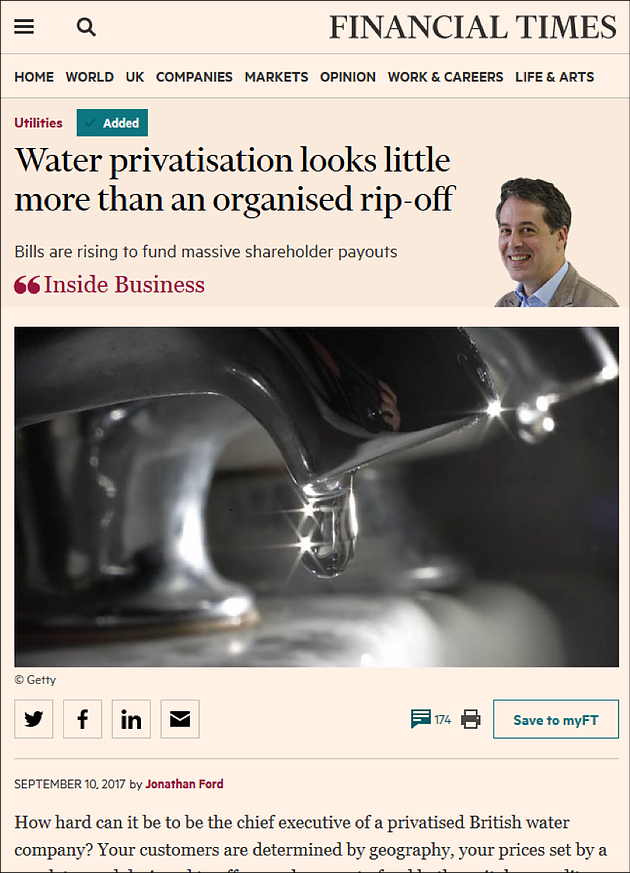
At the same time, the media, and private capital, has been forced to re-examine the problems of privatisation. Surprisingly, the Financial Times has published some of the strongest and most detailed critiques of privatisation and PPPs. Credit rating agency Moodys produced a briefing which agreed that Labour could legally nationalise the water and energy sectors, even without paying full market value in compensation. Investors now take nationalisation as a serious possibility, and the price of the shares of water companies on the London stock exchange has fallen by 25% or more Since May 2017, when Labour’s manifesto was first published. A report on the energy sector, commissioned by the Conservative government from a neoliberal economist, Dieter Helm, surprisingly recommended public ownership of the electricity transmission and distribution grids. A major new report on outsourcing has also undermined.

The process has been reinforced by further problems with privatisation, including the bankruptcy of Carillion, one of the major multinationals involved in PPPs in the UK (and elsewhere), and financial problems with another major PPP operator, Capita.

Chart 7. Financial Times articles, September 2017

Read More

Fighting neoliberalism and the privatization of public services: The struggle for social commons

Fighting neoliberalism and the privatization of public services: The struggle for social commons

April 22, 2018 | Francine Mestrum

1. Our public services, education, health care, public transport … all belong to our systems of social protection, systems that we need and have to promote because they are essential for our individual and collective survival. Individuals are not self-sufficient, they are interdependent.

This is an easy statement, but the question is how we try to achieve the existence of universal quality public services for all. We know that the current neoliberal philosophy wants governments to cut public spending, and, in general, social expenditures are severely limited.

However, markets, and the production system they require, cannot function properly without a decent reproduction, or simply put, if people have no clean water, no education system, no health care, no public transport, etc., the economic system will fail. Moreover, and this is for us an even more important argument: social protection is a human right, confirmed in the Universal Declaration of Human Rights and repeated and explicitly stated in the International Covenant for Economic, social and cultural rights as well as other regional treaties.

The experience of the past decades, all over the world, has shown that privatised public services cannot do the job: they are too expensive, so that poor people cannot afford them, they are rarely universal because they are then not profitable, they cut back on employment and do not allow for any democratic and participatory approach.

That is why there is now a broad movement to reclaim these services, at the national, the regional or the municipal level. This is the movement we want to support and promote. Social protection and public services are ours: people pay for them with taxes and social contributions, and that is why we call them social commons. They should be universal and be at the service of all, and not only of those who are rich enough to pay for them. Public services belong to the public, they can and should be organised in a democratic and participatory way.

2. This is all very reasonable and logical. Yet, it is sometimes difficult to explain. And the reason is words may mean different things to different people.

We speak here of ‘public services’, but we might also speak of ‘utilities’ or of ‘social services’ or of ‘services in the general interest’.

One of the main problems lies with the word ‘public’: for most people, especially on the left, this refers to public authorities or to the State. We do not want privatised services, we want public authorities to organize them.

An that is why neoliberals, who do not want this, started to talk, in Europe, of ‘services of general interest’, or why the World Bank speaks of ‘social services’, and why in countries like the UK or in Holland, they speak of ‘utilities’. All these other words mean one thing: we should not ask public authorities to take care of these services.

The French, particularly, have very serious problems with this terminological change.

However, many critics forget one thing: ‘public’ not only refers to the organizer, the public authorities, but also to those these services are meant for: the public!

What this means is that even if you do not want public authorities to organize these different services, there is no need to change the word: we are talking about public services, at the service of the public, at the service of people.

3. This is a long introduction for a very simple idea. But it is very important. Because today, while most of us will reject the privatisation of services, many of us will also have serious doubts about the capacity of States to really be at the service of people. In the past, we have seen how many services really functioned badly or not at all. States and public authorities are not necessarily democratic. Very often, public services are used as power instruments or for clientelist objectives. Today, we see how local authorities like municipalities are trying to take over.

The idea that I want to present here is the idea of social commons, that is a system that makes the opposition between private and public and between state and market irrelevant. Social commons give a role to citizens and their organisations.

I am not going to dwell on the concept of commons itself. Let me just briefly repeat that commons, basically, are the material and immaterial things that belong to us all: our planet, our oceans, our forests, our land, our seeds… These are natural commons. We also have cultural commons: our knowledge, which cannot be a private property, our cultural heritage, our internet … And we have social commons: our human rights, our public services, our social security. Commons are the result of a co-activity which supposes reciprocity between people. This co-activity is a basic condition and it constitutes a ‘we’. Commons then are the things that a political community decides to be their commons, which means there can be no commons without commoners. They are the political and social actors that decide on what in their society – at whatever level, local, national, regional or global – has to be considered a common, on the way to regulate it, on the rules for access to it and on monitoring its use.

Commons never are an intrinsic characteristic of things, but are the result of a common and democratic political decision concerning the access, the use and the monitoring of things. It means citizens are taking control in their communities, societies or at the global level. Commoning public services basically means to democratize them and to emphasize collective ownership.

This is very concretely what we mean when we say that decisions have to be taken bottom-up instead of top-down.

4. However, this does not mean that States play no role anymore, on the contrary. We will always need States for redistribution, for guaranteeing our human rights, for making security rules, etc. It means States are co-responsible for governing our interdependence. But the States we are talking of in relation to public services, will be of another kind, the State will be itself a kind of public service, it will be at the service of its citizens.

In the same way, markets will be different. Public services as commons does not mean there is nothing to be paid anymore, people who work in the health sector obviously have to be paid, but prices will not respond to a liberal market logic, they will respond to human needs. Never forget that workers in the public sector do produce value. In a system of commons, we focus on the use value instead of the exchange value.

So if we say social commons go beyond state and markets, we do not say they go without states and markets. It is a different logic that applies.

All this, because we should never forget that social protection is ours! We pay for it, with taxes and/or social contributions. We have to decide on it. And we have to trust the public. People know best what their needs are, and these needs will be different from one place to another. People’s organisations, such as trade unions, will have a crucial role to play.

5. The economic and social crisis we are currently living in, is in the first place a crisis of social re-production, in a world where employment increasingly fails to support subsistence. The privatisation of public services is a new enclosure, where the livelihoods of people are taken out of their hands and are turned into profit-making mechanisms. We want to defend our rights, make them concrete and contribute to new rights and policies in which people take back control. Without re-production there cannot even be production.

Social commons confirm the need for a non-profit approach on re-production, for abandoning exclusive state provisioning of services and for re-connecting with the full meaning of ‘public’. The co-activity and co-responsibility it implies also combine collective and individual rights, the obvious statement that there can be no individual freedom without collective freedom and collective responsibility.

This democratic, participatory and emancipatory way of organizing the public services we all need allows to protect individuals as well as society itself. Neoliberalism is destroying societies by solely focusing on individuals and interpersonal competition. Shifting the focus to the collective dimension of our societies, beyond communities and families, is a highly political task. Individual and collective rights have to go hand in hand if we want to protect our common goods.

Therefore, commons can be a strategic tool to resist neoliberalism, privatisation and commodification. With public services as commons, we can fight inequality. Applying the principles coherently and consequently, this will change the power relations, it will lead to changing the economic system, which is far more difficult to do from without. Social commons are indeed transformative, because you cannot have a preventive health care system if people have no right to water, if corporations are allowed to use toxic substances, if car companies are allowed to pollute the air we breathe. Pursuing on these points, it is easy to see there is a direct link between social justice and environmental justice. Both make it possible to preserve the sustainability of life, of humans, of society and of nature.

The language of commons offers an opportunity to the left to re-define its strategies, to renew its thinking on production, markets, nature and the State to create a new narrative to better organize our resistance to neoliberal and conservative forces.

Destroying public services is destroying society, social relationships, solidarity and collective values. Preserving and promoting public services is promoting citizenship and the sovereignty of people.

Francine Mestrum – Global Social Justice – www.socialcommons.eumestrum@skynet.be

*** Francine Mestrum has a PhD in social sciences and worked at the European institutions and several Belgian universities. Her research concerns the social dimension of globalisation, poverty, inequality, social protection, public services and gender. She is an active member of the International Council of the World Social Forum and helps in the organisation of the Asia Europe People’s Forum events. She is the author of several books (in Dutch, French and English) on development, poverty, inequality and social commons. She is the founder of the global network of Global Social Justice and currently works on a project for social commons. www.socialcommons.eu

Read More

Housing and Public Services

Housing and Public Services

April 22, 2018 | Meena R Menon

In 2008, for the first time, the world’s population was evenly split between urban and rural areas. There were more than 400 cities over 1 million and 19 over 10 million. More developed nations were about 74 percent urban, while 44 percent of residents of less developed countries lived in urban areas…..It is expected that 70 percent of the world population will be urban by 2050 and that most urban growth will occur in less developed countries.[i]

In most cities in the developing countries, social-political people’s movements are focused on the concerns around acute agrarian distress, which is very immediate, and urbanization is often seen only as an evil that needs to be rolled back for a better world. But this is looking more and more unlikely at least in the near future. Many consider the terms sustainability and urbanization as mutually exclusive. Is it possible to reverse urbanization? What is the role of technology? Should we think more about how cities will have to be made more sustainable, rather than the hope that cities can be done away with altogether at lease in the imminent future? Most important, what are the basic social needs of a population that is largely urban and how will they be met? There is a need for a more comprehensive urban program of action, for more policy activism on sustainable cities, urban planning, sustainable urbanization. Urban activism will perhaps have to go beyond defensive struggles and evolve a better understanding of the urban space, solutions to urban poverty, and engagements with urban aspirations. This is critical, not only for the urban poor but also to save the environment and the planet.

Read More

Statement on Syria

Statement on Syria

April 15, 2018

The Asia-Europe People’s Forum (AEPF) condemns the April 14 US-led missile strike on Syria’s territory.

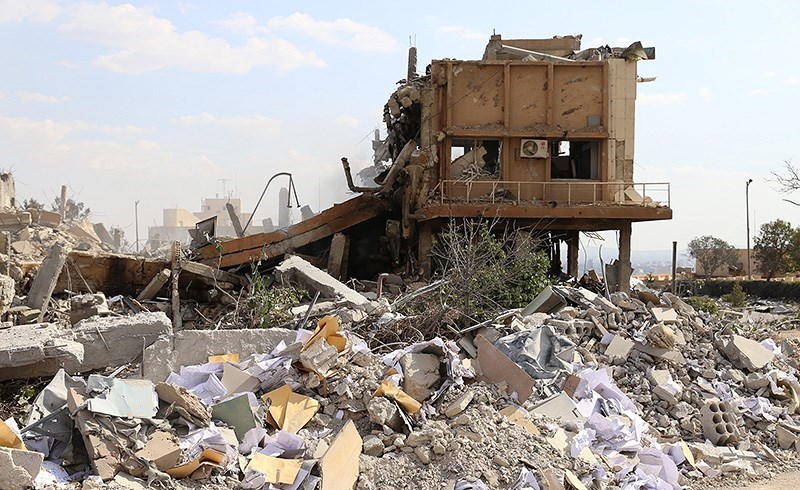
The US-France-UK attack, targeting Syria’s Homs province, which the US and their allies claimed was in response to the Syrian Army’s use of chemical weapons, not only heightens tensions in the region but also threatens people’s lives and livelihood.

The situation in the so-called chemical weapon zone is murky and UN chemical weapons inspectors should visit the area and ascertain if chemical weapons were used. They should be given all necessary facilities by the Assad Government to ensure a thorough and unbiased investigation.

It is also important to highlight the Turkish aggression in the Northern Syrian region of Afrin where the Kurdish minority is facing an armored attack by Turkey.

We urge the US, its allies and the Russian Federation, as well as all parties to immediately stop using or threatening to use force and violence in all settings, contexts, and circumstances and start an inclusive dialogue.

The AEPF expresses its solidarity with and support for all Syrian people working for a just peace and peaceful, negotiated end to the conflicts in Syria and those who are victims, internally displaced and refugees from the conflicts. AEPF calls on all peace-loving movements to urge an end to hostilities enabling conditions for a peaceful resolution of hostilities. We ask for an immediate cease-fire monitored by the UN to ensure peace throughout this region.

Read More

The Untold Story

The Untold Story

April 8, 2018 | Satoko Kishimoto and Olivier Petitjean

You would be forgiven, especially if you live in Europe, to think that public services are by nature expensive, inefficient, maybe even somewhat outdated, and that reforming them to adapt to new challenges is difficult. It would seem natural to assume – because this is what most politicians, media and so-called experts tell us continuously – that we, as citizens and users, should resign ourselves to paying ever higher tariffs for services of an ever lower standard, and that service workers have no choice but to accept ever more degraded conditions. It would seem that private companies will inevitably play an ever larger role in the provision of public services, because everything has a price, because politicians have lost sight of the common good and citizens are only interested in their own individual pursuits.

The book Reclaiming Public Services [i], however, tells a completely different story. Sometimes it may feel as though we are living in a time when profit and austerity – when it is not authoritarianism and xenophobia – are our only horizons. In reality, below the radar, thousands of politicians, public officials, workers and unions, and social movements are working to reclaim or create effective public services that address the basic needs of people and respond to our social, environmental and climate challenges. They do this most often at the local level. Our research shows there have been at least 835 examples of (re)municipalisation of public services worldwide in recent years, involving more than 1,600 cities in 45 countries. And these (re)municipalisations generally succeeded in bringing down costs and tariffs, improving conditions for workers and boosting service quality, while ensuring greater transparency and accountability.

This (re)municipalisation[ii] wave is especially strong in Europe, but it is also gaining strength elsewhere in the world. What is more, many of the 835 examples we identified are not merely technical changes in ownership but very often entail broader economic, social and environmental changes. (Re)municipalisation initiatives emerge from a range of motivations, from addressing private sector abuse or labour violations, recovering control over the local economy and resources, or providing affordable services to people, to implementing ambitious energy transition and environmental strategies. (Re)municipalisations occur at all levels, with different models of public ownership, and with various levels of involvement from citizens and workers. But out of this diversity a coherent picture nevertheless can be drawn: the movement for (re)municipalisation is growing and spreading, despite the continued top-down push for privatisation and austerity policies.

Remunicipalisation refers to the return of public services from private to public delivery. More precisely, remunicipalisation is the passage of public services from privatisation in any of its various forms – including private ownership of assets, outsourcing of services and public-private partnerships (PPPs) – to public ownership, public management and democratic control. While our main focus in this research is on cases of return to full public ownership, the survey also includes cases of predominantly publicly owned services when the model is implemented with clear public values, to serve public objectives and when it contains a form of democratic accountability.

Remunicipalisation beyond water

We felt it was crucial to study and document the remunicipalisation trend, precisely because well-resourced knowledge institutions, think tanks and financial institutions have done nothing to research it. Corporations, economic ‘experts’ and national governments have neglected remunicipalisation – perhaps because they do not want it to be known. They would rather lock in the notion that privatisation is inevitable. In 2015, civil society organisations and trade unions came together to study remunicipalisation in the water sector. We found that since 2000 there had been at least 235 cases of water remunicipalisation in 37 countries, affecting more than 100 million people.[iii] Water remunicipalisation, a rare phenomenon 15 years ago, has accelerated dramatically and the trend keeps gaining strength. This raised the question of the extent to which remunicipalisation was also happening in other essential services such as energy, waste collection, transport, education, health and social services. We were also curious to find out whether remunicipalisation in these sectors happened for similar reasons and with the same results than in the water sector.

A dynamic, accelerating trend

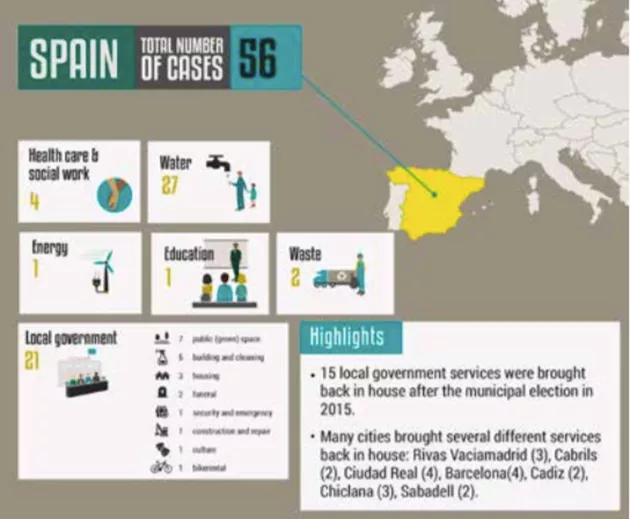
Through the participatory survey and our own research, we identified 835 (re)municipalisation cases in seven public service sectors worldwide. They have occurred from small towns to capital cities, from urban to rural contexts. Energy (311 cases) and water (267 cases) are the sectors with the most cases. Various local government services such as swimming pools, school catering, public space maintenance, housing, cleaning, security services were brought back in-house in Canada, Spain, the UK and elsewhere (140 cases in total).

Roughly 90 per cent of (re)municipalisations in the energy sector happened in Germany (284 cases), the country famous for its ambitious ‘Energiewende’ policy. Many water remunicipalisation cases occurred in France (106 cases), the country with the longest history of water privatisation and home to the leading global water multinationals, Suez and Veolia. For the health and social work sectors, more than half of the cases came from Norway and other Nordic countries (37 cases in total).

Different forms of de-privatisation

We are using (re)municipalisation with parentheses because this survey also includes actions in which local governments established new municipal companies in liberalised markets. This typically happened in the energy sector. Local governments can also create completely new public services to meet citizens’ basic needs. The state of Tamil Nadu in India, for instance, created people’s canteens to provide meals at very low cost to reduce hunger and malnutrition. In total, our survey found 143 new municipal or regional companies established to provide public services for citizens. Many of them are municipal energy utilities (122). In Germany alone, our survey found that 109 new municipal energy companies were created in recent years. Other examples include newly created municipal funeral services companies in Spain and Austria that provide an affordable alternative for families in a critical moment for human dignity.

De-privatisation can also occur in the form of (re)nationalisation. Remunicipalisation and renationalisation often share common features in that they recover public capacity from corporations, but the motivations can be very different. Many of the private banks in Western Europe were rescued and recapitalised by states with public funds after the financial crisis in 2008. After the massive nuclear disaster in Fukushima in Japan, the Tokyo Electric Power Company (TEPCO) – responsible for the nuclear reactor – was similarly nationalised. The Japanese government intends to privatise it again when the market is ready. More than 200 services, mainly in the finance and energy sectors, were renationalised in Hungary by the current authoritarian regime, with the aim of consolidating central power.[iv] These examples have to do more with either temporarily fixing private failures without introducing public scrutiny or with a nationalistic approach. In Latin America, on the other hand, after privatisations spread across a wide range of public services in the 1990s, several governments renationalised economically and socially strategic sectors such as energy, gas, water, pension funds, postal services and air transport. So we present a separate and selective list of renationalisation cases, the motives and objectives of which were to expand equitable and affordable services to the whole population. These cases are mainly from Latin America.

Our research focuses mainly on steps taken with the aim to boost local capacity and with potential to provide better and democratic public services. While 70 per cent or 589 cases were implemented by local and regional authorities, some were also coordinated at the inter-municipal level. Half of the water sector cases in France occurred at the inter-municipal level. It often means that the many surrounding municipalities in a metropolitan area have joined to benefit from the services of remunicipalised public water management, as happened in Nice, France. Inter-municipal actions are common in the energy (148 cases) and transport (19 cases) sectors as well.

Broader mandate but less resources

Public services are facing a multi-faceted challenge. Most countries continue to struggle to recover from economic crisis. Neoliberal governments stubbornly stick to deepening austerity and intensifying competition and downward pressure on social and environmental standards through neoliberal trade and investment agreements. Avoiding catastrophic climate change requires a deep transformation of the economy. Universal access to essential services like water and sanitation remains a major challenge around the world. Scandalous tax avoidance and evasion by corporations and super-wealthy individuals has been exposed to a large public, but governments continue to allow this to happen.

Local and regional governments are increasingly asked to do more with less resources. They are on the frontline to take on the multiple challenges of climate change, the UN Sustainable Development Goals (SDGs), building resilience against natural disasters and accommodating refugees. At the same time, they are faced with a major challenge in terms of how to finance public services and infrastructure.

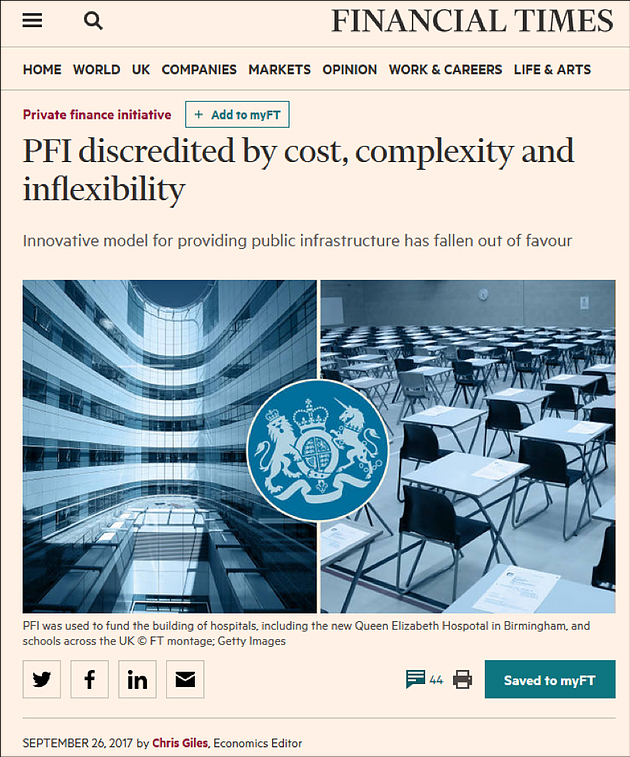
For several decades we have been told that outsourcing, privatisation, PPPs and financing schemes, such as private finance initiatives (PFIs) in the UK, are the only options for local authorities in a context marked by more responsibilities and less resources. But evidence is growing that such policies are bad for public budgets in the long term, and lead to poor services and a loss of democratic accountability. It is becoming clear that abandoning outsourcing, PPPs and similar neoliberal policies and choosing to deliver public services in-house instead leads to major savings as argued below. The increasing number of remunicipalisation initiatives, is a reflection of the failures of privatisation and PPPs.

Immediate benefits of de-privatisation

In our 2015 water remunicipalisation research, we identified the main motives for ending privatisation to be linked to cost savings, improved quality of service, financial transparency, and regaining operational capacity and control. In this broader survey, which includes other essential services besides water, we find the same motives. Environmental objectives, such as speeding up renewable energy development, integrated environmental policies toward reducing waste, or enhancing public transport systems, are other key drivers. Providing affordable services for low-income households in the context of energy and water poverty (where many families cannot afford the high utility bills) is an important motivation, especially in Spain and the UK where those services are dominated by large profit-making corporations.

Regarding the results of remunicipalisation, we found in 2015 that a large number of cases resulted in cost savings and increased investment in the water sector. It may be too early to assess the results of (re)municipalisation in other sectors in a systematic manner since many cases happened in very recent years. Nevertheless, there is significant empirical evidence from other sectors that remunicipalisation has brought immediate cost savings for local governments. To give just a few, Bergen (Norway), where two elderly care centres were taken back in-house, made a surplus of €500,000 when a €1 million loss was expectedThe termination of transport PPPs in London resulted? ?in a £1 billion reduction in costs, mainly through the elimination of shareholder dividends and legal fees, and through procurement and maintenance efficiencies). Chiclana in Spain transferred 200 workers to the public sector for three in-sourced services, and the municipality nevertheless expects to save between 16 and 21 per cent on its budget.

Citizens stand up for de-privatisation

It is not surprising that many remunicipalisation initiatives originate in vibrant citizens’ movements. The German energy transition is promoted by municipalities and citizens’ groups; the majority of the population in the UK demands public ownership of water, energy supply and transport; the massive grassroots resistance against social cuts sparked the emergence of new progressive local politics in Spain; and more than 2,300 cities across Europe rejected the US-EU free trade agreement (TTIP). All of these stories tell us that there is strong support for an alternative path to ever expanding privatisation, ever deepening austerity and ever lower quality services.

In a vast majority cases in our survey citizens and workers get involved in de-privatisation processes to a different extent. In Nordic countries, organised workers experienced problems in their workplace after privatisation and pushed for de-privatisation in health and social work. The same happened with various local government services in the UK and Canada. In these countries workers and citizen coalitions have been fighting for many years against water privatisation and work together with city councils to de-privatise when political opportunities arise. Massive grassroots campaigns for referendums resulted in de-privatisation, for instance that of the energy grids in Hamburg, Germany and in Boulder, US,[v] and that of water in Berlin.[vi] Citizens are not merely service users. Newly created municipal energy companies are backed by engaged citizens and community energy movements. Londoners are now campaigning to set up a not-for-profit energy supply company with an extended citizen participation mechanism.[vii] Citizens engagement and mobilisation are essential and central to the (re)municipalisation movement.

Hybrid model and de-privatisation from below

We deliberately take a broad definition of ‘public’, which allows us to capture a larger range of initiatives. For instance, citizen co-operatives that have taken over profit-driven commercial energy service providers (e.g. Minnesota and Hawaiian island Kauai in the US) fall into our research scope.

Unlike local authorities, the citizen co-operatives or housing associations that have played a role in providing affordable energy to residents are in principle private entities and as such they are only accountable to their members. They are, however, often not-for-profit and can clearly serve public interest goals. The most important angle in this survey is therefore not just the distinction between state and non-state actors, but rather the objectives behind the initiatives and factors such as proximity (locally rooted). In other words, we contrast corporate and financialised forms of ownership and locally organised not-for-profit forms of ownership that explicitly aim to serve the broader public interest, based on principles such as equality, universal access, environmental sustainability and democracy. Our Power, for instance, which was established by 35 social housing associations in Glasgow, Scotland in 2015, is a hybrid model of partnership between the local authority and citizen co-operatives. The Scottish Government has invested £2.5 million in Our Power, which aims to make a difference for low income households who are currently disadvantaged in the energy market and struggling to pay their bills.

We see (re)municipalisation as a strategic window to bring about positive change in our communities and to help connecting diverse movements and actors: those promoting climate justice and energy transition, those fighting against neoliberal trade and investment regimes and privatisation, those denouncing tax avoidance, the trade union movements and their allies standing up for workers’ rights, the emerging municipalist movement, and other alliances among cities. The growing collective power of these different groups to reclaim democratic public services puts resilient and thriving communities back on the horizon.

*** Satoko Kishimoto is a coordinator of the Public Alternative Project at the Transnational Institute (TNI).Olivier Petitjean is a French writer and researcher, who is currently the chief editor at the Multinationals Observatory, an investigative website on French transnational corporations.

[i] Kishimoto, S., Petitjean, O(2017) Reclaiming Public Services: How cities and citizens are turning back privatisation. Amsterdam: Transnational Institute. https://www.tni.org/en/publication/reclaiming-public-services

[ii] We use ‘remunicipalisation’ to refer to the process of bringing previously private or privatised services under public control and management at the local level. We are aware that as a term it is not always entirely adequate, because in some cases the services that are reclaimed have always been in private hands, or did not exist. In these instances, ‘municipalisation’ would be a more adequate term. (Re)municipalisation covers both instances. There are also examples of public services that have been de-privatised at the national level. We treat ‘renationalisations’ separately in order to focus on local actions and because some forms of renationalisation (when they are about centralising power or temporarily rescuing failed private companies) do not fall under our research scope. Finally, there are numerous examples of citizens and users taking the lead in reclaiming essential services from commercial entities to run them on a non-profit basis for their communities. For us, these cases also fall under (re)municipalisation insofar as they are oriented toward public service values and non-commercial objectives. De-privatisation then serves as an overarching term for (re)municipalisation, renationalisation and citizen-led reclaiming of public services, which are all oriented toward fighting against the ills of privatisation.

[iii] Kishimoto, S., Petitjean, O., Lobina, E. (eds.) (2015) Our Public Water Future: Global Experiences with Remunicipalisation. Amsterdam: Transnational Institute. https://www.tni.org/en/publication/our-public-water-future

[iv]Mihályi, P. (2016) Diszkriminatív, piac- és versenyellenes állami gazdaságpolitika Magyarországon, 2010-2015 (Discriminative Anti-Market and Anti-Competiton Policies in Hungary, 2010-2015). IEHAS Discussion Papers, MT-DP – 2016/7, Hungarian Academy of Sciences.

[v] See the detailed case of Boulder on the Energy Democracy website: Buxton, N. (2016) Boulder’s long fight for local power. http://www.energy-democracy.net/?p=364

[vi] See the detailed case of Berlin on the Remunicipalisation Tracker: http://www.remunicipalisation.org/#case_Berlin

[vii] See the detailed case of London on the Energy Democracy website (2016):

http://www.energy-democracy.net/?p=355

Read More

A citizen wave to reclaim public and democratic water in Catalan municipalities

A citizen wave to reclaim public and democratic water in Catalan municipalities

April 5, 2018 | Míriam Planas

Catalonia experienced its first remunicipalisation of water in 2010, in the town of Figaro. Seven years later the door of remunicipalisation (or municipalisation considering that water was never publicly managed in some places) is now wide open and an estimated 3.5 million of the 7 million inhabitants in Catalonia, including Barcelonans, could see a change to their water management model during the coming years. This is an opportunity to advance management of water as a common good, in a more democratic way that guarantees the right to water for all, ensuring the most basic needs of the people and the preservation of water ecosystems. The water remunicipalisation trend in Catalonia is part of a wider trend throughout Spain, which continues in spite of the conservative central government’s every efforts to hinder it. The Agbar quasi monopoly in Catalonia Private companies supply water to 83.6 per cent of the Catalan population. The Agbar Group (Aguas de Barcelona), now a subsidiary of the French multinational Suez, services 70 per cent of the population, that is, 5.6 million inhabitants. Additionally, nearly 0.5 million people get their water from Aqualia, a subsidiary of the Spanish construction company FCC (Fomento de Construcciones y Contratas). At the national level, roughly 57 per cent of the Spanish population gets its water from a private provider. Agbar, which is headquartered in Barcelona, is by far the dominant player in the Spanish market. Historically Barcelona and Catalonia have thus formed the bastion of private water management in the country.

The Agbar quasi monopoly in Catalonia

Private companies supply water to 83.6 per cent of the Catalan popu- lation. The Agbar Group (Aguas de Barcelona), now a subsidiary of the French multinational Suez, services 70 per cent of the population, that is, 5.6 million inhabitants. Additionally, nearly 0.5 million people get their water from Aqualia, a subsidiary of the Spanish construction company FCC (Fomento de Construcciones y Contratas). At the national level, roughly 57 per cent of the Spanish population gets its water from a private pro- vider. Agbar, which is headquartered in Barcelona, is by far the dominant player in the Spanish market. Historically Barcelona and Catalonia have thus formed the bastion of private water management in the country.

In Catalonia, the private sector is concentrated in medium and large cities because larger populations offer better return on investment. Elsewhere there is a long tradition of public management, with 450 small munici- palities being serviced by public water utilities – that is, half of the mu- nicipalities of Catalonia but only 16.4 per cent of the population.

According to a report of the Spanish Court of Accounts in 2011,1 private water management is 22 per cent more expensive for small and medium towns than public provision, while offering a lower performance on av- erage. Catalan average water prices in privately managed municipalities are 25 per cent higher than in municipalities with public management. In Barcelona’s metropolitan area (includes 22 surrounding municipalities), the Aigua és Vida platform estimates that Agbar’s water rates are 91.7 per cent more expensive than in neighbouring towns such as El Prat de Llo- bregat and Barbera, which have public management.

The situation of water provision in Catalonia may be about to change radically, however, considering that 14 Catalan towns have already mu- nicipalised or remunicipalised their water. Concession contracts in some 90 more municipalities – home to about 3.5 million people – are set to expire in the coming years (2017-2025, see Appendix). Many of the pri- vate contracts in force today have not gone through a proper tendering process. Dozens of town councils have already approved the study of (re) municipalisation scenarios for water provision. Along with the vibrant citizen mobilisations and platforms for reclaiming public and democratic water in Catalonia and the whole of Spain, this has resulted in the current wave of (re)municipalisation.

Change of scenario: The (re)municipalisation wave

In 2015, citizen-led, progressive coalitions gained power in many Span- ish cities, including Madrid and Barcelona. This was the result of years of citizen movement campaigning for access to basic rights and against the corruption of traditional political parties and their close connections to big business. In turn, it created a favourable political environment for remunicipalisation. Valladolid (300,000 inhabitants) is the largest city to have remunicipalised water services in Spain.2 The municipal council has decided to return water management to public hands when the con- tract with Agbar expires, in July 2017. Although it does not fall within the scope of this chapter, it must be noted that many of these municipalities (which are not necessarily driven by progressive coalitions) embarked on remunicipalising not only water, but other services as well. An im- portant obstacle, however, is the central government, which is trying to make it impossible for cities to remunicipalise public services. In April 2017, the central government presented a draft budget proposal that in- cluded an additional disposition (no. 27) that was cause for concern for many but that was not adopted as proposed.3 It would have prevented the transfer of those workers previously in the private sector into any new public body, with the underlying objective of turning unions and workers against remunicipalisation. This would have led to a loss of expertise and created a lack of skilled workers to provide the services. The central gov- ernment also has directly fought against remunicipalisation in Valladolid. In March 2017, the Ministry of Finance through the State Attorney’s Of- fice filed a lawsuit4 to block the staff’s transfer from the private company to a new public company, invoking budgetary adjustment regulation.

A citizen wave to reclaim public and democratic water in Catalan municipalities

The year 2016 was a turning point in the management of water in Cata- lonia and throughout Spain. In March, a judgment of the Court of Justice of Catalonia cancelled the public-private partnership contract for wa- ter supply to 23 municipalities in the Metropolitan Area of Barcelona. In April, Collbató, a village of 4,000 inhabitants, became the 12th munic- ipality to recover water service management in Catalonia. Water losses in its network were more than 60 per cent. Then in November, the first meeting of Spanish cities for public water was organised in Madrid, with the participation of seven mayors from some of the largest cities in Spain, along with public water operators and civil society organisations. The ob- jective of this unprecedented event was to strengthen and coordinate the water movement across Spain, in a context where the central government is strongly opposed to remunicipalisation. Finally, in December, after 75 years of concession, the contract of private company Mina Pública de Ter- rassa (35.5 per cent owned by Agbar) with the city of Terrassa (215,000 inhabitants) was put to an end.

The trend has continued in 2017, with nine municipalities in the Metro- politan Area of Barcelona – representing three in four inhabitants – ap- proving motions in favour of considering public management of water. On 19 March 2017, Terrassa saw the first popular demonstration in favour of the public management of water in Catalonia with the participation of 4,000 people. Three days later, a Catalan Association of Municipalities for Public Management of Water was created. The municipalities involved in this new Association include Barcelona, Badalona, Cerdanyola del Valles, El Prat de Llobregat, Sabadell, Terrassa and Santa Coloma de Gramenet, representing a total of 2.5 million inhabitants. Its objective is to develop a new public model including new forms of social control to ensure trans- parency, information, accountability and effective citizen participation. The Association is committed to providing assistance, knowledge and support to those municipalities wishing to remunicipalise and implement this new management model.

This radical shift toward a new model for public water is largely the re- sult of the efforts of the many civil society platforms that organised years ago and have been denouncing irregularities and private profiteering ever since: Taula de l’Aigua (Water Table) in Terrassa; Aigua és Vida Girona (Wa- ter is Life Girona) in Girona, a city whose contract is set to expire in 2020; Aigua és Vida Anoia (Water is Life Anoia) in Igualada; Volem l’aigua Clara i Neta (We want clean and clear water) in Torello, where the contract ex- pires in 2018; Taula de l’Aigua de Mollet (Mollet Water Table) in Mollet del Vallès, where the council has already approved a study of remunicipali- sation when its contract expires in 2020; and Aigua és democràcia (Water is Democracy) in La Llagosta.

Terrassa: Ending a concession after 75 years

Private company Mina d’Aigües de Terrassa S.A. has managed the water service in Terrassa for 75 years, through a concession that ended on 9 December 2016. Since March 2014, a group of people from neighbour- hood movements, social movements and ordinary citizens created Taula de l’Aigua, a citizen platform that aims to recover direct public manage- ment of water in Terrassa, with citizen participation and social control. Mina is a subsidiary company of the Agbar Group, which controls its management and has a 35.5 per cent stake in the company. In 2013, as first evidence of a simmering conflict, it presented to the City Council a proposal to increase the price of water by 6 per cent. The Council asked for a justification and ended up rejecting the proposed tariff hike, as did the Price Commission of Catalonia, in favour of a 1.25 per cent increase. With the end of the concession approaching, the city began investigating into its options and requesting information from Mina, which it had nev- er done before. Citizens also requested information from the City Council, but Mina refused to provide most of the information. Important aspects such as the price of Mina’s water wells or the breakdown of the costs of the service are not yet public. The Mayor of Terrassa clearly expressed his dissatisfaction with the way the company, which is supposed to be a service provider for the Council, was retaining information in order to hinder a possible remunicipalisation. Two years of intensive informative and educational work done by Taula de l’Aigua succeeded in making the water issue central to the political agen- da. In July 2016, the City Council approved a motion in favour of direct management of water. Among the 27 city councillors, 20 were in favour, three abstained and four were against. The private company claimed that recovering the service would cost the city €60 million. The Council, how- ever, maintains that the cost will not be more than €2 million. When the council confirmed the end of the concession and the return of the system to the city in December 2016, Mina turned to the courts to have the reso- lutions cancelled, so far without success. The second step was to design the new public service. Taula de l’Aigua de Terrassa together with the Terrassa Council of Organisations convened the first Terrassa Citizen Parliament, which approved two motions to be presented to the City Council, on the objectives of the new management model and on social control of the service. To reclaim public and dem- ocratic water, a wide public demonstration was organised in Terrassa in March 2017 in support of the Council’s decision to end the contract.

In April 2017, the City Council of Terrassa initiated the process of devel- oping a new model for managing public water supply in the city, which must be approved before the end of 2017. In the meantime, Mina has been granted temporary contract extensions.

Terrassa demonstration
Photo by EPSU, Twitter
Over 4,000 people took to the streets to celebrate the turning tide of public water services at the World Water Day 2017 in Terrassa

Throughout this process, Taula de l’Aigua will continue promoting the management model approved by the Terrassa Citizen Parliament in February 2017, to make sure the recovery of public water in Terrassa is also a step forward in managing water as a common good.

The remunicipalisation of water in Terrassa is currently the spearhead of the recovery of public water in Catalonia, just as remunicipalisationof water is the spearhead of that of other basic services. Therefore, the success of the Terrassa remunicipalisation and the implementation of a new management model with effective citizen participation would open the door for many other progressive and democratic remunicipalisations in Catalan cities. Barcelona: A historical opportunity Next on the list could be the city of Barcelona, along with the 22 mu- nicipalities in its metropolitan area. Barcelona’s water has always been under the control of private company Agbar, with no proper contract. In 2010, a judge finally ruled this situation to be illegal, forcing Agbar and the Barcelona Metropolitan Area to sign a public-private partnership (PPP) contract in haste to regularise the situation. Initially, Agbar had 85 per cent of the PPP and the Metropolitan Area of Barcelona, 15 per cent. Subsequently, Agbar transferred 15 per cent of its shares to Spanish bank La Caixa. But this new PPP contract was approved for 35 years without a tendering process and without sufficient technical justification. For these reasons, in 2016 the Supreme Court of Catalonia cancelled the contract. Agbar has filed an appeal with the Supreme Court of Spain to override the ruling. Meanwhile, the Barcelona City Council has already approved a study for the municipalisation of the service and the preparation of technical and/ or legal reports necessary for the transition to public management of wa- ter. Eau de Paris, the remunicipalised water operator of the French capital, has agreed to provide legal and technical support for this work, while Agbar, again, refuses to co-operate and to provide information. Eight city councils from the metropolitan area have followed in the footsteps of Barcelona and have approved motions in favour of public management of water. In parallel, the city of Barcelona has already remunicipalised several public services (kindergartens and gender violence prevention) and created a new public electricity company.

Participation as an anchor

Remunicipalisation is not only a matter of municipalities recovering pub- lic management and restoring public governance. If we really want re- municipalisation to endure and lead to democratic, effective and sustain- able water services, we need to manage water as a common good. This is why citizen participation is crucial within the remunicipalised public services, just as it has been crucial in pushing for remunicipalisation in Catalonia in the first place.

Water is life not only for people, who cannot live without water, but also for the environment, which involves protecting the quality of water and ecological flows in rivers. This is especially important in Mediterrane- an regions such as Catalonia, which aresubject to the impacts of climate change. Strong citizen mobilisation for water in Catalonia has always been related to this sense of the vital importance of water as a common good. (Re)municipalisations of water are a tool to move a step forward and require municipalities to develop water policy that takes into account the limits and the quality of local water sources. Water management is a key tool for ensuring regional balance and respect for the environment, based on a concept of water not as a resource, but as a natural good, and an essential part of the ecosystem in which we live.

What form should citizen participation take? Each municipality, each platform must define what form of governance and management ensures better involvement of their citizens. What is there that already exists in the municipality’s social fabric? What spaces for participation are there? Which new ones should be opened up? Who should participate? On which decisions should citizens be engaged?

Participation must be the anchor of a new water management model. This model needs to ensure that the reclaiming of public water manage- ment in municipalities results into truly democratic deepening, through mechanisms of transparency, accountability, education and training for citizens. All this in order to keep at bay the old practices of the private management model, characterised by opacity, corruption and enrich- ment through water.

*** Míriam Planas is a member of Engineering without Borders Catalonia, working for development cooperation to guarantee universal access to basic services. She is also actively involved in Aigua és Vida, the citizen platform in Catalonia, which consists of more than 50 organisations working toward public, democratic and non-commercial water management.

Informe de Fiscalización del Sector Público Local, ejercicio 2011: http://www.tcu.es/reposito- rio/fd3654bc-3504-4181-ade5-63e8a0dea5c2/I1010.pdf

See the detailed case of Valladolid on the Remunicipalisation Tracker: http://remunicipalisati- on.org/#case_Valladolid

Eldiario.es (2017) El Gobierno carga contra los procesos de remunicipalización de los Ayun- tamientos a través de los Presupuestos, 16 April. http://www.eldiario.es/politica/remunicipali- zacion-presupuestos-ayuntamientos_0_631686916.html

Eldiario.es (2017) Montoro se enfrenta a Valladolid y se persona por primera vez en una causa de remunicipalización del agua, 31 March. http://www.eldiario.es/politica/Hacienda-persona-primera-remunicipalizacion-servi- cio_0_627488367.html

Read More