The Belt and Road Initiative (BRI): An AEPF Framing Paper

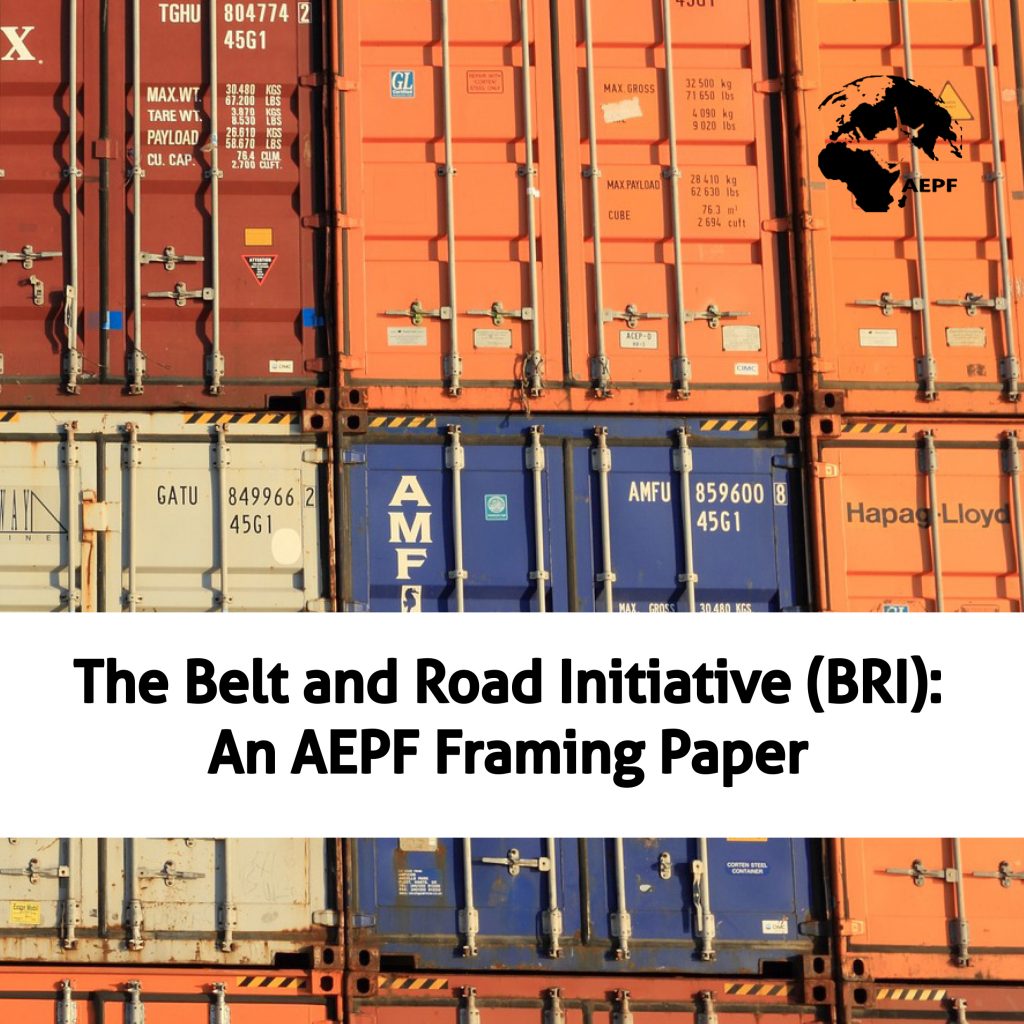
The Belt and Road Initiative (BRI): An AEPF Framing Paper

Since the launch of the BRI in 2013, 136 countries and 30 international organizations have signed BRI cooperation documents, received US$90 billion in Chinese Foreign Direct Investment (FDI) and exchanged US$6 trillion in trade with China. President Xi Jinping has described the BRI as the ‘Project of the Century’, yet the motivations, aims and scope of the BRI have been continuously debated and the Chinese Government has struggled to put forward a clear narrative for the initiative. At the same time, social movements, affected communities and non-governmental organisations across the globe have criticized BRI projects for harmful environmental, social and economic impacts, and resisted their implementation.

In 2018 at AEPF12 in Ghent, Belgium, the AEPF began analysing the BRI and sharing experiences relating to the BRI, continuing with a workshop in Amsterdam in June 2019. This paper outlines a framing for how the BRI could be understood that emerged from these two sessions. It is hoped that this framing paper will guide future AEPF work in relation to the BRI.

Download the full paper (English)

Download the full paper (Spanish)

Read More

Narrative Report: Participation of a delegation of the AEPF Social Justice cluster in the Gwangju Conference ‘World Human Rights Cities Forum’, September 30- Oct 3, 2019

Narrative Report: Participation of a delegation of the AEPF Social Justice cluster in the Gwangju Conference ‘World Human Rights Cities Forum’, September 30- Oct 3, 2019

The AEPF social justice cluster participated with a small delegation in the World Human Rights Cities Forum in Gwangju, South-Korea.

The delegation:

Two participants from Europe:

–        Francine Mestrum, co-coordinator of social justice cluster
–        Cesare Ottilini, global coordinator of IAI, International Alliance of Inhabitants

Four participants of Asia:

–        Chandan Kumar, Global Platform Right to the City, India
–        Varghese Thekanath, Montfort Social Institute, India
–        Erik Villanueva, Institute for Popular Democracy, Philippines
–        Michael Beltran, National Alliance for Filipino Urban Poor, Philippines

Two participants from South-Korea:

–        Choi Ji Hee, Minsnail Union
–        Hong Jeonghoon, People’s Solidarity for Participatory Democracy

Two more participants from South Korea joined our group:

–        Chansik Park, Jeju People’s Assembly against 2nd airport
–        Maria Youngsin Lim, Imagine Peace

Our delegation met for a coordination meeting on Sep 30 afternoon

The Conference opened on Sep 30 with a ‘Human Rights Dark Tour’, a visit to the places of the 1980 rebellion against the military dictatorship, having caused hundreds of victims. It is in memory of these events and these victims that the city of Gwangju is organizing these regular conferences, focusing on democracy and human rights, this year also on the ‘right to the city’.

At the opening ceremony at 4 pm the City Mayor welcomed the participants. Several senior civil servants and representatives of international bodies, such as UN OHCHR and UN Habitat joined in the opening speeches.

Several initiatives have been taken these last years to give a major role to cities and local governments for the promotion and defence of human rights and democracy. Worldwide, city brands are emerging, and till now a total of 53 ‘brands’ have been registered, from ‘human
rights cities’ to ‘inclusive cities’, ‘green cities’, ‘transformative cities’, ‘fearless cities’, ‘innovative cities, etc. etc.

The UN now has a New Urban Agenda and a World Charter for the Right to the City has been adopted.

More than 100 million people are homeless today, worldwide, and 1.6 billion live in inadequate houses. Housing has become an asset for investors. The total value of these ‘assets’ is estimated at 163 trillion US$, more than twice global GDP.

AEPF participants attended several workshops during the two days conference.

Our major activities took place on Sep 30: A co-organised event with UCLG ( United Cities and Local Governments), and the International Alliance of Inhabitants.

The introduction was in the hands of Amanda Flety from UCLG.

A first presentation was from Julieta Perucca, advisor to the Special Rapporteur on the Right to Adequate Housing, Ms Leilani Farha. She presented the Make the Shift Campaign, meaning ‘adequate housing’ has to give an opportunity for a life in dignity with participation in decision-making. Efforts are made to shape a platform with OCHR, UCLG and other civil society organisations. One should never forget housing is about people who need a home. The forces we are facing are global and we should be able to answer globally.

Representatives from the cities of Vienna, Ulaan Baatar and Taipei presented the situation of social housing in their cities.

Brenda Perez of the Asian Coalition for Housing Rights, a wealthy organisation, explained the community-led approach that should lead to system change.

Francine Mestrum explained the objectives and opportunities of AEPF’s Global Charter for Social Protection Rights and the commons approach for public services, such as housing.

Cesare Ottolini presented the zero eviction campaign, worldwide.

Varghese Theckanath, Erik Villanueva, Michael Beltran presented the difficult situation in their home towns and countries, focusing on the necessary holistic approach when talking about housing, since it concerns livelihoods. More attention should go to the people, not ‘the
poor’ but ‘the workers’ who built the cities. New projects are to be owned by the people, very often political education is needed so that people can claim their rights. There is a need for resistance. We should never concede to the ‘adapt/resilience’ discourse.

Choi Ji Hee and Hong Jeonghoon talked about the specific problems in Seoul and South Korea.

Two representatives of JeJu island explained the difficult struggles of the inhabitants against the offensive of the tourist industry on their island, building airports, ports, hotel complexes, etc. Land should never be an asset, but should remain a common good.

Local students gave a brief presentation of their perspective on the problems of housing.

Our second meeting was a more ‘internal’ one, coordinated by Chandan Kumar, meant to prepare our strategy.

After a brief presentation of the major problems, it was noted that we should strive for as much cooperation as possible. Problems can arise because we all use the same language, but we do not necessarily use the same meanings.

Therefore, speaking of ‘commons’, ‘community-driven’ and ‘participation’ or ‘system change’ is not enough. We should try to find out what exactly are the objectives and how far we can walk along the same path.

We most probably share the same analysis, though our solutions might be different.

We should start to build a political process.

The social justice cluster presented a draft declaration concerning our strategy.

Finally, in a third ‘private’ meeting with representatives from Polis and the Right to the City Platform, we looked at the concrete possibilities for arranging a seminar in Manila in spring 2020. Polis has started a research project in four countries. The seminar might be an opportunity for a first discussion on the results.

Objectives of the social justice cluster:

The objectives for this conference of the social justice cluster have clearly been met:

Building a robust partnership with progressive movements to challenge neo-liberal forces. Housing for the people, that is commons, not an asset.

The need for addressing urban and rural poverty has become critical. The right to housing and the right to the city are basic human rights, implying all public services that are needed for a life in dignity and an adequate standard of living.

The extent to which Asian movements are organised for resistance to the current neoliberal trends is limited. We have started a political process, with first contacts, that will need to be worked on in the immediate future.

We therefore have to organise and support resistance beyond adaptation and resilience, we need a comprehensive approach including housing, along with all crucial public social services, such water, energy, sanitation, public transport, etc

Asia is a very dynamic region with high growth rates , but dramatically low social spending, and moreover the continent is particularly vulnerable to the consequences of climate change. The
region is characterised by weak democracies with limited citizen’s participation in decision making.

In our strategy meetings, it was suggested we might try to organise a seminar on ‘The right to housing, basic services and social protection’ in the Philippines, preferably in spring 2020. The point will certainly also be taken up at AEPF13 in autumn 2020.

The main purpose will be to work towards common perspectives and strategies in our approach to urbanism; social protection and sustainability. he final objective should be to go towards the
building of a broad network/partnership of urban and rural activism in Asia.

Contacts were made with a member of the Malaysia Parliament: Ms Maria Chin Abdullah.

These matters are closely related to democracy and to the environment and offer ample opportunities for inter-cluster cooperation. The social justice cluster is ready and available for giving an input to the Amsterdam meeting of the democracy cluster on transformative
cities in December 2019.

Read More

Labour Markets in Asia: Reforming the Informal Sector and the Platform economy

Labour Markets in Asia: Reforming the Informal Sector and the Platform economy


Bishnu Upreti*
International conference on Universal Social Protection and Labour

For stocktaking, as a researcher I am sharing 5 issues that are needed to achieve social protection as defined in the Global Social Protection Charter (GSPC):

1. Governance issues

  • Increase in security budget in South Asia (e.g., WMD, nuclear weapons, arms trading, etc.) directly affects social protection:,
  • For example:
    • a) Increased defense budget: in 2016 India: $ 55.9 billion, China $ 215.7 billion and Pakistan: $ 9.9 billion (SIPRI 2017)
    • b) India increased defense budget by 9.46% in FY 2015-16 to Rs 2,46,727 crore, which is Rs 23,357 crore more than FY 2014-15 (Kanwal, Indian Defense Review., 28 Feb , 2015)
    • c) investment in space/satellite technology (e.g., in espionage, missiles (Brahmas, Agni, grand plans to build) in India
    • d) Nuclear power expansion: India invests $8 Billion for six nuclear-powered submarines and seven stealth frigates (Diplomat 19 Feb 2015).
  • Many Asian countries (both labour exporting and importing) are facing armed conflicts or civil unrests, political tensions, ethnic and religious radicalization and youth militarization.
  • Governance in some labour recipient countries in Asia are not conducive to achieve social security according to universal social protection framework.
  • Violence against women, poor service delivery and elite capture of state resources are common in the South Asian countries.

2. Demographic issues/challenges will alter the current labour market sphere:

a. Increasing ageing workforce in many countries (e.g., Nepal)
b. Growth of world’s population: 1.6 bn at the beginning of the 20th century will reach 8 billion by 2030, and more than 9 billion in 2050
c. Demographic changes in Islamic countries: dramatic population increase in: Bangladesh, Egypt, Indonesia, Nigeria, Pakistan, and Turkey.
d. Negative population growth in developed countries.
e. SA regional demographic changes: Pakistan may grow to 349 million, up 134 percent in 2050. In Afghans close to 75 million in 2050; India’s population will reach 1.6 billion by 2050): all of them affect labour markets.

3. Asian labour market issues: labour market dynamics is affected by:
a. Political situation of the labour exporting and importing countries: political stability/instability, conflict or peace and government policies, leadership (e.g., emergence of far rightist politicians intolerant to foreign labour force, migrants, etc.)

b. Economic dynamics: big companies moving to cheap labour countries, e.g., Vietnam, China to other SE-Asia countries.

c. Natural calamities (e.g., tsunami of 2004, earthquakes) alter labour market.

d. Challenge for balancing employers’ conditions (higher efficiency and flexibility) and labour’s needs e.g., secure employment, better wage, ensuring social protection).

e. Skills and employability: Skills enhances employability (e.g., nursing or driving) but many Asian labour producing countries have not prioritized this issue. Skill development is shaped by rapid process of globalization, advancement of new technology and changing patterns of work. It takes time for skill development and global markets needs are immediate, there is often a mismatch between skills of available labour force and labour demands for new jobs.

4. Social protection issues/challenges (tension between provisions and actual implementation)

  • On one side, there is debate of ensuring universal social protection (means everyone must have access to all services: basic social security, labour rights, access to universal benefits of health, education, civic services like water, energy, sanitation, public transport, clean air and environment, and basic human needs like shelter, food, clothing. On the other side actual translation of these provisions to action is quite a challenge for many developing countries to guarantee access to all these needs of all labour demands. Nepal’s new Constitution has very ambitious fundamental rights (articles  31 to 48 = 18 articles) but it is quite a challenge to implement)
  • Such a mismatch in the case of Nepal creates tensions and conflict and adds complications in the labour market.
  • Cooperation of private sector: common expectation is that guaranteeing access to these services is a responsibility of the state, but the state alone cannot do much if private sector does not cooperate (e.g., Nepal Government launched a historical contribution-based (by workers and the employers) Social Security Scheme on 27 November 2018 with specific deadline of 18 February 2019 and asked all companies to join but. But out of 900000 companies only 1,620 from the formal private sector have registered (KTM Post of 19 Feb 2019).

5. Geopolitical issues

  • Indo-Pack tension and its effect on regional labour dynamics.
  • Open border between Nepal and India and flow of migrant labour.
  • BRI (OBOR) and China’s strategy of labour mobilization in the region.
  • Europe faces a ‘migration crisis’ (research findings of Allen William and team 2018) and consequent impact on mobility.
  • 2015 Indian blockade and crisis in Nepal led to severe economic crises in Nepal.

6. Conclusions

a. High time for labour market reforms and a need to formalize labour market governance with fair working conditions (decent wages, defined period, working hours, rest and leave, standard social security, freedom of association, right to collective bargaining, preventing labour discrimination, forced labour and child labour, sexual harassment) in each country. Otherwise, conflict and tension in societies is inevitable leading to political instability.

b. Labour reform need to focus on making cooperatives a) owned by employers and employees b) efficient, equitable and fair work conditions requires i) functional regulatory and institutional frameworks, ii) strong and fair labour administration systems, iii) collective interests are framed in transparent agreement;

c. Addressing to achieve the social protection of labour, with well elaborated agreement between the countries exporting and importing labour forces under the framework of Universal Social Protection Charter as a necessary condition,

d. Promoting social protection as per the provisions of the USPC requires governments’ commitments, conducive policies, laws and intuitional arrangements. The following actions will help to achieve social protection:

i. Collaboration between global, regional and national networks for sharing learning and exert positive pressure.
ii. Closely working with national governments and providing them evidence based options and making regular follow up.
iii. Concerted action among academics, researchers, advocacy groups, civil society organizations/actors and political parties.
iv. Regular sharing of experiences, success stories and good practices between all stakeholders including governments.
v. Strengthen research to generate evidence and to address new issues.

e. Developing Countries cannot be developed by supplying labour to other countries because:

i. developing countries require labour force for their own development,
ii. international labour market in Asia (mainly middle-east) is volatile (example is the Arab Spring of Tunisia in late 2010 with a self-immolation of a street vendor and spread almost all over the Arab world);
iii. Among the 4.5 million migrant works of Nepal most of them are in the Arab world and Malaysia but they are not getting standard social protection, not even basic social security, labour rights, access to benefits of health, education, public transport etc.)
iv. European risk assessment about migration is not supportive.

*Bishnu Upreti is a researcher at the Nepal Centre for Contemporary Research


Read More

What Security, Whose Security? Military Security is not Neutral

What Security, Whose Security? Military Security is not Neutral

Jordi Calvo Rufanges*

(*International Peace Bureau Vice President, Global Campaign on Military Spending Coordinator, Centre Delàs for Peace Studies Coordinator and researcher.)

There is no doubt that we are facing a new, wide and deep process of militarization worldwide. Military budgets are increasing every year, arms exports show a constant growth, military industry keeps expanding and more countries are capable of producing weapons. Investing in arms is very profitable, public grants and loans for research and development of new weapons are increased now more than ever; military organizations such as NATO are proud of their legacy and push member states to dedicate 2% of their GDP to military budgets; migrations and borders are also more militarized than ever. In Europe alone there are 1,000 km of walls, even humanitarian aid is falling under military heads; all these fall within a process of general privatization, where security is not an exception, as the traditional arms industries now offer security products and services. Everything can become militarized when it becomes a security matter.

Military spending has reached the highest level since the end of the Cold War: 1,739 trillion USD is SIPRI’s estimation for 2017, representing 2,2% of global GDP and 230 USD per person per year. As usual, a few countries account for most of the Military Spending, spending 60% by the first 5 (USA, China, Saudi Arabia, Russia and India). By regions it is North America (40%) leading this ranking, followed by East Asia (18,6%) and Western Europe (14,1%). Europe and Asia together accounted for 45% of global military spending. Military budgets are mainly used to cover for the cost of the army’s human resources and their weapons and equipment – there are 16,5 million militaries and 11,9 million of paramilitaries in the world, but also to keep and maintain the military-economic sector.

Main arms producers export 30,000 millions USD of major weapons every year, according to SIPRI’s data. How does the arms export sector work? Most of the military companies are private and try to get contracts from any government that is willing to buy, but arms trade is not a free market, it is highly regulated by international and national norms and treaties. Military industries cannot sell weapons if their government doesn’t allow them to do so. Main regulations for arms trade are focused on criteria not to authorize arms exports licenses to countries in conflict, instability or where human rights are violated. In spite of that, every year arms are sold to countries engaged in conflicts and war and violate human rights, such as Saudi Arabia and UAE, members of the military coalition in the Yemen War, Turkey, Egypt, Iraq, Afghanistan, and many others far from being peaceful or an example of respecting human rights. Main importers of arms in 2018 in the world are Saudi Arabia, India, Egypt, Australia, Algeria, China, UAE, Iraq, South Korea, Vietnam, Pakistan and Indonesia.

Financing of arms is also an important issue of the military economic cycle. Military companies are financed by banks, insurance companies and investors through many of their products: loans, revolving credits, bonds issuance, shareholding, etc. We know from the International Armed Banks Database that financing of the main 40 arms companies in the world has reached 526,000 million USD in the period 2013-17, with the participation of more than 500 banks, from 30 countries.

There are thousands of arms companies in the entire world, but as in many other sectors, few of them dominate global military markets. The first 100 arms industries identified by SIPRI are producing arms worth about 400,000 million USD every year. Regarding their origin, main arms companies come from the main military expenditure and arms exporting countries: 57% are from USA, 9,5% from Russia, 22% from western Europe, but also from Japan, Israel, India and South Korea. As we can see main arms producers are NATO countries and other military allies. But there are new countries that are investing in a future national military industry, through imports that combine the acquisition of costly weapons systems with the transfer of technology and production of part of them in national territory. That is the case of Australia and what Saudi Arabia is attempting to do.

It’s a fact that among main arms companies there are some big trans-European companies like Airbus Military, and others from the main military industries in Europe: UK, Germany, Italy, France and Spain. It shouldn’t be a coincidence that the EU has been in the process of approving, in a hurry and out of public and political debate, few weeks before the EU elections of May 2019, the main change in history of the EU defence budget, that will include an extraordinary amount of resources for Research and Development of weapons, that expects to get about 50,000 millions € for 2021-27, including member states contributions of 35,000 million € that won’t count as deficit.

The final justification for the existence of military spending, military organizations and other institutions created for defense and security is that they are considered to be the best way of responding to the fears of a society and to the threats to its security. But what are these threats? Whose security is being discussed? What means should be used to ensure security? For the EU, NATO or US the main threats to security are terrorism and violent extremism, proliferation of weapons of mass destruction, cyber-security, energy security, organized crime, maritime security –and in the case of the US this extends to air and outer space–, climate change, irregular migratory flows –and in the case of the EU, the management of external borders– and economic crises –which NATO specifies as financial, and the US widens to economic slowdowns as security threats. Finally, all of them seem to have in common in the analysis of risks or threats armed conflict and the so-called weak or failed states.

The previous analysis of threats and risks to security places us in a scenario in which military response doesn’t seem to be the most useful option, indeed, it would seem a marginal resource of doubtful utility in terms of confronting all threats mentioned above. In fact, they are already faced with diplomacy, police, environmental measures, humanitarian action and social services, among others.

Military security is not the best response to the challenges faced by our modern, global, interdependent and diverse society. Theoretical foundations and practical approaches point toward the possibility and necessity of building a theory and practice of security based on different parameters that are an alternative to and even opposed to the hegemonic security state that encourages the military-economic cycle. Arms businessmen are the most interested in the promotion of securitization, as the best scenario to keep up their economic activity and profit.

Security is not a given, objective and unquestionable dimension, but rather it is susceptible to any number of interpretations, and as a result, analysis on the topic is not independent from a moral or political viewpoint. An epistemological approach is necessary, as security analysis is not neutral. Military industrial complex is not neutral, we need to reduce its power to influence security policies, through political work to reduce military spending in public budgets and by controlling and reducing arms exports, avoiding working with banks that are financing arms companies and withdrawing grants and public support to military industry, thus making more difficult arms production for the military industry. There is a need to build security based on human security, feminism, environmentalism and pacifism.

Read More

Social justice the bedrock for universal peace

Social justice the bedrock for universal peace

Dagmar Walter, (Country Director ILO India)

This year (1919)  the International Labour Organization is celebrating its 100th anniversary. It is so timely that at the inaugural plenary we are set to unpack the issues of social justice in the world of work – an issue that just so 100 years ago led to the setting up of ILO.

The ILO came about when the world was trying to recuperate after World War I. The prime preoccupation that resulted in the creation of ILO was this realization that social justice is key to achieving universal and lasting peace.

That also became the opening statement of the preamble of the ILO constitution, ‘Universal and lasting peace can be established only if it is based upon social justice’. We deliver on this high principle by devising country-level Decent Work Programmes. Our aim is to ensure everyone has dignity at work, equality, meaning, protection and justice.

We are the only UN agency that brings the voices of governments, workers and employers together – to set international labour standards and promote fundamental principles and rights at work. In 1926, the ILO headquarters in Geneva, Switzerland was inaugurated and opened using three keys, representing governments, employers and workers. This was symbolic of the tri-partite nature of the ILO, representing the three voices of the constituents, but it was also a very powerful statement of the purpose and cooperation needed to advance social justice and peace. Our current Director-General Guy Ryder, says, “When these three keys turn together, when governments, employers and workers are able to come together, doors open and social justice advances.”

ILO received the Nobel Peace Prize in 1969, which also marked the 50th anniversary of its founding. There are few organizations that have succeeded to the extent that the ILO has, in translating into action the fundamental moral idea on which it is based,” said the Chair of the Nobel Committee, Mrs. Aase Lionaes, in her speech. Indeed, the ILO has offered the world of work a process of bargaining and negotiation to replace violent conflict as a means of securing more human and dignified conditions of work.

The ILO has three major tasks, the first of which is the development and adoption of international labour standards, called Conventions and Recommendations, for ratification by member States. Second major task, which has also steadily expanded in the last two decades, is that of development cooperation, cooperation to assist nations in implementation of these labour standards. Third is knowledge creation and sharing — done by way of extensive research, providing training, educational modules, and publications. We have travelled far in these 100 years. By advocating tripartism and social dialogue, rights and labour standards, equality and non-discrimination, social protection, working conditions, skills for the future of work and more. Yet we have a lot more to do. Social justice evolves over the years, work scenarios changes, and new models of governance of work emerge, especially non-standard forms of employment. In such times, ILO’s significance is even more relevant.

Today the youth, the marginalized, the voiceless, the invisible workers, are asking for fairness in the society. Without fair jobs – they cannot carve meaningful roles in societies, nor can they share the fruits of prosperity.

The way our parents used to work and how the current generation is working, or future generations will work, are markedly different. The problems of unemployment, underemployment, inequality and injustice are becoming more, not less, acute.

The ILO is gearing up to respond to these changes in the world of work. We are calling for a fairer globalization, for economic growth that drives social progress and for balanced and sustainable development.

Today we have representation from both Europe and Asia here. We face very different realities. Yet, we share common concerns regarding how best to achieve ‘decent work for all’ especially those who are marginalized.

We are also debating how the future work will be organized. Say when it comes to wages for women and men – the world gender pay gap represent one of today’s greatest social injustices. The ILO Global Wage Report of 2018/19 covers 70 countries and examines about 80 per cent of wage employees worldwide. It says that on an average women earn 20 per cent less than men. The Sustainable Development Goal (SDG) target 8.5 calls for equal pay for work of equal value, within the framework of the United Nations 2030 Agenda for Sustainable Development.

Then we also have the issue of declining wages, rise in unemployment and non-standard forms of employment, no recognition of women’s unpaid care work, declining safety nets, and others.

ILO is now taking the lead on how we all can shape a future of work that works for all, through its Future of Work initiative. As part of this initiative ILO formed a Global Commission, which released its Future of Work report this January 2019.

The Commission calls for a “human-centred agenda’’ for a decent future of work. It outlines the challenges caused by new technology, climate change and demography and calls for a collective global response to the disruptions they are causing in the world of work. The report offers ten recommendations, relating to:

  • A universal labour guarantee that protects fundamental workers’ rights, independent of workers’ status. An adequate living wage, limits on hours of work and safe and healthy workplaces;
  • Guaranteed social protection from birth to old age that supports people’s needs over the life cycle;
  • A universal entitlement to lifelong learning that enables people to skill, reskill and upskill;
  • Managing technological change to boost decent work, including an international governance system for digital labour platforms;
  • Greater investments in the care, green and rural economies;
  • A transformative and measurable agenda for gender equality;
  • Reshaping business incentives to encourage long-term investments.

In the International Labour Conference, to be held in Geneva in June this year, member States will discuss the future of work and the future of the ILO. Also there is the Commemoration of the one-hundredth anniversary of the establishment of the ILO within the UN General Assembly, taking place on the 10th of April. And keeping in sync with changing times, we are launching a global tour of ILO’s 100 years where in 24 hours you will see 24 countries host 24 events to celebrate this landmark anniversary. The Global Tour coincides with the anniversary of the plenary session of the Paris Peace Conference on 11 April 1919, which established the ILO Constitution.

Either we accept what we have in the world of work, or we shape it in a way that no one is left behind. The choice is ours. It is only our collective experiences, efforts and political will that will lead us towards a future that is firmly based on the principles of universal human rights and propagates values of justice and equality.

https://www.ilo.org/newdelhi/info/public/sp/WCMS_682143/lang–en/index.htm

Read More

After the Post-Cold War Era: Geostrategic Dynamics of the Interregnum & A Vision for Eurasian Common Security Diplomacy

After the Post-Cold War Era: Geostrategic Dynamics of the Interregnum & A Vision for Eurasian Common Security Diplomacy

By Joseph Gerson
(Joseph Gerson, Vice President of the International Peace Bureau and well known American Peace activist)*

I want to thank Dong Huy Cuong, Cora Fabros, Reiner Braun and other Workshop organizers, for the opportunity to be joining this gathering.  As challenging as these times are, I trust that what I learn from you will prove helpful as with partners in Europe, the U.S., Russia and Asia we develop a 21st century call and network to advance common security. My recommendations at the end of my talk may seem too optimistic. But change is the constant of the universe, and as the proverb tells us, “A people without a vision will perish.”

The Uncertain and Dangerous Interregnum

It has become increasingly clear that the post-Cold War era is over. We are living in the interregnum between disorders, marked by uncertainties and dangers, as well as opportunities. Some see the confrontations of the moment as a new Cold War. Michael Klare has written that the U.S. and China are engaged in war by another name[i], while the U.S. government uses the term “strategic competition.” Richard Hass, the former head of Policy Planning at the State Department, and others see analogies to the period leading to World War I:  tensions between rising and declining powers, complex alliance structures, intense nationalism, territorial disputes, arms races with new technologies, economic integration and competition, autocracies and wild card actors.

The relative decline of U.S. imperial power and the emergence of a multi-polar disorder were evident during the Obama years, but they have been accelerated by Trump’s ignorance, authoritarianism, incompetence, arrogance, racism, dishonesty, trade wars, disregard and abrogation of treaties, and his humiliation of U.S. allies. Thinking of Mussolini and banana republics, I am continually amazed, and not a little frightened, by the power this pathetic tyrant wields over the U.S., the world, and our collective futures.

The novelist William Faulkner wrote that “The past isn’t dead. It isn’t even past.”  Trump, unfortunately, is an expression of the long U.S. history of racist know nothing political movements and the deluded American exceptionalist ideology.

Unlike Trump, and thinking geo-strategically, we do well to recall that the Cold war was multi-dimensional. The U.S. – Soviet competition for world dominance overlaid a world still largely defined by the legacies of 18th and 19th century imperialism, Russian as well as American and European.  Now, struggle for dominance has become still more complicated with China’s rise, relative U.S. and more serious Russian decline, the emergence of multi-polarity, and the proliferation of nuclear weapons and asymmetric technologies.

The Middle Kingdom’s spectacular rise has been disorienting in much of the West and Japan: six hundred million people lifted from poverty, advanced industrial and technological expertise, a hybrid form of state capitalism, new means of near-totalitarian social control, and an updated version of tributary empire that is extending its influence across Eurasia and the South China Sea. With the Belt and Road Initiative comes the potential of the deepening integration of Eurasian economies, cultures and political influence from Seoul to Sweden, with the U.S. on the geostrategic margins.

Recall Mackinder and Brzezinski. They argued that whoever controls Eurasia is the world’s dominant power. This helps to explain U.S. island power policies: efforts to contain China with its near-encirclement of the Middle Kingdom with alliances and military bases, the so-called “Freedom of Navigation” military exercises, the embrace of Modi’s Hindu authoritarianism, massive U.S. arms sales to Taiwan, Trump’s disastrous trade war with China, and the recent joint military exercises with ASEAN nations.

The Administration’s National Security Statement calls for “strategic competition” and preparations for a three-front “Long War” against China and Russia.[ii]

Not unrelated is Russia’s reassertion of its great, if economically weak, power capacities which are tacitly allied with China’s. Responding to NATO’s reckless expansion to its borders, Moscow is increasing its export of advanced weaponry, fossil fuels and other natural resources to China, while deepening its military collaborations and joint “exercises” with the PLA,

Elsewhere, Russia is renewing its influence in Europe and the Middle East, even checking the U.S. in Venezuela. Although it has reduced its military budget, it is compensating with asymmetric technological capabilities and by its efforts to upgrade its nuclear weapons and delivery systems. As we saw in August’s Archangel nuclear missile accident, we don’t have to wait for a war to be victimized by the new arms races.

Across Asia, the United States’ junior partner, Japan, is hedging its bets. It is collaborating with the U.S. in deepening a regional alliance structure including Taiwan, the Philippines (despite Duterte[iii],) Australia and India. Tokyo’s bet is that this alliance system might survive and serve Japan should the U.S. in time  pull back from the region under regional or domestic political pressures. Reinforcing this dynamic, Prime Minister Abe remains steadfast in his efforts to trash Article 9, the foundation of Japan’s peace constitution.  Further afield, intensifying Indian-Pakistani tensions and their nuclear arms race threaten both South Asian genocide and the survival of people across the northern hemisphere.

Add to this stew, the reality that nuclear weapons technologies are now nearly eighty years old, increasing the dangers of proliferation. North Korea’s nuclear arsenal, which is both dangerous and fuels right-wing nuclear ambitions in Japan and South Korea. Trump’s violation of the Iran nuclear deal may rekindle Teheran’s nuclear program. Saudi Arabia apparently has ambitions to join Israel as the second nuclear weapons state in Southwest Asia. And Bolsonaro in Brazil has his own nuclear ambitions

The nuclear danger didn’t end with the Nagasaki A-bombing. As Dan Ellsberg has long taught, during wars and international crises, every U.S. president has used nuclear weapons in the same way that an armed robber points his gun at his quarry’s head. Whether or not the trigger is pulled, the gun has been used. On more than 30 occasions, during international crises and wars, the U.S. has prepared and threatened to initiate nuclear war. With the history of U.S. first-strike nuclear threats against North Korea, it’s not hard to understand what has driven the DPRK’s nuclear program. Unfortunately, the U.S. is not alone in practicing nuclear brinksmanship and extortion. Every nuclear weapons state has threatened or prepared to initiate nuclear war on at least one occasion.

The Bulletin of the Atomic Scientists tells us that the time is two minutes to midnight. They cite the lack of coherent U.S. foreign and military policies, the U.S. first-strike doctrine, the nuclear powers increased reliance on their nuclear arsenals, which are being upgraded across the world. They also cited the return to Cold War rhetoric and the absence of arms control negotiations, which has since resulted in the collapse of the world’s arms control architecture.

Common Security

While China has reiterated its “no first use” doctrine, it is on track to “surpass France as the world’s third-largest nuclear armed state” and is reinforcing its second-strike arsenal in the face of the rising U.S. challenge.[iv]

Which brings me to the imperative of developing a vision and advocacy for common security diplomacy that can see us through this increasingly dangerous and uncertain time.

My understanding of Common Security is rooted in Swedish Prime Minister Olaf Palme’s Independent Commission on Disarmament and Security. At the height of the Cold War in 1981 & 82, Palme brought together heads of state, foreign ministers and political leaders from Europe, the Soviet Union, North America, Japan and the Global South to explore how to reverse the spiraling arms race that threatened human survival.

The commission’s conclusion was that “it is important to replace the doctrine of mutual deterrence,” and that the two great powers “must achieve security not against the adversary but together with him. International security” it warned “must rest on a commitment to joint survival rather than on a threat of mutual destruction.”  Its Common Security paradigm grew from the truism that neither individuals nor nations can be secure unless their rivals simultaneously enjoy security.

The Commission recognized that when nations develop and deploy new weapons and military doctrines to counter perceived threats, their actions are seen as escalating threats. That, in turn, leads the newly threatened rival to respond in kind, resulting in a spiraling arms race and to increased dangers of deadly miscalculations. This is today’s reality.

The Palme commission, spurred and reinforced by massive social movements and protests, identified six principles that contributed to the negotiation of the Intermediate Nuclear Forces Treaty, functionally ending the Cold War:

  • All nations have a legitimate right to security
  • Military force is not a legitimate instrument for resolving disputes between nations
  • Restraint is necessary in expressions of national policy
  • Security cannot be attained through military superiority
  • Reductions and qualitative limitations of armaments are necessary for common security
  • “Linkages” between arms negotiations and political events should be avoided.

Foundations for 21st Century Common Security

How might these principles apply to rising U.S.-Chinese military, economic and political tensions and to others in the Asia-Pacific region?

In the U.S., China is widely seen as a revisionist power, a “peer competitor” challenging U.S. global hegemony and the U.S. imposed liberal international economic order. Indeed, the rules of the post-World War II disorder were designed to benefit Western elites, not the Chinese elite or the Chinese and other peoples To overcome these inequities, we now have the AIIB competing with the IMF and the World Bank. We have the Belt and Road initiative, and we have China’s claims and neo-imperialist actions in the South China Sea.

Yet, in many ways, China’s rise mimics that of the U.S and other Western countries: exploitation of workers, protectionist tariff walls, industrial espionage and intellectual property theft, and the Marshall Plan and so-called foreign aid. China’s claims and bases in the South China Sea echo the Monroe Doctrine, the rationale for U.S. conquests and neo-colonialism across the Caribbean, Central and South America.

Michel Klare argues that technologically, economically, diplomatically and via the military buildups and provocative military “exercises”, the U.S. and China are already at war.  Elsewhere, Graham Allison has won acolytes for his contention that we face a classic Thucydides Trap, the inevitable tensions between rising and declining powers that often lead to disastrous wars.[v]

But even Allison concedes that a great power war is not inevitable, and Ho-fung Hung of John Hopkins University makes a powerful case that the China Boom is not “a subversive power within the U.S.-centered global neoliberal order.” China’s rise, he argues, has been dependent on the post-war order,  that the U.S. and Chinese economies remain mutually dependent, and that China seeks to revise the balance of power within the neoliberal system, not to overthrow it.[vi]

Contrary to Trump, sectors of the U.S. elite are urging coexistence, as well as competition, with China.[vii] Recall too that popular movements and diplomatic initiatives brought us U.S.-Soviet détente and an end to the Cold War despite deeper ideological differences, distrust, and vested – if different – interests, and existential threats.

If Trump is defeated in 2020 there may be a constituency for the pursuit of Common Security diplomacy with Beijing. We thus need to prepare for the medium and longer terms, clarifying our vision and policy recommendations, and putting our advocacy networks in place.

Negotiations need to seek and identify shared interests despite differences, addressing the legitimate national interests of the engaged states and their peoples.  At its core, such diplomacy needs to address the distrust and increasingly dangerous military and economic competition between the U.S. and China, as well as the tangle of six-party tensions across Northeast Asia. It must not simply seek a U.S.-Chinese grand bargain. Because means determine ends, the process must include inputs from the region’s nations and civil society. If it can be commenced, common security diplomacy will require political will, popular support, patience, and compromise, pursued via complementary bi-polar and multi-polar negotiations.

A decade ago, I asked Professor Shinhide Mushakoji, one of Japan’s most respected scholars, how war between the U.S. and China could be avoided. His answer: “Build the web of relations that make war unthinkable.” This, I think, is the most important and challenging common security task before us, and it also applies to U.S./NATO tensions with Russia. Even in the face of Trump’s trade war, growing political repression in China, and mutual U.S.-Russian suspicions, some of this web is already in place and can be preserved and built upon.

Our most important resources lie in U.S.-Chinese economic interdependence and the number of U.S. and Chinese scholars, students and business people who interact daily. The outrage voiced by U.S. farmers, financiers and industrialists in response to President Trump’s ill-conceived and unconstitutional order to stop doing business with China was so immediate and so powerful that it forced Trump to reverse course – at least rhetorically.[viii]

We also have the precedent of the semi-annual U.S.-China Strategic and Economic Dialogues that, if revitalized, they could serve as a forum in which to negotiate alternatives to Trump’s Trade War and dangerous U.S. and Chinese military confrontations. Creating systems for crisis management could later serve as a foundation for disarmament negotiations. Addressing the continuing nuclear tensions on the Korean Peninsula, calls for the creation of a Northeast Asian Nuclear Weapons Free Zone, and collaborating to stanch the climate crisis can also provide the occasion for U.S.-Chinese and Japanese-Korean-Chinese trust building and diplomatic cooperation.

Our peace movements have potential tactical allies such as Colin Powell’s former Chief of Staff Lawrence Wilkerson and the CATO Institute in the U.S. are also critical resources. They are urging the closure and withdrawal from the hundreds of U.S. military bases and installations that encircle China and the reduction of military spending.

Our movements need to challenge the gross human rights violations on both sides of the Pacific: concentration camps, family separations, record number of imprisoned people, and assaults on freedom of thought and speech on both shores of the Pacific. Yet, as with 1980s détente and Obama’s Iran diplomacy, our first imperative must be avoiding a catastrophic and potentially nuclear war.

Possible Elements of Asia-Pacific Common Security Diplomacy

Ending the U.S.-Chinese trade war is a first priority.  With face saving cover, the U.S. should suspend all tariffs in exchange for China committing to substantive negotiations to guarantee an end to intellectual property theft, enforced technology transfers and fair market access. More importantly, both sides should commit to substantive negotiations to address the structural economic imbalances:  domestic economic inequalities, wage suppression, near unlimited credit and deficit spending which are major drivers of global economic instability and the climate crisis.

Means must be found to reduce the military confrontations and systems in Asia and the Pacific. This could include:

  • Cancellation of all provocative military exercises and creation of crisis management systems – including increased military to military consultations
  • Concluding a code of conduct among nations with claims to the South China Sea, with a parallel process addressing other regional territorial disputes
  • Step by step negotiations for the denuclearization of the Korean Peninsula and for a Northeast Asia Nuclear Weapons Free Zone. A first step would be declaration of the end to the Korean War, commitments to negotiation of peace treaty to replace the Armistice, and an end to missile “tests”
  • Agreement not to unilaterally alter Taiwan’s status
  • Significant reduction of foreign military bases, including the South China Sea islands militarized by China and U.S. bases that ring China
  • Significant reduction of missile forces and so-called missile defenses
  • Resumption of arms reduction negotiations between U.S. and Russia and including China
  • Commitments to reduce military spending
  • The Japanese government and society must sincerely face and apologize for its brutal wars, occupations and abuses inflicted across East Asia. It should recognize the DPRK to better engage in negotiations and seek common ground with South Korea to resolve their territorial dispute over the Dokdo/Takeshima island.

Russia Must Be Engaged

Adding to the complexity of Common Security negotiations is the reality of Russia as a Eurasian and Pacific power.

As George Kennan predicted, U.S. violation of the Bush/Baker – Gorbachev agreement providing for German reunification on the condition that NATO not move an inch closer to Moscow has been a disaster. Russia’s history of suffering devastating invasions from the West helps to explain its military and nuclear modernizations, its intervention in Ukraine, its support for right-wing governments in Europe, its interventions in the 2016 U.S. election, and its joint military exercises with the PLA.

Common Security in relation to Russia, means abandoning the dream of NATO expansion to Georgia and Ukraine, the vision of a Fort Trump in Poland, and the increasing militarization of the Nordic nations.  It also means conceding that the shelf life of U.S. dominance over Europe as a western toehold on the geopolitically strategic Eurasian heartland has expired.

There are alternatives to NATO which can also provide models for Asia-Pacific Common Security negotiations, among them the Helsinki process and the Organization for Security and Cooperation in Europe.  Other elements must include:

  • Restoration of the INF Treaty and extension of the New START Treaty combined with efforts to bring China and other nuclear powers into these treaties.
  • A universal halt in deployment of new nuclear weapons and their delivery systems
  • Eliminating launch on warning systems and first strike nuclear doctrines
  • Credible steps toward fulfilling the Nuclear Nonproliferation Treaty’s obligation for good faith negotiations for the complete elimination of nuclear arsenals
  • Reaffirmation and updating the Conventional Forces in Europe Treaty
  • Multi-lateral negotiations to reduce the risks of attacks on computer technologies and networks, especially those of nuclear-armed states.
  • Fulfillment of the provisions of the Minsk II agreement

Finally, we cannot ignore India. Its annexation of much of Kashmir increases the  danger that miscalculations could lead to a devastating Indo-Pakistani war. Ways must be found to identify common interests and to negotiate a just solution to these deep wounds in the human fabric.

In concluding, let me say that I have no illusions about the pursuit and defense of imperial and autocratic power. That said, we know that we must struggle for human survival and justice, and that change – often unexpected – is the constant. Proverbs teaches us that “A people without a vision will perish.” And as Margaret Mead preached, we must “never doubt that a small group of thoughtful, committed citizens can change the world; indeed, it’s the only thing that ever has.”


[i] Michael T. Klare. “The United States is Already at War with China”, the Nation. February 19, 2019. https://www.thenation.com/article/the-us-is-already-at-war-with-china/

[ii] Michael T. Klare “Pentagon Plans for Three-Front ‘Long War’ Against China and Russia”, TomDispatch, April 3, 2018.

[iii] Jason Gutierrez. “U.S. Checks manila As China Extends Reach”, New York Times, July 17, 2019

[iv] Hans M. Kristensen & Mark Korda. “Chinese nuclear forces, 2019, Bulletin of the AtoSeemic Scientists, Volume 75,2019: https://www.tandfonline.com/doi/full/10.1080/00963402.2019.1628511

[v] Graham Allison. Destined for War: Can America and China Escape Thucydides’s Trap?. HMH Books. New York, 2017

[vi] Ho-fung Hung. The China Boom: Why China Will Not Rule the World, New York, Columbia University Press, 2016

[vii] See Odd Arne Westad, “The Sources of Chinese Conduct: Are Washington and Beijing Fighting a Nw Cold War?” and  Kurt M. Campbell and Jacke Sullivan, “Competition Without Catastrophe: How America Can Both Challenge and Coexist with China”, Foreign Affairs, September/October, 2019

[viii] “Trump Says China Badly Wants Deal, U.S. Open to Calm Negotiation”, Bloomberg News, August 25, 2019, https://www.bloomberg.com/news/articles/2019-08-26/china-firmly-opposes-u-s-trade-war-escalation-liu-says

*https://www.ipb.org/ipb-board-members/joseph-gerson-vice-president/


Disclaimer: The European Union co-funds the activities and work of the Asia Europe Peoples’ Forum (AEPF). Its contents are the sole responsibility of the speakers/ authors/ AEPF and its partners and do not necessarily reflect the views of the European Union.

Read More

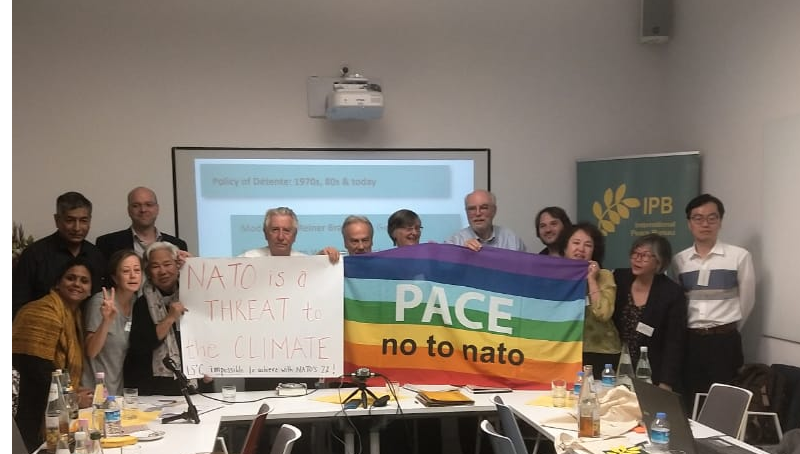
Statement – AEPF & IPB Conference, 23-24 September 2019, Berlin

Statement - AEPF & IPB Conference, 23-24 September 2019, Berlin

We in the Europe Asia peace movements, resolutely recommend a commitment to the idea of a Common Security. Earlier developed by the Palme Commission (1982), we are re-imagining and proposing Common Security as a peace and justice instrument as part of a people’s agenda accepted by all 57 OSCE countries with the Charter of Paris (November 1990) which brought the cold war to an end.

We are living at the edge of unprecedented and multiple crises reflected in: international economic and social production processes; fragmentation of social cohesion, rise, and election of nationalist authoritarianism, an attack on multilateralism and disregard of international law, and almost irreversible climate catastrophe, and destruction of ecology. The presence of more than four million people across the world who protested on 22nd September, shows that people, especially the young want dramatic policy changes without which a climate extinction is a reality. It is clear that the climate cannot be saved in a system undergirded by unrestrained militarization, continued nuclear weaponisation, and unrestricted consumerism, neoliberal competition and economic growth in the industrialised countries.

Hegemonic politics and aggression by the US led forces and unilateral sanctions add to the spiral of violent retribution.

We activists of the international peace movements recommend:

A new security architecture where Eurasia is an appropriate geopolitical zone to move from a politics of confrontation and sanctions to a politics of cooperation, dialogue and peace. The Charter of Paris from November 1990 should be accepted as the basis for a policy of cooperation and dialog. The existing instrument for a policy of cooperation in Eurasia is the OSCE. It must be strengthened and further developed.

That the nuclear powers cease the upgrading of their nuclear arsenals, move to fulfill their obligations under the nuclear non proliferation treaty and the International Court of Justice’s advisory opinion on the Use and Threat of Use of Nuclear Weapons and pursue detente based on the six primary principles of the Palme Commission. The Treaty of the Prohibition of Nuclear (TPNW) must be signed and ratified by all countries.

That a climate and environment saving fund should come from international cuts in defence and military expenditure. Reductions in military spending with the savings redirected to addressing urgent human needs and investment in infrastructures that contribute to sustainability.

We urge that all states implement Security Council Resolution 1325, and equally include women and young people in conflict resolution and all policy-making bodies.

A commitment to anti-racism is a way to ensure national and international cohesion.

The Berlin Wall and its end thirty years ago show that the new trend of building walls is unsustainable, unworkable, undemocratic and will be resisted by popular movements.

A return to multilateralism and strengthened international laws that can assist in ending all armed conflicts, and ending state and non state led violence.

We oppose military alliances since these increase threat perceptions and lead to increased all-round militarisation. Thus an inclusive Common Security, related to all human security would better provide security with justice for all peoples at this time of climate emergency. This has been articulated in SDG 17 and in the principles of the OECE.

Download the Full Statement

Read More

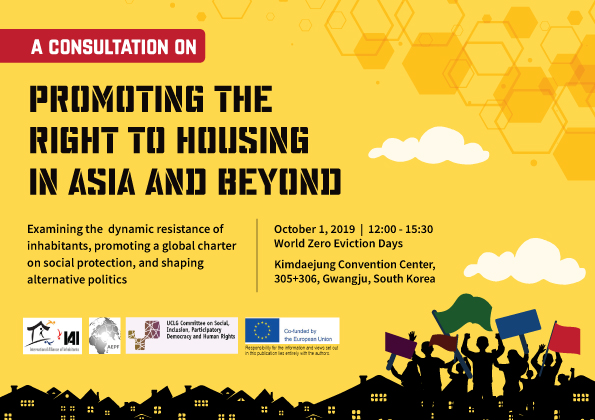
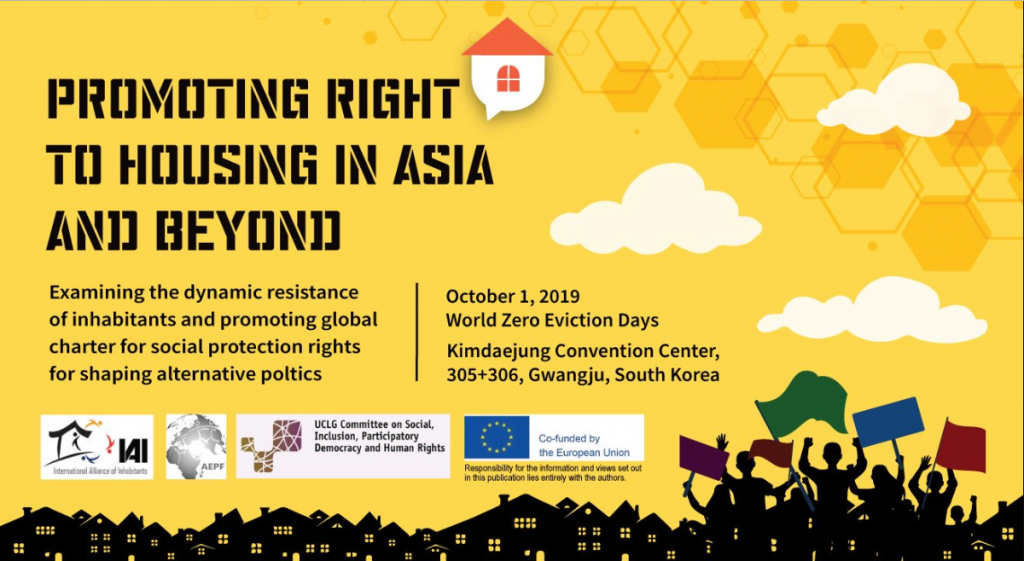
Promoting the Right to Adequate Housing in Asia and beyond – Gwangju, Oct 2019

Promoting the Right to Adequate Housing in Asia and beyond - Gwangju, Oct 2019

Overview

Session name: “Promoting the Right to Adequate Housing in Asia and beyond”

Theme: Exploring ways by which local governments – in cooperation with other
stakeholders and following innovative methodologies – can promote the right to
adequate housing and the human rights based-approach (HRBA) in habitat policies. The
session will focus on the Asian context, and propose tools such as the “Cities for
Adequate Housing” Declaration as concrete roadmaps for local governments to advance
the right to housing. It will welcome inputs from civil society organizations.

Preferred Date: October 1st, 12:00 am to 15:30 pm

Time: 3 hours

Organizers: UCLG Committee on Social Inclusion, Participatory Democracy and
Human Rights, the Asia Europe People’s Forum and the International Alliance of
Inhabitants.

Download Full Programme

Read More

Workshop On Challenges Of A Common Security Policy In Eurasia

Workshop On Challenges Of A Common Security Policy In Eurasia

Download the Full Programme Brochure 

Introduction & Context

The “Peace and Security” Circle of the Asia- Europe People Forum (AEPF) is a critical
part of the Forum that collectively understands, analyses, interprets and formulates
alternative responses and actions on issues of peace, security, conflicts, threats and
opportunities in Asia and Europe as envisioned by the people’s movements of this region.

Since 2016, the world has experienced major events which are likely to greatly affect the
world’s order as well as peace and security. These events include: Brexit; Trump
becoming the US President; the rise of aggressive xenophobic leaderships in many
countries that advocate and overlook violence in order to endorse their agendas; wars,
conflicts and tension in regions as diverse as Ukraine, Libya, Syria, Palestine, the Korean
Peninsula, South China Sea/West Philippine Sea/East Sea; the non-Resolution of many
low intensity and frozen conflicts and the potential rise of ethnic and identity conflicts; etc.
Besides, increasing military spending, foreign military bases, terrorism, internal conflicts,
territorial disputes, militarization and the nuclear arms race, neo-racism, refugee crisis,
oppression of minorities and xenophobic nationalism have been threatening people’s
lives and peace and security.

A policy of confrontation, especially between NATO and Russia has increasingly
prevailed in Europe. The nuclear weapons of all nations are being modernized.

On the other hand we can also observe positive steps towards peace, such as the
incidents on the Korean Peninsula both between the US and North Korea as well as
between both Korean nations.

But we should not forget: the continuous force and spread of the terror group calling itself
the Islamic State (IS) and other terrorist movements have used violence as a way of
threatening the world’s security.

In such a context, the Peace and Security Circle of the AEPF plans to coordinate with
peace movements and people’s organizations; research and scholars in academic
communities and institutions in Asia and Europe to organize various activities/ campaigns
to create effective synergies in the struggle for peace and to find the better way to
respond. The emergence of social movements that seek to find alternative solutions to
recurring as well as new problems should be encouraged.

Currently, Southeast Asia faces continued difficulties in peace and human security in the
effort of the world’s super powers to maintain economic and political hegemony
over our countries

Challenges: Reimagining a Common Security

New alternatives for a common security policy and –architecture in Europe and Asia are
urgently needed. Those alternatives should take into account the positive experiences of
the policy of détente from the 1970s and 80s. A Common Security Policy (also known as
Collective Security Policy) should serve as the basis of this new security architecture.

The term originates from the title of the Palme-report “Common Security: A Blueprint for
Survival“, which was the conclusion of the Independent Commission on Disarmament
and Security Issues (“Palme Commission”, 1980-1982) presided by Sweden’s Prime
Minister Olof Palme.

The key message of the study reads: “In the present time security cannot be achieved
one-sided. We live in a world, which economic, political, cultural and in particular military
structures are increasingly dependent of each other. The public safety of a nation cannot
be bought at the expense of other nations.”

This security philosophy developed by Willi Brandt, Bruno Kreisky, Olaf Palme and others
US based upon the principle: the security of a state can only be guaranteed if the security
of the other (the opponent) is guaranteed as well. The key principles that define this term
of common security are “interdependence”, “joint responsibility” and “security for” instead
of “security against.”

Objectives

  • To analyze the current situation in the two continents and its impact on peace and
    security, as well as people’s lives.
  • To analyze the current security situation in Asia and Europe and draw conclusions for
    a new security architecture.
  • To develop items of a security architecture based upon the concept of a Common
    Security Policy.
  • To address inhibiting as well as stimulating factors of the concept.
    To name actors and implementation strategies for a Eurasian Common Security
    concept.

Programme – First Day – September 23rd

Core Components of a New Security Architecture

10:00 – 14:00: Introductory Speeches

Opening and Moderation by Lisa Clark (IPB, Italy) and Dong Huy Cuong (Peace
and Development Foundation/AEPF, Vietnam)

Formal welcome: Introduction of AEPF, IPB, and the thematic cluster of Peace &
Security; Background and Rationale of this workshop on Common Security

1) What are the basic elements of a Common Security Policy?
by Joseph Gerson (IPB, Campaign for Peace, Disarmament & Common Security, USA);
Ingar Solty (Speaker Peace & Security Policy, Rosa-Luxemburg Stiftung, Germany);
Anuradha Chenoy (Jawaharlal University, India)

2) How is the current security situation in Europe?
by Claudia Haydt (Board of the European Left, Germany) and Jordi Calvo (GCOMS,
Spain)

3) How is the current Security Situation in Asia?
by Walden Bello (Focus on the Global South and Senior research fellow for Southeast
Asian Studies of Kyoto University, Japan)

4) What are the current mechanisms to deal with peace and security?
by Mark Christopher Batac (Global Partnership for the prevention of Armed Conflict)

14:00 – 15:00: Lunch break

15:00 – 18:00: Is the Common Security Policy a realistic/useful basis for the security
architecture in Eurasia?

Commentaries from different continents:

Europe: Claudia Haydt, Erhard Crome (WeltTrends Institute for International Politics,
Germany), Tom Unterrainer (Russell Peace Foundation & CND, Great Britain) Jenny
Cegg (CND Great Britain) Jordi Calvo (Justicia i Pau, Spain)

Asia: Moon Ah-Young (Peace Educ. Policy, Peace MOMO, Korea); Suvrat Raju
(Campaign for Nuclear Disarmament & Peace, India); Yayoi Tsuchida (Japan Council
Against Atomic & Hydrogen Bombs, Japan); Rabindra Adhikari (Nepal Peace & Security
Council, Nepal); Ke Jung (Indigenous Peoples Partnership, Myanmar)

Central-Asia: Eldor Aripov (Director of the Institute for Strategic and Interregional Studies
under the President, Uzbekistan) Marc Batac (Global Campaign for the Prevention of
Armed Conflict and IID, Philippines) Salman Akran Raja (Pakistan Peoples’ Party, and
Pakistan India Forum for Peace and Democracy, Pakistan) Kamal Chenoy (India)

Anastasia Lavrina (International Eurasia Press Fund, Azerbaijan), (TBC, Kazakhstan)
USA: Joseph Gerson

18:00 – 18:30: Break

18:30 – 20:00: Discussion

Policy of Détente: 1970s, 80s & today

Moderation: Amela Skiljan (IPB, Germany)
Discussion with Wolfgang Gehrcke (Former MP die Linke, Germany)

20:00 onwards
Dinner on a boat & evening programme

Programme – Second Day – September, 24th

How do we achieve a Eurasian Common Security Policy?

Facilitator: Theresa Kresse (IPB, Germany)

10:00 – 12:00: Introduction – What could be the core components of a common security policy
for Eurasia?

Asian perspective: Lee Junkyu (Center for Peace Research, Korea); Au Loong (Borderless
HK, China) & Suzuyo Takazato (All Okinawa Coalition to Prevent Construction of a New Base
in Henoko, Japan)

European perspective: Reiner Braun (IPB, Germany)

US perspective: Joseph Gerson

12:00 – 13:00: Break

13:00 – 14:45 Continuation of commentaries from different countries

14:45 – 15:35 Working Group Session – Question/issues to be discussed in 3 separate groups:

1. What could be the core components of a Common Security Policy for Eurasia?
2. How does the process toward achieving a Common Security Policy look like?
3. What is the role and responsibility of big and small countries?
4. Implementation and reaching of agreements
5. Developing Conflict Solutions – Case Studies (Conflict India/Pakistan and China/Vietnam)
Report back of working group sessions (one facilitator and moderator per group)

16:00 – 18:00: Panel Discussion

How does the process towards achieving a Common Security Policy look like?
Next
steps and controversies

Europe: Kathrin Vogler (MP die Linke, Germany), Joseph Gerson, Michael Müller (Former
state secretary of the ministry of environment, SPD, Germany), Jenny Clegg (CND, UK) &
Roland Kulke (Transform! Europe, Belgium)

Asia: Anuradha Chenoy, Au Loong & Cristine Ebro (AEPF, Philippines)

Implementation and reaching of agreements

Corazon Fabrios (AEPF, IPB, Philippines), Reiner Braun & Dong Huy Coung

18:00 onwards: Dinner and evening program

Download the Full Programme Brochure 

Read More