Building a New Narrative Migrant and Refugee Peoples Convergence of Voices and Journeys
This publication, Building a New Narrative, Migrant and Refugee Peoples: Convergence of Voices and Journeys, brings together diverse and distinct elements in the construction of a new Narrative on Migrant and Refugee Peoples. It is the narrative that is being written in the lives and work of migrants and refugees and in their strategies and protagonisms for transformative system change which they are participating in together with social movements and other social and political actors.
It marks a moment of convergence at the Asia Europe Peoples Forum (AEPF 13), in May 2021 – a Round Table that brought together activists, leaders and analysts drawn from migrant and refugee organisations, as well as from social movements, trade unions and from civil society and solidarity organisations. It focuses the perspectives shared there as part of a process of ongoing struggles and engagements and does not aim to be a comprehensive overview.
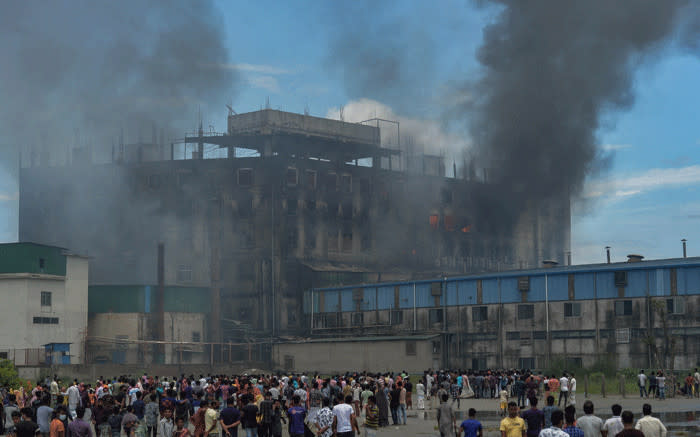
A food and beverage factory in Bangladesh was engulfed in fire killing at least 52 workers and injuring more than fifty others. The workers were trapped inside the building since the only exit had been locked. This illegal practice to force workers to remain inside the factory has led to this terrible tragedy. This once again reveals the extremely callous standards of safety that come to public notice only when a tragedy of such magnitude occurs.
The number of actual deaths are yet to be ascertained as many more workers are feared to be trapped in the fifth and the sixth floor of the building which continued to burn even after 24 hours of the incident.
The factory is owned by Sajeeb Group, a Bangladesh company producing juice under Pakistan’s Lahore-based Shezan International for exports to Australia, the US, Malaysia, Singapore, India, Bhutan, Nepal and to the Middle East and Africa. The AEPF condemns this massacre and culpable homicide, and stands in solidarity with the working people of Bangladesh.
Bangladesh has a dismal record of industrial safety and has many previous incidents including factories catching fire with workers locked inside. According to Bangladesh labour laws no factory can lock its exit during working hours and when the production is on. However, the laws are routinely flouted resulting in workers getting charred inside as it happened nine years ago at Tazreen Fashions garment factory killing at least 112 workers.
It is also no coincidence that most of these accidents are happening at export oriented units which employ workers at a pittance and flout safety measures at will. The factory owners also resort to beatings and other threats and intimidation to coerce workers and to stop them from unionising. Even though Section 195 of the Bangladesh Labour Act (2006, amended 2013) prohibits such practices, their implementation remains very weak. Additionally, women workers are super-exploited and often abused.
After the Tazreen Fashions fire and Rana Plaza collapse, international bodies including the ILO emphasised the necessity for enhancing safety and working conditions in the garment and other industries but these calls went largely unheeded. In its 2017 report the ILO has acknowledged that the country’s regulatory framework and inspections “had not been able to keep pace with the development of the industry”. Similar concerns about the workers safety and security were also raised by a number of monitoring agencies and labour rights campaigners.
The AEPF denounces this wilful neglect of workers’ lives and condemns the factory owners, the international buyers and the authorities for such repeated disasters. We also demand the:
Immediate establishment of a high level committee by the concerned authorities to investigate this incident, identify the responsible entities and recommend strong steps to prevent any more incidents of this nature. The committee must include workers’ representatives and safety experts.
The concerned authorities must initiate criminal prosecution against all those who are culpable – directly or indirectly, and they must be sentenced to rigorous imprisonment.
The government must ensure a fair, just and timely compensation for the families of the killed and, no doubt, permanently disabled by the corporate negligence.
Immediate enforcement of safety measures and proper working conditions.
Guaranteeing decent living wage and working conditions of workers.
Stop union busting and allow workers to organise and form their associations.
Big Pharmaceutical Monopoly & Impunity During the Covid19 Pandemic
Rachmi Hertanti Member of the International Organizing Committee of the Asia Europe Peoples’ Forum (AEPF) Executive Director of Indonesia for Global Justice (IGJ) (The article was presented at the Side Event 47th Session of the UN Human Rights Council: Big Pharma VS The People in the times of Covid19: Ways to safeguard the Right to Health)
Rachmi Hertani shows how Intellectual Property Rights of the WTO contribute to vaccine inequality during the Covid-19 Pandemic. Large numbers of countries and peoples in the global South are victims of this inequality and will remain unvaccinated till 2023.
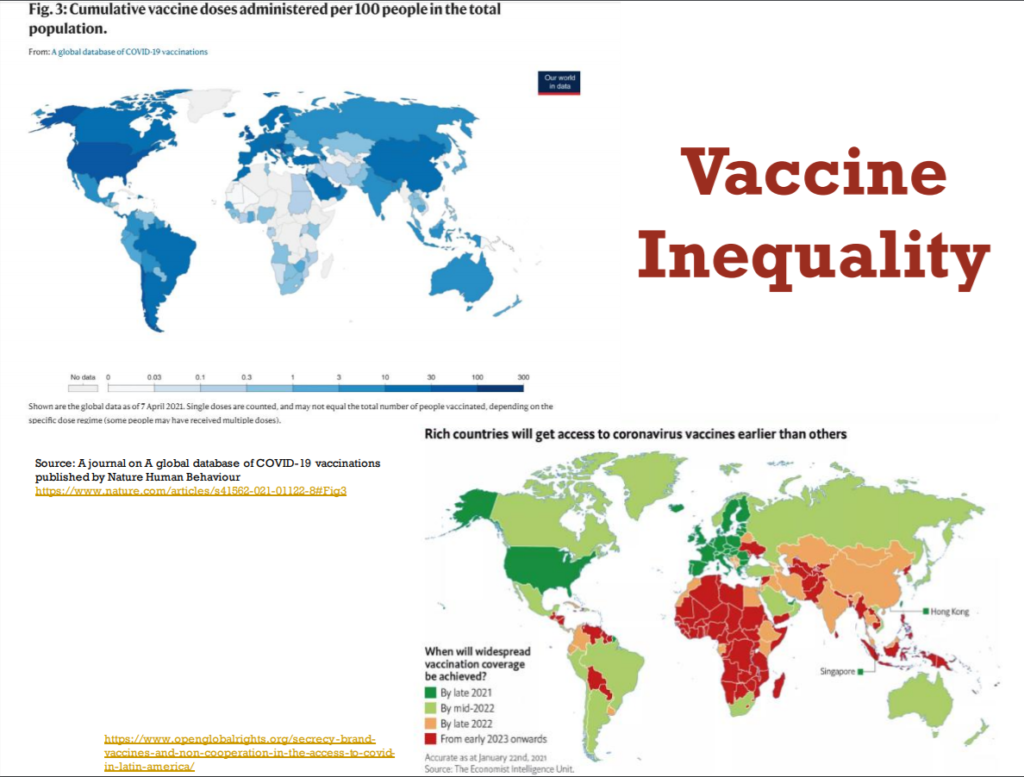
We are witnessing inequality in access to vaccines and medicines needed to combat Covid19 in the world. From this picture above, we can see that many regions especially in the Global South are far behind in the vaccination program.
Based on a global database of Covid19 vaccinations published in the Nature Journal on June 2021, it was mentioned: “There are large differences in vaccination rates between countries. The data reveal large differences in the scale of the vaccine rollout across countries. As of 7 April 2021, the cumulative number of doses administered per 100 people ranges from 118 per 100 in the case of Israel, to less than 0.1 doses per 100 in countries that have just begun their vaccination campaigns, such as Mali and Namibia.”
It can be seen that Africa is the region that lags behind most in vaccinating and is far behind until it reaches herd immunity. Furthermore, with the worsening of inequality, a lot of poor countries can be fully vaccinated only by 2023.
Indonesia is no exception, although it has secured 94 million doses of vaccines, yet this figure is only 20% of its total needs. Indonesia needs around 426 million doses of vaccines to cover 181 million people. We still need about 300 million more doses of vaccines. All these facts keep us away from the reality of the end of the pandemic, because “No one is safe until everyone is safe”.
Intellectual Property Controls
The cause of inequality in access to vaccines and medicines is due to limited production and supply of vaccines worldwide and this cannot be separated from the root of the problem, namely the control and monopoly of big pharmaceutical companies over Intellectual Property Rights (IPR).
Since the beginning of the pandemic, pharmaceutical companies have continued to adopt a ‘business-as -usual’ approach, either by maintaining tight controls over their intellectual property rights or by pursuing secret commercial deals and monopolies and excluding countries that are badly affected by COVID-19.
The monopoly of Intellectual Property has been impeding the production needed to ensure fair global access to the vaccine and other health products. Defending the protection of the IPR monopoly also goes against the goal that COVID-19 medicines and vaccines be treated as global public goods.
In handling COVID-19, almost everything is related to IPR. Almost all health products, such as test kits, diagnostics, masks, medicines, vaccines and ventilators are protected under patents, trade secrets and industrial designs. This in turn opens up opportunities for the pharmaceutical industry to take advantage of a pandemic situation to extract profit as much as possible from the abuse of IPR protection and encourages monopolistic practices of knowledge, production, price, and supplies.
Profit Taking/Making Behavior
An article written by Brooke Baker1 (March 2021) mentioned how much Big pharmaceutical companies profit from the IP Monopoly that are supported by the governments in the north countries, while we know that they were funded by public money.
…we can realistically hazard a guesstimate that total R&D expenditures on the vaccine were $1 billion or less. And don’t forget, BioNTech got $445 million from Germany to speed up its vaccine development and for initial investments in expanded manufacturing capacity.
Compare these R&D expenditures with projected earnings.
Pfizer is already on record predicting $15 billion in earnings from the vaccine this year. BioNTech’s estimate is $11.5 billion. But these projections are based on 1.4 billion doses only. The partnership is planning to increase production up to 2.5 billion doses by end of the year. Selling those additional .9 billion doses at $19.50, the U.S. price, would yield another $17.55 billion in revenue (note: Pfizer had already predicted another possible $15 billion in sales).
In fact, the big pharmaceutical companies showed little interest in the race for vaccines. This is due to past experience, making vaccines, especially in acute health emergencies, has not been shown to be beneficial or rather profitable. Only when governments and international agencies step in with funding agreements, that is when they like to work on it. Governments and multilateral organizations have agreed to buy billions of doses at fixed prices. Pharmaceutical companies selling to wealthy countries will certainly be able to start seeing returns on their investments2.
Big pharma like Pfizer and BioNTech claimed that they have not made enough money to justify their vaccine R&D investments, but looking at the numbers on their balance sheets reveal that their claims of loss are ridiculous. We can see from comparisons that Pfizer and BioNTech earned hundred times more than the R&D cost.
Furthermore, the vaccine developed by AstraZeneca and the University of Oxford brought in $275 million in sales from about 68 million doses delivered in the first three months of this year, most of which came from sales in Europe. Even though AstraZeneca has pledged not to profit on its vaccine during the pandemic. They have been selling the shot to governments for several dollars per dose, less expensive than the other leading vaccines3. That is why these companies need to keep a control and monopoly on IPRs, so they get more profit even from the poor countries.
How they Control?
The race to secure vaccines has encouraged more bilateral deal practices. The bilateral agreements between companies and the states have been done under the trade secret protections clauses. These clauses ensure the enclosure of all information required by the public, such as prices given, the quantity of supplies, including delivery schedules.
For example, price differences are impacted from bilateral deals. The impact of a bilateral agreement between richer governments and producers of Covid19 vaccine (read: vaccine nationalism) has raised concerns over rising prices and lack of supply for low- and middle-income countries. This is where the big pharmaceutical companies have a chance to take advantage of the price game. We have heard about the issue of South Africa where Last January 2021, The Guardian reported on the issue of inequality regarding vaccine prices experienced by South Africa. In its article, it was stated that South Africa paid 2.5 times more than the European Union for the vaccine. South Africa has ordered 1.5 million doses of vaccines from the Serum Institute of India (SII) with a price per dose of around 4.32 Euros, which is compared to the price per dose obtained by the European Union which is only around 1.78 Euros4.
The control of pharmaceutical companies over vaccine production cannot be separated from licensing practices that are often implemented in the midst of a pandemic. According to Medicines Sans Frontiers (MSF), companies holding IPR protection can apply for licensing terms to other licensed producers, such as limiting supply to a limited geographic range and other conditions that limit the benefits of global competition and supply. This licensing practice is definitely implemented with an agreement that is highly confidential in nature. This is why vaccine production cannot be carried out on a massive scale and only limited to certain manufactures that require special permission from IP owners.
Even more, the bilateral deal has potentially become a tool for big pharmaceutical companies to threaten the poor and developing countries. They are afraid that in the future there will involve legal cases from the states for the adverse effects of the vaccine. Pfizer made controversial demand where governments put up sovereign assets guaranteeing and indemnity against the cost of any future legal cases. These two articles gave examples from Latin America and South Africa, where Pfizer tried to put irresponsible requests in the midst of a pandemic crisis5. This should be considered as an unethical practice.
Our demand:
Therefore, to end corporate monopoly and impunity, we need to push more demands:
First, NO IP Monopoly on Covid19 Health products. TRIPS Waiver is being negotiated at the WTO and this is a pretty tough battle because the different positions between the rich countries and the sponsoring countries still haven’t been resolved. In fact, the next challenge after the TRIPS Waiver still has the potential to hinder efforts to open access to just COVID-19 vaccines and medicines due to control over technology and know-how.
Second, we need alternatives. We need to support developing countries that are currently developing vaccine candidates or medicines which can then be directed to south-south cooperation to realize global solidarity.
Third, the very important aspect to end corporate impunity is: How can we ask Big Pharmaceutical Companies for accountability that has prevented the states, especially in developing and underdeveloped countries, to implement their obligations fulfilling the right to health in their countries?. Therefore, it is really important to continue the negotiation on the legally binding treaty on transnational companies at the UN with constructive engagement from the states.
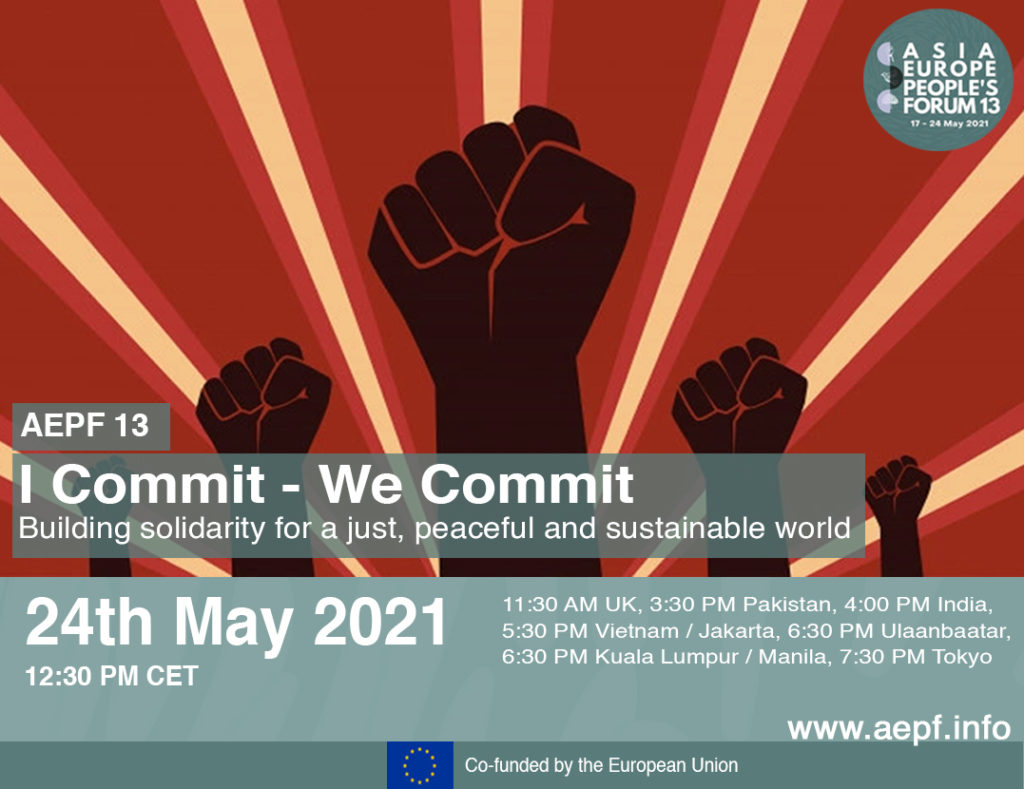
1. I Commit – We Commit – Sharing the summary context and then the 6 pre-filmed and complied People’s Pledges – People’s Voices of Commitments
2. Moderated opportunity for participants to share what they are committing to and to how. Responses and additions from AEPF13 participants
3. Ways forward – Campaigns and activities that we can join together on. Short, 2-3 minutes, presentations of the actual campaigns that people and organisations can be part of and how.
4. Collective affirmation
Watch this video where activists from different countries accross Asia and Europe express their commitments towards the People’s Agenda and commit to building solidarity and fight for a just, peaceful and sustainable world.
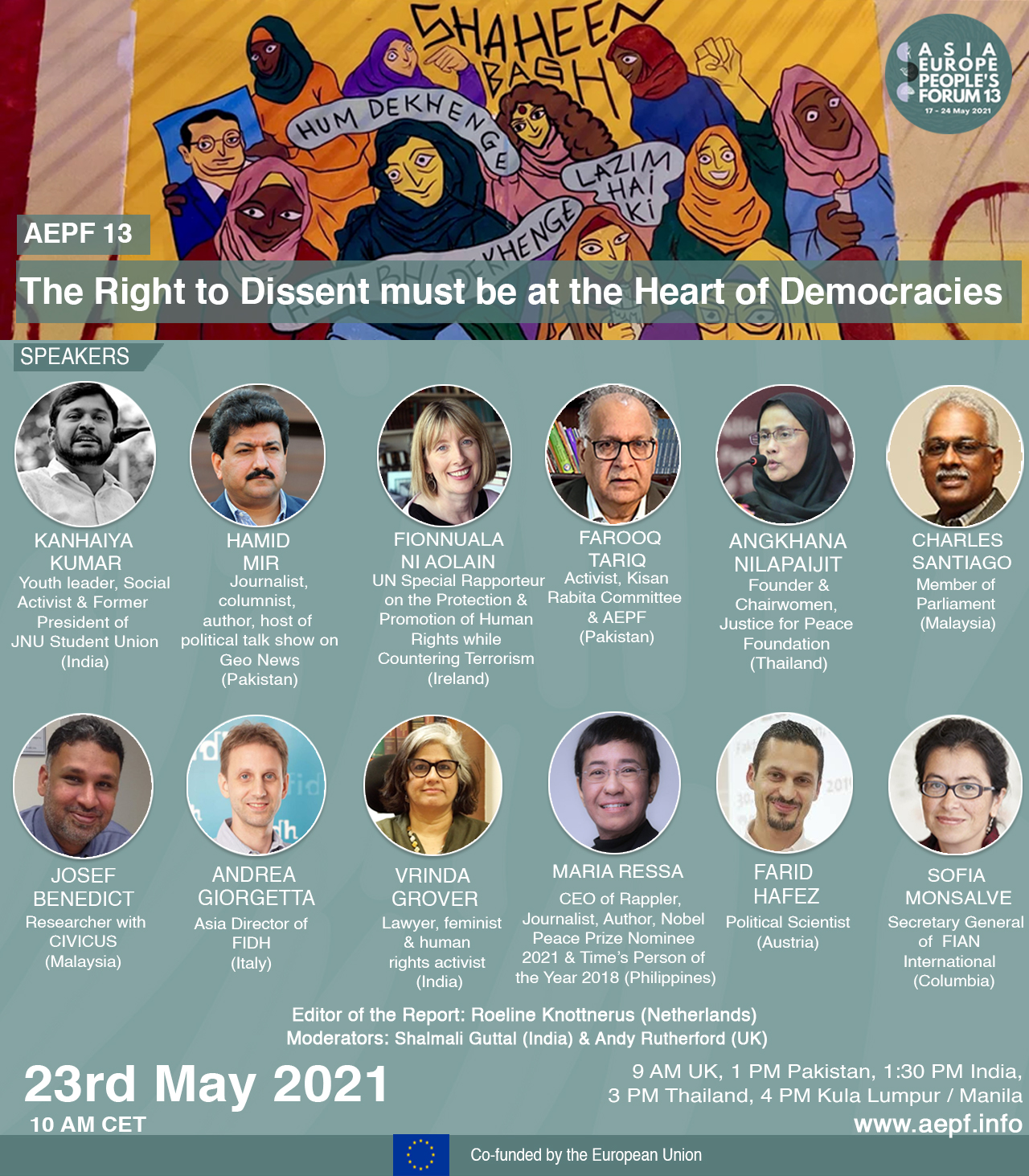
In this session, we launched a 10 country study that analysed trends on how, who and why dissent is being throttled in these countries. It gives examples of laws and methods being used to curb dissent and what mechanisms are employed and how they curb democratic voices. The publication has a theoretical framework and conclusion that show broad trends in these countries.
The aim of this plenary session was to launch a call for a global coalition that can plan and initiate a campaign to revitalise the universal rights to speech, expression, peaceful assembly and dissent. We wanted to raise awareness through advocacy amongst people about the inter linkages between rights, participatory democracy, social justice and human development.
We wanted to bring to the notice of the global community the voices that are being oppressed and cannot be heard in some specific countries; to bring international pressure on the systematic abuse by states of individual and collective liberties.
In this session we also wanted to form and interlink the community of jurists, activists, Rights Defenders and organizations for collective action against official and “extra-official” measures of oppression, silencing and persecution.
Lastly, we linked and advocated for the freedoms of expression and speech, and the right to information with deepening democracy.
Speakers:
Kanhaiya Kumar: Youth leader, Social Activist & Former President of JNU Student Union (India)
Hamid Mir: Journalist, columnist, author, host of political talk show on Geo News (Pakistan)
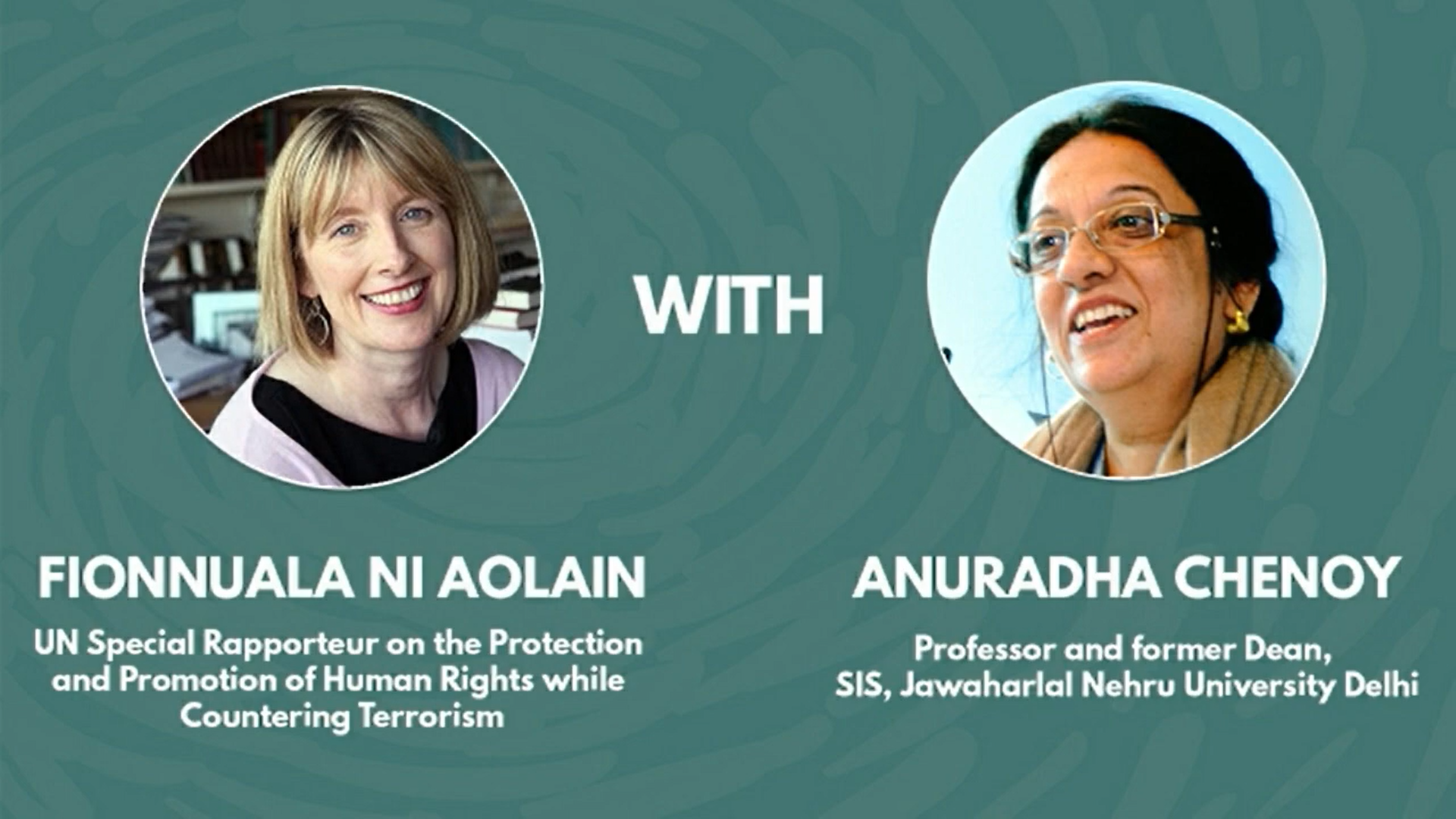
Fionnuala Ni Aolain: UN Special Rapporteur on the Protection & Promotion of Human Rights while Countering Terrorism (Ireland)
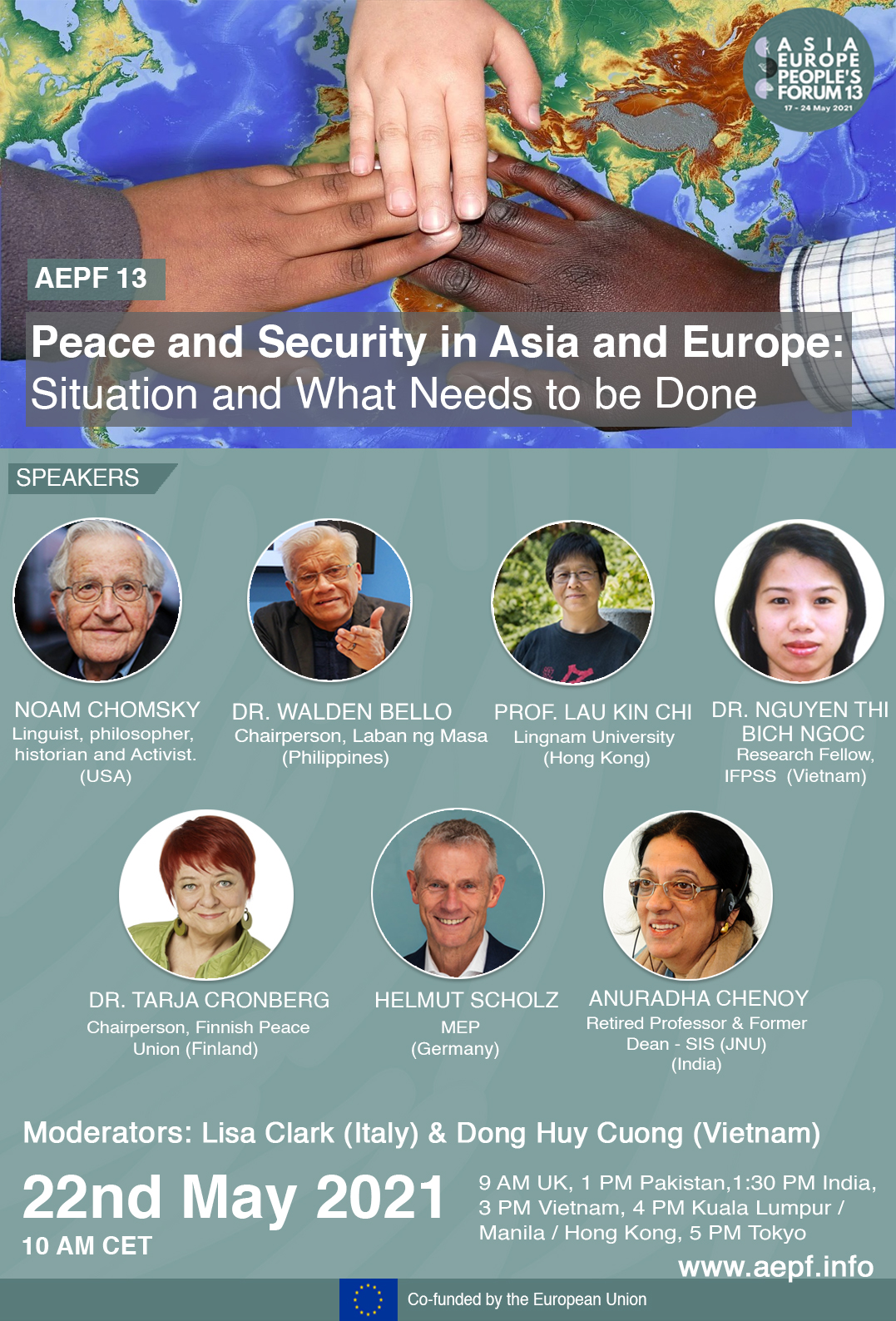
To analyze the different perspectives to the peace and security situation in Asia and Europe over the last two years.
To show how the international security situation is linked to national developments of major states as well as to human security issues, especially global health, economic insecurities and climate change.
To indicate the urgent steps needed to address these issues collectively.
Speakers:
Noam Chomsky: Linguist, philosopher, historian and Activist. (USA)
Dr. Walden Bello: Chairperson, Laban ng Masa (Philippines)
Prof. Lau Kin Chi: Lingnam University (Hong Kong)
Dr. Nguyen Thi Bich Ngoc: Research Fellow, IFPSS (Vietnam)
Dr. Tarja Cronberg: Chairperson, Finnish Peace Union (Finland)
Helmut Scholz: MEP (Germany)
Anuradha Chenoy: Retired Professor & Former Dean – SIS (JNU) (India)
Moderators: Lisa Clark (Italy) and Dong Huy Cuong (Vietnam)
Income Security: Options and Choices. Money, money, money… but that is not all
Watch the Webinar:
The objective was to present our working papers and the research at grassroot level concerning different options for giving people income security. From there, we engaged in a dialogue to see what lessons can be learned from the theoretical and practical examples.
Francine Mestrum showed how income security is necessary for social protection and she presents ways on how income security can be guaranteed for all people. Download the report
Speakers:
Isabel Ortiz: Director Global Social Justice Programme (Spain)
Nikhil Dey: Social activist on employment guarantee (India)
Maris dela Cruz: Network for Transformative Social Protection (Philippines)
Francine Mestrum: Social justice activist and researcher (Belgium)
Kate Lappin: Public Services International, Regional Secretary Asia & Pacific (Australia)
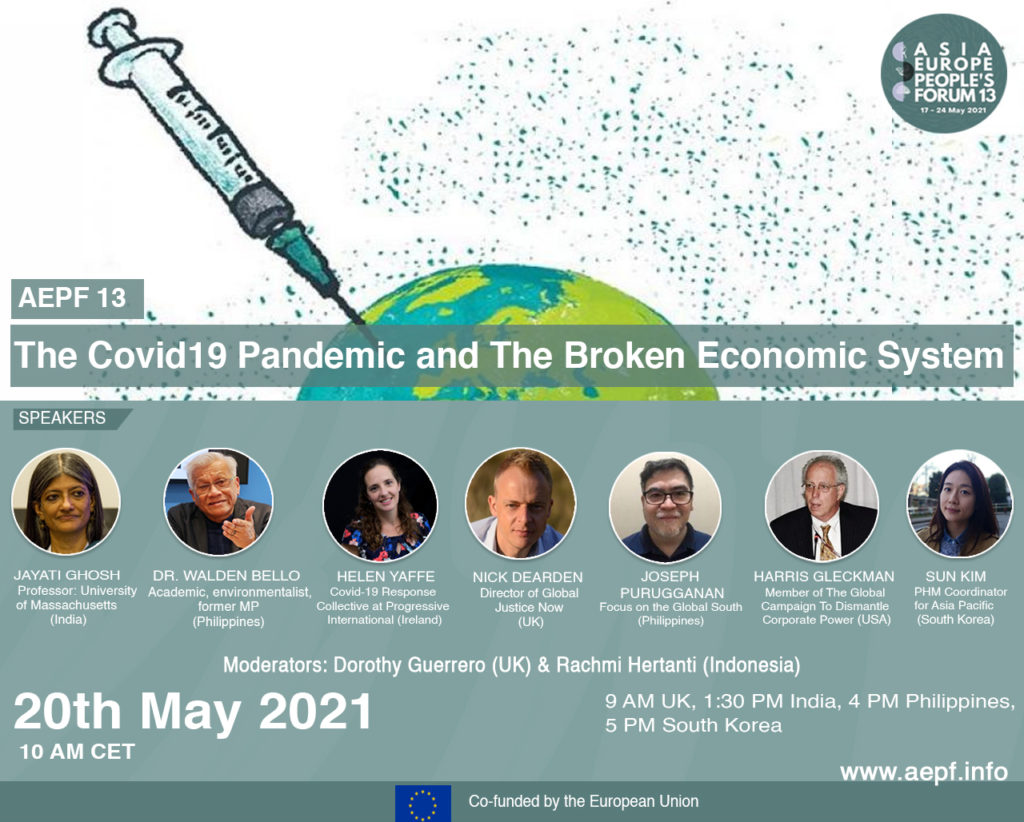
AEPF 13: The Covid19 Pandemic & The Broken Economic System
Watch the Webinar
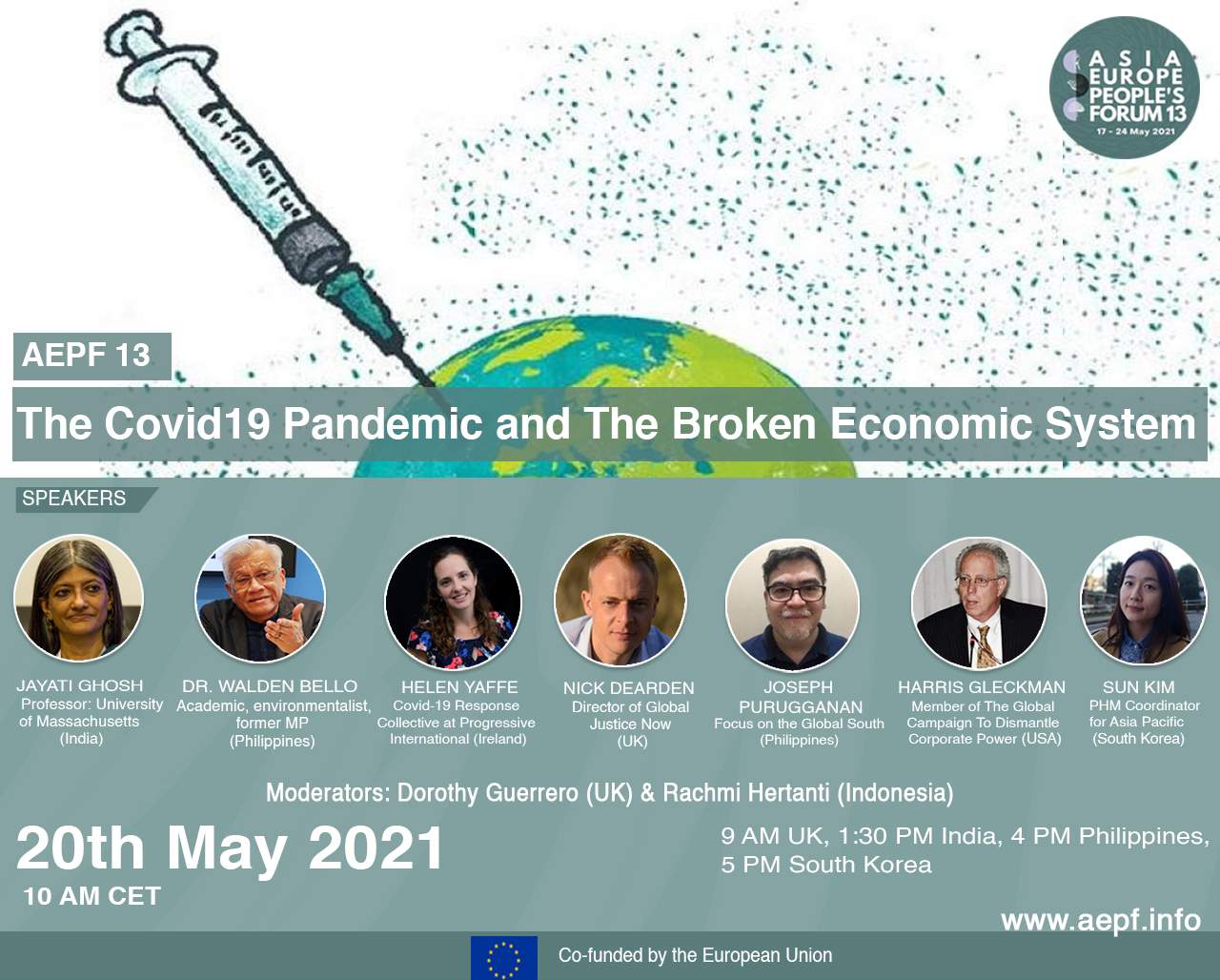
The current global coronavirus pandemic magnified many social and economic injustices in society. Global trade, finance and investment policies increased the power of transnational corporations, which in turn heightened their capture of governance. The pandemic pushed the economy into a crisis far deeper than previous ones. The loss of lives and livelihoods and massive unemployment while the virus is continuing its spread and even mutating are now driving countries, especially poorer ones to more debts and unjust economic partnerships with more powerful states. The poor are forced to choose between life and livelihood. This will further deepen the already unacceptable inequality between countries and within societies, which in turn heighten the climate crisis, and erode human rights. The global pandemic has indeed exposed more clearly the structural weaknesses of a broken economic system.
A new dimension that has emerged prior to the pandemic, the impact of which has been intensified in the context of the global health and economic crisis, is the unequal access and use of technology. From research, development, production and distribution of the vaccines and other medical supplies urgently needed to address the health crisis, to the ‘zoomification’ of societies or the shift to all things digital, technology is clearly a driving as well as disruptive force shaping the new world order.
The plenary discussion aimed to unpack these issues underlying the broken economic system, identify important arenas for public campaigning across both Europe and Asia, and surface key strategies to strengthen efforts to push progressive agenda towards the transformation of the economic system.
Speakers:
Jayati Ghosh: Professor: University of Massachusetts (India)
Dr. Walden Bello: Academic, environmentalist, former MP (Philippines)
Nick Dearden: Director of Global Justice Now (UK)
Sun Kim: PHM Coordinator for Asia Pacific (South Korea)
Helen Yaffe: Covid-19 Response Collective at Progressive International (Ireland)
Joseph Purugganan: Focus on the Global South (Philippines)
Harris Gleckman: Member of The Global Campaign To Dismantle Corporate Power (USA)