Laos: States should ask “Where is Sombath?” at upcoming review of human rights record

States should ask “Where is Sombath?” at upcoming review of human rights record

15 December 2024: On the 12-year anniversary of the unresolved enforced disappearance of Lao civil society leader Sombath Somphone, we, the undersigned civil society organizations and individuals worldwide, urge United Nations (UN) member states to express their concern over this continuing crime and to call for the prompt resolution of Sombath’s case at the upcoming review of the human rights record of Laos.
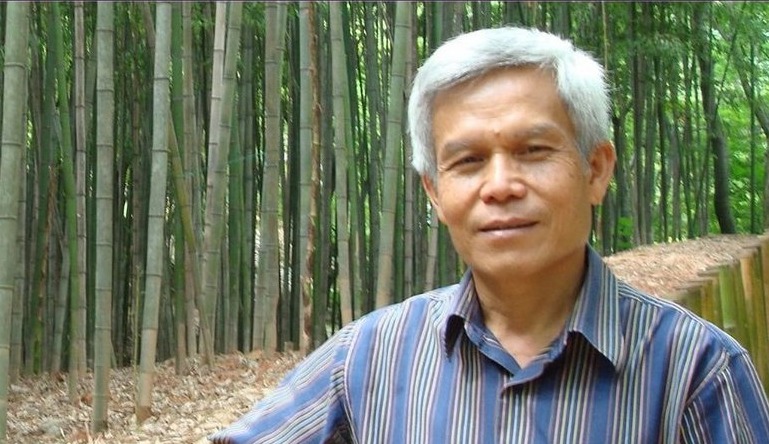
 

As UN member states prepare for the fourth Universal Periodic Review (UPR) of Laos, scheduled for April/May 2025 in Geneva, Switzerland, we call on them to reinforce civil society’s long-standing calls for truth and accountability regarding Sombath’s enforced disappearance.

During the second UPR of Laos in January 2015, Sombath Somphone was the subject of recommendations, expressions of concern, and advance questions by 16 UN member states.[1] During the third UPR of Laos in January 2020, seven UN member states formulated recommendations or advance questions on Sombath’s case.[2]

During both reviews, the Lao government claimed its investigation into Sombath’s enforced disappearance was ongoing. Such statements have been contradicted by the undisputable fact that, for 12 years, the Lao authorities have consistently failed to provide any concrete information on the steps they claim to have taken to effectively investigate Sombath’s disappearance. Instead, the government has engaged in a protracted campaign of misinformation, denials, slander, and cover-ups.[3]

At the upcoming UPR, UN member states should call on the Lao government to take throrough and effective measures to establish the fate or whereabouts of Sombath and all other victims of enforced disappearances in the country, identify the suspected perpetrators of such serious crimes, and provide victims with an effective remedy and full reparations. To date, no case of enforced disappearance in Laos has been resolved and no perpetrators have been identified or brought to justice.

UN member states should also recommend the Lao government promptly ratify, without reservations, the International Convention for the Protection of all Persons from Enforced Disappearance (ICPPED), which it signed in 2008, and fully implement it into national law, policies, and practices.

The Lao government’s failure to uphold its obligations under international human rights law and standards with respect to Sombath is reflective of the human rights violations constituting crimes under international law and related impunity that have plagued Laos for several decades. His enforced disappearance has also had a chilling effect on Lao civil society organizations and human rights defenders, and marked a significant escalation in the government’s silencing of independent voices.

Amid the serious constraints and repression faced by independent civil society organizations and human rights defenders in Laos, and the continued silence of donors, development agencies, and diplomats in the country, concerned international attention remains the primary hope for finding Sombath and delivering justice to him and his family.

We continue to stand in solidarity with Sombath and his family and urge UN member states to join us in asking the Lao government the same question we have been asking for the past 12 years: “Where is Sombath?”

Background

Sombath Somphone, a pioneer in community-based development and youth empowerment, was last seen at a police checkpoint on a busy street of Vientiane on the evening of 15 December 2012. Footage from a traffic CCTV camera showed that police stopped Sombath’s vehicle at the checkpoint and that, within minutes, unknown individuals forced him into another vehicle and drove him away in the presence of police officers. CCTV footage also showed an unknown individual arriving and driving Sombath’s vehicle away from the city center. In December 2015, Sombath’s family obtained new CCTV footage from the same area and made it public. The video shows Sombath’s car being driven back towards the city by an unknown individual.

For further information, please visit: https://www.sombath.org/

Organizations:

  1. Alternative ASEAN Network on Burma (ALTSEAN-Burma)
  2. Amnesty International
  3. Armanshahr|OPEN ASIA
  4. ARTICLE 19
  5. ASEAN Parliamentarians for Human Rights (APHR)
  6. Asia Democracy Network (ADN)
  7. Asia Human Rights and Labour Advocates (AHRLA)
  8. Asian Forum for Human Rights and Development (FORUM-ASIA)
  9. BALAOD Mindanaw
  10. Bangladesh Krishok Federation
  11. Bir Duino
  12. Bytes For All
  13. Cambodian Human Rights and Development Association (ADHOC)
  14. Cambodian League for the Promotion & Defense of Human Rights (LICADHO)
  15. Center for Prisoners’ Rights
  16. Centre for Civil and Political Rights
  17. Centre for Human Rights and Development (CHRD)
  18. China Labour Bulletin (CLB)
  19. CIVICUS: World Alliance for Citizen Participation
  20. Commission for the Disappeared and Victims of Violence (KontraS)
  21. Community Resource Centre (CRC)
  22. Covenants Watch
  23. Cross Cultural Foundation (CrCF)
  24. Defence of Human Rights (DHR)
  25. Equality Myanmar
  26. FIAN International
  27. FIDH – International Federation for Human Rights
  28. Focus on the Global South
  29. Fortify Rights
  30. Fresh Eyes
  31. Front Line Defenders
  32. Globe International
  33. Human Rights Alert
  34. Human Rights Commission of Pakistan (HRCP)
  35. Human Rights in China (HRIC)
  36. Human Rights Watch
  37. Indonesia Legal Aid Foundation
  38. Indonesian Legal Aid and Human Rights Association
  39. International Campaign for Tibet (ICT)
  40. International Commission of Jurists (ICJ)
  41. International Rivers
  42. Internet Law Reform Dialogue (iLaw)
  43. Justice for Peace Foundation
  44. Kazakhstan International Bureau for Human Rights and Rule of Law
  45. Lao Movement for Human Rights (LMHR)
  46. League for the Defence of Human Rights in Iran (LDDHI)
  47. London Mining Network
  48. Madaripur Legal Aid Association (MLAA)
  49. MADPET (Malaysians Against Death Penalty and Torture)
  50. Maldivian Democracy Network (MDN)
  51. Manushya Foundation
  52. National  Commission for Justice & Peace (NCJP)
  53. National Fisheries Solidarity Movement
  54. Odhikar
  55. Pakistan Fisherfolk Forum
  56. Peace Rights Foundation
  57. People’s Solidarity for Participatory Democracy (PSPD)
  58. People’s Watch
  59. Philippine Alliance of Human Rights Advocates (PAHRA)
  60. Psychological Responsiveness NGO
  61. Public Association “Dignity”
  62. Refugee and Migratory Movements Research Unit (RMMRU)
  63. Safety and Risk Mitigation Organization (SRMO)
  64. Stiftung Asienhaus
  65. Suara Rakyat Malaysia (SUARAM)
  66. Taiwan Association for Human Rights (TAHR)
  67. Task Force Detainees of the Philippines
  68. Thai Lawyers for Human Rights (TLHR)
  69. The Corner House
  70. Think Centre
  71. Transitional Justice Working Group (TJWG)
  72. Transnational Institute
  73. Union for Civil Liberty (UCL)
  74. Urgewald
  75. Vietnam Committee on Human Rights (VCHR)
  76. WH4C (Workers Hub For Change)
  77. Women’s Peace Network (WPN)
  78. World Organization against Torture (OMCT)

Individuals:

  1. Shui Meng and Sombath’s family, Vientiane
  2. Nico Bakker, Portugal
  3. Philip Hirsch, University of Sydney
  4. Rosanna Barbero
  5. Anne Sophie Gindroz
  6. Saeed Baloch
  7. Ame Trandem, The Hague, The Netherlands
  8. Nora Sausmikat, Germany
  9. Randall Arnst
  10. Larry Lohmann
  11. Sarah Sexton
  12. Nicholas Hildyard
  13. David JH Blake
  14. Angkhana Neelaphaijit

[1] Recommendations: Australia, Canada, Finland, Germany, Luxembourg, Poland, Portugal, Sweden, Switzerland, and United Kingdom; Expression of concern: Belgium, Netherlands, and Singapore. Advance questions: Slovenia, Spain, and United States.
[2] Recommendations: Australia, Canada, Germany, New Zealand, and United Kingdom. Advance questions: Belgium and United States.
[3] For example, see: BBC, Laos accused of lying over Sombath Somphone abduction, 28 August 2013; https://www.bbc.com/news/world-asia-23862691; Radio Free Asia, EU Parliament Dissatisfied with Lao Efforts to Locate Missing Activist, 28 October 2013, https://www.rfa.org/english/news/laos/eu-10282013191323.html; Human Rights Watch, Laos: End Cover-Up in Activist’s ‘Disappearance’, 14 June 2013, https://www.hrw.org/news/2013/06/14/laos-end-cover-activists-disappearance; APHR, Lao government’s deceptive game on Sombath investigation must end, 12 September, 2014, https://aseanmp.org/publications/post/lao-governments-deceptive-game-on-sombath-investigation-must-end/; FIDH, Government slanders Sombath Somphone, issues “blanket denials” on enforced disappearances during rights review, 18 July 2018, https://www.fidh.org/en/region/asia/laos/government-slanders-sombath-somphone-issues-blanket-denials-on; Human Rights Committee, Information received from the Lao People’s Democratic Republic on follow-up to the concluding observations on its initial report, 18 December 2023, https://shorturl.at/6ZOYe; Sombath.org, The investigation [last accessed on 29 November 2024], https://www.sombath.org/en/who-is-sombath/video/the-investigation/
Read More

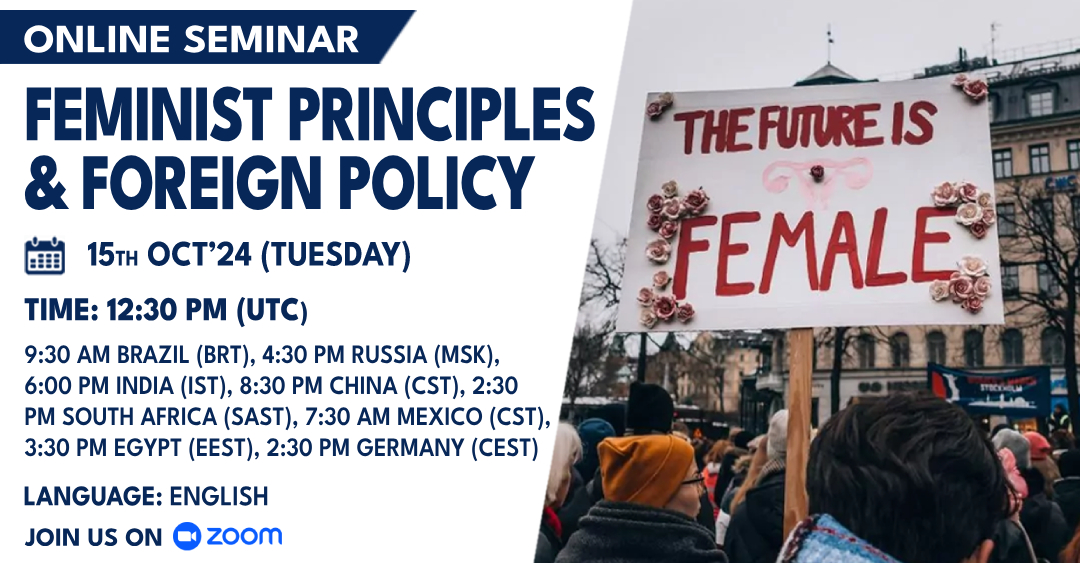
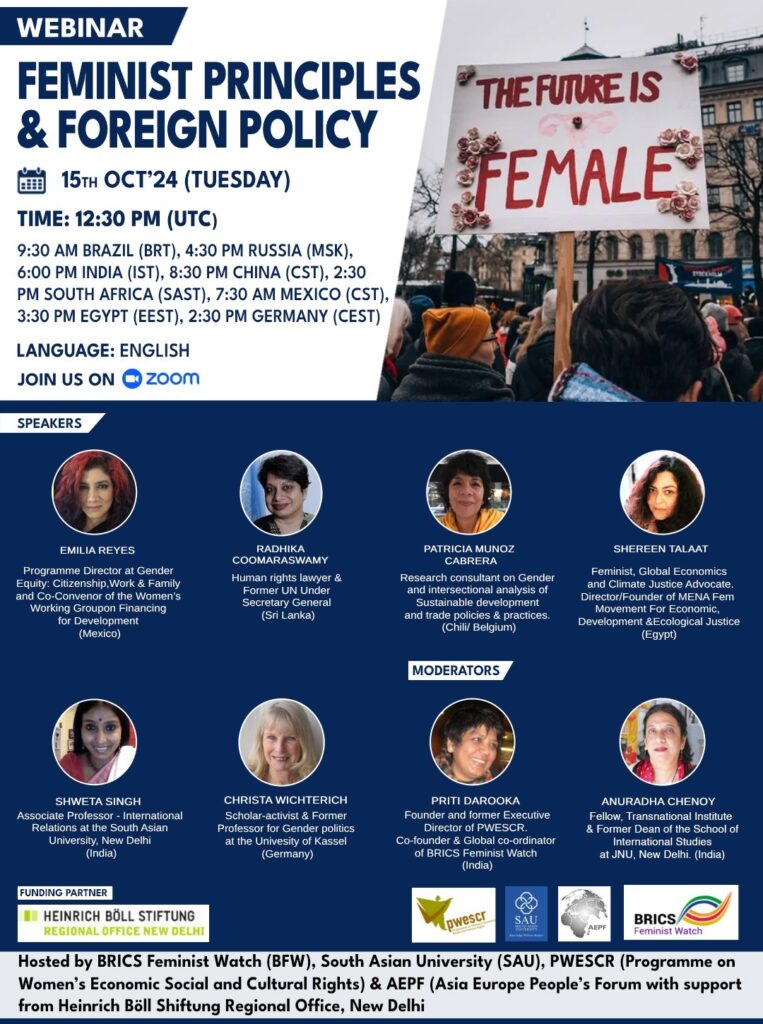
Webinar: Feminist Principles and Foreign Policy

Webinar: Feminist Principles and Foreign Policy

Feminists discuss how principles of feminism like representation, rights and peace can be part of the foreign policies of states.

Watch the Webinar


Speakers:
Radhika Coomaraswamy: Human rights lawyer & Former UN Under Secretary General (Sri Lanka)
Emilia Reyes: Programme Director – Policies and Budgets for Equality and Sustainable Development, at Gender Equity & Co-Convenor of the Women’s Working Group on Financing for Development (Mexico)
Shereen Talaat: Feminist/Global Economics and Climate Justice Advocate and Director/Founder of MENA Fem Movement For Economic, Development And Ecological Justice (Egypt)
– Patricia Munoz Cabrera: Research consultant on gender and intersectional analysis of sustainable development and trade policies & practices (Chili/ Belgium)
– Shweta Singh: Associate Professor of International Relations at the South Asian University (New Delhi, India)
– Christa Wichterich: Scholar-activist, & Former professor for gender politics at the University of Kassel (Germany)

Co-Moderators:

– Anuradha Chenoy: Adjunct Professor, Jindal Global University & Former Dean of the School of International Studies at JNU, New Delhi. (India)
– Priti Darooka: Founder and former Executive Director of PWESCR (Programme on Women’s Economic, Social, and Cultural Rights) & Co-founder and global coordinator of BRICS Feminist Watch (India)

Register Now


Read More

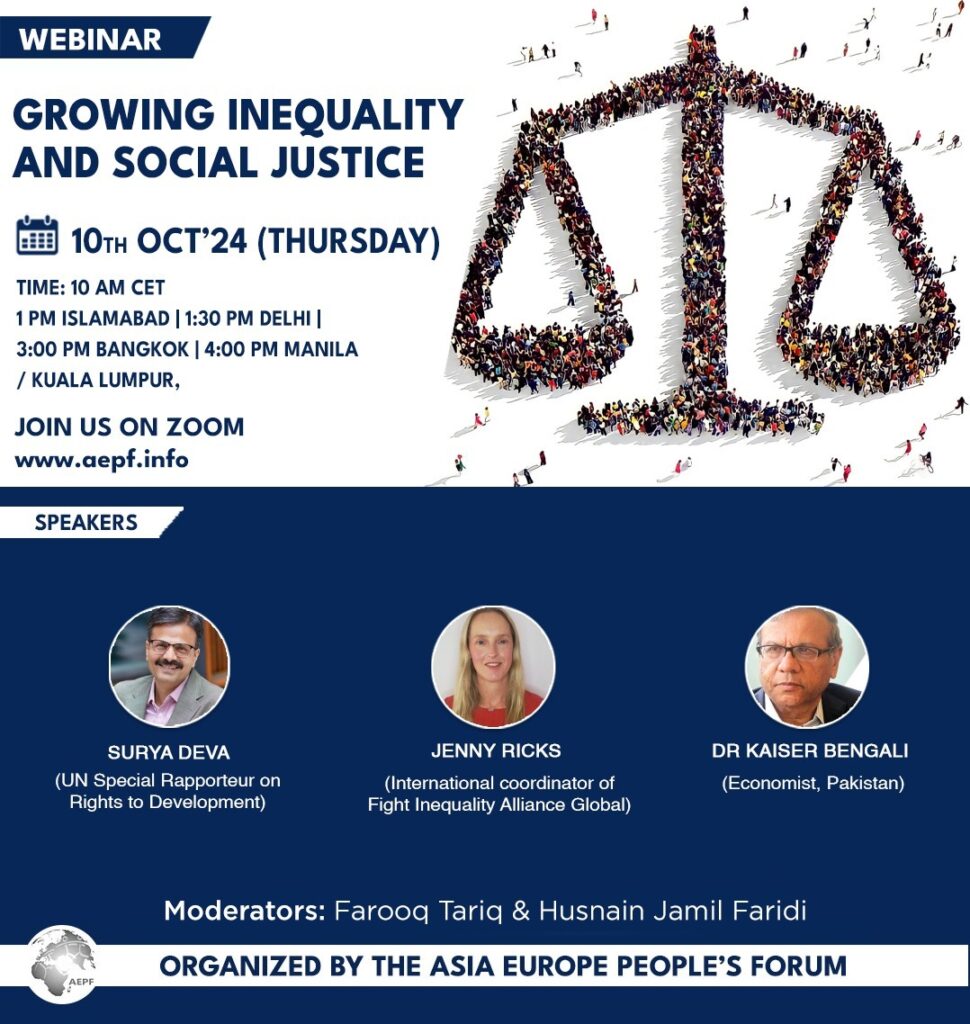
Webinar: Growing Inequality and Social Justice

Webinar: Growing Inequality and Social Justice

Globally inequality has reached extreme proportions. This is more so in the Developing Countries. There is dire need to protect the large vulnerable people with policies of social justice.

Experts in this webinar explains these issues.

Watch the Webinar 

Speakers:
1. Surya Deva (UN Special Rapporteur on Rights to Development)
2. Jenny Ricks (International coordinator of Fight Inequality Alliance Global)
3. Dr Kaiser Bengali (Economist, Pakistan)

Moderator: Farooq Tariq & Husnain Jamil Faridi

Read More

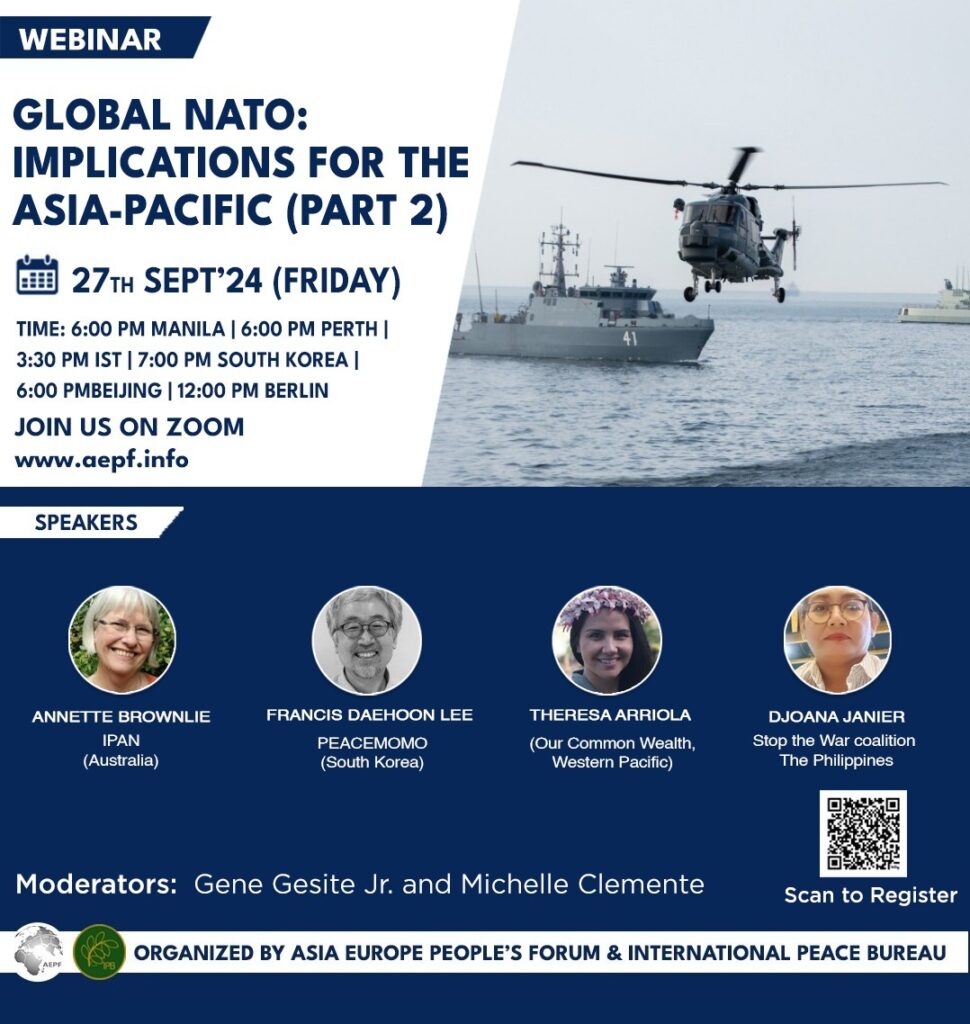
Global NATO: Implications for the Asia-Pacific (Part 2)

Global NATO: Implications for the Asia-Pacific (Part 2)

NATO has been extending its influence into the Asia-Pacific through political and military partnerships. NATO Secretary General Jens Stoltenberg highlighted that Japan, South Korea, Australia, and New Zealand share security threats that could affect Europe. Despite their recent involvement, these nations have historically had little connection to NATO’s traditional security agenda. This webinar aims to deepen the analysis of NATO’s presence in the region, explore the intersectionality of military security, geopolitics, peace, and environment, and provide insights into alternative approaches to security in the Asia-Pacific.

The webinar will be conducted online via Zoom for 1.5-2 hours.

Time: 6:00 pm Manila | 6:00 pm Perth | 3:30 pm IST | 7:00 pm South Korea | 6:00 pmBeijing | 12:00 pm Berlin
Organizers: ​​Asia Europe Peoples Forum (AEPF) and the International Peace Bureau (IPB)

Register Now


Read More

Webinar: Global NATO – Implications and Resistance

Webinar: Global NATO - Implications and Resistance

NATO is fast spreading into the Indo Pacific. What the the implications and challenges.
Join our experts discuss this in our webinar.

Watch the Webinar

Speakers:
Walden Bello ( The Philippines)
Joseph Gerson (USA)
Anu Chenoy (India)
Reiner Braun (Germany)
Moderators: Cora Corazon and Sean Conner


Read More

In a Volatile Time: Political Crisis and the Latice-Like Network of U.S. Indo-Pacific Alliances

In a Volatile Time: Political Crisis and the Latice-Like Network of U.S. Indo-Pacific Alliances

By Joseph Gerson*

These are increasingly dangerous times. Several years ago, Walden Bello wrote a book about counterrevolution. With Trump and Vance, two classical fascists, recent U.S. Supreme Court decisions, and the Heritage Foundation Project 2025, we are approaching the climax of an American counterrevolution. Walden has also recently reminded us of Antonio Gramsci’s insight about the time that we are living through: “The old world is dying, and the new world struggles to be born: now is the time of monsters.” Like Ulysses, we have to navigate the rapids between Scylla and Charybdis. 

It is not going to be pretty,  

Clearly Biden is no gift to the world. Recently a senior arms control diplomat who is close to Ron Klain, President Biden’s first Chief of Staff, said that only three people can convince Biden to step aside: Jill Biden, Nancy Pelosi, and Biden’s sister. There are reports that Pelosi will inform Biden that it’s time to go, but there are no guarantees that she will or that if she does he will step aside, or if he does step aside that the Democrats will be able to come up with a candidate who can beat Trump and his dishonest lackey Vance.

Little noticed here in the United States has been the immensely powerful and dangerous lattice-like network of U.S. military alliances assembled by the Biden Administration in the desperate, probably futile, and multi-faceted U.S campaign to contain China.  As the NATO Summit Declaration put it, the threat as seen from Washington is “global and interconnected.” With the passing of the post Cold-War’s unilateral era and the relative decline of U.S. power, Washington has become increasingly dependent on alliances, across the Indo-Pacific and in Europe to contain Chinese and Russian ambitions. Hence the increasing integration of NATO with the array of U.S. Indo-Pacific alliances, some of which date from World War II’s transformation of the Pacific Ocean into an American Lake and others of more recent vintage. 

Don’t expect this to change if, as seems likely, Trump regains the Oval Office. Over the last two and a half decades there has been remarkable continuity in U.S. Republican and Democratic administrations. The U.S. elite has understood, as Biden’s National Security Statement put it, that China “is the only competitor with both the intent to reshape the international order and, increasingly, the economic, diplomatic, military, and technological power to advance that objective.” Bush the Lesser planned to focus on China but was distracted by 9/11. Kurt Campbell and Obama gave us the Pivot to Asia. Trump doubled down on the Pivot. And despite the Ukraine and Gaza Wars, the People’s Liberation Army has been Biden’s military pacer, driving us toward what former Australian President Rudd terms “an avoidable war.”

A place to begin is President Biden’s statement that the outcome of Prime Minister Kishida’s recent state visit to Washington was “the most significant upgrade in our alliance since it was first established.”  Forget Japan’s Peace Constitution. The Japanese government has! Recall that the U.S.-Japan Mutual Security Treaty was secretly forced on Tokyo in 1952 as a requirement to end the United States’s post-war occupation of Japan. It didn’t end the occupation. Okinawa remained occupied until reversion in 1972, but even the U.S. Consul General in Naha said several years ago that the entire island remains a U.S. military base. And while US bases are concentrated in Okinawa, they extend across the Japanese archipelago, including a massive US air base in the nation’s capital.

The summit with Kishida was designed in part to Trump-proof the alliance. and it deepened military cooperation, including joint development of AI, space technology, and semiconductors. It was formally announced that Tokyo will be purchasing 400 Tomahawk  missiles as part of its now preemptive strike doctrine against China and North Korea. In something of a role reversal, Tokyo will now export of weapons to the US to replenish depleted US stocks that have run low because of the Ukraine War.   There will also be a “joint operations command,” possibly led by a four-star US general, and plans are afoot to create a NATO office in Tokyo.  Meanwhile, the SDF is building up its forces on Okinawan islands in preparation for a possible war for Taiwan.

This alliance expansion is a keystone of the lattice-like alliance network which is not centralized along the model of NATO.  The deepening of the U.S.-Japan alliance undergirds the tripartite U.S.-Japanese-South Korean alliance. Not incidentally, in July Washington and Seoul signed a nuclear guideline that provides for US deployment of U.S. nuclear assets in and near South Korea. The April Biden-Kishida-Marcos summit reiterated Washington’s “ironclad commitment” to the Philippines, while also resolving to increase interoperability between the three nations’ militaries as they contest China for dominance in the South China/West Philippine Sea. 

With Australia and Britain, we now have AUKUS. It  will provide new nuclear powered submarines to augment U.S. naval forces in the Pacific and Indian Oceans and fatten military-industrial complex coffers.  It also reinforces “Anglo-Saxon” Indo-Pacific neocolonialism. Not limited to the Five Eyes intelligence gathering network of the US the UK, Canada, Australia, and New Zealand, the “Anglo-Saxons” are increasingly engaged in joint and collaborative military maneuvers from US-Australia-New Zealand joint exercises to the dispatch of British warships to the Taiwan Strait. To reinforce this network, US, Japanese, Australian, and Philippine military chiefs met recently in Honolulu.

Despite the hype when it was first convened, the  QUAD, comprised of the U.S., Japan, India, and Australia, is not yet a formal alliance. It remains a forum to develop security and economic strategies in the face of  China’s rise. But keeping its options open, India, which has engaged in joint military exercises with the U.S. and Japan, uses QUAD as a hedge against the possibility of finding it necessary to confront China more directly in the future. 

There is also deepening integration of Japanese and other U.S. Indo-Pacific allied militaries with NATO. French, Dutch, British, and German warships have all participated in joint naval maneuvers. Japanese Prime Minister Kishida, South Korea’s President Yoon, New Zealand’s Prime Minister Luxon, and Australian Deputy Prime and Defense Minister Marles all joined last week’s NATO summit in Washington. France and Japan have begun talks for a reciprocal troops pact. Japan and Italy have declared their ‘strategic partnership.”  And Britain, Japan, and Italy have agreed to develop a next generation jet fighter. 

And, for another time, there is the other alliance, more accurately an entente, that confronts the lattice-like network: the deepening military integration of China, Russia, North Korea, and Belarus.

Finally, as we face the probability of another catastrophic Trump presidency, I thought it would be helpful to share what Robert O’Brien, Trump’s last national security advisor who is tipped to return to the White House, describes Trump’s past and future foreign and military policy commitments. O’Brien’s pledge to renew nuclear weapons testing garnered the headlines, but there was more:  Chillingly, he explained that Trump adheres “to his own instincts.”  And, despite doubts about Trump’s commitment to alliances, O’Brien reported that:

  • The Trump mantra is “America first is not America alone…” Trump never canceled or postponed a single deployment to NATO. His pressure on NATO governments to spend more on defense made the alliance stronger.”
  • Trump’s 2017 “ fire and fury” threat against North Korea brought us closer to nuclear war than is understood
  • “Xi is China’s most dangerous leader since the murderous Mao Zedong. “It is “pablum to believe that China is not truly an adversary.”
  • NATO and U.S. cooperation with Japan, Israel, and the Arab Gulf States were all militarily strengthened when Trump was president”  
  • U.S. “should focus its Pacific diplomacy on allies such as Australia, Japan, the Philippines, and South Korea…[and]traditional partners such as Singapore and emerging ones such as Indonesia and Vietnam”
  • The Navy should move an aircraft carrier from the Atlantic to the Pacific, move the “entire Marine Corps to the Pacific” [later clarified to be operational troops, not admin.] He advocates adding  more stealthy Virginia class submarines and Columbia-class ballistic missile submarines and all 100 planned B-21bombers.
  • “Test new nuclear weapons for reliability…and resume production of uranium 235 and plutonium 239”
  • Decouple the US economy from China with a 60% tariff on Chinese goods and tougher export controls on technology
  • In the Middle East “maximum pressure” on Iran, the  source of Palestine-Israel conflict 
  • Support lethal aid to Ukraine paid for by Europeans, while keeping the door open for diplomacy with Russia. while NATO rotates ground and air forces in Poland. 

Would that it were otherwise. We face an exceptionally dangerous and  demanding period as we are moved into what appears to be an era of Trump/MAGA fascism and desperate U.S. efforts to maintain its global dominance. More imaginative and committed organizing for democracy, peace, and climate sustainability are the order of the day. It is also clear that we will need to increase and deepen our international collaborations, among them the current work on a vision for Common Security diplomacy, if the worst is to be prevented.

*This article is based on a talk for the Asia-Europe People’s Forum, July 17, 2024

Read More

AEPF Webinar Series: Rise of Authoritarianism and Challenges by People – The Indian Elections

AEPF Webinar Series: Rise of Authoritarianism and Challenges by People - The Indian Elections

The Indian elections in June 2024 had unexpected results and India will now have a coalition government led by the BJP. What were the issues before the electorate, what do the results mean for Indian democracy?

Watch the Webinar

Speakers:

– Ms. Seema Mustafa (senior journalist and former president, Editor’s Guild of India)
– Nilanjan Mukhopadhyay ( senior journalist and author of many books including a biography of Modi)
– Prof. Zoya Hasan (Professor Emeritus, JNU, writer, political analyst)

Moderators: Anu Chenoy and Andy Rutherford


Read More

AEPF remembers Karamat Ali, a Tireless Advocate for Labour and Oppressed Communities

AEPF remembers Karamat Ali, a Tireless Advocate for Labour and Oppressed Communities

The Asia Europe People’s Forum is saddened by the passing on 20th June, of Karamat Ali executive director Pakistan Institute of Education and Research (PIlER). Karamat was a tireless advocate for the rights of labour, working classes, women and other oppressed communities.

This is a big loss for the labour movement of Pakistan and South Asia. Karamat was a dedicated working class leader, who was deeply immersed with all progressive causes—from the trade Union movement in Karachi, fishermen’s rights, social justice and democratic movements to peace in the subcontinent, and more. An imaginative and undogmatic Marxist, Karamat never shied away from challenging tasks and as a consequence faced many atrocities and prison terms. Karamat is an unsung hero of our times.

Karamat was an organic intellectual and committed democrat. He built PILER which attracted many renowned economists and academics because of his charisma and commitment to the cause of the Labour movement based on relevant research.
Karamat sought to change the economic system for the betterment of the poor. He worked for alternative ideas to build a peaceful and just society

Karamat Ali was from a working-class family, born in the city of Multan(Punjab), two years before the Partition (1945). His father worked as a department worker. Karamat himself worked in a factory and attended the Government Emerson College in Multan in 1962. At that time, a group of 12 activists of the National Students Federation (NSF), were expelled from Karachi by the then Ayub Khan military regime because of their political activities. Karamat mobilised students at this time. When Ayub Khan kicked out Zulfikar Ali Bhutto from the position of foreign minister, Karamat with his student comrades invited him to speak at a public forum with student activists.

Karamat Ali was a civil society institution builder. He was the founder of the People’s SAARC and South Asia Alliance for Poverty Eradication. He was founding member of the Pakistan Peace Coalition, Pakistan-India Peoples Forum for Peace and Democracy,
and South Asia Labour Forum. Karamat was a real South Asian who consistently advocated unity among South Asian nations, opposed militarisation and imperialism.

Karamat was a major organizer of the World Social Forum 2006 in Karachi. He invited hundreds of Indian activists to Pakistan to forge people to people contacts.

He was to attend and speak at the AEPF Ghent event but his health deteriorated and he could not come.

Karamat did his master in labour studies at the Institute of Social Studies at Den Haag. Karamat. Married an Indian academic Amrita Chachi. Karamat had son and two daughters.

With the passing away of Karamat Ali we have lost one of best trade union leaders of South Asia. AEPF mourns his loss and at the same time we celebrate his life and achievements.

Farooq Tariq
Asia coordinator
Asia Europe People’s Forum

Read More

Narendra Modi’s Election Setback Has Opened Up a New Horizon

Narendra Modi’s Election Setback Has Opened Up a New Horizon

By Sushovan Dhar

Narendra Modi has won a third successive term as India’s prime minister in a much closer general election than expected. The ruling coalition, the National Democratic Alliance (NDA), dominated by Modi’s Bharatiya Janata Party (BJP), won 293 of the 543 seats in the lower chamber of the Indian parliament, the Lok Sabha. the opposition INDIA alliance, led by the Congress, got 234 seats. 

Many pundits and a major portion of the media had believed that Modi’s unbridled march would result in an easy victory, but the results showed otherwise. Modi’s ambitious slogan “Ab ki baar, 400 paar” (this time, 400 plus) failed terribly, with the BJP losing its single-party majority and obtaining only 240 seats in the Lok Sabha, down from 303 in 2019. 

If there is one figure that reflects the personal aspect of Modi’s tumble, it is the reduced victory margin of 152,513 votes — down from 471,000 in 2019 — by which he won his own seat in Varanasi. It is not only the margin that has decreased. The prime minister received roughly 62,000 fewer votes this time, despite the fact that total votes in the constituency increased by about 70,000, with his vote share dropping from 63.6 percent to 54.2 percent. 

With the BJP not securing an absolute majority, Modi will have to rely on his alliance partners, which comes as a shock for someone accustomed to having unrestricted power and authority. Modi had to rely on regional parties such as Telugu Desam, Janata Dal (United), and others to save him. 

Not only will India’s political landscape change as a result of the election result, with Modi substantially weakened. He will also face a freshly rejuvenated opposition out to challenge his omnipresence in Indian politics and society.

The Double Crises

The elections were held against the backdrop of an unparalleled socioeconomic crisis, with high levels of inequality, unemployment, and inflation. According to data from the Centre for Monitoring Indian Economy, India has one of the highest youth unemployment rates in the world, at 45.4 percent. The general unemployment rate is 8 percent, which may not account for numerous types of under-employment and disguised unemployment in a country where nearly 94 percent of the workforce is employed in the informal sector.  

While all government messaging focused on achieving a high GDP growth rate and a $5 trillion economy by 2028, few questioned who would benefit from the race to these goals. The ruling party vowed to boost the manufacturing sector’s share of the economy to 25 percent by 2025, but investments in India have primarily been in capital-intensive manufacturing, which has failed to produce jobs. 

The Indian state substantially backs this sector through Production Linked Incentive schemes and other policies, to the detriment of labor-intensive industries. It is no surprise under these conditions that employment growth has stagnated at 2 percent for two decades. Economists anticipate that the task of absorbing surplus labor will be difficult unless the growth rate rises to 4-5 percent. 

With labor’s share of GDP declining, inequality has reached record levels. While the country now has 271 billionaires, ranking behind only China and the United States, 800 million people rely on free foodgrains to survive. The problems faced by the latter, as well as a major segment of the middle class, are exacerbated by high inflation levels, particularly increases in food prices.

On the other hand, the political crisis has been constantly worsening. Over the last decade, Indians have helplessly witnessed the imprisonment of civil society activists, journalists, students, and other dissidents. There has been a process of institutional capture by the BJP alongside the spread of hate speech, violence against Muslim and Christian minorities, and the suppression of all forms of political opposition. 

Last year, over 143 MPs were suspended in a bid to remove any dissent from parliament. Their only transgression had been to request a debate in parliament on a security breach from a government that uses the phrase “national security” to justify arresting thousands across the country. Many members of the opposition believed that a total purge was taking place so the government could pass draconian bills without any significant debate. 

The standard of parliamentary processes also reached an unprecedented low, with the entire budget passed without debate, and the bulk of bills passed without a recorded vote. The investigating agencies and other institutions were mostly (mis)used to target opposition leaders and promote the break-up of rival parties. 

The democratic backslide has never been more obvious, with a clampdown on visual and print media, and universities deprived of their vital function of inculcating the spirit of critical thinking in students. Takeover strategies for Indian-style fascism, like those of its global counterparts, involve the gradual erosion of democratic institutions and practices until only elections remain as a symbol of their democratic credentials.

Modi magic

The BJP’s election strategy depended on “Modi magic.” Previously, the BJP leveraged the ultra-nationalist fervor sparked by the Pulwama attack on Indian security personnel in Kashmir and the subsequent Balakot air strike that Modi ordered on Pakistani soil to win the 2019 elections. This time, without a major sensation to rely upon, India’s pied piper depended on his claim to offer stable governance, continuity of “development,” and efficient welfare measures, as well as the idea that he has improved India’s global image. The BJP also promoted a batch of hyper-nationalist achievements since it came to power in 2014: revoking Kashmir’s autonomy, constructing the Ram temple in Ayodhya, and enacting a discriminatory citizenship law. Modi’s party also expected to secure large dividends from the success of many BJP-ruled states in tightening rules on inter-religious marriages and targeting minorities in the name of cow protection. 

However, the electoral theatre did not conform to this script, and the constant talk of an invincible BJP from Indian news channels proved ineffective. As the campaign began, the opposition seemed weak and trapped in confusion over seat-sharing arrangements, internal rivalries, and desertions. Yet despite its own inherent fragility and lack of a strong leader, the Indian National Development Inclusive Alliance (INDIA) managed to challenge Modi’s larger-than-life image and aura of invincibility. 

The opposition also had to deal with the BJP’s vast financial resources, which ensured that its campaign would enjoy greater reach and influence. The lavish spending of Modi’s party, including vast sums from the now-illegal Electoral Bonds Scheme, aimed to overwhelm the electorate. It spent significantly more than all other parties combined, and total election expenditure this year exceeded that on the US presidential election in 2020. This deluge of cash undermined the already undemocratic Indian system of elections.

However, Modi appears to have lost some of his lustre. The BJP experienced a stunning defeat in Uttar Pradesh, the Hindi heartland state that has been the laboratory of Hindutva politics for the last decade. The setback comes just a few months after the much-hyped consecration of the Ram Temple in Ayodhya, which was supposed to polarize religious feelings during the election. The BJP lost the Faizabad constituency, which includes Ayodhya, despite extensively campaigning on the Ram temple issue. 

Explaining the setback

How can we understand such an election result for a leader whose popularity ratings have always been high? Is it simply a reflection of anti-incumbent sentiment? Are we seeing widespread discontent at inflation, unemployment, and rising public suffering on the one hand, and the government’s attempt to impose unpopular measures such as farm regulations or labor law reforms on the other? 

It has long been clear that the BJP loses elections based on (deflected) class issues, while elections dominated by communal themes and chauvinism have favored its return to power. This is a pattern we have observed in previous state-level elections.

Setbacks for the BJP in Karnataka last year, and earlier in Madhya Pradesh, Chattisgarh, Rajasthan, and other states, show how the party lost power when it failed to polarize public opinion along communal and chauvinistic lines. Its success in promoting such polarization in Uttar Pradesh, on the other hand, turned the state into the BJP’s strongest bastion in the country and the laboratory of Indian-style fascism.

Modi’s political formula had worked best in the parliamentary elections of 2014 and 2019, when he projected himself as a strong leader capable of assuring the country’s political and economic security. This time, however, his campaign lacked a unifying narrative, resulting in a provincialization of political concerns. 

With state-centred issues coming to the fore, the Modi formula lost much of its appeal. The BJP was also unable to cast Modi as a beacon of hope for development, as this might simply have opened a can of worms in view of the current socioeconomic situation. 

As he leaned on the issue of Ram Temple, the prime minister hoped to beat back the challenges of a loose opposition coalition. The “400 plus” slogan was intended to mobilize voters and create disarray within the opposition ranks. But it backfired, supplying the opposition with a rallying cry, as they warned that a landslide victory would enable the BJP to amend India’s constitution. 

While Muslims and other religious minorities were the ones most horrified by such a prospect, Dalits and other backward castes were also concerned that their reservations might be taken away. The India National Congress and other opposition parties cleverly capitalized on the BJP’s resistance to conducting a caste census. The shift in votes from Dalits and non-Yadav OBCs (Other Backward Classes) cost the party dearly in North India.

The way forward 

The BJP lost 38 seats in the constituencies that saw active participation in the farmers’ struggle against Modi’s neoliberal laws. From farmers to doctors to the movements against the discriminatory citizenship law, each battle shifted popular opinion against the BJP government. 

While a large section of society actively marched on the streets, ignoring the danger of serious reprisals, an even larger number silently endorsed the mood and acted in this year’s polling booths. With the iron fist of Modi’s autocracy apparently showing signs of weakness, more such movements are bound to occur in the future, given the all-pervasive crisis that is engulfing us. But are spontaneous outbreaks of protest enough to defeat the threat of fascism? 

Let us not forget that we are dealing with a powerful adversary that has the lethal capacity to strike back, given the global right-wing upsurge. The BJP has a track record of springing back powerfully after each electoral setback, assisted by the strong presence of the Rashtriya Swayamsevak Sangh (RSS) and its fascist network of supporters on the ground. 

We need a clearly articulated strategy and a counter-hegemonic narrative based on an anti-capitalist transformative vision with a strong democratic component. The Indian left ought to be playing a central role in this project, but it is not a force to reckon with in the current Indian political landscape, even though India’s Left parties have slightly increased their parliamentary presence from 6 to 9 seats. 

For too long, India’s left has been bogged down in parliamentarism without any real strategy and has slowly but steadily lost touch with its constituencies on the ground. The mainstream left finds itself unable to win support from any section of the masses suffering under the impact of multiple crises. 

While the BJP has not secured an absolute majority, the party has certainly not been vanquished, and we should not be tempted to exaggerate the opposition’s achievements. However, there are certain outcomes of the 2024 result that need to be carefully analyzed. 

As well as bringing Modi’s image of hegemonic invincibility into question, the election has also returned the country to a situation of coalition government after a decade of single-party control. A strong government with total control over parliament would not have augured well for the interests of the working class, while a weak government led by Modi may open up certain options and possibilities for India’s left and social movements.

Read More