AEPF Statement on the We-20 Civil Society Meeting in India

AEPF Statement on the We-20 Civil Society Meeting in India

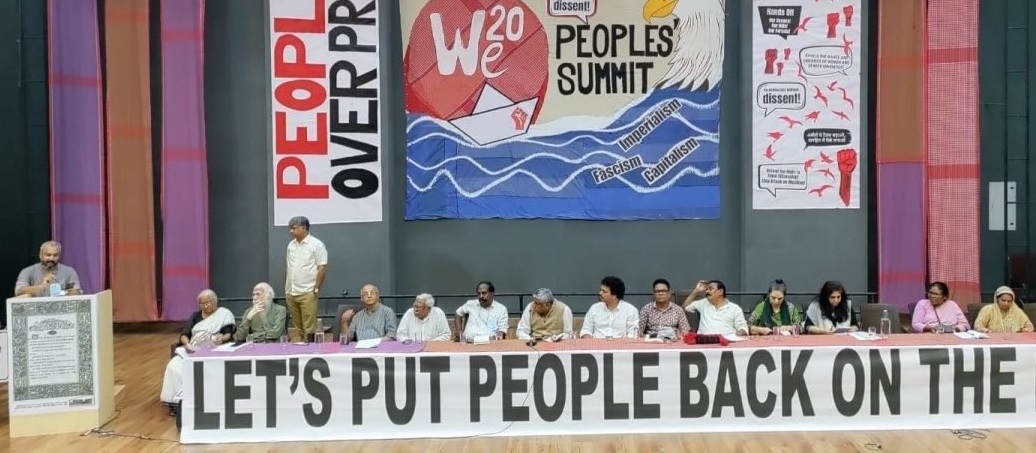
We are distressed to learn that a meeting of Indian civil society activists who gathered in the building belonging to an opposition party of India was disrupted by the Indian Police Department. What is even more disturbing to international civil society is that this meeting of Indian civil society was by the coalition of ‘We-20’ that was meeting to provide an input from civil society to the G-20 meeting that will be held in India shortly.

Image Credits: Subin Dennis (Twitter)

As is the international tradition, many civil society groups are encouraged to have forums and discussions on the areas and issues that are of concern to G-20. These discussions do not have to be confined only to officially designated formal and informal groups. So it disconcerting that an open discussion like this has been forcefully stopped.

We urge the Indian Government and all concerned to allow Indian civil society the space and freedom to engage in discussions in an atmosphere of democratic freedoms and absence of fear which is the arch of any democratic society.

www.aepf.info

Read More

A Coup in Niger and Resurgent Africa

A Coup in Niger and Resurgent Africa

By Anuradha Chenoy

A military coup in  the West African Republic of Niger (July 26) that deposed its president  has vaulted this fragile country to the center of global geopolitics and the people of Niger into a period of instability. The international community condemned the coup, but Niger is too important to be ignored. So the geopolitical narratives are hardening as is the threat of  military intervention that can spill over to  regional conflict in this Sahel region of Africa. 
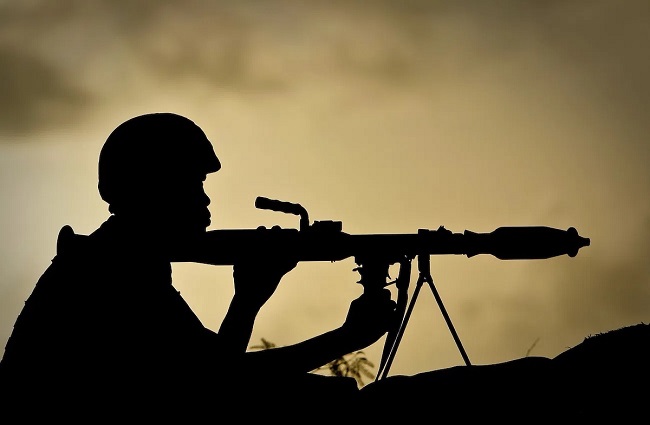
 

Why this interest?

Niger, a former colony of France is amongst the poorest amongst the Heavily Indebted Poor Countries (HIPC). Given Niger’s resources it should not be so poor. It has oil, gold mines and is the fourth largest producer of uranium in the world which is essential for nuclear energy, power and fissile materials. 

The uranium mines of Niger are predominantly controlled by the French state  nuclear power company Orano  (earlier Areva) that mines and exports the uranium to France who enriches, processes, uses and sells – with enhanced profits whereas uranium sales account for only 1.2% of Niger’s budget.  As people in Niger say: Our uranium lights up much of France, while only 20% people in Niger have electricity. This perceptible exploitation and uneven development is no longer acceptable to the people of Niger. This is the reason for public dissatisfaction and the coup.

The narratives and threats of military intervention

The coup has set off distinct narratives that characterize the deepening multipolar geopolitics. First,  the miliary junta claims that deposed president Bazoum has been far too close to the French,  compromises with French neo-colonial interests. Recently he allowed an increase in the presence of  international forces, and the French military that had been asked to leave Mali, are being welcomed to Niger. There has been popular civil dissent on this decision. The military junta says they have to reclaim Niger for the people and are backed by huge demonstrations of support.

The second narrative led by US and France,  says that the democratically elected and now deposed president of Niger should be re-instated. The US Secretary of State Antony Blinken committed that the US will ‘ensure full restoration of constitutional order’. France has said similar words indicating threats of intervention.

The Economic Community of West Africa (ECOWAS)  comprised of fifteen countries* in the region has  demanded restoration of  status quo and given a deadline after which they threaten military intervention  in Niger This grouping where the neighboring Nigeria is influential,  is known for following Western positions in Africa and is likely to be backed by the West in case of intervention. This will be another proxy war, with conflict spill over to the entire Sahel region. As it is, this commodity rich region is beset with radicalisms, is terror prone where identity/ethnic conflicts remain subliminal. At the same time intervention is not that simple either.

Member countries of the ECOWAS group are divided about intervening.  Nigeria’s President Bola Tinubu declared intent for military intervention, but has own  senate opposes this and want a negotiated settlement. Tinubu had been previously been indicted in the US on drugs related charges. He is on the edge in the factional politics of Nigeria, despite the support he gets from the US. For example separatists of the Nigerian-Biafra region have expressed support for Niger.

Other ECOWAS countries like  Mali, Burkina Faso and Guinea, led by post-coup military juntas themselves, have stated that they will militarily support Niger in case of external military intervention.  Libya and Chad have also expressed support to the Niger junta . Algeria’s president Tebboune has  rejected any military intervention in Niger arguing that this would ‘ignite the whole Sahel region’. Algeria is an ally of Russia, and amongst the more stable countries’ in the region.  Algeria has signed a military agreement with Niger. 

The third Narrative is from China, India and others of the Global South that want domestic negotiations, return to stability but non-intervention from any external force. 

Intervention Preparations

French President Macron has evacuated French citizens, but his army of 1500 remains, as do the 1100 American troops who are engaged in the fight against terrorism in the Sahel region of Africa. This terrorism increased after NATO and French intervened and bombed Libya and  removed president Gaddafi for ‘democracy’ in 2011.  Libya remains an unstable, shattered and conflict prone country.  

The ECOWAS community says it is preparing for military intervention but probably negotiating with the West on what support they would get for being proxy. Beyond the uranium, oil and other commodities, Niger is important for the geopolitical interests as the US and others maintain their armies and bases. 

The Russian Phantom and Chinese Shadow

Russia has officially stated that it ‘opposes a military solution’ to this conflict and has no plans to use it armed forces in Niger.  President Putin has opposed violent regime change in Niger as elsewhere. But reports claim the newly instated Niger Junta has asked for help from Wagner Russian mercenary group, that operates in neighboring Mali. 

US conversation on Niger and Africa as a whole is peppered with the Russian threat and unfair Chinese competition. US deputy national security secretary Victoria Nuland landed in the Niger capital and warned the Niger junta of the dangers of aligning with Russia. The US tags the Russian mercenaries- the Wagner Group as a terrorist outfit but many in Africa want a Russian presence to bolster their politics against the West. 

The Anti-neocolonial sentiment

The reasons for anti-French sentiment in the former French colonies besides the stagnant economic development, deep poverty, presence of external military control, is the continuation of French neo-colonial policies that go beyond ruthless commodity-resource extraction. 

The French continue to control and have veto over the monetary policies of these eight countries including Niger that use the  CFA Franc.  France sets the exchange rate and convertibility to the Euro is guaranteed. There is a centralization of foreign exchange reserves- whereby 50% goes into the French treasury and these reserves must exceed money in circulation. In sum there is no monetary sovereignty and all kinds of devious  neocolonial control. 

There is a popular surge against French neo colonialism in West Africa. For example, the Economist shows that over 70% of people in Niger support the anti-French policies announced by the new government. There have been 10 coups in the last five years in the various Sahel countries. Leaders vie for power on the basis on anti-French, anti-colonial sentiment. This attracts the mass of poor people who can see this exploitation and back populist and even military juntas. 

But once in power, the leaders fail to deliver and fall into the same trap whereby in order to get foreign exchange for food and fuel they are forced to negotiate with the French State or MNCs that exploit resources for profit, whilst development issues or promises like the SDGs remain a slow and measly trickle down, barely touching the wider population. This is why the mass of people is asking for a return of Russia, who they see as an ally against neo-colonial exploitation. 

Implications

Any outside military intervention will light up the entire West Africa- Sahel in a regional  war. As the conflict spills over, attrition, migration, and increase in radicalism that already plague this region will only rise. So ECOWAS needs to prevent itself from falling into a proxy war for the West. The African Union must intervene and stop any intervention. It is clear that there is a nationalist surge against neo-colonial French policies in West Arica. Niger and its people alone should decide their future. 

*(Guinea-Bissau, Cote d’Ivoire, Niger, Benin. Gambia, Guinea, Burkina Faso, Togo, Sierra Leone,  Mali, Nigeria, Liberia, Ghana, Senegal, Cabo Verde)

 

Read More

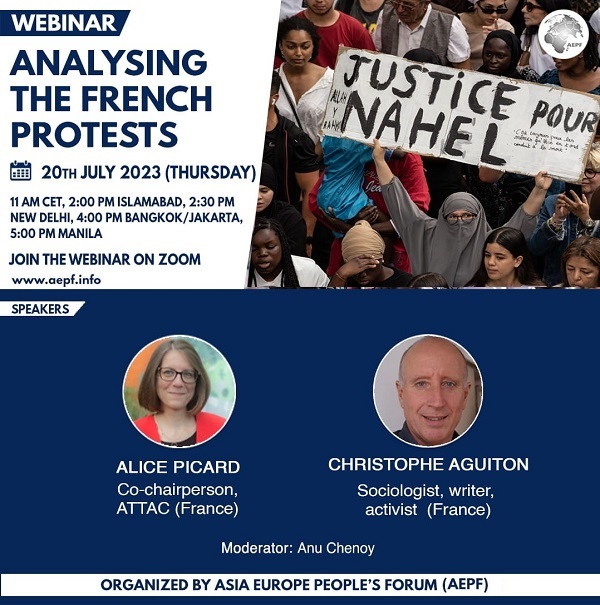
Webinar: Analysing The French Protests

Webinar: Analysing The French Protests

Watch the Webinar

France has been witnessing different kinds of protests over several months. Some of these had turned violent. Two well-known French activists- analysts analyse these protests, in our webinar.

Speakers:
Alice Picard, Co-chairperson ATTAC (France)
and
Christophe Aguiton- Sociologist, writer, activist (France)
Moderator: Anu Chenoy


Read More

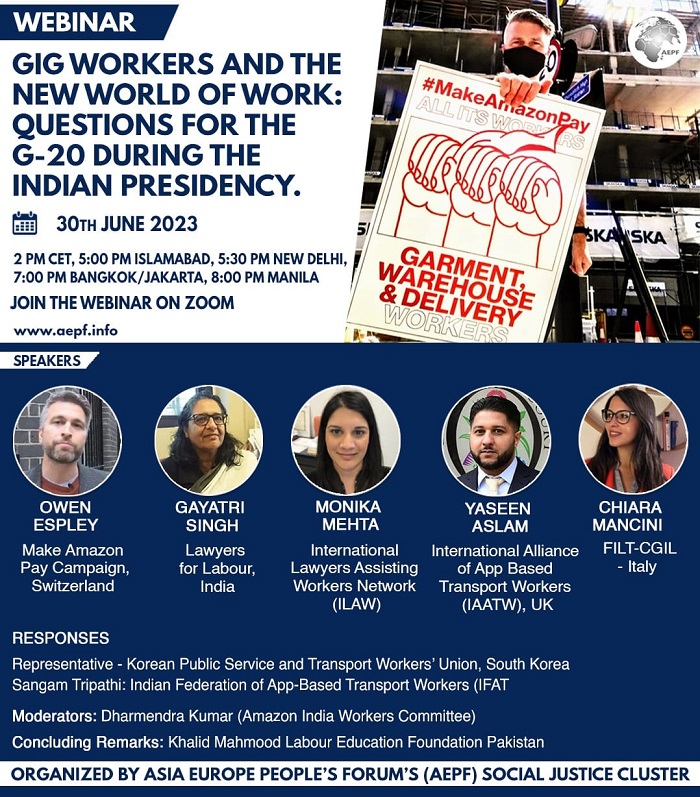
Gig Workers And the New World of Work: Questions for the G-20 During the Indian Presidency

Gig Workers And the New World of Work: Questions for the G-20 During the Indian Presidency

Watch the Webinar

The G20 meeting under the Indian presidency is an opportune moment to raise the issues of gig workers and the new conditions of work.

Speakers:
– Yaseen Aslam- International Alliance of App Based Transport -Workers (IAATW) United Kingdom
– Gayatri Singh – Lawyers for Labour India
– Owen Espley – Make Amazon Pay Campaign, Switzerland
– Chiara Mancini, FILT-CGIL- Italy
– Monika Mehta, International Lawyers Assisting Workers Network (ILAW)
Responses:
Representative – Korean Public Service and Transport Workers’ Union, South Korea
Sangam Tripathi- Indian Federation of App-Based Transport Workers (IFAT)
Moderator: Dharmendra Kumar Amazon India Workers Committee India
Concluding Remarks: Khalid Mahmood Labour Education Foundation Pakistan
Read More

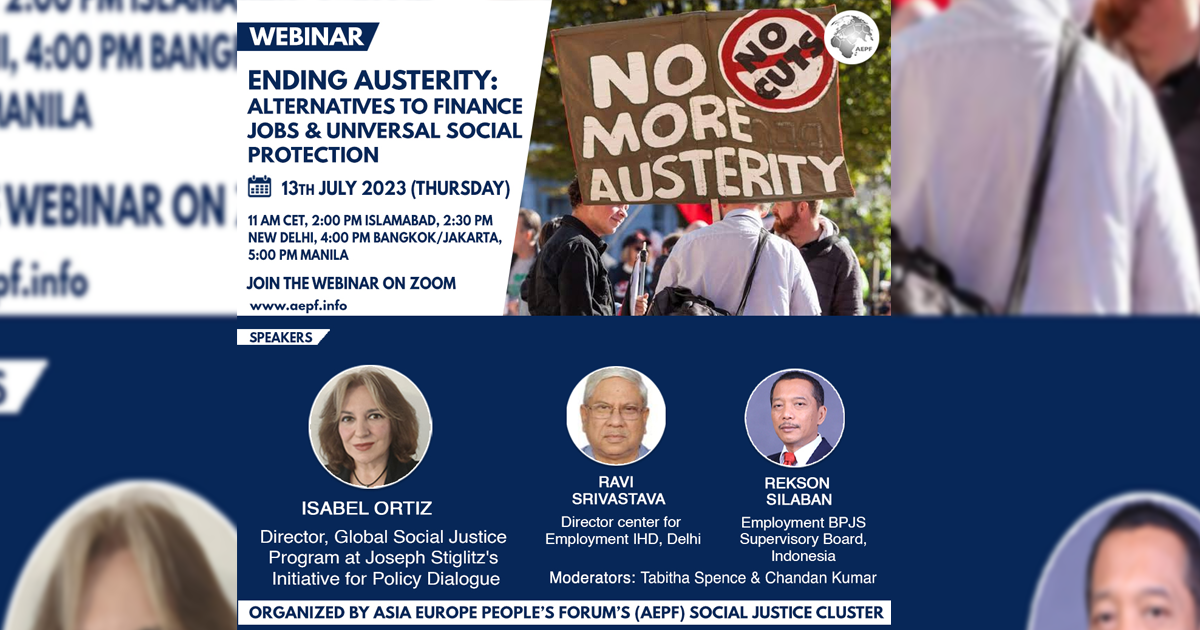
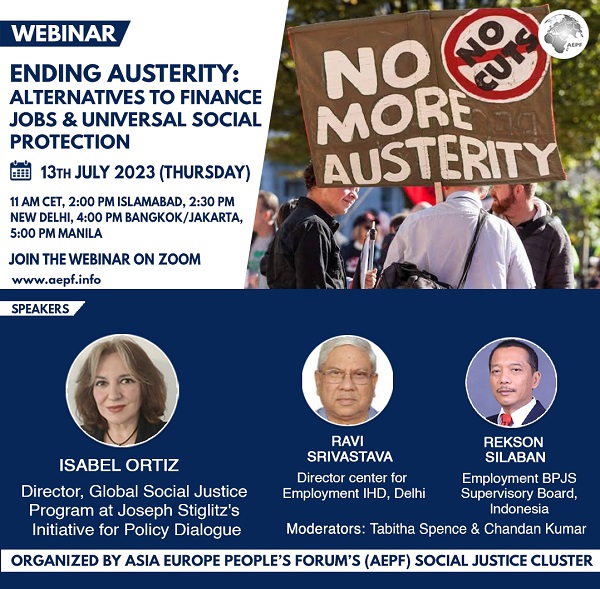
Ending Austerity: Alternatives to Finance Jobs & Universal Social Protection

Ending Austerity: Alternatives to Finance Jobs & Universal Social Protection

Watch the Webinar

Austerity has made millions vulnerable. How can we fund social protection? Listen to international experts in this webinar

Speakers:
– Isabel Ortiz (Director, Global Social Justice Program at Joseph Stiglitz’s Initiative for Policy Dialogue)
– Professor Ravi Srivastava (Director – Center for Employment IHD, Delhi)
– Rekson Silaban (Employment BPJS Supervisory Board, Indonesia)
Moderators: Tabitha Spence and Chandan Kumar
Organized by the AEPF Social Justice cluster
Read More

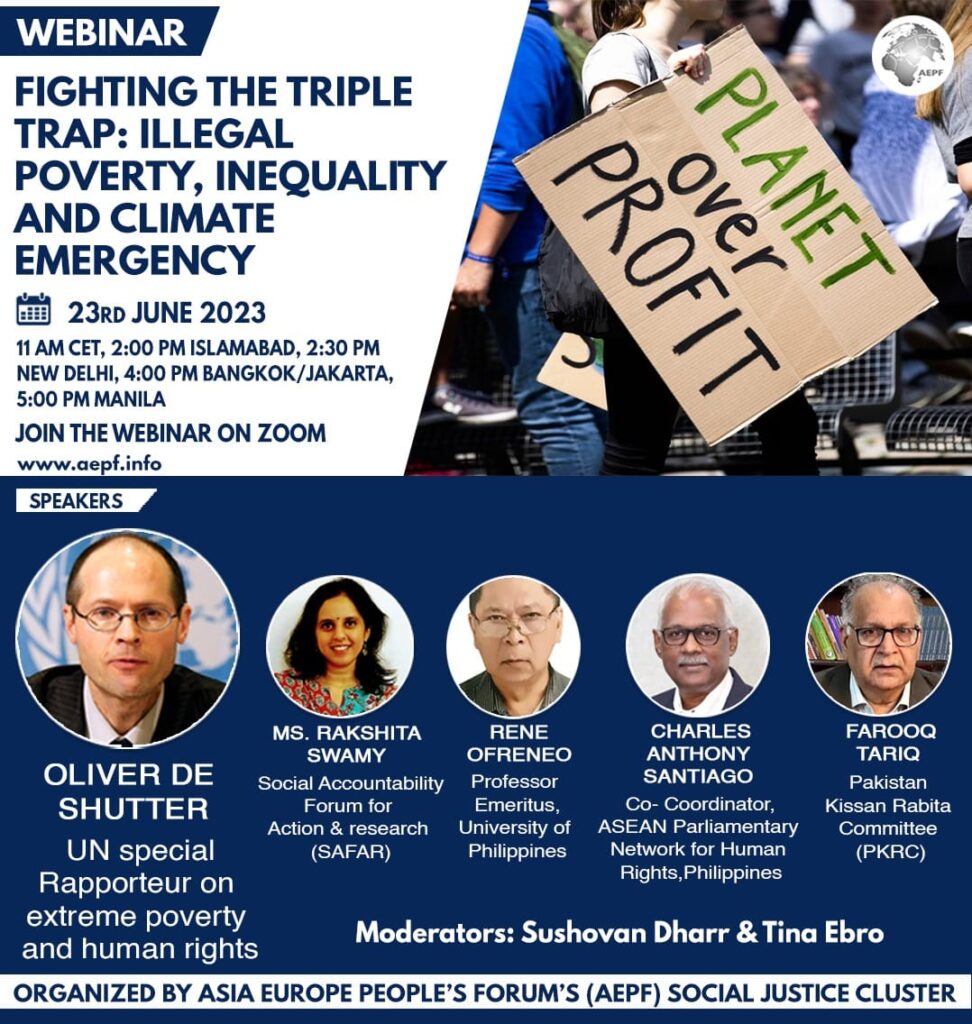
Fighting the Triple Trap: Illegal Poverty, Inequality And Climate Emergency

Fighting the Triple Trap: Illegal Poverty, Inequality And Climate Emergency

The climate emergency is increasing inequality and global poverty. Experts discuss how this triple trap can be averted.

Watch the Webinar: 

Speaker:
Olivier De Schutter – Former UN Special Rapporteur on extreme poverty and human rights

Interventions:
– Rene Ofreneo – Professor University of the Philippines
– Charles Anthony Santiago – Former Parliamentarian Malaysia
– Rakshita Swamy – Social Accountability Forum for Action & research (SAFAR)
– Farooq Tariq – Pakistan Kissan Rabita Committee (PKRC)

Moderators: Sushovan Dhar & Tina Ebro Organized by Asia Europe Peoples’ Forum’s (AEPF) Social Justice Cluster

Read More

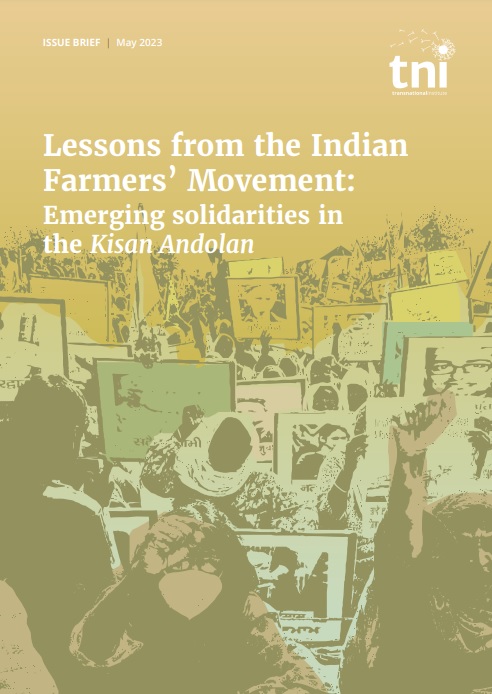
Lessons from the Indian Farmers’ Movement

Lessons from the Indian Farmers’ Movement

Emerging solidarities in the Kisan Andolan

The Indian farmer’s movement that was able to successfully pressurize the Government to withdraw anti-farmer laws provides lessons for social movements engaged in wider struggles for social justice. This issue brief explores the frameworks and processes of alliance formation that contributed to the remarkable success of the Kisan Andolan.

Download

Introduction

Large protests by Indian farmers in 2020 and 2021 marked an important political moment for social movements in the country. The immediate trigger was the hurried passage of three ‘farm laws’ by the Union government in September 2020. Their far-reaching implications, coupled with the lack of wider discussion or consultation, provoked a strong response from farmers’ unions and rural movements across the country. When protesting farmers were prevented from entering New Delhi, the national capital, in

November 2020, they established camps at the capital’s borders – at Singhu, Tikri and Ghazipur – for over a year. This sustained mobilisation ultimately forced the government to repeal the three laws in November 2021. By then, the Kisan Andolan (farmers agitation) had evolved into a wider movement demanding decisive state action to address India’s systemic agrarian crisis and protect rural livelihoods.

Alongside well-organised protests on the ground, the Kisan Andolan was able to effectively shape broader narratives around the movement. It responded to widespread disinformation in mainstream media outlets that were sympathetic to the government by building an active and engaged social media presence. Participants provided regular updates from the protest sites to urban audiences. This included sections of the large Indian diaspora and international supporters who organised solidarity protests around the world. The mobilisation was also extensively documented by supporters and allies. Prominent examples include a biweekly newspaper, Trolley Times, published online and in print in multiple languages, and Karti Dharti, a fortnightly publication by women volunteers.

The farmers’ protests were a crucial victory for social movements in India, and came as the government was using the pretext of the COVID-19 pandemic to push through a far-reaching liberalisation of the economy. The repeal of the laws also represented a significant capitulation by an authoritarian regime that has otherwise sought to crack down on public opposition to its majoritarian nationalist and neoliberal policies. The Kisan Andolan has thus demonstrated real possibilities for confronting the government’s now familiar playbook of discrediting social movements, censoring dissent, and direct repression. The broad-based solidarities — among rural producers and spanning the rural-urban spectrum — that began to emerge over the more than year-long protests generate new expectations for wider political struggles.

This note explores the frameworks and processes of alliance formation that contributed to the remarkable success of the Kisan Andolan. To be sure, the movement is grounded and embedded in the Indian context. But as progressive social movements around the world confront oppression, austerity, militarism, and the prospect of a new global food price crisis, there is much to be learned from the political dynamics of this victory.

Download

Read More

Webinar: Labour and Just Transition(s)

Webinar: Labour and Just Transition(s)

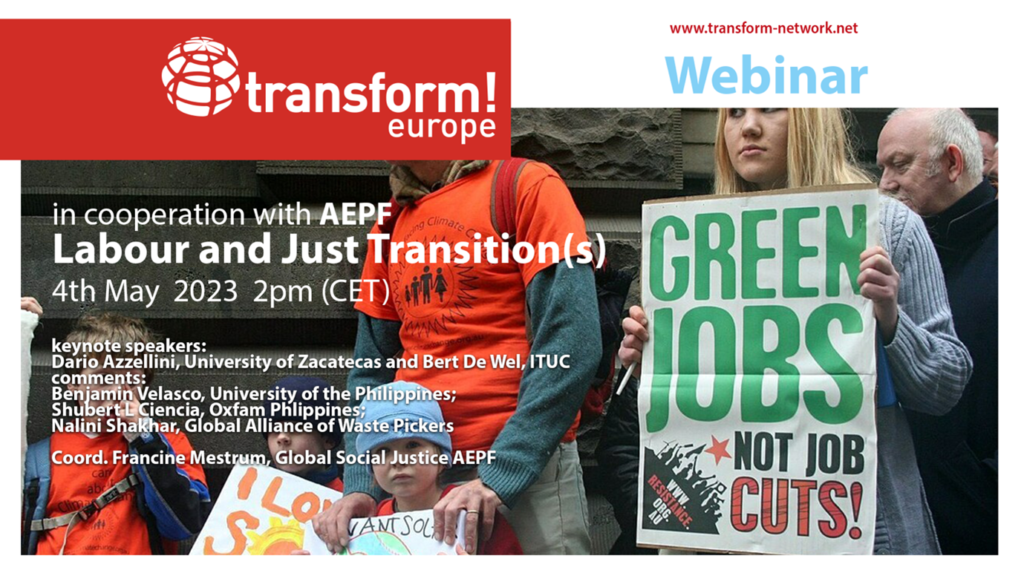
This webinar, hosted by transform! europe and AEPF (Asia Europe People’s Forum), aims to explore and discuss ways to overcome the often sterile debates between orthodox and heterodox advocates of ‘change’ and ‘transition’ in order to solve existing ecological, economic and social problems.

Watch the Webinar:

Keynote speakers:

  • Dario Azzellini, researcher
  • Bert De Wel (ITUC)

Comments:

  • Benjamin Velasco, University of the Philippines
  • Shubert L Ciencia, Oxfam Phlippines
  • Nalini Shakhar, Global Alliance of Waste Pickers

Moderation:

  • Francine Mestrum, Global Social Justice and AEPF

Webinar Summary:

Climate justice and social justice go hand in hand, one is not possible without the other. Less clear is how this can be materialised. From a social justice perspective, many questions remain unanswered in various sectors and many contradictions remain unsolved.


When talking about ‘green jobs’, ‘de/post-growth’ or ‘extractivism’, it is easy to get the impression that these concepts are nothing more than new names for old demands in the context of climate change.

The purpose of the proposed activity is not to find concrete, single-minded answers to different problems, but rather to go beyond the moral discourses, to try to solve the contradictions and to offer realistic strategies for working towards a different world. We are aware of the remaining gap between green, left-green and left-wing solutions to existing ecological, economic and social problems, and we want to try to overcome the often sterile debates between orthodox and heterodox advocates of ‘change’ and ‘transition’.

The main question remains: how to develop a convincing and realistic new progressive discourse about a new and better world that people can fight for? With what strategy?

On the question of work, we have to take into account the many uncertainties that still exist at the level of definitions, as well as the divergent answers that might be given depending on geography (North vs. South?), sectors, technological fixes, etc.

We must also be aware of the fact that in Asia there is a lack of social rights in general and labour rights in particular; in several countries there is not even a right to organise. More generally, austerity policies around the world are threatening people’s living and working conditions.

The ambition could be to make clear that social justice is a precondition for climate justice, not in terms of hierarchical priorities, but in the sense that people need to be ensured a life in dignity before they can be expected to participate in the transition without fear of further setbacks. It seems therefore inevitable to reflect on structural changes of the economic system in general and of the “labour markets” in particular.

This webinar should not be an end point, but a step towards a more complete and coherent perspective on just transition from a social justice perspective. For further steps, cooperation with other AEPF thematic clusters is most welcome.

Read More

Webinar: Our Rights, Struggles and UN Human Rights Conventions

Webinar: Our Rights, Struggles and UN Human Rights Conventions

Watch this webinar with experts and activists working on the struggles around UN Human Rights Conventions.

Speakers:

1. Sofia Monsalve (FIAN International)
2. Dr. Gianni Tognoni (Permanent Peoples’ Tribunal – PPT)
3. Rose Trajano (iDefend- Philippines)
4. Bhalchandra Kango (All India Trade Union Congress, India)
5. Khadija Najlaoui, Transnational Migrant Platform-Europe (TMP-E) & Waling-Waling-Rights for All Migrant Workers
6. Bernice ‘Nice” Cononacion, Deputy Secretary General of SENTRO Trade Union Philippines
7. Paula Goia, La Via Campesina

Moderators: Shalmali Guttal and Andy Rutherford

Read More