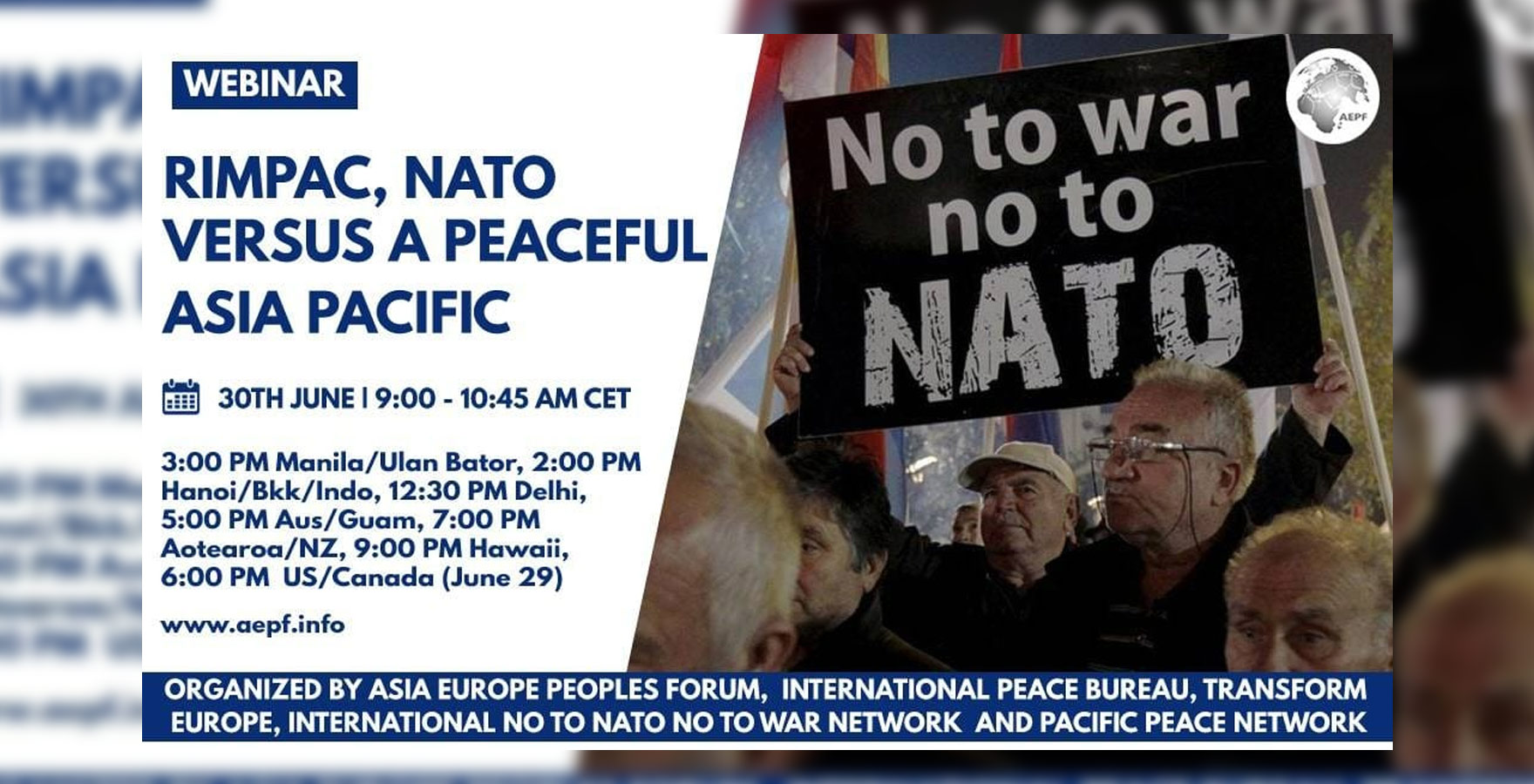
RIMPAC, NATO versus a Peaceful Asia Pacific

RIMPAC, NATO versus a Peaceful Asia Pacific

Watch the Webinar

This webinar analyses and opposes the largest military exercises on the Rim of the Pacific (RIMPAC)

Speakers:

1. Katerina Anastaciou (Transform Europe)
2. Anuradha Chenoy (AEPF)
3. Walden Bello (Focus on the Global South)
4. Reiner Braun (IPB and International No to NATO No to War Network)
5. Walter Baier (Transform Vienna)
6. Col. Ann Wright, ret. (Hawaii Peace & Justice)
7. Monaeka Flores (Prutehi Litekyan: Save Ritidian, Guam)
8. Sean Conner (International Peace Bureau)

Moderators: Dong Huy Coung and Tabitha Spence


Read More

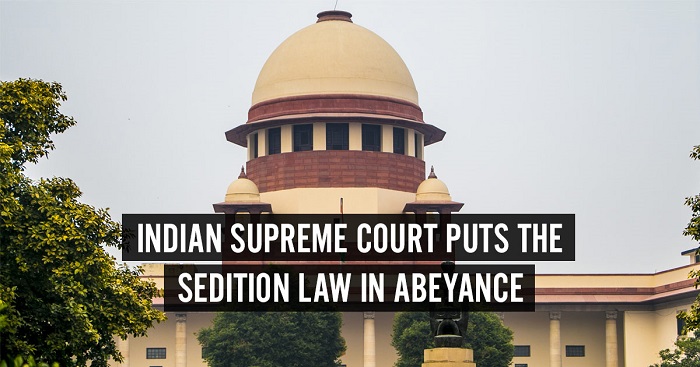
Major Step on Right to Dissent in India

Major Step on Right to Dissent in India

In a historic judgment the Indian Supreme Court has put the colonial era Sedition Law in India in abeyance. There are currently 13000 individuals in jails under this law.
The Court suspended criminal trials under Section 124A that prosecutes people charged with sedition and has asked that this law not be applied until further orders. Clearly the highest Indian Court, the Government and public discourse have influenced this judgement. The Right to Speech that does not provoke violence is foundational for democracy.
This judgment comes after several Public Interest Litigations. The most important one being by the Editors Guild of India, where Ms. Seema Mustafa is the president currently.
Here is Seema Mustafa’s  article on the judgment (first published in The Citizen)

Historic Order – SC Puts the Sedition Law in Abeyance

No more cases to be filed under the sedition law till re-examination

The Supreme Court has delivered a historic interim order, placing the 152 year old sedition law under Section 124A of the Indian Penal Code on hold. The bench comprising the Chief Justice of India NCV Ramana, Justice Surya Kant and Justice Hima Kohli held that all pending cases, appeals and proceedings with respect to charges framed under this law be kept in abeyance. And that “adjudication with respect to other sections may proceed with no prejudice to the accused.”

The apex court has directed the centre and the state government not to register any FIRs under the provision until it was under consideration, and the Supreme Court had delivered its final order. The bench has said, “we hope and expect centre and state governments will refrain from registering any FIR, continuing investigation, or taking coercive steps under Section 124A IPC when it is under reconsideration. It will be appropriate not to use this provision of law till further reexamination is over.”

The court has made it clear that those who have been jailed under Section 124A IPC can approach the concerned courts for bail. And that if any fresh case is registered the concerned parties can approach the courts for relief, and the courts should examine the relief taking into account the Supreme Court’s interim order.

Significantly, the government that had stood by the sedition law initially diluted its stand when the court met to discuss the petitions challenging the colonial law. Noting this the court has now observed that the government’s stand that the sedition law requires “reconsideration and reexamination” basically indicates the government’s agreement with the Court’s view. The CJI observed, “the court is cognisant of the state on the one hand and citizens civil liberties on the other. There is a requirement of balance of consideration.”

It is a major development, and will bring relief to many. As senior advocate Kapil Sibal said in the court, currently 13000 individuals were in jail under this sedition Section. Earlier the CJI had asked the Attorney General for India, “is it still necessary to retain this colonial law which the British used to suppress Gandhi, till etc even after 75 years of independence?”

He had further added, “if we go see the history of charging of this section, the enormous power of this can be compared to a carpenter being given a saw to make an item, using it to cut the entire forest instead of a tree. That’s the effect of this provision.”

And the provision now, finally, after one and half century where it is even today being used against the citizens of India, is well on its way to being struck down permanently.

Read More

The Russia-Ukraine War and the Changing World Order

The Russia-Ukraine War and the Changing World Order

Image Courtesy: manhhai (flickr)

–Anuradha M. Chenoy

(First published in The Economic and Political Weekly, April 16, 2022, Vol.LVII No. 16, pp.10-13)

The Russian illegal war in Ukraine has accelerated a shift in the world order forcing a renewed balance of power.  Countries and analysts are calculating the implications of re-balancing and positioning for significant changes. Ukraine is ravaged; Russia is the aggressor and will suffer long term consequences, the US led NATO has strengthened and forcing the re-balance, Europe is undergoing a human security crises and remilitarization, China has made a strategic choice,  India like many countries of the Global South faces geostrategic pressure as they calibrate their positions. So what are these shifts,  the implications and consequences? 

A brief on this war

The Russian motives in launching this war on Ukraine include a mix of: aspirations for projecting Russian imperial power status and vision; extend influence and support to Russian ethnic and other dissatisfied minorities in the former Soviet Republics;  re-creating a Russian sphere of influence to counter balance the Western one in Eurasia; opposition to NATO expansion, especially the inclusion of Ukraine;  attempt to destroy the Ukrainian military infrastructure to enforce neutrality before NATO could undermine Russia; the  creation of an Eastern Ukraine buffer for Russian security in the Donbas region with the Russian ethnic majority provinces that had declared themselves independent of Donetsk, Luhansk, Crimea, all which give Russia strategic control over the Black Sea. 

Russia is unlikely to achieve all these ambitions. On the contrary this asymmetric  war, like many before will have debilitating long term effects on both Ukraine and Russia as the West places sanctions and isolates Russia. The world but especially the Developing Countries face continuous oil price volatility, grain shortages, supply chain disruptions and economic stagflation. This war has serious consequences internationally marking a shift in the world order that we examine. 

The US Long Term Strategic Plan

The US is key in the planning, the unfolding and the outcome of this war that has given them an opportunity for a renewed grand strategy.  They laid the ground work by promoting continuous hostility to Russia for two decades;  provided material support like advanced weapons, aid, assistance and advice to Ukraine at least since 20141; lent their unmatched soft power and convincing narrative of democracy versus authoritarianism, good versus evil before and during the war and are now ready with the US long term plan for the new phase in international politics.  Russia believed for many years that the Cold War ended with the Soviet collapse and they did try and negotiate with the US. But for the US the Cold War never ended. They continued to see Russia as the threat to a NATO led by the US.

President Biden calls the new phase for global primacy as ‘Strategic Competition’2.  The  strategic crowd in Washington refers to this as  ‘Great Power Competition’ or GPC3.   The earlier geostrategic phase (2001-2021) termed  the ‘war on terror’  is over.  The withdrawal of US troops and NATO’s Resolute Support Mission in Afghanistan in August 2021 appeared shabby, defeatist and hastily conducted but was  as per plan. Biden had already declared in his ‘Interim National Security Strategic Guidance’ document, March, 2021 that global dynamics have shifted and the US needs to reclaim its strategic advantage. The first step towards this was a withdrawal from the ‘forever wars’, of the devastated  Middle East (West Asia) region. The US long confrontation and isolation with Iran however remains their main interest in the region. 

The central focus of GPC-Great Power Competition for the US is China. Any number of documents and speeches since the Obama declaration of ‘rebalance’ and ‘pivot to Asia’ point to this4. The Air-Sea Battle Doctrine (2010) centred China as the focus of a hybrid and military confrontation. The Biden Administration has clubbed China and Russia together as targets. This twinning is deeper than practiced by the Trump administration that appeared contradictory over its Russia policy. The US deep state however has been consistent: “Today, every domain is contested- air, land, sea, space and cyberspace5.” The conclusion- that China is the challenger and Russia is the secondary major threat. 

US Strategists are convinced that a long war in the Ukraine war will weaken Russia irreparably.   Ukraine is being heavily armed by the US and NATO, as General Milley, Chairman Joint Chairman, Joint Chief of Staff testified to the US Congress that this conflict would last for years and that US and NATO would be ‘involved in this for a long time’6.  In this event the US calculates that Russia will be an economic strain on China and the Russia-China strategic alliance gets one sided, therefore beneficial for the US primacy and competition with China. 

The Russian aggression has given the US the opportunity for its already planned strategic competition. The public outrage on the Ukraine war  has subdued the virtual civil war between the Democrats and Republicans forming a  bi-partisan consensus. (Klare, 2022). The US defence budget and military assistance to Ukraine has increased, Russia is increasingly sanctioned, Russian economy is showing signs of stress, Russian citizens are divided as many oppose this war. The US global strategy is unfolding. But it is not unchallenged.

The US as Europe’s Lead

To prepare for Great Power Competition with the Russia China double threat Biden has repeatedly called on allies to both counter the Russian threat and ‘prepare together for long-term strategic competition’ and to push back against the ‘Chinese Government’s economic abuses and coercions that undercut the foundations of the international  economic system’7.  European partners are now open on increasing defence budgets, Germany has increased its defence spending and changed legal provisions to provide arms to a country (Ukraine) in conflict. The Nord Stream Pipeline from Russia has not been commissioned.  France that was miffed because the US cut them out of a deal on nuclear submarines with  the Australia, by signing the US, UK, Australia (AUUKUS) Agreement has fallen in line. 

The Minsk I and II Agreement that were the hope of a negotiated peace led by France and Germany with Ukraine and Russia are not spoken about. States like Poland welcome refurbished bases and increased NATO activity in Central East Europe. The strategic agency of select European powers is at hold. However, most of Europe still does not want to be part of the US grand strategies for primacy. They are aware that European interdependence and development needs a sustainable engagement with Russia and Eurasia as a whole. 

Great Power Competition in the  Asia Pacific

The attention of GPC and NATO is centred in the Asia Pacific around the South China Sea and Taiwan.  Major US allies -Australia, New Zealand, Japan, Republic of Korea, Singapore have placed sanctions on Russia and see China as the major threat. Militarization is stepping up, with Australia’s order of nuclear sub marines from the US and UK and creation of a space force something which they had escaped even during the Cold War period8.  The QUAD partnership of US, Japan, India, Australia has engaged in military exercises in the region. China considers QUAD and AUUKUS “quasi NATO” alliances. India’s strictly neutral position during the Ukraine war has shaken QUAD partners. Other such mini alliances are on the cards.

Deglobalization

International political economy is changing course to keep in step with strategic competition. The West after forty years of globalization calculated that they have lost out to China, India and other emerging countries. To bring back manufacturing they are looking at greater protectionism and barriers as part of a de-globalization process9. Here too China is presented as the main threat, but the emerging economies will be hit as the sanctions on Russia hit global trade, supply and value chains. Trade deals like the Trans Pacific Partnership between the US and Asian countries are presented as encircling an economically unfair China. 

The Senate Strategic Competition Act, 2021, frames China as hostile, as a threat and ‘malign’  to US interests, where negotiations are not possible:   The least developed countries suffer the most, as they recently witnessed vaccine protectionism where Western policy was- when the world suffers a pandemic, put up your barriers (India and South Africa’s attempt for special exemptions on TRIPs, supported by a 100 Developing Countries remains blocked). Within this deglobalization phase, neoliberal  economic and financial practice  continue with rules to coordinate closely with multinational companies and IFIs to give them strategic direction. 

The Chinese Response 

China recognises that they are the primary adversary of the US in the Great Power Competition, the focus on Russia is temporary while strategic coercion against China is constant. China has not named Russia as an aggressor in the Ukraine war, has opposed NATO expansion and sanctions and calls for diplomatic solution while recognising Russia’s ‘legitimate security concerns’. Xi’s conversation with Biden showed the replay of cold hostility11.  If Biden warned China on material support to Russia, Xi in turn warned Biden about ‘playing with fire’ on Taiwan saying, ‘He who bells the tiger will have to take it off ’.12 China is building defences as the US prioritises its military presence in  the Asia Pacific and  creates an international coalition to isolate China and Russia. 

China does not want to be bracketed with Russia and asserts its sovereign position. China call this war ‘the situation’, has supported Russia in the Security Council and UN General Assembly.  The US has  warned them about possible “implications” and “consequences”13.  Chinese  strategic thinkers believe that US attempts to weaken this Sino-Russian  partnership that is described as one with  “no-limits” cannot succeed because Russia gives them strategic depth, supports their energy and food needs and can help them face any US threat14.  Russia and China have since years been putting in place institutions for trade in local currencies like the Rubble – Renminbi trade. The Chinese have chosen sides. Clearly all sides are preparing  for  possibilities and challenges in the Asia Pacific.15  The Chinese are watching and as they say: watch your capabilities and bide your time.

India, Global South

The US is looking to form an international coalition against Russia  that will meld into their long term strategic competition. The US is in no mood to tolerate neutrality, non-alignment or strategic autonomy that characterises the positions taken by India and many developing countries. The attempt to forge a multipolar world by several countries like those in BRICS is under serious threat.  The US vision of a renewed unipolar world demands allegiance. 

India’s stance of neutrality, abstentions during the voting in the Security Council and UN resolutions that condemn the Russian invasion have drawn international attention. India is under extraordinary pressure from the US and its allies. Biden’s inner circle from Secretary Antony Blinken, Victoria Nuland and others to convince India to shift position that Biden has called ‘shaky’. 

India’s position is to balance between Russia which is a historically time tested strategic partner  and the US- a new strategic ally that India is forging ties with given their unresolved tensions with China and Pakistan. India needs both partnerships and there is no other way for them except neutrality.

India’s defence, hydrocarbon and trade relations with Russia cannot be jeopardized when 50% of Indian defence comes from Moscow.  India is leveraging its relations with the US to ensure that these cannot be at the cost of its partnership with Russia or the global South. There is consensus of political forces within India on this position of neutrality. 

Indian strategic thinkers believe they cannot get involved in wars waged by great powers. In an unsettled non normative unstable multi polar world, with  many uncertainties,  India needs to tread the tightrope and focus on domestic growth. India will try and maintain strategic neutrality as part of their goal. Even as they joined the QUAD, they have tried to restrain this grouping to non-targeted military exercises, focus on technology, climate and trade. The Indian position is similar to many countries of the Global South. 

 Countries of the South have broadly four different positions as shown up during voting in the UN General Assembly and  statements around this. 

A few  condemn Russian aggression and  place sanctions (Japan, South Korea, Singapore, Cambodia, Fiji, Kenya). A second larger group condemn the invasion,  hedge this with statements on Russia’s ‘legitimate security concerns’,  oppose sanctions and maintain neutrality (Most of ASEAN, many African and Latin American countries.) The third group of about 40 have adopted  neutrality and strategic silence, abstentions in UN  (South Asia, Brazil, Laos, Mongolia, Vietnam, India, South Africa, several African and Latin American countries). The fourth smaller group remain sympathetic to Russian positions (China, some Central Asian Republics).

Even though developing countries are committed to  safeguarding national sovereignty, favour international law since it protects vulnerable small states, and oppose secessionist movements that threaten to break up states (many developing countries   face secession movements), yet they have chosen neutrality. Reasons include that many  of these countries depend on Russia especially for arms trade. Many source their hydrocarbons, grain, fertiliser and other commodities.

The US position and NATO expansion is viewed as a continuity of the ‘Great game’ replaced by  great power competition. Most countries in the South have little interest in partisanship in  a war between Russia and the US led NATO, where Ukraine is a victim. The discourse from strategists linked to these countries  have argued Russia’s security interests are legitimate; no country can tolerate  targeting by missiles on its border and an expanding  military alliance- NATO. The South has witnessed two decades of Russian appeals, talks, concessions  and believes that that the US could have helped in the resolution of the conflict and the Minsk Accords (2104) They favour the proposal of Ukraine as a neutral zone. They want a quick compromise and return to diplomacy.

Unlike the Central East European countries, developing countries do not see Russia as a threat or as former colonial and racist power.  Russian and Chinese unconditional development aid supports many least developed countries.  Russian assistance during US/NATO interventions, colour revolutions,  regime change and bombing in Iraq,  Lebanon, Libya, Yemen, Afghanistan  and others just in the last twenty years. For example President Obama alone dropped 20,000 bombs16. Madeline Albright’s public statement (1996) that the sanctions that had led to the death of thousands of Iraqi children ‘had been worth it’17 has created impressions in the minds of the Global South.

The South has internalised the contradictions and double standard of moral grounds where normative principles of human rights coincide with geostrategic interests, for example on the Palestine question or the US support to Saudi Arabia in their war on Yemen. Make no mistake, the regimes of the South are no holders of normative values themselves and weigh primarily national and even pure interests to their own regime’s stability. They would also maybe take similar imperial steps as the great powers do, given half a chance. But history has given them a place in this hierarchic unequal world order, and they similarly justify and legitimise their positions with normative examples.

Clearly countries of the South are no paragons of normative virtue. Normative values are held primarily by peace and social movements, many of which are under stress in the South. Democracy for which the US claims to be fighting is being hollowed out internationally and this war can increase that trend. 

The most dire consequences of this war are the possibilities of expanding the  theatre of war beyond the borders of Ukraine. It has been a wise step to make sure that no acts provoke such expansion, even though some parties may be interested in a long war. At the same time, no side has given in for compromises that are essential for a sustainable and dignified resolution. 

 This war threatens the international non-proliferation regime and encourages many countries to enhance nuclear capabilities. The vision of extended influence by Russia, the US’s grand strategy of deadly competition with China and other great powers’ regional imperial designs have the potential for reviving conventional and hybrid warfare. The US for example has no existential or security threat in Europe. But it has an existential threat in climate, economic crises at home. Clearly, the existential threats for all peoples are climate change, destruction of ecology, increasing social inequity between and within nations. This is what needs to be addressed.

Conclusions:

The unjustified aggression of Russia on Ukraine has led to the devastation of an independent country-Ukraine. Russia itself will have long term debilitating consequences as the West cuts them off from many globalised financial systems. The US pans for global primacy have been accelerated. Many countries are calibrating their positions as we have shown. The carbon foot print of this war and the fast paced global militarization are a step back for the goals of a common future for mankind. Militarist alliance like NATO and others need to introspect their exclusive and negative role. There is no alternate to common and collaborative security which is inclusive. Further, the  double standards in implementing human rights and selective wars of aggression on smaller states by great powers have led to a delegitimization of multilateral institutions and a world that is insecure for all. If this is a war for saving democracy and human rights then international bodies like the UN and Security Council should be democratized. Refugees from all countries be treated with respect and norms for a more equitable world system be initiated. 

References

  1. See for examples comments from several important American strategists like Chas Freeman, Russia in Global Affairs, Oct-December 2021: 130 at https://eng.globalaffairs.ru/wp-content/uploads/2021/12/122-136.pdf ; J. Mearsheimer and others.
  2. Biden, Interim National Security Strategic Guidance, White House, March 2021) at: https://www.whitehouse.gov/wp-content/uploads/2021/03/NSC-1v2.pdf
  3.  US Congressional Research Service, Report to the Congress on Great Power Competition, December 2021. At: https://s3.documentcloud.org/documents/21170190/renewed-great-power-competition-implications-for-defense-issues-for-congress-dec-21-2021.pdf accessed 16 March, 2022)
  4. White House Fact Sheet (2015) “Advancing the Rebalance to Asia and the Pacific”  November 16, Washington, at: https://obamawhitehouse.archives.gov/the-press-office/2015/11/16/fact-sheet-advancing-rebalance-asia-and-pacific
  5. 2018 National Defence Strategy, Summary” at: https://obamawhitehouse.archives.gov/the-press-office/2015/11/16/fact-sheet-advancing-rebalance-asia-and-pacific
  6. General Mark Milley, Testimony to the US Congress, April 5, 2022, quoted in CBS News at: https://www.cbsnews.com/news/ukraine-conflict-years-mark-milley-house-armed-services-committee/
  7. J. Biden, Speech, March 2021, Munich, at: https://www.business-standard.com/article/international/biden-urges-european-allies-to-prepare-strategic-competition-with-china-121021901535_1.html
  8. https://www.abc.net.au/news/2022-03-21/defence-dutton-flags-future-trump-space-force/100927320
  9. Kornprobast M and John Wallace, (2021) What is deglobalization? Chatham House, October 18, at: https://academic.oup.com/ia/article/97/5/1305/6363969 And see special issue of International Affairs (UK) on Deglobalization, September 2021, No. 27 Volume, 5.
  10.  Strategic Competition Act, 2021, at:    https://thediplomat.com/2021/04/senates-strategic-competition-act-will-make-china-us-relations-worse-not-better/
  11.  Biden-Xi Meeting, March 19, 2022, BBC at: https://www.bbc.com/news/world-asia-china-59301167
  12.  Xi Jinping, quoted in Times of India, 20 March, 2022, at: https://timesofindia.indiatimes.com/world/us/china-snubs-us-says-he-who-tied-bell-to-the-tiger-must-take-it-off/articleshow/90329640.cms
  13. The Guardian, 14 March, 2022,  At: https://www.theguardian.com/us-news/2022/mar/13/jake-sullivan-biden-national-security-adviser-china-russia
  14. Hu Xijin, (2022) “Russia is a crucial partner for China in deterring US, Global Times, March 22, at: https://www.globaltimes.cn/page/202203/1256525.shtml
  15. Putin -Xi Joint declaration in February 4, 2022,  agrees on many issues that include- no foreign intervention in CAS; opposition to NATO expansion. President’s website: http://en.kremlin.ru/supplement/5770
  16. Harriet Agherholm, (2017) Maps show where President Barak Obama dropped his 20,000 bombs, January 17, The Independent, UK, at: https://www.independent.co.uk/news/world/americas/us-president-barack-obama-bomb-map-drone-wars-strikes-20000-pakistan-middle-east-afghanistan-a7534851.html )
  17. https://www.newsweek.com/watch-madeleine-albright-saying-iraqi-kids-deaths-worth-it-resurfaces-1691193

Michael Klare https://mondediplo.com/2022/03/04ukraine-us 

Russia, Ukraine, and the New Bipartisanship in Washington and
 
https://www.thenation.com/article/politics/russia-ukraine-bipartisanship/

End Notes

Read More

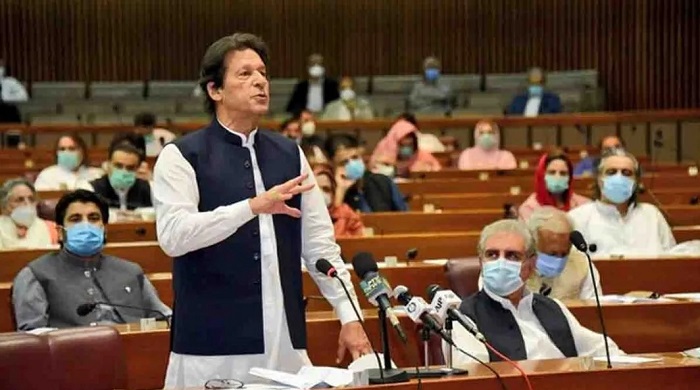
Opportunism behind Imran Khan’s anti Americanism

Opportunism behind Imran Khan's anti Americanism

–  Farooq Tariq  (AEPF)

Suddenly, Imran Khan has become “Anti American”. Former prime minister of Pakistan and head of his Pakistan Justice Party (PTI), Mr Khan is holding mass rallies after losing the majority in the Pakistan national parliament. In his speeches before he was voted out as prime minister but particularly after a no-confidence in the parliament, he is accusing the USA of hatching a conspiracy to oust him from power. He has started a campaign terming it “real independence”. His supporters are campaigning “no to imported government” as a top trend on Twitter since 3rd April when he lost power.  

 Since 17th August 2018, when elected as prime minister, Imran Khan was friendly with the USA and its financial institutions. However, he was unhappy that Jo Biden never called him by  direct telephone call. Previously, he had a very cordial meeting with President Donald Trump in September 2019. On arriving in Pakistan after meeting President Trump, he declared his meeting was similar to winning the second World Cup for Pakistan. Pakistan won a one-day cricket World Cup in 1992 under his captaincy. He was jubilant when Pakistan got USD 6 billion loan from IMF just after he took power in August 2018, with harsh conditionalities.  

 All that changed once a vote of no confidence against him was tabled at the National Assembly on 8th March 2022. He initially challenged his opponents to bring together 172 votes needed for change of the government at the National Assembly. He did not realize that over 30 of his PTI parliamentarians had defected. These defectors were hiding at a place provided by the Sindh government. Sindh, one of the four province, is not ruled by PTI but by the Pakistan People’s Party (PPP) of Benazir Bhutto, who had been assassinated by religious fanatics in December 2007. Now her son Bilalwal Bhutto and her husband Asif Zardari are leading the PPP.  

 Once Mr Khan got wind of defections, he alleged that millions of rupees were paid to buy off the political loyalties of PTI defectors. He accused the United Opposition, which brought together arch rivals the Pakistan Muslim League (PML) and the PPP together, for conspiring and removing him from power through bribes and conspiracies. The  PTI government had become very unpopular because of its bad governess and the unheard of inflation due to the implementations of the IMF-mandated conditionalities. This was the real reason for the defection of PTI parliamentarians who were of the view that the  PTI had lost popularity and they would not win the upcoming elections on the PTI platform. The next general elections are due in 2023.  

In the meantime, the coalition government of Imran Khan also showed cracks in their ranks and several important allies publicly broke with the ruling coalition, resultantly Imran Khan lost the majority in the parliament. 

 In absolute desperation, Imran Khan announced that his PTI would hold a historic sit-in against these political moves and gave a religious touch to his rhetoric. At that juncture, he was using threats to disqualify his parliamentarians who had defected from the PTI.  

 On 27th March, his so-called million march was attended by less than 20,000 in front of the federal parliament where he waved a letter that he claimed was a ‘message of threat’ passed by a foreign power. He claimed that he got this letter on 7th March, a day before tabling of vote of no confidence.  

 The PTI Speaker of the National Assembly refused to hold a vote on the No Confidence motion in violation of the constitution. The United Opposition went to the Supreme Court against this unconstitutional act of the PTI government. The Supreme Court had rescued the PTI government several times prior to this hearing. The top judges were considered to be pro-PTI. After four days of hearing, the Supreme Court gave a verdict against the PTI and ordered the Speaker to call the National Assembly session and hold a vote on 3rd April.  

 The difference this time, was the so-called ‘neutrality’ of the military establishment during the crisis. No parliamentarian received any telephone call by “unknown” persons as was the case in the past. The military establishment which had helped Imran Khan to come to power in 2018, was not happy for several reasons. Imran Khan wanted to replace the sitting army chief, General Bajwa, with his own favourite: General Faiz Hameed. The military establishment was also in trouble because the army was being blamed for the bad governess of PTI government since the military establishment rigged the previous elections to bring Mr Khan to power. The apparent neutrality was a signal to the PTI allies and defectors to help the United Opposition in ousting the Imran Khan government. But Imran Khan kept addressing the nation on television on an almost daily basis before he was removed and in one of his final speeches, he named – apparently as a Freudian slip of tongue – the USA as the conspirator.  

After a high pitch theatrics, a vote of no confidence was held and Imran Khan was voted out. This was only possible through military’s covert intervention.  

Since he lost power Imran Khan rhetoric against the USA has intensified. Imran Khan’s anti- America stand cannot be termed as anti-imperialism. It is an opportunist act to deceive people. It is an act of sheer desperation. It is an act of anti-imperialism of the fools. It is to find an excuse for generating public support. It is an exploitation of anti-imperialist feelings of the people of Pakistan.  

Imran Khan ruled Pakistan for three and half years accepting all the harsh conditionalities of IMF and raised the prices of electricity, gas, petroleum products along all the kitchen items. He never raised the wages according to the level of price hike. He was a committed neo-liberal, staunchly anti-left who tried to do away with the pension system. He introduced a “health card” which allowed all the private hospitals to treat the patients at the public expense. This policy was aimed at pleasing the private hospital mafia. Instead of building new public hospitals and medical colleges, he tried to privatize all areas of the health sector. Most of sugar mill owners were from his party and the sugar price went up from 55 Rupees a kilo to 110 Rupees a kilo in three years.  

In the realm of culture, he tried to ‘Islamize’ every aspect of state and society. Imran Khan, for instance, introduced “single national curriculum” to further introduce religion in education. In at least one province, the Punjab, even PhD scholars in sciences now have to study Quran. The school children are supposed to recite Quran on daily basis. He tried to employee 70,000 religious’ teachers at the school level instead of improving the present education staff.   

Being an anti-American, his effort is to attract the conservative votes. “Death to America” was a popular slogan of the extreme religious fanatics including the Taliban and al-Qaida. There is a great difference between “Anti Americanism and Anti-imperialism”.  

We as the left, are anti-imperialists and not Anti-Americans. Anti-Imperialism means opposing colonialism, imperial hegemony, and defending the right of self-determination. Progressive anti-imperialism means opposing all imperialist states, not siding with some of them against the other. Imran Khan says that because he went to Russia and supported President Putin during the Ukraine war, hence Americans wanted him out of power. For him, it is ok to side with Russia, a thoroughly imperialist state as opposed to the USA. To quote Farooq Sulehria, a left wing activist,  

 “Anti-imperialism is freedom, for all oppressed, from all oppression. In contrast, an Osama bin Laden, or Ayatollah Khomeini for that matter, offers an anti-imperialism that does not tolerate these values. Theirs is an anti-imperialism that chokes minorities and strangles small nationalities. Anti-imperialism represents liberation. One cannot be a liberator and an oppressor at the same time. The anti-imperialism that upholds Osama as its poster boy does not solve this contradiction. We have seen this anti-imperialism in action in Pakistan’s neighbourhood, exemplified by Iran, or Afghanistan under the Taliban where it was reduced to burqa and massacre of minorities”.  

Imran Khan’s “anti-imperialism of an opportunist” is the latest variety on display. His “anti-imperialism” is based on repression of women, religious minorities, trade unions, peasant organizations and all the political parties. He termed all opponents as traitors.  

 Imran Khan termed Osama Bin Laden as “martyr” in August 2020, while he was prime minister.  His ministers termed this as slip of tongue. But on 13th April, 2022, while Imran Khan was speaking at mass rally in Peshawar, one of his charges against the US was that they killed Osama Bin Laden in Pakistan.  

We in progressive movements have never sided with religious fanatics when they were fighting NATO or American forces in Afghanistan as they were not anti-imperialists. Imran Khan is a softer version of extreme religious fanatics. Being “anti-America” implies more votes from the extreme right. This is sheer opportunism and not anti-imperialism. Internationally, an impression is being given that Imran Khan has been overthrown because he was an anti-America. Far from it, this was an afterthought to build a political narrative that could help find some support among the ordinary people. We must not be fooled by Imran Khan empty anti-imperialist demagogy.  

Read More

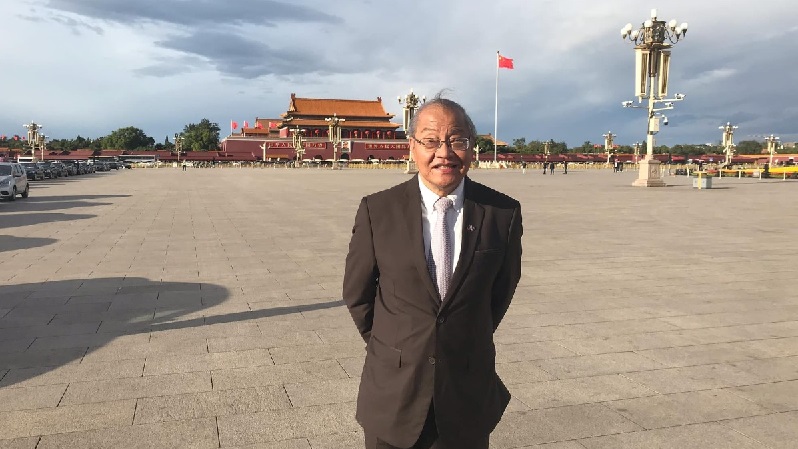
STATEMENT ON THE DEMISE OF JOSE SANTIAGO CHITO STA. ROMANA

STATEMENT ON THE DEMISE OF JOSE SANTIAGO CHITO STA. ROMANA

It is with grief and sorrow that we heard about the demise of his Excellency. Comrade Jose Santiago Chito Sta. Romana, Ambassador of the Philippines to China, a prominent fighter for peace and our respected friend.

His passing away is a great loss for not only his family but also people’s movements of the Philippines, as well as in Asia and Europe.

The Asia-Europe People’s Forum honours this charming personality, and especially to the great contributions to the work of the Peace and Security Cluster where he was a regular contributor. We remember his work for peace and human security.

The AEPF would like to convey its profound condolences to the family and loved ones of Ambassador Chito and strongly believe that his efforts to advance the cause of world peace will continue, and his tremendous contribution will be his legacy to us and generations to come.

In solidarity

Read More

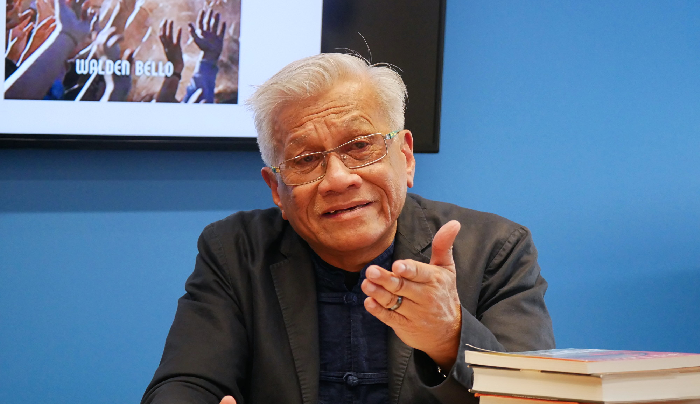
Support to Dr.Walden Bello from Slanderous Statements

Support to Dr.Walden Bello from Slanderous Statements

Recently, a political party founded by Sara Duterte (daughter of Philippine President Rodrigo Duterte), incumbent Mayor of Davao City, and now vice-presidential candidate for the 2022 national elections—unfoundedly and maliciously labelled Former Member of The Philippines Congress Dr. Walden Belo as a “narco-politician.”

This attack is clearly intended to silence dissent and undermine free speech. This is not unprecedented under the Duterte regime. Anyone who dares to speak truth to power and criticize the administration and its allies are harassed or worse, killed. 

To draw international attention to this politically-motivated attack against Dr. Belo, hundreds of organisations and eminent individuals have released the following statement. 

Background Context

In a recent statement released by Hugpong ng Pagbabago (HNP or Alliance for Change), the regional party founded by Sara Duterte, daughter of Philippine President Rodrigo Duterte, activist-scholar Professor Walden Bello was unfoundedly and maliciously labelled as a “narco-politician.” 

Prof. Bello is currently running for Vice President under Laban ng Masa (Fight of the Masses), a left-wing electoral coalition of democratic socialist and progressive groups, against Sara Duterte and several other candidates for the May 2022 Philippine National Elections. Last March 20, 2022, in a televised debate, Prof. Bello called out the issue of illicit drug trade in Davao City, dubbing it the “Drug Center ” of Southern Philippines. Prof. Bello questioned why the former aide of Sara Duterte (Davao City’s incumbent Mayor) was exonerated and freed despite clear involvement in a recent drug bust in Davao. Prof. Bello also pointed out that Sara Duterte’s refusal to attend the said debate displayed a glaring lack of public accountability in confronting the said issue, against the backdrop of thousands killed in the Duterte administration’s deadly “war on drugs”.  

In retaliation, Prof. Bello was painted by the HNP “as a danger to peace and order and a threat to the anti-illegal drugs campaign of the government”, and accused of supporting the same drug trade he called out by supposedly withholding information from the authorities. This narco-tagging comes on top of Prof. Bello’s declaration as a persona non grata in Davao City (an act that further vilifies him), along with a 10-million peso (USD 192,000) “cyber libel” lawsuit filed by Sara Duterte’s former aide—a criminal case under Philippine laws that might lead to incarceration despite an ongoing trial.

Statement of Solidarity & Support for WALDEN BELLO amidst Narco-Tagging incident

WE, THE UNDERSIGNED INDIVIDUALS AND ORGANIZATIONS vehemently condemn these defamatory and dangerous actions against Prof. Bello. While the premise behind HNP’s accusation is both baseless and senseless, we are deeply concerned by the convoluted logic and narrative constructed against Prof. Bello due to their serious implications on his safety and security. Such accusations, in this case, are politically motivated; designed to induce prejudice and shift the burden of proof to those painted as involved in the illicit drug trade. Ultimately, it is to silence those who dare speak truth to power by exposing them not only to a trial by publicity but to the serious threats to life and liberty posed by the “war on drugs” campaign.

Prof. Bello’s reputation, credibility, and contributions as a progressive activist and public intellectual speak for themselves and are inconsistent with the imputations being hurled at him. Prof. Bello has been a key figure in the international human rights movement, being actively engaged in the advancement of democracy and social justice since the Marcos dictatorship. Furthermore, as the Right Livelihood Award (also known as the Alternative Nobel Prize) had described him, Prof. Bello has made a “major contribution to the international case against corporate-driven globalization as a human rights and peace campaigner, academic, environmentalist, and journalist.”

Prof. Bello has assumed different posts at various academic institutions in the Philippines, across Asia and the United States. Prof. Bello obtained his PhD in sociology from Princeton University in 1975 and is currently the International Adjunct Professor of sociology at the State University of New York at Binghamton. He has also served in varying positions with several well-respected policy think tanks and non-governmental organizations at the national, regional, and international levels such as Executive Director of Food First, Co-Founder and Co-Chair of the Board of Focus on the Global South, President of Freedom from Debt Coalition, Member and Former Chair of the Board of Greenpeace Southeast Asia, and Member of the Board of the International Forum on Globalization, the Transnational Institute, and Nautilus Institute, and Member of the ASEAN Parliamentarians for Human Rights.

Furthermore, as a human rights advocate, Prof. Bello has also been one of the vocal critics of Duterte’s “war on drugs.” Since 2016, he has stood in solidarity with various civil society and human rights groups condemning the campaign as a war against the poor and asserting that such a violent approach that narrowly seeks to eliminate alleged drug users and pushers will not address the root cause of the drug problem.

Narco-tagging or any other malicious form of political labelling against activists, dissenters, and opposing voices MUST NOT BE TOLERATED. If this can be done to Prof. Walden Bello—a globally renowned intellectual, human rights advocate, and former Philippine legislator, what more to ordinary people?

WE CALL ON all organizations, movements, networks and individuals committed to upholding human rights, democracy, justice and peace to condemn this irresponsible and life-threatening narco-tagging and the baseless cyber-libel lawsuit, and express our solidarity and support for Prof. Walden Bello, and all those who seek justice, public accountability and genuine democratic participation.

The statement remains open for more endorsements.  To endorse, please click:
https://docs.google.com/forms/d/e/1FAIpQLSeEJ9qA-lyAoe8Jskrdk5iflpO-MUIg5vXNNn_mQYlzkx8AcA/viewform


Read More

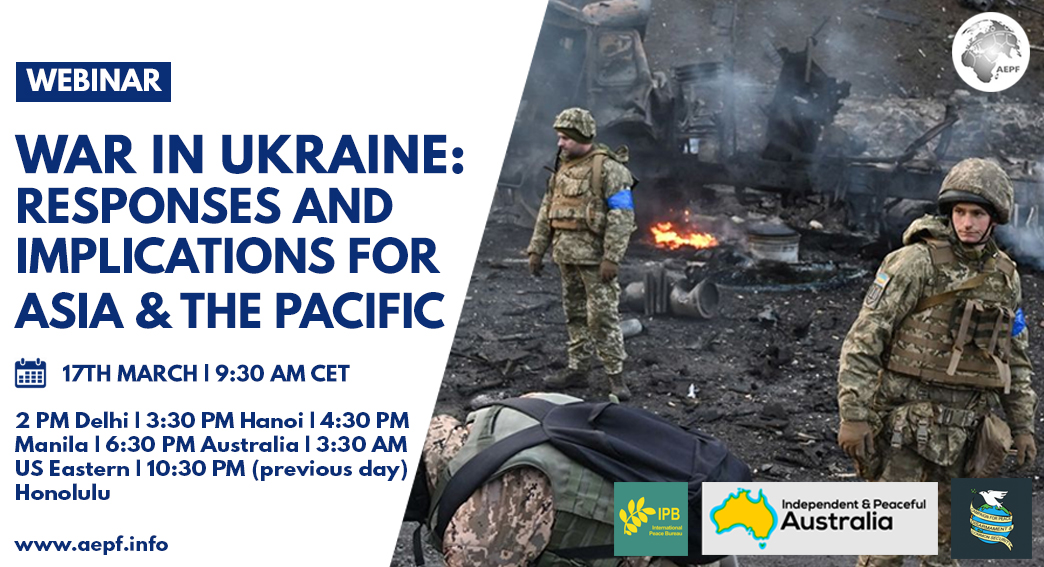
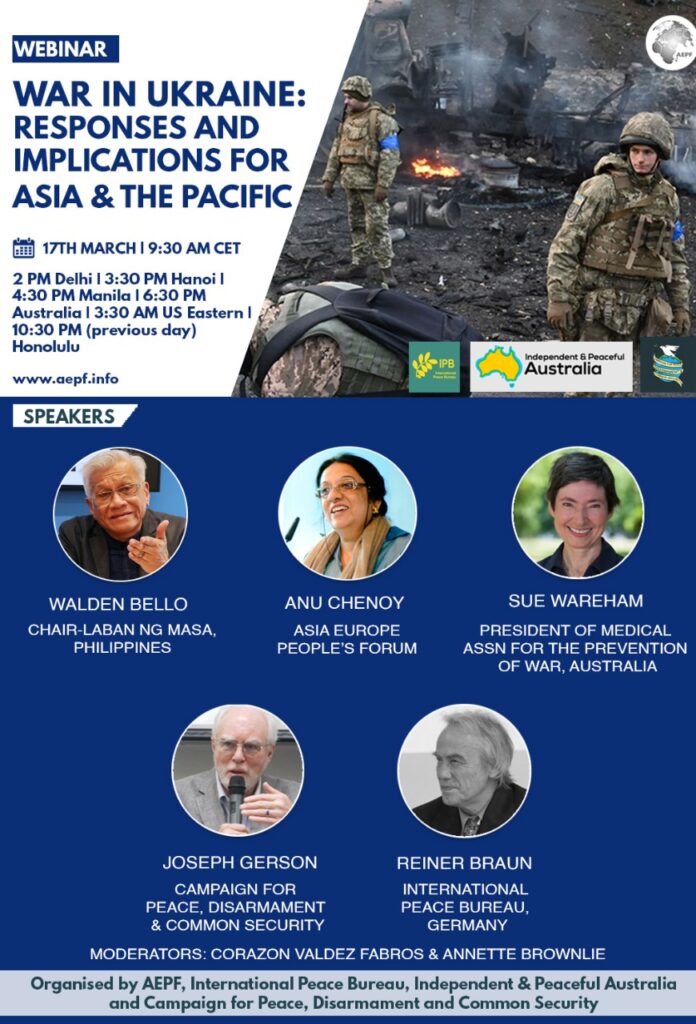
Webinar: War In Ukraine – Responses and Implications for Asia and the Pacific

Webinar: War In Ukraine - Responses and Implications for Asia and the Pacific

While calling for peace in Ukraine, this webinar focuses on the responses and implications in the Asia Pacific. It looks at how states, civil society and peace movements of Asia Pacific have reacted to this war. We will strategise on what role peace movements can play for sustainable and just peace.

Watch the Webinar

Co-organizers:
– Asia Europe Peoples Forum
– International Peace Bureau
– Independent & Peaceful Australia
– Campaign for Peace, Disarmament and Common Security

Speakers:
– Reiner Braun, International Peace Bureau (Germany)
– Anu Chenoy, AEPF Peace and Security cluster (India)
– Dr Sue Wareham, President of Medical Association for the Prevention of War (Australia)
– Lau Kin Chi, Global University for Sustainability (Hong Kong)
– Joseph Gerson, Campaign for Peace, Disarmament & Common Security (USA)

Read More

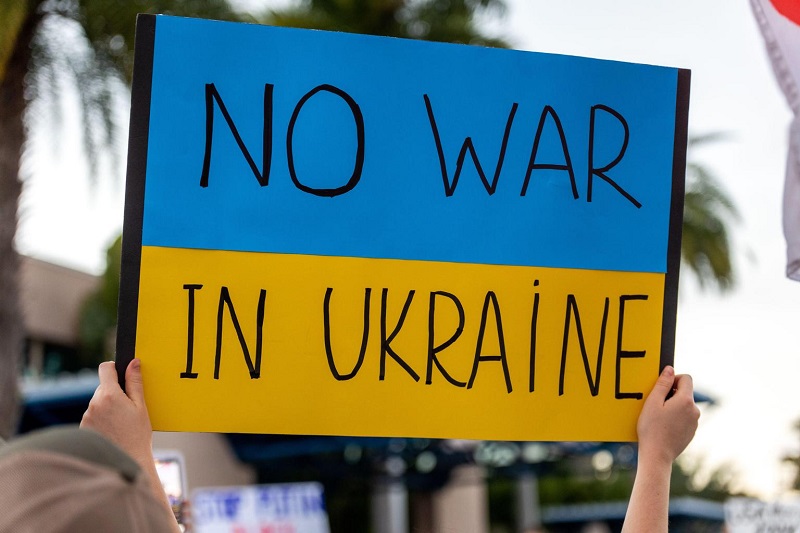
No to War in Ukraine

No to War in Ukraine

The Asia Europe Peoples Forum (AEPF) condemns the aggression and war by Russia in Ukraine. AEPF is opposed to all act of force and calls for an immediate cessation of hostilities and a return to dialogue. This Russian aggression is causing death and damage in immeasurable ways. We believe that war cannot be a solution and compromise and negotiation is the only way forward. Safeguarding human rights and human security should be at the center of the negotiated settlement between Russia and Ukraine.

It is evident that policies of competitive security and one sided military alliances have enhanced threat perceptions. This has led to a break down of dialogue leading to this terrible situation where ordinary people are facing the brunt of war.

We believe that inclusive and common security alone can lead to sustainable peace. For peace with justice an immediate ceasefire is essential. It would be positive to revitalise the Minsk Agreements, get the leadership of Ukraine and Russia back on the negotiation table, involve the the Council of Europe and the Organization for Security and Cooperation in Europe (OSCE) of which Russia is an affiliate to stand as guarantor of peace.

The real existential issues faced by people across the globe are climate change, inequities and lack of social justice and violation of rights. For this to be realized war and militarism should be collectively ended. We join peace movements and civil society across the world in appealing for a sustainable peace with justice.

Read More

EU: Time to Act on Human Rights Situation in the Philippines

EU: Time to Act on Human Rights Situation in the Philippines

February 20, 2022

Asia-Europe Peoples Forum (AEPF)

Statement on the European Parliament’s Urgent Resolution on the Human Rights Situation in the Philippines

 EU: Time to Act on Human Rights Situation in the Philippines


We, civil society organizations from Asia and Europe under the banner of the Asia-Europe Peoples Forum (AEPF) call on the European Commission (EC) to urgently act on the situation in the Philippines and initiate withdrawal procedures with respect to the Generalized Scheme of Preferences (GSP+) granted to the Philippines.

 Our call echoes  the concerns raised by the members of the European Parliament contained in two European Parliament Resolutions (2020/2782 and 2022/2540 (RSP)) on the human rights situation in the Philippines.

In its 2020 Resolution, the European Parliament already drew attention to the rapidly deteriorating human rights situation in the Philippines including the attacks on human rights defenders under President Duterte and the thousands of extrajudicial executions and other serious human rights violations linked to the government’s war on drugs.

Furthermore, serious concerns were already raised over the deteriorating level of press freedom in the Philippines and condemned all cases of threats, harassment, intimidation, unfair prosecution and violence against journalists. Two years ago, the European Parliament sounded the alarm already on policies like the newly adopted anti-terrorism law, and proposals to reinstate the death penalty that could further undermine human rights in the country and go against the human rights obligation of the Philippines.

 The latest urgent resolution highlighted, among others, the following critical developments that point to the failure of the Duterte government to address the issues and concerns raised: 

  1.   The Supreme Court upheld the legality of most of the Anti-Terrorism Act passed by President Duterte’s administration, which gives security forces the power to arrest and detain suspects for up to 24 days without a warrant and without bringing charges;
  1.   COVID-19 pandemic has further accelerated the deterioration of the human rights situation in the Philippines, particularly with regard to freedom of expression, media integrity and predictable enforcement, and has had grave repercussions on the capacity of the media and civil society to document such transgressions; whereas the most vulnerable communities in urban areas have been seriously affected by the police and the military’s use of violence to enforce quarantine;
  1.   The UN High Commissioner for Human Rights, Michelle Bachelet, in her most recent report on the Philippines of 7 October 2021, stressed that continuing and severe human rights violations and abuses across the country are taking place and that basic human rights standards are being ignored;
  1.   The ICC pre-trial chamber announced that it had authorised the Office of the Prosecutor to open an investigation into crimes against humanity including murders committed in the context of the ‘war on drugs’ under the administration of President Duterte and also into those allegedly perpetrated in Davao City by the so-called Davao Death Squad from 2011 to 2016
  1.   The Philippine House of Representatives adopted at third reading House Bill No 7814, which according to the Philippines Human Rights Commissioner ‘provides for presumptions of guilt for people accused of being traffickers, financiers, protectors, coddlers and/or being involved in illegal drugs’ and ‘also attempts to reintroduce the death penalty’;
  1.   The adoption of the Human Rights Defenders Protection bill, passed by the House of Representatives, is still pending in the Senate

As civil society organizations in both the EU and Asia that follow the developments in the Philippines, and have worked closely with Philippine CSOs and movements,  we supported the grant of special trade preferences to the Philippines in 2014 under the EU’s Generalized Scheme of Preferences (GSP+). GSP+ is meant to advance sustainable development and good governance in the Philippines. These privileges were granted on condition of the Philippine government’s fulfillment of its obligations under the 27 conventions on human and labor rights. 

Given the seriousness of the human rights violations in the country, the European Parliament has once again called on the European Commission to immediately initiate the procedure, which could lead to the temporary withdrawal of GSP+ preferences. 

We support this renewed call, which echoes similar calls made by Philippine groups, and urge the European Commission to take decisive actions to initiate the process of withdrawal of these preferences.

Read More