Webinar: Knowledge as Commons – Towards Freedoms

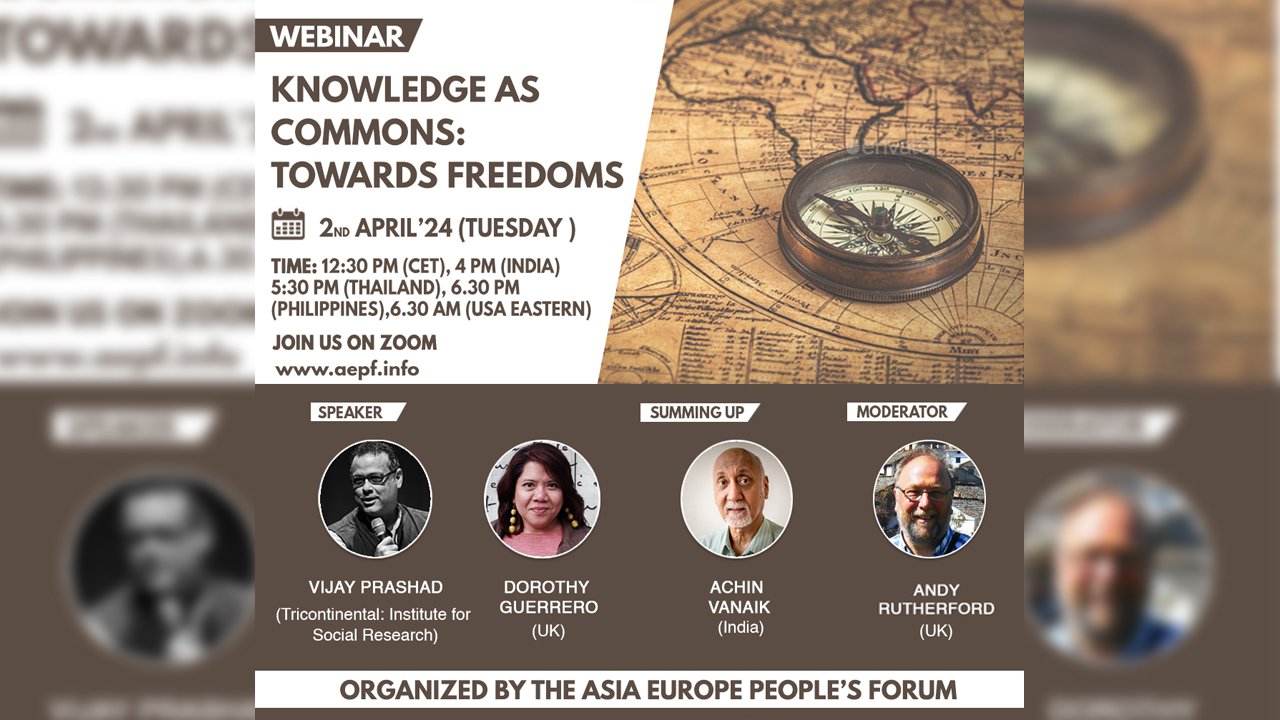
Webinar: Knowledge as Commons - Towards Freedoms

Watch the Webinar

For human progress scientific knowledge needs to be part of the Global Commons.

Speakers: Vijay Prashad, (Tricontinental: Institute for Social Research) & Dorothy Guerrero (UK)
Summing up: Achin Vanaik (India)
Moderator: Andy Rutherford (UK)

Read More

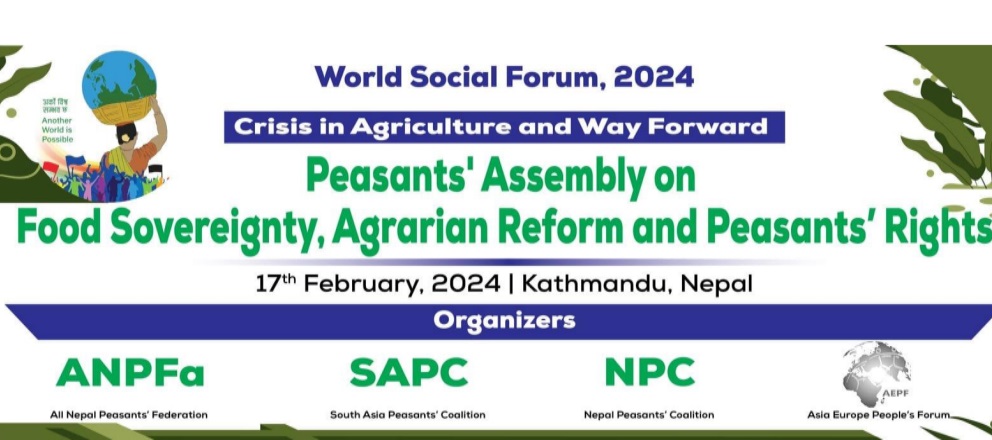
Declaration of the Peasant Assembly at the World Social Forum, Kathmandu Nepal 2024.

Declaration of the Peasant Assembly at the World Social Forum, Kathmandu Nepal 2024.

Download the Declaration

Square of Statement
Kathmandu Declaration
17th February 2024

We, the representatives of All Nepal Peasants’ Federation (ANPFa), South Asia Peasants’ Coalition (SAPC), National Peasants’ Coalition (NPC) and Asia Europe Peoples’ Forum (AEPF), including different agricultural labor unions, plantation workers’ unions, peasants, women, Dalit, indigenous people, consumers, policy makers, media, workers, and fisher-folks have gathered here in Kathmandu, for 16th edition of the World Social Forum, to activate, extend support, and strengthen and consolidate worldwide solidarity and commitments to the peasantry movements in Nepal, South Asia region along with global level.

We, farmers worldwide, are marginalized by anti-peasant policies of the government and by the policies of International Financial Institutions (IFIs), including the World Bank and the International Monetary Fund (IMF), and multilateral trade institutions, such as the World Trade Organization (WTO). Policies of neo-liberalization, deregulation and privatization have adversely impacted lives and livelihoods of peasants. Most of the subsidies in agricultural inputs and minimum support pricing legislations have been made ineffective or withdrawn.

Over the decades, there has been rampant supply of Hybrids and GMO seeds from multinational companies and the traders make compulsion to buy and grow in the agricultural communities by virtue of which the indigenous seeds are disappearing. Increasing use of such seeds have made compulsion to use modern fertilizers and pesticides in commercial as well as home consumption cereal crops too. There are multiple reports over detrimental health effects due to residual chemical effects on pregnant women, children and elderly people’s health by over use of these chemicals.

Food sovereignty-based agriculture is only the key approach for agrarian development which incorporates diversified component of local resources contributing to equity and equality in addressing the need and necessity of marginalized people in Agriculture sector. Now this is
seriously threatened by government hegemony to peasants’ right through several bottlenecks on accessing to natural resources like cultivating land, native and climate resilient seeds, adaptive livestock breeds, potential irrigation sources, forest resources and local indigenous species. In the name of agrarian reform, the land lords and money transfer control number (MTCN’s) agents are monopolistically benefitting. Through liberalization, corporation, land grabbing, residential buildings and tourism, they have dispossessed farmers and fishermen, dismantling their social and cultural communities.

The national policies have failed to address the sufficient food and nutrition supply protocols to the poor peasants, women, factory workers and majority of the rural people. So, in all sectors there is grave violation of human right possessing to food insecurity, malnutrition, poverty and civic inertia.

There is an increasing control of imperialist forces, namely World Trade Organization (WTO), World Bank (WB), Asian Development Bank (ADB), and International Monetary Fund (IMF). The impacts of WTO-dictated policies of liberalization, deregulation and privatization, such as WTO’s Agreement on Agriculture (AoA) with its provisions of market access and reduction of farm export subsidies have proven detrimental to peasants. We continue to fight to keep WTO and Free Trade Agreements (FTAs) out of agriculture. We deeply condemn anti-peasant policies in the name of poverty reduction programmes by the IFIs and multilateral trade institutions, including micro-credits, which have devastated peasants’ lives, many a time causing them to commit suicide. We delight agriculture and food system as a basis of life to peasants and marginalized peoples not a marketed commodity.

All Nepal Peasants’ Federation (ANPFa), South Asia Peasants’ Coalition (SAPC), National Peasants’ Coalition (NPC) and Asia Europe Peoples’ Forum (AEPF) have collectively been advocating for food sovereignty, agrarian reforms, and peasants’ rights. The following demands are in response to the above-mentioned exploitation and marginalization experienced by peasants
in the region:

1. Ensure small-scale farmers’, fisherfolks’, and indigenous people’s control over the region’s food system. Keep multinational corporations out of agriculture and cultivable land.

2. We demand that local food systems be strengthened through the protection of indigenous food varieties, indigenous livestock breed, seed banks, and indigenous technical knowledge.

3. Peasant organizations have been demanding agrarian reforms that focus on increasing productivity, food security, and sustainability and ensuring Food sovereignty and Right to Food for all. Regional governments to enact policies that provide land tenure security, productions inputs, and other service supports to small farmers in appropriate point of time.

4. The right to land is a key demand of ours. We CSOs fight for labor rights, protection from evictions and land grabbing, and access to markets on fair terms. We call for comprehensive land reforms that take gender, caste, and ethnicity into account, and distribute land to the tillers. We aim to create a more equitable and food-secure future for peasants and their communities in a sustainable way.

5. The neo-liberalism designed by corporations and operated through markets that favor unjust profiteering over people’s sustainable development and deny peoples’ collective rights of commons to MTCN.

6. Ensure equal rights to and use of land for women for sustainable agriculture practices. Ensure justice and equality for women, which require the transformation of social and economic arrangements, including access to land, credit, education, social benefits and power through full decentralization to community governance.

7. Supply subsidized and cheap inputs to individual farmers and guarantee crop insurance. Ensure Minimum Support Prices for small farmers in the form of legislation such as Minimum Support Guarantee Act. Increase the State budget allocation in agriculture
parallel to GDP generation through agriculture and forestry sector.

8. Effective implementation of land use policy in each country ensuring protection of fertile farming land. We also demand to stop Foreign Direct Investment (FDI) in primary agricultural production sector and allied industries.

9. Many smallholder farmers in South Asia are burdened by debt due to high interest rates, lack of access to credit, and crop failures. The governments must provide relief and support to these farmers in participation with farmer’s organization.

10. National, Regional and local governments should introduce a comprehensive loan waiver scheme, at the time of crisis, for small and marginal farmers, who are the worst affected due to the agrarian crisis. Which could help these farmers to come out of the indebtedness
trap and revitalize their farming system.

11. We urged governments to recognize and value women’s care work contribution to agriculture through policies and programs. Government must conduct social mobilization in the communities to uplift women farmers in benefit sharing through implementing a women friendly agricultural system.

12. Women are often exposed to high levels of pesticides during agricultural work, which can have adverse health effects, including infertility and cancer. The governments must take measures to protect women from these hazards

13. We call the regional government for better land classification and land use policies to protect the interests of smallholder farmers in the region. This is urgent to achieve an ecological based agricultural system.

14. We need to ensure the farming rights and address the problems faced by peasants in the national parks, conservation areas and buffer zones through an integrated policy and ecology-based protocol.

15. The state must ensure that work is available round-the-year for agricultural workers with a justified wage and working hours.

16. We also call upon other peasants’ movements to join us to broaden and strengthen farmers’ movements.

17. The state should ensure social protection of peasants – health, insurance, and pension but also of peasants, farm workers, tenants, and sharecroppers

18. The state should develop Minimum Support Price guarantee Act at national level; the laws, by-laws and directives for implementation at regional, district and local level.

19. The state should be aware about Water management, flood control measures and other natural disasters dismantling the agriculture land.

Organizers:

1. All Nepal Peasants’ Federation (ANPFa)
https://wsf2024nepal.org/organization/activity/44
2. South Asia Peasants’ Coalition (SAPC)
3. National Peasants’ Coalition (NPC)
4. Asia Europe Peoples’ Forum (AEPF)

Read More

The Non Aligned Movement, Neutrality and Multipolarity

The Non Aligned Movement, Neutrality and Multipolarity

By Anuradha Chenoy*

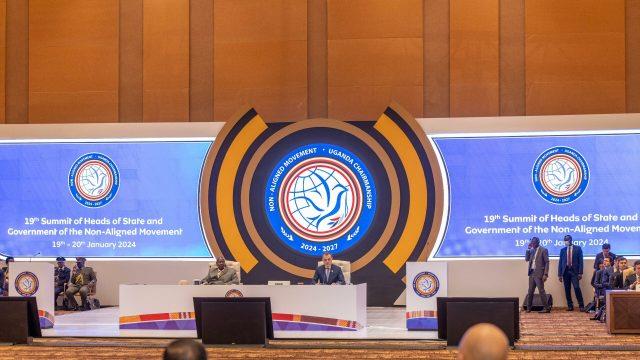
Two summits the Non-Aligned Movement (NAM) and G-77 (Group of 77 countries),  both in Kampala, Uganda January 19_ 22, 2024,   indicate new stirrings in the Global South. This geographical metaphor for the former colonies, earlier called the ‘under developed countries’ and then the ‘Third World’ now clubbed as the Global South,   show collective political assertion that is startling the great and hegemonic powers. 

The gathering of foreign ministers of the 120 countries of NAM   in this 19th meeting, strongly condemned the illegal Israeli  military aggression in Gaza, demanded ceasefire, unhindered, expanded  humanitarian assistance and expressed support for South Africa’s genocide case against Israel at the International Court of Justice. The African Union Commission’s Chair Moussa Faki Mahamat described the war in Gaza as ‘immoral and unacceptable’, while South African President Cyril Ramaphosa  called for a release of the hostages and the start of talks for a just solution for Palestine. 

The Kampala Declaration has not minced words  to ask for an end to Israeli occupation, including achievement of the independence and sovereignty of the State of Palestine, with East Jerusalem as its capital, and also demanded Israel withdraw as the occupying power of the Syrian Golan to the borders of 4 June 1967.

NAM’s  urgent call for ending the unjust war in Palestine, was framed in three intersecting contexts that reflect the concerns of the Global South:

(i)Constructing a multipolar world with a reformed UN as its cornerstone. India’s External Affairs Minister S. Jaishankar, focussed on this, arguing that  despite overcoming colonialism, the world still grapples with new forms of inequality and domination.  South African President also called for reform of the United Nations since it is inadequate in preventing  conflicts. The collective South  clearly believes that a world with  multiple great and middle powers would give more spaces for the voices for the Global South and their platforms like NAM. 

(ii)Emphasis on South-South solidarities. This was the theme of this meeting and the agenda of the G-77 meeting that followed. All African countries are members of NAM and voiced support for a NAM that would work for collective, coordinated policies and solidarity. Regionalisation and decentralization of global decision making was chimed.

(iii)A drive for a more fair and equitable world order. This  was framed in anti-imperialist language by the current president of NAM and host  President Yoweri Museveni, who critiqued ideas and practices of imperialism and ‘uni-ideology’  and questioned “why not respect the freedom of everybody if you are a democrat?” Linked to this were the repeated demands for sustainable development and methodologies for this. It was stated that the last few years had seen more wars and conflicts that were undermining and damaging the interests on the countries of the South.

Through the meeting, there was a recalling of the basic principles of NAM: that respect the UN Charter, sovereignty and territorial integrity; equal recognition of all races; abstention from intervention and interference in internal affairs of another country; opposition to unilateral economic sanctions, with a demand that these be lifted; opposition to collective military arrangements that threatened the security of the rest of the world. 

Declaratory Resistance?

So is NAM primarily a platform for high declarations, with little capacity for action? Unlike NATO for example, that carries out actions, uses military force even without declarations? This impression of non-action stands challenged currently as these examples show:

(i)South Africa a member of NAM, BRICS and the African Union took a lead to practice anti-apartheid and non-violence and take Israel to the  International Court of Justice on a case of genocide against Gaza. It has been backed by many members of the Global South and now formally by the NAM Foreign Ministerial. The countries of the North have largely backed Israel with the US calling the South African case “meritless, counterproductive and completely without any basis in fact whatsoever”. 

(ii) Analysis shows that from 1946 to 2019 (and to date), countries of the Global South have collectively voted in the United Nations for: a two state solution to Israel-Palestine; call for arms control; oppose unilateral economic sanctions; have collectively opposed  US/NATO wars of interventions in the various countries of the Global South. While the US, EU countries have either opposed, vetoed, or voted against these resolutions. 

Is neutrality inherently peaceful?

Non Alignment as policy has advocated neutrality during conflict situations. This movement however, has continuously clarified that this ‘neutrality’ is not a juridical equidistance between warring sides, but a political position, that where there is a ‘just war’ against oppression as there is in Gaza, Palestine  they would take sides. Just as they opposed and did not stand neutral against wars of intervention in Vietnam, Iraq, Libya, and elsewhere. 

Ultimately, it would appear, that the NAM that had started fading after the first Cold War ended and the US declared the ‘unipolar phase’ of its dominance, this movement of the Global South is  once again revving up its act. The NAM does not coordinate its actions, appears anarchic, is  body without a clear structure but has taken a moral if marginalised position in international politics. 

*Anuradha Chenoy is an Associate Fellow of The Transnational Institute, and Adjunct Professor, Jindal Global University (Haryana, India). 

Read More

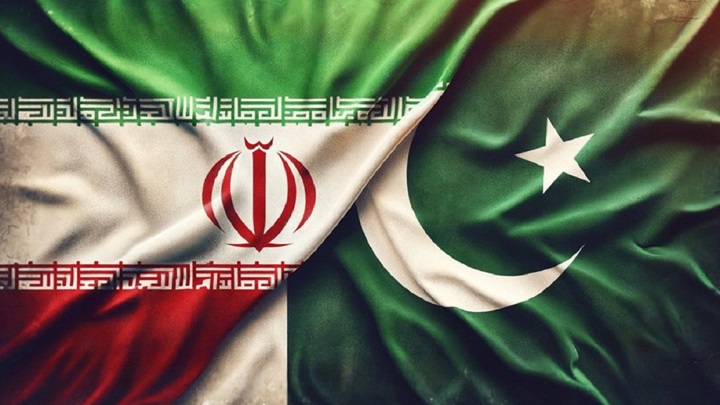
The Pakistan-Iran Border Conflict: In Historic Perspectives

The Pakistan-Iran Border Conflict: In Historic Perspectives

By Farooq Tariq


Pakistan and Iran share a long border that is populated by Baloch tribal ethnic communities on both sides of this fractious border. It is not surprising to know that after World War I, the British colonialist divided Balochistan and gifted Western Balochistan to Iran. This colonial legacy of a divided Baloch people, who still seek to be united causes periodic unrest across the region in both Pakistan and Iran. So besides separatists, radical armed groups, left over from Afghan and other ‘forever wars’ find refuge in these restive regions. 

It is in this melee, that Iran believed that non-governmental forces from Pakistan’s Baloch regions  attacked some cites within the Iranian border on January 16. The Pakistan air force retaliated on 18th January, inside the Iranian bordering town killing at least 9  people. This Pakistan-Iran conflict has the potential to escalate into a full scale war. However, both Pakistani and Iranian governments took a wise step and agreed to de-escalate, maintain a status quo and re-establish full fledge diplomatic relations. Various state actors in the region encouraged this settlement.  

 For the time being, there is a complete lull, as both countries appear satisfied after taking revenge from their “enemies” and spilling some blood of radical elements who take refuge in each other’s country. Both Iran and Pakistan claim to have killed some from the  terrorist group known as the Jaish al Adl (army of justice) in Pakistan and the Baloch separatists in Iran. This Jaish al Adl armed group in Pakistan  claimed responsibility for the attack in the Iranian town of Rask in the Southern border province of Sistan – Balochistan,  an attack that was condemned by Pakistan.

 It is  the Baloch people who are the targets on both sides of the Iran-Pakistan border. Some of these Baloch tribes fight “Pakistani atrocities” and others are fighting the Iranian colonial occupation of part of Balochistan. Pakistan’s attack on “Balochistan separatists camps” in Iran took place at a time when many hundreds of Baloch activists are camping in Islamabad to recover missing Baloch activists and stop extra judicial killings. These Baloch activists came to Islamabad from Turbat district of Balochistan in a long march that caught the attention of many internationally.

 The escalation of border tensions turning into missiles attacks inside Pakistan and Iran has to be seen in the background of Israel’s genocide of Gaza-Palestinians. This is the first time that there has been an air strike and missiles attack by Pakistan inside Iran. It is clear that this satisfies the goals of American imperialism in this region because Iran is their designated enemy and if Iran is kept busy in defending itself from attacks from Pakistan, it would divert them from supporting the Palestinians and Iranian proxies. 

The Background to the Iran-Pakistan Conflict 

There is a long history of border conflict between Iran and Pakistan. There was a guerrilla war in Balochistan during the first Bhutto government in the 1970s. This took place after an elected provincial government of National Awami Party (NAP) in opposition to Pakistan People’s Party federal government was overthrown by Bhutto on the instigation of Shah of Iran in 1973. Many Baloch youth went into the mountains to fight back and many migrated to Afghanistan and Iran.  

 During this decade, Iran tried to bring in other tribes into the neighboring province of Sestan-Balochestan to change the majority of Baloch people into a minority, similar to what Israel did with Palestinians. The Shah of Iran was terrified with the growing resistance of the Baloch tribes inside Iran that he asked Zulfiqar Ali Bhutto to take action against the provincial government of NAP. Bhutto brutally  crushed the Baloch resistance with help of army operations inside Balochistan. The Shah of Iran was afraid of the fact that if Eastern Balochistan becomes independent, then Western Balochistan inside Iranian territory would become part of it. The Baloch people have been targeted since then on both sides but the resistance in many forms continues till today.

Both countries,  the religious groups in Pakistan and nationalist groups in Iran blame each other for harboring  “terrorists” in their countries. If this conflict  escalates again, it would damage both countries’ economies to a low level never seen before. Oil supplies to Pakistan can be hit hard by the Iranians. Trade between the two countries would halt. Already Iran benefits from the “smuggling” of sanctioned Iranian oil in bulk into Pakistan at present.

Earlier in August 2023, the foreign ministers of both countries met in Islamabad to formulate a five-year trade plan with the aim of trade targets of $5 billion. It is important to note that trade activities between Pakistan and Iran continued as usual, even during this fracas, as both countries kept all trade routes open despite airspace violation by Iranian forces and the subsequent retaliatory strike by Pakistani forces. Trade activities continue along border towns including Taftan, Gwader, Kech, Panjgor and Washuk.

 The threat of a full fledge war appears to have de-escalated  at present as the foreign ministers of both Iran and Pakistan have spoken to each other and emphasized “brotherly” relation. However, this is just an interval between the two so-called brother Islamic countries, who are waiting for a better time to strike, depending on  their internal/domestic  crisis situation. 

The women led movement against the Islamic Republic of Iran during the last few years and the women led ‘long march’ by Baloch activists in Pakistan are the real hope for progressive movements in both countries and internationally. There has to be a stop of abductions and killings of Baloch by the Pakistani government and in Iran. Peace in the region is necessary for its dignified survival.

Farooq Tariq
Asia Europe Peoples Forum 

Read More

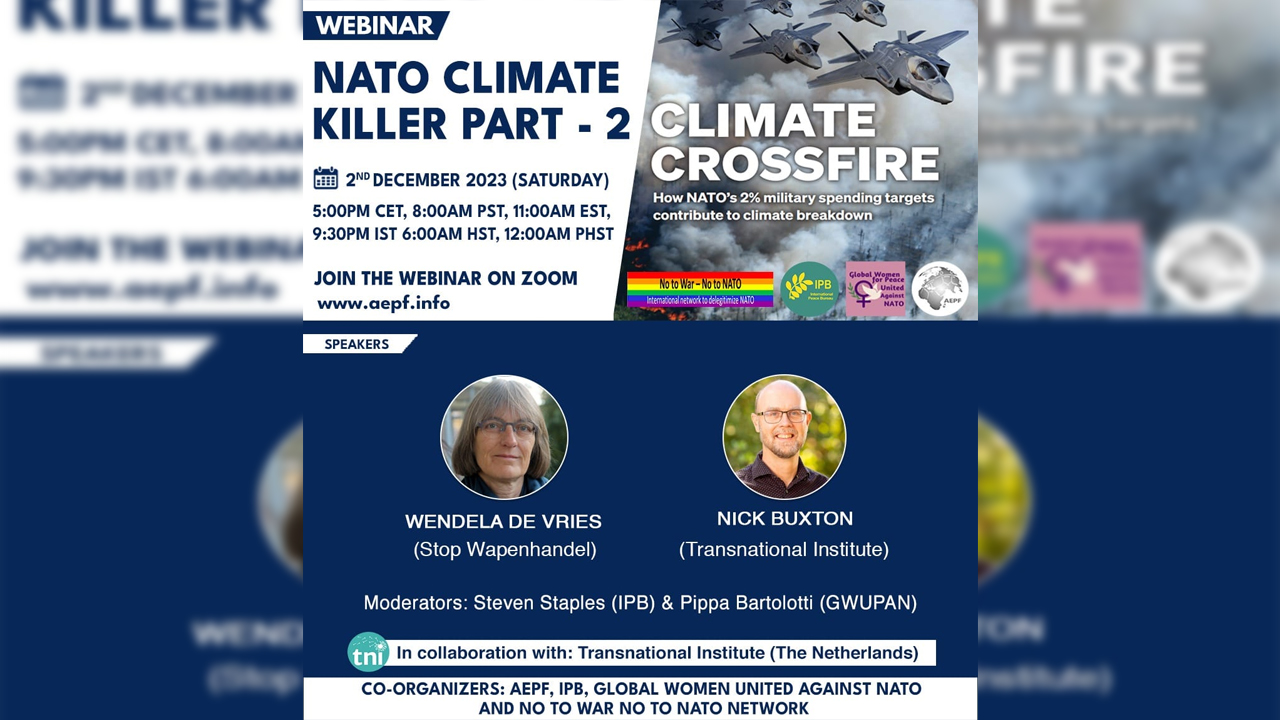
NATO Climate Killer Part 2: Climate Crossfire webinar (Dec. 2)

NATO Climate Killer Part 2: Climate Crossfire webinar (Dec. 2)

The impact of defense and militarisation on climate: listen to the authors and experts of this pathbreaking report.

Watch the Webinar

Post-review of NATO Climate Killer Part 2: Climate Crossfire Webinar, recorded on December 2nd, 2023, during COP 28

Author: Pippa Bartolotti

As we navigate COP 28, this webinar addressed the pertinent issues of military spending and its environmental ramifications.

Ably introduced by the Canadian policy analyst IPB Vice President Steven Staples, this important webinar discussed in detail the links between the military and environmental degradation. Taking place on Day 4 of the COP 28 summit in Dubai, it was a thorough reality check.

The first speaker was Nick Buxton, Transnational Institute, who had some superb graphics and data to support his call to shrink the military, boost renewables and fund poorer nations in their efforts to combat the climate change they did not cause.

He explained that, in view of global emissions significantly exceeding the pledges to stay within 1.5 degrees of warming, (Paris Agreement 2015) we now only have a tiny window in which to take radical action. Shrinking the military was now critical is we are to deliver climate justice.

The gap between policy and action has increased. Those countries promising to make adjustments by 2050 were basically not planning to make any changes at all. In other words, 2050 pledges are the ‘do nothing’ option.

Nick pointed out that holding this COP in a petro-state such as the UAE was rather like asking the head of a tobacco company to launch an anti-smoking campaign – ludicrous. His research showed clearly that those countries with the highest military spending created the most emissions, and that fossil fuel expansion had been the real aim since the end of WW1 when the Ottoman Empire was carved up to reflect the places where oil pipelines were going. The US backed Israeli onslaught on Gaza in order to claim the gasfields off that coast are an ongoing example of this policy.

The global military spend in 2022 was $2.24 trillion. In 2028 it is expected to be $11.8 trillion. The richest countries spend 30 times more on their military than on supporting a survivable climate.

In 2015 £100 billion was promised to help poorer countries. Only half of that has been delivered to date, and that came late.

Russia spends $158b on the military, China $578b, NATO spends $2,327b – that is 55% of global military spending. Of the 2% of GDP spending goal expected from NATO countries, 20% is targeted to be spent on military equipment, thus enriching the military industrial complex.

Nick showed us a map pinpointing the 750+ US military bases across the world, most of which correlate closely with the infrastructure of resource extraction.

Every country now has Climate Security Plans. The trend is to see climate change as a security issue where the victims are seen as threats, where borders become militarised, where exploitation of the vulnerable is increased, and where any form of peaceful response is denied. Spending on borders alone is now twice the spend on climate finance. NATO is now in place to deal with the consequences of the unstable conditions they themselves have created.

The second speaker was Wendela de Vries of Stop Wapenhandle, has been looking at the lack of transparency and accountability of the military across the globe.

She spoke of hardliners evading the subject of emissions, of the NATO Arctic Command established in order to protect deep sea mining in the Arctic. Of how current discussion is fuelling a new cold war and how closely correlated military spending was to a rise in emissions.

Most military spending is now in equipment not personnel. There is not expected to be a rise in numbers of personnel. But expenditure on ships, tanks and weapons would increase.

The military carbon footprint as of 2021 was bigger than the worlds footprint from civil aviation.

Th US emissions are more than all other NATO countries combined. More than 70% of all military emissions come from the US. 50% is from the military and more than 20% is on weapons manufacture.

Future member contributions to NATO are scheduled to rise to 3% of GDP. This is important for the arms industry who want to consolidate long term contracts, but labor and environmental rights are being damaged in the upscaling of weapons production – largely being driven by the Ukraine war.

Wendela spoke of the greenwashing of military products, such as the fallacious term ‘sustainable defence’ being used to greenwash biofuels and synthetic fuels, both of which still require burning for energy, and which will not reduce emissions at all. In the case of biofuels, enormous amounts of land would be required to grow the feedstock, damaging ecosystems and compromising biodiversity. The military are not going to change their energy systems to electricity as that would make all their ships, tanks etc obsolete. Electric propulsion would require a full redesign, and as military hardware is expected to last 40 years, such a proposal is not entertained.

Nuclear, particularly the plethora of small reactors, will make it much more difficult to control the toxic waste, and is no solution at all.

The arms industry still has huge support, many people still believe that the military make the world a safer place, and that thinking has to change. We have to de-militarize to be more safe.

Some interesting points came out of the question and answer session at the end. There was discussion about health being at the heart of peace, that a peaceful world would enable a healthy and dignified life for all. Others were looking for some way out of our current trajectory of everlasting war where every problem looked like a nail, and needed a hammer to solve it.

There was concern that rich countries did not look after poor countries. On the whole the speakers were not optimistic for the future as we sink into dark circumstances in this crisis of all crises.

The real challenge is to put collaboration before competition, to find a different pathway, and to make war illegal. Hope remains with social movements and in the streets.

Co-organized by four esteemed organizations—the International Peace Bureau, Global Women’s United Against NATO, No to War, No to NATO, and the Asia-Europe People’s Forum—this series of webinars seek to provoke thoughtful dialogue and foster a deeper understanding of the complex interplay between militarism and the environment.

Read More

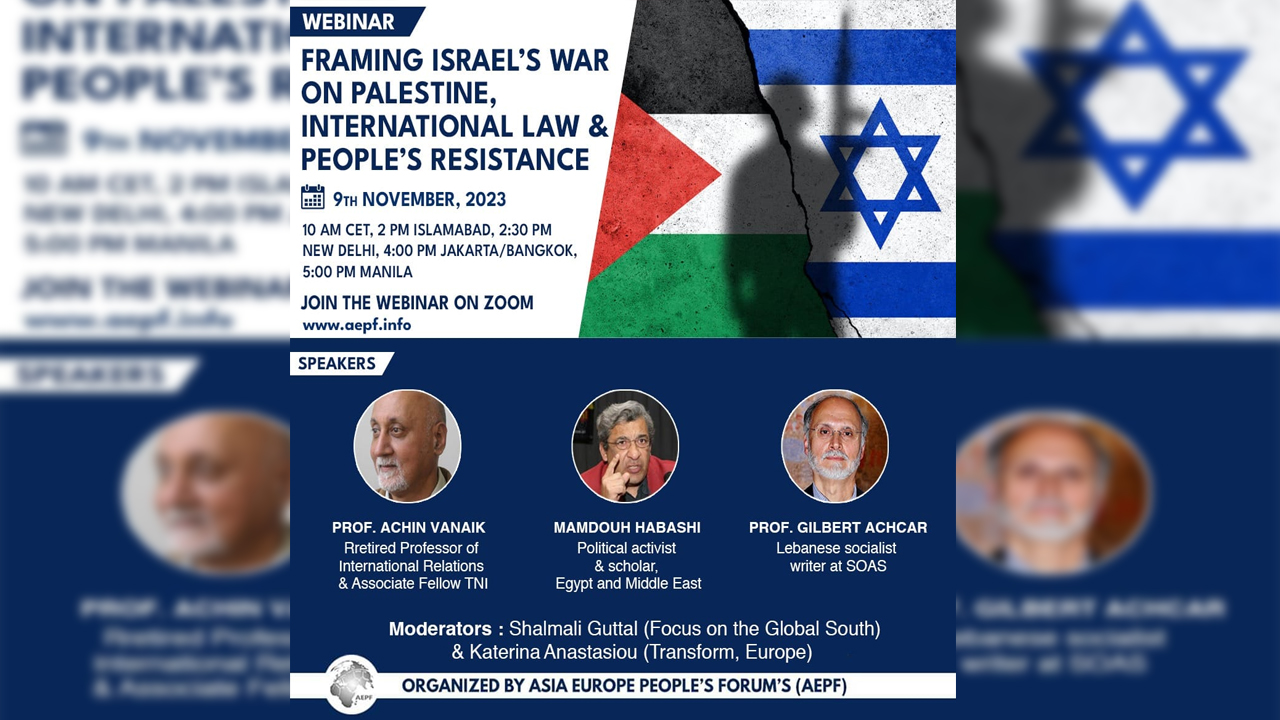
Webinar: Framing Israel’s War on Palestine, International Law & People’s Resistance

Webinar: Framing Israel's War on Palestine, International Law & People's Resistance

The ongoing war by Israel on Palestine in response to terror attacks on civilians by Hamas is now being seen as a disproportionate and motivated response. This response has led to huge people’s protests.

The AEPF is providing a platform to discuss how people’s movements frame this war in the context of international law.

Watch the Webinar

Speakers:

1. Prof. Achin Vanaik, retired Professor of International Relations and Associate Fellow TNI
2. Mamdouh Habashi, Political activist and scholar, Egypt and Middle East
3. Prof. Gilbert Achcar, Lebanese socialist writer at SOAS

Moderators: Shalmali Guttal (Focus on the Global South) and Katerina Anastasiou (Transform, Europe)

Read More

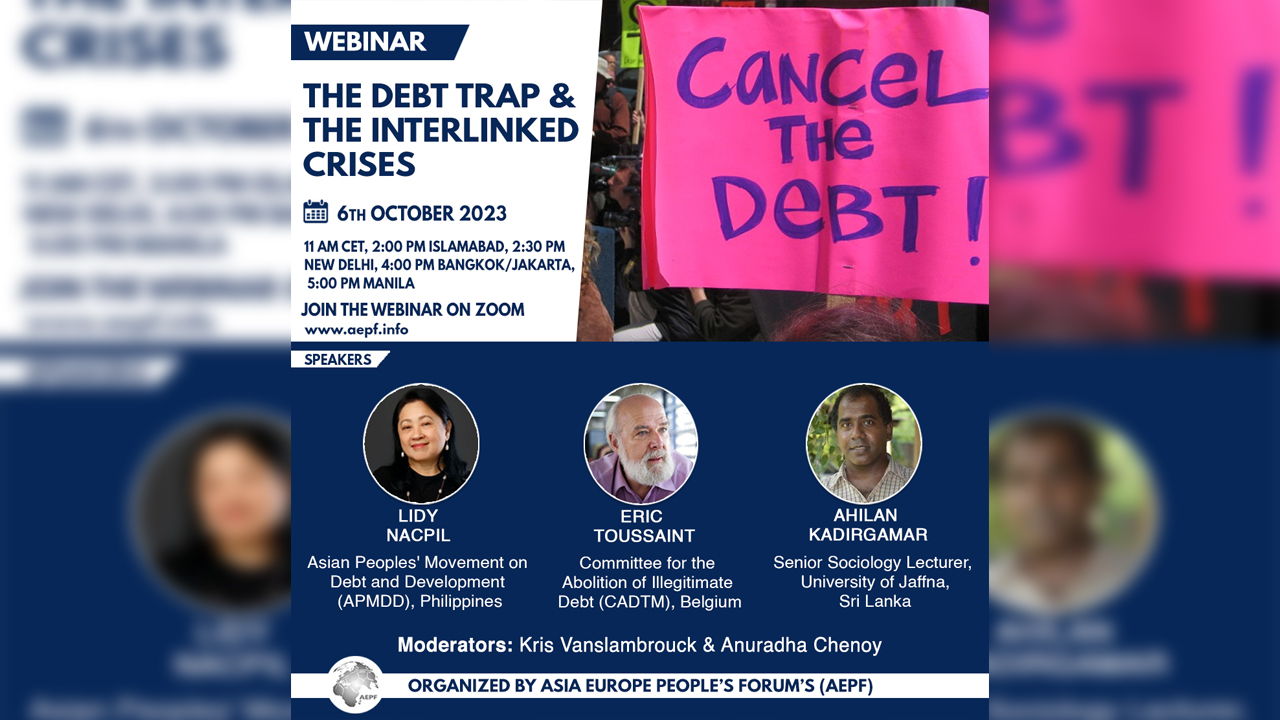
Webinar: The Debt Trap and the Interlinked Crises

Webinar: The Debt Trap and the Interlinked Crises

We continue to witness country after country from the Global South falls victim to the ‘debt trap’ and inability to repay foreign loans.
People in these countries bear the multiple burdens of indirect taxation as governments failing to repay debts and interests to powerful governments pass the responsibility on to unwitting people through indirect taxes, and cuts on subsidies on health and education that further impoverish an already oppressed mass.

This forces governments and people to depend on fossil fuels, resort to regressive social practices and encourage displacements and migrations in search of sustainable life.

This webinar with renowned experts will examine the reasons for the debt and explain how people put pressure to escape these cyclical debt and poverty traps.

Watch the Webinar

Speakers:

– Lidy Nacpil: Asian Peoples’ Movement on Debt and Development (APMDD), Philippines
– Eric Toussaint: Committee for the Abolition of Illegitimate Debt (CADTM), Belgium
– Ahilan Kadirgamar: Senior Sociology Lecturer, University of Jaffna, Sri Lanka

Read More

Multistakeholderism: Is it good for developing countries?

Multistakeholderism: Is it good for developing countries?

The preparations for the September 2024 Summit of the Future (SOTF) are well underway. In this process, the UN Secretary-General and most OECD countries argue that multistakeholderism should now be accepted as a part of global governance and multilateralism. This paper argues the opposite: multistakeholderism undermines multilateralism and limits the role of developing countries in global governance.

Download: Multistakeholderism: Is it good for developing countries?  (PDF)

Global governance operates via a common narrative, a set of institutions, and the exercise of power. The first section of the paper provides the background to the World Economic Forum’s role in developing the narrative and the preliminary efforts of transnational corporations (TNCs) and major Northern NGOs to build an institutional structure for multistakeholderism. The first section also locates these developments in the context of TNC pressures on the UN and developing countries, going back 50 years to President Allende’s appeal to the General Assembly and UNCTAD.

The second section identifies six fundamental challenges presented by multistakeholderism to multilateralism and G77 governments.

(a) an erosion of sovereignty
(b) the outsourcing of global governance
(c) a decline in accountability and trust in the international community
(d) a shift in implementation from OECD governments to TNCs based in OECD countries
(e) a narrowing of the range of policy directions to those that are compatible with a commercial return; and
(f) a corruption of diplomatic language by masking the legitimate difference in governance actors as equivalent ‘stakeholders’

After an in-depth analysis of each challenge, the paper concludes with a menu of multilateral options to respond today and in the context of the SOTF to multistakeholderism’s intrusion into global governance. The choices include counter-moves on the political level and on the procedural level, the combination of which allows governments to create a variety of counter-strategies.

Read More

Our Future is Public: Energy Democracy Movements Declaration

Our Future is Public: Energy Democracy Movements Declaration

The Energy Democracy Declaration is a result of a two-day Energy sector meeting as part of the international Our Future is Public conference in Santiago, Chile, that involved Indigenous representatives, trade unions, ecofeminists, climate justice organisations, solidarity collectives and NGOs. It outlines six dimensions that can jointly pave the way forward to ensure clean, affordable energy for all.

Download: Our Future is Public: Energy Democracy Movements Declaration  (PDF)

Introduction

It has never been clearer: profit-driven energy corporations have influenced governments, international institutions and UN environmental conventions in support of policy decisions that favour greed and capital accumulation. As such, these policies are failing to prioritise ecological and human needs. There are severe and deep cracks in the blind faith in neoliberal market economics, founded upon decades of privatisation, extraction and exploitation.

As billions across the world face energy poverty and record high energy bills, this is a crucial moment to transition towards a public energy system rooted in justice, solidarity and democracy. It is time to unite globally to put the care of people and our planet before profit.

As we rise up against injustice, we work together for energy democracy. We see the fight for energy democracy as part of the wider struggle towards climate justice that acknowledges the intersections between racism, classism, capitalism, economic injustice, gender exploitation, and environmental harm. We need to make the necessary systemic changes to realign our economies with our natural systems. From local collectives to regional, national and international transformations: we have solutions. There are social and technological challenges ahead of us. There are also false solutions to the climate crisis which replicate colonial capitalist patterns. Yet groups fighting for energy democracy at all levels of society are leading resistance and remedies towards a better future.

We stand at a turning point at the intersection of multiple crises. How do we end energy poverty without further fossil fuel extraction? What does it look like to decolonise and dismantle exploitative energy policies at local and international levels? How do we actualise reparations with and for global South countries on the frontlines of the climate crisis so that they can decarbonise? How do we develop participatory planning and ensure equity in new energy models?

Ultimately, we have the choice of two energy transitions: green colonial imperialism or energy democracy underpinned by equitable public ownership. The latter ignites a fundamental shift in how we understand, value, consume and manage energy beyond economic cost.

It is time to

  • Decarbonise – Democratise – Deprivatise – Decolonise
  • Depatriarchalize – Demarketise – Decommodify – Degrow
  • Our global, regional, national and local energy systems!

Support the global movement to reclaim our energy systems.

Support the Declaration 


Read More