AEPF 13: Lessons of the Indian Farmer’s movement

Lessons of the Indian Farmer’s movement

Watch the Webinar: 

The current struggle of Indian farmers is the most important mass mobilisation in decades and represents the biggest challenge to the BJP government since it first came to power in 2014. The farmers are protesting against the three agricultural-reform laws forced through Parliament which the Indian government insists are necessary to overhaul an antiquated and obsolete system. The session looked at the dynamics of the ongoing farmers mobilisation in India and the various opportunities it presents.

Objectives:

  • To understand the deeper issues and the crises plaguing the Indian agriculture for the last three decades. Setting the agrarian situation in India, and locating farmers movement in that context.
  • An analysis and lessons from the strength of the movement and its capacity to unify and ally with a larger mass transforming the issue from sectoral demands to a bigger political question.
  • The wider context of the movement and the challenges.
  • Exploring the issue of the marginalised, Dalits, Adivasis, landless farmers, agricultural workers and others who are not at the forefront of the struggle. Their involvement in the movement and stakes in the new farm laws and ongoing agricultural reforms in general.
  • Caste, class divide within the movement and the way forward.
  • Possibilities, hope and defragmentation.
  • Ideas and lessons.

Speakers:

Manoj Jha: Member of Parliament, India; Professor, Delhi School of Social Work.
Yogendra Yadav: President, Swaraj India
Amarjit Kaur: General Secretary, All India Trade Union Congress
Kanimozhi Karunanidhi: Member of Parliament, India; Secretary, Women’s Wing, Dravida Munnetra Kazhagam
Praveen Jha: Professor, Jawaharlal Nehru University

Moderators: Sandeep Chachra & Kathy Bernaerts

Organisers: AEPF Cluster on Food Sovereignty & Resource Justice


Read More

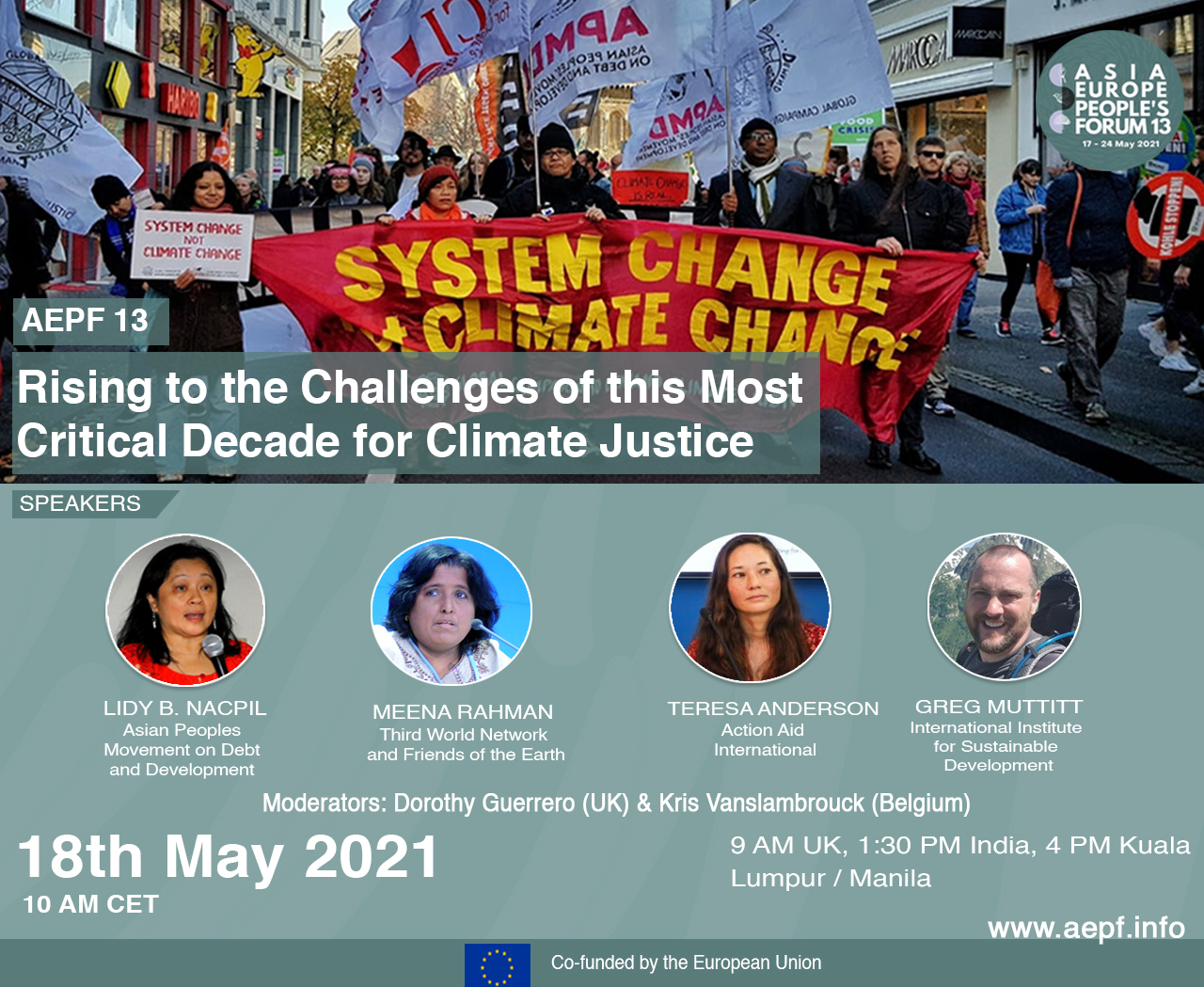
Rising to the Challenges of this Most Critical Decade for Climate Justice

Rising to the Challenges of this Most Critical Decade for Climate Justice

Watch the Webinar: 

1. Meeting the requirements of keeping global temperature rise to below 1.5 degrees celsius – and where governments are at vs their fair shares

2. Climate Finance

3. The challenge of Real Zero and the dangerous deception of Net Zero

4. The Fight to End Fossil Fuels Equitably and through a Just Transition

5. Food, Land, Agriculture and Climate Change

Speakers:

Lidy B. Nacpil: Asian Peoples Movement on Debt and Development
Meena Raman: Third World Network and Friends of the Earth
Teresa Anderson: Action Aid International
Greg Muttitt: International Institute for Sustainable Development

Moderators: Dorothy Guerrero (UK) & Kris Vanslambrouck (Belgium)

Resources: 
Presentation: Equitably ending fossil fuel extraction by Greg Muttitt
Presentation: The Net Zero Fallacy by Meena Raman

Organisers: AEPF Cluster on Climate Justice & Just Transition

Read More

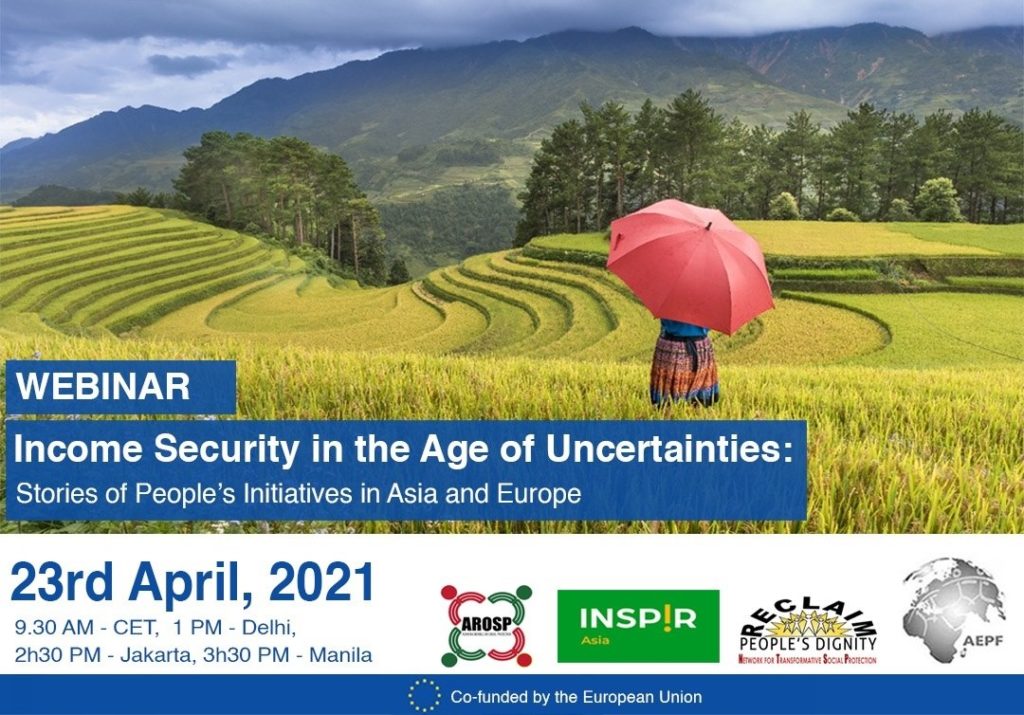
Webinar: Income Security in the Age of Uncertainties – Stories of People’s Initiatives in Asia and Europe

Webinar: Income Security in the Age of Uncertainties - Stories of People’s Initiatives in Asia and Europe

Organised by INSP!R Asia, NTSP and AROSP

Watch the Webinar: 

Given the critical need for income security, and the shortcomings in government programs in many countries, especially in low and middle-income countries, the webinar shall:

  • Present cases and/or concrete proposals of civil society and other actors towards guaranteeing income during (and after) the COVID pandemic
  • Include both advocacy actions and own actions to strengthen and/or guarantee vulnerable groups in society an income/livelihood during the pandemic, with the intention to have a long-term impact.
  • Include actions/activities of members from INSP!R, NTSP and AROSP
  • Include some good practices by national/local governments in low and middle-income countries, if there are any.
  • Share existing and other possible sources of funds to support the income guarantee program/s
  • Gather lessons learned and potential advocacies (demands or recommendations) to be put forward to regional/international bodies and possibly, even to IFIs (i.e. ASEAN, ASEM, G20, etc…).
  • These recommendations will also serve as input for a plenary session on the issue of sustainable income security/income guarantees at AEPF 13 by the Social Justice Cluster.

Speakers:

– Mr. Bidur Karki, Vice President GEFONT, General Federation of Nepalese Trade Unions (Nepal)
– Ms. Josephine Olive C. Parilla, Executive Committee of Homenet PH. (Philippines)
– Mr Martin WILLEMS, Secretary United Freelancers, ACV-CSC (Belgium)
– Mrs Elly Rosita Silaban, President KSBSI (Indonesia)
– Mr. Arnd Spahn, EFFAT Agriculture Secretary (Germany-EU)
– Mr Charles Santiago, Founding Director, Monitoring Sustainability of Globalization (Malaysia)
– Dr. Nguyen Hoang Yen, Coordinator of M.net (Vietnam)

Moderators:

– Mrs. Van Thi Thu Ha – coordinator AROSP
– Mrs.Maris De La Cruz – Coordinator NTSP
– Mr Bismo Sanyoto – INSP!R Asia
– Mr Koen Detavernier – WSM


Read More

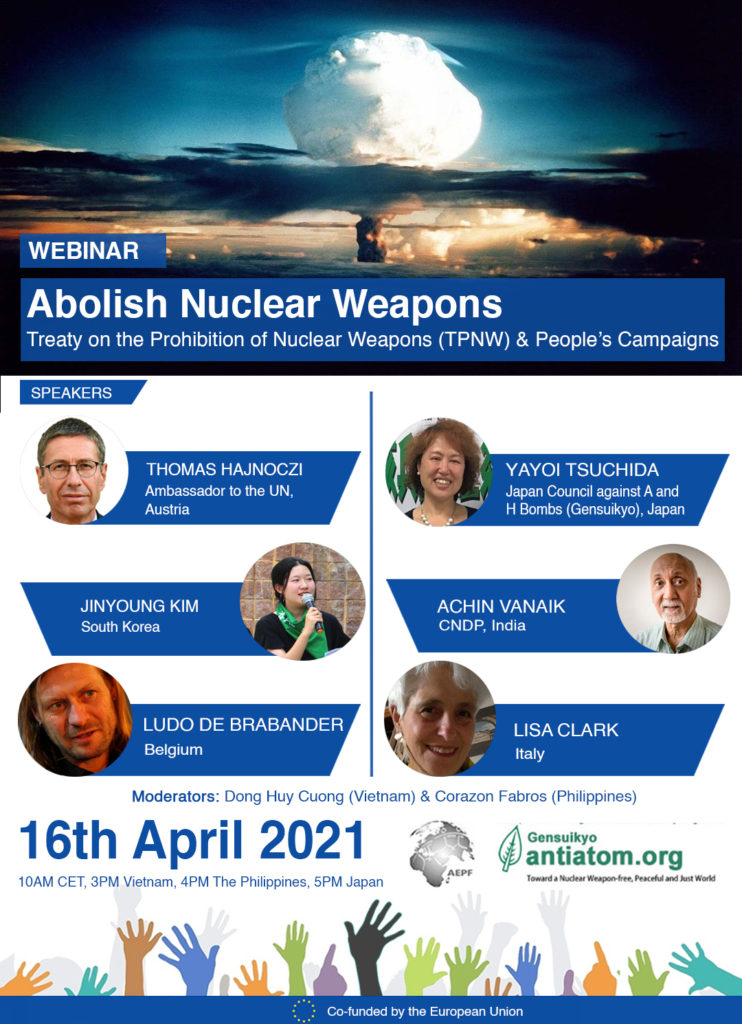
WEBINAR: Abolish Nuclear Weapons: Treaty on the Prohibition of Nuclear Weapons (TPNW) and People’s Campaigns

WEBINAR: Abolish Nuclear Weapons: Treaty on the Prohibition of Nuclear Weapons (TPNW) and People’s Campaigns

Watch the Webinar: 

There are still about 13400 nuclear weapons on earth, representing existential threat to humanity. Be it intentional, by accident or as a product of miscalculation, any nuclear explosion would cause catastrophic humanitarian consequences beyond borders.

The abolition of nuclear weapons is essential for ensuring peace and security in Asia and Europe. Only their total elimination can bring security.

Despite the midst of the coronavirus pandemic, humanity made a great achievement of the Treaty on the Prohibition of Nuclear Weapons (TPNW) entering into force in January 22, 2021, rendering nuclear weapons illegal and creating a momentum for advancing towards a world without nuclear weapons.

Taking this momentum and being backed by the growing people’s voices calling for more human security and more investment on health, social security and welfare, during this webinar we will learn about the TPNW itself, the significance of its entry into force and discuss what campaigns/actions we should take as a next step to achieve a world without nuclear weapons and ensure peace and security in Asia and Europe.

Speakers:

1) Mr. Thomas Hajnoczi, (Ambassador to the UN, Austria)
2) Ms. Yayoi Tsuchida, Japan Council against A and H Bombs (Gensuikyo), Japan
3)Ms. Jinyoung Kim (South Korea)
4)Mr. Achin Vanaik, (CNDP, India)
5)Mr. Ludo De Brabander (Belgium)
6)Ms. Lisa Clark (Italy)

Moderators: Corazon Fabros and Dong Huy Cuong

Read More

Webinar: Towards decent and adequate housing in Asia – Exploring solutions and alternatives.

Webinar: Towards decent and adequate housing in Asia - Exploring solutions and alternatives.

Watch the Webinar:

Also download Making houses affordable to the low income people by Lajana Manandhar from Lumanti Support Group For Shelter

Asian cities are notoriously unsustainable.

A comprehensive approach to sustainability of our cities, and therefore of land, housing, and public services, is critical to the future of the world. This webinar seeks to explore, demand and attempt to build alternatives in the area of housing so that the goal of access to decent housing for all can be a reality, not a faraway dream.

Session 1: Housing solutions, sustainable urbanization and ‘Right to the City’
Speakers: Kirtee Shah (Asian Coalition for Housing Rights (ACHR)), Rebecca Oochong (Habitat for Humanity, Asia-Pacific), Representative – Public Services International (TBC)
Moderator: Cesare Ottolini – IAH, Italy

Session 2 : Right to Adequate Housing: An Asian Perspective and current discourse
Speakers: Bipin Rai (Delhi Urban Shelter Improvement Board, Government of Delhi, India), Erik Villaneuva (Institute for Popular Democracy, Philippines), Elisa Sutanudwara (RUJAK, Indonesia), Sri Sorfjan- Huairou Commission, Malaysia (TBC)
Moderator: Meena Menon – Co-Convenor, Social Justice Cluster, AEPF

Read More

UNPACKING The Regional Comprehensive Economic Partnership (RCEP): What Governments are Not Saying about the Mega FTA*

UNPACKING The Regional Comprehensive Economic Partnership (RCEP): What Governments are Not Saying about the Mega FTA*

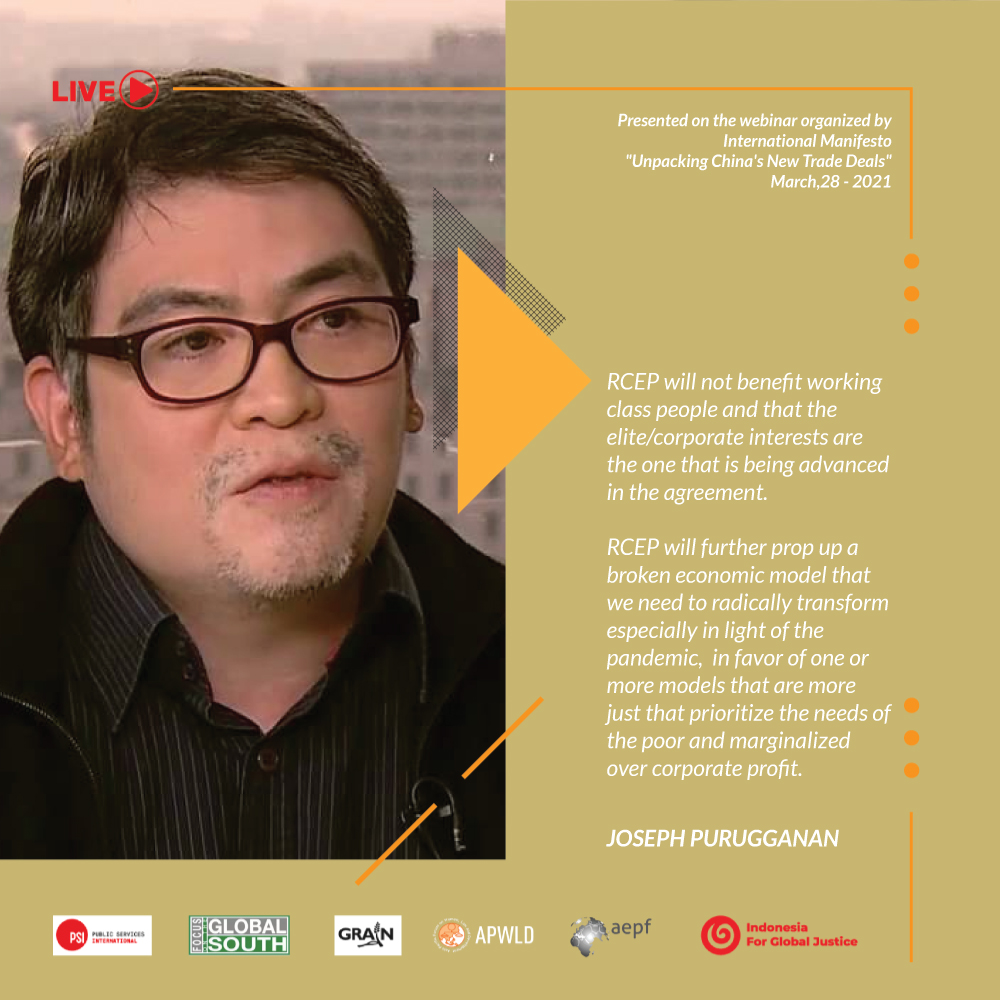
By Joseph Purugganan
Focus on the Global South
INTRODUCTION

I will unpack China’s new trade deals especially with ASEAN. I analyse the RCEP more from the perspective of a trade justice campaigner, questioning the rationale behind these ambitious economic agreements that have benefitted a few and for most part worked against the interest of many.

There is now a strong push from governments across the 15 RCEP countries (ASEAN 10 plus China, Japan, South Korea, Australia and New Zealand) to galvanize broad public support for this comprehensive trade and investment agreement in a move to secure ratification and concurrence for it to come into effect. So far the deal has secured ratification in China and Thailand and the processes towards ratification has been initiated across all parties with most countries eyeing 2021 as completion of this process.

But governments are leaving out crucial issues that must be considered, especially in light of the Covid-19 pandemic and the need to put in place more progressive economic policies that would support the needs of the poor and marginalized.

The Covid-19 pandemic, the contraction of the global economy, and growing calls from CSOs for a stop to FTA negotiations were not enough to deter parties from the 15 countries negotiating the Regional Comprehensive Economic Partnership Agreement or RCEP to conclude the talks for what is now considered the world’s largest free trade agreement. We will recall that parties declared substantial conclusion of the talks as early as 2019 with only the trade in goods aspect being ironed out. And then the pandemic hit the globe early 2020 and like everything else, RCEP talks were likewise temporarily suspended.

Virtual negotiations restarted however in April 2020 and monthly online discussions ensued with 2 more negotiating rounds and 2 Ministerial conferences before the talks were concluded in November 2020. Thailand’s chief trade negotiator was quoted in the Bangkok Post as having said this about the negotiations proceeding despite the lockdowns: “We [trade negotiators] have completed many negotiation issues during the past two months. It is faster and saves on time and costs. Covid-19 brings a new normal to trade negotiations.” 

The shift to online communications however had at least one casualty: civil society participation. In the first place, RCEP talks, and most FTA talks for that matter, have not necessarily been a completely open, transparent and participatory space for civil society engagement. In fact, in the case of RCEP, the only space for directly engaging the trade negotiating committee (TNC) called the Stakeholder Engagement Process, was only organized in 2016, a full 3 years since the negotiations had begun. The stakeholder engagement process nevertheless still provided a space, albeit limited, for CSOs and grassroots movements to raise concerns about the agreement directly to trade negotiators. 

Selling the agreement as a big win for everybody

An agreement that has been kept off-limits to the public–with no access to the negotiation text and very limited engagements in the process– is now being aggressively sold by governments as part of the effort to secure parliamentary concurrence. 

This drive to sell RCEP to the broader public and galvanize support for the agreement is evident in the  pronouncements from governments on the significance of the agreement. A foremost concern, of course, across the globe is the pandemic and economic and social issues induced by the health crisis. It’s not surprising therefore that RCEP is being promoted as a key response to the crisis and a driver of recovery. 

The Joint Leaders Statement on RCEP presented at the virtual signing ceremony in November 2020 asserted: “In light of the adverse impact of the pandemic on our economies, and our people’s livelihood and well-being, the signing of the RCEP Agreement demonstrates our strong commitment to supporting economic recovery, inclusive development, job creation and strengthening regional supply chains as well as our support for an open, inclusive, rules-based trade and investment arrangement.”

China’s Role in RCEP

One question that has continuously hounded these talks is what exactly is China’s role in these negotiations? Many have described the RCEP talks as China-led. If you take a broader geopolitical view and look at the landscape of FTA negotiations across the globe, it’s easy to see why one would think that way.  Aside from RCEP, the global landscape is dotted with other key mega FTA negotiations– there was at one point the Transpacific Partnership Agreement or TPP, which many characterized as US-led trade negotiations, the Transatlantic trade and investment partnership agreement or TTIP between the US and the European Union; the EU itself was quite actively engaged in FTA talks with Asia, launching its New Partnerships with Asia in 2007 with simultaneous trade talks with India and ASEAN.  Asia has become an important hub for these new generation FTAs. We can point to 3 main reasons why this is so– Asia is a high growth region therefore its growing market is a target for economic expansion; it’s also an important source of raw materials. Developed economies need to import these raw materials in order to export competitively, securing access to these raw materials is therefore an important strategic consideration; the third reason is China. The EU and the US for instance connect China’s efforts to secure trade deals with the rest of Asia as expansion of its not just economic but political influence in the region.

On the other hand, if one looked at the agenda of more ambition, greater coverage, of really what true free trade believers call a high standard FTA– that was pushed in the RCEP talks and who were the players that were most aggressive in pushing that agenda, one can say that in fact Japan, Korea, to some extent Australia and lesser extent New Zealand, countries outside ASEAN that were also engaged in the TPP negotiations- were driving the negotiations.

Then there is ASEAN and its projection of ASEAN Centrality or the assertion that RCEP is in fact built on ASEAN’s FTAs with its development partners. ASEAN developed its own guidelines for RCEP negotiations where it emphasised the importance of recognizing the asymmetries that exist among RCEP parties, and pushed for flexibilities for the least developed countries. To what extent these flexibilities reflected in the final text is therefore a true test of ASEAN centrality. And as I point out later, while the RCEP was not as ambitious as the developed countries had hoped for, and there were elements of the RCEP agenda that were left out for the time being- like the dreaded investor state dispute settlement mechanism or the TRIPS+ provisions–it looks like ASEAN will not benefit much from the deal and in fact would see its balance of trade worsen.

How are governments selling this agreement?

Many have touted the agreement a “big political win for China,” highlighting how the agreement would sustain China’s “advantages in global supply chains.” 

For his part, Chinese President Xi Jinping has made it a point to emphasize the global role of China. In a speech before APEC business leaders, Xi expressed confidence “that the steady unleashing of the China market potential will create vast business possibilities for other countries, and this will create stronger impetus for maintaining stable growth of the global economy.”

Other leaders have used RCEP as an opportunity to highlight RCEP in light of their own development needs. Sok Siphana, an advisor to the Cambodian government, referred to RCEP as a “victory of multilateralism and is a good pool for regional economic cooperation and integration.” The Vietnamese government on the other hand highlighted the potential opportunities for ASEAN and Viet Nam to “become a centre of investment attraction” but it also downplayed the risks saying the agreement “would not worsen the trade deficit Viet Nam was running with signatory markets.”

The Philippine government chose to highlight as well the positive impact of the agreement on investments. Lead Trade Negotiator Allan Gepty said ”the conclusion of RCEP will facilitate more investments into the region aside from allowing freer flow of goods among the 15 participating countries.”

Lost in the chorus of positive messages and effectively left out in the discourse however are key issues that have been consistently raised by CSOs and grassroots movements. 

Secret Negotiations

The negotiations have clearly failed the transparency and public participation test. A CSO report on RCEP and Transparency found that there was no or little publicly available information on the state of negotiations, draft texts or key government positions throughout the negotiating process. There were very limited or token/ad hoc stakeholder engagement forums. As mentioned earlier the first Stakeholder Engagement was tentatively conducted in 2016, 4 years after the negotiations were launched.  Parliaments or other public institutions had very little opportunity to impact or influence the process while special interests and business groups have been given a privileged role and access to information.

Dangers of Modern FTA

Governments are bragging that RCEP is a modern FTA but give no further explanation of what that means or what the implications would be. A modern trade and investment agreement means that the scope and coverage of the agreement cover not just trade in goods, but also services, intellectual property rights, investments, and more recently includes a chapter as well on electronic commerce. A modern or new generation FTA would push further liberalization and deeper obligations to open up the economy and harmonization of regulations in the name of policy coherence. 

While there are different templates, there are a number of key elements that are common in most modern trade and investment agreements. There is the push for stronger protection of intellectual property rights (IPR). IPR chapters of most of these agreements push for obligations that go beyond the minimum standard set out in the WTO Trade Related Aspects of Intellectual Property Rights Agreement. There is a huge disparity in the levels of IPR protection among the RCEP parties. Based on the World Economic Forum’s global competitiveness ranking on IPR protection we see Singapore (4th), New Zealand (6th), Japan (14th), and Australia (16th) rank highest in terms of IPR protection. While Thailand (121st), Cambodia (130th) and Myanmar (134th) are at the tail end of the global rankings. 

A 2012 report by the UN Development Program and UNAIDS on the potential impact of free trade agreements on public health issued a strong warning to state leaders against trade agreements that inflate the price of medications and deny access to lifesaving treatments for poor citizens across the globe.

There is also the agenda of investor protection, as exemplified in the ISDS provisions. For those who are not familiar, ISDS is the mechanism present in most modern FTAs that gives corporations the power to sue governments over public policies or regulations.

So we can debate on which country drove the negotiations, whether China, Japan, Korea or ASEAN but it’s clear that the corporate agenda is definitely a key driver. 

Rising imports and declining exports

A new working paper from Boston University’s Global Development Policy Center focusing on RCEP: Goods Market Access Implications for ASEAN,  by Rashmi Banga, Kevin P. Gallagher and Prerna Sharma, with a detailed disaggregated product-level impact analysis of tariff liberalization based on actual tariff schedules found out that:

  1. The results of the simulations show that tariff liberalisation under RCEP will deteriorate the existing balance of trade of ASEAN vis-à-vis RCEP countries by 6 percent per annum, while balance of trade will improve for some of the non-ASEAN countries in the RCEP
  2. The maximum gains in terms of improved balance of trade or net exports will go to Japan, followed by New Zealand and Australia. Post RCEP, balance of trade will worsen for Cambodia, Indonesia, Lao PDR, Malaysia, Myanmar, Philippines, Singapore, Thailand and Vietnam
  3. RCEP sensitive list analysis reveals that it is the developed countries which have been able to negotiate higher protection against imports as compared to ASEAN countries or even least developed countries within ASEAN.

The balance of trade issue is also related to a question that governments prefer not to discuss, why India opted out of the agreement. India left the negotiating table in November 2019 because it felt that RCEP did not adequately address its concerns. A key concern for India is its ballooning trade deficit, particularly with China.

Impact on Covid response

Around 400 CSO from across the globe issued a statement in April 2020 calling on trade ministries and the World Trade Organization (WTO) to stop all trade and investment treaty negotiations during the Covid-19 outbreak. They called for “flexibilities to set aside trade rules that constrain the ability to resolve the pandemic crisis, without fear of repercussions, and to cease other negotiations and activities that divert their energy and resources from that goal.”

Trade and health advocacy groups have raised the concern that the agreement – the text of which was concluded in 2019, before the pandemic – could severely constrain policy space needed to effectively address the health and economic crisis. There have been no studies on the impact of these rules on limiting the ability of States to respond to Covid and future pandemics and emergencies, and ability to recover and rebuild economies. 

This struggle against constraints to policy space from FTAs is evident in the current efforts to secure support for a TRIPS Waiver in the WTO. The proposal initiated by India and South Africa, which has now garnered considerable support from most developing countries to temporarily suspend trade obligations is being met by strong opposition from the US, the European Union among others and from Big Pharma. 

In a recent hearing of the Senate Foreign Relations Committee in the Philippines on a proposal calling for the Philippine government to support the waiver, representatives from the Departments of trade, foreign affairs as well as the Intellectual Property Office (IPO) raised the concern that support for the waiver might run contrary to obligations under FTAs signed by the Philippines namely with the European Free Trade Association  and RCEP.

RCEP would also further lock- in countries to this FTA Regime that is already facing a lot of scrutiny not just from CSOs but also from institutions like UNCTAD. As Trade Justice Pilipinas articulated in its statement: “RCEP will further prop up a broken economic model that we need to radically transform in favour of one that is more resilient.” 

What now for Trade Justice Movements?

A key battleground now in the campaign against unjust trade agreements is the ratification process for RCEP. Organizations and campaign networks across the region would have to argue in Parliaments and Congress against concurrence. This is a tough fight for CSOs considering the late and limited access to the official documents, and the strong support for the agreement from the business sector. 

 Another important task related to the concurrence process is analyzing the text of the actual agreement together with the schedule of commitments. CSOs would need to sharpen their arguments against RCEP especially as the agreement allows for future ratcheting of obligations in the key areas of investor protection, and intellectual property rights.

 Finally, RCEP can be seen as opening the floodgates for more comprehensive and ambitious agreements. Already there are renewed calls for more trade negotiations with the United States under the new administration of President Joseph Biden, including the possibility of the US re-joining the defunct Comprehensive and Progressive TPP (CPTPP) and China joining the same, as well as new mega regional agreements under the mantle of Asia Pacific Economic Cooperation (APEC), and a host of bilateral FTAs.

Trade Justice movements across the region are now confronted with the major challenge of resisting this renewed push for FTAs like RCEP as key drivers of the recovery efforts, at the same time push the discourse towards more just economic policies that prioritize the needs of the poor and marginalized.

* The presentation is based on an article entitled What Governments are not saying about RCEP: Civil Society has a different take on what the trade deal means for participating countries originally published in German for the Newsletter Rundbrief (https://www.forumue.de/hintergrundanalyse/rundbriefe/) of the  Forum Umwelt und Entwicklung (Forum on Environment and Development) based in Berlin. 

Read More

Witness People’s Voices on the Regional Comprehensive Economic Partnership (RCEP)

Witness People's Voices on the Regional Comprehensive Economic Partnership (RCEP)

ASEAN’s fate hangs in a RCEP balance. What research, reason and experience shows. Witness peoples voices on the Regional Comprehensive Economic Partnership (RCEP) (recorded on 25th March 2021. )

ASEAN countries signed the Regional Comprehensive Economic Partnership (RCEP) with China and several countries, with the hope of increasing exports.  Research shows that with RCEP,  the balance of trade does not favour the ASEAN nations. Dr.Rashmi Banga, Senior economic affairs officer, UNCTAD explains this.

Experience shows that the trade proposed by the Regional Comprehensive Economic Partnership (RCEP) is not compatible with ASEAN value chains explains, Dr. Ika Riswanti, Vice-Dean, Diponegoro University, Indonesia.

Josua  Mata Secretary General, SENTRO, Philippines, says that ASEAN countries should not ratify Regional Comprehensive Economic Partnership (RCEP) as experience has already shown that it will curb the ASEAN countries’ decision making choices, especially for pro-people policies.

Read More

Global MPs form International Parliamentarians Alliance for Myanmar

“Global MPs form International Parliamentarians Alliance for Myanmar”

JAKARTA – Lawmakers from across the world have come together to form the International Parliamentarians Alliance for Myanmar (IPAM). The Alliance’s first meeting included 24 members of parliament (MPs) from 12 countries, spanning from Canada, through Europe, Pakistan, Thailand, Japan and all the way to Australia and New Zealand.

The MPs committed to join forces and use their position inside and outside of parliament to support fellow lawmakers from Myanmar, including members of the Committee Representing the Union Parliament (CRPH), to promote democracy and human rights for all in Myanmar, and ensure accountability for international crimes.

The people of Myanmar need support now, as bullets are being fired, prisons filled, and lives stolen by a ruthless military. As parliamentarians it was evident to us that we needed to come together and form a united front against the Myanmar army’s unrelenting attack on democracy and human rights,” said Heidi Hautala, Member of the European Parliament.

Our message is clear, we as elected representatives will use our voice to support the people of Myanmar in their quest for democracy,” said Jamie Parker, Member of the New South Wales Parliament of Australia. “Working collectively will strengthen our respective actions, and present the Myanmar military junta and the international community with unified calls and a clear path forward.” 

The initial meeting of the Alliance was convened at the initiative of the ASEAN Parliamentarians for Human Rights (APHR), with a view to connecting lawmakers with Myanmar civil society and MPs, to provide a forum for developing joint international and regional strategies, and to serve as a consistent public voice for democracy and human rights for all in Myanmar.

“Our first action will focus on supporting Myanmar MPs currently being detained or forced into hiding when their only crime has been to be elected by the people of Myanmar to serve in Parliament,” said Charles Santiago, Member of Parliament of Malaysia and Chair of APHR. It is our duty to stand with our colleagues when they face life threatening risks and when the institution of Parliament is being attacked.” 

Members of the Alliance agreed to help gather signatures of parliamentarians around the world for a statement calling for the immediate release of their Myanmar colleagues, and to introduce in their respective parliaments a resolution or motion condemning the coup.

provide a forum for developing joint international and regional strategies, and to serve as a consistent public voice for democracy and human rights for all in Myanmar.

Here is the link for you to sign as well: https://aseanmp.org/2021/03/22/international-lawmakers-call-for-the-immediate-and-unconditional-release-of-their-myanmar-colleagues-and-for-democracy-to-be-upheld/

Read More

“Stop Vaccines Monopoly: TRIPS Waiver Now! No to Third Way!”

“Stop Vaccines Monopoly: TRIPS Waiver Now! No to Third Way!”

Asia-Europe People’s Forum Statement: Responding to The Result of The TRIPS Council Meeting on 10-11 March 2021

AEPF, 12 March 2021. We, Asia-Europe People’s Forum (AEPF), join  the global demand  to all WTO members and DG WTO, Ngozi Okonjo-Iweala, to immediately reach an agreement on the TRIPS Waiver Proposal as the solution supported by majority of members in addressing the access inequality of Covid19 vaccines to end the Pandemic.

Around 200 people in Asia and Europe have lent their support to the campaign and growing peoples movement by sending a strong message highlighting  the importance of TRIPS Waiver to allow all, but especially the poor nations open and equitable access to vaccines in order to address this global pandemic.

The delay in the approval of  TRIPS Waiver at the TRIPS Council reinforces the view that the WTO is an institution that is driven by the interest of the rich and powerful. We deplore the efforts of the rich countries and the big pharmaceutical companies to  the Covid19 pandemic an opportunity to secure windfall  profits over and  above the humanitarian crisis and the interest of people across the globe.  This issue over vaccine monopoly must be resolved through global solidarity action.

The “Third Way” promoted by the DG WTO to supposedly improve access “through facilitating technology transfer within a multilateral regulatory framework” and by pharmaceutical companies entering into licensing agreements to enable other producers to produce vaccines and other products will not address the problem of vaccine monopoly.

“Third Way” proposal offered by DG WTO should be rejected. The voluntary licensing is confidential and restrictive. There is a serious lack of transparency as the terms of the license are usually confidential and still provides exclusive rights to pharmaceutical companies.  The geographic scope of the proposal is also limited excluding many developing countries from being supplied under the license agreement or allowing for manufacturing only for purposes of export (can you rephrase this please? Its not clear, Are we saying it allows only for export from countries with manufacturing capacity?; license is only offered as well to very specific manufacturers presumably aiming to limit supply; and  the restrictive terms on the source and production of active pharmaceutical ingredients (APIs)[1].

In this regard, we emphasized that we don’t need a compromise solution, but we want to TRIPS Waiver as solution endorsed by developing countries to abolish the monopoly of vaccines. The TRIPS Waiver proposal must be reached immediately to end the COVID-19 pandemic.

The TRIPS Waiver proposal is a proposal submitted by India and South Africa in October 2020 at the WTO but has since been endorsed by 100 developing countries to allow all countries not to implement the TRIPS Agreement which regulates patent protection, copyright, and related rights, industrial design, protection of undisclosed information, which is directly related to drugs, diagnostic tests, vaccines and other technologies regarding COVID-19 in the course of the pandemic. However, wealthy countries such as Australia, Brazil, Canada, European Union, Japan, Norway, Switzerland, the UK, and the US, still hold back their support for the proposal considering that they have traditionally been supporters of the interests of pharmaceutical companies through the Intellectual Property Rights (IPR) monopoly system. ****

With Solidarity:
Indonesia for Global Justice, Focus on The Global South, Global Justice Now-UK, Transnational Institute

Contacts:

Rachmi Hertanti, IGJ: rachmihertanti@gmail.com
Joseph Purugganan, Focus: josephp@focusweb.org
Dorrothy Guererro, GJN: Dorothy.Guerrero@globaljustice.org.uk
Pietje Vervest, TNI: pietje.vervest@tni.org

Read More

AEPF STATEMENT: RESTORE DEMOCRACY IN MYANMAR. STOP THE BRUTAL REPRESSION OF PEOPLE!

AEPF STATEMENT: RESTORE DEMOCRACY IN MYANMAR. STOP THE BRUTAL REPRESSION OF PEOPLE!

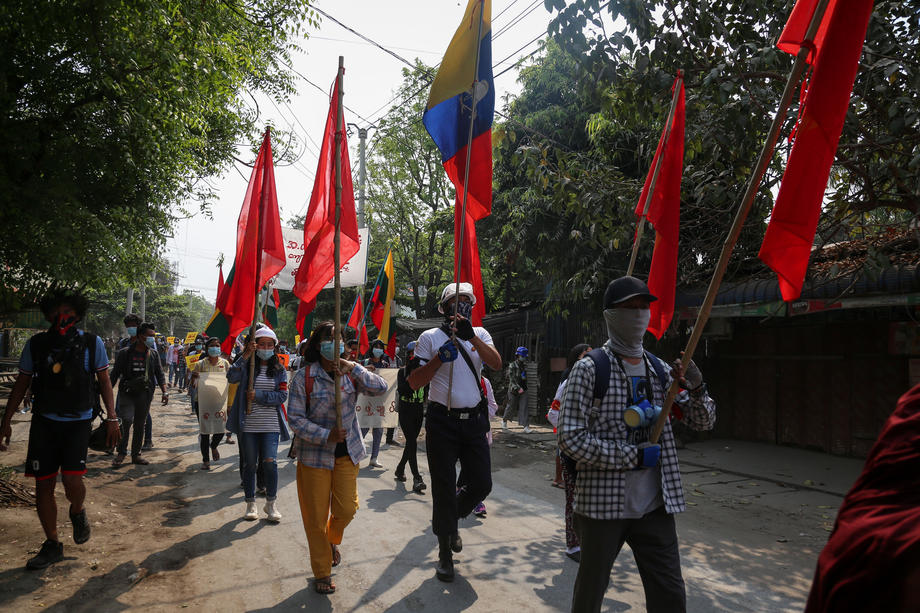
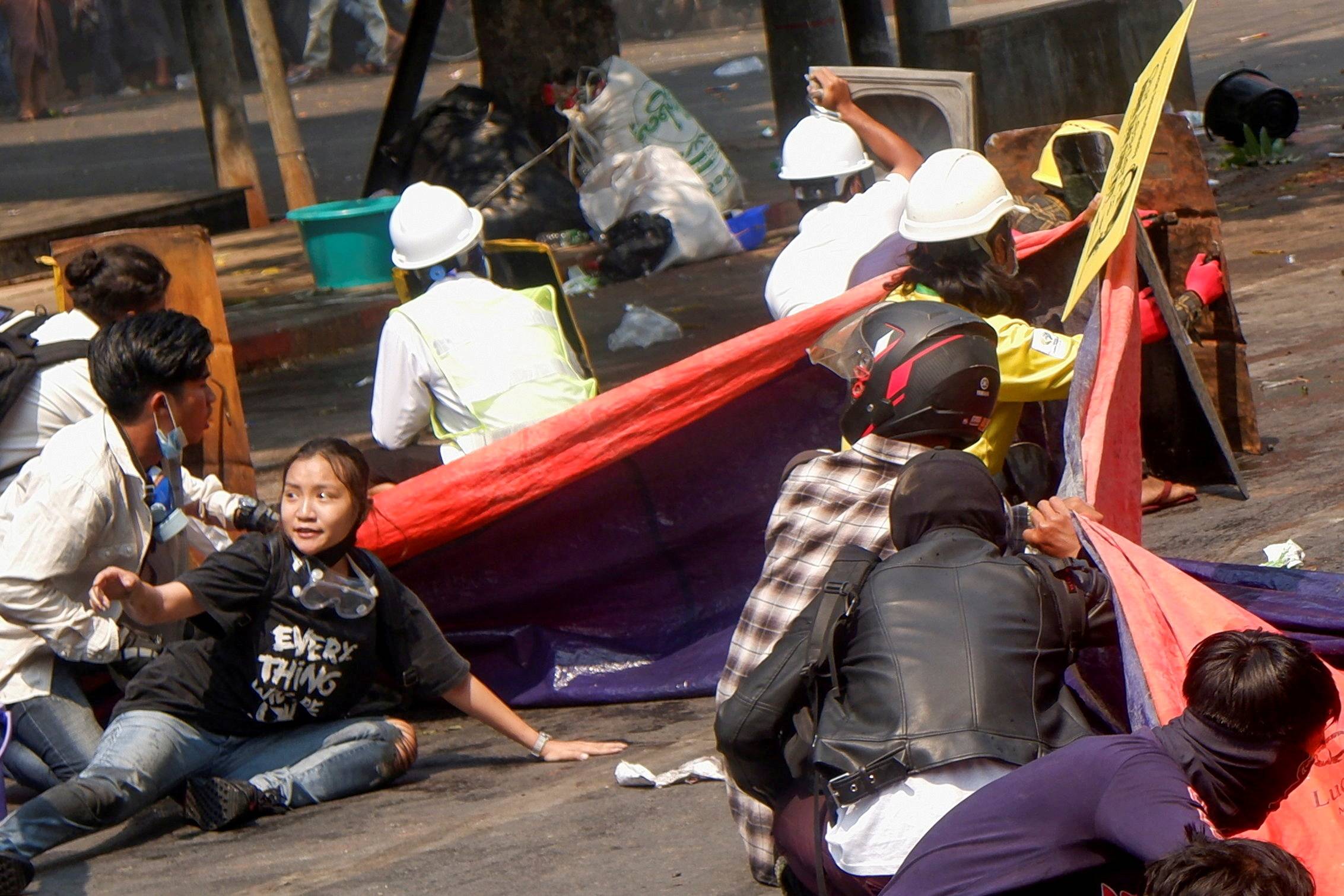
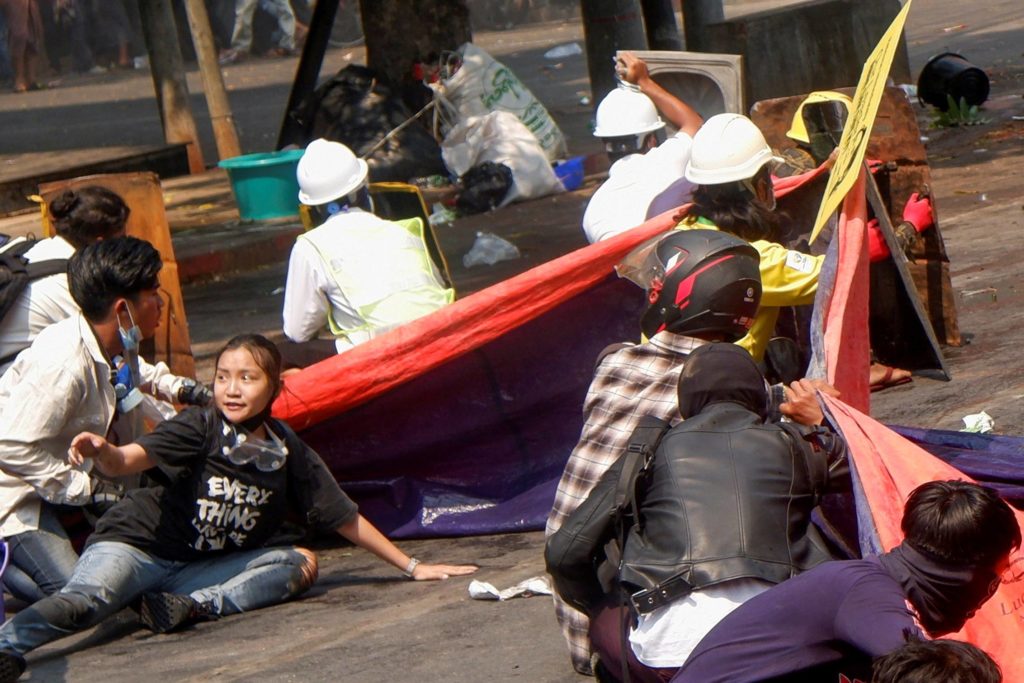
Protesters lie on the ground after police opened fire to disperse an anti-coup protest in Mandalay, Myanmar, March 3, 2021. Among them, Angel, 19, bottom-left, also known as Kyal Sin, took cover before she was shot in the head. REUTERS/Stringer TPX IMAGES OF THE DAYThe AEPF expresses solidarity with the people of Myanmar who are bravely resisting the military coup that reversed the fragile democratic process that was unfolding in Myanmar.

The world is witnessing a brutal crackdown where all kinds of force and intimidation are being used on the nonviolent, civil mass resistance that seeks to restore democratic forces, release from incarceration elected representatives and civil society leaders, and restore civilian rule and processes. The people of Myanmar want an end to the emergency and return to an atmosphere of freedom, peace and genuine stability.

After decades of military rule characterized by brutal atrocities and human rights abuse, especially against ethnic nationalities, the people of Myanmar were beginning to emerge from a climate of fear and intimidation to one where they could build democratic institutions and move towards a federal state. By seizing power forcefully on February 1 2021, the Myanmar military annulled the November 2020 elections just as the new parliament was to convene. Since then, the military regime has been using battle tactics to control opposition to the coup from a massive civil disobedience movement which includes many civil servants and workers on strike.

Many peaceful protestors are being killed every day.

Years of authoritarian control and international sanctions had thwarted economic and social developments in Myanmar that woefully lags behind its South East and South Asian neighbors key social indicators. The people of Myanmar have been deeply impacted by the militarization of daily life, lack of freedoms and poor public infrastructure for essential services.

On March 10, the United Nations Security Council unanimously condemned the violence against peaceful protestors, and called for an immediate reversal of the military coup and return to civilian power. On March 11, UN Special Rapporteur on the Situation of Human Rights in Myanmar, Thomas H. Andrews, stated in the UN Human Rights Council that the numbers of murders, arbitrary detentions increases every day. Freedoms of association, assembly and expression are destroyed. Since the coup, thousands of people from ethnic minorities have been attacked and displaced. The level of abuse could qualify as genocide. The UNHRC called for an emergency Coalition for the People of Myanmar that would propose concrete actions. Andrews statement outlined five options that could be taken immediately:

  1. Stop the flow of funds to the junta, including by imposing targeted sanctions on the Junta’s business enterprises and on Myanmar Oil and Gas Enterprises, the single largest source of revenue to the State of Myanmar;
  2. Impose an international arms embargo;
  3. Ensure accountability for the crimes, through national courts using universal jurisdiction if the Security Council is unwilling to refer the matter to the International Criminal Court;
  4. Work directly with local civil society and aid organizations to provide humanitarian assistance whenever possible;
  5. Deny recognition of the military junta as the legitimate government representing the people of Myanmar.

The AEPF stands in solidarity with the people’s non-violent resistance and calls for all measures to be taken to urgently end the coup, restore civilian processes in Myanmar, and support the demands of the people of Myanmar for participatory democratic transition and a federal state.

Signed,
Asia Europe People’s Forum

Read More