Women’s Day: A Salute to their Courage and Strength

Women’s Day: a salute to their courage and strength

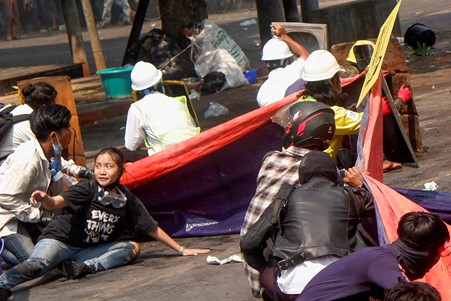
According to the New York Times, Ma Kyal Sin “loved taekwondo, spicy food and a good red lipstick”.

She was a young woman, with hopes and aspirations just like any other 19-year-old.

Angel, as she is also known, was shot dead by Myanmar security forces a few days back, triggering a huge outcry.
Scores of people turned up in Mandalay to bid their final farewell to the teenager, who has now emerged as the country’s icon for civil disobedience.

We have many “Angels” all over the world: be it the women who fight against patriarchy; the single mothers who soldier on despite poverty and lack of resources, guided only by the fierce determination to educate their children; the transgender women who are murdered for having the courage to be who they are; women who break glass ceilings; journalists who die pursuing stories; women artists who speak truth to power; our mothers and the list goes on.

As I sit contemplating about the International Women’s Day, I realised that what we are celebrating is the courage to be.
The courage to continue doing what they believe in despite a system that’s created to favour and support men.

Angel did the same: she took to the streets as a show of resistance to the Myanmar security forces and the country’s most hated man, General Min Aung Hlaing, who orchestrated the coup.

Thousands of women protested next to her, clearly signalling the crumbling of patriarchy that the generals were fond of preaching.

Just like them, we see women rise up against tyranny and oppression all over the world.

In pledging solidarity on this special day, I choose to challenge and call out gender bias and inequality.

And I choose to celebrate their courage and strength.

Charles Santiago
Member of Parliament Klang  

Read More

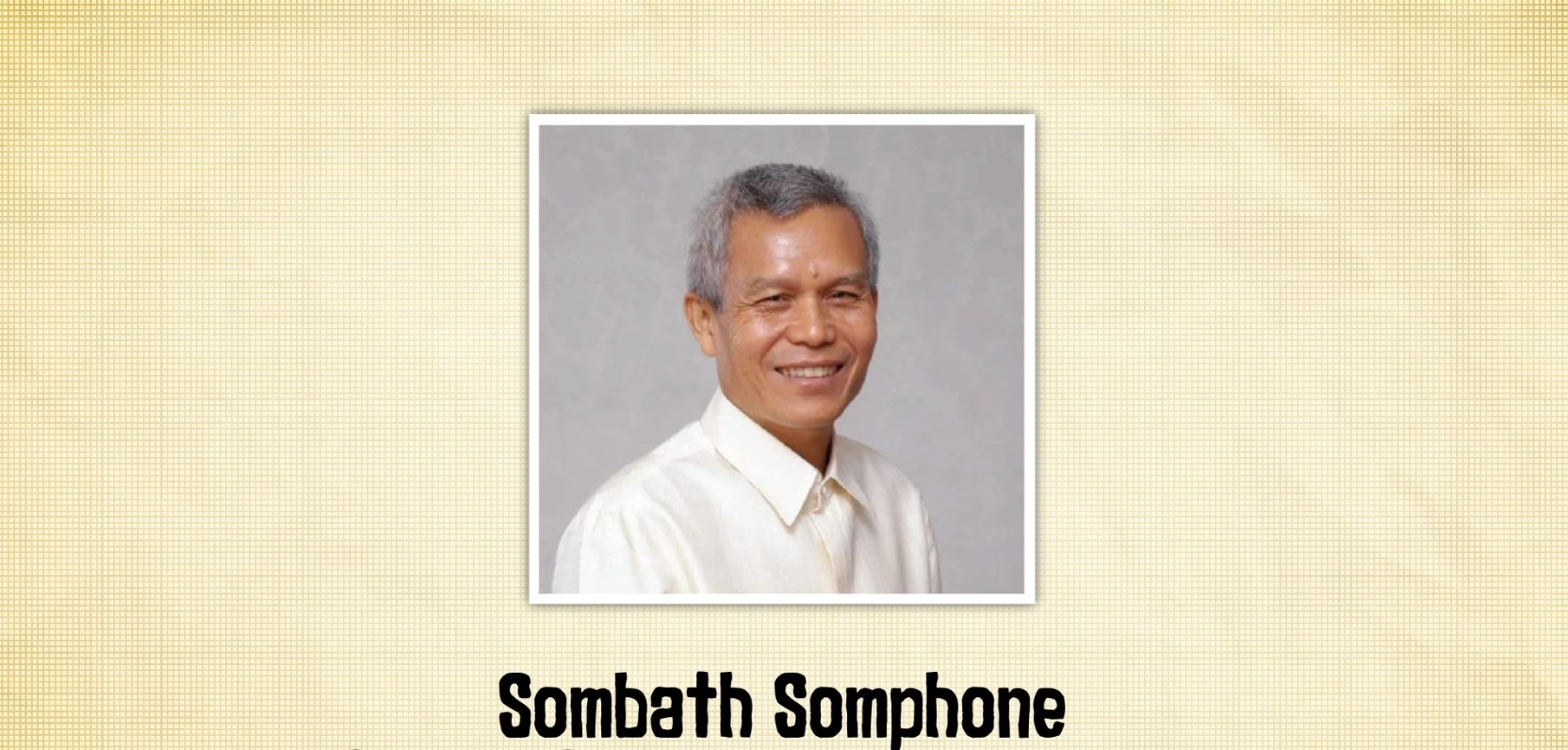
For 8 years, I am asking my government: Where is Sombath?

For 8 years, I am asking my government: Where is Sombath?

The Asia Europe People’s Forum wants to express solidarity with Human Rights Defenders worldwide, who risk their lives daily when they speak out and stand up for the rights of people in precarious situations.

For 8 years, Shui Meng is asking her government “Where is Sombath?”.
Her husband, who dissapeared in 2012, is a symbol of ten thousands of people who disappeared while raising their voice.

The Asia Europe People’s Forum released a statement and a video to demand international organizations, governments, parliaments, institutions, civil society organisations and others to end enforced disappearances and deliver justice to the victims.

Please support us by:

1. Sharing the video
Facebook: https://fb.watch/2hCi36e66C/
Twitter: https://twitter.com/_AEPF/status/1336963902848999427

2. Signing the statement: https://rb.gy/1lgqgh

Read More

AEPF SOLIDARITY STATEMENT WITH INDIAN FARMERS

AEPF SOLIDARITY STATEMENT WITH INDIAN FARMERS

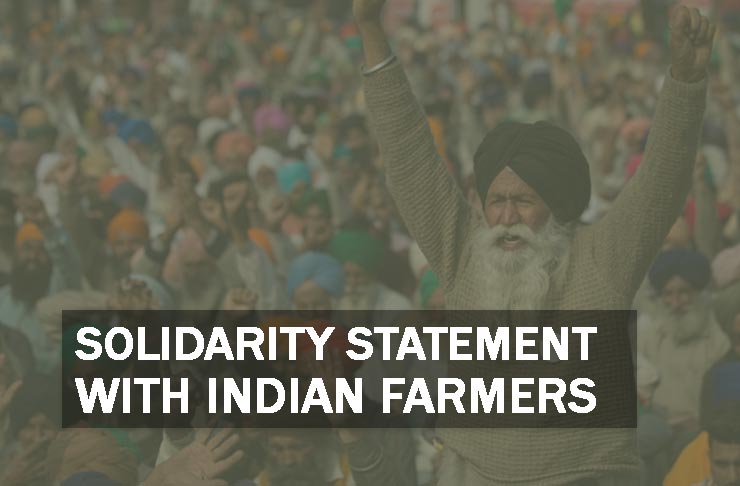
The Asia Europe Peoples Forum, expresses its solidarity with the hundreds of thousands of Indian farmers that have been protesting around the capital Delhi, day and night over the past several days. We stand in solidarity with the millions of other farmers and workers who are in support of the demands that the Indian farmers havemade to the Government of India.

We believe that the Indian farmers are correct in their opposition to the Modi Government’s two new Farm Bills and one amendment to an earlier Farm Bill, that were hurriedly pushed through a majoritarian Indian Parliament during the time of Covid-19, without consulting the farmers.

We are convinced by the analysis of the Indian farmers that these Acts benefit primarily the big corporates and will leave the farmers (especially the small land holders) in penury. Further, the farmers once at the direct mercy of big corporates would be forced to sell their land and become landless labour. The farmers fear that enabling the agrarian structure and cropping pattern to become controlled by corporates encourages only profit-making crops and is a threat to Indian consumers. It also threatens climate change. We believe all these ramifications that the Indian farmers are talking about have not been respected by the Government, who seem to have listened only to corporate demands.

We are of the opinion that these farm laws will also dismantle institutions like ‘Agriculture Produce Market committees (APMCs)” which provide employment to thousands of informal workers who support in loading, unloading, stacking, packaging, and measuring of farmers’ produce. It is pertinent to mention that these state led APMCs have  played a pivotal role in ensuring  that the farmers get minimum support prices/fair prices, which is one of the key demands of the protesting farmers.

We believe that any attempt at modifying the agrarian structure should be pro-farmer and agricultural labourer, include land reforms, and balance the various stakeholders in the agrarian production system. A national debate with farmers, all political parties and agrarian leaders should be part of a process of any deep agrarian change. In the absence of such a process, the reforms can be disastrous to the farmers and the entire agrarian economy on which the very economy depends.

We support this non-violent farmers’ movement and appeal to the Indian Government to accede to the demands made by the farmers, treat them with dignity, remove these laws and bring in pro-farmer legislation.

Read More

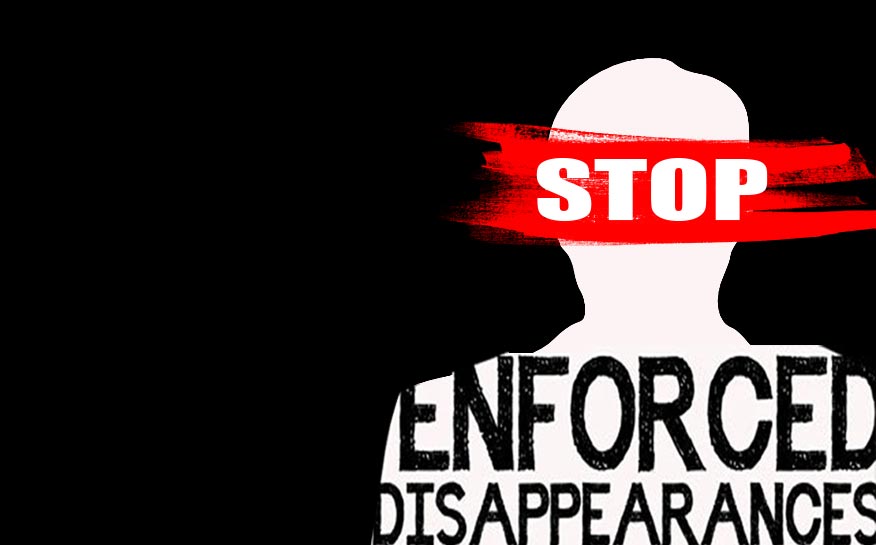
SIGN-ON STATEMENT ON ENFORCED DISAPPEARANCES

The Asia Europe Peoples Forum (AEPF), like many civil society organisations and networks, together with families and friends of those who have been forcibly disappeared, continues to search for answers from governments under whose watch enforced disappearances have taken place.
The disappeared include women and men who have championed democracy, human rights, equality, and social, environmental and climate justice, and defended the rights of workers, peasants, fishers, indigenous peoples and women.

Enforced disappearance is a heinous violation of human rights and infringes upon a range of human rights embodied in the Universal Declaration of Human Rights and elaborated in major international human rights instruments. It is an international crime and a crime not only against the disappeared and their families, but against entire society since it is a strategy to spread terror and silence those who seek justice and closure. When practiced repeatedly and systematically, enforced disappearance constitutes a crime against humanity.

We ask responsible, accountable governments committed to the rule of law to put pressure on governments who refuse to answer questions about the disappeared, despite compelling evidence of their actions. We demand that all nations pledge an end to this inhuman, criminal practice.

We make this appeal based on our own loss and experience.
Sombath Somphone, a civil society leader and co-organiser of the AEPF in 2012[i] in the Lao PDR (Laos), was forcibly disappeared in Vientiane on 15 December 2012 on his way home.[ii] Footage from CCTV cameras[iii]  reveals that he was last seen at a police check-post where his vehicle was stopped and within minutes individuals forced him into another vehicle and drove away. The fact that this was done in the presence of police officers strongly indicates the complicity of state actors.

Since then, the Lao Government has failed to provide any credible answer to Sombath’s disappearance. Sombath’s wife Shui Meng-Ng continues to wait and search for her husband. She along with the AEPF demands answers from the Lao Government and extends her support for the hundreds who have been forcibly disappeared before and after Sombath. Disturbingly, this practice continues in many countries, especially where there is resistance to state oppression and the socially and environmentally destructive practices of many corporations.

Since Sombath’s disappearance, the AEPF has repeatedly appealed to the European Union, ASEAN bodies and the Lao Government to

  1. Give credible answers to the whereabouts of Sombath Somphone.
  2. Set up an impartial and legitimate enquiries into enforced disappearances, including that of Sombath Somphone.
  3. Work with all countries to sign, ratify, incorporate into domestic legislation and implement the International Convention for the Protection of All Persons from Enforced Disappearance (ICPPED)
  4. Regularly report internationally on the practice and observance of this Convention at country level.

This year, on the anniversary of the disappearance of Sombath Somphone, we once again call on international organizations, governments, parliaments, institutions, civil society organisations and others to join together to end enforced disappearance and deliver justice to the victims of this heinous crime.

Signed

AEPF

[i] 9th Asia-Europe People’s Forum (AEPF9) • ASEM InfoBoard
[ii] https://www.sombath.org/en/
[iii] https://www.sombath.org/en/who-is-sombath/video

[/vc_column_text][/vc_column][/vc_row]

Read More

STATEMENT OF SOLIDARITY WITH THE INDONESIAN PEOPLE AGAINST THE ANTI-PEOPLE OMNIBUS LAW

STATEMENT OF SOLIDARITY WITH THE INDONESIAN PEOPLE AGAINST THE ANTI-PEOPLE OMNIBUS LAW

Signatories: 

Sl no. Name Organization Country Sign on as individual or organization
1 AEPF Asia Europe People’s Forum Organization
2 Global Justice Now (UK) UK Organization
3 11.11.11 Belgium Organization
4 Laban Ng Masa Philippines Organization
5 Kisan Rabita Commiittee Pakistan Organization
6 Asienhaus Germany Organization
7 Fresh Eyes UK UK Organization
8 Transnational Institute The Netherlands Organization
9 Parti Sosialis Malaysia (PSM) Malaysia Organization
10 Partido Lakas ng Masa (PLM) Philippines Organization
11 Transnational Palm Oil Labour Solidarity (TPOLS) Network Organization
12 Farooq Tariq Haqooq Khalq Movement (Peoples Rights Movement) Pakistan Individual
13 R. Jamal Tewary Worker’s Initiative – Kolkata, India India Organization
14 Francine Mestrum Global Social Justice Belgium Organization
15 Mohammad Amin Pakistan Kissan (Farmer) Rabita Comittee United Kingdom Individual
16 Marianne Klute Rainforest Rescue / Rettet den Regenwald Germany Organization
17 Willy Indian Social Action Forum India Organization
18 Anuradha Chenoy AEPF and professor (retired) India Individual
19 Kamal Chenoy Retired professor India Individual
20 Jaybee Garganera Alyansa Tigil Mina (ATM) Philippines Organization
21 Manjette Lopez SANLAKAS Philippines Organization
22 Renata Sandhi Libraswulan Verite Southeast Asia The Philippines Organization
23 Yogi Paramitha Independent Scholar Indonesia Individual
24 Aliyah Almas Sa’adah Students Indonesia Individual
25 Natalie Lowrey AidWatxh Australia Organization
26 Leody de Guzman BMP ( Solidarity of Filipino Workers) Philippines Organization
27 Ramadhani Ario Yudhanto Self-employed Indonesia Individual
28 jeevindran Gunarattnam Socialist party malaysia Malaysia Individual
29 Darmashakthini Arujunan Party Socialist Malaysia Malaysia Individual
30 Adrian Pereira North South Initiative Malaysia Organization
31 Hermann Klosius none Austria Individual
32 Martha Meijer Nederland Individual
33 Sivarajan Parti sosialis malaysia Malaysia Individual
34 Sanita Independent Indonesia Individual
35 Merck Maguddayao Solidarity of Unions in the Philippines for Empowerment and Reforms (SUPER) Philippines Organization
36 Daniel Ongd AFRICANDO Spain Organization
37 Daniel Perez Creus Private Senegal Individual
38 Wuri handayani Individual Indonesia Individual
39 Nestor Yaranon Kilos Maralita Philippines Individual
40 Muhamad Kosar Independent Forest Monitoring Network/JPIK Indonesia Organization
41 Prof B Gills Peoples Sovereignty Network United Kingdom Individual
42 Catherine Coumans MiningWatch Canada Canada Organization
43 Jane Byrne Unite Union United Kingdom Individual
44 Farooq Tariq Haqooq Khalq Movement (Peoples Rights Movement) Pakistan Individual
45 Matthew kelliher Self employed England Individual
46 Alvin Jimenez Bukluran ng Manggagawang Pilipino Philippines Individual
47 Nouval Murzita Perhati Indonesia Individual
48 Gerry Arances Center for Energy, Ecology and Development Philippines Organization
49 Arnold Tarrobago Active Citizenship Foundation Philippines Individual
50 Elizabeth Ibañez Sibuyanon Against Mining SAM Philippines Organization
51 Jean Enriquez Coalition Against Trafficking in Women – Asia Pacific (CATW-AP) Philippines Organization
52 Josua Mata Sentro ng mga Nagkakaisa at Progresibong Manggagawa (SENTRO)ng PHILIPPPINES Organization
53 Jean Enriquez Coalition Against Trafficking in Women – Asia Pacific (CATW-AP) Philippines Organization
54 Josua Mata Sentro ng Nagkakaisa at Progresibong Manggagawa (SENTRO) Philippines Organization
55 Yasmin Rizal Patti Sosialis Malaysia Malaysia Individual
56 Florencia Quesada University of Helsinki Finland Individual
57 Wilson Fortaleza Partido Manggagawa Philippines Organization
58 Florencia Quesada University of Helsinki Finland Individual
59 Elizabeth Ibañez BAYAY SIBUYANON INC. Philippines Organization
60 Oliver Corbito Alliance of General Union Institutions& Labor Associations, Aguila Rider’s & GUARDIANS PHILIPPINES Individual
61 Mar mercado BMP- Solidarity of pilipino workers Philippines Individual
62 Jusupta Tarigan NTFP EP Indonesia Indonesia Organization
63 Tony Salvador Third World Network Philippines Individual
64 Kathy Bernaerts 11.11.11. Belgium Individual
65 Apo Leong HKSSS (social security society) Hong Kong Individual
66 Devied Independent Indonesia Individual
67 ariefanto gevani pengangguran indonesia Individual
68 Mary Ann Manahan World March of Women-Philippines Philippines Organization
69 Judy Ann Chan Miranda Partido Manggagawa- Labor Party Philippines Organization
70 Marilou Verano Ang Aroroy Ay Alagaan. Inc/Marian Women Producers Cooperative/ Unified Civilian Society Incorporated Philippines Organization
71 Bart-Jaap Verbeek Centre for Research on Multinational Corporations (SOMO) Netherlands Organization
72 Mirjam van Rijn De Groenen The Netherlands Organization
73 Ryan Martinez n/a Philippines Individual
74 Rovik Santiago Obanil Freedom from Debt Coalition Philippines Organization
75 Rinda Amalia Dosen Indonesia Individual
76 Ely Guzman Bukluran ng Manggagawang Pilipino Southern Tagalog Chapter (Solidarity of Filipino Workers Sothern Tagalog Chapter) Philippines Organization
77 Rona Sutowo Local Authority worker United Kingdom Individual
78 Joanna Ewart-James Freedom United UK Organization
79 Celia Alejandra Mena González Individual Nicaragua Individual
80 Ananeza Aban UP CIDS Program on Alternative Development Philippines Individual
81 Femy Pinto NTFP EP Asia Philippines Organization
82 Stephanie Joubert Individual Nederland Individual
83 Ana Maria R. Nemenzo WomanHealth Philippines Philippines Organization
84 Ana Maria R..Nemenzo WomanHealth Philppines Philippines Individual
85 Maria Carmina Alba None Philippines Individual
86 Joseph Purugganan Trade Justice Pilipinas Philippines Organization
87 Heity Ariaty Nonr Indonesia Individual
88 Vincent Alex Mukhari DENOSA South Africa Individual
89 Rena Herdiyani Kalyanamitra Indonesia Organization
90 Robin Averbeck Rainforest Action Network United States Organization
91 Oyette Zacate Oriang Philippines Organization
92 Jericho J. Roblss SPARK(Samahan ng Progresibong Kabataan) and Bukliran Student Alliance – Integrated Student Organization Philippines Individual
93 Jones Toh Bukluran ng Manggagawang Pilipino Philippines Individual
94 Patricia Justine Celemin Racca Samahan ng Progresibong Kabataan Philippines Individual
95 Patricia Justine Celemin Racca Samahan ng Progresibong Kabataan Philippines Organization
96 Justin Klayne B. Dizon SPARK – Samahan ng Progresibong Kabataan Philippines Individual
97 Red Ligot Samahan ng Progresibong Kabataan Philippines Organization
98 Aira V. Delfin Bukluran Students’ Alliance- Integrated Students’ Organization Philippines Individual
99 Aira V. Delfin Bukluran Students’ Alliance- Integrated Students’ Organization Philippines Organization
100 Princess Mae Bartolome None Philippines Individual
101 Ferdinand Salazar Stewards and Volunteers for the Earth – Philippines (SAVE Philippines!) Philippines Organization
102 Sophia Gaton Save PH Philippines Organization
103 General Du Alliance of General Unions, Institutions and Labor Associations (AGUILA) Philippines Organization
104 Christine Joyce Samonte SAVE PH & PLM SAVE Philippines Individual
105 Jeraldine Cabawatan SAVE PH Philippines Organization
106 Cindy Mae Delegencia SAVE PH Philippines Individual
107 Daphne Pia Bacsafra SPAEK SPARK Individual
108 Jailouise A. Perez Bukluran Student Alliance Philippines Individual
109 Kate Li-Anne E. Gonzalo BUKLURAN Philippines Organization
110 Jonathan Correa Bukluran Student Alliance Philippines Organization
111 Michaela Alicia Eola Bukluran Students’ Alliance- Integrated Students’ Organization Philippines Organization
112 Henny Saptatia Drajati Nugrahani European Studies Master Program Indonesia Individual
113 Fiana Isnaeni Maheda Ronie Universitas Indonesia Indonesia Individual
114 Indira Rahma None Indonesia Individual
115 Mahesa Ulung Individual Indonesia Individual
116 Obert Masaraure ARTUZ ZIMBABWE Organization
117 Obey Manayiti Non Zimbabwe Individual
118 JAPHET MOYO ZCTU- zimbabwe Zimbabwe Organization
119 Simon NA Zimbabwe Individual
120 Simon NA Zimbabwe Individual
121 Japhet Moyo ZCTU Zimbabwe Individual
122 Roselilly Ushewokunze Artuz Zimbabwe Individual
123 Learnmore Magorimbo Zimbabwe Youth Alliance Zimbabwe Organization
124 Margaret Mutsamvi Economic Justice for Women Project Zimbabwe Organization
125 Elvis Mugari STATE 55 AFRICA Zimbabwe Organization
126 Kudakwashe Munengiwa Zimbabwe Urban Councils Workers Union Zimbabwe Organization
127 Kudakwashe Munengiwa Zimbabwe Urban Councils Workers Union Zimbabwe Organization
128 Janneke Bazelmans Milieudefensie/Friends of the Earth Netherlands The Netherlands Organization
129 M Hendriks Both ENDS Netherlands Organization
130 Tayyaba haq None Pakistan Individual
131 Warren McGregor ZACF South Africa Individual
Read More

A Socialist Manifesto For A Post-Covid-19 Philippines

Socialist Manifesto For A Post-Covid-19 Philippines

“Socialist Manifesto for a Post-Covid-19 Philippines” of Laban ng Masa (Peoples’ Fight) a Philippine socialist coalition”
As government and the private sector attempt to mitigate the impact of the Covid-19 pandemic by instituting both health and social amelioration measures, the assumption reigns that when all this is over things will go back to normal and it will be “business as usual.” This means going back to the modes of economic and political life that have long defined Philippine society, one dominated by rent-seeking economic elites and rapacious political oligarchies.

This social formation mode has resulted in huge swathes of inequality, poverty, marginalization and disempowerment of the great majority of the people. The capitalist liberal regime and its unquenchable profit maximization goals built on liberalization, deregulation, and privatization, while sidelining social protection and distorting the health and medical sciences is, to a large extent, responsible for the lack of foresight, poor preparation and erratic direction in addressing the Covid-19 crisis.

The manner and disorder of these hegemonic players’ responses to the crisis proves beyond a shadow of doubt that the old order can no longer be restored and its ruling classes can no longer administer society in the old way. The chaos, uncertainties, and fears resulting from Covid-19, depressing and dreary though they may be, are also pregnant with opportunities and challenges to develop and offer to the public a new way of organizing and managing society and its attendant political, economic, and social components. As the socialist Albert Einstein pointed out: “We cannot solve our problems with the same thinking we used when we created them.”

Introduction

The Novel Coronavirus (Covid-19) pandemic is projected to infect 13.63 million people worldwide with 1.72 million deaths by May 2020. For the Philippines the projection is 73,800 cases with 2,215 deaths. This is the second super-crisis of the global capitalist system in slightly
over a decade. The first was the global financial crisis of 2008-2009 that threw hundreds of millions of people out of work and sank the global economy into a recession and stagnation from which it had not yet recovered when Covid-19 hit.

These two crises illustrate what Marx said about capitalism being its own grave digger. The financial crisis underlined how the greed of a small number of speculators can destabilize the global economy, trigger widespread unemployment and the plunge to poverty of countless
working people. The coronavirus pandemic, for its part, was triggered by the capitalist economy’s ruthless invasion and plunder of the habitat of wildlife and was transmitted at internet speed to different parts of the globe by the “air connectivity” that was touted as essential to the success of globalization. It was compounded by the neglect and monetization of healthcare and the market orientation of medical education.

Other than contributing to the health crisis from Manila to New York, the global economy has also virtually ground to a halt because the global supply chains that were the pride of corporate giants like Apple, Microsoft, Amazon, Facebook, Toyota, Samsung, Alibaba, and Shell have become dysfunctional. Whereas the financial crisis was quickly mitigated by flooding the economy with trillions of dollars in bailouts to the failed giant corporations, the current pandemic is hampered by the shortage of health personnel, face masks, personal protection
equipment, ventilators, and hospital and other care spaces. These necessities, it turned out, have been long neglected, taken for granted and abandoned to the callous and merciless laws of the market whose priorities lay elsewhere.

In a March 27, 2020 article in Monthly Review, the research science team of Wallace, Chaves and Liebman argued that “the failures to prepare for and react to the outbreak … were actually programmed decades ago as the shared commons of public health were simultaneously neglected and monetized.” They also bemoaned how “current political structures allowed multinational agricultural enterprises to privatize profits while socializing and externalizing costs” provided by the context of pandemic infection” and must therefore be subject to “code enforcement that re-internalizes these costs if truly mass-fatal pandemic disease is to be avoided in the future.”

Governments label their anti-Covid-19 efforts a “war” in the literal sense with the Philippine efforts spearheaded by military and police officers and identified “frontliners.” Arundhati Roy, however, rhetorically asks: “If it were not masks and gloves that its frontline soldiers needed, but guns, smart bombs, bunker busters, submarines, fighter jets and nuclear bombs, would there be a shortage?”

The warning bells have long been tolled on the unpreparedness and inadequacies of existing health systems. As late as 2019, the Global Health Security Index, which assessed health security capabilities in 195 countries, concluded that “collectively, international preparedness for epidemics and pandemics remains very weak” and that “no country is fully prepared” for a major health crisis. For the Philippines, a 2018 UN WHO Report concluded that, despite achievements over the years, many concerns remain such as “regional and socio-economic disparities” that hamper “the availability and accessibility of resources, maldistribution of infrastructure and other resources,” inadequate availability of health professionals, the absence of an “effective mechanism to regulate private for-profit health-care providers,” lack of public knowledge of public health insurance benefits, and absence of an “effective mechanism to monitor the accreditation of facilities, and regulate the cost and quality of services.” In the Global Health Security Index, the Philippines ranks 53rd, lower than its Asean neighbors Vietnam, Indonesia, Singapore, Malaysia, and Thailand.

Opportunity Beckons

An opportunity to create an alternative way of organizing society and economy presented itself following the 2008-2009 global financial crisis. That opportunity was squandered, however, owing to the continuing political hegemony of the capitalist class, as well as the weakness of progressive movements. This explains why the impact of the coronavirus crisis is so much greater than the global financial crisis. This renewed opportunity to create a new system that the current crisis presents is one that humanity cannot afford to waste.

The prophets of capital acknowledge that the post-Covid-19 will be different and game-changing. The Economist refers to a coming new set of “radical economic policies,” meaning,increased government intervention and stimulus spending as a percentage of GDP to prevent
firms from going bust and laying off workers, relief from household and individual debt payments, rent, and utility bills and even (heaven forbid) “heavier taxation of incomes and wealth of the rich!” The whole objective, however, of what appears to be a retreat from the
forty-year-reign of neoliberal policies is to strengthen the capitalist state and assure the continued dominance of big firms and monopolies. In the words of the American president: “Government intervention is not government takeover. Its purpose is not to weaken the free market. It is to preserve the free market.” To this end, international financial institutions such as the World Bank, the Asian Development Bank, the Asian Infrastructure and Investment Bank and the International Monetary Fund are all extending hundreds of billions of dollars in loans to hard-hit developing states to shore up the capitalist system and drive recipient economies further into debt. In other words, there is nothing radical in a capital-friendly state exercising greater control over the economy in order to protect its allies and patrons in the corporate world.

It is, of course, essential and crucial to assist in responding to the immediate and critical needs of those most severely affected by the pandemic crisis in terms of their health and basic needs. Popular organizations, civil society groups, and individuals (especially health care professionals) are acting in a variety of ways to assist in containing the pandemic. But progressive and socialist groups should also take the time to reflect on what a post-Covid-19 era should look like and imagine a different society and culture that create the conditions that will prevent recurrences of pandemics while constructing the building blocks of a truly participative, democratic, ecologically-friendly, gender-fair, and socially-just Philippines. More important and crucial is the transfer of political and economic power into the hands of the working classes whose interests represent the future of humanity. Only by doing so will a post-pandemic world be a genuinely radical departure from the old order.

Contrary to what the intellectual mouthpieces of capital and the oligarchic state allege, the basic elements of an alternative way of organizing our economic and social lives have been present in our societies for some time now owing to the innovative thinking of socialist, ecological, and feminist economists and activists. As opposed to the claim that these are “impractical” or “utopian,” these principles when translated into strategy, can, in fact, be more effective in bringing about results that better serve the needs of the vast majority of peoples and the needs of the planet itself. Additionally, in communities at the grassroots level and among organized popular sectors acting independently of the state and market, alternative practices abound that successfully challenge the assumptions of the neoliberal paradigm and lay in place the elements of a new and different social order.

These principles of organizing economic and social life and the practices must be embedded within a larger context of a broader, more comprehensive change that prioritizes values above interests, cooperation above competition, collective good above individual profit, and
community above bureaucratic efficiency. In contrast to capitalism, the economy, instead of driving society, is subordinated to the values of equity, justice, community, and the enlargement of democratic space. In a word, a truly socialist way of life.

Principles and Strategies

Laban ng Masa draws from this wealth of ideas in painting and imagining its vision of a New Social and Economic Order and drawing up the principles and strategies that undergird this vision. Set in manifesto form, this vision responds to what Jomo Sundaram calls a “crisis of
humanity” that “has exposed fault lines in trust among humans … and faith in many of our assumptions about life, beliefs, … and knowledge itself.”

1. Radically restructure the health and medical sciences sector.

1.1. Nationalize, institute and prioritize various modes and levels of public control over health services and the pharma industry.
1.2. Provide free medical care for all.
1.3. Ensure safe pregnancies and childbirth, and the availability/accessibility of family planning commodities.
1.4. End gender-based violence.
1.5. Emphasize community-based primary health care. Learn from and develop traditional health care systems.
1.6. Ensure that advanced health research and biotechnology programs benefit primarily peoples health.
1.7. Pay greater attention to the social and environmental determinants of health in development planning, since these account for 80% of people’s well-being.
1.8. Re-direct infrastructure development towards building more primary care clinics and hospitals, especially in remote areas of the country.
1.9. Develop appropriate mental programs to cope with the stress of modern living.

2. Focus on other social protection and public services programs

2.1. Ensure the universal provision in education, housing, water, power, and a mass transport system.
2.2. Institute free education for everyone all the way to the university and graduate levels.
2.3. The power and transportation systems must be transformed into decentralized systems based on renewable resources.
2.4. Ensure decent housing for the poor and homeless population. Redesign government housing projects to make them more spacious, comfortable and with enough common public spaces. Upgrade blighted urban communities.
2.5. Reorient and reallocate the government budget away from economic-growth-oriented programs, mega infrastructure projects and the military/police towards social protection, with immediate and greater emphasis on health needs and concerns.

3. Overhaul the education system so that it becomes truly rights-based and inclusive, with everyone benefitting from quality learning and aiming not to become cogs in or feed into economic production, but to continuously transform and make peoples’ lives more meaningful through lifelong learning.

3.1. Provide options for different pathways of learning that are equally valued and recognized, whether through formal or non-formal education, and ensure that career paths of teachers for both learning modes are equally rewarding.
3.2. Provide ample spaces and time for leisure, entertainment, and family-oriented activities, since these are where socialization and informal learning happens.
3.3. Reorient core value systems away from cutthroat competition and self-absorbed individualism towards cooperation, solidarity, and communitarian ideas and practices.
3.4. Strip down patriarchy and misogyny so that gender equality values can percolate through all levels of society.
3.5. Implement comprehensive sexuality education in the school system.
3.6. Bring back the concept of education as a social activity that is enjoyable and at the same time develops in our learners a culture of solidarity and resistance.
3.7. Develop the arts, humanities, and literature towards a people-oriented culture, and eschew the World Bank’s concept of a Human Capital Index that dictates our national education agenda.
3.8. Make the internet accessible to all as part of the education commons.
3.9. Realign scientific, technological, and social science education and research to serve the priorities and needs of the people and the requirements of the new development paradigm.

4. Discard the market-oriented and economic-growth-focused model of development.

4.1. Explore and develop new indicators of development that directly reflect people’s lives and aspirations. Discard purely economic growth indicators such as GNI, GDP, export figures, and investments.
4.2. Focus on essential human development and peoples’ well-being. emphasizing the upgrading of the quality of life of all.
4.3. Abolish special economic zones (SEZs) as they distort sound national economic development and deprive the country of needed public revenues.

5. Develop and support ecologically sound agricultural & industrial policies, programs, and
technologies

05.1 A healthy balance must be maintained between society’s population and ecology.
05.2 In agriculture, assert food sovereignty principles and practices.
05.3 Subsidize farmers in the form of outright grants and credit; recover the right to plant and develop sustainably food crops the country needs.
05.4 Industries must be reorganized and redirected to meeting the people’s need in food, health provisions, education, housing, etc.

6. The principle of subsidiarity should be enshrined in economic life by encouraging production of goods both at the level of the community and at the national level.

6.1. Support family farms and rural micro-enterprises as the backbone of agricultural development. Encourage and support food production at the community level.
6.2. Complete the redistribution of agricultural lands through a radical agrarian reform program that removes all exemptions and plugs existing loopholes.
6.3. Support organic and environmentally-friendly farming research and technologies.
6.4. Provide direct access between producers and consumers; curtail the role of the middle traders.
6.5. Abolish all monopolies and business cartels.

7. Produce mainly for domestic needs rather than the global market.

7.1. Prioritize production for social and ecologically sound goals.7.2. Industrial and trade policies must utilize subsidies, quotas, tariffs, and trade to revitalize and strengthen the manufacturing sector.
7.3. Protect the local economy from destruction by corporate-subsidized commodities with artificially low prices.

8. Maximize equity to reduce social, economic and environmental disequilibrium.

8.1. Implement a wealth tax to address social and income inequalities.
8.2. Institute a program for universal basic income for the most vulnerable sectors.
8.3. Provide incomes and benefits for all workers and employees in both public and private sectors that meet the essential and necessary requirements for a dignified and sustainable quality of life.

9. Protect and preserve the environment by ending its exploitation for profit.

9.1. Target mining, logging, agribusiness plantations, use of fossil fuels and toxic chemical inputs, etc.
9.2. Aim for maximum renewable energy use in production, distribution, and household and community use.

10. Radically transform the financial system from being a gambling casino of speculative and
rent-seeking practices to a system that enables progressive investment in industrial and
agricultural development to meet the needs of the majority.

10.1.Nationalize the banks, eliminate fractional reserve banking, and end the banks’ power to create money.
10.2.Extend loans based on meeting peoples’ needs as opposed to repayment capacity.
10.3.Eliminate illicit financial flows and prohibit the transfer of funds to tax havens.
10.4.End tax holidays and other forms of subsidies for big business concerns.

11. Emphasize public ownership of economic and public interest enterprises over private
monopolies. Reverse privatization policies and process.

11.1.Develop state-owned industrial and cooperative enterprises including family-farm-based collectives.
11.2.Abolish private ownership of natural resources and of land beyond household and family-farm sizes.
11.3.Institute workers’ control through direct ownership and management of enterprises.
11.4.In accordance with the mixed and diversified economy model, indigenous private enterprises are to be encouraged and transnational corporations are excluded.
11.5.Public ownership should extend to media enterprises through the transfer of majority shares of stocks to their workers and employees who will thereafter gain control and management but without prejudice to the principle of editorial independence.

12.Manage rationally the country’s debt so that it fulfills and prioritizes social and human
development goals over repayments.

12.1.Cancel and/or suspend debt repayments (principal, interest, and charges) for five years.
12.2.Repeal the automatic debt appropriation law.
12.3.Independently review and audit all existing debts to identify illegitimate, onerous and unsustainable debt transactions.
12.4.All succeeding foreign assistance should be in the form of untied grants, not loans.
12.5.All public debts (including official development assistance) must comply with standards based on social and environmental impacts, equitable distribution, popular consultative mechanisms, participative decision making, monitoring, and pre- and post-audit processes.
12.6.Abolish the practice of granting sovereign guaranty for private debts.

13.Strategic economic and political decision-making should be broadened so that all questions
are subjected to democratic decisions and choice. Decision-making cannot be left to the
market or to technocrats.

13.1.Support and strengthen autonomous civil society, popular, and sectoral organizations as vehicles for participatory bottom-up and grassroots-based decision making.
13.2.A gender lens must be applied in all areas of decision-making to ensure gender equity.
13.3.Ensure that the high education performance of young girls later translates to equitable participation of women in the economic and political spheres.
13.4.Deputize qualified and relevant civil society organizations and other mass-based groups to constantly monitor and evaluate the actions of the private sector and the state.

14.Recognize the right to self-determination of all ethnic nationalities and indigenous people.

14.1.End assimilationist and integrationist policies and programs.
14.2.Empower indigenous peoples by providing the necessary enabling mechanisms and support policies.
14.3.Empower and support indigenous peoples to determine their own path to development in accordance with their own worldview, indigenous political structure, and justice systems.
14.4.Ensure that there will be no discrimination or any form of violence against indigenous women in the name of culture and customary practices.

15.Uphold international solidarity, cooperation, and the common ownership and/or joint
development of disputed natural resources. Discard ultra-patriotism and national
chauvinism.

15.1.Support “globalization-from-below” through people-to-people networks and exchanges in the spirit of oneness with other peoples and societies.
15.2.Push for the replacement of centralized global institutions like the IMF, World Bank, and the WTO with regional institutions built on principles of cooperation and mutual benefit not on free trade and capital mobility.

Conclusion

This manifesto lays down our ideological and strategic perspective in addressing program and policy issues and in mobilizing for our demands. Many of the above principles and strategies have been more commonly identified with generic socialist systems of thought and practice. But they also depart considerably and reflect lessons learned from socialist revolutions and “actually existing socialisms” of the 20th century that have attempted to translate these ideas with varying degrees of successes and failures. Apart from these, they have also been culled from the lived experiences of peoples and their organizations in many contemporary societies struggling for a better and higher quality of life. They thus belong to a new socialist paradigm for the 21st century.

The Covid-19 crisis has opened a national discourse, a debate on what the future should be for our country and the whole world. This Manifesto is a proposal to the entire nation. Never has the noble purpose of saving lives require social equality, the transformation of the economy, the regeneration of our environment and human rights more than now. These proposals not only express the aspirations and struggles of the working class and the entire working people, the great majority and the biggest productive force of the nation and the world, and to which we belong. They are also derived from decades of scientific study by many intellectuals and institutions, and the best practices of societies that have achieved both equality, progress and the protection of the environment. We are prepared to reach out to everybody including those from the upper sections of society in the great bayanihan tradition of our people. But we will not allow a privileged few to narrow down and hijack the historical opportunity that has opened up to serve their selfish ends.

To paraphrase the great socialist novelist, Carlos Bulosan, we know that out of the pandemic will emerge a new generation of humanity, and history will continue. The old world must die, a new world must live. The struggle to live inspires sacrifices out of the ashes that we are loathe to see. The magnanimous gesture of care wrapped in the deceptive cloak of guns and bullets, the false promises and show of power, the data of deaths and contamination will energize our inner strengths into an unimagined bravery heretofore unseen. The old world must die so that the new world will live with a breathtaking force for those who will survive among us.

Finally, the words of Arundhati Roy brim with wisdom and acumen and reflect what everyone should optimistically be looking forward to:
Historically, pandemics have forced humans to break with the past and imagine their world anew. This one is no different. It is a portal, a gateway between one world and the next. We can choose to walk through it, dragging the carcasses of our prejudice and hatred, our avarice, our data banks and dead ideas, our dead rivers and smoky skies behind us. Or we can walk through lightly, with little luggage, ready to imagine another world. And ready to fight for it.

**********************

Download the Manifesto

Read More

ASEAN AND COVID

ASEAN AND COVID

Statement by the Initiatives for International Dialogue

The Association of Southeast Asian Nations (ASEAN) has been excruciatingly sluggish in responding to the COVID 19 crisis. 

 Touting to lead and represent a population of almost 700 million people, this regional intergovernmental group seems to be paralyzed anew or showing sheer inutility in addressing the needs of its peoples in the face of the pandemic.

 ASEAN has always been quick to convene more than a thousand meetings annually to discuss and cooperate on economic integration, trade, tariff controls and exemptions, joint border patrols or cultural exhibits, countless ministerial gatherings and summits.

 That is so far what it has again been doing amidst this crisis. For the past weeks, ASEAN has issued some declarations, statements, convened online meetings and come up with some plans. 

 Indeed, intra-ASEAN consultations have stepped up in the past two weeks with Vietnam as ASEAN Chair taking the lead.

 Vietnam has proposed to set up regional medical and essential goods reserves in case of an emergency, building a common health response based on guidance from the World Health Organization and organizing online drills at the ASEAN Center of Military Medicine on responding to epidemics.

 ASEAN and China medical experts have tackled COVID-19 in a video conference; ASEAN and the U.S have vowed to keep working together to counter Covid-19 with the ASEAN Coordinating Council (ACC) tasked with monitoring the collective response, presenting subsequent recommendations and reporting to the 36th ASEAN Summit originally scheduled on 8-9 April but rescheduled to June.

 Malaysian Foreign Minister Hishammuddin Hussein said that ASEAN “must prioritize the COVID-19 ASEAN Response Fund to expand the scale of existing emergency stockpiles for pandemic responses with items such as face masks, test kits and protective equipment.”

 Early this week, ASEAN issued a Declaration during a special online summit on COVID 19.

 Yet, for this emergency, it has still been “each to its own” mentality with every country virtually shutting down its borders. While this may be a natural knee-jerk reaction, it has been almost three months since the outbreak, and there has yet to be a concrete collective response on the ground from the group. 

 Member countries have been reacting to the virus in varying ways. A few have managed to contain the contagion with proactive approaches relying primarily on health experts, calm and astute civilian leaders such as in Singapore and Vietnam. 

While others have resorted to almost draconian measures with either politicians or former generals leading the calamity response such as in the Philippines and Cambodia. Unsurprisingly, however, ASEAN’s response to the crisis as a regional community has yet to be felt. Many countries beyond the region have also taken a “me-first” strategy, as the UN itself struggles to rally a decisive, coordinated global response. 

 Senior fellow Randy Nandyatama at Gadjah Mada University’s ASEAN Studies Center pointed out that ASEAN had never responded collectively to any regional crises as they were occurring, but rather created a new mechanism once the crisis had passed. For example, the Chiang Mai Initiative, the bloc’s legacy from the 1997 Asian financial crisis, was only formed after 2000. ASEAN states also tended to use a security paradigm when facing regional challenges, which generally resulted in a zero-sum mentality.

 It is thus troubling that COVID 19 will aggravate the woes of the peoples of ASEAN as this will undeniably test the capacity for crisis mitigation and response of the region’s governments, as the virus will potentially ravage each and every nation. It is more worrying in countries and communities where overt violence and political instability are present and where economic capacities and social capital are fragile, making them more vulnerable to the impact of the outbreak, and possibly exacerbating existing conflicts or giving rise to new ones. 

 Even before the virus swept the 10 countries comprising ASEAN, the region has been reeling from numerous armed conflicts that have resulted in the deaths of more than 30,000 since 1989, displacement of more than 300,000 internally displaced peoples and a refugee population of more than 1.5 million.  More than half of those killed were from Burma/Myanmar.

 In a recent joint statement by the Initiatives for International Dialogue (IID) and the Global Partnership for the Prevention of Armed Conflict- Southeast Asia (GPPAC-SEA) and signed by Nobel Laureate and former Timor Leste President and Prime Minister Jose Ramos Horta and 2013 Ramon Magsaysay Awardee Seng Raw Laphai, together with more than 500 civil society organizations in the region– mostly coming from Burma/Myanmar, and around the world, ASEAN was urged to “place human security and conflict sensitivity as core principles in their emergency responses, ensuring that measures are proportionate, necessary and non-discriminatory aligned with international human rights law and standards, and are sensitive to the disproportionate vulnerability to pandemics of conflict-affected communities, refugees, asylum-seekers, stateless, internally-displaced persons (IDPs), people with disabilities, women, children and elderly”. 

The statement was in response to the call of the United Nations Secretary General Antonio Guterres for a global ceasefire. 

The call for a global ceasefire is not only a prudent step, but also a moral imperative. 

This time is thus a test of ASEAN leadership in the region, for a model of ASEAN integration to bud beyond just economics and trade. States need to recognize that while border lockdowns may temporarily contain the pandemic, without supporting the capacities of more fragile countries and without coordinated action, we will not be able to beat the virus. 

ASEAN should convene a space for cooperation and solidarity among ASEAN nations—including Timor Leste — and monitor how to protect those who may have been forgotten by individual states e.g. refugees, stateless, undocumented, asylum seekers, etc. For example, the ASEAN Intergovernmental Commission on Human Rights (AICHR) can monitor that state responses are not discriminatory against or do not forget access of refugees, IDPs and the stateless. And have the public and civil society organizations involved in soliciting support for these communities and in developing a reporting system on their status. AICHR and the ASEAN Commission on Women and Children (ACWC) can set up these bodies, which can act as an oversight entity.

During an online meeting of the ASEAN Coordinating Council (ACC) last 9 April, foreign ministers endorsed the setting up of a COVID-19 ASEAN Response Fund to be drawn in part from the existing ASEAN Development Fund, and the sharing of information and strategies and ways to ease the impact of the global health crisis on people and the economy. They also discussed a planned video summit of their leaders with counterparts from China, Japan, and South Korea (ASEAN + 3).

The Philippines Foreign Secretary Teodoro Locsin, Jr. emphasized the need for continued cooperation among ASEAN states in ensuring food security, particularly a stable rice supply; access to medicines, personal protective equipment, and other essential medical supplies; as well as the importance of “maintaining peace and stability in the region during this crucial time, particularly in the South China Sea,” referring to the recent sinking of a Vietnamese fishing vessel by a Chinese coast guard ship last 2 April.

But beyond these pronouncements and plans, there has yet to be clear action steps towards achieving these agreements. It is time to roll out a collective response.

The virus will not discriminate with regards to religion, race, ethnicity, political ideology and affiliation. This will hurt us all, but will unevenly hurt the poor, the politically and economically marginalized and the communities that are already devastated by violence — the same people in whose name many of the state security actors and non-state armed groups claim to fight for. 

All efforts must be expedited to contain the pandemic and find durable solutions to this common problem. Ceasefires will allow humanitarian aid to reach the most vulnerable communities, and can open corridors for dialogue and coordination for emergency response, without the risk of being derailed due to any unnecessary armed confrontation. Resources must be directed preventing further damage to those who have already lost so much through armed conflict. 

In line with this aim, States must ensure that human security and social justice are at the heart of their response, and that emergency powers are not abused for narrow political gains, otherwise such will only exacerbate the inequalities, insecurity and distrust that underpin these armed conflicts. 

Beyond its recent special summit declaration, ASEAN can become more relevant if its member states take the following steps without delay:

1.) Declare immediate unilateral ceasefires in order to establish humanitarian corridors and delivery of aid, particularly health education and services, to affected communities. This can serve as a starting point to negotiate and forge reciprocal ceasefire agreements and ceasefire monitoring mechanisms with armed groups; 

2.) Allocate adequate resources to ensure non-discrimination, transparency and respect for human dignity in the delivery of health services and humanitarian aid, regardless of citizenship, race, religion, political affiliation, gender and economic status. Utmost attention must be provided in addressing the particular needs of the most vulnerable and conflict-affected communities, such as indigenous peoples, refugees, stateless, asylum seekers, IDPs, such as their access to clean water and sanitation, to protective and hygiene equipment like face masks, and to immediate testing, quality medical care and social protection. The special needs and disproportionate risks for displaced women must be addressed; 

3.) Ensure that the crisis response, including implementing state services and security forces, abides by the existing standards and principles of international human rights law. Declarations of state of emergencies, community-quarantines, lockdowns and restriction of freedom of movement must not come at the expense of the right to freedom of expression and access to information. Internet shutdowns that are in place in conflict-affected areas must be lifted, and context-specific information dissemination must be put in place in order to ensure every person is informed on the status of the pandemic and the government response. Emergency powers enacted into law must have clear limitations and have oversight and grievance mechanisms; 

4.) Take steps to ensure support for and the safety of people involved in crisis response, especially healthcare workers in the frontlines, such as by providing them adequate protective gears and equipment and psychosocial support; and, 

5.) Divert resources from arms and military spending to healthcare, social services and peacebuilding.

It is thus a good sign that the Philippine government, the National Democratic Front of the Philippines (NDFP) and the Barisan Revolusi Nasional (BRN) in South Thailand declared their respective unilateral ceasefires to focus on responding to the COVID 19 onslaught. We eagerly await for the Indonesian government and the Organisasi Papua Merdeka (OPM) or the Free Papua Movement to follow suit.

It behooves us however that the Burmese/Myanmar military (Tatmadaw) flatly rejected the UN ceasefire plea claiming it is not needed. The Tatmadaw is locked in an ongoing brutal armed combat with countless ethnic armies in Burma/Myanmar. One is the Arakan Army (AA) which it earlier designated a terrorist group. The AA hails from the Rakhine State composed of mostly ethnic Rakhine. 

The Rohingya people also live in Rakhine. Almost a million Rohingya were displaced since 2016 due to what a UN report classified as a virtual genocide perpetrated by the Tatmadaw. The Tatmadaw and civilian government led by the Nobel Laureate and then democracy icon Aung San Syu Kyi claim that the recent conflict with the Rohingya started in response to attacks by the Arakan Rohingya Salvation Army (ARSA) composed mostly of Rohingya insurgents. Most of the Rohingya, who are Muslim, now live in squalid and frail refugee camps inside Bangladesh. 

Brad Adams of HumanRights Watch says that health conditions are already disastrous for displaced people in Rakhine, Kachin, and northern Shan camps, and now COVID-19 is threatening to decimate these vulnerable communities.

The situation in Burma/Myanmar drives home the point for the necessity of heeding the UN call for a ceasefire. Even if only to create humanitarian corridors, and mitigate the impact of the virus on communities whose healthcare systems are already devastated. 

Perhaps that is why more than one half of those who signed IID’s/GPPAC’s petition were civil society groups and individuals from Burma/Myanmar.

The UN call is an opportunity for ceasefires to be sustained beyond just the pandemic, even if the initial reason is only for humanitarian purposes. A global ceasefire can be a springboard for coordination, cooperation and trust building, which can be the basis for a broader and formal peace process dialogues. 

But mechanisms to ensure trust should be in place. Unilateral ceasefires must be turned into a reciprocal one, with clear monitoring and accountability mechanisms – even if this will be difficult to do since most attention and efforts are understandably on emergency response. If no reciprocal ceasefires can be achieved for now, third party actors and the public should then closely monitor unilateral ceasefires. Political disincentives must be clear for violations of a unilateral ceasefire. Through sensitizing the wider public of the need for these ceasefires, and proactively calling out violations from both sides. 

This is what happened in an incident last March 28 where a clash transpired  between the Armed Forces of the Philippines (AFP) and the New People’s Army (NPA) of the NDFP after their ceasefire declarations that needed to be called out, regardless of their respective versions of what happened. Without clear mechanisms agreed by both parties, the only foundation of these unilateral ceasefires is the moral legitimacy the parties have in the eye of the public. It is incumbent then for civil society to call them out; for those unilateral ceasefires not just to remain on paper and if calls for peace do not linger as a mere plea. 

That is why in these trying and anxious times, solidarity among peoples and nations is needed more than ever. 

It is heartening to witness the already burgeoning solidarity among peoples that is sweeping the planet through viral actions, petitions, webinars, chat groups, debates, analysis, policy discussions, fundraising and mobilizations among others.

Let us further harness the people-to-people solidarity which the region’s civil society have forged in its engagement with ASEAN since the mid 1990’s starting with its accompaniment and support for the self-determination struggle of the East Timorese people. This continued with the democracy movements for Burma, Indonesia, Thailand, Malaysia, and the Philippines and in engaging ASEAN through the inception of its charter. This persisted in shadowing its summits through the ASEAN Civil Society Conference/ASEAN Peoples Forum (ACSC/APF) and in calling to task governments such as on the disappearance of the Laotian social development leader Sombath Somphone. 

With some of the ASEAN states having binding obligations in their peace processes, these can be buttressed or aggressively implemented in the light of the COVID 19 menace. 

With the active engagement of its citizens, this is the moment for ASEAN and its member-states to act as indeed a “people-centered, people-oriented, caring and sharing community”. 


Read More

Over 100 Groups Worldwide Call For Debt Cancellation To tackle The Public Health Crisis

Over 100 groups worldwide call for debt cancellation to tackle the public health crisis

PRESS RELEASE
Quezon City, Philippines, 7 April 2020

Asian Peoples’ Movement on Debt and Development (APMDD) urges channeling public finance to social needs, stressing harshest impacts of the pandemic on the poor, low-income and women in the Asian region.

∙ Emergency finance must not add to debt burdens
∙ Process to abolish illegitimate and unsustainable debts also needed

Quezon City, Philippines, 7 April 2020:  On World Health Day, amid an unprecedented global crisis, more than 100 organisations are calling for developing country debt payments due in 2020 to be canceled to fight the COVID-19 health and economic crisis.

Canceling all 2020 debt payments to be made by low-income countries to other governments, multilateral institutions and private lenders would free up to US$ 25.5 billion to fight coronavirus in 2020 alone. Extending the cancellation to apply to payments due in 2021 would make another US$ 24.9 billion available to help save lives now and in the future.

The IMF and the World Bank have called for debt payments by the poorest countries to other governments to be suspended, but with the effects of the pandemic likely to last for years, delaying payments rather than canceling payments won’t solve the problem. 

Cancellation of debt payments also needs to apply to all creditors, including bilateral, multilateral and private lenders, to ensure freed-up money goes to support the pandemic response, and not to pay off other debts.

Hundreds of millions of people in the world’s impoverished countries are facing devastating health, social and economic crises as a result of the COVID-19 pandemic,” said APMDD Coordinator Lidy Nacpil. “Permanently canceling upcoming debt payments (deleted owed by) by these countries would be the fastest way to free up existing public resources to tackle this unprecedented crisis and to save lives.

The COVID19 crisis deepens long-existing inequalities in the Asian region. UN Economic and Social Commission for Asia and the Pacific (UNESCAP) data cites 400 million people living on less than $1.90/day; 1.5 billion without access to adequate sanitation; 1 billion in precarious jobs, of whom 60% are without any social benefits. Public spending on social protection stands at less than 4% for many Asian countries, way below the global average of around 11%. As countries under lockdowns are now experiencing, women heavily bear the impacts in the disproportionate, increasing burden of care work and heightened exposure to gender-based violence in homes and public spaces. Budgets for programs promoting gender equality and reproductive health are under threat of being cut back or diverted.

Nacpil added that “the suspension on debt payments called for by the IMF and World Bank will fall short of this goal if it doesn’t apply to all lenders and only postpones payments. Full cancellation of all external debt payments in 2020 is critical, along with emergency finance that doesn’t add to debt burdens. This must be followed up with a more comprehensive and long-term approach to abolishing illegitimate and unsustainable debt.”

In addition to the cancellation of debt service, up to  US$ 73.1 billion more of emergency finance will be needed to help impoverished countries as they respond to the crisis in 2020. This must be provided through grants, rather than loans, to stop recipient countries from getting even deeper into debt. Addressing the long-term debt pressures on developing countries also requires decision-makers finally agreeing to fundamental reforms to the international system including those dealing with debt payments, outstanding debt, lending and borrowing policies, once the acute COVID-19 crisis has passed. 

A joint letter– signed by APMDD – will be sent to governments and their representatives at the IMF and World Bank today. It calls for:

  • The permanent cancellation of all external debt payments due in 2020 by developing countries, with no accrual of interest and charges and no penalties. 
  • The provision of additional, fresh emergency finance that does not create more debt.
  • Debt cancellation and new financing to be provided free of demands for market-friendly and austerity-focused policy reforms in developing countries.
  • Measures to be put in place to protect developing countries from lawsuits when ceasing 2020 debt payments.
  • A process under UN auspices to be agreed in the longer term, to support systematic, timely, and fair restructuring of sovereign debt.
  • Signatories of the statement include the African Forum and Network on Debt and Development (Afrodad), Asian Peoples’ Movement on Debt and Development (APMDD), Latin American Network on Debt, Development and Rights (Latindadd) and European Network on Debt and Development (Eurodad). Other signatories include Jubilee Debt Campaign UK, USA and Germany, Oxfam, ActionAid, International, The ONE Campaign, Cafod, Save the Children and Global Justice Now, as well as the Mozambique Budget Monitoring Forum, Budget Advocacy Network in Sierra Leone and CUTS International, Zambia.
  • African finance ministers have called for a suspension of all interest payments in 2020, and all principal and interest payments by fragile states.
  • Urgent calls for debt relief have also been made by the United Nations Secretary General, the United Nations Conference for Trade and Development, the Prime Ministers of both Pakistan and Ethiopia, the Ecuadorian Congress and Vatican Cardinal Luis Antonio Tagle.

 The statement calls for:

  • Multilateral institutions, including the IMF and World Bank, should offer an immediate cancellation of all principal, interest and charges for the remainder of 2020 for all countries in need, and most urgently for all PRGT and IDA countries. 
  • The IMF and World Bank should urge any country ceasing multilateral and/or bilateral debt payments to also cancel payments to private external lenders. Any new IMF and World Bank finance should be in the form of grants not loans, and require other lenders to reprofile the debt where sustainability is uncertain, or restructure their debt where it is unsustainable,  to help ensure money is used to support public policy priorities in response to the COVID-19 crisis, rather than to repay other lenders.
  • Lender governments, both Paris Club members and others such as China, Saudi Arabia and Kuwait, should cancel all principal, interest and charges for the remainder of 2020 for all countries in need, and most urgently for all PRGT and IDA countries. Ideally a debt cancellation should be coordinated between lenders but should not wait for them all to agree. 
  • The G20 should support moves by any country to stop making payments on debt to private external lenders. 
  • Key jurisdictions, especially the UK and New York, should pass legislation to prevent any lender suing a government for stopping debt payments in 2020. 
  • Debt payment cancellations and additional finance should be free of economic policy conditionality promoting privatisation, deregulation and trade liberalisation. The crisis has been caused by exogenous shocks: developments over which countries in the global south had no control. 
  • Debt payment cancellation and additional finance should be designed specifically to bolster public expenditure targeted at protecting the rights and needs of populations, especially to maintain and increase social protection and health spending in response to COVID-19 and, 

 The statement also calls for longer-term measures: 

  • The creation through the United Nations of a systematic, comprehensive and enforceable process for sovereign debt restructurings.
  • The IMF to introduce clear guidelines on when a debt is unsustainable, and follow its policy only to lend to countries with unsustainable debts if there is a default or debt restructuring.

Lidy Nacpil
Coordinator – Asian Peoples Movement on Debt and Development (APMDD)

Read More

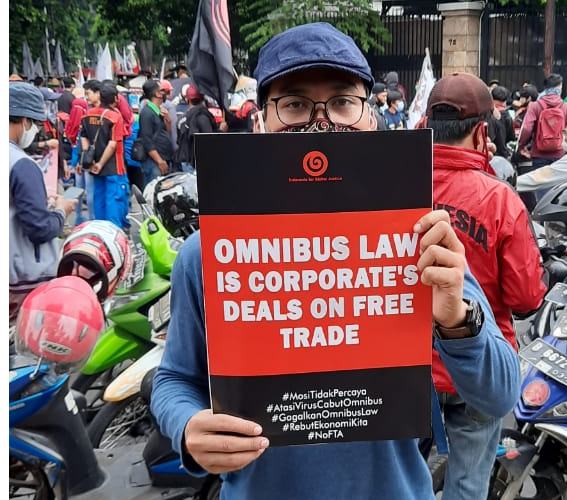
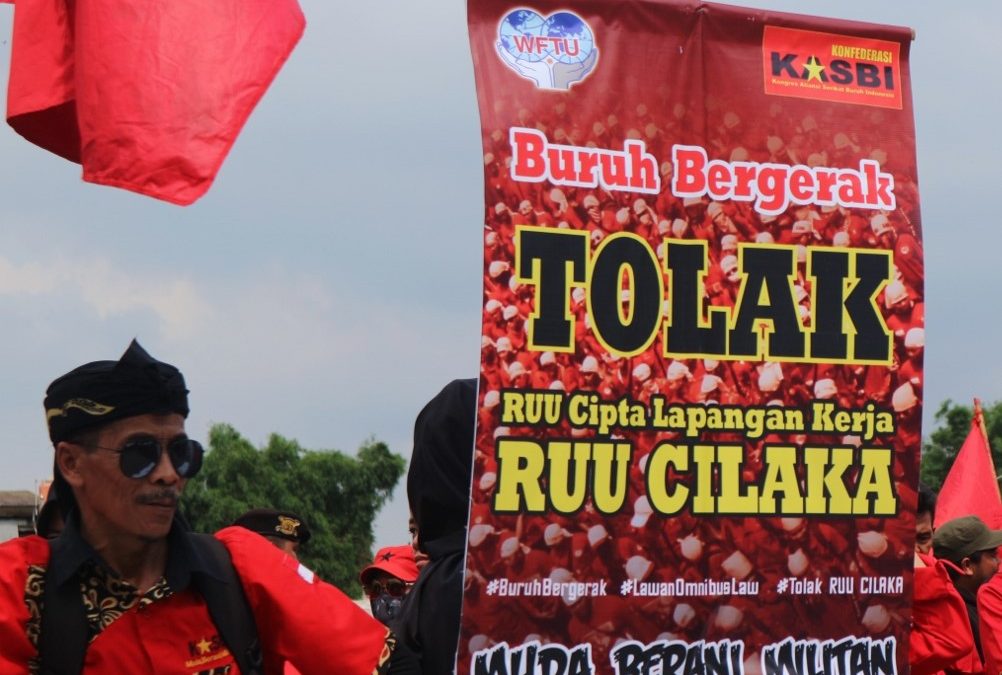
Humanitarian Crisis at the Indonesian Parliament, Stop Discussing the Omnibus Law Amid the Covid-19 Crisis

Humanitarian Crisis at the Indonesian Parliament, Stop Discussing the Omnibus Law Amid the Covid-19 Crisis

Statement of Indonesian Civil Society Coalition for Economic Justice

 Jakarta, April 2nd 2020

The Civil Society Coalition for Economic Justice (MKE Coalition) strongly condemns the evil intentions of the Government and the Parliament of Indonesia that have  made the Covid-19 pandemic outbreak as a loophole to discuss regulations that were widely rejected by the public.

Among them are the Omnibus Law, Job Creation, Taxation and the Capital City. Because, until the last session of Parliament on Monday, March 30th, 2020 the Parliament still insists on establishing the omnibus law and capital city discussions to continue. It appears that they don’t have empathy and humanity, in the midst of this crisis the Parliament and the Government still persist to prioritize  the  interests  of  investors  rather  than the  lives  of  Indonesian  citizens  whose numbers continue to rise due to Covid-19.

Such conditions are reiterated in the policy recommendations issued by Bapennas (National Development Planning Agency) regarding economic policy amid the Covid-19 pandemic. Stated therein, it will accelerate the discussion and  completion of the omnibus law as a solution to attract investment in the second half of 2020. This policy is not effective and full of errors, what was  needed  now is  the presence of  the government in protecting the citizens  of Indonesia amid the threats of Covid-19, not to protect the interests of investors behind the acceleration frame of the omnibus law completion.

The Covid-19 pandemic outbreak should be a turning point not to return to the trade policy of “business as usual”, and dependence on private investment must be corrected, particularly those related to health, food, and basic public services. Several countries that acted quickly to nationalize hospitals immediately and put food management in the hands of the public rather than private, show that, there is something wrong with the pre-pandemic economic and trade policies. Countries that have lost food production capacity will be severely hit because they are highly dependent on export and  import, while in this  kind of  quarantine situation it becomes increasingly limited.

The completion of the Omnibus Law discussion amid the global economic turmoil due to the Covid-19 pandemic also does not guarantee the ability to attract investment to drive the industrial sector. This is because there are no investors who are willing to invest their capital amid  a very high financial risk. If Jokowi’s expectation is that by approving the Omnibus Law in the near future will be able to increase the value of trade to save the balance of payments deficit,  then  there is actually no  guarantee that exports  will also  increase, given that the global production supply chain is also stalled. Global trade is not in a normal conditions. The crisis of capitalism is already permanent. Today’s condition cannot be answered with the same economic system, but rather the people’s economic strength is the right solution.

Therefore, the discussion of the Omnibus Law amid to Covid-19 pandemic outbreak only further shows that the Government and the Parliament are not sensitive to people’s lives, and shows that this country has an acute humanitarian crisis.

On that note, we demand that the Government and the Parliament  stop discussing the Omnibus Law Bill and focus on handling the Covid-19 crisis problem in a structured manner by issuing effective and targeted policies on health issues. Protection of human life must take precedence over other interests. In fact, Rp. 466 Trillion budget should be used for the Capital city transfer, was diverted to handling Covid-19. As of April 1st, 2020, there have been 1,677 people who have tested positive in Indonesia and 157 people have died from Covid-19.

Civil Society Coalition for Economic Justice: 

Indonesia for Global Justice (IGJ), Women Solidarity, the people’s coalition for justice in fishery (KIARA), Indonesian Forum for the Environment (WALHI), Indonesian Peasant Union, Coalition for the Right to Water (KRuHA), Indonesian Traditional Fishermen Association (KNTI), People’s Struggle Association (KPR), Indonesia Aids Coalition (IAC), Indonesian Human Rights Committee for Social Justice (IHCS).

 Contact person:

Susan Herawati, KIARA – +62 821-1172-7050.

Arieska Kurniawaty, Solidaritas Perempuan – +62 812-8056-4651.

Rahmat Maulana Sidik, Indonesia for Global Justice (IGJ) – +62 812 8048 0561.

Herman Abdulrohman, KPR – 0822 1342 6109.

Posted by

Rachmi Hertanti
Executive Director
Indonesia for Global Justice
www.igj.or.id 

Read More

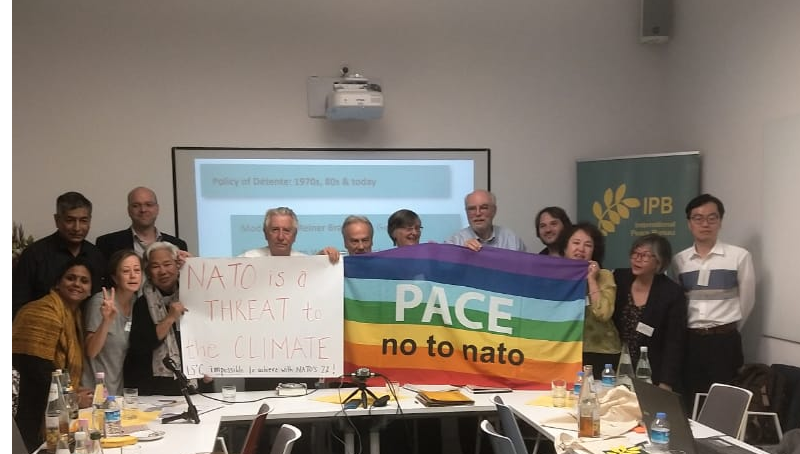
Statement – AEPF & IPB Conference, 23-24 September 2019, Berlin

Statement - AEPF & IPB Conference, 23-24 September 2019, Berlin

We in the Europe Asia peace movements, resolutely recommend a commitment to the idea of a Common Security. Earlier developed by the Palme Commission (1982), we are re-imagining and proposing Common Security as a peace and justice instrument as part of a people’s agenda accepted by all 57 OSCE countries with the Charter of Paris (November 1990) which brought the cold war to an end.

We are living at the edge of unprecedented and multiple crises reflected in: international economic and social production processes; fragmentation of social cohesion, rise, and election of nationalist authoritarianism, an attack on multilateralism and disregard of international law, and almost irreversible climate catastrophe, and destruction of ecology. The presence of more than four million people across the world who protested on 22nd September, shows that people, especially the young want dramatic policy changes without which a climate extinction is a reality. It is clear that the climate cannot be saved in a system undergirded by unrestrained militarization, continued nuclear weaponisation, and unrestricted consumerism, neoliberal competition and economic growth in the industrialised countries.

Hegemonic politics and aggression by the US led forces and unilateral sanctions add to the spiral of violent retribution.

We activists of the international peace movements recommend:

A new security architecture where Eurasia is an appropriate geopolitical zone to move from a politics of confrontation and sanctions to a politics of cooperation, dialogue and peace. The Charter of Paris from November 1990 should be accepted as the basis for a policy of cooperation and dialog. The existing instrument for a policy of cooperation in Eurasia is the OSCE. It must be strengthened and further developed.

That the nuclear powers cease the upgrading of their nuclear arsenals, move to fulfill their obligations under the nuclear non proliferation treaty and the International Court of Justice’s advisory opinion on the Use and Threat of Use of Nuclear Weapons and pursue detente based on the six primary principles of the Palme Commission. The Treaty of the Prohibition of Nuclear (TPNW) must be signed and ratified by all countries.

That a climate and environment saving fund should come from international cuts in defence and military expenditure. Reductions in military spending with the savings redirected to addressing urgent human needs and investment in infrastructures that contribute to sustainability.

We urge that all states implement Security Council Resolution 1325, and equally include women and young people in conflict resolution and all policy-making bodies.

A commitment to anti-racism is a way to ensure national and international cohesion.

The Berlin Wall and its end thirty years ago show that the new trend of building walls is unsustainable, unworkable, undemocratic and will be resisted by popular movements.

A return to multilateralism and strengthened international laws that can assist in ending all armed conflicts, and ending state and non state led violence.

We oppose military alliances since these increase threat perceptions and lead to increased all-round militarisation. Thus an inclusive Common Security, related to all human security would better provide security with justice for all peoples at this time of climate emergency. This has been articulated in SDG 17 and in the principles of the OECE.

Download the Full Statement

Read More