Reviving the Commons and Reviving Europe

Reviving the Commons and Reviving Europe

January 14, 2019 | Roberto Morea
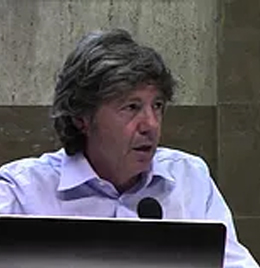
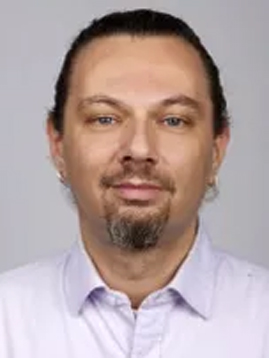
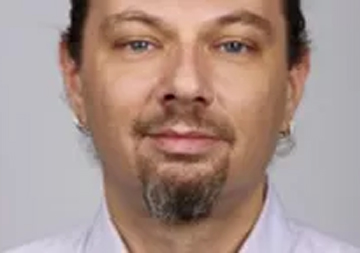
Robert Morrea the president of Transform! Europe, makes the point that the dismantling of welfare policies that made the idea of Europe are being dismantled and this is leading to the decline of Europe as both a power and a social model for progress. This is a presentation from Our Common Social Future: Towards a Social Commons, Social Justice Cluster, Barcelona (June 2018).

What is happening to-day is that Europe is increasingly giving up its ambitions for all the people who live on the continent. What we are facing now is the transformation of our societies.

Globalisation has acted as if we all lived in the same country (same policies for all). We do indeed share with the Asian countries a lot of similar problems, because of globalisation. There are rich people that get richer and richer and there are poor people, everywhere.

In that sense we need to have a discussion on what the solution is. We have to ask ourselves if the European Union can be a solution. We have a long history with a unique political space. What is clear now is that the economic and political power also has a possibility to enlarge this space. Europe was in a sense a good example of capitalist expansion.

We built welfare states which served as a model for many countries outside Europe, and now what we are facing is the destruction of this social model. And at the same time companies are entering in spaces that we thought were our spaces, such as health care and other sectors. We now have to fight privatisations because we are losing our public services. They are made into profit sectors, with less concerns for people.

That is why in this global scenario we are also losing. The way we react in Europe is also showing that we as Western Europe, as such, are losing power. We are losing potential for transformation of the system.

My organisation, Transform! Europe, works with 32 organisations and foundations all over Europe, from 21 countries, in order to establish contacts among all the left parties in Europe and connect them into one single party. This is not easy, because we are very different in different countries. I come from a country in the South of Europe, with different systems of public services compared to what exists in Sweden or Denmark. Bringing together people and parties from different countries is a real challenge for us. That is why I think that what we share is that social justice is the core of our mission. I also think that the commons strategy can be a way to unify different perspectives. That is also why we have to open up and share with other countries and other people, social justice and commons strategies. This is the way we can put together our different perspectives. We have to try to give to the people the strength to change the rules. I think what we are trying to do at the European level, to unify people, we also have to try and do it on the global level.

*Robert Morea is an activist and president of Transform! Italy, the Italian node of the network transform! Europe, of which he is a member of the board. Facilitator of the ‘Common Goods working group’. Morea was a councillor for social services in the 1st municipality of Rome, promoter and part of the City of the other economy in Rome.
Read More

Social justice for a life of dignity for all: The Social Justice Charter explained

Social justice for a life of dignity for all: The Social Justice Charter explained

January 10, 2019

The current reality is one where increasingly people cannot afford medical care, give quality education to their children, get pensions, as youth face employment insecurity. This three minute presentation explains this phenomenon. It calls for support and mobilization for the Social Justice Charter.

Read More

Commons and Conflict

Commons and Conflict

December 14, 2018 | Dario Azzelini

Today, everyone is speaking about commons and ‘commoning’, everyone wants to build commons. The World Bank has a group which is supposedly ‘protecting and improving the global commons’ and it reaches out to the private sector to ‘advance common goods’. You can find texts on commons on the website of the European Union, banks organize seminars on the commons. Transnational companies tell us they are building the commons, big magazines declare that Uber is commoning cars, and that the “sharing economy” is a form of commoning.

I think we have to be very clear about what the commons are. Or at least what they are structurally. It does not mean that we can define in every detail what the commons are or what they will be. The commons and the activity of commoning are nowadays brought forward by many social, political and even economic actors.

Mainstream research suggests that commons and capitalism can peacefully co-exist. It speaks about the absence of conflict and that the rights of the commoners to decide and manage their own commons are neither questioned nor challenged by external authorities, are at the centre of successful commoning.

But if we look at history it is important to remember one thing: The commons are not a gift. And even if many researchers tend to describe the commons as working best if there is harmony, there is this big desire for harmony in many alternative circles mentioning the commons, this is not the case. Commons are most likely to be achieved and/or to be preserved in time if we organize and are ready for constant conflict because the history of capitalism is a history of enclosure of the commons. The commons preceded private property and capitalism. Capital needs the commons for the ongoing accumulation by dispossession. A capitalist system will therefore always prey on the commons and at the same time destroy the fundaments for sustainable social practices and ultimately the fundaments of life itself.

Especially in the global south, where we have much more traditional commons that have survived, or have been preserved over time, people have the experience how capital, transnational companies, etc. grab the commons and incorporate them whenever they need them. Even if there was some kind of official recognition of the commons earlier or if you had some kind of supposed harmony, it does not matter anymore once capital wants to appropriate the commons. And it will at some point, always. Because the law of capitalism is expansion, it has to expand. In a limited world expansion means to take away from others. The history of capitalism shows how it is incorporating, coopting, what is socially produced by the people. Capital is totally unable to develop anything for humanity. We see all these tales about the free floating creativity of capital making all the inventions possible. But this is not true. Capitalism is blocking progress, for example with patent rights and things like that, which make it for example, impossible to develop new cancer medicine because most of the elements are already patented by a different company, so it is not worth anymore for a company to develop a cancer medicine if they have to pay patent rights to other companies.

We can see that neither are the commons a result of any harmony between the state, the private and the people, nor can they be preserved any better if there is this supposed harmony. The commons, like everything else people have won over the course of the past hundreds of years, are a result of struggles of the people. Moreover, there is an important change over the past decades to take into account. Many got to believe that liberal democracy is granting rights. This is a big misunderstanding. Over a few decades liberal democracy was the frame in which rights could be expanded, always through struggles, there were no rights given for free… they were all won in struggles by huge movements, women’s movements, workers’ movements etc. They were a result of struggles. But this worked only as long as liberal democracy was the frame for modern industrial capitalism to develop. We have seen over the past 2-3 decades that liberal democracy is not anymore the political model corresponding to capital’s development today. That is why we experience the authoritarian tendencies all over. That is why in so many struggles we have been barely able to preserve the status quo, but not anymore to achieve any progress. The liberal democratic frame is not anymore a frame for expanding rights. It turned into a frame of reducing rights, of making them invisible, of creating structures in which people don’t have a say anymore even if people are told that they have. And we can see very well that people are not satisfied. All the “anti-representative” revolts of the past decade were a result of people feeling – in representative democracies as well as in authoritarian regimes felt that the proposed model of representation is not democratic. It does not represent them, they do not have a say, they cannot decide on their future. In an interview during my research on the 15-M movement a few years ago, an interview partner said: “It’s like a big storm is coming over you and you don’t have any means to influence the situation.”’

The hope that we will win because we have the better arguments, the better reason, is a lost hope. We have to organize struggles from the bottom up to preserve commons that exist, to achieve commons that do not exist, and to keep us as communities, as people, in a position where we decide, we take the decisions and are constantly involved in decisions that are made, if we do not achieve that, if we leave it to the state to preserve the commons, we will neither preserve them nor achieve them. Because the times the expansion of rights corresponded to the production model are over. The function is not anymore to preserve or to create any rights anymore.

When we are formulating the strategies to achieve commons it is also very important to look at what kind of commons we want to achieve and how we think about them. Because there are also commons that are functional for capitalism. I am, for example, totally in favour of having free internet access for all, but it is also something that is completely functional to capitalism. It is not the case that every commons is automatically an emancipatory idea.

We also have to think about – and it has been part of the past seminars we organized – reproduction. That is very central. The commons cannot be something that is, once again as other production models and especially Fordism, based on gendered labour and the reproduction of labour by women. The danger is always present, especially when times get more precarious, it is often easier to externalize certain amount of work and make it invisible. To achieve and preserve the commons we have the outer dimension of struggle, which is not based on harmony, and we have also an internal struggle to think and act differently regarding reproduction.

* Dario Azzelini is an academic and activist. His work focuses on democracy, workers’ and local self-management and social movements. He co-authored They Can’t Represent Us. Reinventing Democracy From Greece to Occupy (Verso 2014)

Read More

Social Commons, Social Justice, Systems Change: A Programme for Sustainability

Social Commons, Social Justice, Systems Change: A Programme for Sustainability

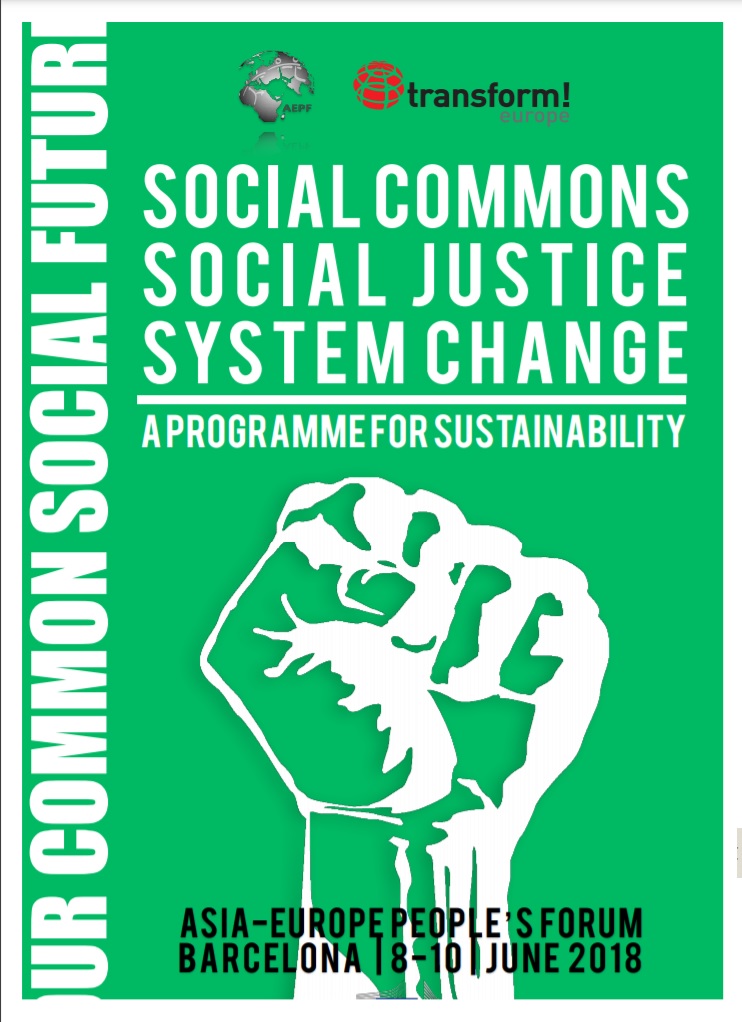
A Summary of Experts Presentations on ‘Social Commons, Social Justice, Systems Change: A Programme for Sustainability’ (Download)

Progressive movements from Asia and Europe gathered in Barcelona to discuss the highly topical issue of social commons.

For the Asian movements of the Asian-Europe People’s Forum, the discussion was a continuation of a programme on social justice, after a conference in Manila on public services, and before the People’s Forum in Ghent and another conference in 2019 on labour.

For Transform! Europe,the conference was a continuation of a long-term project on commons, searching for alternatives to neoliberalism and the outdated statist programmes of parts of the left.

This common search for a future oriented perspective on social justice was very successful and allowed for opening a new horizon for political action and campaigns. The cooperation between scholars and activists was particularly helpful to identify the strengths and
weaknesses of this emerging new concept.

Apart from the stated objectives of the conference – clarification of the meaning of social commons, development of a new narrative, etc. -, the most important contribution seems to have been the links that were explained between different sectors, such as social, environmental, macro-economic and gender policies, production and re-production, amongst many others.

Most of all the interdependence of people and the interconnectedness of different issues made clear that no single issue can dominate the agenda. We need to work on all different fronts and at all different levels, simultaneously, from the economy to the labour market,
from social protection to climate justice, at the local as well as at the national, regional and global level.

This is indeed a daunting task, but cooperation like the ones established at this conference show that it is perfectly possible.

Different speakers explained the social situation in their country, which, in every case, had several similarities because of the growing inequalities and the persistent poverty. Contrary to many misplaced beliefs, commons are not a search for harmony, they cannot
peacefully exist in a neoliberal capitalist model, they are always a result of social struggle. This is also why they can contribute to social, economic and political change.

In order to achieve this the concept of commons invites us to think differently, to go beyond the current international initiatives for social protection, to think differently on ownership and property, to look differently at self-determination and self-governance.

Finally, the conference heard stimulating stories about how clever and efficient social policies, are helping people to live in dignity, and have been fruitful for progressive parties winning the elections.

To sum up, and as was stated in the final ‘Barcelona Declaration’ ‘by focusing on the collective dimension of our social and economic rights and by directly involving people in shaping public policies, the commons approach can become a strategic tool to resist neoliberalism, privatisation and commodification … Claiming and controlling social commons means building power together with others. It is a primary task for all progressive forces’.

Many important questions remain to be further examined such as the role of the State and other public institutions, the issue of scale and the transformational potential of commons. There is work to be done, but this work is directly related to the sustainability of life. Worth doing!

This is why the organisers of this conference thought the different presentations might as well be published, to remain a lasting contribution to the debates that will certainly continue and to inspire others to join this great effort.

It took some time, and we have not succeeded in collecting all the contributions, but we are sure that with the content of this booklet, a very important source of inspiration can be found for all those who want to work on solidarity, on social justice and on commons.

We thank more particularly Dr Anuradha Chenoy and Bishnu Singh for the editing work and Dr Francine Mestrum for the organisation and the lay-out. And of course Jen Derillo for the wonderful posters. We thank all the organising organisations for their precious contribution.

Download the report

Read More

Charles Santiago (MP, Malaysia) at AEPF, Barcelona, 8-10 June, 2018

Charles Santiago (MP, Malaysia) at AEPF, Barcelona, 8-10 June, 2018

November 30, 2018

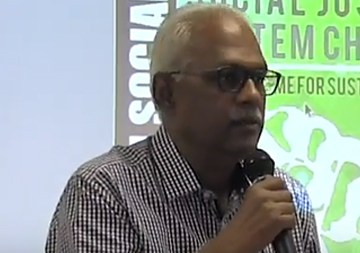
Charles Santiago (Member of Parliament, Malaysia) speaks on the situation in ASEAN Countries and tells how his party won the elections by increasing programs on social justice and through inclusive policies at “Social Commons, Social Justice, Systems Change: A Programme for Sustainability”, AEPF, Barcelona, 8-10 June, 2018

Read More

Sushovan Dhar on Global Social Protection Charter

Sushovan Dhar on Global Social Protection Charter

November 29, 2018

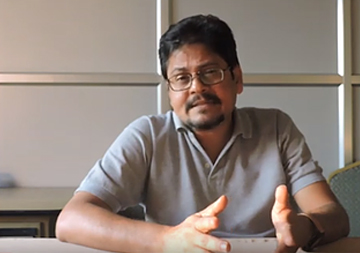
Sushovan Dhar, of the Committee for the Abolition of Illegitimate Debt, endorses the Social Justice Charter, and speaks of the needs and ways to end debt and close the inequality gap.

Read More

Social Justice and System Change

Social Justice and System Change

October 13, 2018 | Francine Mestrum

What are the objectives of social justice cluster?

We want to develop a concept that is positive, creating hope, that is politically attractive and we also want to make it very concrete, by showing:

  • That social justice is central to the political, environmental and economic changes we desperately need and want – ‘erst das Fressen und dann die Moral’ (Bertold Brecht) – we want to point to the importance of economic security. We also do not want to forget the origins of socialism, in this city of Ghent, in which soup kitchens played an enormous role!
  • One of the major elements of social justice is social protection, this should and can be broadened – this social protection is based on economic and social rights and on solidarity.
  • Social protection means social security (insurances, unemployment benefits, sickness benefits and health care, pensions, care for young mothers and children …) but also social assistance (help for poor people so as to prevent and eradicate poverty), labour rights and also – very important – public services
  • We consider social protection to be an integral part of a social common – we may have time to discuss this further, during this meeting, but basically it means that we need a State to guarantee people‘s rights, whereas citizens have to be actively involved in the conceptualization, the implementation and the monitoring of social protection policies.
  • Social protection is closely linked to other sectors we are concerned about: climate change in the first place, but also trade and democracy, and in the end, obviously, peace. The Constitution of the ILO, which will celebrate its centenary next year, in 2019, explicitly states: peace is not possible without social justice.
  • In that way, if we consistently and coherently pursue our objectives, social protection can be transformative, that is directly contribute to economic and environmental system change.
  • Examples: housing for climate change ; mobility in cities, public transport, etc.
  • Democracy: discuss and decide on (social) policies – the core of social common
  • Economy : stop Monsanto/Bayer to produce (and use) pesticides if we want to have preventive health policies.
  • Trade: stop making huge profits on patents on pharmaceutical products etc

Let me briefly point to some other problems

1.The discourse on social protection is today dominated by the right and the multilateral institutions:

a. SDG’s and SPF’s are very important, but they do allow for privatisations, they will not stop land grabbing and corporate greed, on the contrary – read The Economist on how ‘liberalism’ is claiming to be the only progressive force today!

b. The World Bank has played a very important role these past thirty years in changing the meaning of ‘social protection’ from ‘poverty reduction’ to a totally eroded concept and finally targeted policies for the poor

c. Neoliberalism is not our only enemy anymore, because in the meantime, populist right-wing governments, in Europe, in Asia and in the Middle East are promoting ‘social protection’ that defends ‘traditional values’, that are non-emancipatory, etc.

2. What is happening today is this: as the German sociologist Claus Offe said: capitalism does not want welfare states, but at the same time it realizes that it cannot survive without welfare states. So what is happening today is that the World Bank and many governments, are trying to establish and to save these (minimal) parts of welfare states that capitalists need – and they talk of social investments. That is why we see that everywhere, they will cut on pensions and unemployment benefits, they cut on public health and subsidise private insurance; you do not invest in old people and everyone has to be part of the labour market. Today, social protection is at the service of markets.

3. As for right wing populism, its strategy is purely electoralist, while in the meantime keeping people away from emancipatory policies; they will defend and promote ‘traditional values’

4. That is why we have to defend our vision of an emancipatory, universal, comprehensive and transformative social protection.

And let me add one more argument:

We need to have our own agenda. For the reasons mentioned above we need to go beyond the currently existing international initiatives – which we support, they are good – but we, progressive social movements, we should develop our own agenda. We should not limit our fights for things that have already been given to us. Because that is what international organisations do : they decide on what our agendas should be. There we say: NO; We have our own agenda.

That is why in our Manila meeting in February of this year(2018), we discussed public services; and that is why we had a conference on social commons in Barcelona in June of this year. Our aim is to continue to search for theories and practices promoting social justice while contributing to system change.

That is why we drafted a Global Charter for Social Protection Rights, which goes indeed further, which does not have to be taken in all its details, but which can be a reference points for the social struggles and campaigns we have to organize.

Because yes, do not forget this: we have to organize, we have to coordinate, we have to work together. And we have to strategize.

Here in this plenary meeting, speakers will tell you how social justice is linked to democracy, and how it is linked to the economy, and how through a reflection on social justice, we can, together, contribute to change.

Read More

Presentations for the event “Our common social future: Commoning and sharing for society, the environment, and the economy”

Presentations for the event "Our common social future: Commoning and sharing for society, the environment, and the economy"

Choose what presentation you wish to download –

Read More

BARCELONA DECLARATION

Barcelona Declaration

July 6, 2018

Asia Europe People’s Forum
Social Justice Cluster
Our common social future: Commoning and sharing for society, the environment and the economy. A programme for a democratic, participatory and transformative social protection

BARCELONA DECLARATION

Social justice is at the center of all our concerns and of all our efforts to work for a better world. These are shared concerns in Europe and Asia. Levels of development differ widely between these global regions, but also within them. The superrich in Asia have now overtaken their counterparts in Europe. However, at the level of social justice and more particularly social protection, labour law and social services, developments in Europe and Asia are similar and are dictated by the same neoliberal philosophy, strengthened by conservative forces.

Today, social protection is high on the international development agenda, for example through the UN Sustainable Development Goals, the ILO’s Social Protection Floors and the European Union’s Pillar of Social Rights. While these initiatives are interesting and important, daily political practice continues to widen inequalities, to make employment more precarious, and to roll out the privatisation of public services such as water and health care.

Benefits of market-driven economic growth do not trickle down to the poor. That is why there is now a broad movement, all over the world, to reclaim rights, health care, water, pensions, land and schools: because people are being robbed of their livelihoods, including jobs and wages.

Governments and international institutions often make socially viable solutions impossible. As a result, trust in public authorities is dwindling, sometimes deservedly but often as a result of political manipulation. More and more people are responding by taking initiatives to help themselves, creating small scale farms, providing care for the elderly or the very young, and organizing to produce clean energy, local currencies and cooperatives.

The commons are life’s necessities, we need them to meet basic human needs. Social commons are activities and relations co-designed and co-produced by people, with shared ownership and control, forging new relations between people and the public realm. Commons go beyondmarkets and states, but not without markets and states: both will have to adopt a different logic. Commons change the ways in which we understand and practice democracy, participation and governance.

This conference further reflected on progressive definitions of social commons in the context of the self-organisation of people. It has explored the conceptual and practical implications of claiming social resources as commons. It contributed to clarifying the concept and begun to explore links with other sectors, such as the environment and culture, macro-economics and fiscal policies. It examined the potential of the social and solidarity economy.

Climate change broadens the requirements for social protection and social justice. Both will have to be re-defined and scaled up with even more urgency. Climate change is a game changer for how social protection, equitable and sustainable development and the fulfilment of human rights can be realized.

Feminists put the emphasis on social re-production, helpful for thinking about the interdependence of human activities. Many of the commons initiatives are started by women because the expansion of commodification and privatisation in patriarchal and capitalist societies increases the workload for women by integrating them into global commodity chains while at the same time expanding their unpaid social re-production work. It is important that commons do not become women’s responsibilities in a new gendered division of labour.

This pursuit of social commons must be seen in the context of our ambition to shape a better world. This calls for a transformation of social, economic and political systems, and for resistance to the dismantling of economic and social rights, which are in effect a new form of enclosure. We are not searching for harmony through adaptation of the status quo. On the contrary, it should be clear that commons and neoliberal capitalism cannot peacefully co-exist. Commons can only endure in the long term through struggle and conflict aimed at building a new political economy to support people’s control of essential resources. Therefore, the social protection we envisage will go beyond the currently existing initiatives; it will not be a corrective mechanism but will contribute to the radical changes we need.

By focusing on the collective dimension of our social and economic rights and by directly involving people in shaping public policies, the commons approach can become a strategic tool to resist neoliberalism, privatization and commodification. It can help to build a new narrative to strengthen and broaden people’s movements as well as for political and legal action against the exploitative use of our resources. Commons are about power. Claiming and controlling social commons means building power together with others. It is a primary task of all progressive forces, at all political levels, from local communities to global institutions. Facing the challenges of all important recent changes, it is clear the labour movement has to play an important role, countering the fragmentation and precarisation of work, taking into account the role of women and creating alternatives based on their abilities and skills.

Social protection alone will not be enough to achieve system change. But social justice can become an entry point for policies of social, economic and political transformation. Emphasizing our interdependence and the necessary collective dimension of all our efforts can be a vital step towards strengthening social movements and building citizens’ power.

Many important questions remain to be further examined, such as the issues of scale, of class, the role of public institutions, ownership and the transformational potential of commons.

What we are working for is the sustainability of life, for people and the planet. Our social protection, our economic and social rights are ours, so we decide on them. This is a call to join our efforts and fight for social justice in a comprehensive way and to create a message of hope for the future.

This Declaration has been adopted by the conference on social commons, held in Barcelona from 8 to 10 June 2018, co-organised by the social justice cluster of the Asia-Europe People’s Forum and Transform! Europe. More information can be found at: www.aepf.infowww.transform-network.net and www.socialcommons.eu

To watch the videos click here

Read More