Redefining the Agenda for Social Justice: Voices from Europe and Asia

Redefining the Agenda for Social Justice - Voices from Europe and Asia

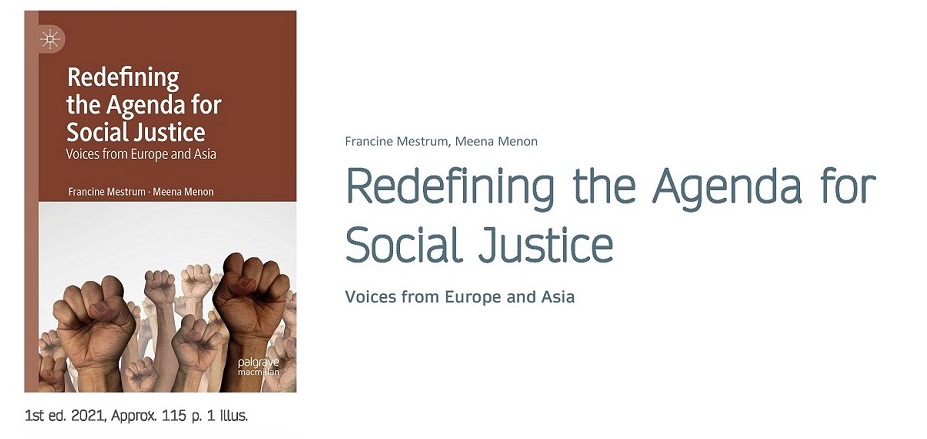
AEPF Social Justice Cluster is happy to announce the publication of a book by Francine Mestrum and Meena Menon ‘Redefining the Agenda for Social Justice’, Palgrave Macmilan, 2020, New Delhi. This book covers the gap in literature on new ideas for social policies

You can get a copy of the book here

Read More

Webinar: The Covid19 Lesson: Building a Strategy for Universal Health Care and Social Protection

Webinar Video & Resources - The Covid19 Lesson: Building a Strategy for Universal Health Care and Social Protection

What are the lessons we have learnt from Covid-19? What are the best strategies for the way forward? AEPF and NGO-Forum are reaching out to organisations across Asia and Europe to discuss a joint campaign on universal healthcare and social protection

Watch our Webinar on “The Covid19 Lesson: Building a Strategy for Universal Health Care and Social Protection by an internationally known panel of experts: Francine Mestrum, Rayyan Hassan, Hani Serag.

Download the Webinar Report 

Links to the presentations of our speakers

Hani Serag’s presentation on Covid-19: The urgent need for universal health care and social protection

Francine Mestrum writes about   Health Care and Social Protection: What strategy?

Rayyan Hassan writes about Asia teetering at the edge: The significance of government debt amid Covid-19

Read More

COVID-19 and Advocacy in Multilateral Spaces

COVID-19 and Advocacy in Multilateral Spaces

The COVID-19 moment has provided a short-term and medium-term boost to the digitalization of the world economy and the consolidation of the market power of Big Tech. Anita Gurumurthy’s presentation examines how these developments open up new battlefronts in multilateral advocacy: the regulation of digital trade in goods and services, the governance of cross-border data flows, renegotiation of global taxation and IP frameworks, and official development assistance for the creation of essential digital and data infrastructure.

Read More

Asia Europe People’s Forum: Declaration of the Social Justice Cluster On World Health Day, April 7,2020

Asia Europe People’s Forum: Declaration of the Social Justice Cluster On World Health Day, April 7,2020

The Social Justice Cluster calls for the establishment of public and universal health systems, a revaluation of so-called “reproductive” work and taking into account the social health determinants and the real needs of the people

The coronavirus crisis is a wake-up call and a warning all over the world. Governments from the North and South are helpless, health systems are failing, everyone, especially the sick and informal workers are the victims.

Governments presented precautionary measures that are blind to the social and economic realities of the population. Confinement is a solution only if you actually have a house; the recommendation to wash your hands is only valid if you have soap and water; the anti-bacterial gel is only available to those with income; proper nourishment is only possible for those with money to buy healthy food… In other words, to avoid the virus, it is better not to be poor, an informal worker or homeless.

The failings of our social systems worsen the health situation. For those who are sick, in too many cases there is no access to free and effective health care; for those who lose their jobs, too often there is no sickness allowance. Faced with this situation, too many patients prefer to ignore the risks and contaminate their neighbours, their colleagues, their families.

Our frontline- doctors, nurses and other health workers, expected to save the lives of the sick, are often unprotected themselves and their lives are in danger, whereas their working conditions are unacceptable.

In short, this crisis shows us how decades of privatization and austerity policies have seriously undermined the ability of states to care for their populations in the event of an epidemic.

This is why the social justice cluster of AEPF urgently requests:

1) The establishment of public universal social protection systems. These systems will be based on rights and solidarity, not for profit. For that, it will be necessary to put an end to austerity policies and to set up taxation systems at national and global level so that all can contribute to and benefit from this social protection.

2) It is also necessary to look beyond traditional social protection policies and care for the means of meeting people’s basic needs:

  • Access for all, as a matter of right, to life’s essentials, including clean water, decent housing, education and adequate nutrition for all
  • Guaranteed income systems must be put in place in case of unemployment
  • Labor laws must provide sickness benefits
  • To recognize and value paid and unpaid care work
  • Safe and affordable medicines

3) Apart from these few elements of emergency policies, it is also necessary to prepare for the future and put into place legislation so that:

  • People can have popular education systems so that they know their rights and duties in the event of an epidemic as well as get information on disease prevention and treatment
  • Research can be funded so the world is better prepared for other viruses and other epidemics
  • Patents on possible vaccines and medicines are in the domain of global commons and cannot be monopolized by States or pharmaceutical companies

4) Finally, it is imperative to reflect on environmental and agricultural policies in order to reduce the risks of endangering biological diversity and gear health systems towards the prevention of risks.

Faced with these multiple elements which are directly linked to the coronavirus crisis, it is obvious that effective solutions go far beyond health systems and social protection. In fact it is about our entire economic system so that the real and urgent needs of the people can be taken into account. Markets have proven to be utterly inadequate for this task. Indeed, it is not enough to “fight poverty”, it is absolutely necessary to put an end to the production of poverty. It is therefore not enough to ‘redistribute’ wealth either, it is the primary production of wealth that will have to be put on track differently. The crisis clearly shows that so-called “reproductive” work must take a central place in our social organization. Also, the immense funding of militarization must stop in order to sufficiently provide health care systems in particular and social protection in general with sufficient resources.

AEPF underlines that such policies require social and democratic transformation, in order to set up participatory processes.

To that end, the Social Justice Cluster of AEPF has drafted a Global Charter for Universal Social Protection Rights. We invite all to endorse it and work towards the realization of these rights.
www.globalsocialprotectioncharter.eu


Read More

Southeast Asia: Social Protection rhetoric versus exclusionary socio-economic policies

Southeast Asia: Social Protection rhetoric versus exclusionary socio-economic policies

 Notes prepared for  the International Conference  on Universal Social Protection and  Labor, organized by the Asia-Europe People’s  Forum and Nepal Partners. Held at Kathmandu, Nepal,  April 4-6, 2019.

Rene  E. Ofreneo
(President, Freedom  from Debt Coalition, Philippines)

  1. Two decades  ago (1997-98),  Southeast Asia gave the world the “tom-yung” financial  crisis, better known as the Asian financial crisis (AFC). Four Asian countries sunk into  depression: Indonesia, Malaysia, South Korea and  Thailand. The Philippines and other Asian countries, including Russia and some countries in Latin American countries were shaken.  The AFC was followed a decade after (2007-2010) by the bigger global financial crisis (GFC), which originated from the heartland of financial capitalism: New York and London.
  2. Millions lost jobs overnight in Southeast  Asia due to the AFC. Indonesian strongman Suharto himself lost his job, after meekly submitting his country to  the supervision of the IMF.
  3. It  was against this  backdrop that some  serious re-thinking about social protection took  place within the official policy circles in Southeast Asia.  In the 1980s-1990s, the World Bank and its neo-liberal cohorts actively  promoted the privatization of government-managed pension and social security programs, as  part of the broader program of privatizing, deregulating and liberalizing economies of the world. This privatization  proposal was meaningless to all those who lost their jobs and incomes due to the AFC.
  4. In Thailand, the government of  the populist Thaksin Shinawatra pushed  for the 40-baht universal health care despite  the earlier austerity program pushed by the IMF-World  Bank group. In Malaysia, Mahathir defied the IMF by imposing capital controls  to stop the haemorrhage of capital and jobs out of the country. But the beleaguered Suharto completely succumbed  to the IMF diktat.
  5. And  yet, ten years after,  at the height of the GFC,  the world re-discovered the  Keynesian approach in crisis situations, that  is, government stimulating the economy through various deficit spending mechanisms.  In America, the spending program was even seized by the big banks, which precipitated  the crisis, as a means to save themselves by arguing that their collapse will lead to the  bigger collapse of the economy. These banks that were projected as “too big to fail”. In 2017, the  IMF Research Department wrote a “mea culpa” on capital controls, virtually telling the world that Mahathir,  the medical doctor, was correct in making interventions in the capital market in 1997-98.
  6. The  foregoing narrative  on IMF-World Bank policy with somersaults on austerity and  capital controls shows that there are social and economic realities on the  ground that cannot be ignored. These realities are forcing these institutions to adjust  their neo-liberal lenses somewhat somehow.
  7. One  important  adjustment is  the way these  lenders and their neo-liberal supporters are treating  social protection. In the 1980s-1990s, the ILO had a weak  program on social protection. But from the turn of the millennium, the ILO  has become more assertive. In 2012, the ILO’s concept of the social protection  floor has gained global acceptance with the adoption of Resolution 202.
  8. This ILO Resolution   is now supported by the World  Bank, which has been collaborating with the  ILO in a number of social protection promotion  programs. The World Bank also stopped talking of pension  privatization, after strong criticisms by Joseph Stiglitz. One  major program of the World Bank is the promotion in Asia of  its Latin American experiment called “Bolsa de Familia” or conditional  cash transfer (CCT).  Under the CCT, minimal monthly allowance is given to poor mothers  on the condition that the mothers get maternal medical check-up and  her school-age children continue to go to the schools.
  9. In  Southeast Asia in  the meantime, the Thaksin universal health  care initiative has also gained wider acceptance in some  countries, in Indonesia and the Philippines in particular.  Social protection has also become a major ASEAN theme since 2007, when the  ASEAN Charter was adopted. Thus, there has been a proliferation of social protection programs  being bandied around or being proposed, with the World Bank and ADB coming in now as the social protection  champions and supporters. In 2013, the ASEAN came up with a sweeping Declaration on Strengthening Social Protection, which cites all UN conventions  on economic and social rights that citizens should be able to get. There are other ASEAN Declarations: an ASEAN Declaration on Ageing: Empowering Older  Persons in ASEAN, an ASEAN Declaration on Strengthening Family Institutions, an ASEAN Declaration on the Enhancement of the Role and Participation of Persons  with Disabilities, and an ASEAN Declaration on the Enhancement of the Welfare and Development of ASEAN Women and Children. Today, the ASEAN has been organizing numerous  ministerial meetings on how to push social protection through the ASEAN Strategic Framework on Social Welfare and Development (2016-2020).
  10. At the level of the individual ASEAN countries, political leaders also talk endlessly on the need for social protection  — universal health care, education, pension for the retirees, social assistance to the disabled, etc. – for the poor and  those in the margin of society. The only limit is budget that can be allotted for this purpose, or money that can be borrowed  from the World Bank, ADB and other aid givers, again for this purpose.
  11. And this is precisely the problem.  The issue of social protection, now  accepted and articulated by government officials, has  become a question of budgetary allocation. The deeper problem on why there are so many poor and so many are  on the margins is not being addressed fully. More importantly, neo-liberal policies that are in place and the  neo-liberal thinking that still dominates general economic policy formulation are not being questioned. For example, the privatization of  public services such as water and electricity, instead of being kept in the hands of government to ensure universal access for all, is still  a priority program in many countries. These are usually bundled under what the technocrats call as the Public-Private Partnership (PPP), a scheme pioneered  in London under Margaret Thatcher. Under the PPPs or their hybrid forms in Southeast Asia, the big private service providers are able to transform natural monopolies into private sector monopolies.  As a result, inequality is deepening and the exclusion of the many is being exacerbated.
  12. Worse, programs  or policies that are  anti-poor deepen poverty and  the lack of social protection  for them. Example: many peasants, indigenous  people and rural poor are being displaced due to the rapacious land  accumulation programs of the big land developers, the big agribusiness investors and the  members of the national elite who want to get the best lands. In this process, the displaced  become the “floating population” of poor circulating within countries. They join the huge army of the  ‘informals’ who constitute two-thirds of the labor force in most countries. They include the home-based  workers, the street vendors, the informal transport workers/operators and the coastal fisherfolks. Most of the informal labour  do not get adequate social protection, only paltry social assistance programs that are dependent on limited budgetary allocations  of governments.
  13. In  the formal  labor market,  there are also problems.  The army of the precariat continues  to grow, partly because of the efforts of  neo-liberal economists and corporations to pressure governments to maintain labor  flexibility policy, meaning employers can hire or fire workers at will. The non-standard or non-regular paid workers, who outnumber  the regulars, are often not given formal employment contracts nor are they enrolled by their employers in the social security system.
  14. To complete  the labor market picture, the  floating population of displaced  landless rural poor and jobless urban poor is supplemented  by the floating population of migrant workers crossing borders.  There are varied estimates on their number. In Southeast Asia, the biggest destination countries are Singapore, Malaysia and  Thailand. A number of migrants are doing well. But majority, who occupy the low-end jobs are shunned by the nationals of the destination countries, and are in  the most vulnerable position, with limited access to legal and social protection assistance. Again, increased migration is largely the outcome of poor economic policies at home, while  those using migrants’ services are able to restrain wage increases in their own countries.
  15. So how  then do we wipe  out poverty and provide social  protection for all given the foregoing?
  16. In the ASEAN, the good thing is the rising awareness  within policy circles on the importance of providing universal social protection, starting with universal  health care. The sad part is: all this is treated as a funding or budgetary issue. There are numerous meetings and  workshops on social protection or various aspects of social protection such as systems of delivering services, packaging the  services and so on. But rarely is there an exhaustive and serious discussion on the root causes of poverty and social exclusion.
  17. And  yet, the  reality is that universal and  adequate social protection is not possible if there are  no meaningful social and economic reforms to ensure that economic growth  is inclusive, balanced and sustainable. The point is that a program of social protection  should be part of a bigger transformation program. It means discarding the neo-liberal assumption  that growth automatically trickles down to the benefit of the poor. There is a need for re-thinkinging and  transformation too of the overall design of regional and global integration. Why should countries at different levels  of development be subjected to uniform rules for the rich and poor countries? Each country, given the level of its development, should be given the  freedom to determine its development priorities based on the principle of special and differential treatment. As well as needs of their people.
  18. Socio-economic  transformation programs  should be synchronized too  with programs dealing with transitions – just transition  in addressing problems of the environment and climate change risks and  just transition to prepare the people on the impact of rapid technological change  under the ongoing Fourth Industrial Revolution. On the environment, climate change risks are mounting everywhere and  decimating agriculture, water systems and so on.
  19. On  the other hand, the  technology revolution is subverting Factory Asia, which is based on international  subcontracting initiated by the multinationals in the car, electronics and so many industries.  Some institutions, including ironically the ILO, are talking of scaling up developing countries’ participation in the  global value chains when the reality is that these GVCs are now being reconfigured because of robotization and automation.  Also, there is no way, the laggards can graduate to a higher level of development if they simply tie their fate to the coattails of the GVCs of the MNCs.
  20. So,  it is  an urgent task for governments and  the working peoples to come up with just transition  programs tailored and sustainable within the parameters of  the environment and the technology revolution. ‘Just’ here means  just transformation programs involving the people every step of the  way. For example, cleaning a coastal area should not lead to the displacement of the coastal fishing community but should enable the  community to become partners and keepers of clean coastal areas while building a prosperous fishing community.
  21. Clearly, so much has  to be done. The task of securing universal, adequate and  comprehensive social protection for all cannot be reduced to a mere question  of creating the fiscal space for this such as generating new taxes. The most basic is  how to align social and economic policies in support of inclusion and sustainability by  abandoning the neo-liberal development straitjacket and by abandoning the regional and global  Race to the Bottom in the treatment of workers and resources of a country. We need to embrace a new  paradigm of regional and global integration, where people are truly at the center of development.   
Read More

For a Politics of Living Labor

For a Politics of Living Labor

Thomas Coutrot, (Economist, former spokesperson for Attac, France) writes on ‘For a politics of living labor’

French economist Thomas Coutrot makes an argument for a sustainable socio-ecological economic and productive system that benefits labour and society as a whole.
The Fordist compromise between capital and labor traded submission at work for access to consumption and a certain social security, at the cost of the ecoystem. It has been rejected by capital since the neoliberal shift in the 1980s which casualized labor, compressed purchasing power and increased inequalities. Returning to it would be neither desirable for workers and democracy, nor sustainable for nature. We need to move beyond the current treadmill of production.

The search for shareholder value at all costs is indifferent to the impacts of work on the world: as Marx might have said, abstract labor crushes concrete labor. As for the so-called green growth promised by some, it is but a mere illusion: there is no growth without increased consumption of energy and materials, without CO2 emissions and additional pollution. We must aim for the decline in material and energy consumption in order to shift towards a society based on the good life and frugality – something completely incompatible with the capitalist obsession of accumulation. We need to replace the obsession of production and accumulation with the centrality of care – the necessity to take care of others and watch over the world.

Can trade unionism take this turn? It seems more than necessary considering that “without the defection of one of the central actors of the gear [of production], the hope of seriously shaking the status quo is weak” (1). However, at first glance, things might seem off to a bad start.

Trade unionism and ecology: a painful convergence

It must be admitted that in most cases, trade unions have little interest in the quality and usefulness of work or its effects on the world. They sometimes even defend work at all costs, against citizens’ aspirations for clean production and a healthy environment. In France, trade unions in the nuclear industry are at the forefront of the fight against  the closure of obsolete and dangerous nuclear plants. In the United States, the American Federation of Labor and Congress of Industrial Organizations (AFL-CIO) supports the shale gas industry and the construction of pipelines for the transportation of fossil fuels, while German and European unions in the chemical industry have worked with employers to limit the ambition of the REACH regulation over the use of chemicals in Europe.

Nevertheless, things are still moving about. Numerous initiatives are flourishing, thereby renewing aspirations to reclaim control on how and why we work and to bring freedom and democracy to the workplace. The AFL-CIO itself has always been ambivalent. For example, it has supported “the creation of federal laws for the protection and preservation of wilderness […] The AFL-CIO supported the defenders of the most emblematic environmental legislation, such as the Clean Air and Clean Water Acts”. (2) The Blue Green Alliance brings together the main trade union federations and environmental organizations to fight global warming. At the international level, trade unionism is strongly committed to establishing alliances for a “just transition” and “climate jobs”. This is the case of the International Transport Federation (ITF) which advocates for the priority of public transports in order to reduce CO2 emissions (3).

In Belgium, the two major trade unions centers, the Christian Trade Union Confederation and the General Federation of Belgian Labor (also called the FGTB) run the Inter-Trade Union Network for Environmental Awareness ((http://www.rise.be/). The Trades Union Congress (TUC) of Great Britain encourages the creation of “environmental delegates” to reduce the environmental impact of production and lead campaigns for “green workplaces”. In France, the CGT claims the enlargement of the “Committee for Health, Safety and Working Conditions” (CHSCT) to “Committees for Health, Safety, Working Conditions and the Environment” (CHSCTE). The trade union Solidaires is very attentive to these questions and regularly publishes a bulletin of “Solidarity Ecology” which shows the concrete links between work and ecology.

While many national and international union leaders have understood the importance of  embracing the ecological struggle, it is much less the case at the local or sectoral level. This is much easier for peasant unions because of their direct relationship to nature. A few examples include Chico Mendes and the fight of the seringueiros (rubber harvesters) for a sustainable exploitation of the Amazon resources, or the Kerala artisanal fishermen’s union, the KSMTF, which fought against industrial trawlers to preserve the sea and fish. Peasant unions, like those united in La Via Campesina, also fight to protect nature against the predatory agro-industry. However, these struggles concern primarily independent peasants, in other words, it is harder to encounter such examples among wage workers submitted to capitalist management in industry or services.

In the case of France, we can cite the intervention of the CGT of Vinci, the largest French corporation for public utilities, against the construction of an airport in Notre-Dame-des-Landes. Management,  politicians and several local unions did support the project in the name of regional development and employment, against the peasants threatened with expropriation and the autonomous environmental activists of the ZAD (Zone à défendre). Breaking with the productivist consensus, the CGT-Vinci joined forces with the anti-airport struggle, explicitly favouring “the social utility of production”. A few months later, the government abandoned  the project.

However, such examples often remain too isolated. The trade unionist movement cannot only cultivate alliances in order to put health and ecology – the stakes of concrete labor and use value – at the heart of its strategy. It must find the political resources that will revitalize its action in the work activity o itself, as demonstrated by new union practices that are striving to achieve more balanced power relations by mobilizing workers around issues of quality of  work.

To work is to disobey!

Everything stems from the well-known fact in the science of work (ergonomics, psychology, sociology …), that to work is to disobey. Faced with the variability and uncertainty of changing weather, the heavy bag of cement, the restive animal, the broken machinery, the irritated customer, the complicated problem etc., official instructions offer some guidance but  are never enough. Indeed, to get the job done, one has to adapt these instructions, to circumvent them, to invent other rules. Nothing good comes out of strictly following the orders. Quite the contrary, following them can even lead to blocking the entire production process, like during industrial actions known as “work-to-rule”. Ergonomists have long shown that even in the seemingly most physical work – that of handlers for example – the essence of work is about thinking.

The systematic and irreducible gap between ”assigned work” and  “real work” has two major effects. On one hand, it must be filled by the indispensable creativity of the individual in his work, which we can qualify – using Marxist terms – as his/her/their “living labor” (4). Faced with unforeseen circumstances that constantly arise, improvisation – based on experience – is always required. A fully routinized task eventually ends up being automated. On the other hand, it makes the collective creation of working rules – resulting from the experience and exchanges between colleagues, transmitted and reworked over time – something indispensable. These rules, often clandestine, support and contribute to the capacity to improvise.

Living labor is the real activity of the person at work: it is what he/she/they deploy(s) with sensitivity, affect, intelligence, inventiveness, empathy, to overcome obstacles and achieve not only the goals assigned by the organization, but also his/her/their own goals. As Marx said:  “the overcoming of obstacles constitutes an affirmation of freedom in itself […] the self-realization, objectification of the subject, hence real freedom, whose action is, precisely, labor”.

By circumventing instructions and orders, workers clandestinely exercise their freedom to defend their own conception of  a “job well done”. While the boss wants “quality for the market” – i.e. quality which maximizes profits – workers seek to make a beautiful object, to satisfy the real needs of the customer, to take care not only of other people but increasingly  of endangered nature. The ethics of care, identified and theorized by feminists, is an intrinsic feature of living labor: whether for women, most often assigned to tasks related to care, or in general for all workers who pay attention to what they produce – which is most often the case. By working, we cannot settle for mechanically executing tasks, we continue – often unconsciously – to be inspired by personal and professional ethics, the need to feel useful and recognized as well as the concern of others and of life. The concern of the quality of work very often implies to struggle against the quantitative targets and the logic of financial abstraction.

Struggle to work well

At Volkswagen, engineers had to lie and rig to invent a software concealing the true level of CO2 emissions from their diesel engines. We know the financial consequences that this scandal had on the firm, but the psychological cost was for the workers involved in this fraud is known: “this affair reveals the civic significance of the work for the whole of humanity, when the quality of manufactured products and services poisons the existence of all ” (5).

Workers usually experience these conflicts in isolation and shame, which lead them to frustration, boredom, anger, and often suffering or even depression. However, if trade unions were dedicated to confronting these contradictions, this would not have to be the case. For example, from 2008 to 2010, the CGT, with the help of researchers, conducted a remarkable action research at Renault, particularly at the factory in Le Mans. First, they developed an investigative study with the workers, which helped them understand precisely how their work was being hindered. Then, they brought them together through debates, which helped them assert their own standards of quality and to obtain very concrete adjustments, not only of working conditions but of production methods. After which, they rapidly even started challenging the very purposes of production.

Fabien Gache, the main representative of CGT Renault, summarizes the conclusions of this experiment: “the more we look at real labor in detail, the more we discover how much it  interests workers, and the more we question the meaning of what we do, what we produce, individually and collectively (…) Workers emancipation appears as the constituent element of their own health, capacity to act on the surroundings and therefore to fully be  citizens in society” (6). Incidentally, the union has recruited a large number of new members.

It is by taking care of  these conflicts – which most mobilize workers – that trade unionism can both rebuild its power to act in workplaces and forge links with external actors concerned by the concrete results of work . It is by contrasting their conception of a job well done with the one promoted by capital that employees can integrate ethical dimensions into their struggles such as the dignity of peoples and the defense of the health of humans and nature against the greed of the ruling classes.

The new practices of living labor

Even without the interference of trade unions, new practices of work orientated towards taking care of others and of the world are asserting themselves everywhere. Many examples include renewable energy co-operatives, collaborative co-operatives, help for the elderly or home care, amongst others.

In Germany and Denmark, the energy transition was largely based on a citizen and communal movement of renewable energy cooperatives, supported by a public development bank; these cooperatives now produce 30 to 40% of electricity. In France, Atelier Paysan (Peasant Workshop) is a collaborative cooperative, a “farm lab”, which advises and helps farmers to design and build equipment and machinery adapted to the technical and cultural practices of organic farming. The employment cooperative Coopaname organizes hundreds of self-employed workers who pool their resources to finance their own employee status and benefit from its protection. In Catalonia, collaborative cooperatives are booming, especially with the support of the city of Barcelona. The collaborative telecommunication network Guidi.net ensures access to broadband in remote areas of Spain for more than 50,000 users, through radio waves or optical fiber. Etc…

The  aging of populations has fueled a rapidly growing elderly care industry. The irruption of women into the labor force reconfigured these activities, which were assigned to them voluntarily in the domestic sphere by the traditional sexual division of labor. Nevertheless, women remain  a majority in these now salaried activities, which can be organized according to very different models. Most often, like in France, bureaucratized associations or capitalist groups like Orpéa manage huge, expensive and often inhuman institutions because of the pseudo-rationalization of care. In 2018, professionals revolted against the lack of staff in these institutions, which prevents them from truly taking care of the elderly. Their fight for the quality of care has received strong support from public opinion concerned for the well-being of elders. In Japan, on the other hand, the capitalist and/or bureaucratic structures do not dominate this sector: the long-term care insurance scheme, created by the government in 2000, has funded the development of thousands of local eldercare associations, whereby  work can be more easily deployed in a real logic of care.(7)

Professions in the health sector, like those helping the elderly, were subjected to the neo-Taylorist pseudo-rationalization. Everywhere, home-care health services are carried under rigorous time regulations: 10 minutes for an intravenous, 15 minutes for washing a patient … To control the productivity of interventions, a label with a bar code is stuck on the patient’s door, which the nurses must flash after each visit along with the administered product. No more time to take care of people, talk to them, listen to them … it is “rationalized” abuse.

However, in the Netherlands the nurses have rebelled: they have joined en masse a new association, Buurtzorg, organized on the basis of self-managed teams responsible for a geographical area. Nurses developed patient autonomy by taking the time needed to support them and by stimulating peer support. They improved their quality of life and that of patients, and achieved spectacular health and economic results: for example, the rate of re-hospitalization of patients has been reduced by 30%. In just a few years, from 2006 to 2016, Buurtzorg literally drained the home care sector, increasing from 10 to 10,000 nurses, or three-quarters of the profession.

The commons at the service of care

These experiences illustrate the extraordinary potential of hybridization between the commons and care. The logic of commons is not limited to certain categories of resources, whether they are natural or digital: it irrigates any project that makes participation, responsibility and co-decision inseparable. In the same way, the ethics of care has a validity that goes far beyond care activities: it is concerned with shifting from a masculinist logic of domination  to an ecofeminist logic of attention. According to the beautiful definition proposed by Joan Tronto: care is “the generic activity that includes everything we do to maintain, perpetuate and repair our ‘world’ so that we can live there as well as we can. This world includes our body, ourselves and our environment, all the elements we seek to connect in a complex network, in support of life” (8). This ecofeminist perspective is relevant for all labor activities which always involve our bodies, ourselves and our environment.

The renewal of the commons and the affirmation of the ethics of care are also observed in the new forms of collaborative and self-governing work that some managerial sectors promote – which should not be neglected. When consultants invent models of work organization where individual autonomy and collective intelligence replace obedience and subordination, and where the mission of the enterprise is not profit but a societal goal, when some small family enterprises start functioning on a daily basis as self-managed utopias, something undoubtedly new is happening (9).

These models dispute the conception of profit as an end in itself, even if it is necessary for the survival of the company. They are inspired by the functioning of living systems, where the nested levels of organization operate according to the principle of subsidiarity: the lower levels solve all the problems that do not require  a broader vision of the context. They question the postulate, hitherto undisputed (including in the Left!), of the indispensable character of hierarchy. By reorganizing work according to principles of equality and autonomy, its productive efficiency is not diminished but increased. According to Jean Gadrey’s formula, collaborative work of care allows to “replace productivity by quality”. Quality work requires  attention to the consequences of different production choices and deliberation to decide; it requires organizational structures and governance capable of producing this deliberation and attention. Therefore, it is doubtful that this would be possible for huge companies or bureaucracies: without dismantling these mega-structures, it seems unlikely one can hope to democratize and liberate labor…

In the same vein, these principles are not compatible in the long run with the dictatorship of shareholders. Even if the self-government of labor allows for better quality at the same or even lower cost, it forces capital to give up power to workers and to risk a loss of control. This is why, in enterprises with dispersed shareholders, the experiments of “agile work” or “liberated enterprise” are always deeply disappointing or even depressing for those who believed in it. After often spectacular results in a first stage, due to the initial enthusiasm of workers, shareholders often regain control. The logic of capital is much more that of power than of profit: when confronted with a choice   between more profit but less power, or the opposite, top managers and shareholders almost always prefer power.

Extreme bureaucratization generated by “lean management” and “new public management” has become counter-productive even in the eyes of its promoters. The contradiction between freedom and worker’s initiative – essential to production – and the obsession of shareholder and bureaucratic control, forces management to innovate. However, for political reasons, it is profoundly unable to really let go. This is a particularly challenging field of struggle to regain workers’ power by making the quality of work a truly political issue.

For a politics of living labor

While forces which today seem all-powerful would fiercely resist it, pursuing this agenda would be in the interests of many social actors. By posing the political requirement of quality work, trade unionism could certainly reconquer legitimacy. In alliance with researchers in the sciences of work, it could multiply experiments in companies and demonstrate the political power of the freedom of labor. Workers suffer from “prevented work”, i.e. the impossibility of a job well done. Collectively asking “what matters for us in our work?  What and who do we want to care for and about?” is an efficient way to reconstruct work collectives and their power to act.

This  purpose calls for a deepening of alliances with citizen movements that defend health, ecology and real democracy, organizations of patients, consumers, local communities in transition, health professionals, researchers for citizen science, ecological organizations, actors involved in the solidarity and collaborative economy, hackers and activists, movements of alternative pedagogies, indignant citizens and activists advocating direct democracy, but also humanist managers… There is indeed a long list of social actors potentially interested in promoting living labor, which would undoubtedly be a powerful lever for reviving democracy, as  real democracy in the general society is inconceivable without democracy in the workplace.

The two key players are, of course, trade unions and environmental movements. The former could play a leading role, as long as it gives up its exclusive face-to-face relationship with dead labor – “business unionism” or corporatist collective bargaining – to move towards the construction of an alliance for the sustainability of life. The latter could also play an important role, insofar as it would firmly commit itself against social inequalities and the unlimited accumulation of capital. As Laurent Vogel of the European Trade Union Confederation – an expert on the difficult relations between trade unions and ecology – claims, a double cultural revolution is necessary: ​​”in the trade union movement, a critical vision of the productivist ideology, of the belief that growth  is the condition of social progress; in the ecological movement, the abandonment of naive conceptions on the possible emergence of a green capitalism without upsetting relations of domination” (10).

Building these alliances for labor, nature and democracy is a difficult task. It would be easier if unions succeeded in experimenting and constructing political strategies centered on freedom at work, liberating labor  from shareholder requirements, to begin valuing the obligation of taking care of one’s self, others and the rest of the world. At the same time, this politics of living labor would be easier if it relied on the expectations of stakeholders outside the company, on the aspirations of citizens for an autonomous, quality work, i.e. the only guarantors of the preservation of the environment and democracy. It is, by and large, through work and inside the workplace that the possibility of a decent human life will be preserved, or will eventually be destroyed faster than we imagine.

This politics of living labor is first a politics of freedom. Conservatives and neoliberals confiscated the theme of freedom without encountering any resistance. The radical Left gave up this struggle and instead, erected equality as the supreme value against economic liberalism. However, equality is not to be pursued per se: it is only a mean for everyone to be free. Neoliberalism, far from promoting freedom, caused incredible inequalities and destroyed  the freedom of the great majority. Liberating work through the social energy of living labor, should be a major contribution to the socio-ecological turning point we need so badly.

Notes

1Brian Obach (2004). New Labour : Slowing the Treadmill of Production ?. Organization & Environment, Vol 17, issue 3.
2B. Obach, op. cit.
3http://www.itfglobal.org/media/1780093/17fr0920-itf-statement-for-cop23_final.pdf 

4Parisa Dashtipour, Bénédicte Vidaillet, « Work as affective experience: The contribution of Christophe Dejours’ ‘psychodynamics of work’ », Organization, vol. 24,1,  Jan. 2017 ; Christophe Dejours, Travail vivant. Tome 2 : Travail et émancipation, Payot, 2009
5Yves Clot, « Clinique, travail et politique », in A. Cukier (dir.), Travail vivant et théorie critique, PUF, 2017
6Fabien Gache, http://www.comprendre-agir.org/images/fichier-dyn/doc/2013/colloque_travail_evaluation_ugict_cgt_2012_chsct.pdf
7Chizuko Ueno, The Modern Family in Japan. Melbourne: Transpacific Press,  2009.
8Joan Tronto, Un monde vulnérable. Pour une politique du care, La Découverte, 2009, p. 143.
9Like the model of holacracy (Brian J. Robertson, La révolution Holacracy, Alisio) or the self-managed enterprise (Frédéric Laloux, Reinventing organizations, Diateino, 2014). Even if these experiments never question the exclusive power of decision-making of the owners on the division between wages and profits.
10Laurent Vogel, « Enjeux et incertitudes de la politique européenne en santé au travail », Mouvements, 2 / 58, 2009

 

Read More

Changing State and Labour relations in China

Changing State and Labour relations in China

Chris K.C. Chan, (Chinese University, Hong Kong and Asia Monitoring Resource Centre) makes a presentation on ‘Changing State and labour relations in China’. He relates labour issues with the Chinese economy and economic problems. He shows that the Belt and Roadways initiative has been designed to help the over production in Chinese manufacturing industries and the tuse of Chinese labour abroad, has helped decrease unemployment in China.

Read More

Productive Transformation and the Creation of value: A Case of Human Rights & Dalit Activist in Nepal

Productive Transformation and the Creation of value: A Case of Human Rights & Dalit Activist in Nepal

Ganesh Bk
Rastriya Dalit Network, Nepal

This is a presentation about the Dalits (Lower castes) in Nepal. It is recognized that Dalits (lowest castes in the Hindu caste system-deigned to be only menial workers) have been socially, economically and historically excluded. We show that the Dalits continue to be an excluded community. It is important for social movements to address the Dalit question in Nepal.

A. Political Sectors

  • Lack of inclusion in political parties : 
    • No major post 
    • Communist Party of Nepal (CPN) has 24 out of 341
    • Nepal Congress (NC) 5 out of 85
  • Lack of inclusion in parliamentary bodies : 
    • Federal Government: Minister. Only 1, province -0
    • Federal MPs: 19 (16 female and 3 male)
    • Province MPs: 34 (29 female and 5 male)
    • District Chair 6 (77), deputy Chair 3 (77)
    • Mayor 5, Deputy mayor  9 (393)
    • Village Chair 3 (753), Vice Chair 7(753)
    • Ward Chair 300 (6743), Dalit Women 5653(6743)
    • No Dalit became/chosen as a minister (2007 to 2057 BS).
  • Lack of inclusion of administrative bodies :
    • CDO 1 (77)
    • Secretory 0
    • Judge 2 (No one in Supreme Court)
    • Joint Secretory 1
    • Planning commission (0) despite 70 years history.

B. Economic Sectors

  • Landlessness : 
    • 44% Terai Dalits, 15% Hill Dalits 
  • Malpractices :
    • Haliya, Harawa\Charawa, Balighare
  • Unemployment:
    • There is no fact based data.
    • Only a reservation 45 equals 100

C. Social & Cultural Sectors

  • Lack of education (Dalit Literacy rate:33% (National average 54%)
  • Impunity (16 Dalits are killed)
  • Untouchability ( 1000s of case found).

New Constitution of Nepal and Dalits

  • The Preamble:
    It mentions non-discrimination and elimination of all forms of caste discriminations and untouchability.
  • Fundamental Rights and Duties includes 31 various rights relating to civil and political, economic, social and cultural rights; as well as right to development.
  • We have JUSTICE, LIBERTY, EQUALITY & FRATERNITY.
  • It makes clear that Identity, Accessibility and Representation in the constitution.
  • Constitutional Dalit Commission.
    1. Right to Freedom:
    2. Right to Equality:
    3. Right against Preventive Detention:
    4. Right to Women:
    5. Right to Dalit (Rights to land, empowerment, Health, Education, Housing)
    6. Right to Inclusion:
    7. Right to Social Justice:
    8. Right to Remedy: The Article 51 for the right to constitutional remedy and enforcement of fundamental rights is the weakest provision of the Constitution, ever made in Nepal.

But when 3 types of governments were formed but despite this, there has not been any significant change in the benefits or staus of Dalits. There has been no added value for Dalits in production relations, and no creation of value. There is no priority for the much needed land reforms in the country. The land reform issues has been converted into land management and agrarian development. In this connection we are demanding a: Dalit Rights Decade (2020 to 2030).

The Nepal Dalit movement requires:

Productive Transformation

  • Productive transformation that contributes to creating value of production, better jobs as a result of all sections of society working together.
  • We have many challenges: accumulation of productive capacity, technology adoption, quality education for competitiveness, safe and stable environment, Dalit friendly infrastructure and sustainability, among others.

Human Rights and Social Justice

  • Structural change & Ownership patterns for Dalits.
  • The global economic system and integration of Nepal
  • Global value chains,
  • Influence of the financial market and the new corporate governance system.
  • The political economy of technology upgrading.
  • Industrial policy, including its political and social dimensions
  • The practical design of structural upgrading strategy, including the development of appropriate indicators
  • Rights discourse and claims by marginalised groups.

Productive effects of contemporary neoliberal economics:

  • Polarization of labour market.
  • The number of high-education jobs (Doctor, Engineers) and middle-education jobs (clerks, machine operators, assemblers) is declining.
  • Number of low-education service occupations,
  • Technology was incorporated performed by middle-skill workers, causing substantial change.
  • Lack of Free Competition
  • Reservation or affirmative action has been insufficient.
  • Class problem, where there is a convergence of caste and class.

Mode of production, change in the future of work

  • Introduction of multifunctional robots has been most extensive in the developed world and gradually being transferred to the developing countries.
  • Massive investment to implement these labour displacing technologies is required and expenditure for social sector is diverted.
  • Collaborative economic models need to be researched.
    Intelligent machines will be increasingly capable of carrying out high-skill and possible non-routine tasks.

Impact in labor market

  • Industrial production, concerns about the potential displacement of labour emerge.
  • Displacement or productivity- will dominate in the artificial intelligence era?
  • New industries have also emerged, with a net positive impact on employment.
  • Past industrial revolutions in the west suggest that in the short run the displacement effect may dominate, but in the longer run, when market and society are fully adapted to major automation shock, the productivity effect can dominate and have positive impact on employment
  • The lesson from the west must be learnt.

Ways to integrate social issues & guarantee security for all?

  • The ability to use the technological advances for the benefit of their work requires developing particular digital skills through well designed policies
  • Policymakers will need to develop a framework of rules for the operation of machines and AI system.
  • Collective consultation with affected parties and experts.
  • Comprehensive debate on the regulation of the liability, safety, security and privacy of these technologies.
  • Updating of relevant skills and training program working with these new technologies.
  • Equilibrium approach- focus on automated technology, the industrials robots, and their impact on employment.
  • Respect/improve cultural norms and values of indigenous production system.

Challenges and opportunities

  • Accumulation of productive capacity.
  • Technology adoption.
  • Education for competitiveness.
  • Safe and stable business environment.
  • Infrastructure.

Summing up

  • Looking at the labour displacement and productivity effects of AI on employment, the middle-level jobs that require routine manual and cognitive skilled are the ones that are most at risk.
  • In the long run, initial labour displacement effects of job with routinized manual or cognitive skills, as in previous industrial revolutions, will be compensated for by the growth in non-routine jobs at the high and low end of the economy.
  • Need to take into account that firms’ market strategies and investment are endogenous to technology shocks.
  • Nepal needs stronger affirmative action to include Dalits into the political and economic and governance structures in Nepal.
Read More

Christphe Aguiton: “New Challenges for Social Protection in Europe”.

Christphe Aguiton "New Challenges for Social Protection in Europe"

French sociologist and activist Christophe Aguiton who  works with ATTAC, presents a power point on ‘New Challenges for Social Protection
in Europe.’

Christophe Aguiton shows that decent and increased social expenditure spending by governments helps people live sustainable lives. And leads to socially cohesive societies.
Read More