Beyond divide and rule? From the Washington to the Beijing Consensus

Beyond divide and rule? From the Washington to the Beijing Consensus

October 10, 2010 | Tom Reifer

Source: tni.org

Cold War divisions were central to the rise of Asia-Pacific regionalism, but what factors are influencing alternative visions for Asia in the twentieth century, and what implications do they have for the global system as a whole?

{edocs}http://www.tni.org/sites/www.tni.org/files/Reifer_Geopolitics_and_Trajectories_of_Development.pdf,650,500{/edocs} Download .pdf

Read More

Diplomats support transformative social protection drive; Campaign for life with dignity in ASEAN resonates with Europeans

Diplomats support transformative social protection drive; Campaign for life with dignity in ASEAN resonates with Europeans

November 9, 2009

MANILA, Philippines—The modern-day idea of transformative social protection sprang from the squalor of mid-nineteenth century Europe when standards for water supply, sewerage, and housing (elements to a decent life) were left to market forces, which kept them so degradingly, dangerously, and deadly low that reforms particularly on health became necessary.

Thus, ASEAN civil society’s long-term campaign for the inclusion of transformative social protection (TSP) in ASEAN agenda gains support from the Head of Delegation of the European Commission to the Philippines Ambassador Alistair MacDonald, Finnish Ambassador to the Philippines Heikki Hannikainen, and Foreign Affairs Assistant Secretary Eduardo J. Malaya.

The campaign resonates with Europeans, Ambassador Hannikainen told the newly formed Network on TSP.

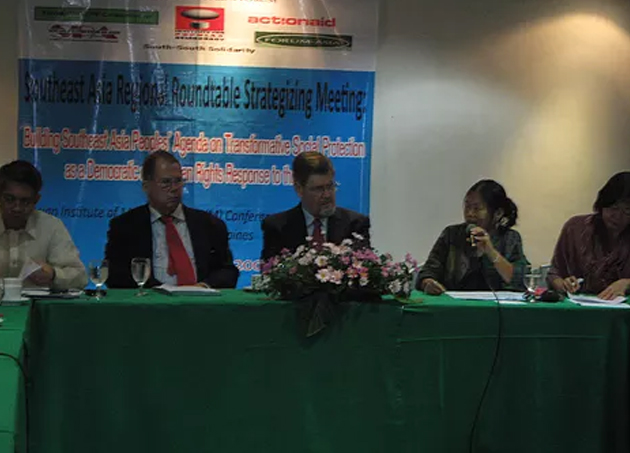
The Network on TSP, which was created during the regional strategising meeting prior to the ASEAN People’s Forum and the ASEAN Summit, held a dialogue with diplomats from Europe and the Philippines on October 14, 2009 at the Asian Institute of Management Conference Center in Makati City.

Members of the Network, most who also form part of the Asia-Europe People’s Forum presented to the envoys a communiqué resulting from the Southeast Asia regional strategising meeting on TSP. The communiqué, among other things, commit the Network to propagating the idea that everyone is entitled to jobs, food, water, housing, electricity, pension, and health and education services, especially as a response to the global financial, food, energy, and climate crises.

“These are ambitious goals, but it doesn’t mean we don’t strive for them,” Ambassador Hannikainen said. “They resonate very well in Finnish society.”

Supporting the campaign, Ambassador MacDonald said social protection mechanisms have always improved people’s purchasing power, stabilising the economy in the process.

But, Ambassador MacDonald noted, positive state policies on social protection, as well as human rights, in Europe were the result of years of struggle, “of solidarity among its citizens.” He narrated how the social and environmental situation in Europe during the industrial revolution from the 1830s to the 1840s—and later at the birth of the European Union after World War II—forced “industrial and agricultural monetary transfers” for the poor and the dispossessed.

In northern Europe, the struggle for social protection and human rights “was long,” MacDonald said. “Economic history shows that experience was gained after a long time and with great difficulty. Substantive development cooperation, as well as complex and sensitive systems on human rights, crime, and governance, later evolved in terms of support, assistance, or advice.”

The current crises present both challenges and opportunities—for working together, the European ambassador said. “As in the effects of climate change, our actions and inactions affect our individual and collective future. If we do not take responsibility now, the future generations will curse our names,” he warned.

Chalida Tajaroensuk, executive director of the Peoples’ Empowerment Foundation, which is part of the Network, said TSP is not a one-time campaign but a long-term drive for a pro-people agenda in ASEAN and in its member-states.

She agreed that opportunities for solutions framed on human rights abound. “There is a social protection big gap between rich and poor. There is a gap between government and people. And both ASEAN and EU support the idea that social protection could only lead to a better life to ASEAN peoples.”

Tajaroensuk said the agenda must be clear in the blueprints for regional or national action plan.

The Philippines’ diplomat welcomed civil society’s engagement with intra- and inter-regional institutions like ASEAN and ASEM (Asia-Europe Meeting). He noted that the idea of social protection is incorporated in agreements that the country and the regional bloc formalise with others, like the ASEAN-EU Partnership Cooperation Agreement.

“In the ASEAN Charter, under the socio-cultural community, the Philippines initiated this and we are proud how it turned out to be. In the preamble and purposes (parts of the Charter), a lot of the themes are of human rights, democracy, people’s participation, and sustainability,” Malaya said.

“The challenge is how to put it in concrete terms,” said Malaya, who is also spokesman of the Department of Foreign Affairs, pointing to the creation of the ASEAN Intergovernmental Commission on Human Rights as one of the major breakthroughs.

Noting that many of the demands in the Network’s communiqué are doable, he suggested that civil society become more active in fleshing out the blueprint for the multi-year work program for the socio-cultural community. He also welcomed the provisions on migrant workers and their families in the communiqué.

“Collaboration between governments and civil society community will go on and I expect there would be more fruitful partnerships in the years to come,” he said.

Mirko Herberg, country representative of the left German institution Friedrich Ebert Stiftung, was also present at the dialogue. He emphasised that states must not see funding for social protection “as a consumption expense that government can or cannot afford,” especially in ASEAN where governments can easily brush it off as an expense it can ill afford.

“It should be expanded to mean also productive investment. Broadly, it is more than money transfer, but it has an empowerment dimension, as in active labor market policies which can facilitate its transfer from one job to another,” Herberg said.

He noted that the concept of social protection is founded on the strong helping the weak, especially during difficult times like economic crisis and disaster. “We are interconnected. We should not build walls. We are on the same boat. There should be solidarity in both programs and actual policies,” he said.

But as in every endeavor, the problem is in the details, he said.

“The challenge is to go beyond communiqués and demand actual budget allocation, create the right incentives, developing projects, institutional governance advocacies to deliver goods,” Herberg said.

He also elaborated the transformative potential of social protection when recipients are also participants in the crafting of the means so that these inherent rights are fully realised. In the long run, could social protection transform the social system? Herberg is optimistic. “The positive impacts expected from this concept have outlived social protection measures.”


Read More

SEA Meeting Communique

SEA Meeting Communique

October 24, 2009

COMMUNIQUE
By Network for Transformative Social Protection
14 October 2009

Even before the global economic meltdown and the recent natural disasters that deepened the crisis in many countries in Asia, the poor have already been reeling in poverty. These crises impacted heavily on the lives and livelihood of people—depriving millions of their basic human rights to guaranteed jobs and livelihood, adequate food, and essential services like healthcare, housing, education, safe water, and electricity. Hungry, homeless and without access to services, the poor are usually at the receiving end of state or non-state effort, if any, to get them out of misery; they are often seen as part of the problem but ironically, the decision-making and implementation of the solution do not involve them.

With the increasing number of poor and vulnerable groups in deplorable condition needing urgent and humane response, we members of social movements in Southeast Asia have come together on 12-13 October 2009 in the “Southeast Asia Roundtable Strategising Meeting on Transformative Social Protection” to collectively build a people-centered agenda based on the principles of human rights.

As a Network for Transformative Social Protection, we are concerned that the age-old chronic problems of the poor and the vulnerable sectors of the society have not been strategically addressed by our governments. The poor lack not only material needs to live with dignity but also opportunities to participate in shaping their future, as the corporate-led economy view people as either forces of production or as potential markets, not as humans with basic rights including right to social protection.

Especially in this period of crises, every individual’s right to a transformative social protection has to be respected, protected, and fulfilled. People are not passive recipients, they must be central in the planning, implementation, and monitoring of the programs to ensure a life without poverty for all. Putting into the hands of the few, through privatization, the responsibility of fulfilling the rights of the people to social protection cannot address chronic poverty and inequities.

Transformative social protection demands that the state fulfill its role both as duty bearer and facilitator to ensure that every human being will live with dignity. People will be the driving force in making sure accountable, transparent, participatory, and transformative programs are directed towards this goal. The poor and vulnerable shall be empowered to act for a better future.

TO OUR GOVERNMENTS, we strive to present a democratic and rights-based agenda for transformative social protection that advance the principles of equity, inclusion, solidarity, and sustainability.

ADOPT A LABOR INTENSIVE GROWTH STRATEGY which does not only create employment, but also nurtures and protects worker’s rights as human rights. State and non-state actors must ensure job placement, job training, and assuring fair and decent wages and social protection measures (like pension for those who have been disabled, displaced, or retired) in accordance with the standards of the International Labor Organization.

COMMITMENT AND DECISIVE ACTION ON WOMEN, RURAL AND FARM WORKERS’ RIGHTS Women workers’ rights including the rights to guaranteed maternity leave and job return must be ensured. Like other informal workers, rural and farm workers should enjoy the same level of rights to employment and social protection.

ENSURE FOOD SECURITY (also known as food sovereignty, food sustainability, right to food) through universal access to resources (land, forests, sea, farm inputs, capital, extension services). Stop crops conversion to biofuels. Democratise land distribution through farmer cooperatives and grains/crops through grain banks. People’s collective rights to the use and management of resources that sustain their lives must be respected, protected, and fulfilled.

ENSURE UNIVERSAL ACCESS TO SAFE AND QUALITY ESSENTIAL SERVICES

Water for all. Stop the commodification of water, and ensure that everyone has access to clean and potable water to live a decent life.

Humane shelter and housing that is decent, affordable, quality, environment-friendly, and with access to other essential services such as water and electricity. Poor people’s right to the city must be recognized; towards this goal, draw up a democratic, people-driven development plan that integrates the poor and prioritises in-city housing for low-income settlers. Forced eviction must be immediately stopped. And humane shelter must be ensured in times of disaster.

Education for all. Free education must be provided until university. Six percent of the country’s gross domestic product (GDP) must be allocated for education, following the standard set by UNESCO.

Universal health care. The same budget allocation of 6 percent of GDP for prevention and cure, for health education, and for reproductive health must be ensured. One way of ensuring budget for health and education can be by reducing the budget on military and defense.

Access to affordable and quality electricity service. Electricity should be made available to all. There must be no discrimination in the access to electricity.

UNIVERSAL PENSION FOR OLD AGE, where old people are provided food and health care and opportunity to be productive citizens who contribute to society’s well being. Initiate programs that ensure social inclusion for old people.

TO THE ASEAN, we ask that civil society participation and its input in “Development for a United ASEAN” be recognised. We ask the ASEAN Human Rights Commission to conduct a review in all ASEAN member countries on the protection and fulfillment of rights of people to social protection, and to establish mechanism for educating people on human rights at national and regional levels. Lastly, we urge ASEAN and dialogue partners’ governments to work out a fair and just mechanism on shared resources management so that people will enjoy their lives with security and development. In the light of heavy flooding in the region, many of which are allegedly caused by big dams, we call that the construction of big dams be stopped and that those whose lives and livelihoods have been negatively affected by these floods be immediately and justly compensated.

TO THE GOVERNMENTS OF THE NORTH AND SOUTH, cooperate with each other in removing barriers among peoples, including policies like the “Return Directive” in Europe that discriminate against migrant workers in their countries. The rights of the workers to form and join trade unions and to negotiate in a collective manner for their rights are crucial. States must immediately adopt, implement, and enforce pro-labor policies.

Recognizing that this is a collective effort, WE COMMIT to establish working groups at national and regional levels, and work with other progressives in formulating and pursuing country-specific studies and strategies for transformative social protection (as national policy with guaranteed budget). We also commit to link with Latin-American civil society for best practices on such a campaign.

Signed (initial members – in Southeast Asia – of the Network for Transformative Social Protection):

Regional (Asia): Action Aid International · Asia-Europe People’s Forum – Secretariat for Asia · FORUM Asia · Social Protection in Asia · South South Solidarity; Indonesia: Indonesian Popular Governance Institute · International NGO Forum for Indonesian Development · La Via Campesina; Malaysia: Jaringan Rakyat Tertindas (JERIT) · Monitoring Sustainability of Globalization · Parti Sosialis Malaysia · National Union of Bank Employees; Philippines: Coalition of Services for the Elderly · Global Network for Asia-LEARN · HomeNet Asia · Institute for Popular Democracy · Kilos Maralita (Movement for Social Protection of the Poor) · Makataong Pamumuhay Campaign (Transformative Social Protection) · Pambansang Kilusan ng Kababaihan sa Kanayunan (Rural Women’s Congress in the Philippines) · Partido Manggagawa (Workers’ Party) · Rural-Urban People’s Linkages; Thailand: Peoples’ Empowerment Foundation · Thai Labour Campaign · Foundation for Older Persons Development; Vietnam: The People’s Aid Coordinating Committee (PACCOM)- Vietnam Union of Friendship Organisations (VUFO) · Social Policy Section, Department of Social Protection- Ministry of Labor, Invalids and Social Affairs of Vietnam

Read More

AEPF holds Southeast Asia Regional Strategising Meeting on Transformative Social Protection

AEPF holds Southeast Asia Regional Strategising Meeting on Transformative Social Protection, Manila, October 12-13, 2009

October 14, 2009

On 12-13 October 2009, the Asia-Europe People’s Forum (AEPF) is organizing a Southeast Asia Regional Roundtable Strategizing Meeting with the theme “Building Southeast Asia Peoples’ Agenda on Transformative Social Protection as a Democratic and Human Rights Response to the Crisis ” at the Asian Institute of Management (AIM) Conference Center Manila in Makati City, Philippines.

This meeting is a step forward in the “Reclaim People’s Dignity” campaign (campaign on transformative social protection of the poor) that began to take shape at the caucus among Asian poor people’s movements at the Seventh Asia-Europe People’s Forum (parallel to the ASEM Summit) in Beijing. Facilitating this campaign and co-organising the meeting in Manila are: Action Aid Asia, Institute for Popular Democracy, FORUM-Asia, Social Protection Asia, and South-South Solidarity. The Finnish AEPF Committee also sponsors this roundtable.

Some thirty scholar-activists, and representatives from social movements and grassroots people’s organizations from Indonesia, Malaysia, Philippines, Thailand, and Vietnam are coming together for this meeting with the aim of: (a) building a consensus among Southeast Asian campaigners on an agenda on transformative social protection as a democratic and human rights response to the current crisis (see attached manifesto) and on strategies in pursuing this; and (b) activating a dynamic core group on this campaign in the region, working both at national and regional levels.

In the immediate, the output of the meeting (Southeast Asian People’s Agenda to Reclaim People’s Dignity), as well as the manifesto, shall be presented to the officials of the ASEAN during its dialogue with civil society groups at the ASEAN People’s Forum (APF) scheduled on October 18 to 20, and if possible to the ministers and leaders at the ASEAN Summit that follows the APF on October 23 to 25.

Read More