Narrative Report: Participation of a delegation of the AEPF Social Justice cluster in the Gwangju Conference ‘World Human Rights Cities Forum’, September 30- Oct 3, 2019
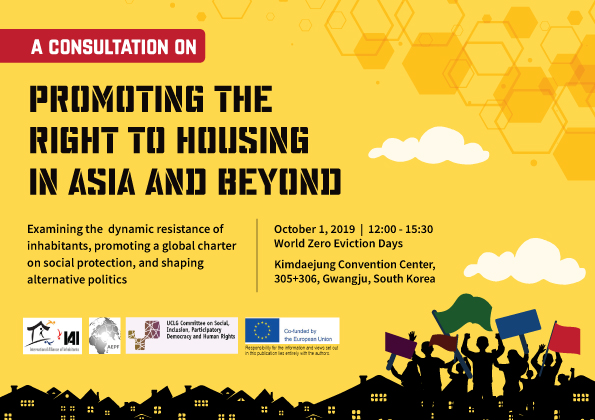
Narrative Report: Participation of a delegation of the AEPF Social Justice cluster in the Gwangju Conference ‘World Human Rights Cities Forum’, September 30- Oct 3, 2019

The AEPF social justice cluster participated with a small delegation in the World Human Rights Cities Forum in Gwangju, South-Korea.

The delegation:

Two participants from Europe:

–        Francine Mestrum, co-coordinator of social justice cluster
–        Cesare Ottilini, global coordinator of IAI, International Alliance of Inhabitants

Four participants of Asia:

–        Chandan Kumar, Global Platform Right to the City, India
–        Varghese Thekanath, Montfort Social Institute, India
–        Erik Villanueva, Institute for Popular Democracy, Philippines
–        Michael Beltran, National Alliance for Filipino Urban Poor, Philippines

Two participants from South-Korea:

–        Choi Ji Hee, Minsnail Union
–        Hong Jeonghoon, People’s Solidarity for Participatory Democracy

Two more participants from South Korea joined our group:

–        Chansik Park, Jeju People’s Assembly against 2nd airport
–        Maria Youngsin Lim, Imagine Peace

Our delegation met for a coordination meeting on Sep 30 afternoon

The Conference opened on Sep 30 with a ‘Human Rights Dark Tour’, a visit to the places of the 1980 rebellion against the military dictatorship, having caused hundreds of victims. It is in memory of these events and these victims that the city of Gwangju is organizing these regular conferences, focusing on democracy and human rights, this year also on the ‘right to the city’.

At the opening ceremony at 4 pm the City Mayor welcomed the participants. Several senior civil servants and representatives of international bodies, such as UN OHCHR and UN Habitat joined in the opening speeches.

Several initiatives have been taken these last years to give a major role to cities and local governments for the promotion and defence of human rights and democracy. Worldwide, city brands are emerging, and till now a total of 53 ‘brands’ have been registered, from ‘human
rights cities’ to ‘inclusive cities’, ‘green cities’, ‘transformative cities’, ‘fearless cities’, ‘innovative cities, etc. etc.

The UN now has a New Urban Agenda and a World Charter for the Right to the City has been adopted.

More than 100 million people are homeless today, worldwide, and 1.6 billion live in inadequate houses. Housing has become an asset for investors. The total value of these ‘assets’ is estimated at 163 trillion US$, more than twice global GDP.

AEPF participants attended several workshops during the two days conference.

Our major activities took place on Sep 30: A co-organised event with UCLG ( United Cities and Local Governments), and the International Alliance of Inhabitants.

The introduction was in the hands of Amanda Flety from UCLG.

A first presentation was from Julieta Perucca, advisor to the Special Rapporteur on the Right to Adequate Housing, Ms Leilani Farha. She presented the Make the Shift Campaign, meaning ‘adequate housing’ has to give an opportunity for a life in dignity with participation in decision-making. Efforts are made to shape a platform with OCHR, UCLG and other civil society organisations. One should never forget housing is about people who need a home. The forces we are facing are global and we should be able to answer globally.

Representatives from the cities of Vienna, Ulaan Baatar and Taipei presented the situation of social housing in their cities.

Brenda Perez of the Asian Coalition for Housing Rights, a wealthy organisation, explained the community-led approach that should lead to system change.

Francine Mestrum explained the objectives and opportunities of AEPF’s Global Charter for Social Protection Rights and the commons approach for public services, such as housing.

Cesare Ottolini presented the zero eviction campaign, worldwide.

Varghese Theckanath, Erik Villanueva, Michael Beltran presented the difficult situation in their home towns and countries, focusing on the necessary holistic approach when talking about housing, since it concerns livelihoods. More attention should go to the people, not ‘the
poor’ but ‘the workers’ who built the cities. New projects are to be owned by the people, very often political education is needed so that people can claim their rights. There is a need for resistance. We should never concede to the ‘adapt/resilience’ discourse.

Choi Ji Hee and Hong Jeonghoon talked about the specific problems in Seoul and South Korea.

Two representatives of JeJu island explained the difficult struggles of the inhabitants against the offensive of the tourist industry on their island, building airports, ports, hotel complexes, etc. Land should never be an asset, but should remain a common good.

Local students gave a brief presentation of their perspective on the problems of housing.

Our second meeting was a more ‘internal’ one, coordinated by Chandan Kumar, meant to prepare our strategy.

After a brief presentation of the major problems, it was noted that we should strive for as much cooperation as possible. Problems can arise because we all use the same language, but we do not necessarily use the same meanings.

Therefore, speaking of ‘commons’, ‘community-driven’ and ‘participation’ or ‘system change’ is not enough. We should try to find out what exactly are the objectives and how far we can walk along the same path.

We most probably share the same analysis, though our solutions might be different.

We should start to build a political process.

The social justice cluster presented a draft declaration concerning our strategy.

Finally, in a third ‘private’ meeting with representatives from Polis and the Right to the City Platform, we looked at the concrete possibilities for arranging a seminar in Manila in spring 2020. Polis has started a research project in four countries. The seminar might be an opportunity for a first discussion on the results.

Objectives of the social justice cluster:

The objectives for this conference of the social justice cluster have clearly been met:

Building a robust partnership with progressive movements to challenge neo-liberal forces. Housing for the people, that is commons, not an asset.

The need for addressing urban and rural poverty has become critical. The right to housing and the right to the city are basic human rights, implying all public services that are needed for a life in dignity and an adequate standard of living.

The extent to which Asian movements are organised for resistance to the current neoliberal trends is limited. We have started a political process, with first contacts, that will need to be worked on in the immediate future.

We therefore have to organise and support resistance beyond adaptation and resilience, we need a comprehensive approach including housing, along with all crucial public social services, such water, energy, sanitation, public transport, etc

Asia is a very dynamic region with high growth rates , but dramatically low social spending, and moreover the continent is particularly vulnerable to the consequences of climate change. The
region is characterised by weak democracies with limited citizen’s participation in decision making.

In our strategy meetings, it was suggested we might try to organise a seminar on ‘The right to housing, basic services and social protection’ in the Philippines, preferably in spring 2020. The point will certainly also be taken up at AEPF13 in autumn 2020.

The main purpose will be to work towards common perspectives and strategies in our approach to urbanism; social protection and sustainability. he final objective should be to go towards the
building of a broad network/partnership of urban and rural activism in Asia.

Contacts were made with a member of the Malaysia Parliament: Ms Maria Chin Abdullah.

These matters are closely related to democracy and to the environment and offer ample opportunities for inter-cluster cooperation. The social justice cluster is ready and available for giving an input to the Amsterdam meeting of the democracy cluster on transformative
cities in December 2019.
Read More

Social justice the bedrock for universal peace

Social justice the bedrock for universal peace

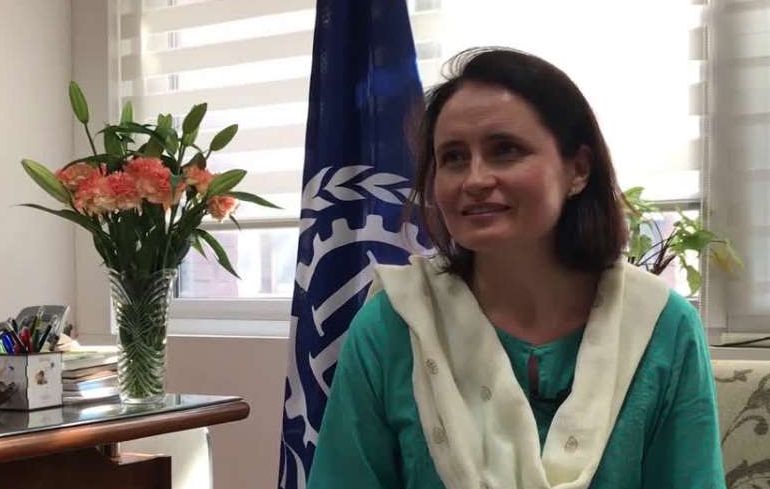
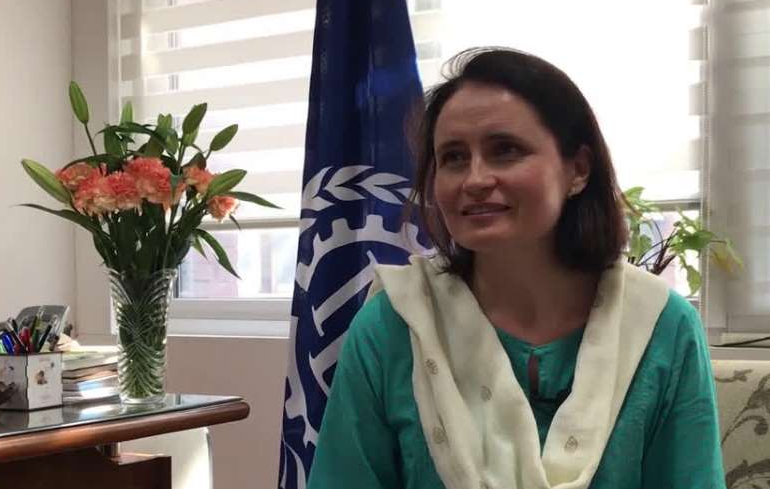
Dagmar Walter, (Country Director ILO India)

This year (1919)  the International Labour Organization is celebrating its 100th anniversary. It is so timely that at the inaugural plenary we are set to unpack the issues of social justice in the world of work – an issue that just so 100 years ago led to the setting up of ILO.

The ILO came about when the world was trying to recuperate after World War I. The prime preoccupation that resulted in the creation of ILO was this realization that social justice is key to achieving universal and lasting peace.

That also became the opening statement of the preamble of the ILO constitution, ‘Universal and lasting peace can be established only if it is based upon social justice’. We deliver on this high principle by devising country-level Decent Work Programmes. Our aim is to ensure everyone has dignity at work, equality, meaning, protection and justice.

We are the only UN agency that brings the voices of governments, workers and employers together – to set international labour standards and promote fundamental principles and rights at work. In 1926, the ILO headquarters in Geneva, Switzerland was inaugurated and opened using three keys, representing governments, employers and workers. This was symbolic of the tri-partite nature of the ILO, representing the three voices of the constituents, but it was also a very powerful statement of the purpose and cooperation needed to advance social justice and peace. Our current Director-General Guy Ryder, says, “When these three keys turn together, when governments, employers and workers are able to come together, doors open and social justice advances.”

ILO received the Nobel Peace Prize in 1969, which also marked the 50th anniversary of its founding. There are few organizations that have succeeded to the extent that the ILO has, in translating into action the fundamental moral idea on which it is based,” said the Chair of the Nobel Committee, Mrs. Aase Lionaes, in her speech. Indeed, the ILO has offered the world of work a process of bargaining and negotiation to replace violent conflict as a means of securing more human and dignified conditions of work.

The ILO has three major tasks, the first of which is the development and adoption of international labour standards, called Conventions and Recommendations, for ratification by member States. Second major task, which has also steadily expanded in the last two decades, is that of development cooperation, cooperation to assist nations in implementation of these labour standards. Third is knowledge creation and sharing — done by way of extensive research, providing training, educational modules, and publications. We have travelled far in these 100 years. By advocating tripartism and social dialogue, rights and labour standards, equality and non-discrimination, social protection, working conditions, skills for the future of work and more. Yet we have a lot more to do. Social justice evolves over the years, work scenarios changes, and new models of governance of work emerge, especially non-standard forms of employment. In such times, ILO’s significance is even more relevant.

Today the youth, the marginalized, the voiceless, the invisible workers, are asking for fairness in the society. Without fair jobs – they cannot carve meaningful roles in societies, nor can they share the fruits of prosperity.

The way our parents used to work and how the current generation is working, or future generations will work, are markedly different. The problems of unemployment, underemployment, inequality and injustice are becoming more, not less, acute.

The ILO is gearing up to respond to these changes in the world of work. We are calling for a fairer globalization, for economic growth that drives social progress and for balanced and sustainable development.

Today we have representation from both Europe and Asia here. We face very different realities. Yet, we share common concerns regarding how best to achieve ‘decent work for all’ especially those who are marginalized.

We are also debating how the future work will be organized. Say when it comes to wages for women and men – the world gender pay gap represent one of today’s greatest social injustices. The ILO Global Wage Report of 2018/19 covers 70 countries and examines about 80 per cent of wage employees worldwide. It says that on an average women earn 20 per cent less than men. The Sustainable Development Goal (SDG) target 8.5 calls for equal pay for work of equal value, within the framework of the United Nations 2030 Agenda for Sustainable Development.

Then we also have the issue of declining wages, rise in unemployment and non-standard forms of employment, no recognition of women’s unpaid care work, declining safety nets, and others.

ILO is now taking the lead on how we all can shape a future of work that works for all, through its Future of Work initiative. As part of this initiative ILO formed a Global Commission, which released its Future of Work report this January 2019.

The Commission calls for a “human-centred agenda’’ for a decent future of work. It outlines the challenges caused by new technology, climate change and demography and calls for a collective global response to the disruptions they are causing in the world of work. The report offers ten recommendations, relating to:

  • A universal labour guarantee that protects fundamental workers’ rights, independent of workers’ status. An adequate living wage, limits on hours of work and safe and healthy workplaces;
  • Guaranteed social protection from birth to old age that supports people’s needs over the life cycle;
  • A universal entitlement to lifelong learning that enables people to skill, reskill and upskill;
  • Managing technological change to boost decent work, including an international governance system for digital labour platforms;
  • Greater investments in the care, green and rural economies;
  • A transformative and measurable agenda for gender equality;
  • Reshaping business incentives to encourage long-term investments.

In the International Labour Conference, to be held in Geneva in June this year, member States will discuss the future of work and the future of the ILO. Also there is the Commemoration of the one-hundredth anniversary of the establishment of the ILO within the UN General Assembly, taking place on the 10th of April. And keeping in sync with changing times, we are launching a global tour of ILO’s 100 years where in 24 hours you will see 24 countries host 24 events to celebrate this landmark anniversary. The Global Tour coincides with the anniversary of the plenary session of the Paris Peace Conference on 11 April 1919, which established the ILO Constitution.

Either we accept what we have in the world of work, or we shape it in a way that no one is left behind. The choice is ours. It is only our collective experiences, efforts and political will that will lead us towards a future that is firmly based on the principles of universal human rights and propagates values of justice and equality.

https://www.ilo.org/newdelhi/info/public/sp/WCMS_682143/lang–en/index.htm

Read More

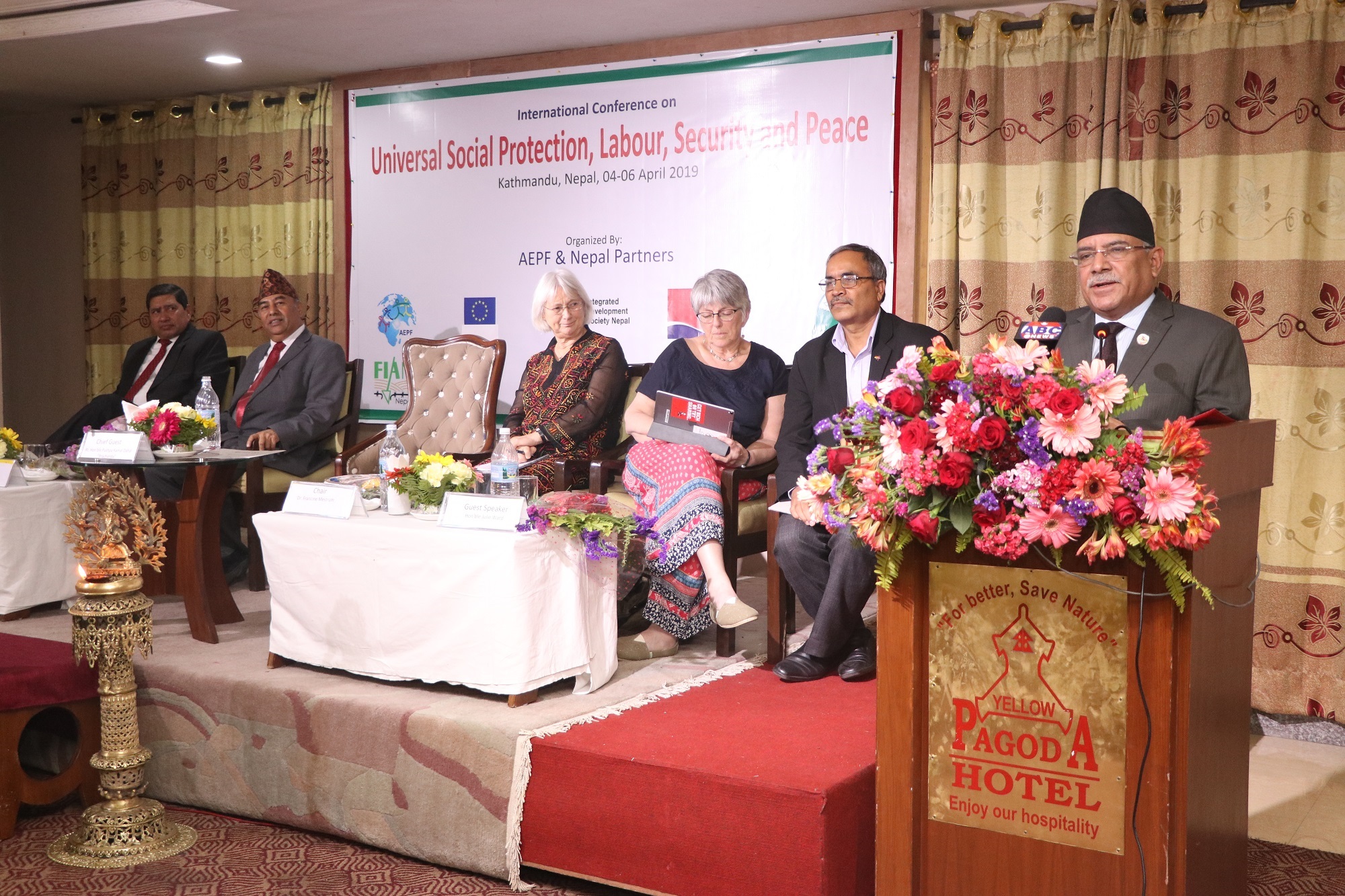
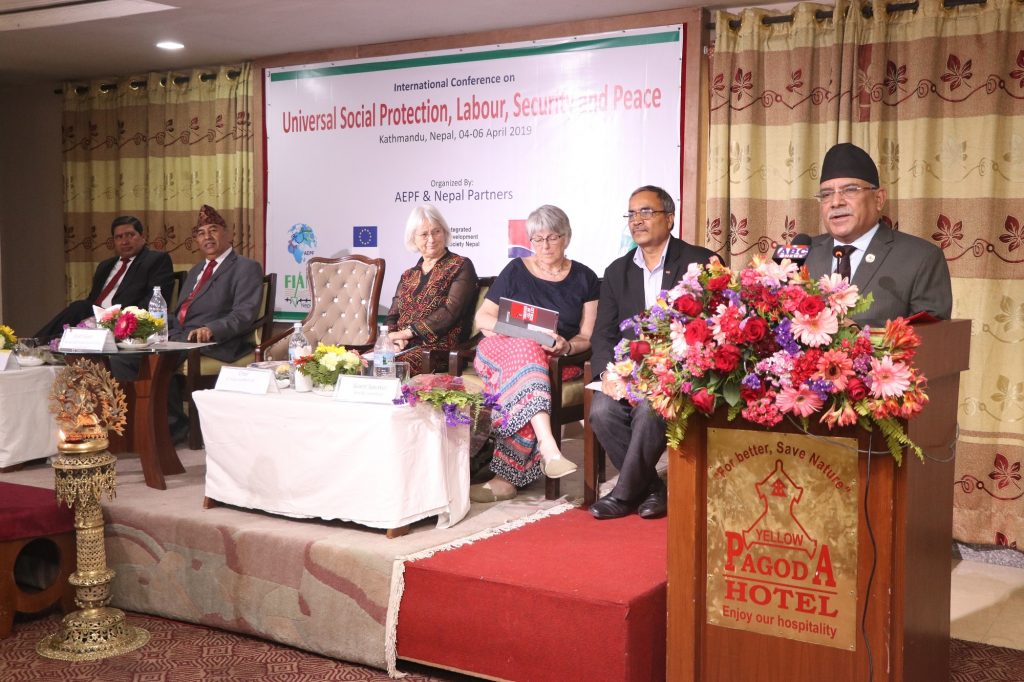
Rt. Honourable Former Prime Minister and Chairperson of Nepal Communist Party Pushpa Kamal Dahal “Prachanda” , Inaugural Speech International Conference on Social Protection, Security and Peace

Rt. Honourable Former Prime Minister and Chairperson of Nepal Communist Party Pushpa Kamal Dahal “Prachanda” , Inaugural Speech International Conference on Social Protection, Security and Peace

04 April 2019, Kathmandu, Nepal.

Chairs of the opening session Dr. Devkota and Dr. Mestrum, Former Deputy Prime Minister and Spokesperson of our Party NCP Mr Shrestha, Distinguished Guest on the Dais, Parliamentarians, Panelists, Participants, Media persons, Members of Civil Society, Ladies and gentlemen!

It is my immense pleasure welcoming you all, particularly the distinguished foreign delegates coming from different parts of the globe, to debate and try to seek potential solutions in this highly coveted conference on social protection, security and peace in our societies.

Nepal, the newest federal democratic republic, is the birth place of Gautam Buddha – which is also known as the light of Asia, and his world famous teachings that enshrine the messages of non-violence, social harmony and peace, among others. However, the Nepalese society at large was subjected to different types of suppression, exploitation, discrimination, inequalities and marginalization throughout the significant period of our history. Until the recent past, the country was ruled by a monarchy in disguise of party-less political system just dominated by handful of elite groups. This system remained in the country for nearly two and half centuries mainly brewing autocratic and feudal regimes controlled by the king and his family. So, when the rest of the countries and societies around the world were already enjoying popular participatory democracy and hence socio-economic development, the Nepalese societies were under the grinding stones yielding rampant violations of fundamental human rights, forget about the socio-economic development based on the principles of social justice and peace. It continued to create and perpetuate poverty and further injustices in different forms and manifestations.

Defeating the rulers of the period and bringing desired political changes, people of Nepal have no option but to sensitize, organize and revolt in all their capacities, under the leadership of Communist Party and other democratic political forces. The then Communist party of Nepal (Maoist) had taken up arms to fight against the establishment, and it smoothened the ground and created a favourable environment within a decade of ‘people’s war’ to overthrow the centuries’ old monarchy and establish long awaited republican set of governance in the country.

Now, after little long political transitional period, we have consolidated and institutionalized the hard won democracy by promulgating a constitution that is framed within the framework of international human rights principles and relevant instruments. It has guaranteed power sharing with all levels of governments that are elected through adult franchise, democratic processes and rule of law that are prerequisites for socialism oriented socio-economic development of the country. The three layers of governments – federal, provincial and local, are independent to exercise their powers as per the constitution. We believe in participatory democracy, and hence we had successfully elected people’s representatives to all tiers of governance very recently through ballots. These governments are working day and night to enact necessary laws and set up mechanisms towards ensuring the best delivery of their services to the people. Our current destiny as proclaimed in the constitution is socialism and sustained peace. We are determined to eradicate all forms of discrimination and exploitation, and ensure freedom, fundamental rights, periodic elections, adult franchise, participation, inclusion and press freedom.

The ultimate beneficiaries of good social protection policies and schemes are mainly the people encountering different levels of difficulties and hardships to live a life with dignity in ecological harmony with nature. These schemes, in whatsoever forms and modalities, are intended to prevent or reduce human sufferings and hardships in order to facilitate dignified enjoyment of human rights. They help human beings to elevate, to flourish and thereby to realize their potentials. In other words, social protection instruments not only prevent or reduce human hardships, sufferings and difficulties but also tremendously help to narrow down disparities, tackle injustices and inequalities caused by whatever reasons.

In our context, Social protection, peace and security are the fundamentals for realizing our visionary dream of “Happy Nepali, Prosperous Nepal.” Therefore, the government under the leadership of highly committed Comrade KP Oli, the other Chairperson of Nepal Communist Party, has been trying to promulgate laws, and policies and set up functional mechanisms for timely delivery of people friendly policies and plans. It is in this context that the parliament as well as the government have promulgated several Acts, regulations and guidelines, for example, the Compensation-based Social Security Act-2017, guidelines for establishing social security fund, the Right to Work Act, Labour Act, minimum wage, Prime Minister’s Employment Programme, and etcetera. The compensation based social security act is one of the most sought Acts, and is the first of its kind in Nepal.

The above mentioned laws and other provisions are necessary as the Constitution of Nepal has envisioned social security as a step towards establishing a welfare society. Although the state has many liabilities towards its citizens, welfare of the people and societies is one of its prime liabilities. Thus, the Acts were enacted as per the social welfare concept, and in accordance with which the people have rights to welfare of various kinds, such as taking care of people, especially vulnerable ones like the old, the widow, the sick, the disabled, the unemployed and children, in terms of providing them with food, shelter, healthcare, education, etc., thus promoting their wellbeing and allowing them to live in society with dignity and pride.

Having said this, positive developments are rapidly happening in the country, the proper implementation of the regulations and other relevant provisions is not free from challenges because we are still in the UN defined state category of Least Developed Countries. Availability of means of implementation, mainly financial resources and institutional capacities are yet to be further enhanced. The society is still marred by perpetual poverty, hunger, inequalities, discrimination and unjust and derogatory practices as a consequence of patriarchal mindset, feudal remnants, inadequate awareness and lack of effective governing institutions. But, the Nepalese government under the enabling leadership of Nepal Communist Party is confident to overcome the said challenges with the strong solidarity and support from different walks of life – the party cadres, development partners, civil societies and all the well-wishers and friends of Nepal, your best efforts being indispensable, in a way.

I believe, you will take home the best messages of our relentless efforts towards materialising social justice, peace and security of Nepalese people, acting locally and contributing to world social justice, peace and security. I think, social justice and peace are two sides of a coin -there is no sustained peace without comprehensive social justice and no social justice without peace. Hence, I wish this conference will dwell further discussions on ways and modalities for creating awareness, consolidating and expanding the achievements of our struggles, and finding new avenues backing Peace, Security and Social Justice through the appropriate mechanisms of social protection and rights. I am sure, people united will definitely achieve their noble goal of human dignity.

Finally, let me reiterate that I am very much delighted and proud to be part of this process. I wish for your meaningful meeting, grand success of the conference and pleasant stay in Nepal. While in Nepal, I am of the strong belief that you will enjoy the warmth of hospitality accorded by Nepalese people and the natural beauty of Nepal.  Nepal is a country of socio-cultural unity with diversity in terms of mix of population groups, their cultures, languages and the way they enjoy their socio-cultural lives. Nepal is a treasure of natural beauty and cultural diversity, which if observed and engaged will give a peace of mind and satisfaction.

I wish for your pleasant stay and meaningful days in Kathmandu.

Thank you all.

Watch the video of the speech here: 

Read More

Global Charter for Universal Social Protection Rights by all, for all

Global Charter for Universal Social Protection Rights by all, for all

Social Protection is an inalienable part of Social Justice. Social Protection is the way to ensure equity and social and economic rights. The Global Social Protection Charter shows the way forward.

The initiative to draft a Global Charter for Social Protection Rights emerged at the AEPF (Asia-Europe People’s Forum) at Ulaan Baator, Mongolia, in July 2016. The aim is to use these texts – a full text and its synthesis – for a campaign to strengthen the already existing initiatives of the ILO’s Social Protection Floor and the UN Sustainable Development Goals.

Read the full Global Charter for social protection rights on: http://globalsocialprotectioncharter.eu

Download the Charter

Read More

AEPF Social Justice Narrative Report – Kathmandu 2019

AEPF Social Justice Narrative Report - Kathmandu 2019

May 19, 2019 | Francine Mestrum

Universal Social Protection and Labour:AEPF International Conference by the Thematic Cluster:
Social Justice
Kathmandu 4-6 April 2019

Narrative Report (Draft) written by Ms Francine Mestrum

Participating Organizations: Transform! Europe, Attac France, Global Social Justice, IT for Change, Action Aid, World Solidarity Movement, Home Based Workers Concern Society, Institute for Popular Democracy, AMRC, AIDWA, Dalit Network, NGO Forum on ADB, Working People’s Charter, Institute for Human Development, Asia Network on the Right to Social Protection, StreetNet.

The AEPF Kathmandu conferences were attended by members of parliament from Nepal, key political figures including advisors to the Nepal foreign ministry, policy makers and many civil society activists including labour and women’s groups.

The papers presented and the videos will be put up on social media. The video of the opening speech by Rt.Hon Pushpa Kamal Dahal (‘Prachanda’) key figure of the Nepal revolution was put up on social media platform and viewed more than ten thousand times in first three days itself.

Report

The conference of the Social Justice Cluster was back to back with a conference of AEPF Peace and Justice Cluster, commemorating the foundation of the International Labour Organisation (ILO) in 1919, stating in its preamble that ‘lasting peace is not possible without social justice’.

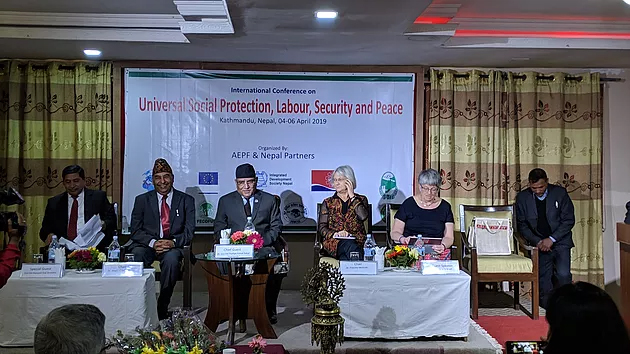
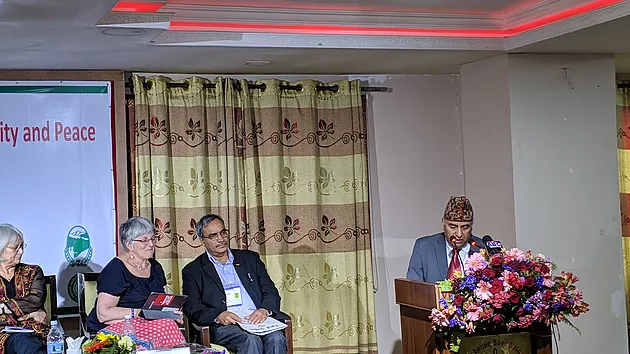
The joint opening session took place in the presence of the Rt Honorable former Prime Minister, Mr Pushpa Kamal Dahal and the former Deputy Prime Minister, Mr Narayan Kaji Shrestha. Both speakers referred to the 10 year long people’s war in Nepal and the successful peace process. Referring to the ILO, they stressed the links between peace and social justice, mentioning that social justice is not utopian. The current government is working on political change and hopes that this conference can help to bring out the proposals and promises of the new government.

Julie Ward, MEP, stressed that indeed we can change the world.

The keynote address was given by Ms Dagmar Walter, ILO representative for South Asia.

Speakers were Anuradha Chenoy from India, Nimalka Fernando from Sri Lanka and Daman Nath Dhangana, former speaker of Parliament of Nepal (see programme). They all stressed the importance of the links between peace and social justice, especially in the case of Nepal with a new government and many migrant workers in the rest of the world.

The conference of the Social Justice Cluster had four sessions.

Session one was meant for stocktaking: what is the situation in Asia and Europe concerning economic and social rights?

Social spending is high in Europe, up to around 30 % of GDP (without education) and around 15 % in Central Europe. This does not mean there is no poverty, precariousness or inequality! The benefits of globalisation largely went to the rich. We also see industry to be dwindling (less than 20 % of the labour force) and agriculture with less than 3 %. Services on the other hand takes up more than 70 % of the labour force, though it is a dual labour market with lots of vulnerable jobs at the lower side. Unemployment remains high, especially in countries of Southern Europe.

As for Asia, after the crisis of 97-98 and after the global crisis of 2008 and the World Bank’s privatisation efforts, a strong demand for social protection was heard. Thailand introduced some exemplary policies, though in most countries and because of budgetary problems, governments adopted Private Public Partnerships. In many cases however, this led to private monopolies with dire social consequences. Due to high urban unemployment and the displacement of landless rural poor people, migration remains very high.

To-day, the climate crisis and the new technological revolution could make an end to ‘Factory Asia’. What is needed is a transition programme with the fiscal space needed for it, so that the neoliberal straitjacket can be abandoned. The region needs a new paradigm for regional and global integration.

Special attention went to the influence of China in the region and the role of new initiatives on labour rights and social protection. There is little unemployment, but social protection policies have been frozen and wage rises have slowed down. With the emergence of a platform economy, labour is informalizing rapidly. Workers have many rights on paper, but in practice there is no freedom of association. We have seen a sharp rise in labour protests and peasants’ protests against land grabbing. There has been a major decline in the labour share of incomes, major income gains go the 10 % richest partof the population. The control over civil society has been strengthened. The Belt and Road Initiative is mainly due to a crisis of over-production and half of overseas investments are not profitable. China wants to become a global leader by 2050 but its combination of neoliberalism and state capitalism is now leading a race to the bottom with a repressive labour regime.

In session two the conference looked at the productive transformation of the economy and the future of work.

An industrial sector is necessary, also from the perspective of state power since, along with trade policies, they determine the sovereignty each country and people has. As for the digital revolution, there are two major trends: (1) planetary boundaries, which go beyond simple CO2 emissions. (2) Privatised Keynesianism is finished.

The digital revolution concerns the merger of the internet and manufacturing systems. Its goals are:

  1. Higher workers exploitation – since Europe has strict rules, many companies move to China, controlling workers in three dimensions (with wristbands monitoring your movements)
  2. Control of each single produced good along the value chain: chipping each item to connect it to workers
  3. Autonomous production, with artificial intelligence (AI). Hence, strikes would be neutralized. What would the labour movement then do?

All this leads to further pressure on extractivism in the Global South + rising energy demands + longer value chains with more transport. In one word: enhanced concentration of productive assets in the Centre (Germany vs Italy). In the III. World: premature deindustrialisation, See for example, the garment sector and AI.

In the IT sector, we witness a platformisation of the economy. Amazon is a good example, since it didn’t start as selling of books, but as a tool to replace retailers, creating the market, not occupying a single marketplace. It created a monopoly, which is the end game, creating shareholder value. As its first strategy, it is involved in multiple, unrelated businesses, like making movies, fashion, selling books etc. Each part of the business strengthens another section. It gathers information which it can use to sell its own goods. As a second strategy, with Alexa, it becomes omnipresent.

All this negatively impacts on jobs. Other businesses shut down, and also hawkers in India express concerns whether they will be pushed out of business. This also happens in the tourism sector, for example, with TripAdvisor.

What is the role of civil society? We can’t continue as before. How to hold transnational digital corporations accountable? New labour standards have to be updated, as well as labour laws. We need to stop the free flow of data and protect. People can claim their data as theirs, like New Zeeland farmers saying they “own” their data, which is a new perspective.

What is the role of civil society? We can’t continue as before. How to hold transnational digital corporations accountable? New labour standards have to be updated, as well as labour laws. We need to stop the free flow of data and protect. People can claim their data as theirs, like New Zeeland farmers saying they “own” their data, which is a new perspective.

Three practical things to do:

  1. Lobby politicians to stay out of any form of e-commerce in trade negotiations
  2. Do mass education
  3. Dedicate budgets for alternative platforms, either from public sector or cooperatives

Reflecting on the future of work, a good idea can be to think of liberating work to heal the world and develop a politics for living labour.

Living labour is the big strength of the left. They bring death, we have to bring life. There is a polarization of jobs, with increasing informalization and precarious types of work. The routinization of labour implies lean production, standardization and control, as well as “bullshit” jobs doing useless things while being well-paid or invisible work. From the left, we present parallel resistances: against inequality (like Indignados, Occupy, gilets jaunes…), against the ecological demise, against the degradation of work.

Could we find a common cause between the parallel resistance movements? Themes like living wage, decent work, or living labour? What is work and how to define it? Work should be to disobey, when workers are confronted with an unpredictable world. These unforeseen aspects are what dead labour cannot deal with. It requires commitment, creativity etc. The social power of living labour is necessary for profit, not controllable by capital and vital for workers. It is empowered by our aspiration for autonomy and our aspiration to defend life. What could these politics of living labour contain: What matters for us in work? As workers, but also as citizens, humans, inhabitants of earth? For our health, for democracy, for nature?

If we manage to position these questions at the center, we could build a natural convergence of these struggles, based on common interests. This would lead to liberating work in defence of life.

For instance, the movement of youth for climate is a major opportunity for workers and unions to create a new common agenda around living labour.

Looking more particularly to the Dalit people in Nepal, it is noted that the new Constitution of Nepal provides a lot more rights for Dalits. Still, many problems remain. Dalits are underrepresented in politics, with no Dalits occupying major posts inside political parties or commissions, nor in parliamentarian bodies and administrative bodies or the judiciary. 44% of Terai Dalits are landless and 15% of Hill Dalits. The traditional skills discriminate Dalits. In the social and cultural sector, data shows that Dalit literacy rate is only 33%, compared to the national average of 54%. Even though there is democracy and formal human rights, these problems still prevail.

How can digital democracy serve and include Dalits, provide positive discrimination? Their movement sees three solutions: strengthening organisations of Dalits, promote grassroots education and promote mutual understanding among Dalits, because many differences exist among Dalits.

Session three turned to the sector of re-production and its value creation.

Reproduction is seen as the entire cycle of activity generating and re-generating the human for the market and the social world. Re-production takes place in post-patriarchal times. It is the blind spot of the economic and political tradition of western modernity. It is on this blind spot that the conquest of capitalism, that is inequality, exploitation and injustice reconstitutes itself.

We need then to re-think the economic, the cultural, the natural-material, the social, the juridical and the political. They are interwoven inside a comprehensive and complex valorisation process for which responsibility must be taken.

Reproduction, then, must be seen as a paradigm.

In Nepal the status of women has markedly been improved, though many problems remain. The status of women varies according to caste, but the constitution enhances women’s rights.

As for Vietnam, many problems remain for migrant women, whether they work in the formal or the informal sector. Very often they are not aware of their rights and have no access to social protection. More work has to be done in the policy system and the statistics.

In session four we looked at the Global Charter for Social Protection Rights.

Social protection today means something different from what it was in the past. What it means today is a social protection that is compatible with neoliberal policies and even with austerity. It is a minimal protection for survival and reproduction. What it means is: deregulation of labour markets, privatisation of public services, the enclosure of all ‘commons’, including our common human, economic, social and environmental rights. What it means is, in short: social protection at the service of markets and of growth. It is neoliberalism with a human face.

The social protection we want is different. It is not the social protection of the past, because times have changed, because societies and economies have changed, but it is based on the same valid principles of the past, mainly human rights and solidarity.

Our social protection consists of insurances and assistance, of labour rights and public services.

In this charter, we see social protection as a commons, as something that belongs to us, to us all, as something we have to decide on.

Our social protection is really universal, it is by all and for all, without any exceptions. This means it is not only for the poor, it is also for the rich and the rich should be obliged to contribute. It is emancipatory and transformative. It is based on human rights and solidarity.

The situation in India is characterised by high growth but also by deprivation

Nearly 93 per cent of the workforce is informally employed. This rising informalization means that the percentage of workers without any formal contract had risen even in the public sector and public limited companies.

The percentage of wage/salaried workers outside agriculture with social security had declined between 1999-00 and 2011-12.

There is low social security coverage. Formal social security measures cover only about 7 per cent of the workforce. According to the NCEUS, only about six per cent of workers in the un-organised sector had any social security / social assistance to cope with contingent risks (2006).

The high levels of deprivation/vulnerability and the low (and declining) coverage of social security provide a strong rationale for adequate and effective social protection, along with other measures to improve the quality of employment.

Unequal coverage across sex and social groups. Much remains to be done to have a rights based social protection.

In the closing session, the declaration from social justice cluster was read out. It forwarded the following urge for meaningful social protection leading to social justice.

1. Re-define labour and to ‘free’ it from capital, since the logics of accumulation and profit maximisation are not compatible with the transition towards a more sustainable way of life,

2. Generate a new economic thinking based on the priority of reproduction, a crucial issue in order to connect different struggles and movements,

3. Counter emergence of rentier class by democratisation of economic life, a condition of social justice,

4. Establish and promote regional and global learning centres for education and generation of new knowledge needed to enrich our social movements based on empirical evidences,

5. Establish and strengthen campaigns and networks among the people of the regions, engage in the political and social dialogue, based on strong trade unions, on discussion on how to create the changes we need and want, for greater solidarity for united struggles, movements, people to people cooperation and coordination,

6. Fight against climate warming, the crossing of the planetary boundaries and we struggle in favour of the Global North paying its climate debts to the developing world. We must build bridges to the climate justice movement as climate destruction will be the most important political factor for the future, therefore, we must link our arguments with this movement. The climate debt most probably can be said to be the biggest social injustice to emerge in the future, and the term “climate debt” builds a bridge there to an ongoing struggle, and

7. Realise and materialise the global charter for social protection rights.

The conference participants believed that any move towards social justice is social protection, to be understood in an emancipatory and transformative way.

The Conference adopted the Kathmandu Declaration.

There was a rich exchange of information, convergence of agendas, mobilisation for the AEPF Peoples Agenda.

Download the AEPF Social Justice Narrative Report – Kathmandu 2019

This conference was produced by the financial support of the European Union. Its contents are the sole responsibility of the Asia Europe People’s Forum and do not necessarily reflect the views of the European Union.

Read More

Kathmandu Declaration

Kathmandu Declaration

April 22, 2019

International Conference on Universal Social Protection and Labour
Organised by :
Asia Europe People’s Forum, Social Justice Cluster and Nepal Partners
Kathmandu, 4-6 April 2019

We, the participants of the International Conference on Universal Social Protection and Labour held in Kathmandu from 04 to 06 April 2019 to review and reflect on the current situations prevalent in our societies and develop strategies for the future course reaffirmed our vision, mission to establish society ensuring social protection, social justice, security and peace.

Realizing that socio-political circumstances and the level of wealth accumulation and development in Europe and Asia are very different, as well between as within our respective sub-regions,

Understanding the fact that it is one ‘capitalist logic at work, free trade agreements, neoliberalism and austerity’ worsened by right-wing populism and declining democratic principles, with similar consequences in both regions,

Recognizing that despite that Asia being the most dynamic region in the world with two decades long strong economic growth, rising productivity and high employment ratios, deep rooted structural challenges remain, still, half a billion workers live in abject poverty, a billion are faced with vulnerable conditions of employment, two of every three workers are stuck in the informal sector and weekly hours worked are the world’s highest,

Acknowledging the rising protests as response to growing nationalism, slowing of economic growth, high unemployment, rising inequality and fear of robotization, rising non-standard employment and declining job quality, decoupling wages from productivity due to the pushback of trade unions and collective bargaining, deregulation of labour markets and liberalisation of capital markets,

Realizing the challenges of the digital revolution which will fundamentally alter labour markets, threat to livelihood by the digital economy because of the platformisation of the whole economy, merger of manufacturing and the internet (industry 4.0) at the national level and growing attacks on trade unions,

Acknowledging that without social justice and peace humanity can’t stay inside the planetary boundaries and the world will turn into a hothouse, without a truly sustainable and earth friendly metabolism of our societies there can’t be peace and social justice,

Appreciating the efforts of people in Asia and Europe to make the society with equity, justice, peace and harmony,

Re-enforcing our trust in Global Charter for Social Protection Rights, for all and by all, as a guideline to work on the implementation of all economic and social rights, including public services, as the gateway to environmental rights and requires democracy and popular participation making links to all important progressive social movements,

We urge to,

  1. Re-define labour and to ‘free’ it from capital, since the logics of accumulation and profit maximisation are not compatible with the transition towards a more sustainable way of life,
  2. Generate a new economic thinking based on the priority of reproduction, a crucial issue in order to connect different struggles and movements,
  3. Counter emergence of rentier classes by democratisation of economic life, a condition of social justice,
  4. Establish and promote regional and global learning centres for education and generation of new knowledge needed to enrich our social movements based on empirical evidences,
  5. Establish and strengthen campaigns and networks among the people of the regions, engage in the political and social dialogue, based on strong trade unions, on discussion on how to create the changes we need and want, for greater solidarity for united struggles, movements, people to people cooperation and coordination,
  6. Fight against climate warming, the crossing of the planetary boundaries. We struggle in favour of the Global North paying its climate debts to the developing world. We must build bridges with the climate justice movement as climate destruction will be the most important political factor for the future, therefore, we must link our arguments with this movement. The climate debt can be said to be the biggest social injustice to emerge in the future, and the term “climate debt” builds a bridge to this on going struggle.
  7. Realise and materialise the global charter for social protection rights.

We believe that any move towards social justice is social protection, to be understood in an emancipatory and transformative way.

Read More

International Conference on Universal Social Protection and Labour

International Conference on Universal Social Protection and Labour 2019 - Kathmandu (4-6 April 2019)

March 20, 2019

INTRODUCTION, CONCEPT NOTE AND FULL PROGRAMME

On AEPF:The Asia-Europe Peoples’ Forum (AEPF) is a broad and dynamic network of progressive and major civil society organisations and trade unions, including people’s movements, non-government organisations, and issue-based campaign networks across Asia and Europe. For the past 20 years, the AEPF has remained the only continuing civil society inter-regional network connecting people’s movements and advancing their voices in ASEM (Asia Europe Meeting). It has facilitated the immediate and future collaborations among civil society groups in Asia a n d w it h E u ro p e – b a se d organisations to promote people-centred alternatives being built from below.

Since its formation in 1996, it has organised people’s forums parallel to the Asia Europe Meeting (ASEM) summits. The AEPF has made a substantive contribution to putting the imperatives of a people-centred regional integration on the agenda of civil society in Asia and in Europe – addressing issues of regional democratisation, especially on the centrality of citizens’ participation.

On AEPF’s Social Justice Cluster:

AEPF’s Social Justice Cluster works on an extensive and comprehensive concept of social justice with, at its core, an emancipatory and transformative perspective on social protection. The aim is to identify and clarify the many links from social justice to other topics AEPF is working on, such as peace and security, climate and environmental policies, trade, economics, etc. In our view, social protection is not a corrective mechanism of a failed economic system, but a crucial element contributing to systemic change. At the last AEPF in Ghent, October 2018, a Global Charter for Social Protection Rights was adopted. It serves as a guideline for social movements developing their own social agenda with their own priorities.

The Social Justice cluster has organised in 2018 a conference on public services in Manila and a conference on social commons in Barcelona. The third conference we are now preparing will focus on labour, linked to problems of democracy, migration, ecology and the rise of right-wing populism. This conference is organised in Nepal because of the new opportunities offered by the progressive government and the interesting developments at the level of the left and social movements.

Prior to our conference, on April 4th, 2019, we will have a joint session with the Peace and Security Cluster of AEPF, celebrating the 100th anniversary of the International Labour Organisation which states in its Constitution that ‘lasting peace is not possible without social justice’.

Concept note

Universal Social Protection is a condition for human survival which must be prioritized by governments in all countries.

  • Article 22 of the Universal Declaration of Human Rights states “Everyone, as a member of society, has the right to social security.”
  • The Sustainable Development Goals, particularly SDG 1.3, aims to “ Implement nationally appropriate social protection systems and measures for all, including floors, and by 2030 achieve substantial coverage of the poor and the vulnerable”.
  • The ILO has a slew of instruments, starting with the Social Security (Minimum Standards) Convention, 1952 (No. 102) and encompasses health insurance, medical care and sickness benefits, unemployment benefits, labour accident insurance and benefits, pensions, family and maternity benefits, invalidity allowances, survivors’ benefits.
  • The ILO adopted in 2012 a Recommendation on Social Protection Floors (202) with the basic elements of social protection to be available for all. The reality in most of the developing world is still very far from the realization of these goals. In fact, less than 30 % of the world population is covered by social security systems. In Asia, one of the world’s most dynamic regions, working conditions remain poor, they do not lead to stable incomes and cannot lift workers out of poverty.

Universal social protection means that everyone must have access to all services: besides basic social security, labour rights, access to universal benefits of health, education, civic services like water, energy, sanitation, public transport, clean air and environment, and basic human needs like shelter, food, clothing. Access to all these needs is integral to the survival and well-being of human existence. It must therefore be treated as part of a commons which must be preserved and extended by the national state, to make it accessible for all.

What is the Global Social Protection Charter?

“social protection is a commons, emerging from the democratic and participatory actions of citizens with demands for public authorities. Social protection is not a correction mechanism for the economic system, but should be transformative, that is, contribute to a better productive system and to the sustainability of life. We see social protection as a collective and democratic endeavour for achieving a life in dignity for all. Considering that social protection is justified by a social justice imperative, by aiming at sustainable human development and security, providing all people with an opportunity for a life in dignity.” (From the Global Social Protection Charter)

The Global Social Protection Charter initiated by the Social Justice Cluster of the AEPF is an aspirational document which has been in circulation for two years, and has been signed by organisations in many countries. Its aim is to build a perspective around and support campaigns and projects towards the provision of universal and comprehensive social protection in different parts of the world.

The GSPC sees social protection as being part of a social process of structural social solidarity and not as charity. Social protection goes beyond pover ty reduction, social security and social assistance, and is aimed at eradicating and preventing pover ty, reducing inequalities and ensuring decent livelihoods for all. Social protection is also part of a reproduction process that cannot be de-linked from a production process. Both should be aimed at the sustainability of life It must consist of material and immaterial elements, monetary allowances and additional inkind support where appropriate. Most elements of social protection must and can be realized immediately, though other parts will necessarily be realized in a progressive way, depending on available resources. Social protection is a primary responsibility of States, while some responsibilities are to be taken by subnational authorities and social organisations, and a substantial contribution is to be provided by international solidarity. The Charter is not a binding text but a reference document which can be used by movements aiming at an emancipatory and transformative social protection, avoiding the traps of neoliberalism and right-wing populism.

Just as in previous meetings, we want to look at the European as well as on the Asian situation. We very well know the circumstances and the level of wealth and development are very different, as well between as within our respective regions. Nevertheless, what we want to show is the fact that it is one logic at work, neoliberal globalisation, worsened by right-wing populism, with similar consequences in both regions. In this specific conference, we want to focus on the dismantlement of economic and social rights in general, and labour rights in particular, the weakening of trade unions, the shrinking space for social movements. We want to reflect on possible solutions, the role of social movements, the future of work and the possibilities offered by our Global Charter.

What we want to achieve is

Stocktaking of the situation in Europe and Asia with unemployment, poverty and inequality, migration and climate crisis, as well as its consequences for democracy with the emergence of rightwing populism;

  • Overview of the (new) geopolitical actors at the national and global level;
  • Insights in new productive models and the identification of the crucial elements for the future of work in an era of new technologies with their consequences on labour markets;
  • Insights in the crisis of reproduction, the gender and care problems as well as the worsening situation of peasants, both with the potential of being a crucial part of the solution to our social and economic problems;
  • Clarification on the philosophy of our Global Charter and identification of the concrete possibilities it offers for the work of social movements on social justice;
  • The development of a common narrative on social problems and social justice, linked to other sectors of AEPF campaigns, such as peace, democracy, ecology, trade and food sovereignty, and, more in general, shaping new politics.
  • To popularize the AEPF Peoples Agenda and other documents adopted by the AEPF like the Global Social Protection Charter. To make concrete proposals for their advocacy and adoption by governments and organizations.

International Conference on Universal Social Protection, Labour, Security and Peace
Organised by
Asia Europe People’s Forum, Social Justice and Peace and Security Clusters and
Nepal Partners Kathmandu, 4-6 April 2019
Thursday, 4 April 2019

Opening Plenary and Joint session
Thursday, 4 April, 2-6 pm 1:30-2:00 pm: Registration

2:00 – 3:30 pm: The journey to peace, security and social justice: collective experiences, challenges, opportunities and way forward
Dr Sarba Khadka, IDS Nepal
Chief Guest/ High Representative, Nepal
Narayankaji Shrestha, Spokesperson of CPN and Former Deputy PM, Nepal (TBC) Xavier
Benito Ziluaga, MEP, GUE Podemos, Spain
Julie Ward, MEP, S & D Labour, U.K.
Pryanca Radhakrishnan, MP, Labour Party, New Zealand
Chairs/Facilitation: Dr Dinesh C. Devkota, Nepal and Dr Francine Mestrum, Belgium

Tea/Coffee Break

4:00 – 6:00 pm: ‘Universal and lasting peace can be established only if it is based upon social justice’ (ILO Constitution, Preamble)
Keynote speaker:
Dagmar Walter, ILO South Asia
Speakers:
Anuradha Chenoy (retired), Professor Jawaharlal Nehru University, India
Nimalka Fernando, Human Rights Activist, Sri Lanka
Daman Nath Dhungana, Former Speaker of House of Representatives, Nepal (TBC)
Dr. Rajan Bhattarai, Foreign Affairs Advisor to the PM of Nepal (TBC)
Chairs/Facilitation: Meena Menon, India and Dong Huy Cuong, Vietnam

Friday, 5 April 2019

Session One: 9:00 am to 1:00 pm
Stocktaking:
Labor markets in Europe and Asia, informal sector, precariousness, platform economy, wages, and geo-politics of labor rights, democracy and representation
Speakers:
Christophe Aguiton (Attac, France), Chris King Chi CHAN (AMRC, Hong Kong), Rene Ofreneo (University of the Philippines), Dr Shiva Sharma (National Labor Academy, Nepal), David Adler (Diem25, Greece), AU Loong Yu (Borderless Movement, Hong Kong)
Chairs/Facilitators: Dharmendra Kumar (India) and Tina Ebro (Philippines)

Session Two: 2:00 pm to 6:00 pm
Productive Transformation and the creation of value (1): The crisis of production and the future of work.
How to link productive issues to the social and ecological agenda and how to identify the desirable changes on labour markets? What are the solutions in the age of robotization and the age of artificial intelligence? How to integrate social issues in order to guarantee security for all? How to develop productive commons?
Speakers:
Roland Kulke (Transform, Germany), Anita Gurumurthi (IT for Change, India), Thomas Coutrot (Attac, France), Mikyung Ryu (KCTU, South Korea), Bishnu Prasad Rimal (Principal Advisor to the PM & former President of GEFONT, Nepal), Farooq Tariq (Awami Workers Party, Pakistan).
Chairs/Facilitators: Pampha Busal (MP, Nepal) and Bruno Deceukelier (WSM, B)

Saturday, 6 April 2010

Session Three: 9:00 am to 1:00 pm
Productive transformation and the creation of value (2):
The crisis of reproduction.
The issues of care, gender and agriculture – at the crossroads between production and reproduction – as well as public services are at the heart of the current crisis for people’s livelihoods, with dramatic consequences in terms of poverty, suicides, violence and migration. How to valorize these sectors in order to improve people’s livelihoods? Speakers:
Federica Giardini (University of Rome, Italy), Prabha Pokhrel (Home Based Workers Concern Society, Nepal), Kiran Moghe (AIDWA, India), Ganesh BK (Rastriya Dalit Network), Eric Villanueva (Institute for Popular Democracy, Philippines). Chairs/Facilitators: Dr Renu Adhikari (Nepal) and Sandeep Chachra (India)

Session Four: 2:00 pm to 4:30 pm
Global Charter for Social Protection Rights

Look at the philosophy of our Charter and identify the concrete possibilities it offers for enforcing concrete priorities of local/national social movements.
Speakers:
Francine Mestrum (Global Social Justice, Belgium), Rayyan Hassan (NGO Forum on ADB), Chandan Kumar (Working People’s Charter, India), Ravi Srivastava (Institute for Human Development, India), Mahesh Dahal (Secy, Ministry of MoLESS) or Ram Prasad Gyawali (Social Security Fund, Nepal), Bismo Sanyoto (Asia network on the Right to Social protection (ANRSP), Arbind Singh (StreetNet, India) Followed by discussion with politicians Dr Binda Pandey (GEFONT, MP Nepal), Charles Santiago (MP, Malaysia), Julie Ward (MEP, UK), Xavier Benito Ziluaga (MEP, Spain), Eleftheria Angeli (Syriza Youth, Greece), Balram Baskota (MP & All Nepal Peasants’ Federation, Nepal), and other Nepalese politicians.
Chairs/Facilitators: Prof. Dr. Sharad Onta (Nepal) and Kris Vanslambrouck (B)

4:30 pm to 6:00 pm: Closing Session Chaired/facilitated by Dr. Sarba

  • Summary presentation from Social Justice Cluster
  • Summary presentation from Peace and Security Cluster
  • Press release
  • Vote of thanks by the organizers

6:00 pm to 8:00 pm
Political discussion with representatives of the different AEPF thematic clusters and politicians: Former PM of Nepal Madhav Kumar Nepal and his team, Head of International Department of CPN, Pryanca Radhakrishnan (New Zealand), Dr Binda Pandey (GEFONT, MP Nepal), Charles Santiago (MP, Malaysia), Julie Ward (MEP, UK), Xavier Benito Ziluaga (MEP, Spain), Eleftheria Angeli (Syriza Youth, Greece) and Nepali politicians.
Chairs/ Facilitators: Dr. Dinesh C. Devkota, and Meena Menon (TBC)

Closing Dinner

Download the Program
Read More

Commons: A Systemic Challenge to Capitalism

Commons: A Systemic Challenge to Capitalism

February 9, 2019 | Shalmali Guttal

“Enclosures have appropriately been called a revolution of the rich against the poor.”[1]
“Commons are not just a “third way” beyond state and market failures; they are a vehicle for claiming ownership in the conditions needed for life and its reproduction.”[2]

For generations, rural and urban communities in Southeast and South Asia have been creating and using commons, although they do not use this term. Commons scholarship is of course very important, but at the same time, we need to be mindful that as we seek to understand real, lived experiences of people in diverse contexts, we do not appropriate their realities to fit our analytical frameworks.

The conditions needed for life and its reproduction that De Angelis talks of, have become extremely precarious for the majority of the world’s peoples with the advance of global capitalism. The enclosures that Polanyi referred to, are the theft of these conditions, easing the concentration of all forms of wealth in the hands of a small minority. Enclosures have accelerated and intensified through myriad ways; today, even the concept of the commons is being enclosed to serve market purposes.

The increasing dominance of market forces in all aspects of our lives systematically denies people the necessary conditions, capacities, opportunities and agency by which we can live well today, and in the future.

The commons offer us strategies to claim and sustain collective ownership of these conditions. Commons have immense potential to resist global capitalism and market domination, and co-create just, equitable, sustainable, non-extractivist social and economic systems.

What are commons?

In the broadest sense, I see the commons as different kinds of wealth, spaces, resources, values, social relations, systems, processes and activities that “belong to” groups or collectives , which must be actively claimed, created, restored and protected for collective good and purpose for present and future generations.

“Belonging” implies ownership, but ownership in this context is not proprietary. Rather, these are relationships that entail shared responsibility and shared beneficiary relationships; some call them stewardship, some call them care-taking, and even management.

Commons are not only the resources/wealth/spaces/terrains themselves. Equally important are the relationships between those involved in the commons. These relationships are expressed as rules, social conventions, norms, customs and customary or vernacular laws, and behavioral patterns.

Commons evolve in practice: Peter Linebaugh, the eminent historian and commons scholar talks about “commoning,” i.e., dynamic processes and actions that allow commons to be created, adapted and strengthened to last over generations and serve varying needs. These could be indigenous peoples’ ancestral lands, women’s health collectives, urban community gardens, workers’ cooperatives, online knowledge platforms, watershed protection areas, etc.

The commons demand conscious, deliberate participation and involve rights as well as responsibilities/obligations. People agree to be part of a commons, to enter into the system of rules (however informal or customary) of a commons. Commons governance entail a delicate balance of rules of access and use, boundaries, limits, inclusions and exclusions, that are developed by commons users, and recognized/respected by broader society.

It makes sense to see the commons as a paradigm that includes: tangible and intangible resources/wealth; people, communities acting collectively; and norms, rules and practices that manifest crucial values of equality, equity, dignity, respect and sustainability.

Agency in commons thinking is collective and autonomous from state and market institutions. At the same time, commons do not exist in isolation. Rather, they are nested within existing social, economic, environmental and political systems, or in the intersection of these systems. Commoners have to negotiate with these systems to create and protect commons. This is important to note when we talk about social protection as commons.

The best-known examples of commons are in nature: air, water, land, forests, biodiversity, eco-systems, climate, territories/domains. But commons are also social (health, education, safety), intellectual and cultural (knowledge, technology, the internet, literature, music) and institutional (self-help groups, mutual support associations). With the resurgence of extreme authoritarianism, intolerance, and criminalization of dissent, we need to bring commons thinking into the political realm as well: human rights, justice, democracy and security.

Despite categories, each commons contains natural, social, economic and political dimensions, whether a traditional irrigation system, urban vegetable garden, food collective, community forest, seed saving-sharing system, online knowledge portal, workers’ cooperative or a local savings group.

Public spaces that are accessible to all, the assurance of physical security, and relevant information/knowledge, are all essential for people to be able to gather, build voice, engage in social and political dialogues, participate in policy processes, articulate and defend rights, and build popular democracy. Struggles of rural communities in India, Cambodia or Laos, to protect forests, lands, seeds and water, are connected with the struggles of migrant workers in factories, domestic services or the construction industry.

The notion of the commons does not negate individual agency and responsibility; protecting and managing collective resources requires a collectivity of individual actors working together towards shared goals.

Communities in many rural areas in Asia share labour, produce and income to maintain food reserves. Many villages have community forests, common water sources, and common lands for fishing, grazing, foraging/gathering and farming. In urban gardens, people farm individual plots but manage the garden collectively.

Threats to the Commons

Not surprisingly, the commons are spaces where the fiercest and most enduring resistances to capitalism, neoliberalism, corporate control and economic growth are being waged.
Threats to the commons are threats to all of us, our communities, societies, rights and lives. These include:

  • Privatisation and private capture of natural, social, economic and knowledge wealth and resources through private property regimes (enclosures).
  • Commodification of land, water, seeds, labour, knowledge, etc.; with carbon markets, offset schemes and the Green Economy, the environment, climate and life itself have been commodified.
  • Extractivism: exploitation of natural and social wealth, and expropriation into global value chains to create wealth elsewhere.
  • Financialisation: financial markets are penetrating deeper and deeper into the “real economy” of actual production of goods, services, infrastructure;
    New financial assets and markets are being created to trade these constructed commodities.
    Again, if we look at climate change: new commodities and markets are being created from scratch to satisfy the demands by financial markets for new, high-return investments, for e.g. carbon credits, carbon trading rights, and other derivative contracts.
  • Free trade and investment agreements.
  • Globalisation of production and global value chains: they destroy the abilities of workers to form unions, political communities, undermine their abilities to organize, negotiate, build economies, etc.; no social wages and social protections are possible in such a production system.
  • Bio-piracy and theft of knowledge: appropriation of the wealth and knowledge of peoples and societies into proprietary goods to generate monetary profits through intellectual property rights (IPR) rules; these capture seeds, biodiversity, traditional knowledge, medicines, etc.
  • Militarisation and “securitization” of territories.
  • Repression, criminalization of dissent, authoritarianism, dictatorship

Many governments are complicit and often proactive in enabling these threats through laws, policies and international agreements. In fact, the state can enable or disable commoning through the exercise of its authority. This is especially pertinent to the articulation of public interest.

Public goods and services, i.e., those under the authority of the state, are generally not considered commons. But these goods and services–water systems, food programmes, public procurement, health systems, infrastructure, educational establishments, etc.–are extremely important to ensure equitable access to the conditions necessary for “life and its reproduction” that De Angelis referred to.

Taking the example of water, appropriate laws are needed to protect water in its free state, and prevent its commodification and privatization. At the same time, to ensure that all people in a society have equitable access to water, water needs to be channeled as a public good/service with equity oriented regulation that states must enforce.

The governance of water—in its free state and as a public good—does not have to fall into a bipolar trap of private or state ownership/management. Water can and should be governed as a commons through community councils, rural and urban water boards, water user committees, etc., with the necessary rules and regulations for inclusion, equity, justice, exclusion and accountability that are recognized and respected by state.

Social protection and social commons are inter-dependent on public goods, services, infrastructure, knowledge and institutions, that have been built with public resources (money, labour, capacities, knowledge, natural resources), many of which have been nurtured through commoning. These are the “assets” that corporations most want.

Enclosures of knowledge and knowledge production through privatization of educational and research centres, patents, copy rights and corporate supported IPR laws, have serious implications for social protection and the public interest. Corporations and private institutions that hold patents and copyrights can dictate what knowledge would be produced and released, and when, as well as suppress research and knowledge critical to public and environmental health and safety.

Conclusion

The commons are not free of contradictions. Commons are non-commodified systems of production, but what is produced in some commons are sold as commodities, for example, grains, livestock and other foods. Commons are about collectivity and non-proprietary “ownership,” but to be sustained, they cannot be open to everyone without rules and exclusions. Commons foster equality and equity, but they are not free from class, caste, race and gender discrimination. Women are critical actors in all commons, but commons themselves have not necessarily been emancipatory spaces for gender identity and equality.

The climate crisis is, in a sense, the ultimate crisis of capitalism: there is no easy exit from this endgame; we have to change how we live, produce, consume; we can no longer try to convert ecological limits to barriers that can be overcome through techno fixes; we cannot use modern science to recreate nature—all that has been tried (at great cost) and has failed.

Commoning practices have been getting increasing visibility over the past decade because they offer creative survival options in difficult times, and allow people to effectively resist extractive development, economic growth and capitalist expansion, while rebuilding their own agency and capabilities. By expanding commons, we expand spaces that capital is unable to occupy.

Because of their creative power and resistance potential, they are also open to ideological capture and co-optation—which has become another terrain of struggle.

The relationships between the commons, state and market are complex, and must be carefully negotiated as we build social commons. Particularly important here are issues of ownership, governance, scale and agency. We cannot allow commons to be used as ways to subsidize the state and market. We must not forget how the care work of women has been exploited through austerity and privatization programmes. Social commons should not become de facto ‘safety nets’ for goods, services and infrastructure that must remain in the public realm and be governed democratically.

Building social commons must be supported by policies and laws at multiple levels to enable commoning, for example: collective, non-proprietary “property” rights; de-privatisation; equality and equity across gender, class, caste, race, culture; synergy with public goods regimes; dismantling the threats to the commons; networking different kinds of commons; etc. Experience in how to do this exists among women, workers, social movements, food producers, indigenous peoples, hackers, scholars and rights activists across the world. We need to learn from them, and build communities of learning across gender, class, race, culture and geography.

Shalmali Guttal is Executive Director of Focus on the Global South (Focus), based in Bangkok, Thailand. She has been researching and writing about economic development, trade-investment, food, land, ecological and social justice issues in Asia – especially the Mekong region and India – for over 25 years.

Focus is a regional policy research organization headquartered in the Chulalongkorn University Social Research Institute in Bangkok, Thailand.

[1] Karl Polanyi, The Great Transformation. 1944. (p. 35)

[1] Massimo De Angelis. Crises, Capital and Co-optation: does capital need a commons fix? http://wealthofthecommons.org/essay/crises-capital-and-co-optation-does-capital-need-commons-fix

Read More

Development of Common approaches for transformation of social and economic justice: A Case of Consolidated Social Protection System in Nepal

Development of Common approaches for transformation of social and economic justice: A Case of Consolidated Social Protection System in Nepal

February 9, 2019 | Dinesh Devkota

Nepal is the newest entrant into the federal systems of democratic governance. So, it is facing multidimensional risks and vulnerabilities in the overall development processes. The country is trying to enforce principles of fundamental civil, political, economic, social, cultural and development rights of the citizens in accordance with the newly promulgated constitution. In the meantime, it has also embarked on crafting policies, plans and programs to materialize for the 2030 Agenda for Sustainable Development with goal-wise synchronized efforts.

However, there remain many challenges in addressing environmental and climate risks and vulnerabilities, cross-border migration, crime, and trafficking in person not only within the national boundary but also in the South Asia region.

The Government of Nepal is party to the Universal Declaration of Human Rights and various other international human right instruments (including ICCPR, ICESCR, CEDAW, and CRC), SDG, SAARC Development Goals and many other declarations. Directive Principles of the current Constitution of Nepal 2015 as well as different national and sectoral policies and plans have expressed commitments to effective service delivery and expanded the social protection base. Traditionally, the government has been financing mainly public sector workers’ social security benefits, and some other schemes to cover the most vulnerable sections of society. Since the 1990s the government has introduced several measures of social protection targeting most vulnerable segments of the population by extending monthly allowances to the elderly, widows, handicapped, people facing severe health problems, etc.

Thus, social protection is recognized as an effective alternative approach to address the problems and vulnerability of the historically marginalized. There is realization that benefits of market driven neo-liberal economic growth models do not automatically trickle down to the poorest and most vulnerable sections of the population. In fact, poverty has multiple facets that reinforce hunger, malnutrition, ill health, illiteracy, voicelessness and powerlessness. The systematic forms of exclusion and violence, unemployment and underemployment, and livelihood risks and vulnerabilities have remained at the centre of creating and perpetuating poverty and injustice. Social protection epitomizes the human security approach and tries to offer a broader, practical and effective ways to reduce chronic vulnerability, poverty and inequality. Income centric measurement of poverty does not capture the multiple deprivations and vulnerabilities facing the majority of people.

Several programs planned and implemented in Nepal in the sector of social protection, are far from adequate given the breadth of the inequality and dimensions of injustices. Some programs focus on immediate relief to conflict affected people, some on poverty reduction; others focus on public works through Food for Work programs, school meals, others on labor market reforms, social care as well as micro-finance and micro insurance initiatives. There has been substantial increase in social security allowance for senior citizens, single women, people with disabilities, endangered communities and many more, however, not enough to address the entire range of the society that are in need of meaningful social protection schemes. I believe that there is much scope to improve the various schemes and options of social protection interventions and experiences along with their funding and delivery mechanisms and its systematic framework that integrates with the existing plan and program based on the national context of Nepal.

It is evident however that there is significant potential for ‘social commons’ that encompass dimensions of social, environmental and economic resources in the region from the perspective of social and environmental justice and human rights vis a vis development rhetoric, poverty eradication, food security, health, education, democracy, trade, culture, gender and others. Finally, it is clear that countries can evolve common approaches for transformation of environmental, social and economic arenas while putting the people and communities in the centre of development.

Dinesh Devkota is Visiting Professor, Centre Department of Environmental Science (CDES), Tribhuvan University (TU), Nepal. Chairman, of Centre for Green Economy Development – Nepal (CGED- NEPAL) and also involved in many institutions in an advisory capacity. He is Former Hon. Vice Chairman and former Member (Jan 2009-Sept 2011) of the National Planning Commission (NPC), Government of Nepal.

Read More

Building A New Social Commons

Building a new social commons

January 17, 2019 | Anna Coote

We must build a shared understanding of what commons are. There are many interpretations, but I find these words of Ugo Mattei a useful starting point:

‘The commons are not concessions. They are resources that belong to the people as a matter of life necessity. Everybody has a right to an equal share of the commons and must be empowered by law to claim equal and direct access to it. Everybody has equal responsibility to the commons and shares a direct responsibility to transfer its wealth to future generations’.

What is distinctive about our vision of a new social commons?

  • Forwards not backwards. We aim to reimagine and build on essential elements of the UK welfare system without being purely defensive. The process and content of building a new social commons are geared to the present and future, not the past.
  • People in control. The idea of the social commons starts with the ambition of putting people in control, claiming what should be theirs by right, rather than simply receiving (or hoping to receive) public services and benefits.
  • Promoting collective action. Our proposal gives priority to the collective ideal. This was embodied in the post-war settlement, but has weakened over time. We aim to strengthen our shared capacity for collective action to help and support each other.
  • A common good, shared by all. The ‘social commons’ do not represent a safety net or a conditional privilege, but a common good in which everyone has a stake. The value rests on everyone sharing in the benefits, both directly when they need support, and indirectly because this helps to generate a flourishing society and prosperous economy.
  • Shaped through democratic dialogue. People themselves will decide the purpose and content of the social commons: what it includes and why, and where resources should come from. They will do this through deliberative dialogue that includes local councillors and MPs, bringing together participatory and representative democracy.
  • With the state, not instead of it. This is about transforming relations between people and the public realm. Public authorities, at national and local levels, have a crucial role to play in facilitating and supporting the social commons. We want to transform them, not side-step or replace them, so that they guarantee shared ownership and equal access, as well as setting standards and managing resources.
  • Flexible and evolving. The social commons can embrace multiple forms of shared ownership and draw on a range of resources, from locally based voluntary action to national institutions such as the NHS. We envisage a dynamic process where people decide incrementally what they need, then issue declarations of intent, demonstrate what’s possible through practical experiment, identify what rights are required, and work out how best to develop and enforce them.
  • Grounded in whole systems. This approach recognises that social, environmental and cultural resources are not separate but interdependent: they are – or should be – common goods, held in common, for the common good. They are subject to similar claims and expectations.

Why is it urgent now?

The case for claiming and building a social commons has never been more urgent. Far too many people feel dispossessed and betrayed by the established political order. That generates anger and desperation for change. Public institutions no longer inspire much confidence. The collective ideal – which for 60 years has been expressed in terms of public services, funded through taxation, ‘for each according to need’ – is so closely associated with the old order that it is in danger of being swept up in the general opprobrium. If people want to throw out the bathwater of established institutions, we must rescue the baby of shared risks, pooled resources, collective action and mutual aid. And we must make sure that ‘the baby’ can survive and thrive today and in future. This calls for a transformation of the ways in which social resources are defined, controlled, supported and secured.

Beyond this political imperative, there are four main reasons why it is urgent to build a new social commons. First, it is an expression of social solidarity and collective action. Secondly, it can support social justice and help to reduce inequalities. Thirdly, it can underpin the development of a secure and sustainable welfare system, which is capable of meeting the needs of future as well as present generations. Fourthly, it may serve to anchor progressive social policies against the shock of right-wing populism and the growing appetite for radical disruption.

Meeting needs

The central purpose of social protection or welfare systems is not to supply a productive workforce, but to ensure that people’s needs are met. This means everyone must have access to resources that are essential for survival and flourishing, for health, critical autonomy and participation in society. Care and meaningful relationships are just as important as land, water, air and energy.

Welfare states in the rich world are in crisis, people are dependent but distrustful. Austerity programmes have cut services and amenities drastically. Public policies are failing to prevent harm and adapt to change, which has led to rising demand for costly, curative services, widening inequalities and unmet needs. People feel increasingly powerless to influence decisions and actions that affect their daily lives. Finally, there are new campaigns for ‘basic income’ which threaten to replace collective services with cash hand-outs to individuals.

New politics

The commons are part of a new politics, which is based not on competition, consumerism and choice, but on caring for each other, pooling resources and sharing risks. Our new politics reasserts the collective ideal, seeks to shift control from markets and state towards people at local level, and values unpaid activities on which the formal economy depends. Our goals are best summed up as: social justice, environmental sustainability, more equal distribution of power.

In pursuit of these goals, people should have enforceable rights of access to resources that are essential to meet their basic needs. They should have power to determine how to meet their needs collectively and to design and deliver ways of meeting them. Paid and unpaid work should be understood and valued as mutually supportive. The role of the state must be to support this process, to ensure equal access, to guarantee standards and distribute resources. This calls for a new dynamic between top-down and bottom-up, between local and national politics.

How can this be achieved?

We can start to build commons by learning from existing practice, for example, from pioneering cities such as Barcelona, Ghent and Bologna, where municipal governments have made a commitment to support collaborative approaches to ownership and work in a variety of fields. Decisions about the nature and scope of the social commons are best shaped through a three-way dialogue: to bring together experimental wisdom, professional expertise and political negotiation. At the national level, we can envisage a declaration with accumulating force, whereby ‘soft’ law leads over time to enforceable measures. New models of shared ownership and control will be developed, with new transformative relationships between people, the commons and the public realm.

Unresolved questions

There are still many questions that have not been adequately addressed. For example, we shall have to determine – and reach broad agreement – on the following issues. What is included in the social commons and who decides on this? Who is eligible for access to the commons, citizens or residents? What is the best way to organize a three-way dialogue? How are legally enforceable rights to be made compatible with locally determined initiatives through which people are enabled to meet needs? How can we to transform public institutions so that they support the commons? And finally, which sectors, groups and organisations are likely to support the social commons? As the debate continues, more questions and challenges are bound to arise. But at least the debate has begun to find some resonance at a global level.

(This contribution is partially based on Coote, Anna, The New Social Commons. The People, the Commons and the Public Realm, New Economics Foundation, 2 May 2017)

*Anna Coote is Principal Fellow at the New Economics Foundation (NEF). A leading analyst, writer and advocate in the field of social policy, social justice, sustainable development, working time, public health policy, and for democratic dialogue, gender and equality. She was Commissioner for Health with the UK Sustainable Development Commission (2000-9). Her recent publications include Building a New Social Commons, (2017) Local Early Action: how to make it happen (2015), People, Planet Power: Towards a New Social Settlement (2015) and Time on our Side: why we all need a shorter working week (2013).

Read More