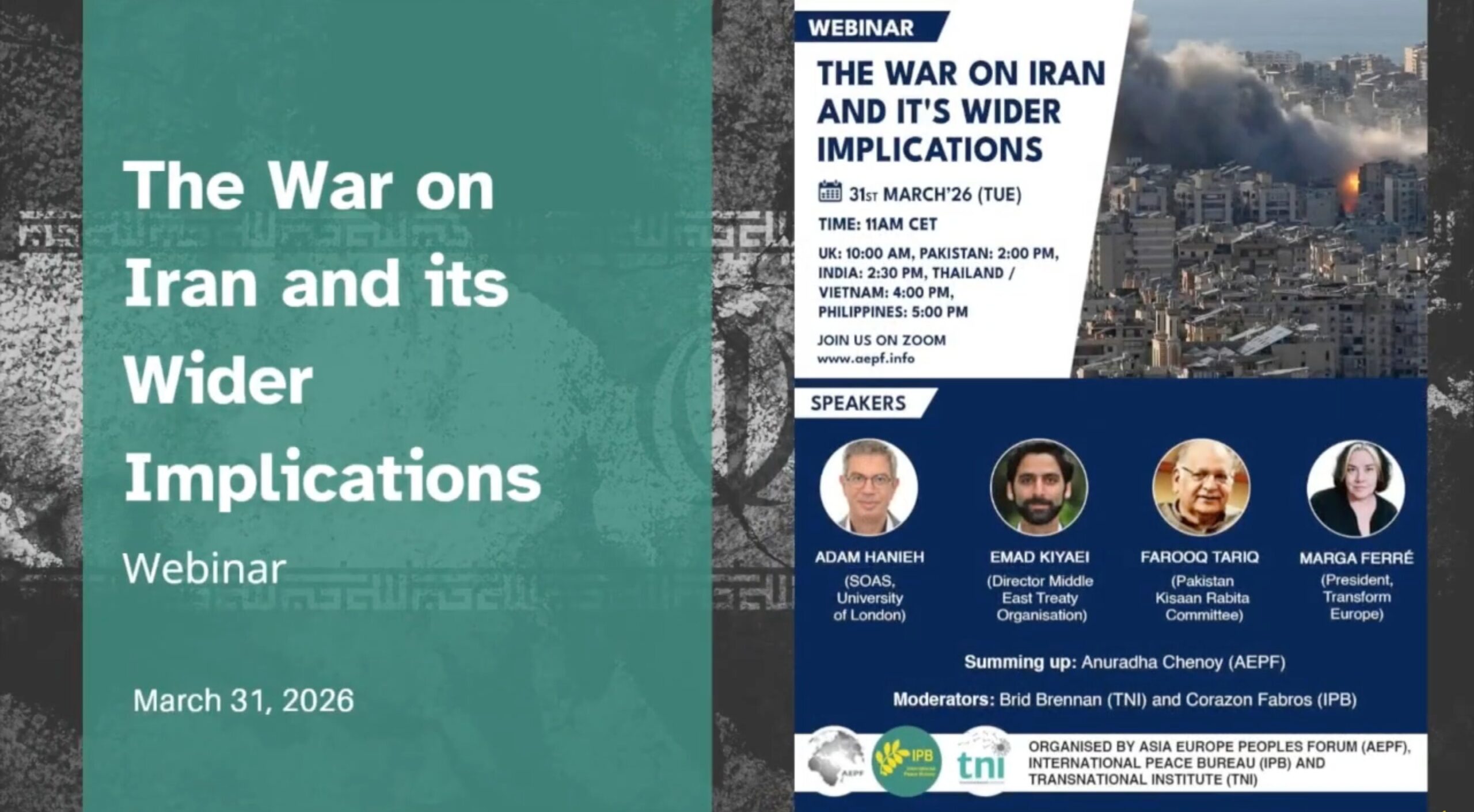
Webinar: The War on Iran and its Wider Implications

Webinar: The War on Iran and its Wider Implications

Watch the Webinar

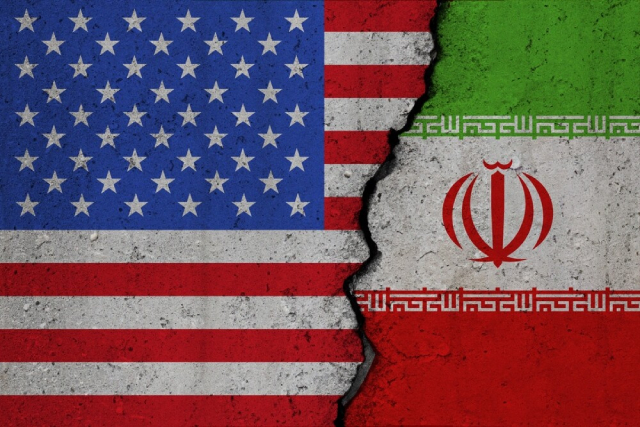
The recent war of aggression by the United States and Israel on Iran marks a dangerous escalation in an already volatile region. It is widely seen as an extension of the ongoing violence in Gaza and reflective of a broader geopolitical agenda aligned with both Zionist expansionism and US imperial interests.

This is the second major escalation in a short span of time—following the June 2025 12-day war—during which Iran was targeted even as it was engaged in negotiations with the United States over uranium enrichment. The attacks reportedly resulted in the killing of Iran’s supreme leader, several political figures, more than 160 schoolgirls, and over a thousand civilians. Despite the scale of destruction, the anticipated regime change did not materialize. Instead, Iran responded by targeting American bases across the Gulf Cooperation Council (GCC) region and disrupting key global energy routes, including the Strait of Hormuz—a critical passage for oil supplies to Asia.

The conflict has since expanded regionally, with far-reaching consequences. It poses serious risks to global energy security, threatens sharp oil price fluctuations, and raises concerns over fertiliser and food supply chains across West Asia and beyond. Smaller states in the region face the additional burden of inflationary pressures and disruptions to everyday life.

Simultaneously, Israel has intensified military operations in South Lebanon, displacing over a million people. These actions are viewed by many as part of a broader effort to reshape regional dynamics and consolidate strategic dominance. The wider objective appears to include control over critical oil and gas reserves, as well as weakening Iran’s regional influence—particularly its support for Palestinian resistance movements such as Hamas. Meanwhile, violence against Palestinians continues in both Gaza and the West Bank.

International responses have remained deeply divided. During a press conference on March 9, EU foreign policy chief Kaja Kallas stopped short of condemning the US-Israeli strikes as violations of international law. Similarly, European Commission President Ursula von der Leyen emphasized the need to address “the world as it is,” a stance critics interpret as tacit acceptance of ongoing military actions. While most EU member states have avoided explicit condemnation, Spain has taken a clearer position. Meanwhile, countries like Britain, France, and Germany have framed their responses around “national interests,” leaving open the possibility of further military involvement, including deployment to the Strait of Hormuz.

In this context, the webinar seeks to unpack the broader implications of the war—not just for Iran, but for Palestine, Lebanon, West Asia, Europe, and the Global South at large. It will explore the political and economic consequences of escalating conflict, particularly in relation to fossil fuel dependency, regional stability, and global inflationary trends. Importantly, it will also examine forms of resistance emerging against war and imperialism.

Speakers: 

  • Adam Hanieh (SOAS, University of London)
  • Farooq Tariq (Global Council Fight Inequality Alliance)
  • Emad Kiyaei, (Director Middle East Treaty Organisation)
  • Marga Ferre (President, Transform! Europe)

    Summing up:
    Anuradha Chenoy (AEPF))
    Moderators: Brid Brennan (TNI) and Corazon Fabros (IPB)
    Organizers:
    Asia Europe Peoples Forum (AEPF), International Peace Bureau (IPB), Transnational Institute (TNI) and Fight Inequality Alliance (FIA)
Read More

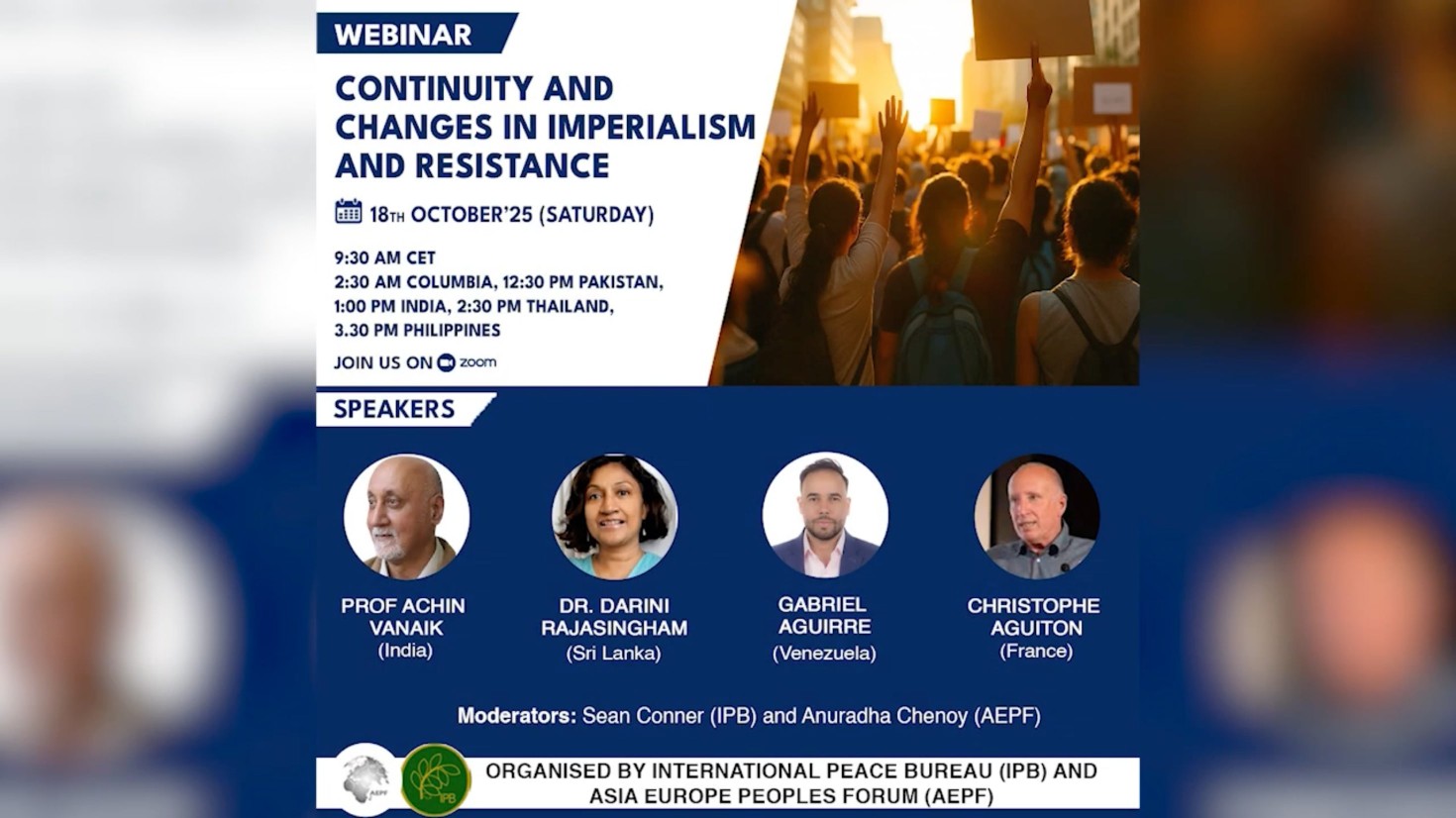
Webinar: Continuity and Changes in Imperialism and Resistance

Webinar: Continuity and Changes in Imperialism and Resistance

The global system is shifting as the US-led West faces rising powers like China and other Asian states. Regional alliances such as BRICS, SCO, and ASEAN offer non-militarist alternatives to NATO, while the US and its allies pursue militarism in Gaza and seek to reshape West Asia. Amid deepening inequality, climate crises, and global instability, peoples’ movements continue to stand with Palestine and resist imperial dominance. This webinar unpacks and connects these global and regional dynamics shaping today’s world order.

Watch the Webinar

Read More

IPB Statement on Thailand- Cambodia Border Clashes

IPB Statement on Thailand-
Cambodia Border Clashes

Statement by the International Peace Bureau (IPB)

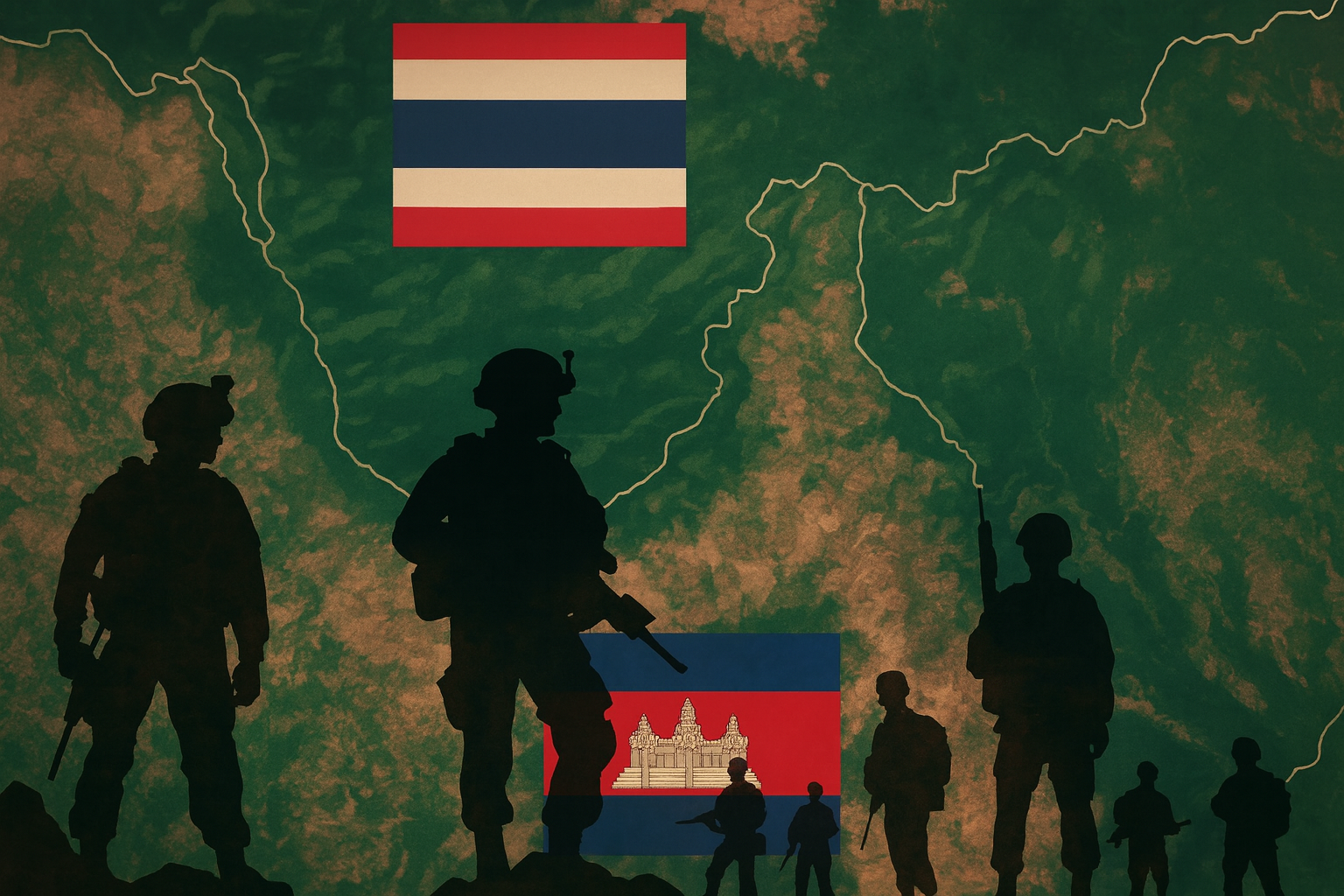
The International Peace Bureau (IPB) expresses deep concern over the rising military clashes and political tensions between Thailand and Cambodia, which have resulted in the death of at least 15 civilians and the mass displacement of civilians from border areas. The escalation of long-standing tensions over the border risks further exacerbating civilian suffering and displacement.

The IPB calls for an immediate ceasefire and a return to diplomatic negotiations and conflict resolution as the only tools that can solve the crisis. Nationalist and militaristic rhetoric must be replaced by dialogue and common security.

Moreover, IPB calls on ASEAN, particularly neighbour states in the region and those with military ties to either party, to encourage de-escalation and peaceful resolution.

Download the Statement

Read More

Webinar: Wars, Genocide and Resistance in West Asia

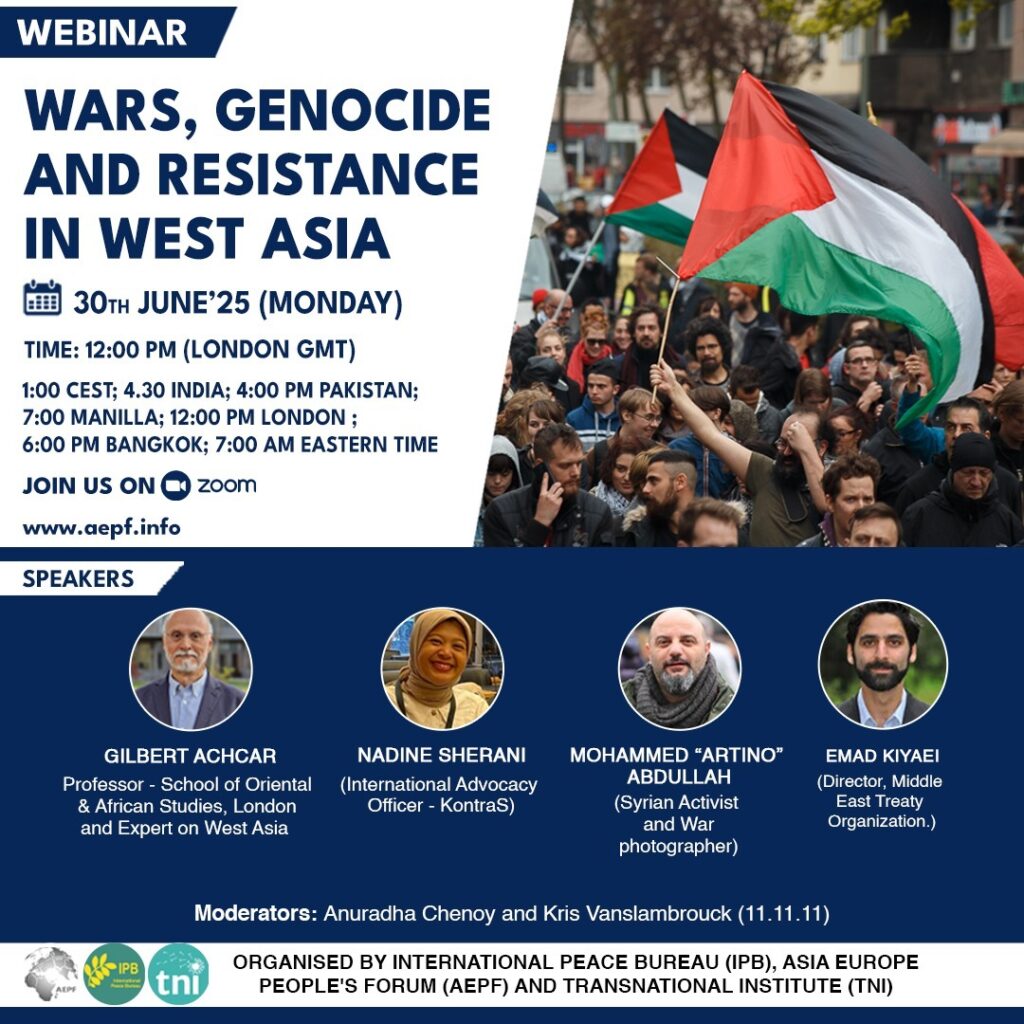
Webinar: Wars, Genocide and Resistance in West Asia

Watch the Webinar

Israel’s colonial settler, continuous expansionism policies centred in the current phase of genocide in Gaza, ethnic cleansing of Palestinians and annihilating any resistance have led to another war this time with Iran. These policies backed and funded by the US follow the wars and destruction in Lebanon, Yemen, regime changes in Syria and Iraq. The reasons for these endless wars, annihilations and war crimes include the control of oil as central to US-Israel hegemony in this region in addition to Israel’s urge to capture and control all of Israel and physically exterminate or remove the Palestinian people. The backing Israel receives has led to curbing dissent and peace movements across the world, including the liberal West.

This webinar seeks to join the dots to analyse the state of this region but also importantly look at the resistance to chalk out the next steps of resistance.

Organisers: IPB, Asia Europe Peoples Forum, TNI


Read More

Webinar: Wars, Genocide and Resistance in West Asia

Webinar: Wars, Genocide and Resistance in West Asia

Israel’s colonial settler, continuous expansionism policies centred in the current phase of genocide in Gaza, ethnic cleansing of Palestinians and annihilating any resistance have led to another war this time with Iran. These policies backed and funded by the US follow the wars and destruction in Lebanon, Yemen, regime changes in Syria and Iraq. The reasons for these endless wars, annihilations and war crimes include the control of oil as central to US-Israel hegemony in this region in addition to Israel’s urge to capture and control all of Israel and physically exterminate or remove the Palestinian people. The backing Israel receives has led to curbing dissent and peace movements across the world, including the liberal West.

This webinar seeks to join the dots to analyse the state of this region but also importantly look at the resistance to chalk out the next steps of resistance.

Register Now 

Read More

INTERNATIONAL PEACE BUREAU STATEMENT: IPB Condemns U.S. Strikes on Iranian Nuclear Sites

INTERNATIONAL PEACE BUREAU STATEMENT - IPB Condemns U.S. Strikes on Iranian Nuclear Sites: An Illegal Escalation

INTERNATIONAL PEACE BUREAU STATEMENT: 
(ipb. org)
June 22, 2025

IPB Condemns U.S. Strikes on Iranian Nuclear Sites: An Illegal Escalation

The International Peace Bureau (IPB) strongly condemns the United States’ recent military strikes on Iranian nuclear facilities at Fordow, Natanz, and Isfahan. Carried out in coordination with Israel, these attacks are a dangerous escalation that violates both international law and the U.S. Constitution—and brings the region closer to a devastating war.

Under international humanitarian law, nuclear facilities are protected due to the catastrophic risks they pose to civilians and the environment. Targeting them is inhuman and illegal. There is no credible evidence that Iran is currently pursuing nuclear weapons—U.S. intelligence has confirmed this repeatedly. Military action under these circumstances has no legal justification.

Domestically, the strikes also violate the U.S. Constitution, which grants Congress—not the President—the authority to declare war. Launching attacks without Congressional approval contradicts both the War Powers Resolution and the principles of democratic oversight.

This is more than a legal issue—it is a matter of global security. Attacking nuclear infrastructure risks the release of radioactive materials, retaliatory strikes, and rapid regional escalation. The consequences could be catastrophic—not just for Iran and the Middle East, but for the world.

NATO members must not follow a U.S. president who acts unlawfully, even within his own constitutional system. They have a responsibility to uphold international law and prevent escalation—not enable it. Silence or complicity only deepens the crisis.

There is no military solution to this crisis. IPB calls for an immediate end to all military operations, respect international law, and return to diplomacy. Peace and common security can only be achieved through cooperation, not weapons.

Corazon Valdez Fabros
Co-President
International Peace Bureau (IPB)]

Read More

Statement: Calling for De-escalation and Peace Between India-Pakistan

Statement: Calling for De-escalation and Peace Between India-Pakistan

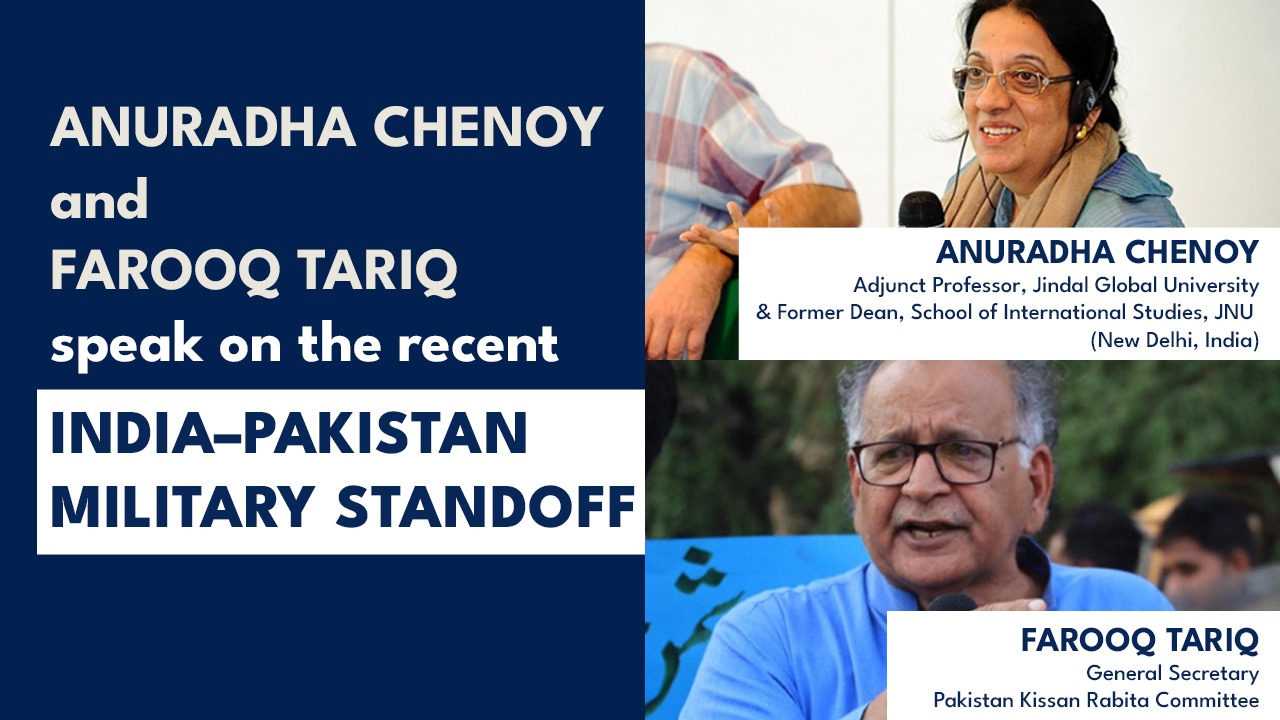
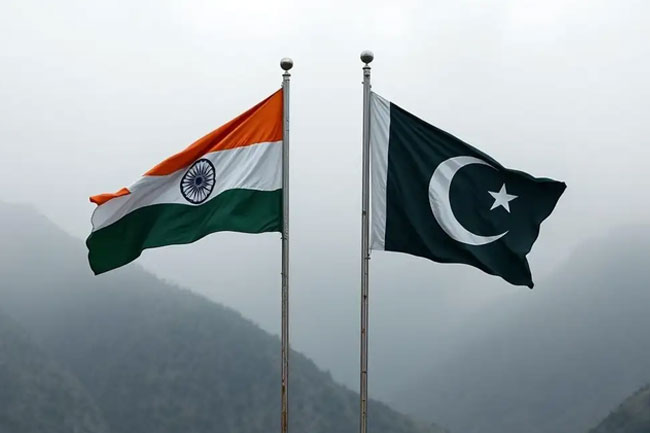
The AEPF strongly condemns the terror attacks in Pahalgam-Kashmir on April 22, 2025. We condole with the families of the 26 civilian victims of this heinous crime. We call for credible investigation into this crime whereby all involved be brought to book. Terrorism in all forms is a criminal activity and has no place in any society and we believe the international community needs to address this issue collectively.

We are witnessing an escalation of war like situation in the Sub-Continent and raised militarist rhetoric as both sides have taken steps to curtail all diplomatic engagements and hurt each other. We believe that wars have serious long term impact on ordinary people and unknown consequences. The AEPF appeals that the Governments of India and Pakistan dial back from these tensions and that all stakeholders assist to de-escalate the atmosphere of war and tensions.

We in AEPF appeal the Governments of India and Pakistan to exercise restraint in this tense atmosphere. We believe that ‘This is not the age for war’ and that all governments take steps to practice this important dictum.

Read More

Webinar: Hague Group Initiative – Gaza Genocide and way forward for Asia-Pacific

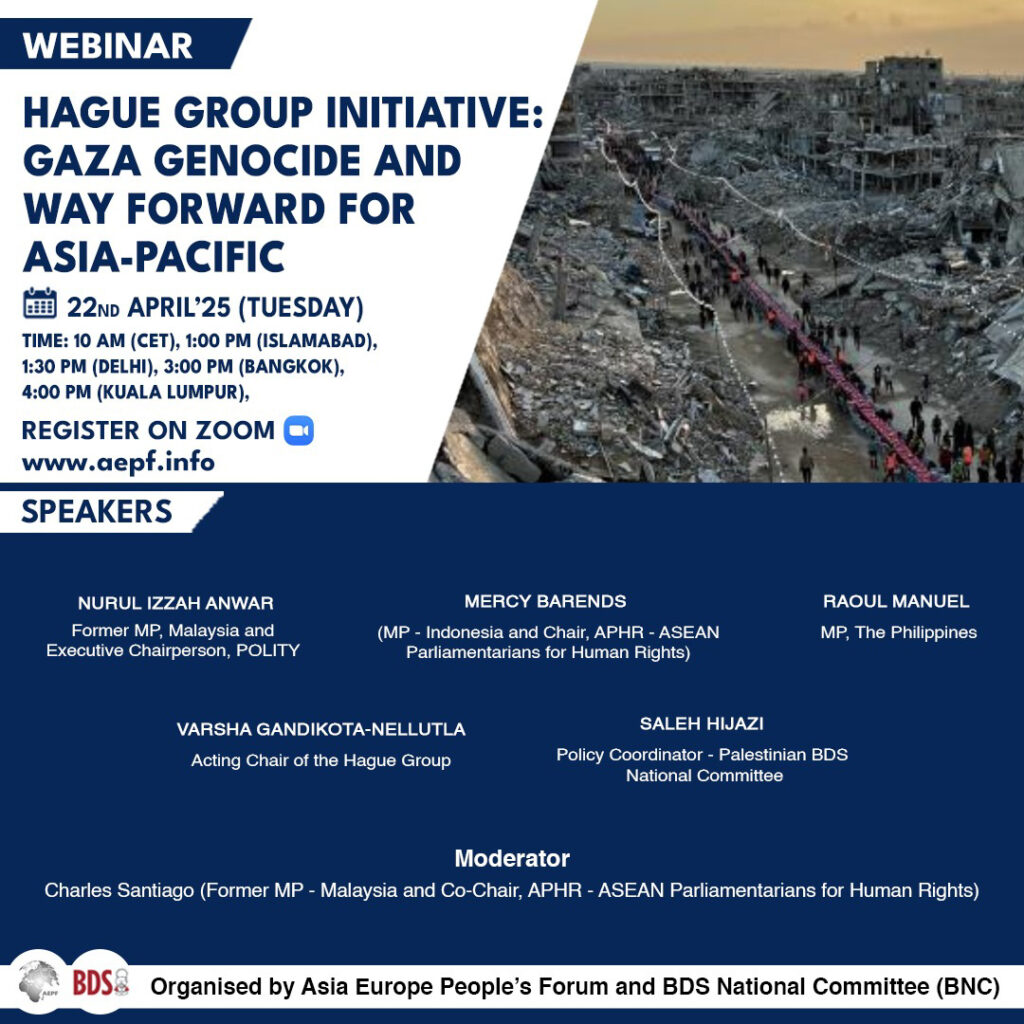
Webinar: Hague Group Initiative: Gaza Genocide and way forward for Asia-Pacific

Watch the Webinar 

Speakers: 

– Nurul Izzah Anwar (Former MP, Malaysia and Executive Chairperson, POLITY)
– Mercy Barends (MP, Indonesia & Chair, ASEAN Parliamentarians for Human Rights (APHR))
– Raoul Manuel (MP, The Philippines)
– Varsha Gandikota-Nellutla (Acting Chair of the Hague Group)
– Saleh Hijazi (Policy Coordinator, Palestinian BDS National Committee

Moderator: Charles Santiago, Former MP Malaysia and Co-Chair, APHR

Organised by TNI, Asia Europe People’s Forum and BDS Narional Committee (BNC)

Read More

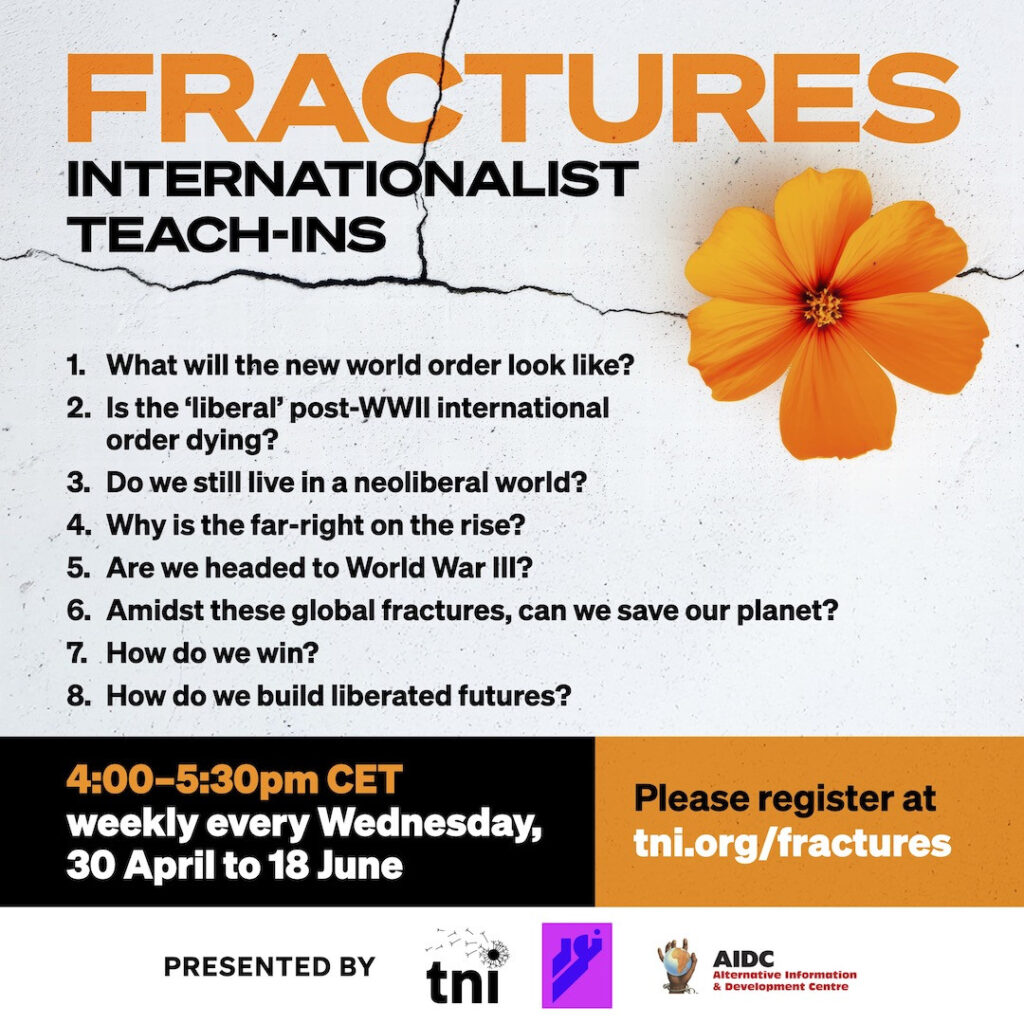
Fractures: Internationalist teach-ins

Fractures: Internationalist teach-ins

Date:  – 
Location: ZOOM

Organisers: Transnational Institute,  Alternative Information Development Centre, NOOR, Asia-Europe People’s Forum & Global Network of Movement Lawyers

Join our eight-week teach-in series to go beyond the headlines and uncover the deeper forces shaping our world. Leading thinkers and activists from across the globe will analyze the challenges we face and explore the strategies needed to resist injustice and build a just, sustainable future.

Register for Online Event 


We are in a fractured world – and we need to understand it to change it. Neoliberalism is cracking apart, age-old alliances are being abandoned, fascist leaders are coming to power, repression of activists is escalating, and marginalised communities are being targeted with ever more brutal force. Social justice movements face a new reality and need new strategies, tactics, and a renewed internationalism to resist. Fractures may cause chaos and division, but they also open up new possibilities—especially if we work strategically, concertedly, and globally.

This eight-week teach-in series will take a step back from the frenzy of news and dig beneath the surface to the long-term global trends that underpin this moment. It will bring together leading progressive and critical thinkers and activists from around the world to reflect on key global dynamics, the challenges and opportunities they pose for all those committed to social and environmental justice, and the tactics and strategies we need to move forward.

Programme

30 April:What will the new world order look like?
What is the future for US imperialism? What are China’s global aspirations? Can the global South be a collective agent for progressive change?

7 May: Is the ‘liberal’ post-WWII international order dying?
What was the promise and reality of the liberal order? Did it deserve to die? What is the future for international law and multilateralism? What will replace it? What should we demand in its place?

14 May: Do we still live in a neoliberal world?
How are the dynamics of capital and class changing? How is Big Tech reshaping capitalism? How does muscular state capitalism and trade wars reshape neoliberalism? How should we articulate public democratic economic alternatives? Can we re-create a democratic state, which has been so delegitimised by corporate take-over, cronyism and corruption?

21 May: Why is the far-right on the rise?
What is the agenda of the far-right? How has the far-right secured the support of anti-elite anger – and appeased by the traditional right? Where did the left go wrong? How can we survive authoritarian rule and best resist misogyny and racism? Where are the fractures in the Right that need to be broken open?

28 May: Are we headed to World War III?
How did global rearmament become hegemonic? What are the intentions of global powers? How do we stop the arms race? How will tech change warfare? How can we rebuild the global peace movement?

4 June: Amidst these global fractures, can we save our planet?
Why has the existential threat of climate crisis been cast aside by so many centrist and far-right political leaders? Why is climate denialism on the rise? What are the paths today towards ecological and climate justice?

11 June: How do we win?
What will social movements look like in the newly emerging era? What does global resistance look like? How do we build a new common sense in an age of internet eco-chambers? What can we learn from recent and past uprisings and movements to sustain them and take power?

18 June: How do we build liberated futures?
What are our imagined liberated futures? How can we build these within and beyond a fractured world? What are the alternatives that social movements are investing time, energy, resources and solidarity into building and sustaining?

Read More