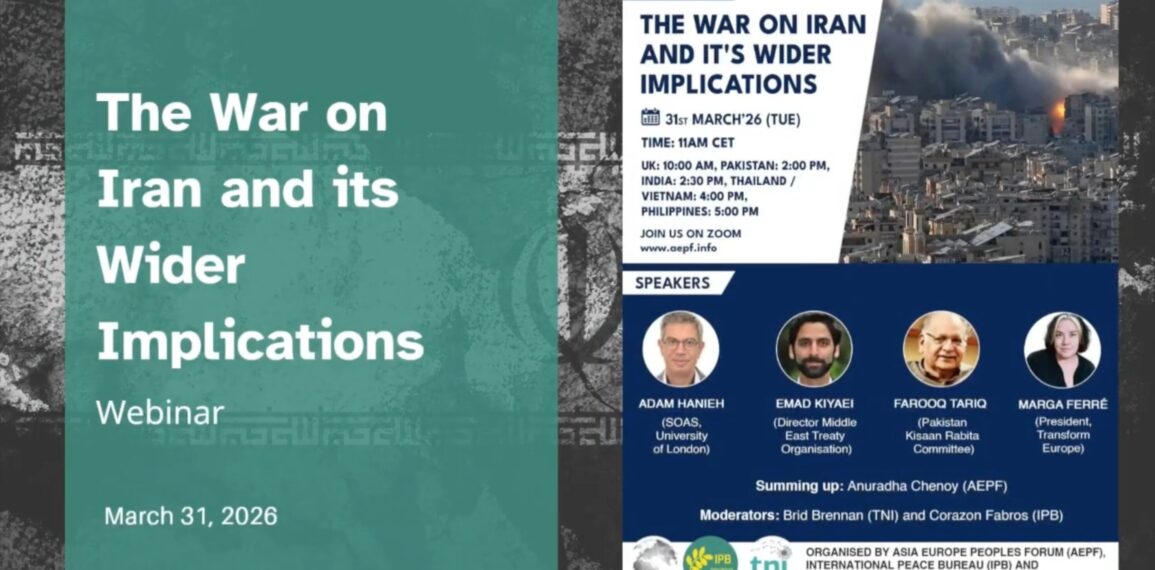
Webinar: The War on Iran and its Wider Implications
Watch the Webinar
The recent war of aggression by the United States and Israel on Iran marks a dangerous escalation in an already volatile region. It is widely seen as an extension of the ongoing violence in Gaza and reflective of a broader geopolitical agenda aligned with both Zionist expansionism and US imperial interests.
This is the second major escalation in a short span of time—following the June 2025 12-day war—during which Iran was targeted even as it was engaged in negotiations with the United States over uranium enrichment. The attacks reportedly resulted in the killing of Iran’s supreme leader, several political figures, more than 160 schoolgirls, and over a thousand civilians. Despite the scale of destruction, the anticipated regime change did not materialize. Instead, Iran responded by targeting American bases across the Gulf Cooperation Council (GCC) region and disrupting key global energy routes, including the Strait of Hormuz—a critical passage for oil supplies to Asia.
The conflict has since expanded regionally, with far-reaching consequences. It poses serious risks to global energy security, threatens sharp oil price fluctuations, and raises concerns over fertiliser and food supply chains across West Asia and beyond. Smaller states in the region face the additional burden of inflationary pressures and disruptions to everyday life.
Simultaneously, Israel has intensified military operations in South Lebanon, displacing over a million people. These actions are viewed by many as part of a broader effort to reshape regional dynamics and consolidate strategic dominance. The wider objective appears to include control over critical oil and gas reserves, as well as weakening Iran’s regional influence—particularly its support for Palestinian resistance movements such as Hamas. Meanwhile, violence against Palestinians continues in both Gaza and the West Bank.
International responses have remained deeply divided. During a press conference on March 9, EU foreign policy chief Kaja Kallas stopped short of condemning the US-Israeli strikes as violations of international law. Similarly, European Commission President Ursula von der Leyen emphasized the need to address “the world as it is,” a stance critics interpret as tacit acceptance of ongoing military actions. While most EU member states have avoided explicit condemnation, Spain has taken a clearer position. Meanwhile, countries like Britain, France, and Germany have framed their responses around “national interests,” leaving open the possibility of further military involvement, including deployment to the Strait of Hormuz.
In this context, the webinar seeks to unpack the broader implications of the war—not just for Iran, but for Palestine, Lebanon, West Asia, Europe, and the Global South at large. It will explore the political and economic consequences of escalating conflict, particularly in relation to fossil fuel dependency, regional stability, and global inflationary trends. Importantly, it will also examine forms of resistance emerging against war and imperialism.
Speakers:
- Adam Hanieh (SOAS, University of London)
- Farooq Tariq (Global Council Fight Inequality Alliance)
- Emad Kiyaei, (Director Middle East Treaty Organisation)
- Marga Ferre (President, Transform! Europe)
Summing up: Anuradha Chenoy (AEPF))
Moderators: Brid Brennan (TNI) and Corazon Fabros (IPB)Organizers:
Asia Europe Peoples Forum (AEPF), International Peace Bureau (IPB), Transnational Institute (TNI) and Fight Inequality Alliance (FIA)