Regional Strategy Meeting Asia Task Force on Legally Binding Instrument on Business Activities and Human Rights

Regional Strategy Meeting Asia Task Force on Legally Binding Instrument on Business Activities and Human Rights

7th -8th January 2020 – Jakarta, Indonesia

This key conference brought together representatives of a range of organisations and movements from Indonesia and from across Asia who are working on the Legally Binding Instrument on Business Activities and Human Rights.

Participants included:  – Indonesia for Global Justice (IGJ);  KruHA; Walhi; Lokataru Foundation;  KIARA: INFID; FIAN Indonesia;  JATAM;  from Indonesia and Focus on Global South; Tebtebba; ATM; THIRD WORLD NETWORK; World March of Women Phillipine from other parts of Asia

We agreed a submission to the important ongoing negotiations.

The submission was sent to United Nations Secretariat in Geneva following the fifth session of the Open-Ended Intergovernmental Working Group (OEIGWG)

The annex responds to the discussion of the 2019 draft text from the fifth session of OEIGWG in Geneva. It paid special attention to the contribution made by Non-Aligned Movement (Grouping), and support the NAM Grouping in negotiation of the text of the Legally Binding Instrument

Please read the letter and the supporting annexe

In addition the conference has enabled stronger linkage between international, national and grassroots level organisations on these key issues. It has also enabled local issues to be ‘amplified’ within this global campaign.

Read More

Peoples Mobilisation to Reclaim Peoples Rights over TNCs, Corporate Profits and impunity

Peoples Mobilisation to Reclaim Peoples Rights over TNCs, Corporate Profits and impunity

Activities towards and Binding Treaty on Transnational Corporations which respects human rights as part of the Week of Mobilisations in Geneva in October 2019.

During the period October 11-19 2019 at the UN Human Rights Council in Geneva, Asian and European organisations from the AEPF were among the more than 100 organisations from affected communities, social movements, women’s organisations, trade unions, indigenous peoples, migrant organisations, parliamentarians participating in the activities. The mobilisation brought together delegations from Latin America and Africa in which all contributed to generate a dynamic and constructive environment for the debate on the ‘Revised first Draft of the Treaty on TNCs and Human Rights’.

Please also read an important background article – by Brid Brennan and Gonzalo Berron (TNI)
https://longreads.tni.org/corporate-power-the-david-and-goliath-struggle-of-the-21st-century/

And an article by Dottie Guerrero (Global Justice Now, UK)
https://www.globaljustice.org.uk/blog/2019/oct/14/crafting-treaty-stop-corporate-impunity-challenges-we-face-fifth-session

and the Final Joint Submission to the Open-ended Inter-Governmental Working Group on the Treaty https://www.stopcorporateimpunity.org/final-declaration-of-the-global-campaign-to-claim-peoples-sovereignty-dismantle-corporate-power-and-end-impunity-in-relation-to-the-v-session-of-the-oeigwg/

Download:
Peoples Mobilisation to Reclaim Peoples Rights over TNCs, Corporate Profits and impunity

Read More

Towards and Binding Treaty on Transnational Corporations which respects human rights

Towards and Binding Treaty on Transnational Corporations which respects human rights

Week of People’s Mobilisation, Geneva, October 2018

Activities towards and Binding Treaty on Transnational Corporations which respects human rights as part of the Week of Mobilisations in Geneva in October 2018

We share the training and engagement in advocacy work for Asia and  Europe based civil society organisations who engaged with government and state actor representatives during the historic opening negotiations on an international legally binding instrument (UN Binding Treaty) on Transnational Corporations and Other Business Enterprises with respect to human rights.

Please also read an important background document:
https://www.stopcorporateimpunity.org/declaration-of-the-global-campaign-for-the-closing-of-the-4th-session-of-the-oeiwg-on-transnational-corporations-and-human-rights/ 

And please look at a film of some of the activities:  
https://www.stopcorporateimpunity.org/video-documentations-of-the-side-events-on-the-week-of-peoples-mobilisation-13-20-october-2018-geneva/

Download:
Training & Engagement in Advocacy work – Asia & Europe CSO Representatives during the historic Opening Negotiations  on a Binding Treaty with respect to Human Rights

Read More

People’s Resistance Agenda Over FTAs and Corporate Impunity

People’s Resistance Agenda Over FTAs and Corporate Impunity

May 5, 2018

Jakarta Call
The AEPF Cluster on Trade Justice & Corporate Accountability

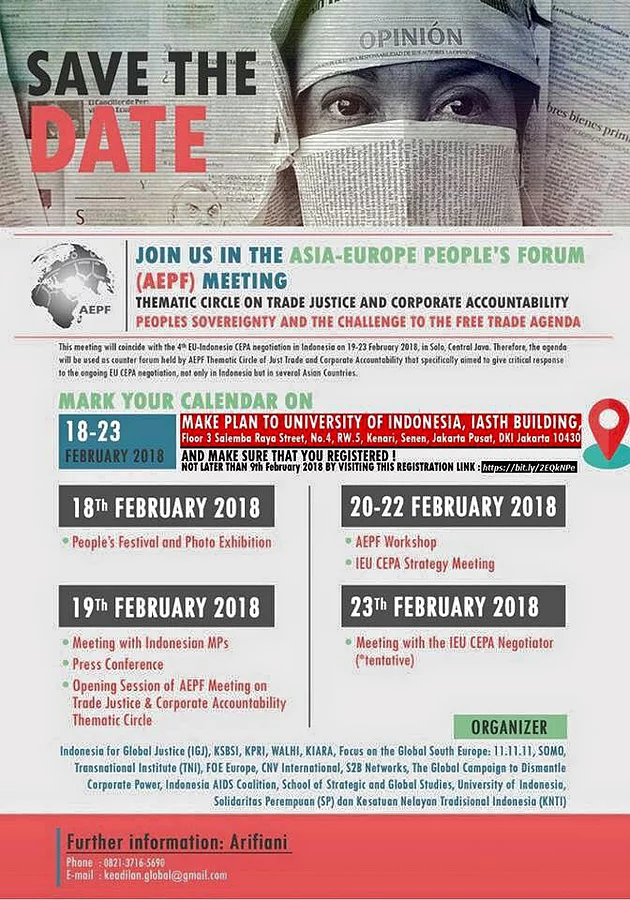
The AEPF week of actions in Jakarta (February 18-23, 2018) has become an important process to re-consolidate people’s proposals and strategies in both regions of Asia and Europe in the story of resistance against free trade agendas and domination of Transnational Corporations.

It has been realized that the control of transnational corporations on the agenda of economic globalization through the massiveness of free trade and investments has greatly contributed to the monopoly of control and exploitation of natural resources that impact on the loss of people’s access to land, water and sea as the source of their livelihood, and threaten their whole economic and life sustainability.

Transnational corporations are more powerful than many countries. They control a huge chunk of the world’s economy, and exert great influence on economic policies from trade to tax policies, and their operations across the globe have huge social, environmental and cultural impacts.

The state has become hostage to corporate influence to such an extent that the protection and fulfilment of Human Rights obligations are not implemented. People’s rights have been marginalized and set aside. Thus, the agenda of resistance on economic injustice over the Free Trade and Investment regime and corporate agenda needs to be re-formulated.

Two resistance agendas were therefore proposed and formulated in this conference, to strengthen joint followup actions: i.e: First, reclaim people’s rights (#ReclaimOurRights); and Second reclaim people’s economy sovereignty (#ReclaimOurEconomy)

1. People’s Agenda to #ReclaimOurRights

In the agenda to reclaim peoples’ rights, actions are cantered in the resistance towards (1) the free trade agenda and (2) corporate power and impunity.

On the Free Trade Agenda

FTAs are being aggressively pursued in the South East Asia region as well as globally. These are ‘new generation’ FTAs with serious problems: Investment chapter & ISDS, IPRs, Digital Trade, services, raw materials, covering non-trade regulations. No transparency in negotiations and no options for public participation – neither from Parliament or civil society. Corporate capture on the other hand gives access for corporate priorities to be carried on in the negotiations. Devastating impacts are experienced on the ground by way of violations of human rights, labour rights and environmental standards; land and sea grabs; de-forestation; toxifying land and water; denial of access to affordable medicines etc. We need more effective documentation on cases of impact and to popularise lessons from existing agreements.

We see human rights violations not only in politics but also in economy in relation with FTAs implementation. There are some strategies and campaigns where the civil society organisations (CSOs) are struggling to ‘Stop the FTAs’ which violate human rights, and these should continue.

First, in relation with Human Rights Impact Assessment (HRIAs). The EU trade policy always accompanies the proposed FTA with a sustainable impact assessment (SIA). However, the SIA only calls for flanking measures, to mitigate for negative impacts of the FTA. It does not change anything about the overriding agenda of liberalisation and de-regulation. The UN Special Rapporteur, indicated that SIAs are completely insufficient to map the human rights impacts of trade and investment agreements. To strengthen SIAs, the Un Rapporteur developed guidelines to address impact assessment that specifically looks at human rights violations.

The advocacy agenda on Human Rights Impact Assessment (HRIA) is necessary to be carried out before the start of the negotiations to make sure that sustainability and human rights are the overriding principles that guide the framework in which trade and investment can take place. Once the negotiations are completed, then the Parliament has to agree or disagree to the agreement and they should have the power to assess the negotiation results on the bases of these impact assessments.

Second, in relation with the Constitutional lawsuits over trade and investment agreements: There are some experiences from Indonesia, Philippines, and EU. Now, the Constitutional Court in Indonesia is examining the CSOs lawsuit about the international treaty law against the Constitution. The reasons for the CSOs challenge are because these investment and trade agreements have caused the loss of democracy where government power is too absolute, and to restore people’s sovereignty.

Like in Indonesia, there have also been legal challenges against the World Trade Organization and free trade agreements in the Philippines, with civil society and public interest groups filing petitions with the Supreme Court. Two such cases were filed against the Japan-Philippines Economic Partnership Agreement (JPEPA). The first petition sought the intervention of the Supreme Court for public disclosure of the negotiating texts and the request and offers made by the Philippine government. In 2008, another petition was initiated by various sectoral organizations against the ratification of the Senate in favour of JPEPA despite its constitutional infirmities. In both petitions however, the Supreme Court ruled in favour of the actions of the government. Despite these setbacks, Philippine civil society groups and social movements continue to demand transparency and public participation with regards to trade negotiations.

Therefore, the experiences from the CSOs lawsuit against FTAs should be documented by the movements and CSOs and become lessons learned for the ongoing campaigns and to strengthen the struggles.

On Corporate power and Impunity

There is widespread resistance to the operations of Transnational Corporations by affected communities. Criminalization of affected communities and workers as well as assassination of human rights and environmental defenders, including the shrinking space for CSOs activities. The human rights violation crisis and forestry fire cases are the results from the crimes and violations done by corporates. Legal instruments available today, both in national and international context, are unable to address the roots of the problems done by TNCs and other business enterprises. Trade and Investment agreements provide a legal architecture of impunity in which TNCs operate and access to justice is denied to affected communities and sectors. In the international context, even with certain certifications that claim to pursue human rights issues it is the TNCs that benefit in terms of their mode of operations and their accumulation of profit.

While efforts to hold corporations accountable have been in place for a long time – these have resulted only in soft law which is voluntary and based of TNC self-regulation. This critique towards soft law is that it is self-regulation and that in practice corporations are not held accountable for the violations that result from their operations. The experience from the implementation on UN Guiding Principles on Business and Human Rights (UNGP) for the past 5 years has not delivered effectiveness in relation to TNCs operations and impacts on communities and the environment. Similarly, the National Action Plans (NAPs) on the implementation of the UNGPs have not given positive results for affected communities or addressed the impunity of TNCs.

The experiences also from European countries have shown that NAPs are not effective. None of them comes with concrete plans to have legally binding and obligations on corporations. The Belgian government has drafted the NAP, but this is not resulting in binding obligations on TNCs. Belgium wanted to be one of the first to show their commitment of complying to human rights standards but this is on the level of recommendations. The NAP raises awareness but is not advancing obligations that are binding.

The same situation with NAPs in Indonesia where The NAP was drafted by the National Human Rights Committee (NHRC) and it was planned to be a Presidential Decree with legally binding power. However, when it was published, the Ministry of Foreign Affairs changed it into National Guidelines.

In the UN, due to persistent campaigns by affected communities, CSOs and responsiveness by some UN Member States, it was urged to develop a code and standards of conduct for TNCs that has a binding nature. In 2014, Resolution 26/9 raised in UN Human Rights Council (UNHRC) was supported by 20 countries in a vote and directed “to establish an open-ended intergovernmental working group with the mandate to elaborate an international legally binding instrument on Transnational Corporations and Other Business Enterprises with respect to human rights”. This was a historic resolution which for the first time raised the agenda of legally binding obligations for TNCs. The Resolution was voted positively by the following Asian countries – Indonesia, Philippines, Vietnam, India and China.

A very broad consolidation of movements, CSOs and affected communities is jointly campaigning for the Binding Treaty under the framework of the Global Campaign to Reclaim Peoples Sovereignty, Dismantle Corporate Power and Stop impunity (Global Campaign). The Global Campaign has developed the People’s Treaty which later became the basis for draft text on the Binding Treaty. This text Treaty on Transnational Corporations and their Supply Chains with regard to Human Rights was submitted to the IGWG last October 2017. The process of The IGWG so far has taken three Sessions 2015-2017 when the Ecuador Chair presented the “Elements” document as the basis for building the Zero Draft Binding Treaty for negotiation at the fourth Session in October 2018.

The negotiation process going forward throughout 2018 and into 2019 and 2020 will require a combination of public information work and advocacy with Parliamentarians and governments in the member states of the UN as well as concerted work with the Permanent Missions at the UN In Geneva.

Since we are members of the AEPF, which is a very important and fertile space to develop further strategies and discussion, and see how we can strengthen the synergy between the campaigns on Trade and Investment and the Binding Treaty.

2. People’s Agenda to #ReclaimOurEconomy

Restoring the sovereignty of people’s economy (#ReclaimOurEconomy) should become an important agenda against economic liberalization. One of the proposals is economic solidarity which in essence is generating the economic and political movements that encourages debate and exchanges of experiences on the hopes and possibilities of developing a more sustainable economy. It means strengthening the willingness and ability of the people to discuss their economic problems including technical start-ups (how to produce, how to manage consumption) how to deal with the current dominant economic framework including the FTA.

To reclaim people’s economic sovereignty, movements should start by discussing the solutions that can strengthen people’s sovereignty and their role in the economy. This can be achieved by three things: agrarian reform, industrialisation, and ecological justice. In relation with economic solidarity, it is key to start producing and empowering our own industry, and making sure the process both in upstream and downstream processes works well. At least there are specific steps to make this happen: first, consumption needs to be structured, then production, then distribution. The trade unions and cooperative institutions need to be strengthened.

The people’s movement must begin not only to criticize the existing FTAs, but it should begin to promote the model of the people’s economic sovereignty, both in practice and in legal recognition. There are similar narratives on this from Indonesia, Philippines, Myanmar, Vietnam, etc.

These dimensions of our resistance agenda should be followed up in every AEPF Forum.

Further Information:
Rachmi Hertanti rachmihertanti@gmail.com

Joseph Purugunan josephp@focusweb.org

Brid Brennan bridbrennan@tni.org

Read More

Trade And Investment – Concept Note And Workshops

TRADE AND INVESTMENT - CONCEPT NOTE AND WORKSHOPS

July 10, 2016

Draft CONCEPT NOTE for ‘Socially Just Trade, Production and Investment’
Asia Europe Peoples Forum, Ulaanbaatar, Mongolia, July 4-6, 2016

Background

The aim of the sessions is to show the relevance and enhance the knowledge of the current trade and investment framework by a) showing the wider context of the trade and investment regime; b) signaling and explaining the risks and dangers in the trade agenda; c) highlighting the growing unease with the current trade and investment framework and the calls for reform, both from active civil society campaigns and from governments primarily in the global South, and pulling all of this global, abstract critique into the Mongolian context by highlighting concrete cases; and e) providing angles for further action and collaboration among all civil society actors present.

The session should also sketch the history of investment protection agreements as such – with the multitude of bilateral investment agreements signed from the 1950s onwards, the exponential growth in the number of investment claims since the 1990s and the reasons behind this, and the current trend of including investment protection chapters in trade agreements, which, unlike bilateral investment agreements, do not have a window of opportunity to terminate or amend.

Key message should be that countries/governments should be much more aware of what crucial capacities and assets they are giving up in order to gain dubious trade and investment benefits: there is no decisive evidence that investment agreements attract more investment, while the trade generated as a result of free trade agreements tends to lock developing countries into global value chains controlled by powerful TNCs while limiting opportunities for balanced domestic economic development – not in the least because trade agreements compel governments to irreversibly liberalise and commercialise vital public services, jeopardizing universal and affordable access for all. The current model for trade and investment relations benefits economic elites and contributes to growing inequality, both between and within countries.

Session 1 (phase 1): Trade and investment agreements – fundamentals of the framework

The session needs to highlight how modern trade agreements in their focus on trade in services and investment go well beyond traditional agreements that only dealt with cross-border trade in goods. It needs to highlight how, because of this new, much further reaching trade focus, modern trade and investment agreements have severe and far reaching impacts on sustainable development and the scope for self-determination of sovereign countries. These aren’t any longer trade agreements. They are agreements of the elites to change the basics of their societies. It is like changing the constitutions. And everything is suddenly under the control of wall street listed entreprises.

The session needs to make very clear that in signing trade and investment agreements states are relinquishing their right to regulate in the wider public interest, that these agreements primarily serve big and footloose transnational enterprise at the expense of small and medium-sized, locally or regionally oriented industry that is much more firmly rooted in society and provides much more stable development opportunities.

Trade Agreement EU – Vietnam as example

Addressing the problems with the trade and investment agenda can be done on the basis of the EU-Vietnam free trade and investment agreement, which the EU put forward as the new model for trade relations with developing countries (and which is different from TTIP als model for agreements between industrialised countries?). It is showcased as development-friendly and beneficial to a balanced sustainable development. But a closer look reveals that the EU-Vietnam trade agenda continues to enshrine some very problematic elements, like irreversible liberalization, hampering governments to regulate and set performance requirements for incoming investment, Investor-state dispute settlement, with potentially severe impacts for public budgets and the risk of regulatory chill.

Session 2 (phase 1): Investment protection and ISDS/ICS

Zoom in on investment. The workshop should focus on what constitutes sustainable investment and the tension between the need to attract sustainable development and the trade and investment framework.

  • Zoom in on the dangers of ISDS: system is growing exponentially; crippling damages are borne by public budgets at the expense of social policies; highlight cases related to extractives and land-grabbing – these are relevant to Mongolia. Extractive companies are main users of ISDS
  • Zoom in on the proposals for reform of the ISDS system that the EU has included in EU-Vietnam FTA. The EU promotes this new Investment Court System, but it does not address the systemic flaws associated with ISDS.
  • Highlight the risks of including investment chapter + investor-state dispute settlement in a comprehensive trade agreement: bilateral investment agreements have a built in time-frame to revise/terminate which FTAs have not: this constitutes a relinquishing of sovereignty, because revisions can only be made in agreement with the other party.
  • Highlight the risk of ISDS in the Mongolian context: The Khan resources case. Mongolia has already decided to terminate a tax treaty with the Netherlands, because of adverse development impacts. Investment protection – including the EU’s ICS – should be observed with equal reservation.

Session 3 (phase 2): Resistance against trade and investment agreements from civil society and sovereign states

Exchange of experiences with resistance against the neoliberal trade and investment agenda from civil society and governments, embarking on a revision or termination of their existing investment agreements. Discuss how resistance from both regions may be harnessed to reinforce each other’s efforts. Visions, perspectives and strategies can be extrapolated from the discussions and brought together in a paper to be published after the event.

  • Very briefly highlight cases: Gabriel Mining, Achmea, Lone Pine, Veolia/Egypt, Philip Morris, etc.
  • Zoom in on Indonesia, which is developing a new model investment agreement to avoid further restraints on policy space, after having been forced to abandon public interest regulation under threat from claims from the extractives industry.
  • Indonesian speaker from Indonesia for Global Justice – possibly Rachmi Hertanti?
  • Zoom in on India, which revised its foreign investment policy after escalating tax disputes with Vodaphone and others.

Also highlight the shortcomings of these revisions from a civil society/sustainability perspective. Indonesia, for example, missed the opportunity to include investor obligations/ a human rights perspective in its new model investment treaty.

Session 4 (phase 3): Strategising

Have an open space meeting to which we invite als speakers and participants from the workshops on trade and investment to sit together, network and discuss what might follow from AEPF11, the trade and investment cluster and all the workshops.

Note: The Thematic Cluster ‘Socially Just Trade, Production and Investment’ is being coordinated by Sustainable Development Research Institute (Mongolia), Focus on the Global South (Bangkok), Monitoring Sustainabilitiy of Globalizations (MSN,Malaysia), Transnational Institute (TNI, The Netherlands), and Rosa Luxemburg Foundation (RLS, Germany)

Read More

Trade and Investment

Trade and Investment

May 2, 2016

By AEPF Working Group, Stiftung Asienhaus, May 2, 2016

In recent years there has been a significant increase in free trade and investment deals that are negotiated and signed globally. Besides the so-called mega regionals such as the Trans-Pacific Partnership Agreement (TPP) or the Trans-Atlantic Trade and Investment Partnership (TTIP) several bilateral and regional free trade and investment treaties are on the agenda of governments and business. Besides the USA, which has recently sealed its deal with the Asia-Pacific region by signing the TPP, the European Union also looks to at Asia. The free trade agreements with Singapore or Vietnam can be understood as blue prints for future trade and investment agreements.

Trade and investment are also used as tools in development politics. The EU’s Generalised Scheme of Preferences (GSP), especially the Everything But Arms (EBA) scheme, is supposed to bring benefits to Least Developed Countries (LDC) also from Asia, giving several countries duty free access to the EU market for their exports, except arms and ammunition.

Advocates of free trade usually promote the triggering effects of such deals for cheaper production chains, the increased opportunities for exports etc. Meanwhile, critics analyze the negative impacts that will occur because the free trade and investment agreements are mainly benefiting large corporations from the global north that are looking for cheap production sites in the global south. Further, these agreements assure an easy and low cost access to human and natural ressources in countries where these „goods“ are available, namely in Asian, African or Latin American countries. The strong export orientation implied by free trade deals brings along a natural obstacle to the development of a healthy local or regional economy, which in the long run will have negative impacts on the development paths of poorer countries that followed the temptation of quick export opportunities.

Too, in times where climate change and environmental degradation are hitting the world, the endeavors of governments and business to trigger economic growth by increasing global trade – which will lead to continuously mounting global transport and hence more and more carbon emissions – seem like a mockery towards the voices of the climate and environmentalist movements but also to the climate protection deal that has been signed by governments themselves in Paris. Additionally, the trade and investment deals must be understood as a threat towards citizens’ rights and participation, democratic state-building as well as rule of law. Often these deals are negotiated in secrecy – with national parliaments or civil society often not being allowed to get insights into the draft papers while representatives of business and their lobbyists belong to the entourage of negotiators.

The mechanism of investor-state-dipute-settlement (ISDS) that is usually part of free trade and investment agreements is totally favor of corporations’ interests. It bypasses national legislation by putting its ruling to off-shore, not democratically legitimized privately run „courts“, punishing states who want to enact for example protective laws for the benefits of their citizens. Cases where national legislators decided for example to enforce laws on health protection against the interests of the tobacco industry or laws on environmental protection against the interests of polluting energy companies have shown that the ISDS will be used to make the governments pay exorbitant fines to the companies that see their future investment potential and benefits being threatened by national legislation.

Hence, in many countries in the EU and in Asia, protests of social movements, farmers, and even business as small and medium sized enterprises have been adressing the negative impacts of this development. As the ASEM summit brings together governments and companies, the AEPF shall be used as a space for the Asian and European civil society to analyze impacts of trade and investment patterns that are on the political agenda of Asian and EU governments. It shall provide opportunity to formulate specific critical analysis by taking into account the voice of citizens, but also bring up alternatives for a more sustainable development path that ensures a fair and just socio-economic agenda. It could discuss questions of how a democratic economy can look like, how a shift towards an Asian-EU fair and participatory trade agenda might look like. Further it could be a space where social movements can exchange their experiences with successful struggles, trigger solidarity among Asian and European activists and build a platform and an ongoing process beyond the AEPF summit, where movements from the EU and Asia create a stronger joint activism for a more just, democratic and sustainable future also in the economic sphere, namely in trade and investment.

Read More

China-EU negotiations on investment

China-EU negotiations on investment

July 17, 2014

An opportunity to set a new standard

China and the EU are preparing to launch negotiations for a bilateral investment agreement at the next EU-China Summit this November. The proposed agreement would replace existing bilateral investment treaties between EU member states and China. This is the moment to develop a more balanced international investment framework that would protect the sovereign power of both parties.

The current international framework for investment protection is increasingly perceived as a threat to national sovereignty and the protection of the rights and values of citizens. The risks associated with the dispute settlement clauses commonly included in these agreements are sparking an ever more urgent debate on a need for alternatives.

Dispute settlement in investment agreements typically enables foreign investors to unilaterally sue host governments behind closed doors before a triumvirate of arbitrators. ISDS allows foreign investors to challenge the laws and regulations enacted by sovereign governments by bypassing national courts. ISDS provides foreign investors with an option to go straight to an international arbitration process that carries an inherent bias in favour of the investors. The arbitrators are generally commercial lawyers or academics who make money out of these arbitrations, which can only be brought by foreign investors.

At the same time, the broad phrasing of the protections in investment agreements allow foreign investors to challenge almost any government measure that might impinge negatively on their projected profits. The clause guaranteeing the foreign investor a ‘fair and equitable’ treatment is particularly controversial because it can be stretched by the investor and the arbitrators to cover almost anything. Investment agreements also stipulate that foreign investors must be compensated for any kind of expropriation. Investment tribunals on various occasions have interpreted general public interest measures as indirect expropriations warranting compensation to the investor. Investors can challenge regulations from public authorities at all levels if they feel these may negatively affect their profitability.

Through the investor-state dispute settlement (ISDS) mechanisms, investment agreements can have a serious impact on policy space. Awards for damages can easily run into hundreds of millions of dollars, payable out of public budgets. And even if the state wins a dispute case, this is still a costly affair due to the costs of the arbitration and legal representation.

The Chinese audience may be aware of the investment dispute initiated by Chinese insurer Ping An initiated against the state of Belgium to claim compensation over damages arising from Belgium´s nationalization of Fortis Bank. It may thus look upon ISDS as a convenient tool to protect the interest of Chinese investors abroad. But if, as the EU wants, market access is included in the proposed investment agreement, China can also expect much more incoming investment from Europe, with European investors able to invoke the protections of the agreement and initiating cases against China if their investments are threatened.

International law firms, who discovered the opportunities of ISDS in the 1990s and are making big money out of dispute settlement cases, are actively raising awareness of the possibilities of investment arbitration with international investors and pushing them to file claims. The number of known investment cases has increased exponentially to arrive at a staggering 514 in 2012 – a number which probably only symbolizes the tip of an iceberg, as there is no obligation to publicly register an investment case, except for those brought before ICSID, the dispute settlement body of the World Bank.

China has already been at the receiving end of a number of WTO complaints, including over its raw materials policy. Without question, policies to boost domestic industries and reserve raw materials for domestic producers would also be challenged under an investment agreement, potentially leading to substantial and deep-cutting damages awards. ‘National treatment’ clauses typically included in investment agreements do not allow for this kind of ‘discrimination’ of foreign investors. An investment agreement would likely impact on other areas of policy-making as well. For example, environmental pollution is emerging as a major problem in China. But should China wish to introduce stricter environmental regulation, an EU-China investment deal would enable European investors to claim compensation if those new rules impinge in any way on their profit expectations.

Similarly, China’s ambition to build up a social welfare system will take time and require reregulation – which may be challenged by foreign investors. Multi-billion dollar compensation suits can be powerful lever to persuade governments to amend or abandon proposed legislation. Foreign investors can use ISDS to change regulations in the way that they want, instead of in the way the public interest, now and in the future, may require. And as investment treaties generally have a life span of decades, there are few exit options once an agreement is ratified.

A growing number of countries around the world feel the current framework for investment protection as a straightjacket, which is increasingly constraining their sovereign power to regulate. And resistance is mounting. Ecuador has recently announced an audit of its bilateral investment agreements because of their bias favouring multinational corporations, Australia has decided to no longer include ISDS in future investment agreements and countries like Canada are seeking to tighten up the legal phrasing of investment protection agreements to avoid overly wide interpretation of their protections by investment tribunals. Faced with a growing number of claims, India has decided to revisit its BITs, while Brazil has always categorically refused to implement any BITs.

South Africa, in a recent review of its BITs, concluded that their added value in attracting foreign investment was at best ambiguous, while their undermining effect on decision-making was significant. South Africa also expressed its concerns about standard BIT clauses on the free and unrestricted transfer of funds, as the current global economic crisis has highlighted the potentially destabilising effects of unrestricted capital movements.

In response to the growing critique, UNCTAD released an Investment Policy Framework for Sustainable Development (IPFSD), aimed at helping policy makers to connect the investment policy framework to domestic development policies and to ensure that investment supports sustainable development and inclusiveness objectives. Another alternative framework aimed at balancing investor rights with investor responsibilities is the Model International Agreement on Investment for Sustainable Development of the International Institute for Sustainable Development.

China would be wise to take note of proposals to reform the current investment protection framework by tightening up the legal phrasing and excluding ISDS before entering negotiations to liberalise its investment policy with the EU. China, as a key economic player, might set its ambition beyond merely seeking integration into existing investment protection standards. As civil society organisations, we call on both parties to seek out avenues to advance a new model that addresses the substantial problems associated with the current system for investment protection.

TNI is a member of the S2B network, which includes development, environment, human rights, women and farmers organisations, trade unions, social movements as well as research institutes form all over Europe.

Photo of Chinese money by Kevin Dooley

Read More