Multistakeholderism: Is it good for developing countries?

Multistakeholderism: Is it good for developing countries?

The preparations for the September 2024 Summit of the Future (SOTF) are well underway. In this process, the UN Secretary-General and most OECD countries argue that multistakeholderism should now be accepted as a part of global governance and multilateralism. This paper argues the opposite: multistakeholderism undermines multilateralism and limits the role of developing countries in global governance.

Download: Multistakeholderism: Is it good for developing countries?  (PDF)

Global governance operates via a common narrative, a set of institutions, and the exercise of power. The first section of the paper provides the background to the World Economic Forum’s role in developing the narrative and the preliminary efforts of transnational corporations (TNCs) and major Northern NGOs to build an institutional structure for multistakeholderism. The first section also locates these developments in the context of TNC pressures on the UN and developing countries, going back 50 years to President Allende’s appeal to the General Assembly and UNCTAD.

The second section identifies six fundamental challenges presented by multistakeholderism to multilateralism and G77 governments.

(a) an erosion of sovereignty
(b) the outsourcing of global governance
(c) a decline in accountability and trust in the international community
(d) a shift in implementation from OECD governments to TNCs based in OECD countries
(e) a narrowing of the range of policy directions to those that are compatible with a commercial return; and
(f) a corruption of diplomatic language by masking the legitimate difference in governance actors as equivalent ‘stakeholders’

After an in-depth analysis of each challenge, the paper concludes with a menu of multilateral options to respond today and in the context of the SOTF to multistakeholderism’s intrusion into global governance. The choices include counter-moves on the political level and on the procedural level, the combination of which allows governments to create a variety of counter-strategies.

Read More

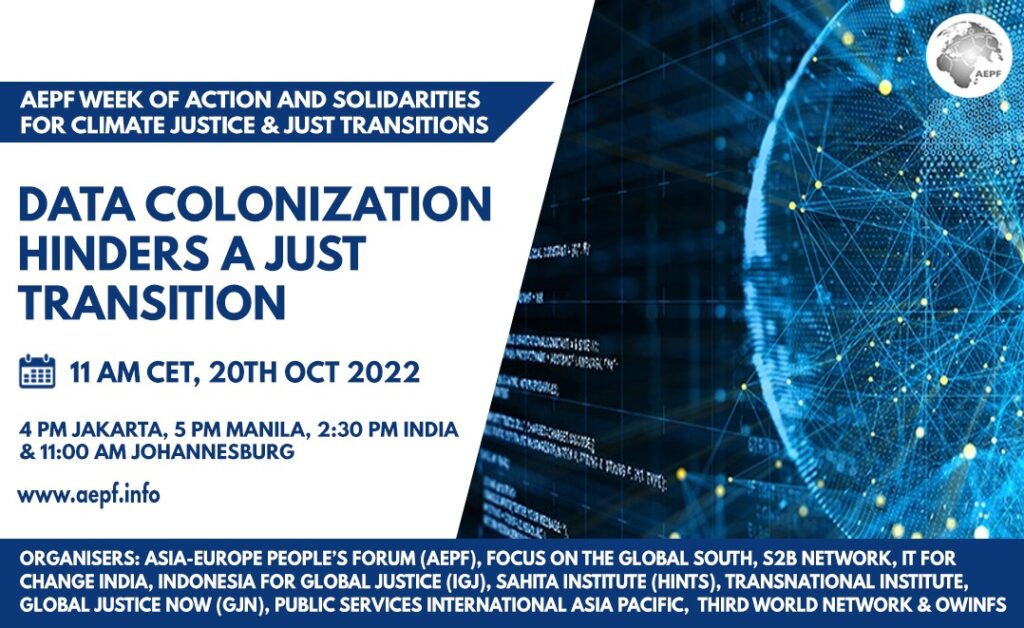
Webinar Report: Data Colonization Hinders Just Transition

Webinar Report: Data Colonization Hinders Just Transition

A Webinar summarized by Rachmi Hertanti (member of AEPF Cluster on A just trade and Corporate Accountability)

The digital economy is globally organised and there is considerable merit for it remaining so, which enables easy exchanges and flow of data. Data is the key resource in a digital society and economy. But currently, most of data value is extracted in and by one or two digital superpowers who control most of the global digital platforms.

Many questions on the control of data and its impact on people, such as who makes decisions on the utilization of data and who secures, who benefit from the use of this data, what is the state of regulation, and who is shaping the digital governance regime nowadays? 

During the AEPF Week of Action on Solidarities for Climate Justice and Just Transition on October 2022, a webinar on “Data Colonization Hinders a Just transition” tried to answer all these questions. It was organized by Focus on the Global South, S2B Network, Transnational Institute (TNI), Global Justice Now (GJN), IT for Change India, Indonesia for Global Justice (IGJ), Sahita Institute (Hints), Public Services International Asia Pacific, Third World Network, Asia-Europe People’s Forum (AEPF).

The webinar aimed to raise awareness of social movements (at grassroots and national level) of the fundamental problems of data colonialization in realizing climate justice and just transition to the peoples in the Global South, and broadening the network to campaign against digital capitalism in the global trade agreement negotiations at the WTO JSI E-commerce and FTAs driven by big techs interest. 

Digital Colonization

The big problems arising from the digital economy is not well understood at all. This is because people who control the narrative do not want it to be understood for what it is. Parminder Jeet Singh from IT for Change revealed the true facts behind this big problem. He explained the fundamental problem of data monopoly and cross-border data flows. 

Data is raw material because it provides intelligence about the subjects of data. And therefore, the real asset is intelligence and the corporations which are at the top of the value chain today, are those corporations which own the intelligence of the sector. These corporations  supersede the intellectual property owned relations, which were till a few years back, at the top of the global value chains.

What is happening today is that for the first-time systematic intelligence has been disembodied from human beings into machines. Not just the intelligence we know in a computer which is a recorded or a deflected intelligence, but a somewhat autonomous system, artificial intelligence and machines that can run whole sectors’ activities and actors almost autonomously.

Now, when looking at Amazon and Uber, the next question is what kind of company are they? Many people only see these companies as platforms for retail and transport. The platform does not really mean much. But, with the data collected by Uber, the autonomous system at once is able to orchestrate the actors activity in the whole Transportation sector. These corporations’ main asset is the intelligence system owned by them. Therefore, these platform companies are called the intelligence corporations. 

In the digital transformation age, the new chain is the data produced in developing countries collected by platforms which are owned by majority big techs in developed countries. The product of intelligence resides inside servers and is controlled by the big tech companies in the US, EU, and even China where then it is exercised over by the physical activity in most of developing countries. UNCTAD statistic shows that 90% of data ownership is divided between the US and China big techs and this is a kind of concentration of wealth. 

That is how the digital colonization happens. If we go to the Industrial Age as an analogy, the industrial colonization consisted of a chain of economic activities where  raw material was produced in the colonies, who were forced  to remain as producers of raw material for the industries in the west, or industrialized countries from where than the finished product was then sold to all, including to the colonies.  And these sectors were monetized, precisely to be able to sell their finished products. Once we keep on getting dependent on what is called ‘Outsource intelligence’, that dependency is acute. There is nothing in comparison to this intelligence-based and database dependencies which are being created. 

So, one of the biggest things we need to do, to address the power of foreign platforms is to have data infrastructures as public infrastructure. India has a committee report of non-personal data framework. It has come up with mandatory sharing of data by platforms of important data. This obliges big data companies, to put the data on infrastructure inside the country where everyone could use it equally within the country. It is not allowed to put the data outside the country. Without the provision of putting up data within the host country, it will create another form of data colonization, but within the country if data infrastructure is developed, then the platforms that collect data are mandated to share that data and therefore local industry can be developed. And we can start digital industrial policy at the national level. 

The Impact in the Agricultural Sector

In the age of rapid expansion of digitalization in every sphere of  life, there is a need for the farmers of the world to wage a war against this monopoly of data across the world. Afsar Jafri, a researcher of GRAIN, unpacked the phenomena where data is being used to monopolize the agriculture system in the developing world where farmers and farming are already in big distress.

In food and agriculture, the industry 4.0 is termed as agriculture 4.0. And interchangeably is also called  ‘smart farming’ and digital agriculture changes. The whole food supply chain is getting increasingly digitalized, or turned into digital information, using data related technologies, such as Precision agriculture, automatic sensory, tracking devices, Internet of Things, mobile and Cloud Technologies, artificial intelligence, or blockchain. Therefore,  data is the core of the digital agriculture system. 

The OECD report 2019 says that the agriculture sector is both an important consumer and supplier of data for the big tech companies. Farm data are particularly important to facilitate global value chain integration. So, as per this report, farmers and farming are the new market. But this report also cautions that essential information like soil conditions, climate and water quality that should be publicly accessible to farmers as it is necessary for agriculture production can easily be extracted, stored, privatized, and monopolized by a handful of agribusiness and digital companies. 

The implementation of digital technologies in agriculture, like the artificial intelligence drones and e-commerce are growing at lightning speed. Agribusiness corporations are teaming up with digital technology companies and creating their own digital arms to create products and services targeting food Supply chains. Today, there is an unprecedented level of investment in digital information, platforms, connected to their cloud services from digital and ICT information and communications  technology companies that traditionally have not worked in the agriculture sector and these are the platform companies like Microsoft, Apple, Google, and Facebook. 

The GRAIN research shows that in 2020 investment in Agri-tech has been more than tripled to 31 billion dollars from 9 billion dollars in 2016. These big company are sitting on vertical and horizontal integration as happens along the food supply chain. The Corporations see the potential of gathering agriculture data enabling enabled by digital technologies to monopolize the supply chain and maximize their profit by using drones and artificial intelligence, and censoring devices. The Big Techs are able to harvest real-time farmers data and analyses the condition of their soil and water, the pattern of growth of their core crops and situation regarding  pests and diseases and the looming weather and climate changes. 

For example, Microsoft has developed a digital platform called Azure FarmBeats that operates through the company’s massive Global Cloud technology called Azure. The platform is being designed to provide farmers with real-time data and analysis on conditions of their soils and water. In addition they will provide date on the growth of their crops, the situation with pests and diseases, the looming weather, and climatic changes they may face. The value of this information and advice depends on the volume and quality of data that Microsoft can Harvest and analyse with algorithms. This is why Microsoft has partnered with the leading companies, that are developing farm drones and censoring devices as well as with those company developing technologies that can receive and act upon the information transmitted from FarmBeats, the high-tech tractors, pesticide spraying drones and other machines hook up to Azure cloud.  

In September, 20, Microsoft and Alliance for a Green Revolution (AGRA) in Africa, which is also one of the big programs by the Bill and Melinda Gates Foundation, developing a partnership to help Microsoft expand its Azure FarmBeats platform across Africa, and deepen their joint effort to deploy Microsoft chatbot app called Kuzabot. This app provides small farmers with advice via WhatsApp and SMS, including information on what inputs to use, and which companies to buy from. 

In India, we have seen a similar exercise. Microsoft signed an MoU with the Union agriculture Ministry in April 2021 to set up AgriStack, which is a unified farmer services interface to provide Indian farmers “End To end Services” across the agriculture food value chain. With this, Microsoft could possibly get access to the database of 50 million farmers and their land records, maintained by the government under different programs with the possibility of more data being added later. Data collected could include personal details, for example, family and bank details, profile of land, health, the measurement of the land, the fertility of the soil, the production details,  sowing details crop quality and the financial details for the gum, how much loan the farmer had, what kind of the credit rating, etc. The farmers’ every  details will go to to the Microsoft data bank. 

Experts fear that the huge amount of data that this project is going to collect can lead to massive exploitation of farmers using their own data against them along with the erosion of their privacy.

Another example is BAYER field view, which is a digital platform and farming platform, that extracts 87,5 billion data points from 180 million Acres of Farmland in 23 countries and funnels it into the Cloud Server of Microsoft and Amazon. Like Microsoft, BASF also has its own app called Xarvio,  run by Microsoft or by Bayer and BASF which identifies weeds, diseases, insects in farms field, and predicts when they would become a problem. to. They use cloud computing platforms of Amazon web services. One of the biggest big tech companies that controls the world’s cloud service and is ahead of Microsoft, Google and Alibaba.

In 2024, the major platforms, like Alibaba, Amazon, Google and Microsoft alone, accounted for 67 Percent of revenue accruing from Global Cloud infrastructure Services. Similarly, Yara, which is one of the largest fertilizer companies in the world, offers a whole set of digital tools to assist farmers fertilizer needs such as the YaralRix, a tool for precision farming that allows farmers to measure crop and nitrogen requirements using their smartphones. It allows farmers to analyse their fields with satellite images and selectively apply fertilizer. Many leading food and beverages processors companies already control Digital Data for raw materials or sourcing processing marketing and delivery.

In this process, data has become a major driver of consolidation. This integration is getting more and more strengthened through corporate partnerships, mergers, and takeovers, creating the possibilities for a much more profound and complete control capture of food system. 

So here the question arises and this is one of the most important questions: who owns and controls  agricultural data generated through digitalization by big tech and agribusiness corporations. 

In fact, when India signed the MoU with big tech companies, like Microsoft, Amazon, and Cisco, one of the activist group in India called ASHA, which is an alliance for sustainable and holistic agriculture,  raised this issue of privacy and data ownership, and in a letter to the Prime Minister, they said that this new development is taking place in a policy vacuum with respect to data privacy of farmers and their related issues.  Till today, India’s does not have a law regarding control and ownership of digital data. Therefore, it’s very important to know where all the data is getting stored, who owns it and who has control over this data. In December 2018 in a speech by one of India’s multinational company CEO, Mukesh Ambani, demanded that Indian government prevent corporates, especially global corporations from owning Indian data. He said data colonialism is an as bad as previous forms of colonization. Data freedom is as precious as freedom we gained in 1947.

Another example in India, when Farmers buy equipment like tractors from John Deere, the farmers must sign up for certain conditions with respect to data that John Deere will gather from the tractor. Farmers sign up a license to operate the vehicle but they are not the owners of the equipment, the software embedded in it, or the data generated by the equipment. In addition, farmers are sometimes forbidden from repairing their own equipment. Their own tractors with they have bought. It has become illegal for farmers or independent technicians to tinker with embedded software, which is considers proprietary. This raises a number of concerns about losing control and ownership over both data and the tools used in farming. 

We have witnessed a big challenge to this monopolization of data or digital agriculture system by farmers in India. In 2021 India witnessed a massive mobilization of farmers across the country and the capital city of Delhi witnessed one of the largest and longest form of protest in the history of Modern India. Apparently, the farmers opposed  the three farm legislations brought out by the government, which they believed are meant to benefit Indian agribusiness. But they were also opposing the increasing monopoly by the big tech companies and agribusiness over food and agriculture, because some of the provisions of the three legislations tried to accelerate Agri-Tech and agribusiness  monopoly through setting up electronic trading platforms and promoting  digital and smart farming initiatives. 

The Impact on the  Energy Sector

There are two types of relationships between data and energy. One is the data driven energy production and the other one is related to  energy consumption of the data centres. Sofia Scaserra, researcher at Transnational Institute (TNI), exposed this nexus very clearly about energy and data in a colonializing point of view. 

The first thing to understand is, on how energy transition in the global South is done especially through colonialism. The energy transition using digital transformation has been creating colonialism from the north to the Global South by appropriating the data and raw materials, that can push and boost the energy productions in the world. Developing countries are being ‘forced’ to realize energy transition and privatized this under the control of corporations. 

With digital transformation the energy sector can take their own decisions based on data and information. It is because the appropriation of the intelligence and information by the big tech companies that they can  control the energy sector. When  energy is being produced worldwide, more and more the energy decisions are being taken by data, like streamlined refinery and distribution process, efficiency, monitoring energy and energy consumption, the increase oversight and ability to perform predictive maintenance and ensuring safety,   comes from the data-driven supply chain management. 

Thus data is being colonialized and  kept by a handful of big techs companies that collaborate with the energy companies. This collaboration will create a new dependency where finally the developing countries once again lose their sovereignty and technological capacities to pursue the energy transition. 

Now, this is not the only relationship between data and energy. There is also a relationship between energy and data centres. It is about the energy that has been consumed by having data centres in the world. First, not all data is being used. We store humongous amount of useless data in the world, and this is a really important issue, because many of the big tech companies, do not even know where the data exactly is and how much of that is really being used. They don’t even erase the data.

Data is being accumulated worldwide in different data centres. The data centres consume a lot of energy and it is becoming a really big problem for the environment worldwide. Data centres need some environmental standards and conditions to create ideal conditions for their operations. For example, heat and humidity could be a threat to the continuous operation of servers. In additions, continuous access to power and water are essential for their operation.

This fact has had major consequence in some countries such as Singapore or Islands where the power consumption of data centres is increasingly high. It has been putting a risk to the energy supply of the population. In the case of Singapore, as a key country for technological development in Asia Pacific, has established a moratorium from 2018 that suspends installation of new data centres in the country on the electric grid and the increase in carbon emissions. Today, there are several projects in Singapore that seeks to incorporate renewable energies and make better use of resources and maintenance of data centres where they aim the lifting of the moratorium soon. 

The truth is a data centres maintenance consumed two fundamental resources, that is energy to keep them running; and water to cool them like the cooling systems in large office Buildings.  The storage industry reliance on water is putting the digital business at risk. That is why the big tech companies are engaged in   huge propaganda about green energy, and the importance a quick energy transition. 

Another example is the Netherlands. Netherlands is a huge data centres and it has the exchange points of information that enter  Europe inside the Netherlands. The large amount of energy consumed by the storage industry has made companies concerned about using green energy. Today, 86 percent of the data centres in the Netherlands are supported by renewable energy. It generates a trade-off between electricity consumption to support households and industrial consumption and the energy consumed by these data centres. 

Big Techs Lobby on Global Digital Rules

The big tech companies are playing a big role in the digital transformation agenda and are pushing for digital and E-commerce rules that are occurring in a variety of trade negotiations. Jane Kelsey, a professor emeritus at the University of Auckland, shared her perspectives on the big techs lobby to liberalize data. 

So why opt for trade rules? 

The big tech companies were worried that the obvious place for developing global rules to deal with the digital domain was the international telecommunications union. It didn’t like that. The big techs would push the public trade rules, bilateral or even multilateral, as the basis of regulation which has a binding and enforceable aspect, and negotiated these in secret.

On top of the list was the right to control data. It is because data is the fuel for the digital economy and the digital domain, and who controls data, essentially can dominate that digital domain. Therefore, they wanted absolute rights to control the data generated in the business. The big tech companies also want that they are  not required  to be held locally responsible inside the country where they function. They do not want that country to even get  a copy of their data. By not using local computing facilities, such as local servers, they take advantage of their economies of scale but also locate themselves in jurisdictions that have minimal regulation and to effectively evade regulations and its enforcement in the source countries of the data. 

Other regulations that the big tech companies  avoid are the obligation to disclose the source code and algorithms, tax and competition regulators, local presence and content requirements, technology transfer requirements, and no limits on the royalties in the context of financial services as they are often located in tax haven countries. This model is being promoted as a model of corporate sovereignty.

In the context of tax issues,  new rules that are being developed dealing with the fact that big tech companies are the tax evaders. For example, last year, Apple’s retail division made profits of nearly 1,000 million pounds and paid tax less than 1 million pounds. Another one is that Amazon reported record profits, during the Covid19 pandemic, 75% higher than its previous record, and paid just six percent of those profits came into the US.

All these regulations are trying to be negotiated in a breakaway group in the World Trade Organization under the WTO plurilateral E-commerce agreement, and in several trade agreements like US driven Indo-Pacific Economic Framework under the pillar one, Trade in Services Agreement (TiSA), EU FTAs, and other bilateral and regional agreements. 

In fact, the G20 forum is an important place to try to advance these rules model. The key players in addition to the US, EU, Japan, Singapore, Australia are all there in the G20, which is, of course, also a major supporter the basic model subject to individual sovereignty over data. In 2019 when Japan was hosting the G20, they had a side meeting that produced what was called the Osaka declaration about data flows with trust. But of course, free data flows with trust is not about the digital corporations being trustworthy. It was about digital consumers and sellers having confidence in the track transactions that were being conducted online.

It was interesting that some countries that are also important players in the G20 developing countries did not support the G20 proposal such as, India, Indonesia, South Africa, and Egypt. These countries did not participate in that process. Several of those countries including others within the ASEAN region also resisted those rules in the Regional Comprehensive Economic Partnership (RCEP) on the digital trade chapter. There does not have the rule on source code or local content rules. It does have rules on data transfer or rules on what are called data localization. In a self-judging way for national security reasons and the chapter is not enforceable.

The big Tech companies have strong influence lobbies in the trade negotiating arena. As having the biggest lobbying budgets in the EU and in the US, Google, Apple, Amazon, Facebook meta, and their trade group, spent almost 95 million dollars in lobbying. Being since 2021 roughly three times on what they spent 10 years ago. And, over 70% of lobbyists, for Google and meta, have formally worked for government bodies in the EU and member state level bodies. 

So, it’s vital to have strong public scrutiny and voices challenging the power of big tech companies and ensuring the governments do not sign up to these digital trade rules driven by the big techs’ interests.

What Can Be Done by  People’s Movements?

Knowledge building within the movement to understand the fundamental problem of digital colonization in all sectors becomes important. The awareness raising will lead the movement to the needs of policy development in protecting their rights over data. Public law on the right of data should be pushed to the governments and not only limited to individual data, but also to broader public data that has been controlled by the big tech companies. Preventing the states ratifying international trade agreements on digital and data privacy should become a strong demand by the people. Lastly, developing an alternative digital infrastructure that is owned and controlled by the people is essential to show the sovereignty of data and using it in a collective way. ****

Read More

The Covid19 and the Digitalization of Life – Digitalization Of Life Report

The Covid19 and the Digitalization of Life - Digitalization Of Life Report

Covid 19 and the Digitalisation of Life- Report shows how Covid 19  accelerated digitalisation in all aspects of social and economic activity and now impacts our daily lives. The biggest beneficiaries of this digitalistion are corporate  businesses. This all encompassing digitalisation is rearranging social interactions but is not accompanied by the much needed protections for labor rights, public data protection or guaranteeing democratic governance.

This Report is written by several experts and is supported by civil society groups Indonesia for Global Justice and AEPF.

Download the report 


Read More

Big Pharmaceutical Monopoly & Impunity During the Covid19 Pandemic

Big Pharmaceutical Monopoly & Impunity During the Covid19 Pandemic

Rachmi Hertanti
Member of the International Organizing Committee of the Asia Europe Peoples’ Forum (AEPF)
Executive Director of Indonesia for Global Justice (IGJ)
(The article was presented at the Side Event 47th Session of the UN Human Rights Council: Big Pharma VS The People in the times of Covid19: Ways to safeguard the Right to Health)

Rachmi Hertani shows how Intellectual Property Rights of the WTO contribute to vaccine inequality during the Covid-19 Pandemic. Large numbers of countries and peoples in the global South are victims of this inequality and will remain unvaccinated till 2023.

Download Presentation

Vaccine Inequality

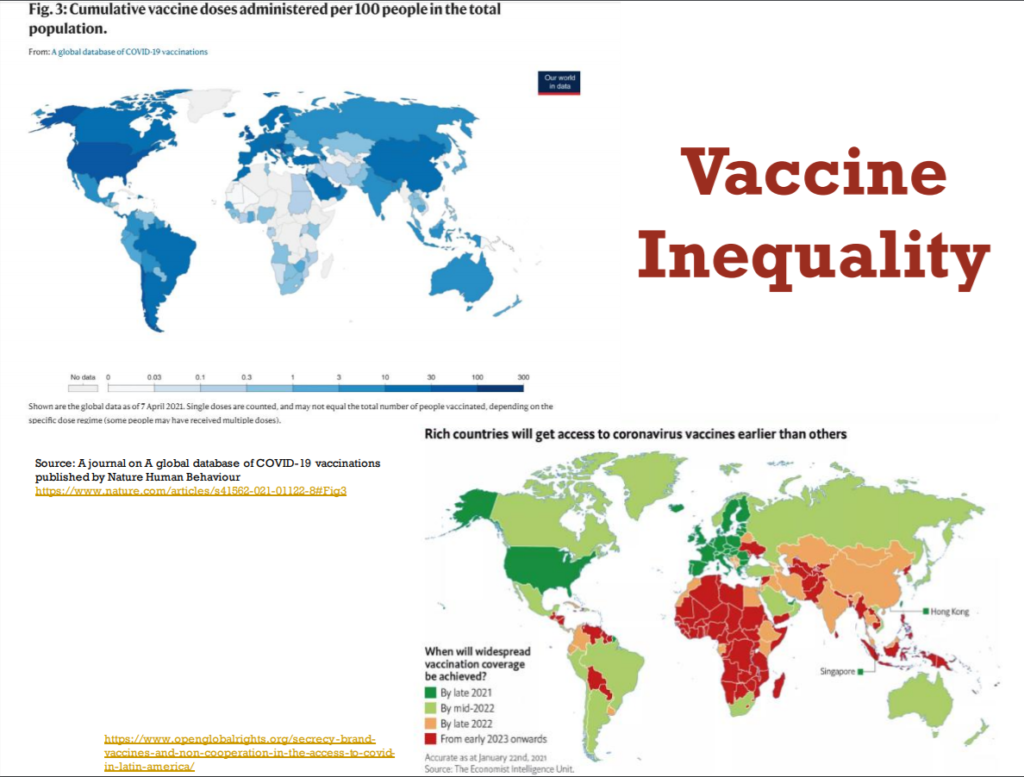
We are  witnessing inequality in access to vaccines and medicines needed to combat Covid19 in the world. From this picture above, we can see that many regions especially in the Global South  are  far behind in the vaccination program.

Based on a global database of Covid19 vaccinations published in the Nature Journal on June 2021, it was mentioned: “There are large differences in vaccination rates between countries. The data reveal large differences in the scale of the vaccine rollout across countries. As of 7 April 2021, the cumulative number of doses administered per 100 people ranges from 118 per 100 in the case of Israel, to less than 0.1 doses per 100 in countries that have just begun their vaccination campaigns, such as Mali and Namibia.”

It can be seen that Africa is the region that lags behind most  in vaccinating and is far behind until it reaches herd immunity. Furthermore, with the worsening of inequality, a lot of poor countries can be  fully vaccinated  only by 2023. 

Indonesia is no exception, although it has secured  94 million doses of vaccines,  yet this figure is only 20% of its total needs. Indonesia needs around 426 million doses of vaccines to cover 181 million people. We still need about 300 million more doses of vaccines. All these facts keep us away from the reality of the end of the pandemic, because “No one is safe until everyone is safe”.

Intellectual Property  Controls

The cause of inequality in access to vaccines and medicines is due to limited production and supply of vaccines worldwide and this cannot be separated from the root of the problem, namely the control and monopoly of big pharmaceutical companies over Intellectual Property Rights (IPR).

Since the beginning of the pandemic, pharmaceutical companies have continued to adopt a ‘business-as -usual’ approach, either by maintaining tight controls over their intellectual property rights or by pursuing secret commercial deals and monopolies and excluding countries that are badly affected by COVID-19.

The monopoly of Intellectual Property has been impeding the production needed to ensure fair global access to the vaccine and other health products.  Defending the protection of the IPR monopoly also goes against the goal that COVID-19 medicines and vaccines  be treated as global public goods. 

In handling COVID-19, almost everything is related to IPR. Almost all health products, such as test kits, diagnostics, masks, medicines, vaccines and ventilators are protected under patents, trade secrets and industrial designs. This in turn opens up opportunities for the pharmaceutical industry to take advantage of a pandemic situation to extract profit as much as possible from the abuse of IPR protection and encourages monopolistic practices of knowledge, production, price, and supplies.

Profit Taking/Making  Behavior

An article written by Brooke Baker1 (March 2021) mentioned how much Big pharmaceutical companies profit from the IP Monopoly that are supported by the governments in the north countries, while we know that they were funded by public money. 

…we can realistically hazard a guesstimate that total R&D expenditures on the vaccine were $1 billion or less. And don’t forget, BioNTech got $445 million from Germany to speed up its vaccine development and for initial investments in expanded manufacturing capacity.

Compare these R&D expenditures with projected earnings. 

Pfizer is already on record predicting $15 billion in earnings from the vaccine this year.  BioNTech’s estimate is $11.5 billion.  But these projections are based on 1.4 billion doses only. The partnership is planning to increase production up to 2.5 billion doses by end of the year. Selling those additional .9 billion doses at $19.50, the U.S. price, would yield another $17.55 billion in revenue (note:  Pfizer had already predicted another possible $15 billion in sales).

In fact, the big pharmaceutical companies showed little interest in the race for vaccines. This is due to past experience, making vaccines, especially in acute health emergencies, has not been shown to be beneficial or rather profitable. Only when governments and international agencies step in with funding agreements, that is when they like to work on it. Governments and multilateral organizations have agreed to buy billions of doses at fixed prices. Pharmaceutical companies selling to wealthy countries will certainly be able to start seeing returns on their investments2

Big pharma like Pfizer and BioNTech  claimed that they have not made enough money to justify their vaccine R&D investments, but looking at the numbers on their balance sheets reveal that their claims of loss  are ridiculous. We can see from comparisons that Pfizer and BioNTech earned hundred times more than the R&D cost. 

Furthermore, the vaccine developed by AstraZeneca and the University of Oxford brought in $275 million in sales from about 68 million doses delivered in the first three months of this year, most of which came from sales in Europe. Even though AstraZeneca has pledged not to profit on its vaccine during the pandemic. They have been selling the shot to governments for several dollars per dose, less expensive than the other leading vaccines3. That is why these companies need to keep a control and monopoly on IPRs, so they get more profit even from the poor countries. 

How they Control?

The race to secure vaccines has encouraged more bilateral deal practices. The bilateral agreements between companies and the states have been done under the trade secret protections clauses. These clauses ensure the enclosure of all information required by the public, such as prices given, the quantity of supplies, including delivery schedules.

For example,  price differences  are impacted from bilateral deals. The impact of a bilateral agreement between richer governments and producers of Covid19 vaccine (read: vaccine nationalism) has raised concerns over rising prices and lack of supply for low- and middle-income countries. This is where the big pharmaceutical companies have a chance to take advantage of the price game. We have heard about the issue of South Africa where Last January 2021, The Guardian reported on the issue of inequality regarding vaccine prices experienced by South Africa. In its article, it was stated that South Africa paid 2.5 times more than the European Union for the vaccine. South Africa has ordered 1.5 million doses of vaccines from the Serum Institute of India (SII) with a price per dose of around 4.32 Euros, which is compared to the price per dose obtained by the European Union which is only around 1.78 Euros4.

The control of pharmaceutical companies over vaccine production cannot be separated from licensing practices that are often implemented in the midst of a pandemic. According to Medicines Sans Frontiers (MSF), companies holding IPR protection can apply for licensing terms to other licensed producers, such as limiting supply to a limited geographic range and other conditions that limit the benefits of global competition and supply. This licensing practice is definitely implemented with an agreement that is highly confidential in nature. This is why vaccine production cannot be carried out on a massive scale and only limited to certain manufactures that require special permission from IP owners.

Even more, the bilateral deal has potentially become a tool for big pharmaceutical companies to threaten the poor and developing countries. They are afraid that in the future there will involve legal cases from the states for the adverse effects of the vaccine. Pfizer made  controversial demand where governments put up sovereign assets guaranteeing and indemnity against the cost of any future legal cases. These two articles gave examples from Latin America and South Africa, where Pfizer tried to put irresponsible requests in the midst of a pandemic crisis5. This should be considered as an unethical practice.

Our demand:

Therefore, to end corporate monopoly and impunity, we need to push more demands:

First, NO IP Monopoly on Covid19 Health products. TRIPS Waiver is being negotiated at the WTO and this is a pretty tough battle because the different positions between the rich countries and the sponsoring countries still haven’t been resolved. In fact, the next challenge after the TRIPS Waiver still has the potential to hinder efforts to open access to just COVID-19 vaccines and medicines due to control over technology and know-how.

Second, we need alternatives. We need to support developing countries that are currently developing vaccine candidates or medicines which can then be directed to south-south cooperation to realize global solidarity.

Third, the very important aspect to end corporate impunity is: How can we ask Big Pharmaceutical Companies for accountability that has prevented the states, especially in developing and underdeveloped countries, to implement their obligations fulfilling the right to health in their countries?. Therefore, it is really important to continue the negotiation on the legally binding treaty on transnational companies at the UN with constructive engagement from the states. 

Also Watch:

****

(1) https://healthgap.org/pfizer-and-biontech-profiteering-exposed-more-than-enough-is-enough/
(2) https://igj.or.id/stop-ipr-intellectual-property-rights-monopoly-against-covid-19-implement-trips-waiver/?lang=en
(3) https://www.nytimes.com/2021/04/30/business/virus-astrazeneca-vaccine-revenue.html
(4) https://igj.or.id/stop-ipr-intellectual-property-rights-monopoly-against-covid-19-implement-trips-waiver/?lang=en
(5) https://readersupportednews.org/news-section2/318-66/69029-held-to-ransom-pfizer-demands-governments-gamble-with-state-assets-to-secure-vaccine-deal
Read More

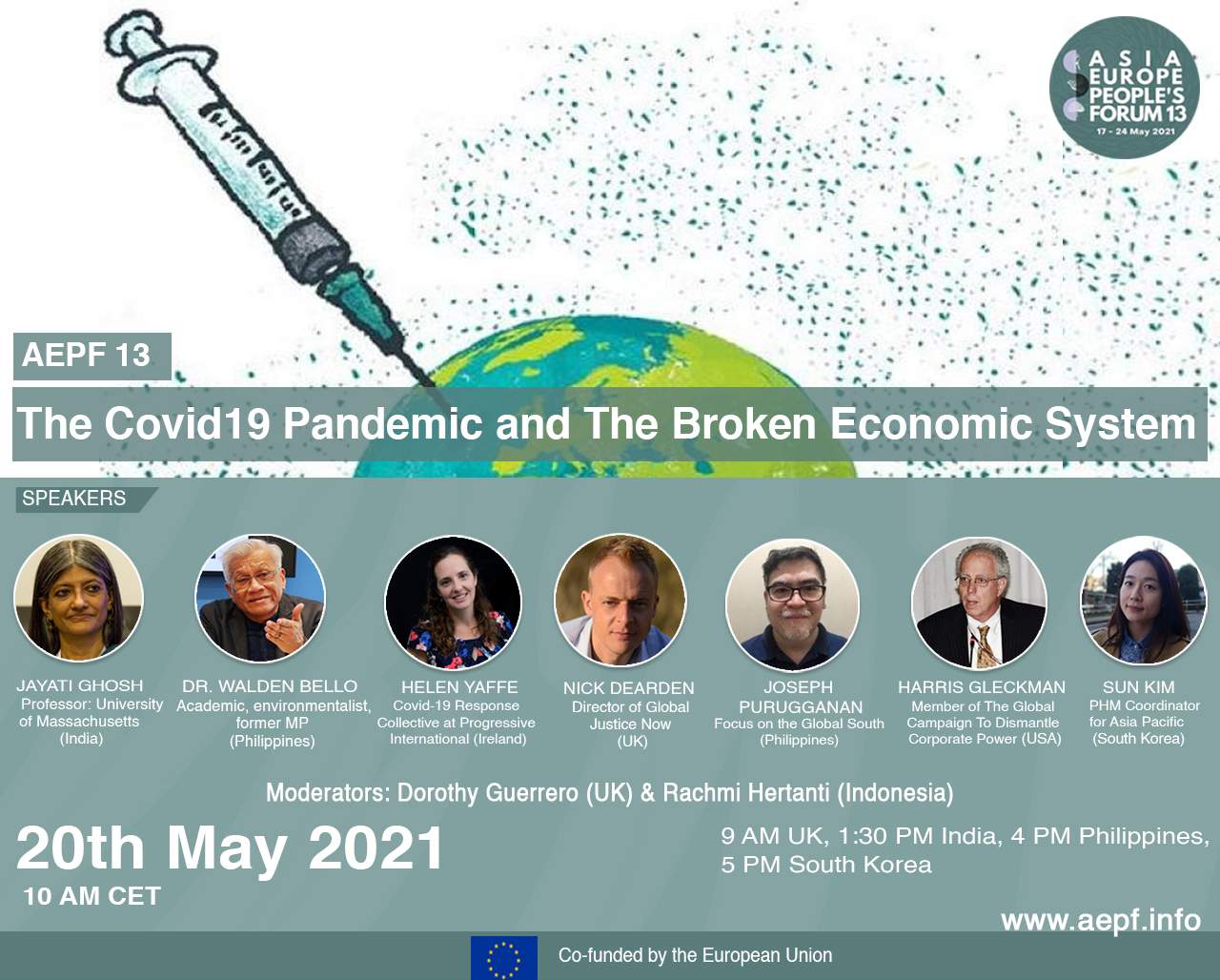
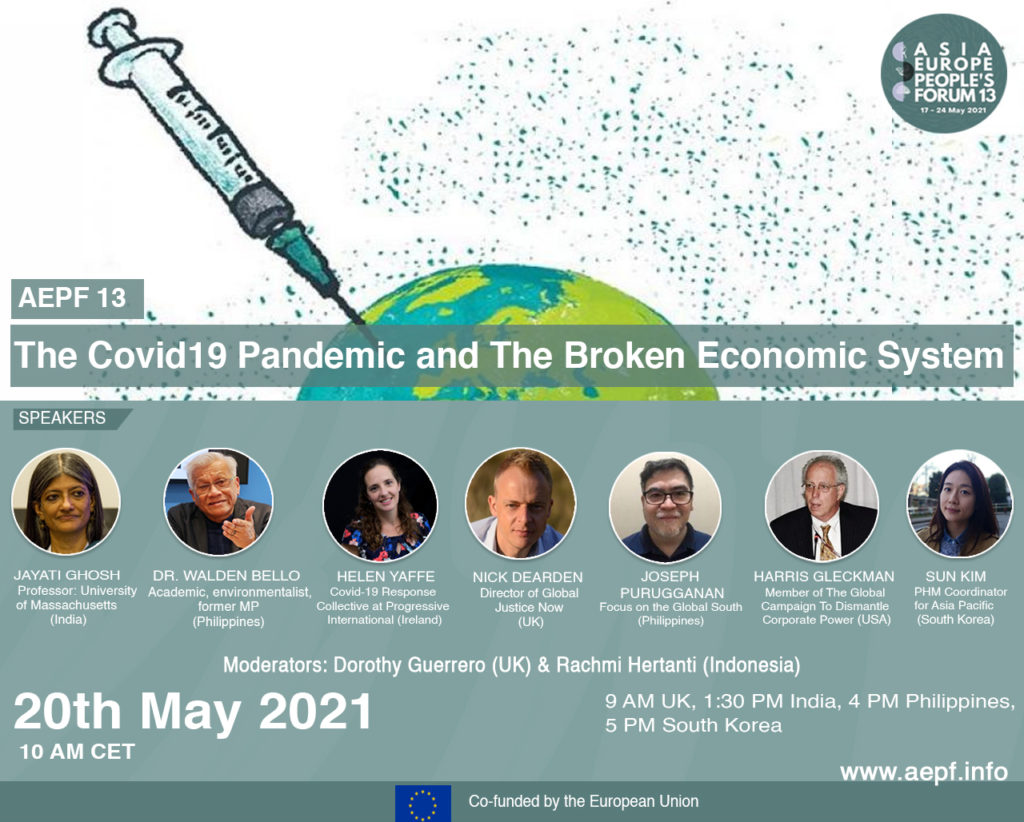
The Covid19 Pandemic & The Broken Economic System

AEPF 13: The Covid19 Pandemic & The Broken Economic System

Watch the Webinar

The current global coronavirus pandemic magnified many social and economic injustices in society. Global trade, finance and investment policies increased the power of transnational corporations, which in turn heightened their capture of governance. The pandemic pushed the economy into a crisis far deeper than previous ones. The loss of lives and livelihoods and massive unemployment while the virus is continuing its spread and even mutating are now driving countries, especially poorer ones to more debts and unjust economic partnerships with more powerful states. The poor are forced to choose between life and livelihood. This will further deepen the already unacceptable inequality between countries and within societies, which in turn heighten the climate crisis, and erode human rights. The global pandemic has indeed exposed more clearly the structural weaknesses of a broken economic system.

A new dimension that has emerged prior to the pandemic, the impact of which has been intensified in the context of the global health and economic crisis, is the unequal access and use of technology. From research, development, production and distribution of the vaccines and other medical supplies urgently needed to address the health crisis, to the ‘zoomification’ of societies or the shift to all things digital, technology is clearly a driving as well as disruptive force shaping the new world order.

The plenary discussion aimed to unpack these issues underlying the broken economic system, identify important arenas for public campaigning across both Europe and Asia, and surface key strategies to strengthen efforts to push progressive agenda towards the transformation of the economic system.

Speakers: 

Jayati Ghosh: Professor: University of Massachusetts (India)
Dr. Walden Bello: Academic, environmentalist, former MP (Philippines)
Nick Dearden: Director of Global Justice Now (UK)
Sun Kim: PHM Coordinator for Asia Pacific (South Korea)
Helen Yaffe: Covid-19 Response Collective at Progressive International (Ireland)
Joseph Purugganan: Focus on the Global South (Philippines)
Harris Gleckman: Member of The Global Campaign To Dismantle Corporate Power (USA)

Moderators: Dorothy Guerrero (UK) & Rachmi Hertanti (Indonesia)

Resources:
Presentation: Vaccine apartheid and need for a TRIPS waiver by Sun Kim

Organisers: AEPF Cluster on Trade Justice & Corporate Accountability

Read More

UNPACKING The Regional Comprehensive Economic Partnership (RCEP): What Governments are Not Saying about the Mega FTA*

UNPACKING The Regional Comprehensive Economic Partnership (RCEP): What Governments are Not Saying about the Mega FTA*

By Joseph Purugganan
Focus on the Global South

INTRODUCTION

I will unpack China’s new trade deals especially with ASEAN. I analyse the RCEP more from the perspective of a trade justice campaigner, questioning the rationale behind these ambitious economic agreements that have benefitted a few and for most part worked against the interest of many.

There is now a strong push from governments across the 15 RCEP countries (ASEAN 10 plus China, Japan, South Korea, Australia and New Zealand) to galvanize broad public support for this comprehensive trade and investment agreement in a move to secure ratification and concurrence for it to come into effect. So far the deal has secured ratification in China and Thailand and the processes towards ratification has been initiated across all parties with most countries eyeing 2021 as completion of this process.

But governments are leaving out crucial issues that must be considered, especially in light of the Covid-19 pandemic and the need to put in place more progressive economic policies that would support the needs of the poor and marginalized.

The Covid-19 pandemic, the contraction of the global economy, and growing calls from CSOs for a stop to FTA negotiations were not enough to deter parties from the 15 countries negotiating the Regional Comprehensive Economic Partnership Agreement or RCEP to conclude the talks for what is now considered the world’s largest free trade agreement. We will recall that parties declared substantial conclusion of the talks as early as 2019 with only the trade in goods aspect being ironed out. And then the pandemic hit the globe early 2020 and like everything else, RCEP talks were likewise temporarily suspended.

Virtual negotiations restarted however in April 2020 and monthly online discussions ensued with 2 more negotiating rounds and 2 Ministerial conferences before the talks were concluded in November 2020. Thailand’s chief trade negotiator was quoted in the Bangkok Post as having said this about the negotiations proceeding despite the lockdowns: “We [trade negotiators] have completed many negotiation issues during the past two months. It is faster and saves on time and costs. Covid-19 brings a new normal to trade negotiations.” 

The shift to online communications however had at least one casualty: civil society participation. In the first place, RCEP talks, and most FTA talks for that matter, have not necessarily been a completely open, transparent and participatory space for civil society engagement. In fact, in the case of RCEP, the only space for directly engaging the trade negotiating committee (TNC) called the Stakeholder Engagement Process, was only organized in 2016, a full 3 years since the negotiations had begun. The stakeholder engagement process nevertheless still provided a space, albeit limited, for CSOs and grassroots movements to raise concerns about the agreement directly to trade negotiators. 

Selling the agreement as a big win for everybody

An agreement that has been kept off-limits to the public–with no access to the negotiation text and very limited engagements in the process– is now being aggressively sold by governments as part of the effort to secure parliamentary concurrence. 

This drive to sell RCEP to the broader public and galvanize support for the agreement is evident in the  pronouncements from governments on the significance of the agreement. A foremost concern, of course, across the globe is the pandemic and economic and social issues induced by the health crisis. It’s not surprising therefore that RCEP is being promoted as a key response to the crisis and a driver of recovery. 

The Joint Leaders Statement on RCEP presented at the virtual signing ceremony in November 2020 asserted: “In light of the adverse impact of the pandemic on our economies, and our people’s livelihood and well-being, the signing of the RCEP Agreement demonstrates our strong commitment to supporting economic recovery, inclusive development, job creation and strengthening regional supply chains as well as our support for an open, inclusive, rules-based trade and investment arrangement.”

China’s Role in RCEP

One question that has continuously hounded these talks is what exactly is China’s role in these negotiations? Many have described the RCEP talks as China-led. If you take a broader geopolitical view and look at the landscape of FTA negotiations across the globe, it’s easy to see why one would think that way.  Aside from RCEP, the global landscape is dotted with other key mega FTA negotiations– there was at one point the Transpacific Partnership Agreement or TPP, which many characterized as US-led trade negotiations, the Transatlantic trade and investment partnership agreement or TTIP between the US and the European Union; the EU itself was quite actively engaged in FTA talks with Asia, launching its New Partnerships with Asia in 2007 with simultaneous trade talks with India and ASEAN.  Asia has become an important hub for these new generation FTAs. We can point to 3 main reasons why this is so– Asia is a high growth region therefore its growing market is a target for economic expansion; it’s also an important source of raw materials. Developed economies need to import these raw materials in order to export competitively, securing access to these raw materials is therefore an important strategic consideration; the third reason is China. The EU and the US for instance connect China’s efforts to secure trade deals with the rest of Asia as expansion of its not just economic but political influence in the region.

On the other hand, if one looked at the agenda of more ambition, greater coverage, of really what true free trade believers call a high standard FTA– that was pushed in the RCEP talks and who were the players that were most aggressive in pushing that agenda, one can say that in fact Japan, Korea, to some extent Australia and lesser extent New Zealand, countries outside ASEAN that were also engaged in the TPP negotiations- were driving the negotiations.

Then there is ASEAN and its projection of ASEAN Centrality or the assertion that RCEP is in fact built on ASEAN’s FTAs with its development partners. ASEAN developed its own guidelines for RCEP negotiations where it emphasised the importance of recognizing the asymmetries that exist among RCEP parties, and pushed for flexibilities for the least developed countries. To what extent these flexibilities reflected in the final text is therefore a true test of ASEAN centrality. And as I point out later, while the RCEP was not as ambitious as the developed countries had hoped for, and there were elements of the RCEP agenda that were left out for the time being- like the dreaded investor state dispute settlement mechanism or the TRIPS+ provisions–it looks like ASEAN will not benefit much from the deal and in fact would see its balance of trade worsen.

How are governments selling this agreement?

Many have touted the agreement a “big political win for China,” highlighting how the agreement would sustain China’s “advantages in global supply chains.” 

For his part, Chinese President Xi Jinping has made it a point to emphasize the global role of China. In a speech before APEC business leaders, Xi expressed confidence “that the steady unleashing of the China market potential will create vast business possibilities for other countries, and this will create stronger impetus for maintaining stable growth of the global economy.”

Other leaders have used RCEP as an opportunity to highlight RCEP in light of their own development needs. Sok Siphana, an advisor to the Cambodian government, referred to RCEP as a “victory of multilateralism and is a good pool for regional economic cooperation and integration.” The Vietnamese government on the other hand highlighted the potential opportunities for ASEAN and Viet Nam to “become a centre of investment attraction” but it also downplayed the risks saying the agreement “would not worsen the trade deficit Viet Nam was running with signatory markets.”

The Philippine government chose to highlight as well the positive impact of the agreement on investments. Lead Trade Negotiator Allan Gepty said ”the conclusion of RCEP will facilitate more investments into the region aside from allowing freer flow of goods among the 15 participating countries.”

Lost in the chorus of positive messages and effectively left out in the discourse however are key issues that have been consistently raised by CSOs and grassroots movements. 

Secret Negotiations

The negotiations have clearly failed the transparency and public participation test. A CSO report on RCEP and Transparency found that there was no or little publicly available information on the state of negotiations, draft texts or key government positions throughout the negotiating process. There were very limited or token/ad hoc stakeholder engagement forums. As mentioned earlier the first Stakeholder Engagement was tentatively conducted in 2016, 4 years after the negotiations were launched.  Parliaments or other public institutions had very little opportunity to impact or influence the process while special interests and business groups have been given a privileged role and access to information.

Dangers of Modern FTA

Governments are bragging that RCEP is a modern FTA but give no further explanation of what that means or what the implications would be. A modern trade and investment agreement means that the scope and coverage of the agreement cover not just trade in goods, but also services, intellectual property rights, investments, and more recently includes a chapter as well on electronic commerce. A modern or new generation FTA would push further liberalization and deeper obligations to open up the economy and harmonization of regulations in the name of policy coherence. 

While there are different templates, there are a number of key elements that are common in most modern trade and investment agreements. There is the push for stronger protection of intellectual property rights (IPR). IPR chapters of most of these agreements push for obligations that go beyond the minimum standard set out in the WTO Trade Related Aspects of Intellectual Property Rights Agreement. There is a huge disparity in the levels of IPR protection among the RCEP parties. Based on the World Economic Forum’s global competitiveness ranking on IPR protection we see Singapore (4th), New Zealand (6th), Japan (14th), and Australia (16th) rank highest in terms of IPR protection. While Thailand (121st), Cambodia (130th) and Myanmar (134th) are at the tail end of the global rankings. 

A 2012 report by the UN Development Program and UNAIDS on the potential impact of free trade agreements on public health issued a strong warning to state leaders against trade agreements that inflate the price of medications and deny access to lifesaving treatments for poor citizens across the globe.

There is also the agenda of investor protection, as exemplified in the ISDS provisions. For those who are not familiar, ISDS is the mechanism present in most modern FTAs that gives corporations the power to sue governments over public policies or regulations.

So we can debate on which country drove the negotiations, whether China, Japan, Korea or ASEAN but it’s clear that the corporate agenda is definitely a key driver. 

Rising imports and declining exports

A new working paper from Boston University’s Global Development Policy Center focusing on RCEP: Goods Market Access Implications for ASEAN,  by Rashmi Banga, Kevin P. Gallagher and Prerna Sharma, with a detailed disaggregated product-level impact analysis of tariff liberalization based on actual tariff schedules found out that:

  1. The results of the simulations show that tariff liberalisation under RCEP will deteriorate the existing balance of trade of ASEAN vis-à-vis RCEP countries by 6 percent per annum, while balance of trade will improve for some of the non-ASEAN countries in the RCEP
  2. The maximum gains in terms of improved balance of trade or net exports will go to Japan, followed by New Zealand and Australia. Post RCEP, balance of trade will worsen for Cambodia, Indonesia, Lao PDR, Malaysia, Myanmar, Philippines, Singapore, Thailand and Vietnam
  3. RCEP sensitive list analysis reveals that it is the developed countries which have been able to negotiate higher protection against imports as compared to ASEAN countries or even least developed countries within ASEAN.

The balance of trade issue is also related to a question that governments prefer not to discuss, why India opted out of the agreement. India left the negotiating table in November 2019 because it felt that RCEP did not adequately address its concerns. A key concern for India is its ballooning trade deficit, particularly with China.

Impact on Covid response

Around 400 CSO from across the globe issued a statement in April 2020 calling on trade ministries and the World Trade Organization (WTO) to stop all trade and investment treaty negotiations during the Covid-19 outbreak. They called for “flexibilities to set aside trade rules that constrain the ability to resolve the pandemic crisis, without fear of repercussions, and to cease other negotiations and activities that divert their energy and resources from that goal.”

Trade and health advocacy groups have raised the concern that the agreement – the text of which was concluded in 2019, before the pandemic – could severely constrain policy space needed to effectively address the health and economic crisis. There have been no studies on the impact of these rules on limiting the ability of States to respond to Covid and future pandemics and emergencies, and ability to recover and rebuild economies. 

This struggle against constraints to policy space from FTAs is evident in the current efforts to secure support for a TRIPS Waiver in the WTO. The proposal initiated by India and South Africa, which has now garnered considerable support from most developing countries to temporarily suspend trade obligations is being met by strong opposition from the US, the European Union among others and from Big Pharma. 

In a recent hearing of the Senate Foreign Relations Committee in the Philippines on a proposal calling for the Philippine government to support the waiver, representatives from the Departments of trade, foreign affairs as well as the Intellectual Property Office (IPO) raised the concern that support for the waiver might run contrary to obligations under FTAs signed by the Philippines namely with the European Free Trade Association  and RCEP.

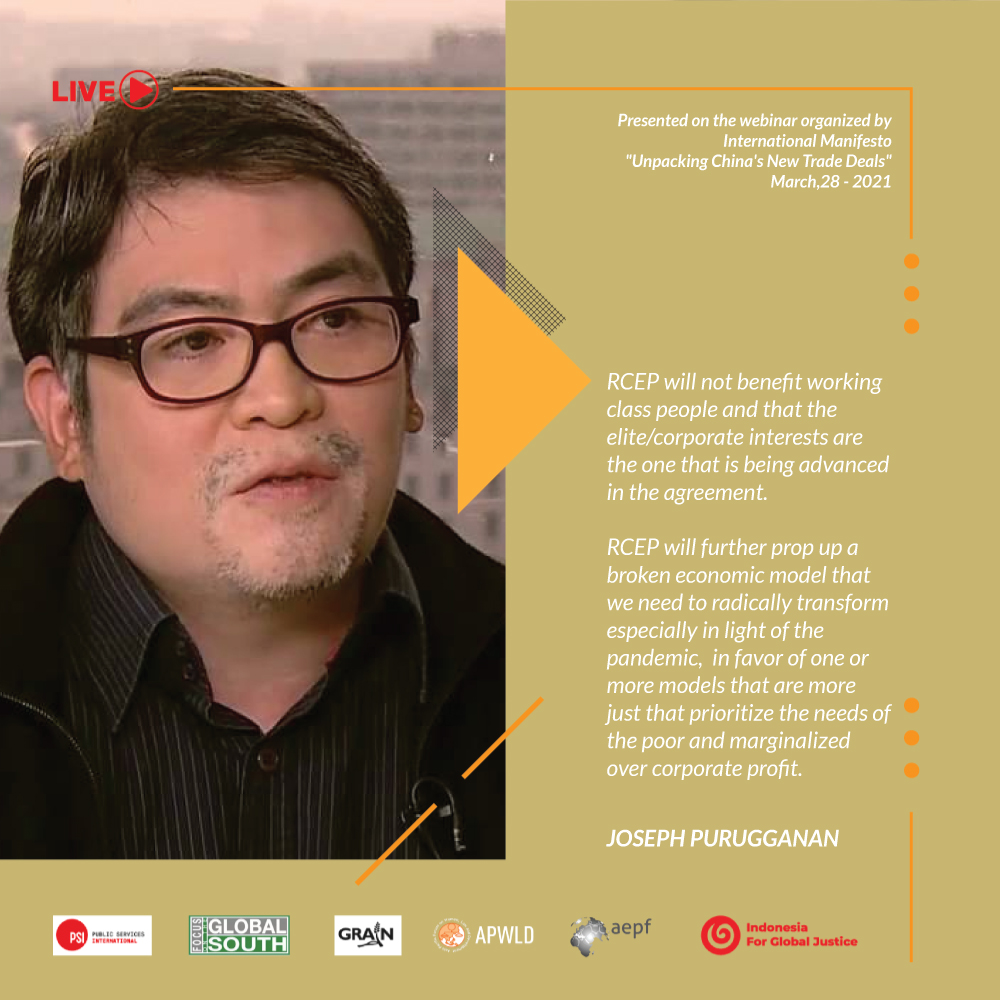
RCEP would also further lock- in countries to this FTA Regime that is already facing a lot of scrutiny not just from CSOs but also from institutions like UNCTAD. As Trade Justice Pilipinas articulated in its statement: “RCEP will further prop up a broken economic model that we need to radically transform in favour of one that is more resilient.” 

What now for Trade Justice Movements?

A key battleground now in the campaign against unjust trade agreements is the ratification process for RCEP. Organizations and campaign networks across the region would have to argue in Parliaments and Congress against concurrence. This is a tough fight for CSOs considering the late and limited access to the official documents, and the strong support for the agreement from the business sector. 

 Another important task related to the concurrence process is analyzing the text of the actual agreement together with the schedule of commitments. CSOs would need to sharpen their arguments against RCEP especially as the agreement allows for future ratcheting of obligations in the key areas of investor protection, and intellectual property rights.

 Finally, RCEP can be seen as opening the floodgates for more comprehensive and ambitious agreements. Already there are renewed calls for more trade negotiations with the United States under the new administration of President Joseph Biden, including the possibility of the US re-joining the defunct Comprehensive and Progressive TPP (CPTPP) and China joining the same, as well as new mega regional agreements under the mantle of Asia Pacific Economic Cooperation (APEC), and a host of bilateral FTAs.

Trade Justice movements across the region are now confronted with the major challenge of resisting this renewed push for FTAs like RCEP as key drivers of the recovery efforts, at the same time push the discourse towards more just economic policies that prioritize the needs of the poor and marginalized.

* The presentation is based on an article entitled What Governments are not saying about RCEP: Civil Society has a different take on what the trade deal means for participating countries originally published in German for the Newsletter Rundbrief (https://www.forumue.de/hintergrundanalyse/rundbriefe/) of the  Forum Umwelt und Entwicklung (Forum on Environment and Development) based in Berlin. 

Read More

Witness People’s Voices on the Regional Comprehensive Economic Partnership (RCEP)

Witness People's Voices on the Regional Comprehensive Economic Partnership (RCEP)

ASEAN’s fate hangs in a RCEP balance. What research, reason and experience shows. Witness peoples voices on the Regional Comprehensive Economic Partnership (RCEP) (recorded on 25th March 2021. )

ASEAN countries signed the Regional Comprehensive Economic Partnership (RCEP) with China and several countries, with the hope of increasing exports.  Research shows that with RCEP,  the balance of trade does not favour the ASEAN nations. Dr.Rashmi Banga, Senior economic affairs officer, UNCTAD explains this.

Experience shows that the trade proposed by the Regional Comprehensive Economic Partnership (RCEP) is not compatible with ASEAN value chains explains, Dr. Ika Riswanti, Vice-Dean, Diponegoro University, Indonesia.

Josua  Mata Secretary General, SENTRO, Philippines, says that ASEAN countries should not ratify Regional Comprehensive Economic Partnership (RCEP) as experience has already shown that it will curb the ASEAN countries’ decision making choices, especially for pro-people policies.

Read More

“Stop Vaccines Monopoly: TRIPS Waiver Now! No to Third Way!”

“Stop Vaccines Monopoly: TRIPS Waiver Now! No to Third Way!”

Asia-Europe People’s Forum Statement: Responding to The Result of The TRIPS Council Meeting on 10-11 March 2021

AEPF, 12 March 2021. We, Asia-Europe People’s Forum (AEPF), join  the global demand  to all WTO members and DG WTO, Ngozi Okonjo-Iweala, to immediately reach an agreement on the TRIPS Waiver Proposal as the solution supported by majority of members in addressing the access inequality of Covid19 vaccines to end the Pandemic.

Around 200 people in Asia and Europe have lent their support to the campaign and growing peoples movement by sending a strong message highlighting  the importance of TRIPS Waiver to allow all, but especially the poor nations open and equitable access to vaccines in order to address this global pandemic.

The delay in the approval of  TRIPS Waiver at the TRIPS Council reinforces the view that the WTO is an institution that is driven by the interest of the rich and powerful. We deplore the efforts of the rich countries and the big pharmaceutical companies to  the Covid19 pandemic an opportunity to secure windfall  profits over and  above the humanitarian crisis and the interest of people across the globe.  This issue over vaccine monopoly must be resolved through global solidarity action.

The “Third Way” promoted by the DG WTO to supposedly improve access “through facilitating technology transfer within a multilateral regulatory framework” and by pharmaceutical companies entering into licensing agreements to enable other producers to produce vaccines and other products will not address the problem of vaccine monopoly.

“Third Way” proposal offered by DG WTO should be rejected. The voluntary licensing is confidential and restrictive. There is a serious lack of transparency as the terms of the license are usually confidential and still provides exclusive rights to pharmaceutical companies.  The geographic scope of the proposal is also limited excluding many developing countries from being supplied under the license agreement or allowing for manufacturing only for purposes of export (can you rephrase this please? Its not clear, Are we saying it allows only for export from countries with manufacturing capacity?; license is only offered as well to very specific manufacturers presumably aiming to limit supply; and  the restrictive terms on the source and production of active pharmaceutical ingredients (APIs)[1].

In this regard, we emphasized that we don’t need a compromise solution, but we want to TRIPS Waiver as solution endorsed by developing countries to abolish the monopoly of vaccines. The TRIPS Waiver proposal must be reached immediately to end the COVID-19 pandemic.

The TRIPS Waiver proposal is a proposal submitted by India and South Africa in October 2020 at the WTO but has since been endorsed by 100 developing countries to allow all countries not to implement the TRIPS Agreement which regulates patent protection, copyright, and related rights, industrial design, protection of undisclosed information, which is directly related to drugs, diagnostic tests, vaccines and other technologies regarding COVID-19 in the course of the pandemic. However, wealthy countries such as Australia, Brazil, Canada, European Union, Japan, Norway, Switzerland, the UK, and the US, still hold back their support for the proposal considering that they have traditionally been supporters of the interests of pharmaceutical companies through the Intellectual Property Rights (IPR) monopoly system. ****

With Solidarity:
Indonesia for Global Justice, Focus on The Global South, Global Justice Now-UK, Transnational Institute

Contacts:

Rachmi Hertanti, IGJ: rachmihertanti@gmail.com
Joseph Purugganan, Focus: josephp@focusweb.org
Dorrothy Guererro, GJN: Dorothy.Guerrero@globaljustice.org.uk
Pietje Vervest, TNI: pietje.vervest@tni.org

Read More

Global Actions For #TRIPSwaiverNow

Global Actions For #TRIPSwaiverNow

The discussion on the TRIPS Waiver at the WTO TRIPS Council has yet to find a bright spot. Rich countries still hold back on their support for the proposal considering that they have traditionally been supporters of the interests of pharmaceutical companies through the IP monopoly system. The third path offered by DG WTO, Okonjo Iweala, is also not a viable solution.

For this reason, the push for #TRIPSWaiverNow for #PeoplesVaccines must be carried out widely and massively by all people around the world.

Let’s join in this global call by posting your Picture Profile using this Twibbon, as a form of our global action to put pressure on the WTO TRIPS Council meeting which will take place March 11, 2021, including to push #TRIPSWaiver to all governments around the world.

Here is the step:
1. klick https://www.twibbonize.com/tripswaiver
2. upload your photo
3. share it!

With Solidarity,

Indonesia for Global Justice
Global Justice Now UK
Focus on The Global South
Transnational Institute
Asia-Europe People’s Forum (AEPF)

Read More