AEPF remembers Karamat Ali, a Tireless Advocate for Labour and Oppressed Communities

AEPF remembers Karamat Ali, a Tireless Advocate for Labour and Oppressed Communities
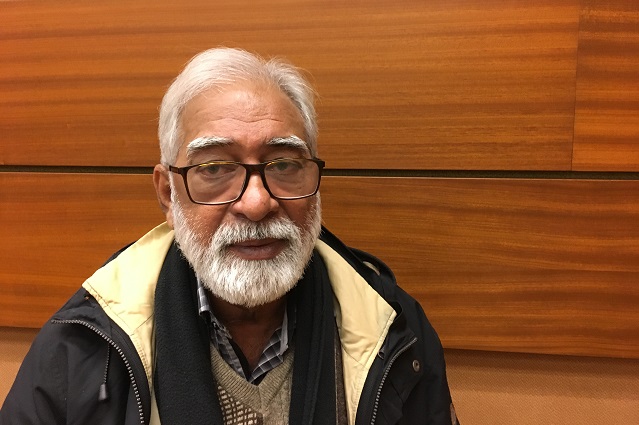
The Asia Europe People’s Forum is saddened by the passing on 20th June, of Karamat Ali executive director Pakistan Institute of Education and Research (PIlER). Karamat was a tireless advocate for the rights of labour, working classes, women and other oppressed communities.

This is a big loss for the labour movement of Pakistan and South Asia. Karamat was a dedicated working class leader, who was deeply immersed with all progressive causes—from the trade Union movement in Karachi, fishermen’s rights, social justice and democratic movements to peace in the subcontinent, and more. An imaginative and undogmatic Marxist, Karamat never shied away from challenging tasks and as a consequence faced many atrocities and prison terms. Karamat is an unsung hero of our times.

Karamat was an organic intellectual and committed democrat. He built PILER which attracted many renowned economists and academics because of his charisma and commitment to the cause of the Labour movement based on relevant research.
Karamat sought to change the economic system for the betterment of the poor. He worked for alternative ideas to build a peaceful and just society

Karamat Ali was from a working-class family, born in the city of Multan(Punjab), two years before the Partition (1945). His father worked as a department worker. Karamat himself worked in a factory and attended the Government Emerson College in Multan in 1962. At that time, a group of 12 activists of the National Students Federation (NSF), were expelled from Karachi by the then Ayub Khan military regime because of their political activities. Karamat mobilised students at this time. When Ayub Khan kicked out Zulfikar Ali Bhutto from the position of foreign minister, Karamat with his student comrades invited him to speak at a public forum with student activists.

Karamat Ali was a civil society institution builder. He was the founder of the People’s SAARC and South Asia Alliance for Poverty Eradication. He was founding member of the Pakistan Peace Coalition, Pakistan-India Peoples Forum for Peace and Democracy,
and South Asia Labour Forum. Karamat was a real South Asian who consistently advocated unity among South Asian nations, opposed militarisation and imperialism.

Karamat was a major organizer of the World Social Forum 2006 in Karachi. He invited hundreds of Indian activists to Pakistan to forge people to people contacts.

He was to attend and speak at the AEPF Ghent event but his health deteriorated and he could not come.

Karamat did his master in labour studies at the Institute of Social Studies at Den Haag. Karamat. Married an Indian academic Amrita Chachi. Karamat had son and two daughters.

With the passing away of Karamat Ali we have lost one of best trade union leaders of South Asia. AEPF mourns his loss and at the same time we celebrate his life and achievements.

Farooq Tariq
Asia coordinator
Asia Europe People’s Forum
Read More

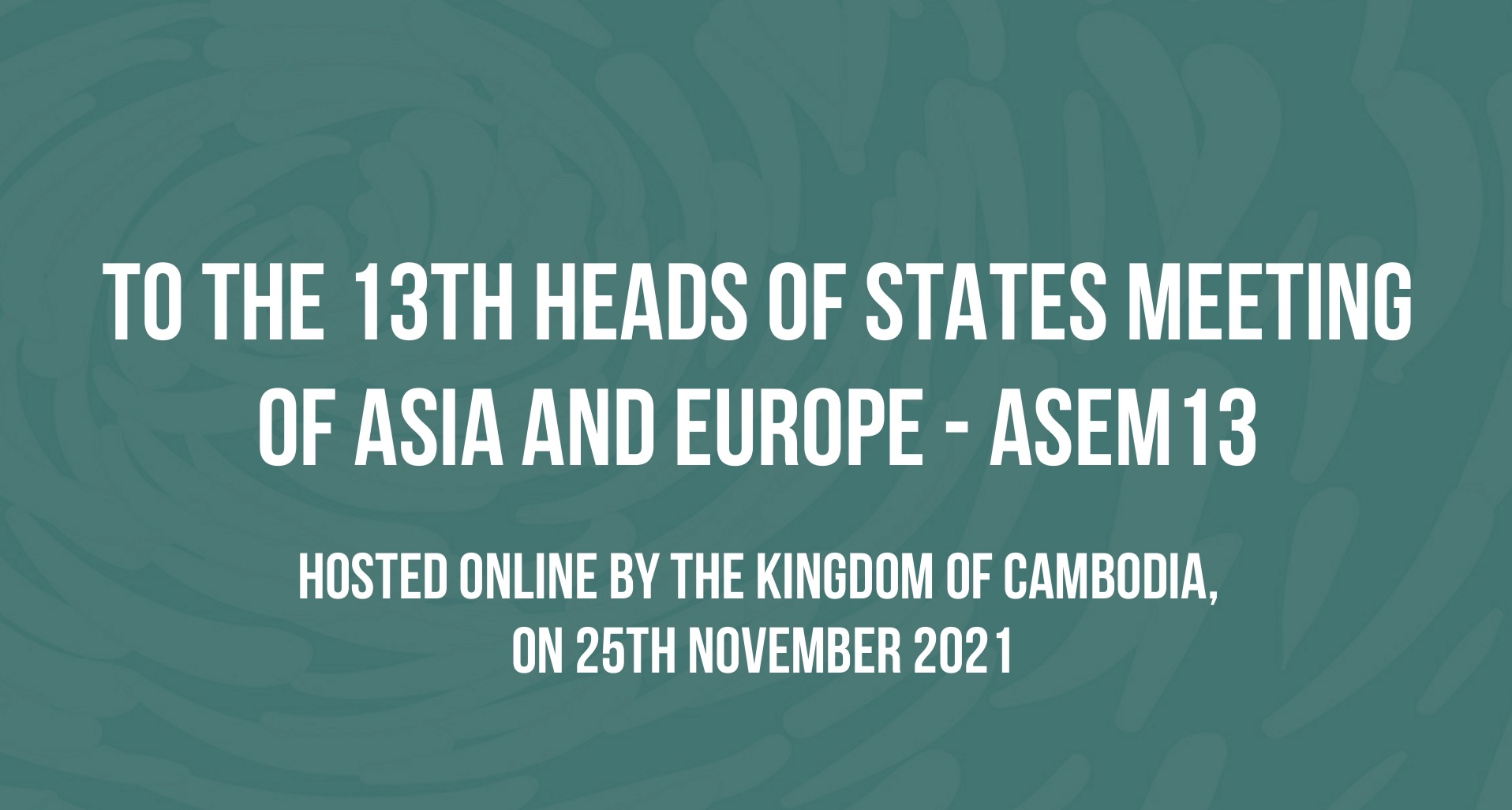
Presentation by the Asia Europe Peoples’ Forum to the Asia and Europe Heads of State and Government – the ASEM13, Held online on 25th and 26th November 2021 Hosted by Cambodia

Presentation by the Asia Europe Peoples' Forum to the Asia and Europe Heads of State and Government – the ASEM13, Held online on 25th and 26th November 2021 Hosted by Cambodia

Presented by our representatives

    Lidy Nacpil, Director of the Asian Peoples’ Movement on Debt and Development (APMDD) and
    Nick Dearden, Director of Global Justice Now

 Presentation:

DOWNLOAD THE PRESENTATION

NOW is the time for us all to join together for profound change and action.  

We must all change! 

Faced with the fundamental challenges of Climate Change and Growing Inequalities, we must transform how we live, govern and co-exist with our environments.

On behalf of the Asia Europe Peoples’ Forum we shared the key recommendations from our recent multi-country and well attended AEPF13. Through its 47 sessions over 8 days of engagement and expression by active citizens, we contributed to both our Peoples’ Agenda for ASEM Parliamentarians ( The People’s Agenda for ASEM Parliamentarians – AEPF) and our Peoples’ Charter for ASEM Parliamentarians. (AEPF: People’s Charter & Agenda – AEPF)

We urge governments to work effectively to address our common challenges of climate crisis and biodiversity loss, rising social inequalities and growing authoritarianism in governments

Together we must build a Just, Equal, Inclusive and Environmentally Sustainable Asia and Europe. 

AEPF urges all Asian and European governments to work for people-centred change.  

On behalf of the Asia Europe Peoples’ Forum we share key recommendations articulated in our Peoples’ Agenda and Peoples’ Charter for Parliamentarians.

Towards Climate Justice, Just Transition and meeting the Paris goal of keeping global temperature rise to below 1.5C and empowering people to deal with the fast escalating climate impacts, we urge all governments  to ensure core commitments become realities by 2025, including:-

  •     The end of all public financing of fossil fuel industries and major progress in the equitable, fair and swift phase-out of fossil fuel production and consumption
  •     Delivery of full obligations by European and rich governments to provide climate finance for all developing countries in Asia and worldwide

Call to make the People’s Vaccine a reality. We call on all governments to support the TRIPS waiver proposed by India and South Africa at the WTO next week. This is essential to overcoming the COVID-19 pandemic

 Ensuring Social Justice for All depends on global tax reform, including:

  •     The establishment of a democratic global tax body under the auspices of the UN to address the problem of illicit financial flows  
  •     Taking urgent action to stop tax avoidance by multinational corporations

 In response to growing authoritarianism and discrimination we must strengthen our commitments to: 

  •     Freedom of Expression, Organisation, Association and an Independent Media, as well as
  •     Condemning attacks on Defenders of Human Rights

 Following a 10-Country Report presented to the UN Special Rapporteur at AEPF13 we reaffirmed that the Right to Dissent must be at the heart of our democracies (THE RIGHT TO DISSENT)

Our presentation is on behalf of all participants in AEPF13 and dedicated to our colleague, Sombath Somphone, who co-organised AEPF9 in Laos, who was then enforced disappeared in 2012, and has yet to be returned safely home.

25th November 2021 

Read More

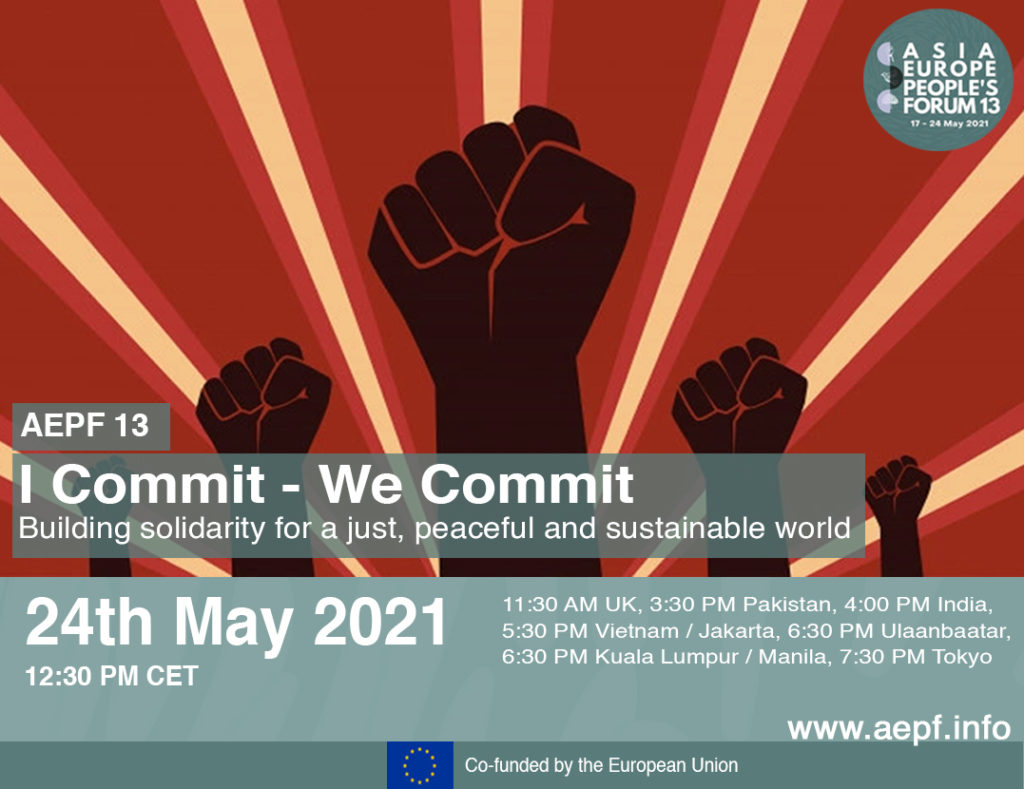
I Commit – We Commit

AEPF 13: I Commit – We Commit

Watch the Webinar:

1. I Commit – We Commit – Sharing the summary context and then the 6 pre-filmed and complied People’s Pledges – People’s Voices of Commitments

2. Moderated opportunity for participants to share what they are committing to and to how. Responses and additions from AEPF13 participants

3. Ways forward – Campaigns and activities that we can join together on. Short, 2-3 minutes, presentations of the actual campaigns that people and organisations can be part of and how.

4. Collective affirmation

Watch this video where activists from different countries accross Asia and Europe express their commitments towards the People’s Agenda and commit to building solidarity and fight for a just, peaceful and sustainable world.

Organisers: AEPF Working Group on People’s Agenda

Read More

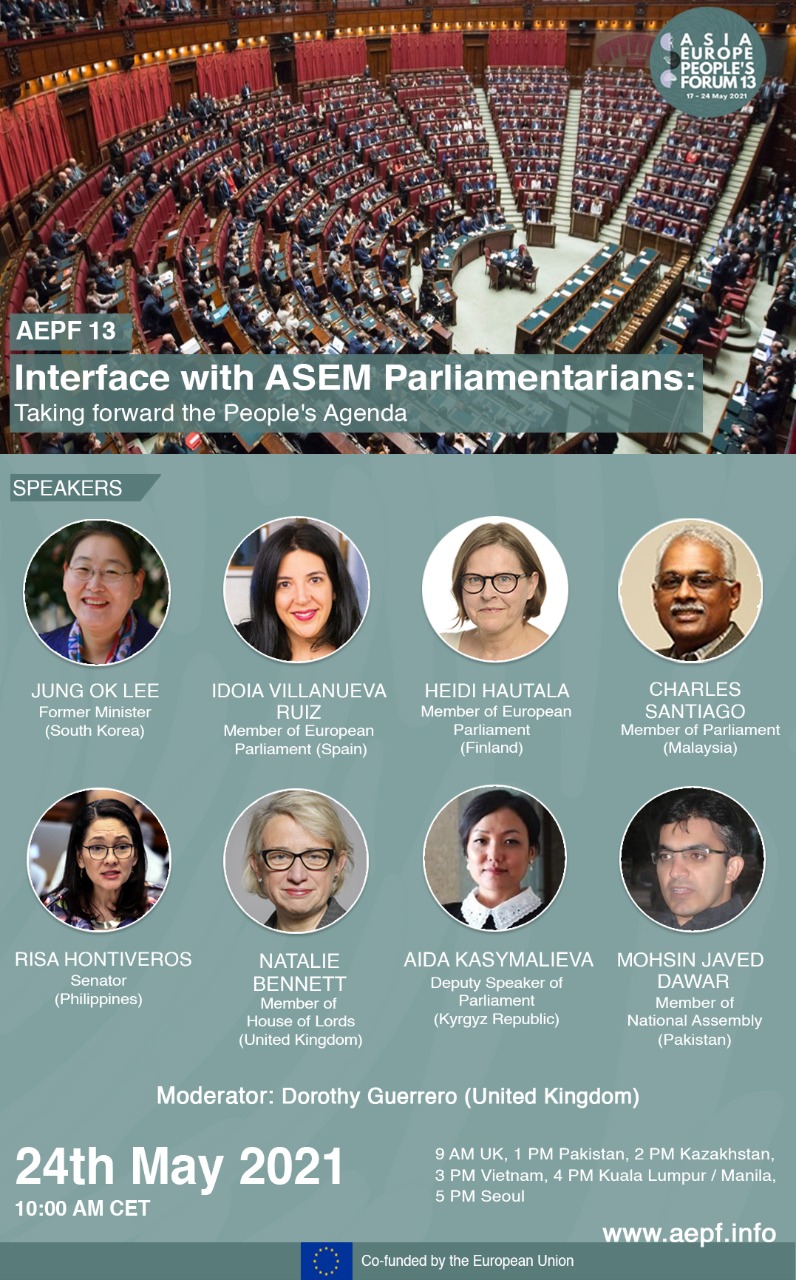
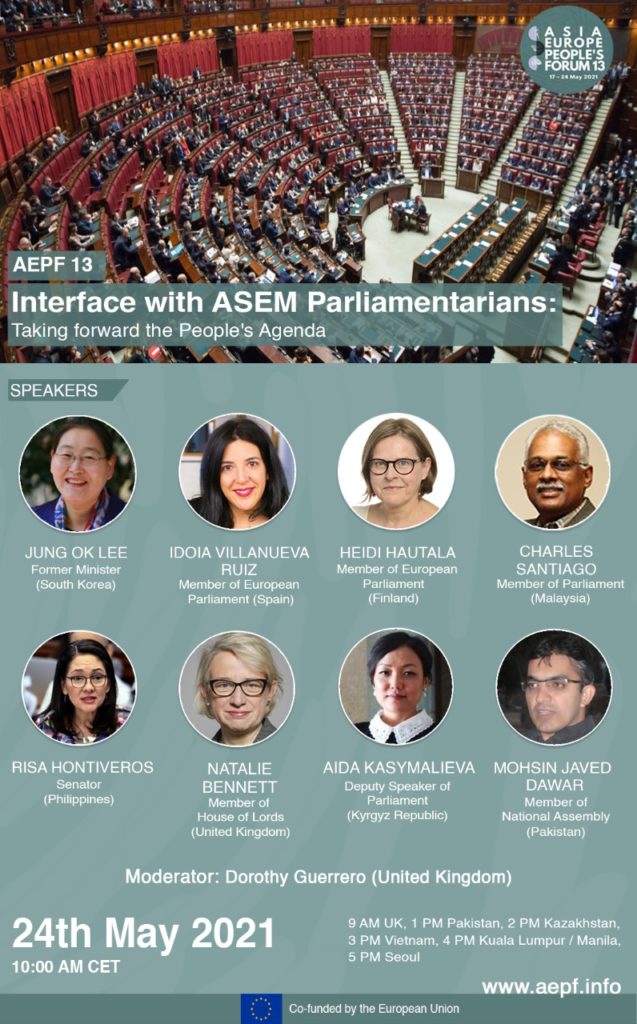
Interface with ASEM Parliamentarians

AEPF 13: Interface with ASEM Parliamentarians

Watch the Webinar: 

The Interface was an important opportunity to engage and interact with 8 progressive Parliamentarians from across Asia and Europe.

The AEPF presented our People’s Charter for Parliamentarians and our six thematic, People’s Agendas for change.

The Interface enabled Parliamentarians to share responses and suggestions on how we can collaborate to turn them into lived realities.

An exchange between parliamentarians on how to take forward ‘pro-people’ change, recognising the context of deepening authoritarianism.

Speakers:

  • Jung OK Lee: Former Minister (South Korea)
  • Idoia Villanueva Ruiz: Member of European Parliament (Spain)
  • Heidi Hautala: Member of European Parliament (Finland)
  • Charles Santiago: Member of Parliament (Malaysia)
  • Risa Hontiveros: Senator (Philippines)
  • Natalie Bennett: Member of House of Lords (United Kingdom)
  • Aida Kasymalieva: Deputy Speaker of Parliament (Kyrgyz Republic)
  • Mohsin Javed Dawar: Member of National Assembly (Pakistan)

Resources:
Presentation: People’s Charter for ASEM Parliamentarians

Organisers: AEPF Working Group on Parliamentarians

Read More

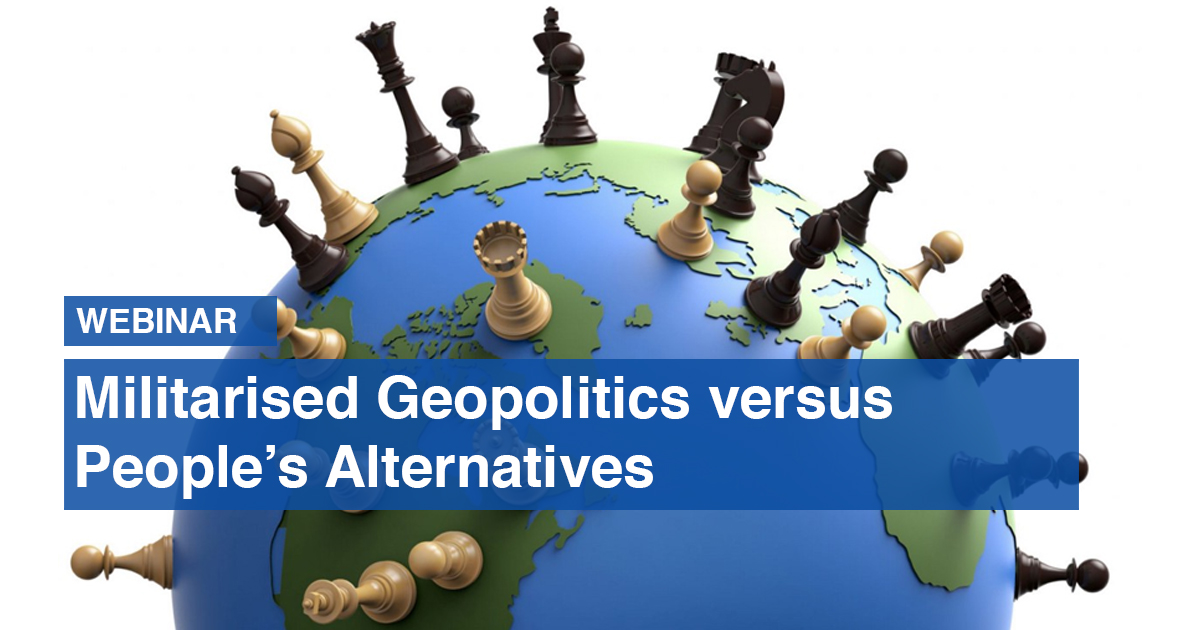
Webinar: Militarised Geopolitics versus Sustainable Peoples’ Alternatives

Webinar: Militarised Geopolitics versus Sustainable Peoples’ Alternatives

Watch the Complete Webinar 

Links to resources from the speakers

Walden Bello’s presentation on Superpower Conflict in the South China / West Philippine Sea

Taking Back Control: The Future of Public Services by Lavinia Steinfort
Ecofeminism: fueling the journey to energy democracy by Lavinia Steinfort

 Concept Note 

Even as the world is caught in the multiple impacts of the Covid-19 pandemic, climate and ecological crises, recession, inequality, hollowing out of democracies, suppression of dissent and minorities by elected authoritarian regimes, geopolitics and a race for hegemony between  great powers, regional powers and power blocs continues.  These geopolitical rivalries are a variation of past ideological/ inter-imperialist confrontations with current neoliberal rivalries and the race for hegemony and influence. These geopolitical and geo-economic contradictions range from the play between the existing great power (USA) and rising powers power (China); to resurgent power Russia; to the assertions of the EU;  aspirations of Asian powers like Iran, India, Turkey;  to frozen conflicts like between North and South Korea, India-Pakistan, China, etc.    

These rivalries encompass the control /influence over territories, maritime routes, seas, outer space.  The race for influence includes control over financial flows, communications, new technologies, scientific and cultural competition. This competition is backed by trans-national capital and corporations that is willing to backs chauvinist/racist nationalisms, and turn a blind eye to disasters in the interest of profit. This is evident in the rise of conflict embedded and failed states, migration and refugee flows, suppression of dissent, crushing of labour rights, etc. This strategic competition has deep ecological consequences, negatively impacts the climate and damages people’s lives and livelihood. Europe and Asia are at the centre of this geopolitical pull and push. 

What is often hidden by dominant discourses and ignored by states and realist paradigms is the impact that such geopolitics has on people,  social relations, on climate and ecology and how people and their movements shape geopolitics too for example the Brexit movement, Black Lives Matter; peoples movement in Hong Kong are consequences of new geopolitics. 

The pillars of such destructive geopolitics are rooted in neoliberal capitalism that privileges capital over peoples’ lives and ecological survival; elitist, imperialist/racial narratives over social justice; national security regimes over people’s security; nuclear weapons and militarised force over peace and justice. These hegemonies (US) as well as conflicts had been simmering along, but what we have now is in a qualitatively different level of antagonisms.

In this webinar AEPF seeks to (1) analyse and question the hegemonic/militarised trends in global geo politics and contrast these with peoples’ security approaches, focussing on social and economic justice and equality. (2) Connect the disastrous impact that the world witnessed with the Covid-19 Pandemic and the inability of great, regional and small ‘powers’ to provide health and social security to their citizens. (3) Point to the false narratives that justify corporate led growth paradigms and trickle down security that prioritises increased spending on vanity projects, military industrial complexes and underfunds universal health, employment and other elements necessary for a sustainable life in peace and harmony with nature.

Panelists: 

(1) Marga Ferré (Tranform!; Spain)
(2) Tariq Ali (Activist/Writer; UK, Pakistan)
(3) Walden Bello (Activist/Writer/Former MEP; Philippines)
(4) Lavinia Steinfort (Transnational Institute; The Netherlands)

Moderators:

(1) Professor Anuradha M. Chenoy (AEPF; India)
(2) Kris Vanslambrouck (AEPF; Belgium)

Read More

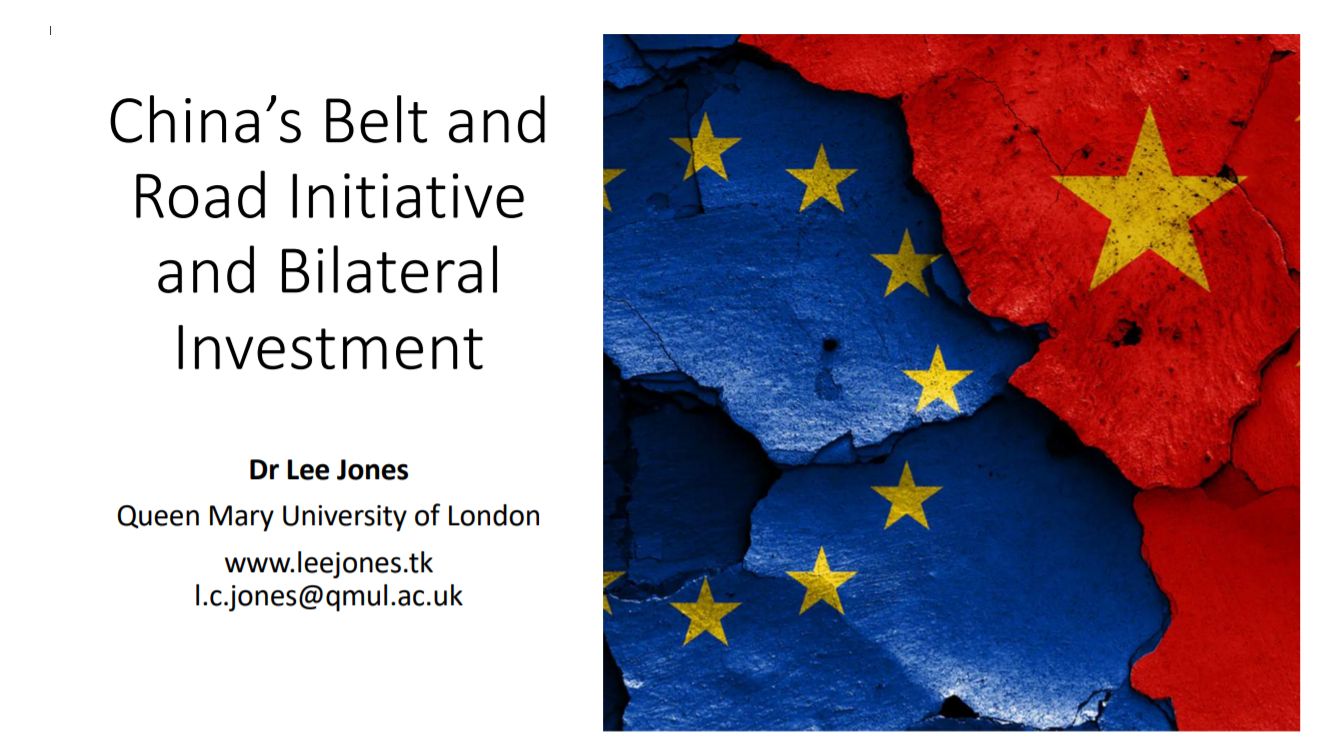
The Belt and Road Initiative (BRI): An AEPF Framing Paper

The Belt and Road Initiative (BRI): An AEPF Framing Paper

Since the launch of the BRI in 2013, 136 countries and 30 international organizations have signed BRI cooperation documents, received US$90 billion in Chinese Foreign Direct Investment (FDI) and exchanged US$6 trillion in trade with China. President Xi Jinping has described the BRI as the ‘Project of the Century’, yet the motivations, aims and scope of the BRI have been continuously debated and the Chinese Government has struggled to put forward a clear narrative for the initiative. At the same time, social movements, affected communities and non-governmental organisations across the globe have criticized BRI projects for harmful environmental, social and economic impacts, and resisted their implementation.

In 2018 at AEPF12 in Ghent, Belgium, the AEPF began analysing the BRI and sharing experiences relating to the BRI, continuing with a workshop in Amsterdam in June 2019. This paper outlines a framing for how the BRI could be understood that emerged from these two sessions. It is hoped that this framing paper will guide future AEPF work in relation to the BRI.

Download the full paper (English)

Download the full paper (Spanish)

Read More

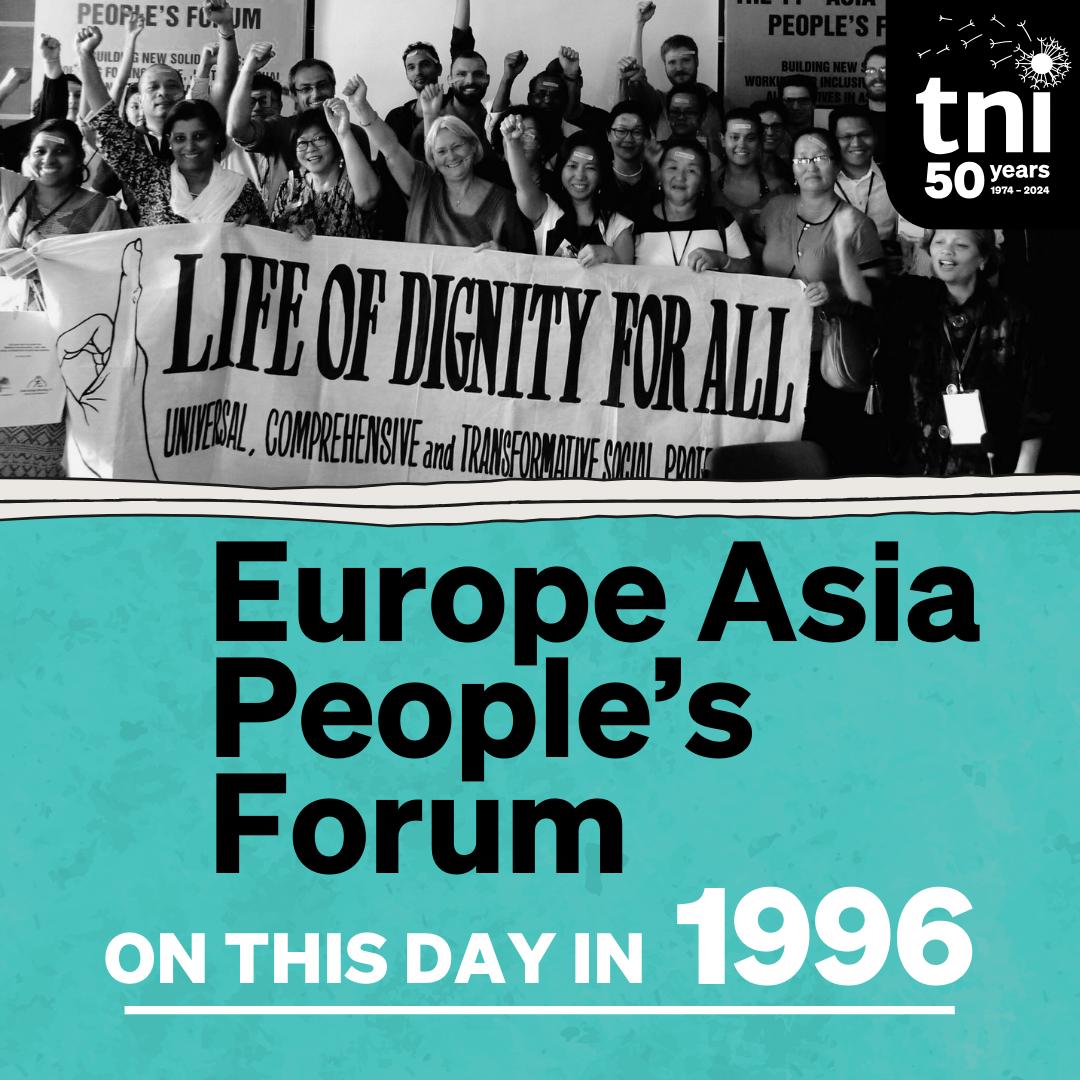
Kathmandu Declaration

Kathmandu Declaration

April 22, 2019

International Conference on Universal Social Protection and Labour
Organised by :
Asia Europe People’s Forum, Social Justice Cluster and Nepal Partners
Kathmandu, 4-6 April 2019

We, the participants of the International Conference on Universal Social Protection and Labour held in Kathmandu from 04 to 06 April 2019 to review and reflect on the current situations prevalent in our societies and develop strategies for the future course reaffirmed our vision, mission to establish society ensuring social protection, social justice, security and peace.

Realizing that socio-political circumstances and the level of wealth accumulation and development in Europe and Asia are very different, as well between as within our respective sub-regions,

Understanding the fact that it is one ‘capitalist logic at work, free trade agreements, neoliberalism and austerity’ worsened by right-wing populism and declining democratic principles, with similar consequences in both regions,

Recognizing that despite that Asia being the most dynamic region in the world with two decades long strong economic growth, rising productivity and high employment ratios, deep rooted structural challenges remain, still, half a billion workers live in abject poverty, a billion are faced with vulnerable conditions of employment, two of every three workers are stuck in the informal sector and weekly hours worked are the world’s highest,

Acknowledging the rising protests as response to growing nationalism, slowing of economic growth, high unemployment, rising inequality and fear of robotization, rising non-standard employment and declining job quality, decoupling wages from productivity due to the pushback of trade unions and collective bargaining, deregulation of labour markets and liberalisation of capital markets,

Realizing the challenges of the digital revolution which will fundamentally alter labour markets, threat to livelihood by the digital economy because of the platformisation of the whole economy, merger of manufacturing and the internet (industry 4.0) at the national level and growing attacks on trade unions,

Acknowledging that without social justice and peace humanity can’t stay inside the planetary boundaries and the world will turn into a hothouse, without a truly sustainable and earth friendly metabolism of our societies there can’t be peace and social justice,

Appreciating the efforts of people in Asia and Europe to make the society with equity, justice, peace and harmony,

Re-enforcing our trust in Global Charter for Social Protection Rights, for all and by all, as a guideline to work on the implementation of all economic and social rights, including public services, as the gateway to environmental rights and requires democracy and popular participation making links to all important progressive social movements,

We urge to,

  1. Re-define labour and to ‘free’ it from capital, since the logics of accumulation and profit maximisation are not compatible with the transition towards a more sustainable way of life,
  2. Generate a new economic thinking based on the priority of reproduction, a crucial issue in order to connect different struggles and movements,
  3. Counter emergence of rentier classes by democratisation of economic life, a condition of social justice,
  4. Establish and promote regional and global learning centres for education and generation of new knowledge needed to enrich our social movements based on empirical evidences,
  5. Establish and strengthen campaigns and networks among the people of the regions, engage in the political and social dialogue, based on strong trade unions, on discussion on how to create the changes we need and want, for greater solidarity for united struggles, movements, people to people cooperation and coordination,
  6. Fight against climate warming, the crossing of the planetary boundaries. We struggle in favour of the Global North paying its climate debts to the developing world. We must build bridges with the climate justice movement as climate destruction will be the most important political factor for the future, therefore, we must link our arguments with this movement. The climate debt can be said to be the biggest social injustice to emerge in the future, and the term “climate debt” builds a bridge to this on going struggle.
  7. Realise and materialise the global charter for social protection rights.

We believe that any move towards social justice is social protection, to be understood in an emancipatory and transformative way.

Read More