State or cooperative ownership? Two means of restructuring public service in the German energy transition

State or cooperative ownership? Two means of restructuring public service in the German energy transition

March 15, 2018 | Sören Becker

Energy as a core public service

Energy systems are embedded in the social relations they enable. The way we harvest and use energy for production, recreation and transport is a vital condition of modern life, and a condition of capitalism as a regime of production and a form of society (Altvater 2007, Huber 2009). Regarding recent openings and transitions towards renewable energy, optimists here refer to Hermann Scheer’s (2007) hypothesis that the decentralised character of renewable energy technologies would also lead to more decentralised ownership structures, and hence a more democratic energy system.

I will not discuss the extent to which these expectations are fulfilled or not, I will seize the opportunity of this short paper to shed some light into the different aspects of organisation and ownership that came to the fore within Germany’s energy transition. I will contrast the cooperative model with a new form of public ownership proposed by social movements: the participatory utility. This short discussion could inform debates about how to organise alternative aims and pathways for participation in public services, in the energy sector and beyond.

New forms of ownership in the German energy transition

From 2005 onwards there are two major trends that challenge concentrated structure of energy markets: the increasing numbers of energy cooperatives and remunicipalisation, meaning the (re-)introduction of state ownership. Both of them depict collective forms of ownership that are distinct from privatised structures which were established before in the wake of liberalisation. Both were set in the context of the roll-out of renewable energy as a tool for reducing greenhouse gas emissions and complement to the phase-out of nuclear energy in Germany (Gailing and Röhring 2016a). Noteworthy, it was the funding scheme based on feed-in tariffs (according to the Renewable Energy Act EEG) which rendered even small-scale, “citizen energy” installations a good investment (Holstenkamp and Kahla 2016, Islar and Busch 2016); and that resulted in a largely decentralised ownership pattern for renewable energy installations. In a study for the year 2012, it was found that about 50 per cent of all renewable energy capacities in Germany are owned by either citizens or farming businesses (trend:research and Leuphana Universität Lüneburg 2013). This shift towards smaller forms of ownership has thus also been interpreted as a decentralisation of energy provision, both in organisational and spatial terms (Gailing and Röhring 2016b, Klagge and Brocke 2012). Similar developments are discussed internationally; see for example the discussion on “community energy” in the United Kingdom (Becker et al. 2017, Seyfang et al. 2013). So to speak, the transition towards renewable energy opened up a new field of energy technology that was occupied by new actors as owners and new spatial dynamics in the context of Germany’s energy transition.

Out of these different collective forms of ownership, energy cooperatives gained most attention in research and public discourse (Yildiz et al. 2016). This is due to an unprecedented dynamic in the formation of energy cooperatives. Since 2005, 812 energy cooperatives were founded with an accumulated number of about 165,000 members, producing an average of 223 members per cooperative (DGRV 2016). Out of these, 86 per cent are active in the generation of electricity, mainly through wind and solar capacities built up. These cooperatives sell renewable electricity according to the feed-in tariff scheme of the Renewable Energy Act. 19 per cent of German energy cooperatives run district heating networks that provide members with heat through mostly insulated networks. Here the cooperative does not only own the capacities for heat generation, but also the adjacent distribution grids. 1 per cent of the cooperatives is running or seeking to run an electricity grid, on a local or regional basis. These cooperatives ideal-typically do not own generation facilities. With recent changes that include the stepwise replacement of the feed-in-tariff system by an auction model prompting allocating bigger installations, the dynamic of cooperative foundation has decelerated (Müller and Holstenkamp 2015). As will be shown below, energy cooperatives are a means to directly involve citizens as owners of energy infrastructure, their political features, however, are sometimes difficult to assess.

Remunicipalisations are a slightly different, but a no less dynamic phenomenon. Remunicipalisations refer to the (re-)introduction of local state ownership in energy infrastructures and/or utilities. Remunicipalisations are an international phenomenon that covers a wide variety of sectors, including waste, water, public transport and other municipal services (Hall et al. 2013, Kishimoto and Petitjena 2017). However, the dimension of remunicipalisations in the German energy sector is without equivalent in other countries or sectors (ibid.). Counting new entries in commercial registers, Lormes (2016) accounted for 122 newly founded local utilities from 2005 to mid-2014 (p. 334). These make up a large part of the 845 local utilities accounted in the official statistics of the year 2011 (ibid.). 90 per cent of these occurred in municipalities with less than 50,000 inhabitants, two third even in the range of municipalities with 10,001 to 20,000 inhabitants. These numbers also include intercommunal cooperation which are more likely to occur in smaller communities (ibid: 334). Other studies relying on different methods of data gathering, including studies of press reports or surveys among trade union members or data provided by the Association of Municipal Enterprises (VKU), confirm these numbers and the information on their spatial distribution and size of the municipalities that remunicipalised at least parts of their system (Berlo and Wagner 2013). While motivations for remunicipalisations span a wide range of arguments including local benefits, employment, and restoring local control over the direction and quality of energy provision, some instances were also based on prospects for accelerating a local energy transition.

New forms of organising participatory public services

This section discusses the concepts according to which four initiatives (one remunicipalisation initiative and one energy cooperative in the cities of Hamburg and Berlin) wanted to restructure ownership relations in the energy provision. It lays out which visions and imaginaries have guided their concepts, but also which are the challenges implied in each of these. These ideas are important in two ways: first, they spell out different forms of participation that contest the given structures around private ownership entitlements. Second, these visions develop forms and strategies to democratise state institutions in a way that would open these up to social movement and citizen demands for equal and sustainable public service provision. As carved out in their publications, however, the pathways for reframing this relationship differ according to the models of ownership: BürgerEnergie Berlin and Energienetz Hamburg are cooperatives relying on membership, while the two remunicipalisation initiatives figure utility ownership by the local state which should be complemented by participatory provisions. This implies a public utility of a new kind; therefore I speak of a “participatory utility”.

To compare their visions, five criteria were derived from the conceptualisation of ownership as entitlement for control and benefits. These encompass: a) the envisioned change in ownership, in other words, the ownership model the initiatives have targeted; b) the bodies of control and participation envisioned; c) the entitlements for benefits; d) the implications for ownership relations; and e) the main challenges of each model for the implementation of its principles in a diverse urban context (see Table 5).
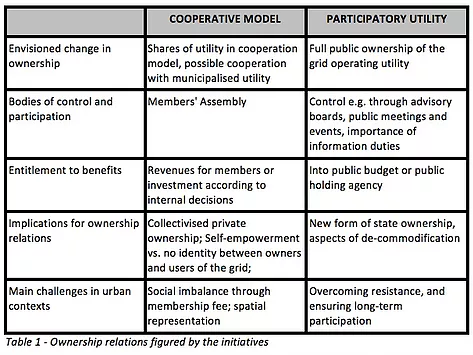
The cooperatives wanted to achieve a situation in which they would own a part of the shares of the grid operating utility, according to the amount of capital gathered through membership fees and donations. The impetus behind that was to secure citizen influence as a minority shareholder with special rights negotiated with the other owner parties. Thereby the cooperative concept does not necessarily entail a new role for the state in energy provision, although cooperative members stated in interviews that they would rather join forces with a public than a private utility.

The cooperative model defines ownership relations around the principle of membership. That means that the Members’ Assembly is the most important body of control. Here, the fundamental decisions on the strategy of the cooperative are made, while each member therein has one vote regardless of the number of shares owned (Schröder and Walk 2014). Also, members are entitled to share the benefits of operations, or to decide what they should be used for. To become a member, a membership fee is necessary (100€ for Energy Network Hamburg; 5 x 100€ for Citizen Energy Berlin). While others have highlighted that energy cooperatives can be interpreted as self-empowerment for people to their energy system (van der Schoor and Scholtens 2015), it is important to note that there is no identity between owners and users in this model (cf. Novy 1985: 127). In an abstract sense one can argue that the entitlements implied in the ownership relation as such are transferred to the collective of the members; which, in turn, is still constituted of a limited group of owners. In this sense, the cooperative model could be described as “collectivised private ownership”. The two main challenges deriving from this ownership model refer to, first, the unknown extent of rights granted to the cooperative for having an effective influence on the business strategy of the grid operator they own minority shares; and, second, a potential social and spatial imbalance as the fee granting admission could become a hurdle for poorer households to become a member. The latter could also have a spatial implication on membership when there is a higher representation of more affluent neighbourhoods within the city itself. In order to gain as much capital as possible, none of the cooperatives has been restricted to citizens of the respective cities only, so that also interested non-locals could become members (yet there is no spatial data on the ownership structure available). Summing up, the cooperative model provides for a high degree of internal equality and democracy, while their general scope is, at the same time, limited by the membership approach and the necessary cooperation with another utility.

Against the internally democratic, but limited approach of the cooperative model, the approach of the participatory utility is wider in scope. The initiatives here targeted full public ownership of the physical grid and the operating utility. In this sense, the control and entitlements to benefits produced by grid operation should be transferred to the state. Noteworthy, what the initiatives had in mind was more than a traditional local public utility; instead they were striving for public ownership tied to targets around renewable energy and social equity, and, most important here, citizen participation and control. For this reason, remunicipalisation initiatives in both cities either have inscribed the principle of democracy (as in Hamburg) or deliberately spelled out concrete participatory and information mechanisms (as in Berlin) into the voting template for the referendum. Table 6 here shows the different provisions for control and information considered in the Berlin model in an exemplary way. The intention is to enable citizens to exert influence on the guidelines and practices of the utility. This should be achieved through designing organisations that have inscribed information and participation duties. Hence, the entitlements of control here differ from traditional models of public ownership with more limited means of control. These provisions, taken together, put forward a new form of state ownership enriched by models of participation and steps towards de-commodification, in the sense of both user integration and non-financial aims.
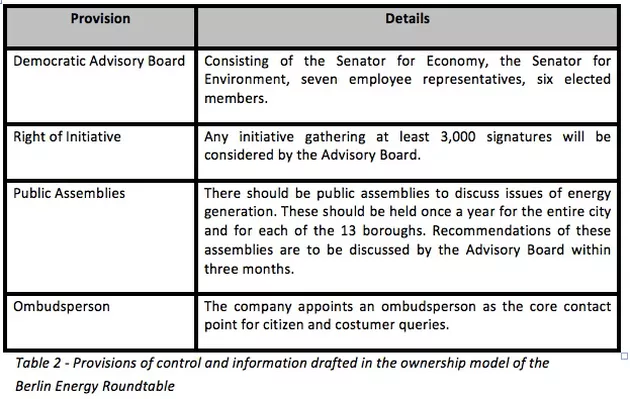
This participatory approach is meant to ensure the ambitions of the project itself. Past evidence shows that public ownership does neither prevent a commercialisation, nor a future privatisation of the utilities (Wissen and Naumann 2006). Hence the activists were sceptical towards the state as the embodiment of general interest of its population. The solution here was to institutionally design a utility that would be open for citizen, and, hence, social movement demands even in the long term. Further, the more “soft” aims of social justice and climate compatibility should also be inscribed into the practice of the utilities. However, therein lay two main challenges: first, the ongoing discussions about the referendum in Hamburg show that in the phase of implementation there are a number of resistances to be overcome, for example referring to different notions of how to actually fulfil the aim of social justice or democracy in the design and practice of the utility, potentially diluting the original aims of the initiatives. Even if participatory provisions as means for user and social movement influence are actualised, the second challenge here rests in ensuring their effective use over the long term. Overall, the participatory utility approach in both cities extends traditional ownership relations as they spell out and redefine entitlements for control, and potentially also for the use of benefits.

A short conclusion

Summing up, both remunicipalisation initiatives and energy cooperatives have outlined alternative forms of ownership for the energy provision of the two cities, each according to their own organisational model. If actualised they would redefine the relations of ownership in energy, in the sense of reversing privatisations in the two cities, and in a more underlying sense of redefining who controls and benefits from the operation of the energy network. In the cooperative model, the group of owners would be widened to those who became members of the cooperative, in the participatory utility citizens would be granted rights of information and participation. In a broader picture, these suggestions carry the potential to also redefine the relations between the state, private businesses and citizens in energy provision – in the way of inscribing entitlements of control for mainly citizens, while also ascribing a core role to the state. In short, while the biggest challenge in the cooperative model is ensure an egalitarian representation of the population as cooperative members, the crucial point in the participatory state model is to actually realise effective participation of everyone interested. The implementation of such models, of course, relies on the power geometries that define political struggles. Interestingly, it happened in the crucial sector of energy that these openings could be seized, yet, a transfer of these models and the debate around it to other sectors of public services need to take into account their specific conditions, technological and organisational arrangements, and lastly, their regulatory framing.

REFERENCES

Altvater, Elmar (2007): The social and natural environment of fossil capitalism. In: 43, pp. 37–59.

Becker, Sören; Kunze, Conrad; Vancea, Mihaela (2017): Community energy and social entrepreneurship: addressing purpose, organisation and embeddedness of renewable energy projects. In: Journal of Cleaner Production 147, pp. 25–36. DOI: 10.1016/j.jclepro.2017.01.048.

Berlo, Kurt; Wagner, Oliver (2013): Stadtwerkeneugründungen und Rekommunalisierungen. Energieversorgung in kommunaler Verantwortung. Wuppertal: Wuppertal Institute. Online https://wupperinst.org/uploads/tx_wupperinst/Stadtwerke_Sondierungsstudie.pdf.

Bontrup, Heinz-J.; Marquardt, Ralf-M. (2011): . 2nd edit. Berlin: Ed. Sigma.

Gailing, Ludger; Röhring, Andreas (2016a): Is it all about collaborative governance? Alternative ways of understanding the success of energy regions. In: –10.1016/j.jup.2016.02.009.

Gailing, Ludger; Röhring, Andreas (2016b): Germany’s Energiewende and the spatial reconfiguration of an energy system. In: Gailing, Ludger; Moss, Timothy (eds.): . London: Palgrave Macmillan UK, pp. 11–20.

Holstenkamp, Lars; Kahla, Franziska (2016): What are community energy companies trying to accomplish? An empirical investigation of investment motives in the German case. In: 97, pp. 112–122. DOI: 10.1016/j.enpol.2016.07.010.

Huber, Matthew T. (2009): Energizing historical materialism: fossil fuels, space and the capitalist mode of production. In: 40 (1), pp. 105–115. DOI: 10.1016/j.geoforum.2008.08.004.

Islar, Mine; Busch, Henner (2016): “We are not in this to save the polar bears!” The link between community renewable energy development and ecological citizenship. In: 29 (3), pp. 303–319. DOI: 10.1080/13511610.2016.1188684.

Kishimoto, Satoko; Petitjean, Olivier (eds.) (2017): . Amsterdam: Transnational Institute.

Klagge, Britta; Brocke, Tobias (2012): Decentralized electricity generation from renewable sources as a chance for local economic development: a qualitative study of two pioneer regions in Germany. In: 2 (1), pp. 5. DOI: 10.1186/2192-0567-2-5.

Lormes, Ivo (2016): . Wiesbaden: Springer VS.

Morris, Craig; Jungjohann, Arne (2016): . Cheltenham: Palgrave Macmillan.

Müller, Jakob R.; Holstenkamp, Lars (2015): Zum Stand von Energiegenossenschaften. Aktualisierter Überblick über Zahlen und Entwicklungen. Lüneburg: Leuphana Universität Lüneburg. Online http://www.leuphana.de/fileadmin/user_upload/Forschungseinrichtungen/professuren/finanzierung-finanzwirtschaft/files/Arbeitspapiere/wpbl20_energiegenossenschaften2014_final.pdf.

Novy, Klaus (1985): Vorwärts immer – rückwärts nimmer: historische Anmerkungen zu einem aktuellen Problem. In: Bierbaum, Heinz; Riege, Marlo (eds.): . Hamburg: VSA, pp. 124-141.

Scheer, Hermann (2007): . London; Sterling: Earthscan.

Schröder, Katrin; Walk, Heike (2014): Opportunities and limits of cooperatives in times of socio-ecological transformation. In: Freise, Matthias; Hallmann, Thorsten (Eds.), Modernising Democracy? Associations and Associating in the 21st Century. Springer, New York, pp. 301-314

Seyfang, Gill; Park, Jung Jin; Smith, Adrian (2013): A thousand flowers blooming? An examination of community energy in the UK. In: 61, pp. 977–989. DOI: 10.1016/j.enpol.2013.06.030.

trend:research; Leuphana Universität Lüneburg (2013): . Bremen, Lüneburg. Online https://www.buendnis-buergerenergie.de/fileadmin/user_upload/downloads/Studien/Studie_Definition_und_Marktanalyse_von_Buergerenergie_in_Deutschland_BBEn.pdf.

van der Schoor, Tineke; Scholtens, Bert (2015): Power to the people: local community initiatives and the transition to sustainable energy. In: 43, pp. 666–675. DOI: 10.1016/j.rser.2014.10.089.

Wissen, Markus; Naumann, Matthias (2006): A new logic of infrastructure supply: the commercialisation of water and the transformation of urban governance in Germany. In: 33 (3), pp. 20–37.

Yildiz, Özgür; Rommel, Jens; Debor, Sarah; Holstenkamp, Lars; Mey, Franziska; Müller, Jakob R. et al. (2015): Renewable energy cooperatives as gatekeepers or facilitators? Recent developments in Germany and a multidisciplinary research agenda. In: Energy Research & Social Science 6, pp. 59–73. DOI: 10.1016/j.erss.2014.12.001.

* Dr. Sören Becker is a geographer interested in alternative ways of organizing infrastructure and technology in cities. He works and publishes on energy remunicipalisation and community energy was published in various academic articles. He is working as a researcher at the University of Bonn and Humboldt University Berlin.

Read More

Food Sovereignty – Concept Note And Workshops

FOOD SOVEREIGNTY - CONCEPT NOTE AND WORKSHOPS

June 9, 2016

Concept Notes on Food Sovereignty
“Corporate Invasion to Food Sector”

Background

Asia region is crucial to European economic interests. The EU has already established its footprint in Asia with an ambitious agreement with South Korea; an ASEAN strategy based on individual agreements as building blocks towards a region-to-region EU-ASEAN framework; FTA negotiations with Japan; and ongoing investment negotiations with China and Myanmar. This Asia strategy will need to be pursued, consolidated and enriched over the next few years.

In south-east Asia, following the agreement with Singapore, the conclusion of negotiations with Vietnam has set a second benchmark for engaging with other partners. The EU remains committed to resuming negotiations with Malaysia and Thailand also to conclude the investment negotiations with Myanmar. EU will also to open FTA negotiations with the Philippines and Indonesia.

In 2015, EU released a new strategy on “Trade for All” that EU have a new approach on Trade and Investment strategy in order to boost economic growth. Of course, by encouraging the expansion of exports and investment in the partner country, particularly in the agricultural sector. Another new approach One of the aims of the EU is to ensure that economic growth goes hand in hand with social justice, respect for human rights, high labour and environmental standards, and health and safety protection.

This new approach must should be criticized given the EU is the country of origin of the many TNCs that operating in developing countries. In fact, sometimes they doing human rights abuses in carrying out its business activities. For example, The FTA between Indonesia and the European Union will increase an aggressive investment coming from the European Union in the agricultural sector especially related to the EU renewable energy policy. The EU’s policy is indicated to escalate the farm land deprivation and marginalization of small-holder farmers in their role as food producers.

Therefore, the Food Sovereignty Working Group will explore 3 sub-theme:

The Problem: Exposing the New approach on “EU Trade for All “, especially in food and agricultural sector, and an outlook of EU Economic Partnership with Asian Countries, Corporates invasion in food and agricultural in Asian Countries and Human Rights abuses to the People.

The emergence of a new approach to Asia, which is called “EU Trade for All” is a symptom of the increasingly massive invasion of multinational corporations in the European free trade agreements with Asian countries. To the experience of some Asian countries, such as Indonesia, invasion of corporations have lead to the diminishing access of peasants to land, criminalization of the peasants, and so on. This invasion may become a serious threat to the sustainability of food sovereignty of Asian countries and increase human rights abuses by corporation. Serious policy measures is necessary to take to ensure food sovereignty in Asia and eliminate human rights violations by corporations.

Lessons Learned: Reclaiming Peoples’ Rights – in Asia & Eropa

The extent of the impact of multinational corporation invasion over the globe have been resisted by various sectors. Peoples’ Tribunal against Monsanto was a civil society advocacy experience that we can refer to the fight against corporate crime. The demands for wage increase by workers, agrarian reform by peasants, access to cheaper health services, as well as the call to bring multinational corporate violating human rights accountable are responses towards the invasion of multinational corporations.

The experiences of Asian and European countries on the success and challenges faced by their community in claiming back their rights that have been deprived by the actions of some corporation needs to be revisited. The evaluation and learning from the success or defeat can be a model for people’s resistance in different parts of our world.

Strategies

The practices of human rights abuses by corporation seem to be untouchable by the law. Legal enforcement by the State against corporate for their bad business practices is toothless. Even more, the influence of corporations in legal and political systems damaging the role of the State to protect human rights. In its development, the application of the UN’s Guiding Principles is still far from what is expected. This is because the Guiding Principles is considered to be blunt in law enforcement on cases of human rights abuses by corporations.

The emergence of the UN Resolution 26/9 concerning the need to create a binding international instrument on Business and Human Rights for accountability of multinational corporations, might be an effective instrument in law enforcement against corporations. Binding Treaty on Business and Human Rights would be an effective remedy mechanism followed by strict and binding sanctions.

To that end, Binding Treaty could be an alternative strategy to restore the rights of people who have been deprived by the actions of corporation. So that it is necessary for civil society to advance a concrete offer concerning the form and content of a Treaty which could effectively answer the issues of food sovereignty in the world.

Note: The Thematic Cluster ‘Food Sovereignty – Beyond Zero Hunger’ is being coordinated by Food Coalition/CHRD (Mongolia), Indonesia Global Justice (IGJ), and the Finnish AEPF Committee.

Read More

Resource Justice – Concept Note And Workshops

RESOURCE JUSTICE - CONCEPT NOTE AND WORKSHOPS

May 31, 2016

AEPF 11
Thematic Cluster:
Resource Justice, Land Rights, Equal access to Water, and Participation – Going beyond Extractivism (Draft programme)
“Buy land, they are not making it anymore” (Mark Twain)

Background

For consumer goods like smartphones, laptops, cars, etc. we need raw materials. Industries, especially in Europe and in East Asia, but also in South and Southeast Asia, are using every year more copper, nickel or tin. Most of the producing countries have to import most of these raw materials from other regions and countries. The consumer and industry are still ask for more. Same with agrarian raw materials. Thus landgrabbing for mining, industrialised agriculture and many other purposes like urbanisation and tourism is increasing, including water grabbing as well.

At the same time we observe an increased concentration of only a few multinational companies providing these raw materials. And the North just exports its mines to the South. Some of the countries in Asia and Europe are called “resource rich”. But this wealth is often not a chance but a curse. The extraction of raw materials is often associated with massive violation of human rights, social rights, workers rights, indigenous rights and the degradation of the environment. There is a huge lack of transparency and involvement of local and affected communities. The host governments are often not willing or not able to secure the rights of local people. The promised benefits of employment opportunities and economic development bypass local communities and even national governments might not gain by increasing revenues or foreign exchange. Critical civil society, social movements and journalists are threatened or even killed if they report about social and environment problems. Multinational companies avoid paying taxes, circumvent national and international regulations and sue countries when governments implement higher social or environmental standards.

Thematic Event 1 (phase 1): Mining in different regions

Mongolia’s mining boom is an example for the development paradigm of extraktivism. It was prepared and launched by development donor institutions “inspired” by so-called investors and led by the World Bank and IMF country strategies for restructuring and liberalizing policies. Government‘s attempts to merge a socio-developmental narrative with a neoliberal policy framework aimed at attracting large foreign mining investors has been successful but the actual implementation process of the socio-developmental provisions follow a particular strategy by the government whereby these provisions are being implemented only sporadically. This „selective absence“ of the state is resulting in political instability and has led factions of recent governments to promote measures that are viewed by the investors as feeding “resource nationalism”. Since 2013 the current elected government has embarked on the road of hectically amending national laws on land, pasture, water and environmental protection to „further improve investor friendly environment“. All laws, donor or development programs lead to ensuring more land freed up for extractive industry exploration and mining activities.

Restructuring and legal reform of this kind do not happen only in Mongolia. Mining activities in many other ‚resource rich’ Asian countries and in Europe, especially in Eastern Europe, with a longer history provide plenty of illustrative material about experiences at the economic, political, social and environmental level. Too, the reference to developments and discussions in Latin America could contribute to the understanding of development impacts, strategies of actors like companies, governments and financial institutions, framing the activities of social movements and CSOs.

Thematic Event 2 (phase 1): Land grab for crops, mining, development

Land and water are two of the main fundamentals for the livelihood of millions of families negatively affected by commercial, industrialised exploitation of natural resources. In the past few years ‚landgrabbing’ has reached threatening proportions with the increasing competition fo powerful companies from this mining sector, from agrobusiness, and from various other profit-seeking activities like financial and urban land speculation or tourism for increasingly scarce land and water resources.

Landgrabbing for Oil palm, Banana and Maize cultivation for example is one of the major threat to the forest in Asia, which produce many non-carbon benefits including food to the local communities and capture CO2 to cool the planet. 90 per cent of the palm oil to Europe comes from Indonesia, Malaysia. The Asian region supplies 25 per cent of the banana market in Europe, with the Philippines as the second largest Banana exporter after Ecuador.

However, corporations grab the forest and agricultural lands with the support of corrupt officials and the politicians. They displace local communities and criminalize the communities and leaders. There are plenty of human rights violations in those locations. They apply huge amount of harmful agrochemicals with grave impacts on the health of local people and the environment.. They pump out river water and the ground water in large scale. They find cheap labour from poor communities who loose their territories.

With the dispossession of land, forests and water, local communities loose the possibilities for self determined, economic viable and sustainable approaches towards their own development aspirations. Shrinking spaces for such alternatives lead into a vicious circle of forcing more and more people into the neoliberal development model with precarious livelihoods as low paid workers, migrants, and underemployed in the informal sectors of the economy.

Thematic Event 3 (phase 2): Lessons Learned (mining, development, agriculture, etc)

Win some, loose some! But how to change the game? – International civil society and social movements in the field of raw materials

Discussing resistance movements and learning from each other – what kind of tactics do work in different contexts?

Governments in Asia and Europe are pursuing policies that foster foreign investments, pushing for free trade agreements, bilateral investment treaties and other contracts. Yet those treaties and agreements favour the mining and agro industry. At the same time, people in Asia and Europe start to organize and protest against such treaties and practices. But a lot of these voices and protests are still isolated. There is a lack of sharing knowledge and experiences, stories of success and failures of our struggles. People miss opportunities to learn from each other.

The workshop will give the opportunity to exchange and discuss about (inter-)national struggles against resource extraction and their associated costs against the background of the discussions at the two workshops of phase 1 and phase 2. What have been failures and successes of past activities by civil society and social movements? We want to discuss which campaigns, lobbying, civil disobedience, demonstrations, media work, drafting of bills / laws, and publications, etc. were successful and which were not. And more importantly: why did they prove to be successful and what were the reasons they failed to achieve the desired outcomes? What can we learn from those past activities to inspire, inform and shape current strategies and tactics? Finding common ground where we might even be able to support each other.

Guiding questions:

Are there positive examples to learn from? What resistance movements do exist in the EU and Asia who do successful work against impacts of extractivism, the influence of IFI on extractivism processes, how these processes being monitored by civil society, etc.?

Thematic Event 4: Strategising

Have an open space strategy meeting to which we invite all speakers and participants from the other resource workshops to sit together, network and discuss what might follow from AEPF11, the resource cluster and all the workshops.

Some ideas about ‘Strategising Alternatives to Resource Extractivist Development’ (Oliver Pye)

Resource extraction and growth = Development. This sums up the development strategy pursued by nations and capital at the ASEM summit. Local groups and civil society organizations are often involved in resisting such projects, as they lead to intense pollution, land grabbing and social marginalization on the ground. But how do we go beyond localized struggles? What alternatives can we offer to this type of development at the national and transnational scale? What strategies do we have that link local struggles to a broader movement for social-ecological transformation of existing production and consumption patterns?

In this context, debates of alternative development concepts from Latin America have become very prominent. Left-wing governments increasingly pursued neo-extractivist strategies – using income from mining and oil to fund social programmes. But this does not challenge the basic model of extractivism, leading to the concept of post-extractivism, which seeks to de-link social development from ever-increasing volumes of resources taken from the ground. The concept of Buen Vivir (good life / good living) was taken up by marginalised people in urban centres like El Alto (Bolivia) which were largely neglected by the state. In Europe, social movements are putting forward the concept of de-growth as part of a social-ecological transition strategy.

In many Asian countries, local and indigenous alternatives play an important role for grass¬roots movements as well as for national politics. Most prominent on an international level is the Buddhist-inspired concept of Gross National Happiness (GNH), which serves as an alternative development index and normative orientation for development in Bhutan. In Mongolia, where mainstream development is dominated by the mining industry, the culture of nomadic pastoralism could be an important source for alternative development ideas.

This strategising workshop aims to draw on the analysis and lessons learnt from the other three workshops in the cluster to discuss forward looking strategies for social-ecological transformation in Europe and Asia. Because production and consumption patterns are increasingly inter-linked between the two continents, local and national strategies will not suffice to develop civil society alternatives that can resonate with the wider population. But do European strategies such as de-growth resonate with the situation in Asia, or do they have to be re-worked to become truly transnational strategies? And can indigenous-informed strategies in Asia leap the local scale and become generalised transformative strategies for wider society?

Possible Inputs (10 minutes):

  1. Challenging the extractivist development paradigm in Mongolia
  2. Post-extractivism and De-growth: strategies for social-ecological transformation in Europe
  3. Generalising from indigenous culture and Gross National Happiness: alternative development paradigms in Asia

NOTE: The Thematic Cluster ‘Resource Justice, Land Rights, Equal access to Water, and Participation – Going beyond Extractivism’ is being coordinated by OT Watch (Mongolia), Center for Environmental Justice/Friends of the Earth-South Asia, (Sri Lanka), and Stifung Asienhaus (Germany).

Read More

Jakarta AEPF Thematic Dialogue on Sustainable Land and Natural Resources Management (2)

Jakarta AEPF Thematic Dialogue on Sustainable Land and Natural Resources Management (2)

January 21, 2015

One of the ten threats that the United Nations High-level Panel on Threats, Challenges and Change has officially warned the countries is environmental degradation, which is defined by the UN as “the reduction of the capacity of the environment to meet social and ecological objectives, and needs.” A most common case of environmental degradation is rapid depletion of natural resources as trade and investments have largely been on land and natural resources.

Economic activities like unsustainable industrial agriculture and fishing, and extractive industries such as mining have led to the exhaustion of our resources, and devastation of our environment and of people’s lives. Peasants, small-scale fisherfolk, pastoralists, indigenous peoples and communities are being dispossessed by the expansion of industrial agriculture, extractive industries and finance capital supported by public policies, thereby pushing these people into further poverty. Meanwhile, powerful corporations and investors are wantonly depleting fertile soils and extracting natural wealth normally through legal channels in the name of trade and investment under the cloak of legal frameworks and policies that allow them to conduct such activities.

Not only the United States, but Europe too has eyes set more steadily on Asia for trade and investment. Asia, a region rich in mineral and other natural resources, is a region of high growth but with high levels of poverty and inequality. Investments in land and natural resources are key drivers of growth in the region, thus governments are moving towards reforming policies including amending national laws and Constitutions in order to attract more foreign investments in key areas of agriculture and fisheries, mining and other extractive industries.

The European Union is strong in trade and investment in Asia which it recognized in 2006 to be an area where there is potential for growth. The EU is now Southeast Asia’s largest foreign investor while China, Japan, India, and South Korea are the big trading partners of EU in Asia aside from ASEAN. It has a strategy to create open markets in Asia in the 21stcentury that looks beyond tariff reduction to trade barriers. Its Asia-Invest Programme launched in 2006 aims to promote and support business cooperation between the EU and Asia towards increased trade and investment flows between the two regions. It can be recalled that the 2006 Communication from the Commission to the Council, European Parliament, and the European Economic and Social Committee and the Committee of the Regions, entitled “Global Europe: Competing in the World,” has argued that EU’s openness to trade to others and vice versa is not just on tariffs, but also on non-tariff barriers and access to resources such as energy, metals, and primary raw materials including agricultural materials.

The European Union has thus, over the years, pushed for bilateral free trade agreements in Asia; it has proactively engaged in negotiations for a number of significant FTAs in the region. It has been proactive in approaching Asian countries to conclude FTA in shorter time possible such as the FTAs with South Korea and Singapore which were already concluded in 2010 and 2012 respectively. The EU’s FTA with South Korea was entered into force in 2011 while the FTA with Singapore still awaits ratification by all EU member States for it to come into force. Aside from India and Japan, there are FTAs in 3 ASEAN countries that the EU also hopes to conclude soon. These are with Malaysia, Vietnam, and Thailand. Even China wants a bilateral investment treaty with the EU. The EU’s Asia-Pacific free trade policy demonstrates that it is all encompassing of Asia, signaling that China is not the only economic option for the EU.

There are other countries in the EU- FTA pipeline. In July 2014, the Philippines also signed a cooperation framework with the European Free Trade Association (EFTA) which is a first step to FTA. There are dynamics experienced by some countries in ASEAN as the FTA negotiations progress particularly towards more comprehensive trade agreements (especially in the fields of trade and investment) that need to be monitored by the communities in the two regions. Indonesia is also engaged in talks with the EU for an EU-Indonesia Comprehensive Economic Partnership Agreement (Indonesia-EU CEPA) which is expected to include provisions on investments and investor protection, but these negotiations have also been hampered since last year.

Governments in both regions recognize the crucial role of trade and investment in realizing sustainable growth. At the 10thASEM Summit held in Milan in October 2014, “Asian and European leaders reiterated their commitment to striving for an open world economy and to strengthening trade and investment relations for stronger economic connectivity between both regions. Leaders underlined their commitment to enhancing inter-regional trade and investment flows. They also recalled that there are global challenges faced by Europe and Asia that are associated with growing population, pressures on natural resources, and climate change which require improved sustainable, safe and efficient food systems as a means of ensuring food and nutrition security. ASEM leaders agreed that good land governance and secure access to land, energy, research and innovation, integrated and sustainable management of water resources, forests and fisheries, and more inclusive agricultural value chains, enhancement of public-private partnership, investment in family farming and sustainable and climate-smart agriculture are important for food and nutrition security and higher productivity of the agricultural sector.”[1]

Trade and investment policies and/or agreements in Asia especially on extractive industries are important to be built or reformed by respective member countries. For instance, it was the decision of the Indonesian government to terminate its Bilateral Investment Treaty with the Netherlands. In ASEAN, adoption of just and sustainable trade policies is being pushed by civil society in light of economic integration of the region that will come into force in 2015 and of the many bilateral and multilateral trade agreements proliferating in the region.It is important to look into the role of ASEAN as exporter of natural and mineral resources particularly to the ASEAN +3 countries (China, Japan and South Korea). Towards the ASEAN Economic Community 2015, there is no mining and extractive industry policy which sufficiently protects the State and the public from the adverse effects of investments in this sector, such as on labor, environment/climate change, and tourism.

It is therefore important to better understand and respond to the latest developments on investment cooperation agreement between the European Union and countries in Asia, particularly the challenges of the agreement to the protection of the rights of the local community and environmental sustainability.

It is with the above backdrop that the Asia-Europe People’s Forum is holding a thematic dialogue on land and natural resources with the theme: “21st Century Trade and Investment Policies: Challenges and implications on Land and Natural Resources in Asia and Europe.” This event is also a follow-through activity to the AEPF10 discussions in Milan, Italy in October 2014 in order to comprehend more the realities and technicalities surrounding the issue and strengthen recommendations to ASEM and other stakeholders especially the policy-makers in ASEM member States and governments. This conference also serves as a venue to strategise on raising public awareness on the FTAs and the role and dynamics with ASEM and its member States, and on strengthening solidarity and cooperation among civil society in advancing the alternative proposals to ASEM and our governments especially in ASEAN.

General Objective: Increase the level of understanding or knowledge of civil society in Asia and Europe on the dynamics of investment cooperation in both regions, particularly on land and natural resources, and for the civil society to be able to participate and contribute more meaningfully in dialogues on these issues with their respective governments and with ASEM which is an informal process of dialogue and cooperation among member countries that aim for creating an enabling environment for the prosperity of their people.

Specific Objectives: (a) Identify the collective advocacy strategy of Asian especially the Southeast Asian and EU civil society in addressing the challenges posed by post-Bali trade and investment agenda; (b) Tackle the important points from AEPF10 session on Sustainable Land and Natural Resources Management and strengthen recommendations to ASEM, EU, and ASEAN leaders especially in light of ASEAN Economic Integration in 2015; and(c) Come up with concrete recommendations and actions for the governments of ASEM so that its activities and actions would truly benefit the people in both regions.

Outputs

Common statement in response to the challenges and implications of investments in both regions, especially related to the land and natural resources, and containing some concrete recommendations to ASEM and member States and governments.
Action plan or working paper for campaign and lobby on the agenda on sustainable land and natural resources management including on related issues on trade and investment.

Participants

About 45 participants are targeted to attend the event. Thirty (30) resource persons and participants coming from the social movements, academe, and parliamentarians will come from Europe and Asia; and 15-20 from Indonesia, mostly those campaigning on trade, environment, and natural resources issues.

[1] Excerpt from the Chair’s Statement of the Tenth Asia-Europe Meeting (ASEM-10) Summit in Milan, Italy on 16-17 October 2014.

The AEPF will hold a thematic dialogue on natural resources with theme “21st Century Trade and Investment Policies: Challenges and Implications on Land and Natural Resources in Asia and Europe” in Ambhara Hotel Jakarta, Indonesia on 29-30th January 2015.

The dialogue forum will present and discuss the dynamics of investment cooperation in Asia and Europe regions, particularly on land and natural resources, and for the civil society to be able to participate and contribute more meaningfully in dialogues.

The event will be participated by social movements, academe, and parliamentarians from 21 European and Asian
countries.

AEPF Thematic Dialogue
on Sustainable Land and Natural Resources Management

“21st Century Trade and Investment Policies: Challenges and Implications on Land and Natural Resources in Asia and Europe”
29-30 January 2015

Read More

Indian Farmers’ Organizations Urge Government to Stand Firm on Food Security at the WTO

Indian Farmers' Organizations Urge Government to Stand Firm on Food Security at the WTO

July 23, 2014

New Delhi, 23 July 2014 — In a statement released ahead of the WTO General Council meeting tomorrow, farmers’ organizations in India called upon the Indian Government to stand firm on linking the Food Security proposal with the Trade Facilitation Agreement in WTO. Farmers’ leaders expressed shock over the Chair’s summary of the G 20 trade ministers meeting which was held on July 19 at Sydney. The Chair’s summary was fully silent over the food security proposal of the Bali Declaration, while it referred specifically to the Trade Facilitation Agreement. Thus “the G20 is increasingly turning to fixing the interest of developed countries by ignoring paramount concerns for people in developing countries and in least developed countries”, the farmers’ groups claimed.

Yudhvir Singh, leader of Bharatiya Kisan Union (BKU), one of the largest farmers organizations in India, said that, “in the backdrop of rising costs and extremely volatile global market prices, to fulfil the constitutional obligation of food security to its people, and also to ensure the livelihood security of producers, the Government of India needs to sustain and increase domestic agricultural production through price support, procurement and other measures to achieve self-sufficiency in food production, across different food grains. This is all the more important in the context of hundreds of thousands of farmers committing suicides in desperation”.

Kavitha Kuruganti, of Alliance for Sustainable & Holistic Agriculture (ASHA) said, “the Government of India lost a historical opportunity in correcting deep-seated WTO wrongs in the Bali Ministerial. At least now, they need to stand firm on our sovereign policy space related to food and livelihood security, and sustainable development pathways. Indian government at that time settled for a temporary solution with so called ‘peace clause’. Lack of progress towards a ‘permanent solution’ vindicates our apprehensions. At this point of time, the government should not buckle under any international pressure. It should remain firm in its position”.

Naresh Sirohi of BJP Kisan Morcha added,”India has currently taken a position to block the ratification of the TFA unless other elements of the Bali Outcome including permanent solution on the food security proposal and the LDC package are advanced. However we are hearing conflicting reports of India being ‘fully committed to the (Bali) package’. This clearly gives an impression that India may agree to the finalization of protocol on trade facilitation without the finalization of Doha Round especially on the issue of food security, which is against the principle of the single undertaking”.

Vijoo Krishnan of All India Kisan Sabha (AIKS) said that, “we are alarmed over government’s recent policy to freeze agricultural subsidies and to reduce public – food stockholding that will endanger food security and push Indian farmers out of agriculture. The government has to reverse it at national level and protect its policy space at WTO to provide production support to its farmers”.

In the context of G-20 Chairs summary, Indian farmers statement;

  • Sought clarification from the Government of India whether it has moved away from its earlier stand.
  • Called upon the Government not to buckle down under the pressure from USA, the EU and other developed countries and not to dilute its position of linking trade facilitation with food and livelihood security and by pushing a permanent solution to the G-33 Food Security Proposal.
  • Called upon the Government of India to use current negotiations to correct fundamental WTO wrongs, to build up and lead a coalition /alliance of like-minded countries to collectively secure safeguards for sovereign development policy space, food security and the livelihood concerns of farmers and its people.
  • Urged the government to take a proactive role in building such alliances as India did in building G-20 and G-33.

For more information please contact Yudhvir Singh at 098-681-46405 or Naresh Sirohi at 098-996-00011.

The Government should Clarify its Stand on Food & Livelihood Security and Trade Facilitation at WTO Negotiations

In the context of the recent WTO negotiations, we the undersigned farmers’ organisations express our disappointment on the Chair’s Summary of the G-20 trade ministers meeting. The Chair’s summary refers specifically to the Trade Facilitation Agreement (TFA) of the Bali Outcome but does not refer to the food security proposal, which is of paramount importance for the people of India.

Further, the Chair’s summary is fully silent on the livelihood concerns of farmers and other affected people in developing countries. This clearly shows that G20 is increasingly turning to fixing the interest of developed countries and totally ignoring the livelihood concerns of people in the developing countries and least developed countries.

Agriculture is the backbone of the Indian economy. Food security in India rests heavily on the Public Distribution System (PDS) and the PDS itself cannot be operated unless farmers are given enough support so that they can continue to produce. In the context of rising costs and extremely volatile global market prices, and to fulfil the constitutional obligation of food security to its people, the Government of India needs to sustain and increase domestic agricultural production through price support, procurement and other measures to achieve self-sufficiency in food production, across different food grains at that. This is all the more important in the present context of deep agrarian crisis manifesting itself in hundreds of thousands of producers committing suicides in desperation.

At the Bali ministerial, the Indian government had sought to secure such subsidies to farmers through the G-33 Food Security Proposal. However due to bungled negotiations, the nation settled for a Peace Clause which allows such subsidies only for a temporary period while the developed countries pushed the TFA which is a permanent agreement. We also bound ourselves under too many conditions in “freeze clauses”. In fact, many of us clearly pointed out that India has chosen to miss a historical opportunity to correct deep-seated WTO wrongs. We were however promised by the Indian government that they will push for a permanent solution to the food security proposal.

India’s primary interest, both domestically and globally, has to be the protection of agricultural producers’ livelihoods and the domestic production of food in order to meet the right to food of its people. Unfortunately the recent policy stance by the government is raising alarm as agricultural subsidies are being frozen and public food-stockholding is being progressively reduced, both of which will endanger food security of the country and push farmers out of agriculture, that too at a time when other sectors are not able to provide employment for the displaced.

India has currently taken a position to block the ratification of the TFA unless other elements of the Bali Outcome including permanent solution on the food security proposal and the LDC package are advanced. In a statement at WTO, India’s Ambassador stated that, “till we have an assurance and visible outcomes which convince developing countries that Members will engage in negotiations with commitment to find a permanent solution on public stock holding and all other Bali deliverables, especially those for the LDCs, India will find it difficult to join the consensus on the Protocol of Amendment.”

However we are hearing conflicting reports of India being “fully committed to the (Bali) package”. This clearly gives an impression that India may agree to the finalization of protocol on trade facilitation without the finalization of Doha Round especially on the issue of food security, which is against the principle of the single undertaking.

In the context of the G-20 Chair’s summary and various conflicting newspaper reports;

  • We seek clarification from the Government of India whether it has moved away from its earlier stand.
  • We call on the Government of India not to buckle down under the pressure from USA, the EU and other developed countries and not to dilute its position of linking trade facilitation with food and livelihood security and by pushing a permanent solution to the G-33 Food Security Proposal.
  • We call upon the Government of India to use current negotiations to correct fundamental WTO wrongs, to build up and lead a coalition /alliance of like-minded countries to collectively secure safeguards for sovereign development policy space, food security and the livelihood concerns of farmers and its people. We urge the government to take a proactive role in building such alliances as India did in building G-20 and G-33.

Endorsed by:

Alliance for Sustainable & Holistic Agriculture (ASHA)
All India Kisan Sabha (AIKS)
Bhartiya Kisan Union (BKU), Delhi
Bhartiya Kisan Union, UP
Bhartiya Kisan Union, Haryana
Bhartiya Kisan Union, Punjab
Bhartiya Kisan Union, M.P.
Bhartiya Kisan Union, Himachal Pradesh
Bharatiya Krishak Samaj (BKS)
BJP Kisan Morchha
Desi Bihan Surakkhya Mach, Odisa
Green Brigade
Karnataka Rajya Ryotha Sanga (KRRS), Karnataka
Kerala Coconut Farmers Association (KCFA), Kerela
Maharashtra Shetkari Sangathan
Paschima Odisa Krisuk Sangathan Samanaya Samiti
Tamil Nadu Farmers Association, Tamil Nadu
Thalaanmai Uzhavar Iyakkam, Tamil Nadu
Thamizhaga Vivasayigal Sangam, Tamil Nadu

Read More

Defend The Right to Health and Access to Affordable Medicines! No To Trips Plus Provisions In Bilateral FTAs!

DEFEND THE RIGHT TO HEALTH AND ACCESS TO AFFORDABLE MEDICINES! NO TO TRIPS PLUS PROVISIONS IN BILATERAL FTAs!

October 1, 2011

(A Joint Position Paper on bilateral free trade agreements and their impact on the right to health and access to affordable medicines published by the Medicines Transparency Alliance (MeTA) Philippines, Inc., Coalition for Health Advocacy and Transparency (CHAT) and the EU-ASEAN FTA Campaign Network, October 2011)

ACCESS TO MEDICINES IN THE PHILIPPINES: SOME STATISTICS

The Philippines is a lower middle income country where total health expenditures (THE) account for only 3.7% of Gross Domestic Product (GDP). Filipino households bear the heaviest burden in terms of spending for their health needs, with private out-of-pocket (OOP) expenditures reaching 56% of THE. (Philippine National Health Accounts, 2006)

(In order to move towards universal coverage, the World Health Organization (WHO) believes that countries would need to spend 4-5% of GDP on health, and keep OOP expenditures below 30-40% of THE.)

In terms of access to medicines, consider the following:

  • At least 30% of our population lacks regular and sustainable access to essential medicines. The Philippines has been identified as one of 64 countries worldwide where access to medicines is classified as low to medium, at best. (World Medicines Situation Report, 2004)
  • Pharmaceuticals account for 46% of total household spending on health, making medicine purchases the largest single item of health care expenditures. (Family Income and Expenditures Survey, 2000)
  • About a third (31%) of all reimbursements made through the National Health Insurance Program (NHIP) are for medicines, making medicines the second largest item in payments made by Philhealth. (PHIC Report, 2010)
  • A 2005 drug price survey revealed that, in the Philippines, prices for originator brand medicines sold through private retail outlets were, on average, 15 times greater than international reference prices, while lowest-price generic equivalents were more than 6 times the reference price. (Batangan, 2005)
  • In a 2009 health facility survey, it was reported that, on a list of 44 essential medicines, mean availability of innovator and generic medicines in the public sector 8% and 27%, and in the private sector, 14.7% and 19.7%, respectively. (2009 WHO Health Facility Survey on Medicines)
  • A study conducted by the European Commission in 2010 revealed that the level of availability of essential drugs in public health facilities at all levels was only 25.3%. (EC-TA Report on performance indicators for the Health Sector Policy Support Programme II, 2010)

DOHA DECLARATION ON THE TRIPS AGREEMENT AND PUBLIC HEALTH[1]

The Declaration on the TRIPS Agreement and Public Health – adopted by the member-countries of the World Trade Organization (WTO) during its Ministerial Conference in Doha in November 2001 – upheld the primacy of public health to promote access to medicines.

“We agree that the TRIPS Agreement does not and should not prevent Members from taking measures to protect public health. Accordingly, while reiterating our commitment to the TRIPS Agreement, we affirm that the Agreement can and should be interpreted and implemented in a manner supportive of WTO Members’ right to protect public health and, in particular, to promote access to medicines for all.

In this connection, we reaffirm the right of WTO Members to use, to the full, the provisions in the TRIPS Agreement, which provide flexibility for this purpose.”

By setting minimum standards on IPR protection, the TRIPS Agreement has resulted in the “significant loss of policy flexibilities especially for developing countries in regulating the grant and use of pharmaceutical patents and controlling the cost of medicines. The Agreement, however, has left some room for countries to put in place public interest measures, including measures to protect public health.”[2]

The Declaration underscored the right of countries to use flexibilities that are built into the TRIPS Agreement such as

  • The right to grant compulsory licenses and the freedom to determine the grounds on which such licenses are granted
  • The right to determine what constitutes a national emergency or circumstances of extreme urgency
  • The right to establish a regime for exhaustion of intellectual property rights without challenge

In its 2005 study, the Commission on Intellectual Property Rights, Innovation and Public Health (CIPIH) found that the use of these TRIPS flexibilities can promote access to medicines in developing countries.

Notably, the CIPIH also study states that, from a public health perspective, developed and developing countries not only have the flexibility to utilize and/or facilitate the utilization of TRIPS flexibilities for public health purposes, but they, in fact, HAVE AN OBLIGATION TO DO SO.

UNIVERSALLY ACCESSIBLE CHEAPER AND QUALITY MEDICINES ACT OF 2008 (REPUBLIC ACT NO. 9502, S. 2008)

Also known as the Cheaper Medicines Law, RA 9502 is considered a landmark legislation that upholds the people’s right to health and access to affordable and quality medicines. Through this law, the government affirmed its mandate “ . . . to protect public health, and when the public interest or circumstances of extreme urgency so require, . . . adopt appropriate measures to promote and ensure access to affordable quality drugs and medicines for all[3].”

Like the DOHA Declaration, the Cheaper Medicines Law clearly tilted in favor of public health against patent protection when it stated that: “(A)ll doubts in the implementation and interpretation of the provisions of this Act, including its implementing rules and regulations, shall be resolved in favor of protecting public health[4].”

The Cheaper Medicines Law likewise incorporated TRIPs flexibilities in domestic policy to provide for effective market competition as a means to drive down drug prices. Through amendments to the Intellectual Property Code of the Philippines to

  • Allow parallel importation of patented medicines from other countries where these are more affordable;
  • Prohibit the grant of new patents based only on newly discovered uses of a known drug substance;
  • Allow local generics firms to test, produce and register their generic versions of patented drugs even before the patent of the innovator drug expires; and
  • Allow the government use of patented drugs when the public interest is at stake,

the Law clearly expresses the State’s commitment and obligation to public health as an overriding development concern.

While many are impatient that the Law has not been used to the full, certain inroads have been made. Reports show that the Law has:

  • Paved the way for government to intervene through the imposition of price ceilings on selected medicines, and consequently influenced market players to voluntarily reduce prices on certain drugs as well;
  • Helped raise awareness about generics, encouraged their use, and provided patients with a wider range of choices. With lower priced alternatives available, patients’ compliance to treatment regimens has likewise improved; and
  • Reduced applications of frivolous patents on the ground of ‘new use’, as reported by the Intellectual Property Office[5].

These gains notwithstanding, the public has expressed impatience over the failure to attain the full potential of RA 9502. We therefore urge the full use of the flexibilities allowed therein, as they are in the TRIPS Agreement; and maximize use of measures to encourage greater market competition as the most effective and sustainable means to further drive down medicine prices.

TRIPS PLUS PROVISIONS

We are concerned over reports that drafts of several regional and bilateral Free Trade Agreements (FTAs) that are currently being negotiated may contain provisions that will effectively require the Philippines to enforce even higher levels of protection of intellectual property rights (IPRs) for medicines than those mandated under the TRIPS Agreement (TRIPS- plus provisions).

The Philippines should not allow itself to be bound to accept standards of protection that go beyond what had been consented to at the multilateral level. Higher standards will, by their very nature, delay or restrict competition, and eventually impede greater access to medicines.

LEARNING FROM THE EXPERIENCE OF OTHER COUNTRIES

According to the United Nations Economic and Social Commission for Asia and the Pacific (UNESCAP), FTAs with TRIPS-plus provisions are usually those involving the United States, the European Union and, to an extent, Japan.

Before entering into FTAs that may contain (even implicitly) TRIPS-plus provisions especially with developed countries like the US and the EU, the Philippines should seriously study their potential impact on public health, as well as on ongoing efforts to improve access to medicines (use of measures in RA 9502, for example). Impact assessment surveys (like those on FTAs negotiated by Jordan and Colombia that contain TRIPS-plus provisions) have shown the detrimental effects of such provisions on medicine prices and health spending.

US-Jordan FTA

A study by Oxfam International on the effects of the US-Jordan FTA on access to medicines[6] concluded that TRIPS-plus rules introduced into Jordan’s IP framework had a negative impact on access to medicines:

  • TRIPS-plus rules, particularly data exclusivity, independently prevent generic competition for 79 per cent of medicines launched by 21 multinational pharmaceutical companies since 2001.
  • Additional expenditures for medicines with no generic competitor, as a result of enforcement of data exclusivity, were between $6.3m and $22.04m.
  • There has been nearly no FDI by foreign drug companies into Jordan since 2001 to synthesize or manufacture medicines in partnership with local generics companies, and this has harmed public health. The only FDI into Jordan by foreign drug companies has been to expand scientific offices, which use aggressive sales tactics to ensure that expensive patented medicines are used in lieu of inexpensive generics.
  • Stricter intellectual property rules have not encouraged companies in Jordan to engage in R&D for medicines since the passage of the FTA, and these companies have not developed any new medicines.
  • New product launches in Jordan are only a fraction of total product launches in the USA and the EU. Many new medicines launched in Jordan are exorbitantly priced and unaffordable for ordinary people. Few or no units of these recently launched medicines have actually been purchased on the local market.

EU-Colombia FTA

A study on the foreseen impact of the EU-ANDEAN FTA on access to medicines in Colombia, particularly the impact of increasing the effective duration of pharmaceutical patents and test data protection, for example, showed the following results:

  • Increase of protected active ingredients from 4% to 30% of the market
  • Increase in medicine prices by 46%
  • Increase in health spending of up to US$ 1 billion annually
  • 5 millions Colombians would lose access
  • 12,000 AIDS/HIV patients would see their life expectancy decrease between 5.3 and 9.9 years

The study further concludes that the (TRIPS-plus) provisions promote an increase in the market share for protected products, thus extending periods of monopoly prices. This, in turn, hinders access to new pharmaceutical products.[7]

These and similar impact assessment studies done on various bilateral FTAs provide evidence that point to the serious negative impact of TRIPS-plus provisions on access to medicines and public health.

OTHER TRIPS PROVISIONS AFFECTING HEALTH OUTCOMES

In addition to the IPR provisions contained in FTAs, we recognize that there are others which will impact as well on the delivery of public health services and the attainment of health targets. These include:

Trade in Services

Based on the 2006 World Health Report, an optimum ratio of 2-3 health workers (doctors, nurses, midwives) per 1000 population is needed for a health system to be able to deliver at least 80% of its essential public health services.

The Philippines is far from achieving this. There is an imbalance in the supply of and demand for health professionals. While there is an excess in the national supply of nurses, there is an evident dearth in the number of health workers in far-flung communities.

The liberalization of the services sector allowed under FTAs may, in the case of the health sector, prove detrimental to efforts to address the evident inequities. Allowing the entry of foreign health professionals will result in stiff competition for limited posts in the urban areas, and a slide in the number of health workers seeking jobs in the rural communities. Filipinos must be given preference in an already congested labor market.

Investments

FTAs usually define “investments” rather broadly, with intellectual property covered under the said definition. In the EU-India and US-Malaysia FTAs, for instance, the inclusion of IPRs under the broad definition will allow foreign investors to take Government to court over disputes concerning investments, including the failure of government to protect their intellectual property.

Investment rules in FTAs and bilateral investment treaties have been frequently used by large companies to influence the legal and policy environments in the countries where they operate.[8]

NO TO TRIPS-PLUS PROVISIONS!

If adopted by the Philippines, regional and bilateral FTAs with TRIPs-plus provisions would render nugatory the Cheaper Medicines Law and compromise access to medicines.

These provisions would:

  • Expand the Philippines’ obligations in patent protection. As a party to bilateral FTAs, the Philippines will be compelled to adhere to other international IP treaties beyond those which it has already signed, and those that are not required under TRIPS. This includes the Patent Law Treaty (PLT) – to which the Philippines is not a part – which aims to streamline and harmonize formal requirements for the filing of national or regional patent applications and pave the way for more patents for medicines. The provisions on the revocation conditions in Article 10 and the addition of the priority claims in Article 13 of the PLT are extra TRIPs requirements that may lead to an increase in patent claims and to evergreening patents[9].
  • Increase the number of medicines being eligible for patents[10] by allowing patents on plants and animals, new uses of existing medicines and diagnostic, therapeutic and surgical methods. Patent protection for plants will not only be disadvantageous to our farmers but will also allow the exploitation of our rich biodiversity by parties other than Filipinos[11].
  • Lead to granting of more patents by curtailing pre-grant opposition to patents. Any opposition to patents would have to be made, therefore, after the patent has already been granted and through court proceedings which are typically more expensive and time-consuming. With patents in force, and pending court decisions on cases, generic versions of these medicines cannot be made available.
  • Extend patent protection beyond 20 years in order to compensate for delays in granting the patent or in registering the medicine. It is important to note that there is no obligation, from an international/legal perspective, to grant such extensions.[12]
  • Stifle competition from more affordable generic medicines. FTA provisions pertaining to data exclusivity will have the effect of expanding the originator companies’ “exclusive rights” over test data, and would cause significant delays in the marketing of generics, as generic companies will now be required to submit their own data to prove safety and efficacy. This will bar competition and impede price reductions that would have resulted from the availability of equivalents.
  • Establish the linkage between registration and patent status. Such a linkage provision in the FTA would oblige the Philippine Government to enforce protection of the rights of pharmaceutical companies, effectively transforming regulatory institutions like the Food and Drugs Administration (FDA) into a patent police.

We assert that TRIPS-plus provisions that are incorporated in FTAs are inimical to our national interest because they would undermine the Philippines’ health and development objectives.

DEFEND THE RIGHT TO HEALTH AND ACCESS TO MEDICINES!

We assert further that TRIPS-plus provisions would:

Violate the right to health enshrined in the Constitution

TRIPS-plus provisions in regional and bilateral FTAs violate the Filipino’s right to health – a basic human right enshrined in the Philippine Constitution. Article II, Section 15 thereof provides that “. . . the State shall protect and promote the right to health of the people and instill health consciousness among them.”

These provisions would likewise undermine state policy on health development and affordable health services, as defined under Article XIII, Section 11 of the Constitution which states “(T)he State shall adopt an integrated and comprehensive approach to health development which shall endeavor to make essential goods, health and other social services available to all the people at affordable cost.”

Impede the commitment to attain the Millennium Development Goals (MDGs) pertaining to health, as well as targets that have been set in the Philippine Development Plan 2011-2016

The Philippine Development Plan 2011-2016 (PDP) has declared that “No Filipino will be denied health care, even those without the means to pay[13].” The PDP also states the commitment of President Benigno C. Aquino III to attain Universal Health Care by 2016. Efforts shall be directed towards ensuring the achievement of better health outcomes, fair health financing and a responsive health system that will provide all Filipinos, especially the disadvantaged groups, with equitable access to quality health care.

Access to medicines is a vital component. The Plan has set a clear target to increase access to affordable medicines from a baseline of 73 % (2009) of the population to 85% by 2015, and to 95% by the end of Aquino’s term in 2016.

To support the attainment of these goals, the Administration should not only use flexibilities provided under the TRIPS Agreement, but safeguard these as well.

USE AND SAFEGUARD THE FLEXIBILITIES!

Despite the incorporation into our domestic law of the TRIPs flexibilities (as contained in the Intellectual Property Code and the Cheaper Medicines Law, among others), the Philippines has not made full use of them.

We should, for example, explore the use of compulsory licensing or resort to parallel importation, both TRIPS flexibilities, to provide our citizens access to essential medicines that are currently not available or manufactured in the country, or are available but only at exorbitant prices. The experience of two (2) ASEAN countries come to mind – the use of compulsory licensing in Thailand for patented antiretrovirals (ARVs) to address the emerging HIV/AIDS problem, and Malaysia’s exercise of government use provisions.

Noting these, we urge all concerned stakeholders to work together not only on pushing for the use of TRIPS flexibilities that have long been available to us, but in safeguarding these as well.

[1] Paragraph 4, Doha Declaration on the TRIPS Agreement and Public Health. World Trade Organization. Adopted 14 November 2001
[2] Musungu, S. and Oh, C., The Use of Flexibilities in TRIPS by Developing Countries: Can They Promote Access to Medicines?, Study 4C, Commission on Intellectual Property Rights, Innovation and Public Health (CIPIH), August 2005. Available at http://www.who.int/intellectualproperty/studies/TRIPSFLEXI.pdf
[3] Section 2, R.A. 9502
[4] Section 3, supra.
[5] As reported during the 23 August 2011 Hearing of the Committee on Trade and Industry of the House of Representatives
[6] All Costs, No Benefits: How TRIPS-Plus Intellectual Property Rules in the US-Jordan FTA Affect Access to Medicines. Oxfam International Briefing Paper. 2007
[7] Regional and Bilateral Trade Agreements, investment treaties and IPR. Presentation by Zenpei X., Director of Trade and Investment Division, UNESCAP. Available at http://www.unescap.org/tid/projects/iptrade_s5xuan.pdf
[8] India-EU FTA: Inclusion of IPR in Investment Chapter – Another Threat to Public Health. 2005. Available at http://donttradeourlivesaway.wordpress.com/2011/04/15/india-eu-fta-inclusion-of-ipr-in-investment-chapter-%E2%80%93-another-threat-to-public-health/
[9] Limpananont, Jiraporn. Krikorian, Gaelle. Impact of IP Provisions from EC Draft Trade Agreement with ASEAN on Access to Medicines. 2009.
[10] Reid Smith, S., Intellectual Property in Free Trade Agreements. Third World Network. 2008
[11] FTAs provide for a national treatment clause which gives nationals of the other party the same preferences and benefits as Filipinos.
[12] Data Exclusivity and Other TRIPs Plus Measures, Briefing Note. World Health Organization. March 2006.
[13] Philippine Development Plan (2011-2016). Chapter 8 on Social Development. Available at http://www.neda.gov.ph/PDP/2011-2016/CHAPTER%208.pdf

Read More

Establishing an AEPF Climate Justice Working Group

Establishing an AEPF Climate Justice Working Group

July 1, 2009 | Dorothy Guerrero

Why a Working Group on Climate Justice in AEPF?

This year’s G8 Summit, which was held in L’Aquila, Italy from July 8 to 10 offered one more opportunity for leaders from major economies to break the climate deadlock by demonstrating their political will in solving the climate crisis and produce something substantial on the table on key issues of technology cooperation and financing. Unfortunately, that opportunity was once more missed. For those following the negotiations in the UN Framework Convention on Climate Change (UNFCCC), this is not surprising for the divide between the interests of developed and developing countries are huge and the contradictions related to offered solutions are getting bigger.

The key issues in the climate negotiations are: a). the long-term goals for emission reductions and avoiding dangerous climate-change impacts, b). adaptation, and c). the introduction of a technology-transfer mechanism and the connected issue of financing that process to allow developing countries to move towards low-carbon economies. Many developing countries still consider the key negotiating texts favorable to developed nations.

The problem with the ongoing UNFCCC negotiations is that the principle of justice is glaringly absent. The basic and undeniable truth in the climate change issue is that the wealthy minority of the world’s countries and corporations, many of them based in the EU, are the principal cause of climate change while the adverse effects are being felt first and foremost by the poor majority. However, this is the big elephant in the room that is being ignored in the talks. The common view among climate campaigners is that the Copenhagen Summit will not deliver just solutions to the climate crisis considering the current state of the negotiations

Climate debt of the developed countries

According to the 2007 study produced by the International Panel on Climate Change, the atmospheric concentration of greenhouse gasses started to increase since the industrial revolution, but the most dramatic increase can be seen from the period 1970 to the present. The atmospheric space is humanity’s commons where we share equal rights and equal responsibilities. However the past, present and the proposed future share between rich and poor countries of this commons shows a grave inequality.

Since 1850, the per person emission of the population of developed countries (or historical emissions), already reached 70%. With 20% of the total world population it is clear that they already used up more than their fair share. This disproportionate share means the denial of space to poor countries and communities. Now the negotiations about targets for decreasing per country emissions until 2050 is about how much can everyone still get from the remaining atmospheric space. The North’s pressure for developing countries, especially China and India to take mandatory reduction targets can be seen as the North’s attempt to deny the opportunity for development to these countries. Some of the developing countries (ex. Bolivia, Honduras, Nicaragua and Venezuela), already presented a position about the historical responsibilities of the rich countries to global warming and this is gaining support from the G77 and China formation.

Many rich member countries of the EU are avoiding their responsibilities

All scientific studies shows that a more than two degrees increase in global temperature is the tipping point for the ecosystems. In the UNFCCC, Southern countries argued that Annex 1 countries (those that have promised to limit their greenhouse gases by 2012 in the UNFCCC) should commit first to a 40% reductions below 1990 levels by 2020 to avoid that. This is still a bottleneck in the UN negotiations. The EU, which regards itself as the vanguard of climate policy, is offering a unilateral 20 percent reduction below 1990 levels by 2020 while India, with 1.2 billion people and currently emitting 4.6% of the total global emissions, is being forced to agree to a 7-15% cut.

The G8 adopted last week that developed countries should reduce their greenhouse gases by 80% by 2050 to prevent the more than two degrees increase in global temperature. This cut will not prevent temperature increase, as the 2007 IPCC study already shows that the required global cut should be 85% by 2050. It also hides a lot of contradictions. If we look at the policies of many EU countries, it includes buying up an average of 50% of the reduction from abroad. The UK for example, will offset half of its emissions to other countries. This automatically means paying other countries to take in their emission and avoid pollution within its territory, which is a mockery of the principle of common responsibilities. Emission rights now costs trillions of dollars (Financial Times estimate is $1 T/year).

According to the US Energy Information Administration, the 39 Annex 1 countries produce 51% of global emissions now. Most will likely do what the UK is planning to do, which is to buy reductions of about 20% of the world’s total carbon production. By selling their right to emission by means of absorbing developed countries’ carbon offset, poor countries would need to cut their own emissions. The outcome: the rich will continue to pollute while the poor must cut their emissions. This means locking the South in poverty as this will arrest their capacity to produce goods, improve livelihoods and living conditions of people.

Meanwhile the adverse effects of the historical and continuing high per person emissions of rich countries on poor communities and countries continue. In Asia the current and future impacts of climate change are:

  • Glacier melt in the Himalayas is projected to increase flooding, rock avalanches from destabilized slopes, and affect water resources within two to three decades. River flows will decrease as the glaciers recede. Decreased Freshwater availability in Central, South, East and Southeast Asia – along with population growth and increasing demand, could adversely affect up to 1.2 billion people by 2020.
  • 30% yield reduction in agriculture in Central and South Asia by 2050. Rain-fed agriculture is expected to drop by up to 50% by 2020 leaving millions without food.
  • Indigenous and local communities are affected by changing ecosystems and threats to traditional livelihoods.
  • The poor communities in concentrated coastal and river flood plains risk flood.
  • Expected rise of diarrheal disease in East, South and Southeast Asia. Increased coastal water temperature would exacerbate the abundance and/or toxicity of cholera in South Asia. 220 to 400 million more people could be exposed to malaria (UNDP).

Another block in the negotiations is about financing for adaptation and mitigation measures and access to technology by developing countries. Developed countries argue that in the WTO regime the intellectual property rights related to such technologies must be respected. Developing countries argue that they should have easy access to such technologies since they are not the ones which created the climate crisis in the first place.

Those affected by climate change must be heard Short-term economic interests are driving the negotiations. Climate change is happening now and will continue to produce grave impacts to poor people in Asia and Europe. If we are to achieve long-term effective and equitable solutions to the climate crisis, it is vital that those calling for genuine climate justice look at the Europe-Asia dimension of the debate. The EU must not continue to steal the skies from Asia. The communities and movements affected by climate change in the two regions, have much to contribute in terms of mobilizing public opinion, and providing analysis and policy alternatives.

Draft made by:
Dorothy Guerrero
Focus on the Global South July 2009

Read More