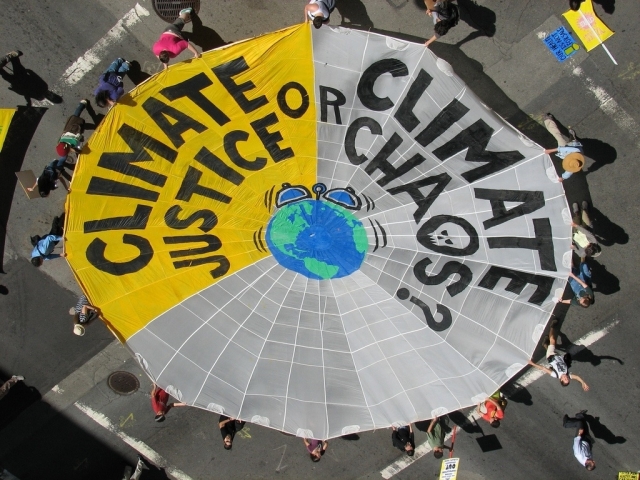
Establishing an AEPF Climate Justice Working Group
July 1, 2009 | Dorothy Guerrero
Why a Working Group on Climate Justice in AEPF?
This year’s G8 Summit, which was held in L’Aquila, Italy from July 8 to 10 offered one more opportunity for leaders from major economies to break the climate deadlock by demonstrating their political will in solving the climate crisis and produce something substantial on the table on key issues of technology cooperation and financing. Unfortunately, that opportunity was once more missed. For those following the negotiations in the UN Framework Convention on Climate Change (UNFCCC), this is not surprising for the divide between the interests of developed and developing countries are huge and the contradictions related to offered solutions are getting bigger.
The key issues in the climate negotiations are: a). the long-term goals for emission reductions and avoiding dangerous climate-change impacts, b). adaptation, and c). the introduction of a technology-transfer mechanism and the connected issue of financing that process to allow developing countries to move towards low-carbon economies. Many developing countries still consider the key negotiating texts favorable to developed nations.
The problem with the ongoing UNFCCC negotiations is that the principle of justice is glaringly absent. The basic and undeniable truth in the climate change issue is that the wealthy minority of the world’s countries and corporations, many of them based in the EU, are the principal cause of climate change while the adverse effects are being felt first and foremost by the poor majority. However, this is the big elephant in the room that is being ignored in the talks. The common view among climate campaigners is that the Copenhagen Summit will not deliver just solutions to the climate crisis considering the current state of the negotiations
Climate debt of the developed countries
According to the 2007 study produced by the International Panel on Climate Change, the atmospheric concentration of greenhouse gasses started to increase since the industrial revolution, but the most dramatic increase can be seen from the period 1970 to the present. The atmospheric space is humanity’s commons where we share equal rights and equal responsibilities. However the past, present and the proposed future share between rich and poor countries of this commons shows a grave inequality.
Since 1850, the per person emission of the population of developed countries (or historical emissions), already reached 70%. With 20% of the total world population it is clear that they already used up more than their fair share. This disproportionate share means the denial of space to poor countries and communities. Now the negotiations about targets for decreasing per country emissions until 2050 is about how much can everyone still get from the remaining atmospheric space. The North’s pressure for developing countries, especially China and India to take mandatory reduction targets can be seen as the North’s attempt to deny the opportunity for development to these countries. Some of the developing countries (ex. Bolivia, Honduras, Nicaragua and Venezuela), already presented a position about the historical responsibilities of the rich countries to global warming and this is gaining support from the G77 and China formation.
Many rich member countries of the EU are avoiding their responsibilities
All scientific studies shows that a more than two degrees increase in global temperature is the tipping point for the ecosystems. In the UNFCCC, Southern countries argued that Annex 1 countries (those that have promised to limit their greenhouse gases by 2012 in the UNFCCC) should commit first to a 40% reductions below 1990 levels by 2020 to avoid that. This is still a bottleneck in the UN negotiations. The EU, which regards itself as the vanguard of climate policy, is offering a unilateral 20 percent reduction below 1990 levels by 2020 while India, with 1.2 billion people and currently emitting 4.6% of the total global emissions, is being forced to agree to a 7-15% cut.
The G8 adopted last week that developed countries should reduce their greenhouse gases by 80% by 2050 to prevent the more than two degrees increase in global temperature. This cut will not prevent temperature increase, as the 2007 IPCC study already shows that the required global cut should be 85% by 2050. It also hides a lot of contradictions. If we look at the policies of many EU countries, it includes buying up an average of 50% of the reduction from abroad. The UK for example, will offset half of its emissions to other countries. This automatically means paying other countries to take in their emission and avoid pollution within its territory, which is a mockery of the principle of common responsibilities. Emission rights now costs trillions of dollars (Financial Times estimate is $1 T/year).
According to the US Energy Information Administration, the 39 Annex 1 countries produce 51% of global emissions now. Most will likely do what the UK is planning to do, which is to buy reductions of about 20% of the world’s total carbon production. By selling their right to emission by means of absorbing developed countries’ carbon offset, poor countries would need to cut their own emissions. The outcome: the rich will continue to pollute while the poor must cut their emissions. This means locking the South in poverty as this will arrest their capacity to produce goods, improve livelihoods and living conditions of people.
Meanwhile the adverse effects of the historical and continuing high per person emissions of rich countries on poor communities and countries continue. In Asia the current and future impacts of climate change are:
- Glacier melt in the Himalayas is projected to increase flooding, rock avalanches from destabilized slopes, and affect water resources within two to three decades. River flows will decrease as the glaciers recede. Decreased Freshwater availability in Central, South, East and Southeast Asia – along with population growth and increasing demand, could adversely affect up to 1.2 billion people by 2020.
- 30% yield reduction in agriculture in Central and South Asia by 2050. Rain-fed agriculture is expected to drop by up to 50% by 2020 leaving millions without food.
- Indigenous and local communities are affected by changing ecosystems and threats to traditional livelihoods.
- The poor communities in concentrated coastal and river flood plains risk flood.
- Expected rise of diarrheal disease in East, South and Southeast Asia. Increased coastal water temperature would exacerbate the abundance and/or toxicity of cholera in South Asia. 220 to 400 million more people could be exposed to malaria (UNDP).
Another block in the negotiations is about financing for adaptation and mitigation measures and access to technology by developing countries. Developed countries argue that in the WTO regime the intellectual property rights related to such technologies must be respected. Developing countries argue that they should have easy access to such technologies since they are not the ones which created the climate crisis in the first place.
Those affected by climate change must be heard Short-term economic interests are driving the negotiations. Climate change is happening now and will continue to produce grave impacts to poor people in Asia and Europe. If we are to achieve long-term effective and equitable solutions to the climate crisis, it is vital that those calling for genuine climate justice look at the Europe-Asia dimension of the debate. The EU must not continue to steal the skies from Asia. The communities and movements affected by climate change in the two regions, have much to contribute in terms of mobilizing public opinion, and providing analysis and policy alternatives.
Draft made by:
Dorothy Guerrero
Focus on the Global South July 2009