WEBINAR: FOLLOW THE (Peoples’) MONEY – How the Governments of the world’s biggest economies are spending Public Funds in response to the Multiple Crisis: COVID19, Economic Crisis, Climate Crisis”

WEBINAR: FOLLOW THE (Peoples') MONEY - How the Governments of the world's biggest economies are spending Public Funds in response to the Multiple Crisis: COVID19, Economic Crisis, Climate Crisis

AEPF joined Asia People’s Movement on Debt and Development (APMDD), Fight Inequality Alliance Asia and ActionAid to co-host an online event titled FOLLOW THE (Peoples’) MONEY: How the Governments of the world’s biggest economies are spending Public Funds in response to the Multiple Crisis: COVID19, Economic Crisis, Climate Crisis 

The webinar was held Live on 17 July 2020, and is available to view on the AEPF website and on Facebook.

Speakers of this webinar included a number of researchers and activists from both Asian and European countries.

Lidy Nacpil is a member of AEPF’s Climate Justice cluster, cofounder of the Fight Inequality Alliance, and coordinator of Asian Peoples’ Movement on Debt and Development. She is also co-coordinator of the Global Campaign to Demand Climate Justice, serves on the coordinating committee of the Financial Transparency Coalition, and is Vice President of the Freedom from Debt Coalition based in the Philippines. Lidy began by offering a general overview of these multiple and overlapping crises, and the role that our governments, financial institutions and corporations are playing to largely exacerbate these crises. 

Tim Jones was the second speaker on the panel. Tim is head of policy at the Jubilee Debt Campaign UK, a UK based organization that campaigns for cancellation of unjust debts in solidarity with campaigners in the global South and for households affected by debt in the UK. Tim spoke about discussed the Fiscal Response Measures to the COVID19 crisis taken by governments in the UK, US, Japan, Germany and elsewhere, as well as the current role of international financial institutions including the IMF and WB.

The next speaker was Iolanda Fresnillo, senior policy and advocacy officer at Eurodad – the European Network on Debt and Development, which works for debt justice. She is also active in the Spanish Citizens Debt Audit Platform and other local and international social movements. Iolanda worked for over a decade as a researcher at Debt Observatory in Barcelona and as a research consultant at MSF France International Institute, as well as several local authorities in Catalonia and Spain. She discussed the Debt Service Suspension Initiative of the UN.

Claire Miranda is senior policy and program officers of the Asian Peoples’ Movement on Debt and Development. She’s worked with the secretariat at APMDD for 11 years under several campaigns and programs. She’s currently leading APMDD’s work on the Green Climate Fund, monitoring both meetings and decisions, providing relevant updates and analysis. Claire spoke about the G20 government’s commitments and the failure to deliver climate finance given the climate crisis.

Alex Doukas is the Stop Funding Fossil Fuels Program Director at Oil Change International. His work focuses on ending international subsidies and public finance for fossil fuels and shifting public resources towards building a clean energy future, including funds for access to energy. Alex spoke about the continued public subsidies for fossil fuels into the year 2020, at a time when GHGs are supposed to be peaking globally.

The webinar and lively Q&A sessions were moderated by Vidya Dinker of INSAF and Kris Vanslambrouck, member of AEPF CJ cluster and 11.11.11.

This event was designed for researchers and advocates to share knowledge and concerns with a wider audience regarding how public funds are being used in response to the COVID19, economic and climate crises. The webinar was strategically held the day before the July 18 and 19 G20 preparatory ministerial meetings of the Finance Ministers and Central Bank Governor in the lead up to the G20 Leaders Summit scheduled in Saudi Arabia in November this year. 

As governments of the world’s biggest economies,  their policies and actions – individually and as the G20 – have huge impacts globally.  As we brace ourselves for the further worsening of the COVID19 pandemic, the deep economic crisis it has spawned, and climatic changes that threaten the entire planet   —  we are spotlighting how these governments are responding across these multiple crises, in particular their use of public funds.  

This webinar looks at and compares the following:

 The 90-minute webinar provides information, analysis and perspectives on the general landscape on these issues and is the kick off to a series that will delve deeper in specific topics in the coming weeks.

Also read:
The G20 continues to ignore calls to cancel the debts of the world’s poorest countries and stop funding fossil fuels
(Dorothy Grace Guerrero on Global Justice Now)

Read More

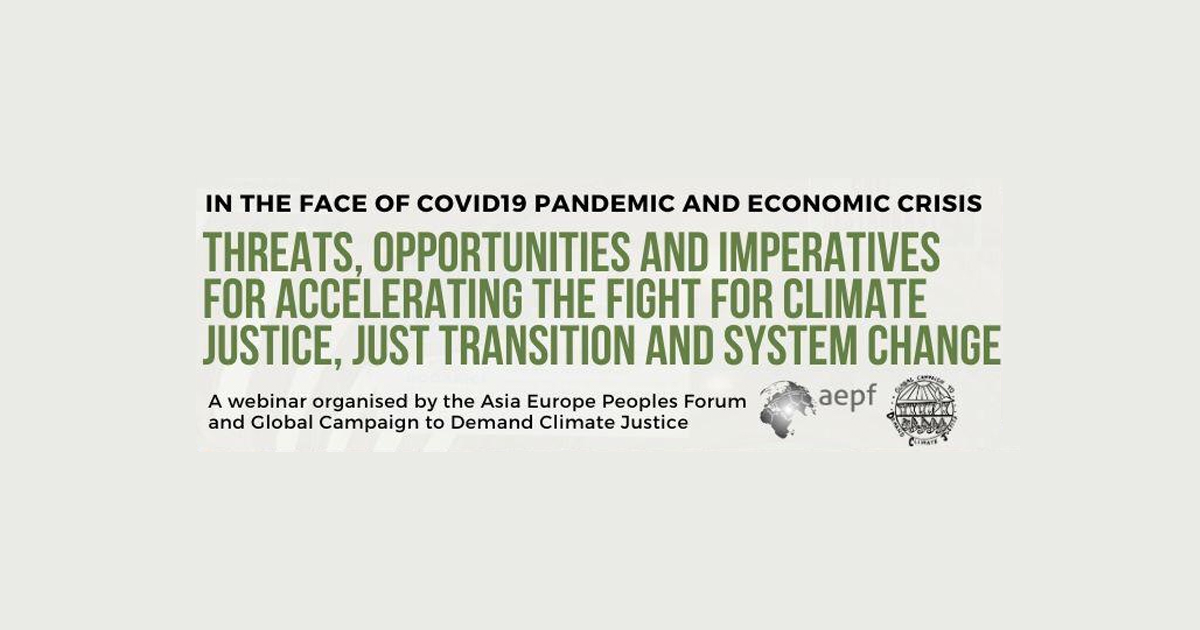
Webinar: In the face of the COVID-19 pandemic and economic crisis, we are confronted simultaneously with threats, opportunities and imperatives for accelerating the fight for climate justice, just transition and system change.

Webinar: In the Face Of Covid-19 Pandemic and Economic Crisis - Threats, Opportunities and Imperatives For Accelerating the Fight For Climate Justice, Just Transition and System Change

Watch the Webinar 

At the start of the nearly global lockdown, many climate activists hoped that the COVID19-pandemic would send a strong signal that a return to the ‘old’ normal would be impossible.
This global shock crisis should be a strong warning that our current neo-liberal system is very fragile, because it does not build strong social and environmental fundamentals and institutions.

In this webinar, Moshin Abdali (PKRC, Pakistan), Molly Walsh (Friends of the Earth Europe), Vijoo Krishnan (AIKS, India), Asad Rahman (War on Want, UK) and Lidy Nacpil (APMDD, Philippines) reviewed the current situation and and identified some crucial points of action to promote and prepare policies towards a just transition.

Moderators: Dottie Guerrero & Tabby Spence facilitated the session.

Informal sector workers feel the burden

Moshin: “For months, Pakistan was in a state of confusion. While the government downplayed the potential impact of the virus, religious leaders used this opportunity to spread misinformation and show that they can act independently. The government tried to prevent a total lockdown, knowing that 73% of the workforce is dependent on daily wages, putting the economy to a stop, would mean people going hungry. As the number of infections started to rise, the government had no other options than to close parts of the economy, but soon, it became very clear that there was no plan nor budget to address the needs of the informal workers.”

Building stronger International solidarity Molly questioned the lack of an internationalist approach to fight the pandemic: “At the start of the lockdown, I was hopeful that this would result in something better, that for once, the experts and science would prevail, and that solidarity would be the way to
handle this crisis. But, very soon, we observed a growing nationalism and opportunist policy makers. The climate movement always have to keep our minds open, we have only one way to go: building stronger and broader alliances to realise our big ideas.”

Divisive leadership

Vijoo deplores that fact that the government lost 2 crucial months in fighting the spreading of the virus. “Our leaders were busy creating racial divisions and organising the Trump visit. PM Modi gave that a higher priority. He also launched new reforms which paved the way for a more large scale agriculture, which goes against the need to decarbonise our economy.”

Magnifying inequalities

Asad points out that the COVID-16-crisis exacerbates the existing inequalities between people and between states. “Millions of people are dropping back into poverty, the death rates are highest
amongst the precarious classes. To address these challenges, we need a clear response: governments have to stop austerity and massively increase public spending. However, what do we observe? Stimulus packages are designed to serve the big polluters, such as the automobile industry and airlines while 50% of the jobs in the Global South are at stake. Thirty years of painful economic growth will be wiped out by one single virus, and who will benefit from the current climate finance schemes, the Global North, as the South is struggling to survive, Northern countries can borrow very cheap, while the weaker countries have to pay higher interests. “

Rebooting our economic order

Lidy looks at ways how to push our agendas. “First of all, we have to empower communities and CSOs in responding to the suffering.

They are in need, so they need more relief. Secondly, We have to denounce the incompetence of our leaders, they just serve the elite and sow fear and terror amongst the common people.
Thirdly, we need to reboot our economic order. The current system fails dramatically, we need changes which result in a sustainable, just, equitable, resilient, post-carbon and non-capitalist society. Fourthly, we have to broaden our movement, we need action and determination to shift to balance of power.”

What strategies to achieve change?

Lidy: We need to monitor the global situation very closely, and understand very well what is going on. Asad adds: there’s close link between the Black Lives Matter-movement and the one urging for
Climate Justice. Is this an opportunity for young Europeans to get more involved into politics? We have to be ready with a clear solidarity message, build a narrative of the ‘we’, not ‘us vs them’.

Our role should be to provide political education, and present an agenda of transformation, in terms of healthcare, social and climate justice, clean energy, healthy food and protection of the public goods.

Vijoo sees one big potential for unifying people: bring a clear message on the need for affordable and social housing. This crisis has clearly shown which families can respect physical distancing, and which cannot. The state must play an active role in realising that agenda.

Molly warns us not to wait for the perfect opportunity, we have to use every occasion to present and defend our agenda. We have inspiring proposals on energy transition, participatory democracy and restoring equality. Moshin confirms the internationalist and revolutionary perspective of our movement: “We need to give concrete answers to people’s concerns, not just present a mild reformative agenda, but answers which excite the imagination.”

Not the virus is the real enemy, we have to find race, climate and capital injustice.
One way to internationalise the struggle is to find common targets and common arenas. Wherever we speak, we should speak the same language, therefore, common platforms, like the AEPF are important as they provide space for interaction between CSOs and movements. Unfortunately, we cannot have face to face meetings to build stronger links, but we have to optimise the online opportunities to build cross sector alliances.

Next to the common narrative, it is also important to keep on exposing the imperial role of our way of living, especially amongst the elites. If we are really honest in fighting for a better world we have to identify our enemies and how they are exploiting people and nature. This is the first step to imagining a better world, and how to get there.

War on Want together with many organisations launched the Global Green New Deal, the search for a global intellectual framework to build the path of the directions to take towards our ‘utopia’. As we have united forces in the past vs the WTO, we should consolidate ourselves to fight the corporate control of the G7, G20 and COP 26. We can unite more people by bringing class back into the conversation and the struggle.

Our language must be uniting the global South and North. Because not this virus is the real enemy, no, race, capital and climate are undermining our system and planet. We can mobilise along the need for clean and green jobs, shifting away resources from fossil fuels and debt payments and for more local food systems.

Despite the pandemic, the struggle goes on! 

We can be proud of our movements, because in times of lockdown and all kinds of authoritarian restrictions, we have been more active than ever. We have totally revised our plans for 2020, and
while some are focussing on assisting local communities, others are building more awareness and resistance. It is clear that these actions are all very much needed in building the ‘bigger we’ as we
have a huge task ahead, we have to expose the failures and inconsistencies of the current system. It is clear, we don’t want the old normal to return, the time is ripe for something new, something better, we need policies which address the real problems and bring more prosperity, security and safety for all.

Read More

AEPF Joins Week of #GlobalStrikeAction (September 20-27, 2019) Bangkok

AEPF Joins Week of #GlobalStrikeAction (September 20-27, 2019) Bangkok

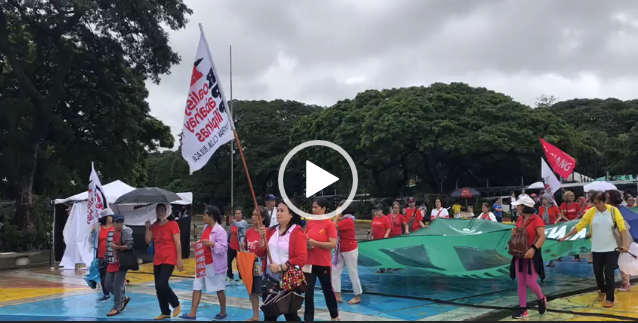
AEPF joined a mass public action during the Global Strike Action September 20-27 in Bangkok. Along with our local partners especially the Asian Peoples Movement on Debt and Development, there were demonstrations, posters, twitter storms in front of the UN Building in Bangkok. AEPF activists in these four brief videos argue that climate justice is linked with social justice. The main demand is that the world collectively and fairly find ways to stop the use of fossil fuels.

Please find some of the videos for the same below:

‘Friends of the Earth’ at the AEPF #GlobalStrikeAction (September 20-27, 2019)
Edo from ‘Friends of the Earth’ represents a network of more than 400 Indonesian Civil society groups is part of the AEPF #GlobalStrikeAction (September 20-27, 2019) action on climate emergency in Bangkok.

Global Campaign for Social Justice at the AEPF #GlobalStrikeAction (September 20-27, 2019)
Nathan Thankim of the Global Campaign for Social Justice, joins AEPF #GlobalStrikeAction (September 20-27, 2019) outside the UN Building Bangkok, demanding social justice as necessary for climate justice

Asian Peoples Movement on Debt and Development (APMDD) at AEPF #GlobalStrikeAction (September 20-27, 2019)
Liddy Nacpil from the Asian Peoples Movement on Debt and Development with AEPF and others during the UN Week on Climate Justice and # Global Strike Action (September 20-27, 2019). Lidy says that climate emergency demands that the use of fossil fuels should end.

Portuguese activists at the AEPF #Global Strike Action (September 20-27, 2019)
Portuguese activists join the AEPF #GlobalStrikeAction (September 20-27, 2019). The main demand is that the world collectively and fairly find ways to stop the use of fossil fuels.

Read More

AEPF Study and Strategy Meeting on Climate and Energy

AEPF Study and Strategy Meeting on Climate and Energy

Around COP23 in Katowice, Poland 30 November to December 2, 2018

The meeting on Climate and Energy built on the outcomes of the Cluster’s previous activities, the Seminar in Bangkok in September 2018 during the COP Intersessional, focusing on Financing of Fossil Fuels, and the Custer’s sessions during the AEPF12 Conference in Gent at the end of September 2018, which discussed various experiences from campaigns against Fossil Fuels.

During the workshop, unities were built along these campaigns on Climate and Energy. Various strategies were developed to strengthen our campaigns against public subsidies of fossil fuel project, such as targeting the G20 countries and using the G20 summit in 2019 as a key political moment. It was an opportunity to learn from specific oil and gas campaigns. The latter is quite new for Asian civil society organisations. We welcomed the presence of Gastivists to share their campaign ideas. We also got more information from geo-engineering and recent developments in the climate and energy topics.

Download: AEPF Study and Strategy Meeting on Climate and Energy

Read More

AEPF Study and Strategy Seminar on Fossil Fuel Finance

AEPF Study and Strategy Seminar on Fossil Fuel Finance

September 3 -7, 2018, Bangkok, Thailand

Vital meeting looking at trends in financing coal and fossil fuels and developing strategies to respond and change.

The conference had three main discussions:

  • Analysis of the current financiers of coal and fossil fuels
  • Common strategies to engage with and confront institutions as institutions, not just on a project by project basis
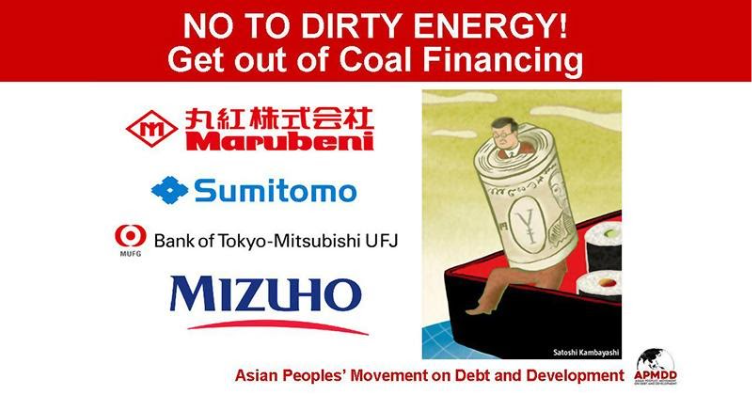
  • Challenging Asian financiers including some of the world’s biggest coal financiers specifically Japanese, Korean and Chinese financiers

Download:
Outcome Summary: AEPF Study and Strategy Seminar on Fossil Fuel Finance – September 3 -7, 2018, Bangkok, Thailand

Read More

State or cooperative ownership? Two means of restructuring public service in the German energy transition

State or cooperative ownership? Two means of restructuring public service in the German energy transition

March 15, 2018 | Sören Becker

Energy as a core public service

Energy systems are embedded in the social relations they enable. The way we harvest and use energy for production, recreation and transport is a vital condition of modern life, and a condition of capitalism as a regime of production and a form of society (Altvater 2007, Huber 2009). Regarding recent openings and transitions towards renewable energy, optimists here refer to Hermann Scheer’s (2007) hypothesis that the decentralised character of renewable energy technologies would also lead to more decentralised ownership structures, and hence a more democratic energy system.

I will not discuss the extent to which these expectations are fulfilled or not, I will seize the opportunity of this short paper to shed some light into the different aspects of organisation and ownership that came to the fore within Germany’s energy transition. I will contrast the cooperative model with a new form of public ownership proposed by social movements: the participatory utility. This short discussion could inform debates about how to organise alternative aims and pathways for participation in public services, in the energy sector and beyond.

New forms of ownership in the German energy transition

From 2005 onwards there are two major trends that challenge concentrated structure of energy markets: the increasing numbers of energy cooperatives and remunicipalisation, meaning the (re-)introduction of state ownership. Both of them depict collective forms of ownership that are distinct from privatised structures which were established before in the wake of liberalisation. Both were set in the context of the roll-out of renewable energy as a tool for reducing greenhouse gas emissions and complement to the phase-out of nuclear energy in Germany (Gailing and Röhring 2016a). Noteworthy, it was the funding scheme based on feed-in tariffs (according to the Renewable Energy Act EEG) which rendered even small-scale, “citizen energy” installations a good investment (Holstenkamp and Kahla 2016, Islar and Busch 2016); and that resulted in a largely decentralised ownership pattern for renewable energy installations. In a study for the year 2012, it was found that about 50 per cent of all renewable energy capacities in Germany are owned by either citizens or farming businesses (trend:research and Leuphana Universität Lüneburg 2013). This shift towards smaller forms of ownership has thus also been interpreted as a decentralisation of energy provision, both in organisational and spatial terms (Gailing and Röhring 2016b, Klagge and Brocke 2012). Similar developments are discussed internationally; see for example the discussion on “community energy” in the United Kingdom (Becker et al. 2017, Seyfang et al. 2013). So to speak, the transition towards renewable energy opened up a new field of energy technology that was occupied by new actors as owners and new spatial dynamics in the context of Germany’s energy transition.

Out of these different collective forms of ownership, energy cooperatives gained most attention in research and public discourse (Yildiz et al. 2016). This is due to an unprecedented dynamic in the formation of energy cooperatives. Since 2005, 812 energy cooperatives were founded with an accumulated number of about 165,000 members, producing an average of 223 members per cooperative (DGRV 2016). Out of these, 86 per cent are active in the generation of electricity, mainly through wind and solar capacities built up. These cooperatives sell renewable electricity according to the feed-in tariff scheme of the Renewable Energy Act. 19 per cent of German energy cooperatives run district heating networks that provide members with heat through mostly insulated networks. Here the cooperative does not only own the capacities for heat generation, but also the adjacent distribution grids. 1 per cent of the cooperatives is running or seeking to run an electricity grid, on a local or regional basis. These cooperatives ideal-typically do not own generation facilities. With recent changes that include the stepwise replacement of the feed-in-tariff system by an auction model prompting allocating bigger installations, the dynamic of cooperative foundation has decelerated (Müller and Holstenkamp 2015). As will be shown below, energy cooperatives are a means to directly involve citizens as owners of energy infrastructure, their political features, however, are sometimes difficult to assess.

Remunicipalisations are a slightly different, but a no less dynamic phenomenon. Remunicipalisations refer to the (re-)introduction of local state ownership in energy infrastructures and/or utilities. Remunicipalisations are an international phenomenon that covers a wide variety of sectors, including waste, water, public transport and other municipal services (Hall et al. 2013, Kishimoto and Petitjena 2017). However, the dimension of remunicipalisations in the German energy sector is without equivalent in other countries or sectors (ibid.). Counting new entries in commercial registers, Lormes (2016) accounted for 122 newly founded local utilities from 2005 to mid-2014 (p. 334). These make up a large part of the 845 local utilities accounted in the official statistics of the year 2011 (ibid.). 90 per cent of these occurred in municipalities with less than 50,000 inhabitants, two third even in the range of municipalities with 10,001 to 20,000 inhabitants. These numbers also include intercommunal cooperation which are more likely to occur in smaller communities (ibid: 334). Other studies relying on different methods of data gathering, including studies of press reports or surveys among trade union members or data provided by the Association of Municipal Enterprises (VKU), confirm these numbers and the information on their spatial distribution and size of the municipalities that remunicipalised at least parts of their system (Berlo and Wagner 2013). While motivations for remunicipalisations span a wide range of arguments including local benefits, employment, and restoring local control over the direction and quality of energy provision, some instances were also based on prospects for accelerating a local energy transition.

New forms of organising participatory public services

This section discusses the concepts according to which four initiatives (one remunicipalisation initiative and one energy cooperative in the cities of Hamburg and Berlin) wanted to restructure ownership relations in the energy provision. It lays out which visions and imaginaries have guided their concepts, but also which are the challenges implied in each of these. These ideas are important in two ways: first, they spell out different forms of participation that contest the given structures around private ownership entitlements. Second, these visions develop forms and strategies to democratise state institutions in a way that would open these up to social movement and citizen demands for equal and sustainable public service provision. As carved out in their publications, however, the pathways for reframing this relationship differ according to the models of ownership: BürgerEnergie Berlin and Energienetz Hamburg are cooperatives relying on membership, while the two remunicipalisation initiatives figure utility ownership by the local state which should be complemented by participatory provisions. This implies a public utility of a new kind; therefore I speak of a “participatory utility”.

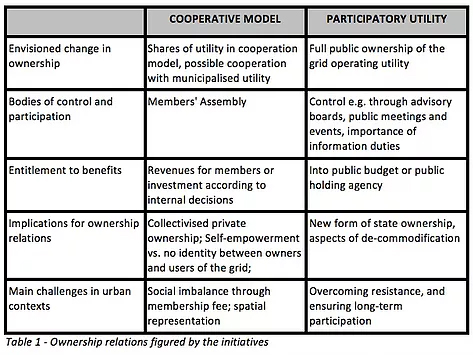
To compare their visions, five criteria were derived from the conceptualisation of ownership as entitlement for control and benefits. These encompass: a) the envisioned change in ownership, in other words, the ownership model the initiatives have targeted; b) the bodies of control and participation envisioned; c) the entitlements for benefits; d) the implications for ownership relations; and e) the main challenges of each model for the implementation of its principles in a diverse urban context (see Table 5).

The cooperatives wanted to achieve a situation in which they would own a part of the shares of the grid operating utility, according to the amount of capital gathered through membership fees and donations. The impetus behind that was to secure citizen influence as a minority shareholder with special rights negotiated with the other owner parties. Thereby the cooperative concept does not necessarily entail a new role for the state in energy provision, although cooperative members stated in interviews that they would rather join forces with a public than a private utility.

The cooperative model defines ownership relations around the principle of membership. That means that the Members’ Assembly is the most important body of control. Here, the fundamental decisions on the strategy of the cooperative are made, while each member therein has one vote regardless of the number of shares owned (Schröder and Walk 2014). Also, members are entitled to share the benefits of operations, or to decide what they should be used for. To become a member, a membership fee is necessary (100€ for Energy Network Hamburg; 5 x 100€ for Citizen Energy Berlin). While others have highlighted that energy cooperatives can be interpreted as self-empowerment for people to their energy system (van der Schoor and Scholtens 2015), it is important to note that there is no identity between owners and users in this model (cf. Novy 1985: 127). In an abstract sense one can argue that the entitlements implied in the ownership relation as such are transferred to the collective of the members; which, in turn, is still constituted of a limited group of owners. In this sense, the cooperative model could be described as “collectivised private ownership”. The two main challenges deriving from this ownership model refer to, first, the unknown extent of rights granted to the cooperative for having an effective influence on the business strategy of the grid operator they own minority shares; and, second, a potential social and spatial imbalance as the fee granting admission could become a hurdle for poorer households to become a member. The latter could also have a spatial implication on membership when there is a higher representation of more affluent neighbourhoods within the city itself. In order to gain as much capital as possible, none of the cooperatives has been restricted to citizens of the respective cities only, so that also interested non-locals could become members (yet there is no spatial data on the ownership structure available). Summing up, the cooperative model provides for a high degree of internal equality and democracy, while their general scope is, at the same time, limited by the membership approach and the necessary cooperation with another utility.

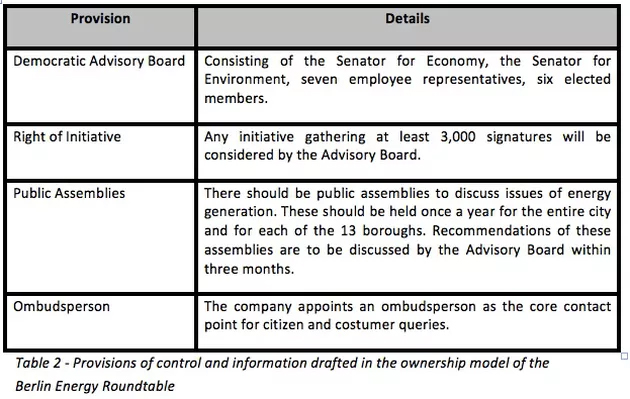
Against the internally democratic, but limited approach of the cooperative model, the approach of the participatory utility is wider in scope. The initiatives here targeted full public ownership of the physical grid and the operating utility. In this sense, the control and entitlements to benefits produced by grid operation should be transferred to the state. Noteworthy, what the initiatives had in mind was more than a traditional local public utility; instead they were striving for public ownership tied to targets around renewable energy and social equity, and, most important here, citizen participation and control. For this reason, remunicipalisation initiatives in both cities either have inscribed the principle of democracy (as in Hamburg) or deliberately spelled out concrete participatory and information mechanisms (as in Berlin) into the voting template for the referendum. Table 6 here shows the different provisions for control and information considered in the Berlin model in an exemplary way. The intention is to enable citizens to exert influence on the guidelines and practices of the utility. This should be achieved through designing organisations that have inscribed information and participation duties. Hence, the entitlements of control here differ from traditional models of public ownership with more limited means of control. These provisions, taken together, put forward a new form of state ownership enriched by models of participation and steps towards de-commodification, in the sense of both user integration and non-financial aims.

This participatory approach is meant to ensure the ambitions of the project itself. Past evidence shows that public ownership does neither prevent a commercialisation, nor a future privatisation of the utilities (Wissen and Naumann 2006). Hence the activists were sceptical towards the state as the embodiment of general interest of its population. The solution here was to institutionally design a utility that would be open for citizen, and, hence, social movement demands even in the long term. Further, the more “soft” aims of social justice and climate compatibility should also be inscribed into the practice of the utilities. However, therein lay two main challenges: first, the ongoing discussions about the referendum in Hamburg show that in the phase of implementation there are a number of resistances to be overcome, for example referring to different notions of how to actually fulfil the aim of social justice or democracy in the design and practice of the utility, potentially diluting the original aims of the initiatives. Even if participatory provisions as means for user and social movement influence are actualised, the second challenge here rests in ensuring their effective use over the long term. Overall, the participatory utility approach in both cities extends traditional ownership relations as they spell out and redefine entitlements for control, and potentially also for the use of benefits.

A short conclusion

Summing up, both remunicipalisation initiatives and energy cooperatives have outlined alternative forms of ownership for the energy provision of the two cities, each according to their own organisational model. If actualised they would redefine the relations of ownership in energy, in the sense of reversing privatisations in the two cities, and in a more underlying sense of redefining who controls and benefits from the operation of the energy network. In the cooperative model, the group of owners would be widened to those who became members of the cooperative, in the participatory utility citizens would be granted rights of information and participation. In a broader picture, these suggestions carry the potential to also redefine the relations between the state, private businesses and citizens in energy provision – in the way of inscribing entitlements of control for mainly citizens, while also ascribing a core role to the state. In short, while the biggest challenge in the cooperative model is ensure an egalitarian representation of the population as cooperative members, the crucial point in the participatory state model is to actually realise effective participation of everyone interested. The implementation of such models, of course, relies on the power geometries that define political struggles. Interestingly, it happened in the crucial sector of energy that these openings could be seized, yet, a transfer of these models and the debate around it to other sectors of public services need to take into account their specific conditions, technological and organisational arrangements, and lastly, their regulatory framing.

REFERENCES

Altvater, Elmar (2007): The social and natural environment of fossil capitalism. In: 43, pp. 37–59.

Becker, Sören; Kunze, Conrad; Vancea, Mihaela (2017): Community energy and social entrepreneurship: addressing purpose, organisation and embeddedness of renewable energy projects. In: Journal of Cleaner Production 147, pp. 25–36. DOI: 10.1016/j.jclepro.2017.01.048.

Berlo, Kurt; Wagner, Oliver (2013): Stadtwerkeneugründungen und Rekommunalisierungen. Energieversorgung in kommunaler Verantwortung. Wuppertal: Wuppertal Institute. Online https://wupperinst.org/uploads/tx_wupperinst/Stadtwerke_Sondierungsstudie.pdf.

Bontrup, Heinz-J.; Marquardt, Ralf-M. (2011): . 2nd edit. Berlin: Ed. Sigma.

Gailing, Ludger; Röhring, Andreas (2016a): Is it all about collaborative governance? Alternative ways of understanding the success of energy regions. In: –10.1016/j.jup.2016.02.009.

Gailing, Ludger; Röhring, Andreas (2016b): Germany’s Energiewende and the spatial reconfiguration of an energy system. In: Gailing, Ludger; Moss, Timothy (eds.): . London: Palgrave Macmillan UK, pp. 11–20.

Holstenkamp, Lars; Kahla, Franziska (2016): What are community energy companies trying to accomplish? An empirical investigation of investment motives in the German case. In: 97, pp. 112–122. DOI: 10.1016/j.enpol.2016.07.010.

Huber, Matthew T. (2009): Energizing historical materialism: fossil fuels, space and the capitalist mode of production. In: 40 (1), pp. 105–115. DOI: 10.1016/j.geoforum.2008.08.004.

Islar, Mine; Busch, Henner (2016): “We are not in this to save the polar bears!” The link between community renewable energy development and ecological citizenship. In: 29 (3), pp. 303–319. DOI: 10.1080/13511610.2016.1188684.

Kishimoto, Satoko; Petitjean, Olivier (eds.) (2017): . Amsterdam: Transnational Institute.

Klagge, Britta; Brocke, Tobias (2012): Decentralized electricity generation from renewable sources as a chance for local economic development: a qualitative study of two pioneer regions in Germany. In: 2 (1), pp. 5. DOI: 10.1186/2192-0567-2-5.

Lormes, Ivo (2016): . Wiesbaden: Springer VS.

Morris, Craig; Jungjohann, Arne (2016): . Cheltenham: Palgrave Macmillan.

Müller, Jakob R.; Holstenkamp, Lars (2015): Zum Stand von Energiegenossenschaften. Aktualisierter Überblick über Zahlen und Entwicklungen. Lüneburg: Leuphana Universität Lüneburg. Online http://www.leuphana.de/fileadmin/user_upload/Forschungseinrichtungen/professuren/finanzierung-finanzwirtschaft/files/Arbeitspapiere/wpbl20_energiegenossenschaften2014_final.pdf.

Novy, Klaus (1985): Vorwärts immer – rückwärts nimmer: historische Anmerkungen zu einem aktuellen Problem. In: Bierbaum, Heinz; Riege, Marlo (eds.): . Hamburg: VSA, pp. 124-141.

Scheer, Hermann (2007): . London; Sterling: Earthscan.

Schröder, Katrin; Walk, Heike (2014): Opportunities and limits of cooperatives in times of socio-ecological transformation. In: Freise, Matthias; Hallmann, Thorsten (Eds.), Modernising Democracy? Associations and Associating in the 21st Century. Springer, New York, pp. 301-314

Seyfang, Gill; Park, Jung Jin; Smith, Adrian (2013): A thousand flowers blooming? An examination of community energy in the UK. In: 61, pp. 977–989. DOI: 10.1016/j.enpol.2013.06.030.

trend:research; Leuphana Universität Lüneburg (2013): . Bremen, Lüneburg. Online https://www.buendnis-buergerenergie.de/fileadmin/user_upload/downloads/Studien/Studie_Definition_und_Marktanalyse_von_Buergerenergie_in_Deutschland_BBEn.pdf.

van der Schoor, Tineke; Scholtens, Bert (2015): Power to the people: local community initiatives and the transition to sustainable energy. In: 43, pp. 666–675. DOI: 10.1016/j.rser.2014.10.089.

Wissen, Markus; Naumann, Matthias (2006): A new logic of infrastructure supply: the commercialisation of water and the transformation of urban governance in Germany. In: 33 (3), pp. 20–37.

Yildiz, Özgür; Rommel, Jens; Debor, Sarah; Holstenkamp, Lars; Mey, Franziska; Müller, Jakob R. et al. (2015): Renewable energy cooperatives as gatekeepers or facilitators? Recent developments in Germany and a multidisciplinary research agenda. In: Energy Research & Social Science 6, pp. 59–73. DOI: 10.1016/j.erss.2014.12.001.

* Dr. Sören Becker is a geographer interested in alternative ways of organizing infrastructure and technology in cities. He works and publishes on energy remunicipalisation and community energy was published in various academic articles. He is working as a researcher at the University of Bonn and Humboldt University Berlin.

Read More

CLIMATE AND ENERGY – CONCEPT NOTE AND WORKSHOPS

CLIMATE AND ENERGY - CONCEPT NOTE AND WORKSHOPS

October 6, 2016

Draft CONCEPT NOTE for CLIMATE and ENERGY
Asia Europe Peoples Forum, Ulaanbaatar, Mongolia, July 4-6, 2016

The climate crisis has already reached the level of a planetary emergency. At nearly one-degree Celsius increase of the global average temperature since pre-industrialization – climate change has already been causing massive loss, destruction and destabilization of ecosystems and communities all over the world but most especially in the South.

Several years ago, climate justice movements were calling for urgent actions that would keep temperature rise to below one degree Celsius. Many scientists are now saying that this is no longer physically possible. They say there is still a chance to stabilize the earth’s temperature to below 1.5 degrees Celsius but this will require huge changes and achieving very high targets in the short term.

The Paris Climate Agreement forged last December 2015 stipulates this 1.5 degrees Celsius limit as the aspirational goal of all parties to the agreement. This is being hailed as an important achievement – as indeed this is the most ambitious goal every agreed to by governments. However, the concrete mitigation targets submitted by governments that form a major part of the Paris Agreement fall very short of this 1.5 degree goal. The collective impact of these national targets condemn the world to a 3-degree rise in global temperatures.

More than every, addressing climate change urgently requires peoples movements to intensify, scale up and escalate all efforts for a comprehensive transformation of the global capitalist system which gave rise to this crisis. Such efforts must also aim for concrete short term and medium term victories. What the world will do in the next 5 to 12 years will determine whether the 1.5 degree limit will still be possible, whether we will still have a chance to prevent climate catastrophe.

A crucial sector where major changes should take place immediately and where complete transformation should be completed the in the soonest possible time is Energy.

Many communities and movements in Asia and in Europe are fighting long-standing battles to stop dirty energy and harmful projects. Others are engaged in resisting privatization and corporatization of energy services and fighting for peoples’ right to energy for their basic needs. And increasingly, movements across these energy issues are uniting around calling for the transition to renewable, efficient and democratic energy alternatives for people and communities – as swiftly as possible in a just manner that ensures that workers and communities are not displaced and dislocated — as all are being made aware of the urgency of addressing climate change. Studies indicate that if we are to keep temperature rise to below 1.5 or even 2 degrees – there is just a fixed amount of carbon the world can still emit which requires that most of the current fossil fuel reserves should be kept in the ground.

A dangerous response to the climate crisis is the promotion of false solutions. The danger stems from the following 1) these solutions do not represent real or reliable results 2) these solution become an excuse or a substitute for taking real effective actions 3) these solutions carry other dangers and other harmful impacts on people and the environment 4) these solutions exacerbate inequality and make it possible for elites and corporations to gain profit from climate change and its impacts.

The sessions on Climate and Energy at the AEPF will involve an exchange of information, analysis and perspectives on the Climate Crisis and transformation of Energy Sytems.

There will be three sessions.

Session One:

  1. The current state of play in the climate front and the requirements for stabilizing the earth’s temperature at the safest level still possible — below 1.5 degrees –
  2. What these mean for the transformation of energy systems

Session Two

  1. The current energy situation in Asia and Europe
  2. What movements are doing for energy transformation – resisting dirty energy and breaking free from fossil fuels, opposing false solutions, working for swift and just transition to renewable energy systems for communities and people

Session Three

  1. Exploring and developing concrete joint strategies and strengthening joint actions in the next months and years

Note: The Thematic Cluster ‘Climate Justice – Towards Sustainable Energy Production and Use’ is being coordinated by Rivers Without Boundaries (Mongolia), Asian People’s Movement on Debt and Development, Indian Social Action Forum (INSAF), and Transnational Institute (The Netherlands).

Read More

Climate Justice, Energy Sovereignty and a Social Ecological Transition

Climate Justice, Energy Sovereignty and a Social Ecological Transition

April 30, 2016

By AEPF Working Group, Sitftung Asienhaus, May 2, 2016

The climate movement has picked a struggle it seemingly can not win: 80 per cent of all fossil fuels have to stay in the ground if to avert catastrophic climate change yet fossil fuels remain a large share of the global energy sources; science demands a substantial cut in global emissions within a few years yet bold policies and global treaties are missing; policy makers invite business and corporations to round tables and global negotiations while business strongly oppose any far reaching climate policies; while new fossil fuel mega projects are in the pipeline millions of people lack access to affordable clean energy.

And yet the climate movement has grown substantially in the past decade: Opposing new mega projects, resisting against the fossil fuel’s industry to dig deeper and further, lobbying governments and politicians to ban environmentally destructive practice, and raising voices of those mostly affected climate change, Naomi Klein has coined the term “blockadia”. But blocking every single coal fired power plant will neither be possible nor will it lead to the substantial change needed. Climate change is not only a matter of keeping carbon in the ground or merely a matter of staging loud protest every time climate deals are sealed. It is a question of social justice, a question of power and it demands nothing less than a systemic change in production and consumption patterns, fundamentally addressing power relations between and within countries.

The climate movement is currently at the stage at which it has to move out of its climate silo and link up with other struggles. Struggles for freedom of movement, the fight against gentrification, austerity measures and cut in public services, protest against corporate influence or the need to avert another free trade agreement are important battles. People need to have the right to safely cross borders, whether they flee from war torn countries or whether the loss of livelihoods and environmental destruction is the driving force. The fight against rising prices for basic needs such as housing, transport or medical treatment are in line with the struggle against rising costs for energy for basic human needs. And the resistance against corporate influence, whether it is in secret trade negotiations or global or national legislation processes, is similar to the one against energy corporations seeking profit by wrecking the climate, receiving state subsidies and transferring prices to consumers.

The struggle for climate justice is about making sure that fossil fuels remain in the ground. But it is also about making sure that those people affected have voice in decision making processes. People need to be able to have a say on whether a new coal fired power plant is being build, on what kind of jobs are needed, or how we can move away from a system of resource exploitation and environmental destruction and what a just transition shall look like.

In Europe, radical movements for climate justice have emerged that work with civil disobedience strategies, energy democratisation initiatives and deinvestment. We reject the European Unions claim to be a “leader” in the fight against climate change. While European countries congratulate themselves for timid support of renewable energy, the same companies, banks and governments are investing heavily in new coal and extractive industries in Asia, for example in Indonesia and Mongolia. European movements need to connect up with Asian activists to confront this hypocrisy and to transnationalise their strategies. There is also a lot to be learnt from each other in terms of successful initiatives and modes of resistance. More fundamentally, we need to discuss and perhaps reconcile different perspectives – including resource nationalism, neo-extractivism, climate debt, degrowth and socio-ecological transition – in a way that reflects differential and uneven development. AEPF can be a platform to facilitate and initiate such a discussion.

Read More

Swamped by Rising Seas, Small Islands Seek a Lifeline

Swamped by Rising Seas, Small Islands Seek a Lifeline

August 17, 2014

UNITED NATIONS, Aug 11 2014 (IPS) – The world’s 52 small island developing states (SIDS), some in danger of being wiped off the face of the earth because of sea-level rise triggered by climate change, will be the focus of an international conference in the South Pacific island nation of Samoa next month.

Scheduled to take place Sep. 1-2, the conference will provide world leaders with “a first-hand opportunity to experience climate change and poverty challenges of small islands.”

For low-lying atoll nations particularly, the high ratio of coastal area to land mass will make adaptation to climate change a significant challenge.
According to the United Nations, the political leaders are expected to announce “over 200 concrete partnerships” to lift small islanders out of poverty – all of whom are facing rising sea levels, overfishing, and destructive natural events like typhoons and tsunamis.
“We are working with our partners – bilaterally and multilaterally – to help resolve our problems,” said Ambassador Ali’ioaiga Feturi Elisaia, permanent representative of Samoa to the United Nations.
“You don’t have to bring the cheque book to the [negotiating] table,” he added. “It’s partnerships that matter.”
The issues on the conference agenda include sustainable economic development, oceans, food security and waste management, sustainable tourism, disaster risk reduction, health and non-communicable diseases, youth and women.
The list of 52 SIDS covers a wide geographical area and includes Antigua and Barbuda, Bahamas, Bahrain, Nauru, Palau, Maldives, Cuba, Marshall Islands, Suriname, Timor-Leste, Fiji, Tonga and Vanuatu.
The conference is expected to adopt a plan of action, also called an outcome document, ensuring some of the priorities for SIDS. A preparatory committee, co-chaired by New Zealand and Singapore, has finalised the outcome document which will go before the conference for approval.
Responding to a series of questions, Ambassador Karen Tan, permanent representative of Singapore to the United Nations, and Phillip Taula, deputy permanent representative of New Zealand, told IPS SIDS have “specific vulnerabilities, and the difficulties they face are severe and complex. The small size of SIDS creates disadvantages.”
These can include limited resources and high population density, which can contribute to overuse and depletion of resources; high dependence on international trade; threatened supply of fresh water; costly public administration and infrastructure; limited institutional capacities; and limited export volumes, which are too small to achieve economies of scale.

They noted that geographic dispersion and isolation from markets can also lead to high freight costs and reduced competitiveness. SIDS have limited land areas and populations concentrated in coastal zones. Climate change and sea-level rise present significant risks.
The long-term effects of climate change may threaten the very existence and viability of some SIDS, Tan and Taula said in the joint interview. “SIDS are located among the most vulnerable regions in the world in terms of the intensity and frequency of natural and environmental disasters and their increasing impact. And they face disproportionately high economic, social and environmental consequences when disasters occur.”
These vulnerabilities accentuate other issues facing developing countries in general, such as challenges around trade liberalisation and globalisation, food security, energy dependence and access; freshwater resources; land degradation, waste management, and biodiversity.
Asked how many SIDS have been identified by the U.N. as in danger of being wiped off the face of the earth, they said no such assessment has yet been undertaken.
However, the Intergovernmental Panel on Climate Change (IPCC) recently released its fifth assessment report (AR5), and its Working Group II has recently issued its contribution to that, on ‘Climate Change 2014: Impacts, Adaptation, and Vulnerability’.
The report warned that small islands in general are at risk of loss of livelihoods, coastal settlements, infrastructure, ecosystem services, and economic stability.
For low-lying atoll nations particularly, the high ratio of coastal area to land mass will make adaptation to climate change a significant challenge.
Some small island states are expected to face severe impacts such as submergence, coastal flooding, and coastal erosion, the report added. These could have damage and adaptation costs of several percentage points of gross domestic product (GDP).
The report notes the risk of death, injury, ill-health, or disrupted livelihoods in low-lying coastal zones in small islands.
However, the WGII report also notes that significant potential exists for adaptation in islands, but additional external resources and technologies will enhance response.
Asked if there will be a plan of action adopted in Samoa, they said the outcome document will highlight the challenges that SIDS face and actions that SIDS and their partners will take to address these challenges.
“The theme of the conference, sustainable development of SIDS through genuine and durable partnerships, recognises that international cooperation and a wide range of partnerships involving all stakeholders are critical for the sustainable development of SIDS.”
As host, Samoa has made it clear that “no partnership is too small to count but what is essential is that they have clear targets, outputs, planned outcomes and timelines.”
Meanwhile, Afu Billy, capacity building volunteer at Development Services Exchange in Solomon Islands, told IPS the experiences that would be shared during the conference will be invaluable for small island states as they learn from each other how they are dealing with these issues and also learn from the international community on how they too are addressing these priorities of SIDS.
The fact that the conference will be bringing together governments and non-government stakeholders, including the private sector, provides a learning opportunity and one that will pose collaborative efforts on how everyone can work together in partnership to assist SIDS.
The conference will also create a space for civil society organisations (CSOs) to have an independent voice and also for governments to hear their views, she noted.
This may create further collaborative initiatives between governments and CSOs for sustainable developments in the SIDS.
Asked whether she expects any concrete outcome, Billy said the idea to form partnerships among all stakeholders including the governments to assist SIDS to do things for themselves “is one outcome that we anticipate the conference delivering.”
Any plan of action that the conference adopts should be inclusive of all stakeholders, she added.
“There should be emphasis on SIDS doing things for themselves to ensure sustainable development and that stakeholders and partners are seen as ‘friends’ who come to their rescue when they get bogged in a ‘rut’ but then let’s them carry on with what they are doing after being ‘rescued’”.
This is to alleviate or minimise donor dependency but also promote sustainable development.
“We expect better and stronger official development assistance (ODA) to be directed on development effectiveness rather than on a dominant aid effectiveness approach,” she said.
“Finally, we expect that the issue of reducing corruption and increase transparency at all levels will be an overarching subject at the Conference and sound recommendations to alleviate corruption will be adopted and incorporated into the Plan of Action,.”

Edited by: Kitty Stapp

The writer can be contacted at thalifdeen@aol.com
http://www.ipsnews.net/2014/08/swamped-by-rising-seas-small-islands-seek-a-lifeline/

Related IPS Articles

  • Cameroon’s Rising Sea Drowns Tourism
  • Micronesia Climate Law Seeks to Inspire Global Action
  • Mangroves Could Be Saviour of Guyana’s Shrinking Coastline
  • Fiji Leads Pacific Region on Climate Adaptation Efforts
Read More