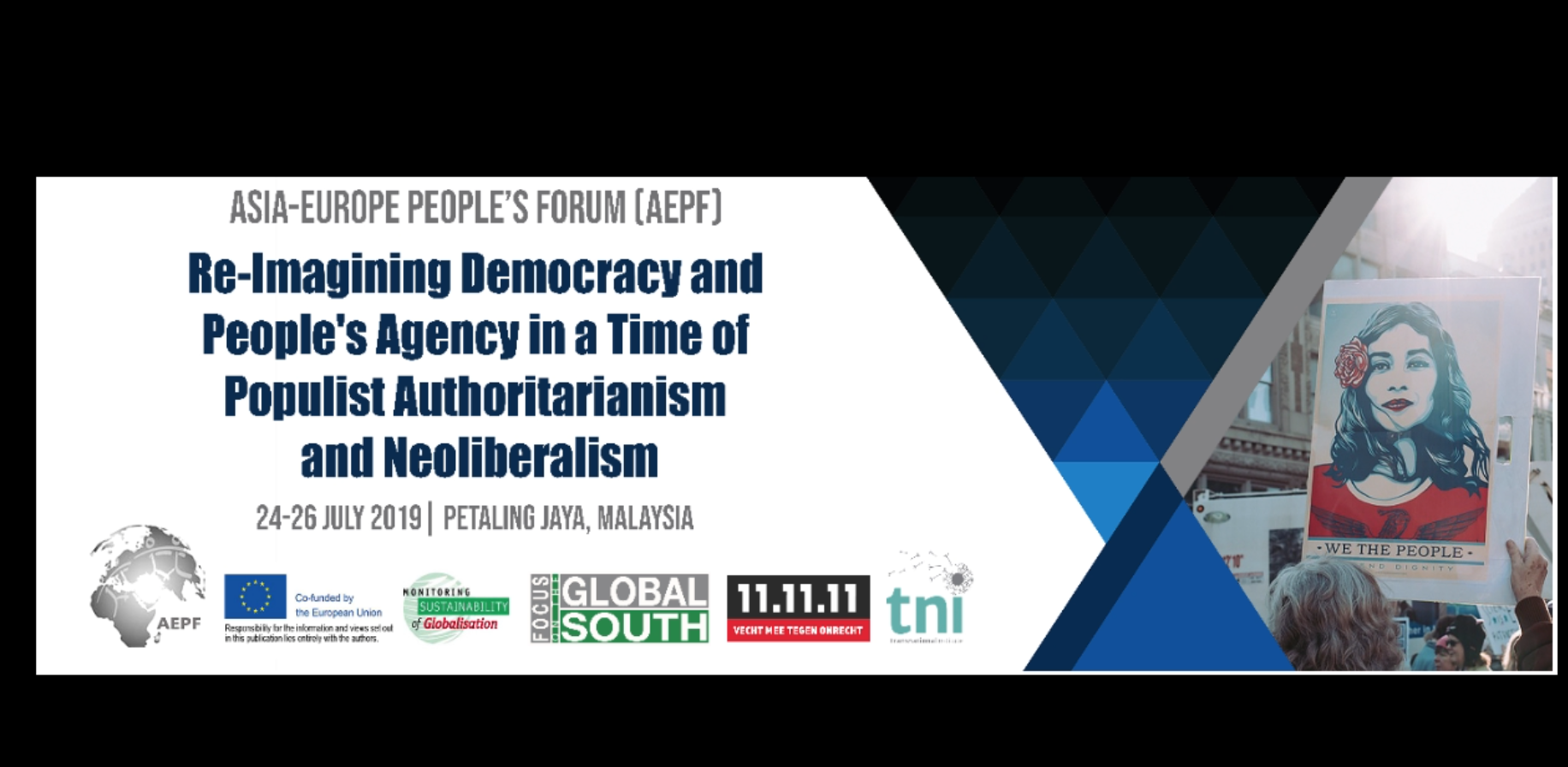
Re-imagining Democracy and Peoples’ Agency in a Time of Populist Authoritarianism and Neoliberalism – A Framing Report

Re-imagining Democracy and Peoples’ Agency in a Time of Populist Authoritarianism and Neoliberalism - A Framing Report
Introduction and Objectives

This Conference of human rights defenders, grassroots activists, movements and individuals committed to participatory democracy and human rights analysed the state of democratic rights in the midst of a wave of populist authoritarianism and neoliberalism. 

The objective of the conference was to analyse the trend where right wing nationalist authoritarian leaders entrenched themselves in many countries across Asia and Europe. To highlight the comparisons between countries, to see the different contexts, to discuss the reasons for this trend and to make a plan and calendar to help ignite popular action to restore and rekindle participatory democracy. 

To set the context, the series of elections in Asia and Europe 2018-2019 elections-–and their implications was analysed. It is evident that expanding corporate power concurrently supports a nexus between political, economic and social trends. This directly promotes and deepens political authoritarianism and increases social-cultural instability.  

There is great need to connect progressive forces in civil society, peoples/social movements and those political parties, which are the drivers of resistances to political authoritarianism, social-cultural insecurity, neoliberalism and corporate power. The methodologies of forging alliances/partnerships among progressive forces across Asia and Europe–including civil society, people’s movements, parliamentarians and political parties—to resist and stop authoritarianism and oppression, and build/strengthen participatory democracy, peoples’ rights and non-capitalism economies is a challenge and objective of this conference.

The Context:

Since migrants are presented as the causes of economic instability by right wing forces, creating complex and dangerous “push and pull” forces, it is appropriate to create the correct perspective on this issue from the framework of participatory democracy and human rights.  At the Global level there has been a major defeat and roll-back with the Global Compact for Safe, Orderly and Regular Migration adopted by the UN in Marrakesh, December 2019. This is a roll-back to voluntary recommendations – far from the binding obligations of the International Convention for the Human Rights of all Migrant Workers and Members of their Families. 

The discussion showed that there is a nexus between political forces, capital and neoliberalism. This nexus has deep social-economic impacts that include:  expected/unexpected political outcomes and forces that are evident from recent elections; the elements that have enabled the rise and expansion of extreme authoritarianism, majoritarian rule, narrow nationalism, and the move away from secular democracy. However the reasons for migration (economic distress, war, resource conflicts, displacement from land-grabbing, infrastructure and investment projects, political, religious and social persecution, disasters/threats, etc.) are often hidden but need to be addressed.  Migration is related also to asylum seekers and refugees. The trend in Asia and Europe are fortified by cross currents from the US where the conscious organising of right wing forces at grassroots level has intensified. 

Europe

The rise of authoritarianism and right wing populism has been further entrenched in the 2019 European Parliament Elections.  However, there has also been a counter-trend e.g. in the outcome of the Spanish and Denmark’s national elections where the Social Democrats gained significantly in a context where the right wing parties were expected to make advances. 

 Across countries, the issue and situation of migrant and refugee people is at the centre of the political agenda. The earlier legislative frameworks that had some empathy with migrants and refugees have been rolled-back: e.g. in Italy, Austria, Hungary – and these are not officially contested at the EU level, since immigration and asylum policy has always been a matter of national jurisdiction.  There is an EU-wide collaboration on an ’architecture of the hostile environment’ which includes measures like: hard borders, externalization/militarization of border policy, based on by a diversion of development funding; the complicity of governments of the Maghreb and Turkey for the out-sourcing of EU/Europe’s security on the Mediterranean and Aegean Sea; widespread criminalisation of the migrant and refugee sector itself as well as criminalisation of opposition and solidarity. 

There are however hopes and signals of growing resistance. Some positive  instances include: – Migrant and Refugee organisations have organised 5 Sessions of the Permanent Peoples Tribunal (PPT) over the past 2 years and have generated  a narrative of an in-depth alternative analysis from the forced displacement in the global south to an opposition to detention and racist discrimination in Fortress Europe. -This is contributing to a new narrative on humanizing the different and showing the significance of labour and gender rights-where increasingly there are ‘sites with rights’ and ‘sites without rights’. 

  • There are exciting practices of a new nexus of transnational activism and solidarity between migrants, refugees and citizens. And there are the Game-Changing initiatives of Mayors of 10 cities strongly opposing the necropolitics of the Mediterranean.
  • The resistances to “austerity” (Yellow Jackets); and impressive mobilisation on Climate Change show the gradual but significant build-up of a counter hegemonic discourse and action.

Asia

The survey of recent elections in the Philippines, Thailand and India reveals how the ‘strong men’ in the region got popular support (Rodrigo Duterte, Prayuth Chan-Ocha and Narendra Modi) even as in their differing ways, they tightened their grip on the levers of power in their respective countries, post-polls. 

Striking similarities manifested themselves in these processes in all three countries: the crushing of the opposition, the consolidation of support across class-caste lines, with the middle class playing a central role; the hollowing out of institutions of regulation and oversight, including the judiciary; the tightening of executive control on the electoral machinery; the deployment of police repression and use of laws against sedition and terrorism to neutralize opposing views…these were only some of the features common to all three electoral contests. 

In Indonesia, religion and race are used as political drama to build the support base of right wing leadership. This was played out in the Jakarta elections which bore witness to how parties gained control. Democracy is stagnant in Indonesia and the military still controls some important business such as the natural resources. For instance mining and palm oil industries are controlled. Speaking about the Indonesian Presidential elections, a strong voice called it a “horrible political drama”, 

there have been good changes on a state level, such as the provision of water with the people being the victims of the chaos.   

In Malaysia for free for the poor as well as protection of healthcare for the underprivileged.  However, it will take time for the federal government to make large scale changes, as the civil servants are still loyal to the previous government which ruled the country since independence. The elites are thought to have been damaging to the political process, and that the running members knew how to manipulate racial sentiments to invoke nationalism as a bid to win votes. Has diversity been eroded to gain power? “People use social media for 14 hours a day” says MP Charles Santiago as he points out that social media is becoming a player in democracy. Those who control social media may control the narrative that people will believe. Social media was a key player in the Malaysian elections, and it can become an ally for the left if it is harnessed and utilised effectively. In Thailand, social network is used widely during elections. It is also notable that some peoples’ lives are not revolving around social media but to remain active in politics, social media is used liked an airstrike.

In Burma/Myanmar, Cambodia, India, Ireland, Philippines, Malaysia & Thailand are all examples of countries in which identity based nationalism is a game changing technique used to gain hegemonic power. ‘Popular Sovereignty’ based on ethnicity, race & religion are constructed using xenophobia, chauvinism, extremism as modalities of governance. Enemies (generally the minorities, migrants and the different) are defined and majority & minority conflicts are dramatised. Also this pattern is far removed from the real issues of addressing poverty and in fact is deemed to result in deeper impoverishment. Populism is connected to authoritarianism which results in ONE strongman emergence as an iconic symbolism of nationalism.

Populist Methods

The Populists work by capturing and controlling institutions and societal discourse through legal and extra-legal means (for e.g., social media, vigilantism, rogue security actors). Violence is used against minorities, migrants, ‘dissenters,’ women, indigenous peoples and anyone who differs from the dominant narrative. Force is perpetrated directly or supported by the state, is justified and normalized. Misogyny and new manifestations of patriarchy are on the rise.

Under authoritarian populist regimes the character of the state and civil institutions is threatened by a nexus and cartels which entrench themselves in the democratic space. We have a military industrial – corporate nexus, business – oligarchy nexus, judiciary – corporate nexus, corporate – media nexus. The state uses repressive laws to control the opposition.

One major force that has exacerbated right-wing authoritarianism is neo-liberalism. Populists are able to link numerous and varied forces and crises in social, economic, political and cultural life to reject the liberal order, social justice and traditional elites.

Populists are able to link numerous and varied right wing forces in social, economic, political & cultural life that rejects social justice and liberal order. People who benefit from this nexus and right wing populism are international finance institutions such as the IMF, World Bank, WTO, corporations, arms manufacturers, upper class & caste, religious groups, party cadres.

Voices of Resistance

  • Activists from the Philippines have been working on various issues related to authoritarianism, alongside various sectors from the country, one of them being the Church to help spread their message of counter authoritarianism. Authoritarianism in the Philippines has meant a decrease in the democratic freedoms of the people, and activists have teamed up with prominent human rights lawyers to fight for the people’s freedom and right to free speech and a free press. The activists also emphasised that a large chunk of what they do is work with local communities, as they say that collaboration with them is crucial in the fight against authoritarianism. Activists in the Philippines reported that Multinational Corporations often ensure that articles that speak of their crimes are silenced, and thus the use of social media has been vital to these activists to bring the truth to light. An organisation like “ I Defend “ is a conglomeration of various organisations including the families of extrajudicial violence, with the idea to expose the nature of Duterte’s rule which draws on the support of a huge overseas Filipino population. So now these categories are being approached to expose Duterte.
  • Activists and professors from India spoke on resistance to the Modi government in India. The farmers’ movements are seen to be one of India’s biggest hopes for oppositional politics. However the divide among the people is because the opposition is without a strategy for a united front for freedoms and even of land rights. People need to realise that authoritarian leaders exploit the various religions and castes to create a divide. The only way that resistance can be sustainable is if they remain united. One of the heartening developments in India is that groups that were not talking or working together are today exploring common ground to resist the ruling forces. A panellist member from India brought up that recently, 49 prominent figures wrote an open letter to the Prime Minister on the rise of mob lynchings in the name of religion and their outrage over this. The case launched against them had to be withdrawn as thousands others joined the protest.
  • In Europe, in relation to the constituency of transnational migrants, one of the biggest issues is access to rights and the racist nature of policing. This fosters animosity and unrest amongst the public, and leads to a democracy having to deal with civil unrest and unable to focus on other policies. The activists reported that the Permanent People’s Tribunal is being used to address immigrant concerns. However, economic inequality and the rise of Shell corporations also pose a threat to European democracy, where the most industrialised regions are often actually one of the poorest. “Shell is able to manipulate democracy” says a voice, talking about how these companies don’t have to pay taxes in the Netherlands. Netherlands is Europe’s biggest Tax haven”.
  • In Burma/ Myanmar, student unionists are the new forces resisting the authoritarian order. This is quite powerful, as the youth are using their rising influence on social media apps to attract a global attention to the ongoing genocide. Women’s groups from different ethnic nationalities are also quite progressive, supporting resistance groups and activists. This shows that Burmese can form a united front in the fight against authoritarianism. Unfortunately when the attacks on the Rohingya broke out only one women’s group came out against them. Moving forward, resistance groups need to remain active even in the worst conditions.
  • Talking about Cambodia, activists work with a range of groups including those of farmers, water activists, sex workers, garment workers and others. These are cross sectoral networks of people who are powerless or left behind.  Cambodian activists have learnt to use action research methods that include learning of social realities and use this learning to build counter strategies. With the rise of nationalism, these research strategies will prove powerful to help change the narrative to one that is willing to stand up for democracy.
  • Thailand does not seem to have a Left movement and so the emphasis becomes on building unlikely alliances of victims across various divides. The tactics of the Thai Junta has also become more violent. There have been disappearances, killings, beatings.  The people have responded with very unconventional forms of activism, such as the symbolic three finger gestures.
  • In Pakistan, there has been a peasant movement in defiance of the military. Here peasants, largely women, by refusing sharecropping payments to the military, are resisting military take-over of their lands. When military agents tried to destroy the cemeteries of Christian peasants, Muslims peasants came out in support of their Christian counterparts.

Alternative Strategies

The key question is how do we counter this authoritarian trend?  How do we consolidate ourselves & how to strengthen analysis and capacity against capitalism and Neo-liberalism?  The participants felt that elections alone will not be enough for the new left wing politics, social movements need to actively engage.  

  • New challenges of the downfall of big parties in Europe where a reform is needed indeed, for example there is a need to nationalize large parts of the economy.
  • There is a need to develop the ability to show that how some religious leaders convince the population to choose a stance on policies blindly, even though some of their arguments do not have a logical view.
  • To counter nationalist authoritarianism we have to go back to the basics, in organising against dictatorship. 
  • It is vital to work with the media, to connect those who are both inside and outside of government. 
  • Empowering youth is fundamental to take stock of the issues. Rather than only talking about problems, we need to address and challenge all issues by engaging with representatives of the government, networking and building local capacities.
  • The kind of common actions that can be initiated are: data monitoring, coordination between the local and international, building allies, having flexibility to assess important issues and energy to work in an inclusive manner. Counter narratives are also a part of the larger narrative and is important to spark interest and awareness.
  • There should be global opposition to racism, religious nationalism, islamophobia, and majoritarianism. 
  • More work needs to be done on the analysis of the nexus between politics & finance, using all human rights mechanisms nationally, regionally & internationally. To be able to develop a new thinking paradigm to challenge the legality of these alliances.
  • Building law from below, building peoples sovereignty & community based laws. It is important to manage youth energy to make them active in the economic sphere and not to be driven as puppets by political parties. 
  • The weak understanding of political ideology in Myanmar was discussed which is used to silence communities. Hence, as in Thailand and some other countries it is necessary to engage across sectors in partnerships, including politicians who cannot be isolated and who provide legitimacy to resist negative forces. For instance, using the Church and religion to collaborate with local communities. 
  • Even while directing energies to counter the negative forces there must be transparency and democracy within movements as well. That is ‘walk the talk’ and ‘back to basics’.
  • Flexibility in terms of constant reorganisation is vital to resist negative forces and new narratives and open data knowledge and resources needs to counter shrinking spaces.

Priorities and Recommendations:

  • AEPF analysis on authoritarianism connection neoliberalism, corporatism, racism and political economy. Understanding new reality
  • Academics, scholars, people’s movements: immersion and learning sharing.
  • New narratives: How we do things
  • Training
  • Link campaigns for example with the International Human Rights campaigns.
  • Meeting of Lawyers that will frame legal strategies. For example, an international campaign against sedition as a way to curb freedom of speech and right to dissent.

II The Interface between Asian and European Parliamentarians

MPs and CSOs in the AEPF Conference on Re-Imagining Democracy and People’s Agency were concerned with the shrinking spaces for freedoms even within democracies. The combination of the growing power of corporations, linked with exclusive nationalism is a matter of great concern. The conference looked for strategies to reclaim people centred democracy. 

Since the holding of the AEPF 12 in Ghent, Belgium we have witnessed the further rise of authoritarianism and right wing populism has been further entrenched including in the European Parliament Elections (we give the data when it is available). Countries across Asia witness, including those where democracy had taken roots see a sliding scale of repressions where the nascent democratic and human rights are systematically violated and an atmosphere of fear prevails. In the already authoritarian- militarized countries, there is even more repression against dissenters, minorities, migrants and the different). 

There has also been a counter-trend e.g. in the outcome of the Spanish national elections where the Social Democrats gained significantly in a context where the right wing parties were expected to make advances. The conscious organising of right wing forces and organisations at grassroots level and in institutions has intensified – with cross currents from the US. There are operative linkages between Steve Bannon and his brand of ideology and politics and key populist leaders and networks of neo-fascists. 

Meanwhile the situation of Migrant and Refugee people is at the centre of the political agenda. The legislative frameworks at national levels have gone into further roll-back: e.g. Italy, Austria, Hungary – and these are not officially contested at the EU level (immigrations and asylum policy has always been a matter of national competence). At the same time, there is an EU-wide collaboration on the ‘architecture of the hostile environment”; borders and externalisation of borders policies; expansion of militarisation and diversion of development funding into forced complicity on governments of the Maghreb and Turkey for the out-sourcing of EU/Europe’s security on the Mediterranean and Aegean Sea; widespread criminalisation of the migrant and refugee sector itself as well as criminalisation of opposition and solidarity. In Asian countries too, migrants are the main targets as new citizenship laws are being enacted and violent repression used to displace and force out migrants.  

There are however hopes and  strong signals of growing resistance – Migrant and Refugee organisations have organised 5 Sessions of the Permanent Peoples Tribunal (PPT) over the past 2 years and have generated with their protagonism and struggles as an in-depth alternative analysis from the forced displacement in the global south to -detention and racist discrimination in Fortress Europe. In Hong Kong the resistance to new laws on extradition brought millions to the streets. This is contributing to a new narrative on human, labour and gender rights-where increasingly there are ‘sites with rights” and “sites without rights’; exciting practices of a new nexus of transnational activism and solidarity – between migrant, refugees and citizens. And there are the Game-Changing initiatives of Mayors of 10 cities strongly opposing the necropolitics of the Mediterranean; the resistances to “austerity” (Yellow Jackets); and impressive mobilisation on Climate Change. 

Links

1)  Programme of the Conference at
https://aepf.info/wp-content/uploads/2017/08/The-Program.pdf

2) Statement from Parliamentarians: https://aepf.info/single-post/Petaling-Jaya

3) Media Statement : https://aepf.info/single-post/2019/07/25/AEPF-Media-Statement-From-Petaling-Jaya-Malaysia

4) Glimpses of AEPF Conference on: https://aepf.info/single-post-2/AEPF-Malaysia-Glimpses


AEPF Website

Day 1 Video: https://aepf.info/single-post/AEPF-APHR-Malaysia

Day 2 Video: https://aepf.info/single-post-2/AEPF-Malaysia-Glimpses

Interviews: https://aepf.info/videos/


Asia-Europe People’s Forum (AEPF)
Interface with Asian and European Parliamentarians

Kuala Lumpur,   24 July 2019

Aims of the Meeting

  • Facilitate a strategic interface between Asian and European Parliamentarians and AEPF.
  • Share experiences of Parliamentarians from each region on the current situation.
  • Enable involvement of Parliamentarians in some key aspects of the AEPF Peoples Agenda and the Ghent spirit.
  • Learn how Parliamentarians are using strategic tactics and parliamentary processes to work in the current very difficult situations.
  • Prepare and release a Common Statement with the key goal on rights and participatory democracy, as well as continuing interface between civil society and parliamentarians.

Panel Of Parliamentarians

Charles Santiago (Malaysia)
Mercy Barends (Indonesia)
Deepak Bhatt (Nepal)
Coining Dorji (Bhutan)
Aida Kasymalieva (Kyrgyzstan)
Hassan Murtaza (Pakistan)
Mylvaganam Thilakarajah (Sri Laka)
Eulàlia Reguant (Spain)

Resource Persons:

Brid Brennan (Ireland/Netherlands)
Kamal Chenoy (India)
Geo-Sung Kim (South Korea)
Achin Vanaik (India)
Farooq Tariq (Pakistan )
Tian Chua (Malaysia)
Leong Tsu Quin (Malaysia)
Tina Ebro (Philippines)
_____________________________________________________________________________________
____________________________________________________________________________________________

the state of democracy, growing authoritarian tendencies and peoples’ resistances in their own countries in a brief way, What they face and what are strategies in their own countries as located regionally and globally. In the light of growing populist authoritarianism and deepening neo liberalism, These below are some  questions you that can guide and focus the discussion: 

  • Can you sum up state of democracy in your country.
  • Is there hate speech, who is targeted and by whom?
  • What are the connections between the political, economic and social trends that support the increasing corporate control (and foreign capital in Asia) How important is the impact of foreign capital on your domestic economy and how does it impact policy making?
  • Which forces are supporting the increased executive power and why? 
  • Who is benefitting from the growing authoritarian policies?
  • What new laws are squeezing democratic spaces, helping foreign capital?
  • Which forces are creating space for resistance and are the source for giving alternate agendas?
  • Who are challenging and what are the ways to counter right wing xenophobic nationalism ?
  • Is there any exception to these hegemonic policies? (eg. Nepal, Denmark) and what is the impact on your country from neighbours and ‘greater powers’?
  • Any success stories of electoral victories? Any success stories in the economy and in the environment?
Read More

AEPF, Democratisation and Human Rights Populist Authoritarianism and Alternative Arguments

AEPF, Democratisation and Human Rights Populist Authoritarianism and Alternative Arguments

By Kamal Mitra Chenoy

There is valid concern about the  electoral victories  of right wing populists (RWP), and the rise of authoritarian nationalism across many countries and societies.  The moves by the far right for hegemony by changing discourse and changing citizenship laws needs to be challenged through the force of ideas and popular movements.

The current conjuncture of unbridled neo liberalism has resulted in social, economic, political crises. Such crises and rising aspirations causes anxieties amongst the popular masses. The RWP use these insecurities to blame and challenge minority communities, migrants, established institutions, create counter narratives, and mobilize forces to gain power. RWPs  blame the crises on  the liberals, universal rights, migrants, on ‘others’, corruption of past leaders, labour rights, etc. Identity assertion and especially Islamphobia, is often at the core of this mobilization.  However, RWP continue with neo liberal policies, with limited changes that were the real reason for the crises in the first place.

How can progressive movements challenge the rise of populist authoritarianisms?

Showing the economic irrational policies and politics of RWP

The reality is that neo-liberal policies of privatization and globalization, unfettered free trade, the increased corporate control over and above state policies have led to  increasing inequality, precarious livelihoods, decrease of public funding on social sector, unemployment and social pressures. The distress promoted the political rise of the far right. RWP promise a future constructed on a ‘pure’ imagined past and identity nationalism as the cure. The RWP narrative is that subsidies to the poor, especially migrants (who are generally citizens), affirmative action for the marginalised, people of colour; (US, EU), Islamic people (India, US, EU et al) entry of women into job markets, are a drain on the national economy, and threaten national culture, during which the  national (‘pure’ ‘nativist’ ‘victimized majority’) community suffers economically and their ‘traditional’ values (religious, family, mythical, etc) are under threat. They also blame liberals and the Left and call for supremacy of a unified, nativist majority mass.

RWP reject liberal rights as well as workers’ rights. They re-assert neoliberal policies, within an ultra nationalist framework. For example, the instrument of placing ‘tariffs’ (by President Trump) as an instrument of foreign economic policy, does not ensuring fair trade or workers’ rights, but appeals to nationalist emotions by only asserting barriers and raising costs. RWP seek to replace class inequality with identity based inequality, by putting in place policies that favour one community, or promoting particular oligarchs (As Putin has often done). So displacing minorities/  migrants/ others/ women and marginalizing them.

Authoritarian nationalism has to be challenged by a democratic and plural nationalism. By showing the impact of corporate control, challenging binding trade treaties, showing the value and inter-linkage of social justice, climate justice, rights and saving livlihoods de-militarization. It is evident that “Democracy in danger of becoming a shell in itself, if the present trend on concentration of wealth continues.” (Kurz Heinz, 2018)

Countering the RWP  project of Hegemony

RWP super imposes itself on   any form of political system, but is especially effective with the new and transitional democracies (Central-East Europe, South East and South Asia, Latin America). Once in power, RWP re-shape institutions and change laws to change the nature of citizenship and management and the state. RWP combine the method of electoral democracy with authoritarian control, shrinking participatory democracy in order to re-order the mass. Therefore the challenge to RWP is through counter ideas, evidence based arguments that show up the real nature and falsehoods of the RWP project.

The RWP agenda of changing state character is through the capture of institutions, changing privileges and laws of citizenship by marking insiders and outsiders.  Several RWP leaders from Presidents Trump, Putin, Erdogan, Duterte, Hungarian President Victor Oban, Brazil’s Bolsonaro,  Modi and others  work to restructure  the balance of power (the centre piece of democratic constitutions), potential sources of power and attack the idea of empowerment. Starting with complete control of their own parties, marginalizing their own cabinets, moving to control over the judiciary and changing the federal structure. In all states where RWP rule, there has been a serious decline of autonomous institutions and general decline in public expenditure. Of course the slide of the scale varies. This capture of institutions has to be resisted by popular movements, from municipality upwards.

RWP seek to fuse  exclusive identity assertions. The nation is identified with  a dominant, singular and homogenized community, based on religious or ethnic roots.  (‘Islamic State’,  ‘Hindu Rashtra’ Christian or Nativist etc). Those  ‘outside’ are politically,  culturally marginalized, with policies and laws. Economic degradation follows. These changes are legitimized by ultra-nationalism.

RWP gain legitimacy through politicized religion, the mythical past, rather than the plurality and complexity of history and reality. They use emotional arguments (‘motherland’, martyrdom and historical victimhood, etc.)  For example Trump called the  migrant caravan (Hispanics) of 4000 an “invasion”. So developing fear psychosis. Populism like other ideologies, makes claims in the name of the people, but the far right’s concept of peoples and policies are generally  exclusive to one dominant identity opposed to several others.

In the RWP project,  ‘outsiders’ are rejected and mocked. This process de-humanises the different and makes them vulnerable to discrimination and vigilante violence. (Jaraslaw Kaczynski  of Poland’s governing PIS described migrants as carrying  “various parasites and protozoa, which don’t affect their organisms, but which could be different here.” India’s Home Minister Amit Shah described Muslim migrants to Assam as ‘termites’). Millions of people from the state of Assam have been made non citizens, through a national citizens register. The Muslim dominated state of Jammu and Kashmir has been dissolved from statehood.

The idea of nation with singular and forced identity have been long challenged historically, theoretically and in practice. History has repeatedly shown the high cost of right wing militarist regimes. Many states have active and frozen conflicts and civil wars on account of suppressing minorities groups from equal citizenship (Sri Lanka, Myanmar). These facts and experiences need to be re-asserted and shown in new popular ways.

The Rise of RWP signifies a backlash against feminism and gender choices, as they focus on ‘set’ family values, stereo typed binary roles for women and express homophobia. Duarte for instance joked about raping Ms.Universe, and equated having a second wife to keeping a “spare tire” in the trunk of a car. (Time, July 23, 2018.) Feminists argue that RWP’s posses ‘toxic masculinity’ and they stereotype binary gender roles, even as these have been long rejected by the women’s movement. They reduce women  as a resource for national development. At the same time,  RWP  tolerate women who belong to their own identity and ideology, but cannot tolerate migrants, and the other.  Women have also backed RWPs from Duterte, Bolsonaro, Trump, on account of different reasons, But women’s movements have also strongly opposed RWP and are major allies in the resistance.

RWP infuse militarism into civilian life. Populists project revivalism as their cadre infuse militarist values into civilian life. Jair Bolsonaro, Brazil, former army captain, appreciates the hated dictatorship of Pinochet, champions unrestricted sales of firearms, argues that  police encounter killing is self defence. The peace movement and information about the rise of military spending has to be popularized to challenge this militarism.

Resistance

Peoples and grass roots democracy supported by a collective of minorities are a major force fighting right wing authoritarianism and populism. Liberals and Left are important part of the resistance, even as the Left has declined in many countries.  Further a major challenge is the condition of enforced silence. Even while liberals support neo-liberal policies and do not see the connect of neo-liberalism and the extreme right, yet they are defending democratic rights in a major way. But the real force that can defeat RWP will be people and alternate ideas. These ideas, practices exist and have defeated right wing authoritarianism earlier. We have to find ways to connect progressive ideas to the mass of people.

Resistance to RWP depends on the depth of democratic culture and rainbow coalitions in each country. This requires intervention in institutions, in constitutional structures, in political parties, social movements and on the streets. This has to be linked to material conditions,  popular livelihoods, popular rights and freedoms, based on peoples security and freedoms from want, fear and violence.

References

Cohen, Roger (2018) How democracy became the enemy, New York Times, April 7-8 2018.p.9.

Heinz, Kurz (2018) ‘Power, the bete Noir of Modern Economics, Ideas Working Paper, 01/2018 at http://www.networkideas.org/wp-content/uploads/2018/04/01_2018.pdf

Read More

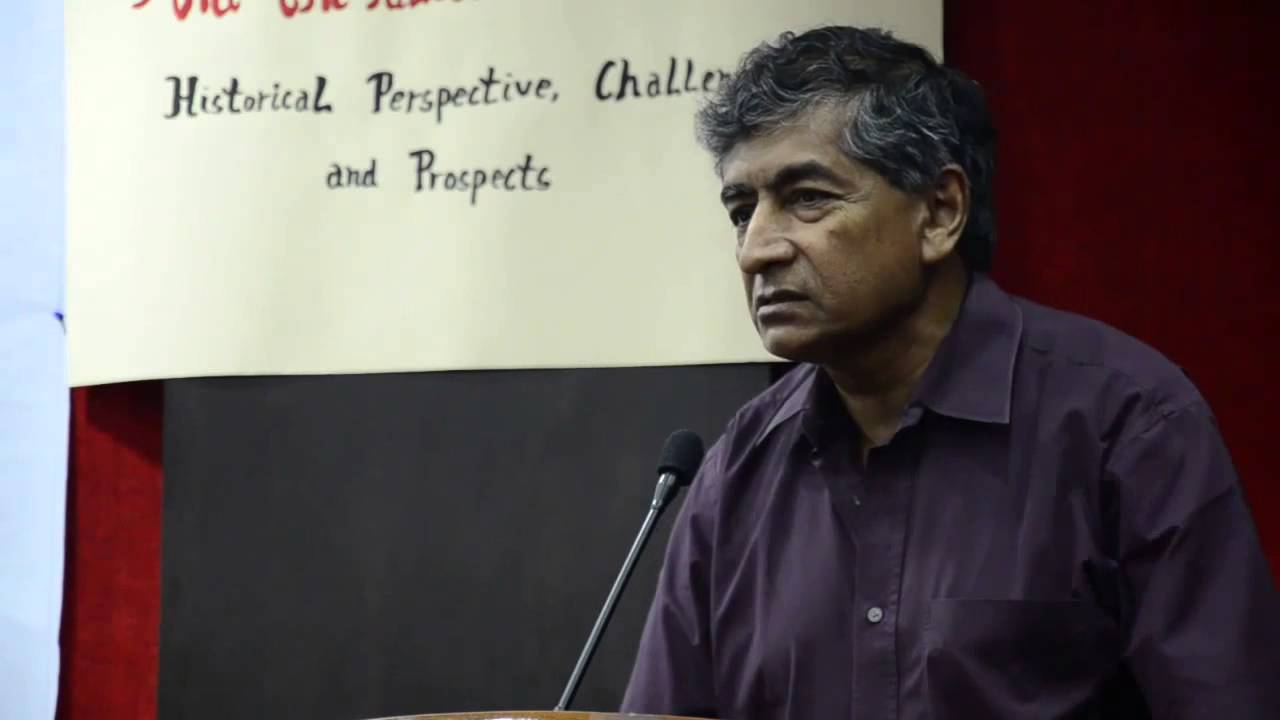
Achin Vanaik on the Rise of Right wing / Far-Right Authoritarianism from Above and Below

Rise of Rightwing/Far-Right Authoritarianisms from Above and Below

By Achin Vanaik

Two Truths

Let us recognise that there are two basic truths that shape the existing world order. First, that we have and will continue to have for the foreseeable future the coexistence of a capitalist form of economic globalization and the multiple nation-states system. Second, that the principal form taken by authoritarian entities (states or movements) that have arisen throughout the world over the last few decades is authoritarian nationalism.

There is a connection between these two realities. While neoliberal globalization (understood as a general rightwards economic drift and not as a fixed ‘state of affairs’) is a transnational phenomenon, this can only be stabilised by right wing/far-right forces or governments having their own specific nationally-rooted politics and ideologies. There are thus both global and nationally specific factors that create the fertile ground for – but do not guarantee – the rise of authoritarian practices and populisms. If the main actors are national (states, parties, movements) nevertheless we can recognize cross-country common features requiring national, regional and more global strategies to counter and defeat these authoritarianisms.

The Factors

One of the key factors which has contributed to this rise of right wing and far-right authoritarianisms is the depredations, material and psychological, that has been caused by the ongoing processes of neoliberal globalization and the politics and ideological discourses accompanying it. Economically speaking, malnourishment and undernourishment continues to be the fate of over 1.5 billion of the world’s population. If we take into consideration unmet ‘basic needs’ concerning healthcare, decent education social security, leisure, decent housing and fair working hours and conditions of work, then one can add maybe a couple of billion or more of the world’s population to the earlier tally. At the same time this miserable state of affairs has seen dramatically rising inequalities of income, wealth and therefore of power. These have everywhere eroded substantive democracy even as procedurally speaking (e.g., elections, some civil liberties) has spread to some more countries of the South. Globalization has also led to much greater psychic destabilisation and greater clinging on to ‘unchangeable’ identities (ascription by birth) to cope with an increasing sense of powerlessness.

This process of neoliberal globalization then has created a huge set of ‘losers’ who have to a) be policed, hence erosion of democratic rights and freedoms; b) made to feel falsely empowered by diverting their anger and frustrations and mobilising them against the designated ‘enemy’ who is the scapegoat for supposedly causing, enhancing or benefitting from, their sufferings.

Another important factor associated with the process of neoliberal globalisation that must be taken note of is the Communications Revolution that has made TV and social media platforms (e.g., mobiles) the main mediums of public conversation between political persuaders and an increasingly atomised and individualised public audience. The result (a) is that the organisation of messaging including the generation of fake news and trolling rather than the quality of argumentation has become more and more important. (b) Political appeal for rightwing/far-right governments, parties, movements has become more ‘personalised’ and reliant on image projection and spectacle. This personalisation of politics has been enhanced by the fact of much greater policy convergence between the main parties contesting elections and striving for state power.

What is specific to rightwing populisms as distinct from leftwing populisms is the central role of scapegoating.  All such entities require the cultivation and spreading of ideologies that embody exclusivist anti-democratic nationalisms and promote new forms of racism. Here Islamophobia has become the dominant (though not the only such) form and has grown within countries as well as spreading across them to become regional phenomena (deepening connections between reactionary Hindu and Buddhist groups in Myanmar, Sri Lanka, India) and even globally via the spread of the dishonest discourses and practices associated with the ‘Global War on Terror’ (GWOT).

Why this Islamophobia? Apart from India where this is foundational to Hindutva ideology, this is because: (a) there is the refusal to deal humanely with migration (particularly of Muslims), forced or voluntary, from many parts of the world. Forced migration will only grow to an even bigger scale in the future because of the guaranteed environmental consequences that will now follow from the climate carbonisation that has already occurred; (b) There is the long history of Western imperialism by US and allies in the MENA (Middle East and North Africa) region; (c) There is the self-serving hypocritical endorsement of GWOT by other big powers e.g., Russia, China, India facing secessionist pressures in Muslim dominated regions.

What Parliamentarians Can Jointly Do

Since this discussion is taking place in an AEPF meeting in Kuala Lumpur, Malaysia where parliamentarians are present from a number of countries in Asia and Europe there is here a set of issues which I believe demand the attention of the AEPF governments and specifically of the Asian member countries. These are listed below and if fulfilled will constitute important steps forward  in the effort to reduce the power and influence of rightwing and far-right populisms in Asia and elsewhere.

  • All Asian countries (the main holdouts) to sign and ratify the ‘International Convention and Protocol on the Status of Refugees’, and even otherwise to abide by its injunctions. Even for non-signatories, Refoulement (Forcible Repatriation) is illegal.
  • Outright condemnation of Islamophobia and other forms of racism.
  • Against hate speech especially by those holding parliamentary and senior government positions thereby having greater power and public influence.
  • End all sanctions on Iran.
  • Call on all Asian countries which have not signed and ratified (brought into force on their territories) the ‘International Convention Against Torture and Other Cruel, Inhuman or Degrading Treatment or Punishment’ to do so immediately. These holdouts include India, Malaysia, North Korea.
  • Call on all states to sign and ratify the Treaty on Prohibition of Nuclear Weapons (TPNW) and promote steps to (a) bring about a Northeast Asian Nuclear Weapons Free Zone; (b) extend the Bangkok Treaty (Southeast Asian Nuclear Weapons Free Zone) to incorporate Bangladesh; (c) encourage Nepal to emulate Mongolia by moving towards declaring itself a Single State Nuclear Weapons Free Zone (SSNWFZ). Representative bodies of parliamentarians from some Asian (and European) countries should visit Bangladesh and Nepal to pursue these efforts.


ANNEXURE

The Refugee Question

The following are the Asian (excluding Middle East) Country Participants in the Convention on Status of Refugees:

Afghanistan, Azerbaijan, Cambodia, China, Fiji, Japan, Kazakhstan, Kyrgyzatan, Papua New Guinea, Philippines, South Korea, Tajikistan, Timor-Leste, Turkmenistan.

Refugees shall

  • abide by the national laws of the contracting states (Article 2)

The contracting states shall

  • exempt refugees from reciprocity (Article 7): That means that the granting of a right to a refugee should not be subject to the granting of similar treatment by the refugee’s country of nationality, because refugees do not enjoy the protection of their home state.[17]
  • be able to take provisional measures against a refugee if needed in the interest of essential national security (Article 9)
  • respect a refugee’s personal status and the rights that come with it, particularly rights related to marriage (Article 12)
  • provide free access to courts for refugees (Article 16)
  • provide administrative assistance for refugees (Article 25)
  • provide identity papers for refugees (Article 27)
  • provide travel documents for refugees (Article 28)
  • allow refugees to transfer their assets (Article 30)
  • provide the possibility of assimilation and naturalization to refugees (Article 34)
  • cooperate with the UNHCR (Article 35) in the exercise of its functions and to help UNHCR supervise the implementation of the provisions in the Convention.
  • provide information on any national legislation they may adopt to ensure the application of the Convention (Article 36).
  • settle disputes they may have with other contracting states at the International Court of Justice if not otherwise possible (Article 38)

The contracting states shall not

  • discriminate against refugees (Article 3)
  • take exceptional measures against a refugee solely on account of his or her nationality (Article 8)
  • expect refugees to pay taxes and fiscal charges that are different to those of nationals (Article 29)
  • impose penalties on refugees who entered illegally in search of asylum if they present themselves without delay (Article 31), which is commonly interpreted to mean that their unlawful entry and presence ought not to be prosecuted at all
  • expel refugees (Article 32)
  • forcibly return or “refoul”refugees to the country they’ve fled from (Article 33). It is widely accepted that the prohibition of forcible return is part of customary international law. This means that even States that are not party to the 1951 Refugee Convention must respect the principle of non-refoulement. Therefore, States are obligated under the Convention and under customary international law to respect the principle of non-refoulement. If and when this principle is threatened, UNHCR can respond by intervening with relevant authorities, and if it deems necessary, will inform the public.

Refugees shall be treated at least like nationals in relation to

  • freedom to practice their religion (Article 4)
  • the respect and protection of artistic rights and industrial property (Article 14)
  • rationing (Article 20)
  • elementary education (Article 22)
  • public relief and assistance (Article 23)
  • labour legislation and social security (Article 24)

Refugees shall be treated at least like other non-nationals in relation to

  • movable and immovable property (Article 13)
  • the right of association in unions or other associations (Article 15)
  • wage-earning employment (Article 17)
  • self-employment (Article 18)
  • practice of the liberal professions (Article 19)
  • housing (Article 21)
  • education higher than elementary (Article 22)
  • the right to free movement and free choice of residence within the country (Article 26)

The Question of Torture and Other Unacceptable Methods of State Behaviour

The following are the Asian (excluding Middle East) Country Participants in the Convention Against Torture and Other Cruel, Inhuman and Degrading Treatment or Punishment:

Afghanistan, Azerbaijan, Bangladesh, Cambodia, China, Fiji, Indonesia, Japan, Kazakhstan, Kyrgyzstan, Laos, Maldives, Mongolia, Nepal, Pakistan, Philippines, South Korea, Sri Lanka, Tajikistan, Thailand, Timor-Leste, Turkmenistan, Uzbekistan, Vietnam.

The International Treaty Prohibiting Nuclear Weapons

The following are the Asian Signatories to the Treaty on Prohibition of Nuclear Weapons:

Bangladesh, Cambodia, Fiji, Indonesia, Kazakhstan, Laos, Malaysia, Nepal, Philippines, Timor-Leste, Thailand, Vietnam. [Only the last two have so far also ratified the Treaty].

Read More

Overview of interface between Asian and European Parliamentarians and civil society representatives in Petaling Jaya (Malaysia), AEPF, 24th July 2019.

Overview of interface between Asian and European Parliamentarians and civil society representatives in Petaling Jaya (Malaysia), AEPF, 24th July 2019.

An interface with parliamentarians from 7 countries of Asia and Europe organised by the Asia Europe Peoples Forum (AEPF) and the Asian Parliamentarians for Human Rights (APHR) on the 24th July, 2019, in Kaula Lumpur on democracy and human rights in the context of populist authoritarianism and neoliberalism.

Read More

Statement from interface between Asian and European Parliamentarians and civil society representatives in Petaling Jaya (Malaysia) on 24th July 2019

Statement from interface between Asian and European Parliamentarians and civil society representatives in Petaling Jaya (Malaysia) on 24th July 2019

Petaling Jaya (Malaysia) Declaration

In this interface between Asian and European Parliamentarians and civil society representatives we declare the following:

Even while about 53% of people globally live under authoritarian regimes, democracy in many countries of Asia and Europe is being weakened. Several governments in collaboration with big corporations are using authoritarian methods to control institutions and curb people’s rights.

We the MPs from seven countries and civil society members from over 20 countries be-lieve in people centered democracy. Participatory democracies have the capacity to pro-vide sustainable development, provide welfare and lift people out of poverty. However with neoliberal globalization, the dominance of oligarchs, trans-national corporations, military industrial complexes and foreign capital has increased. These have disproportionate influence on social, economic, political and cultural policies. This trend is detrimental to democratic processes.

All our societies are diverse and plural in nature. But, religious fundamentalism marked by chauvinist identity politics, exclusive nationalism and selective violence is being used to curb all relevant forms of dissent and target rights.

There are ongoing crimes against humanity which are being normalised. (For example, the genocide of the Rohingya community in Myanmar and the siege on refugees in the Mediterranean). Migrants and refugees are being criminalized. People and organisations who express solidarity with victims of oppression are harassed in multiple ways.

People have lost trust in the system as they believe that democracy has not delivered basic needs. People, especially the youth are therefore turning to right wing movements. Decades of neo-liberal globalisation has increased inequality and about 1.5 billion people are malnourished while basic needs ( education, health social security, etc) are unmet. There is continuous devastation of the global environment, including climate change and loss of bio diversity. This anxiety is leading to a rise in hate speech against the ‘other’.

We Parliamentarians and civil society movements are committed to reclaim democracy and humane politics for people and make some recommendations:

Governments at all levels must become more transparent and accountable to people, and new forms of decentralisation of power and right to information should be institutionalised.

We commit to enhance our struggle against neoliberalism and corporate power. This is because the rise of big finance capital goes against the welfare of people and social jus-tice. It leads to varieties of corrupt power.

We support universal and quality social protection and call for an end to commercialisation in social sectors like education, health, water and energy. We support solidarity economies. For example, community and collective control over local resources, public-public partnerships, re-municipalisation, etc.

Young people have lost faith in the system. We should encourage their participation in progressive movements and in activities they wish to be part of without fear. The monopoly and use of social media by corporations and right wing forces is challenging social relations and democracy. We call for greater norms to prevent hate speech, fake news, trolling, etc.

We have decided to take initiatives to support in the UN the proposed Binding Treaty on Corporations, that makes corporates more accountable.

We call upon Governments to sign, ratify and implement the (1990) Convention on mi-grants and their families and withdraw threats against so-called refugees, many of whom are citizens.

Many of our fellow Parliamentarians have been jailed because of political vendetta. We call for a release of all political prisoners.

We recommend that Parliamentarians and public policy makers engage with civil society in a continuous and accountable way. We believe that governments have the responsibility to make democracy accessible by putting people in the center of policy making and implementation.

Charles Santiago (Chairperson of ASEAN Parliamentarians for Human Rights (APHR); MP, Malaysia); Mercy Chriesty Barends (MP, Indonesia); Deepak Bhatt (MP, Nepal); Tian Chua (Former MP, Malaysia); Aida Kasymalieva (Vice Speaker, MP, Kyrgyzstan); Hassan Murtaza (Member of the Punjab Assembly of Pakistan); Eulàlia Reguant (Former MP, Cat-alonia); Mylvaganam Thilakarajah (MP, Sri Lanka)

Resource Persons from Civil Society: Tur-Od Lkhagvajav (Mongolia); Tina Ebro (Philip-pines); Dr. Geo-Sung Kim (South Korea); Brid Brennan (Ireland and Holland); Kamal Mitra Chenoy (India); Farooq Tariq (Pakistan); Achin Vanaik (India).

Read More

What the deportation of Rohingya refugees reveals about today’s India

What the deportation of Rohingya refugees reveals about today’s India

December 5, 2018 | Pamela Philipose

In early October this year (2018), India deported seven Rohingya youth to neighbouring Myanmar, despite the fact that the latter has systematically persecuted and repressed this Muslim minority community within the country for several decades now. According to a UN fact-finding mission in 2018, the “acts with genocidal intent against the Rohingya in northern Rakhine” conducted by the Myanmarian military since August 2017 had “ultimately led to the expulsion of more than 800,000 Rohingya men, women and children to neighbouring Bangladesh, triggering one of the worst humanitarian crises in modern history.”

The deportation has only made the Rohingya community in India – said to number 40,000, according to government sources and living in the most precarious conditions in under-serviced ghettoes and camps in various pockets of the country – even more insecure.

What is more, it runs counter to the country’s legacy of accommodating refugee communities over the year and which has historically afforded it a great deal of international good will, right from the days when the Zoroastrians, facing persecution in Iran, were allowed to settle in India between the seventh and 13th centuries. More recent accommodations include the hospitality accorded to the over 80,000 Tibetans, who followed the Dalai Lama into India in the wake of the 1959 Tibetan uprising in China; the mass exodus of tens of millions from former East Pakistan during the political cataclysm that saw the birth of Bangladesh; and the wave upon wave of Sri Lankan Tamils from 1983 onwards who fled from the military repression in their country to the southern Indian state of Tamil Nadu.

The recent Rohingya deportation is important therefore because it does not just mark a formal rupture with that legacy of accommodation, it could well prove to be the beginning of several such interventions by India to expel all those it deems as “infiltrators” and posing a “security threat” to the country. Military terminology of this kind has been routinely used to frame and stigmatise refugees and migrants, who have entered India from neighbouring countries over a period of time, either to flee from the repression they faced or in search of a better life.

Any narrative of the refugee/migrant crisis in South Asia would necessarily have to bring India into the picture, given its dominance in terms of presence – the country accounts for around 72 per cent of the South Asian land mass. More importantly, it was the policies of the British Raj, with its locus in New Delhi and London, that had triggered the region’s largest mass displacement– the partition of the sub-continent which resulted in an estimated 14 million people being rendered refugees amidst violence, death and devastation on a scale unprecedented. Partition was conducted on the basis of the two-nation theory resulting in a largely Muslim Pakistan and a largely Hindu India. The toxic sectarian legacy of such a division shaped the politics and society of both countries and continues to do so to this day. It is unsurprisingly therefore that it is the Muslim refugee/immigrant who is accorded the worst treatment by the Indian state.

The present ruling party of the country – the Bharatiya Janata Party (BJP) – came to power in 2014 on a specifically Hindu majoritarian agenda. One of the election promises made by the present prime minister, Narendra Modi, was in fact to expel “Bangladeshis” staying in the country “illegally”. Significantly, however, he made a distinction between Hindu and Muslim refugees/migrants, promising to accommodate “Hindus who are harassed and suffer in other countries”. In 2016, the BJP government introduced a new bill – the Citizenship (Amendment) Bill, 2016 – that considers only non-Muslim asylum seekers as eligible for Indian citizenship. Muslims, even if they have faced repression in their countries of origin, like Shias and Ahmadiyyas in Pakistan, or indeed the Rohingya, will be ineligible. In other words, the Indian state is prepared to offer refuge and asylum on the basis of ethnicity, not humanitarian need.

For the BJP and Prime Minister Modi, the political calculation is that any policy that targets the Muslim, and especially the Muslim “outsider”, will prove popular with their core Hindu majoritarian constituency and thus shore up their political base.

Such an effort becomes even more important as the next general election looms over the horizon – it is expected to take place in the first half of 2019. Among the tropes that will certainly mark the BJP’s electioneering will be the attempt to whip up popular hatred against Muslims generally and the Muslim immigrant in particular. The president of the BJP, Amit Shah, has already indicated how far he is prepared to go down this road, when he publicly referred to immigrants as “termites” before promising that his government will “pick out each and every infiltrator and strike them off electoral rolls.”

The BJP president is only feeding off and feeding into the feelings of hatred for the Muslim Other that has been systematically cultivated in the four and a half years of Narendra Modi’s rule. Deporting a predominantly Muslim community like the Rohingya from Indian soil is an intrinsic part of the larger project. Since 2016, extremist Hindu outfits in the region of Jammu, where some Rohingya camps have come up, had been demanding that they be evicted from the state, claiming that they were “terrorists”. There have even been targeted arson attacks on Rohingya dwellings by vigilante groups. Meanwhile, the Union home minister, Rajnath Singh, who has ordered that the biometric data of all the Rohingya population – he terms them as “illegal immigrants — be gathered as a first step towards sending back with the cooperation of the Myanmar government. The point to note here is that even if the Myanmar government does take back these people, there is no guarantee that they will be safe and allowed to live lives free of fear and repression.

What they have undergone is what one human rights official termed a “textbook example” of ethnic cleansing. Given this reality, India’s deportation of the Rohingya is a clear violation of Article 3 of the international Convention against Torture which it has signed, if not ratified, and which prohibits actions to “expel, return (refouler) or extradite a person to another State where there are substantial grounds for believing that s/he would be in a danger of being subjected to torture.”

For India to pretend that it is doing the right thing and for sections of Indian society to actually applaud these deportations, is just another example of the utterly cynical nature of the politics of Hindu majoritarianism and the general coarsening of public attitudes in the country.

*The writer is Public Editor, The Wire.in. Her book, Media’s Shifting Terrain Five Years that Transformed the Way India Communicates, will be out shortly

Read More

Assuring affordable, accessible and quality public services for all

Assuring affordable, accessible and quality public services for all

March 11, 2018 | Asia Europe People’s Forum Social Justice Cluster

Manila Conference, 13 to 15 February 2018
Political declaration

One very clear message came out of this conference: public services should be in the hands of public authorities and citizens and be fully and exclusively committed to serve the society as a whole. Some speakers put emphasis on the role of the state, others on municipalities and still others on citizens and their self-organisations. But they all agree public services must not be made into profit-making mechanisms, such as international institutions and too many governments now tend to do.

The privatisation efforts of the past decades have failed. Many essential services are not affordable for the majority of poor people, quality is substandard, employment and wages are undermined. Research shows that privatisation leads to excess profits for corporations and high costs for the public. Whether we speak of water, health care, education, public transport, energy, in each and every sector the same problems arise.

Moreover, transnational corporations, the drivers of privatisations, do not hesitate to push for free-trade agreements with private arbitration clauses, so that they can sue governments whenever laws or regulations are proposed in the interest of citizens but possibly affecting their profits.

As a consequence of failed privatisations, the conference shared many examples of reclaimed public services that resulted in significant public benefits, including lower costs. 835 examples of services taken back under municipal ownership and control have been documented, demonstrating that the title of the conference ‘Reclaiming public services’ is becoming an exciting reality.

Movements of citizens and residents are getting stronger to reclaim what is theirs: universal quality of fundamental infrastructures and services in the public interest. To make this possible, governments will have to seriously question, in a participatory process, their macro-economic framework and their tax and public spending policies, as well as their unjust laws, so as to make financial resources available. Public services will also have to contribute to the reduction of the disastrous inequalities and to the sustainability of the environment.

Whether these services are provided by States, municipalities or people’s organisations, the way they are conceptualized, regulated and monitored is crucial for their success. Real participatory democracy is therefore an essential and common characteristic of the public services this conference wants to promote, based on the successful best practices.

Public services go beyond public ownership to embrace dynamic forms of democratic participation and accountability. The conference gave examples of democratic planning of inclusive public services, such as for transport, renewable energy and housing.

It means that in this new era with a new awareness of what is necessary for a life in dignity for all, and with a better understanding of the fundamental differences between progressive policies and a neoliberal and conservative ideology, we can overcome the simple divisions between state and market, private and public.

This conference has been a major contribution to the alliance of all progressive forces, working in the framework of the commons, our collective ownership of our common nature and built infrastructure. We worked to re-define strategies, to renew its thinking on production, markets, nature and the State, to create a new narrative to better organize our resistance to neoliberal and conservative forces.

New forms of cooperation are required, between public authorities at different levels, trade unions and other social movements, academics and legal experts. In the same way as this conference was built, progressive forces can make real progress once they understand their common interest. Victory is possible.

Destroying public services is destroying the very society that makes us what we are, social relationships, solidarity and collective values. Preserving and promoting public services is promoting citizenship and the sovereignty of the people.

Read More

The Indonesian Social Movement Strongly Condemns the Murder of Eight Activists in the Philippines

The Indonesian Social Movement Strongly Condemns the Murder of Eight Activists in the Philippines

September 26, 2017

The killed labor and farmer activists: Mr. Edilberto Miralles, Ms. Emerenciana Mercado-de la Cruz, Ms. Violeta Mercado, and others. de Leon, Mr. Eligio Barbado, Mr. Gaudencio Baga, Mr. Ariel Diaz, Mr. Orlando Abangan, and Mr. Arnel Figueroa. We share our deepest condolences.

We believe that the murders are politically motivated, limiting the space for civil society in the country. The incidents are clearly aimed at suppressing those who fight for people’s rights and intimidating those who fight against the tyranny of the state and the capital.

The Philippine government should protect its people from any form of violence. The extrajudicial killings in the name of the so-called was a peaceful situation in a society. Instead, they promote a culture of violence, making the government ignorant and useless in its obligation to protect and fulfill the rights of the people.

The state can no longer be silent and indifferent, especially when human rights defenders become targets of summary executions. The state has the responsibility to prevent the violation of human rights.

Therefore, we urge the Philippines to immediately stop and prevent all forms of violence. Violence does not address the roots of the problems of the society. Instead, it becomes a tool to weaken the social movement in the Philippines. The government should therefore investigate the murders objectively and fairly. It should therefore guarantee a free, democratic, and safe space for people to fight for their rights.

As we believe the violent acts against labor activists and peasant leaders are against humanity, we therefore strongly urge the Philippines’ Commission on Human Rights to be involved in the investigation of the murders.

Jakarta, 26 September 2016

In the name of the Indonesian Social Movement

  1. Indonesia for Global Justice (IGJ)
  2. The Federation of Indonesian Labor Struggle (FPBI)
  3. Sedane Labor Resource Center (LIPS)
  4. Southeast Asia Freedom of Expression Network (SafeNet)
  5. Indonesian Struggle Union (PPI)
  6. Indonesia AIDS Coalition (IAC)
  7. Indonesian Student Union (SMI)
  8. Anarkonesia
  9. SatuDunia (OneWorld)
  10. Women of Mahardhika
  11. The Federation of Cross-Factory Labor (FBLP)
  12. The People Politic (Politics Rakyat)
  13. The Federation of Independent Labor Union (FSBM)
  14. The Federation of Indonesian Labor Movement Union (FSPBI)
  15. Gema Demokrasi
  16. People Solidarity for Democracy (SORAK), Bandung
  17. PurpleCode Collective
  18. The Legal Aid of Journalist (LBH Pers)
  19. The Legal Aid of Padang Journalist (LBH Pers Padang)
  20. The Church of Grace Community-Reformed Baptist Salemba (Gereja Komunitas Anugerah Reformed Baptist Salembal
  21. Ultimus Bandung
  22. The Union of Indonesian Culture Society against Militarism
  23. The Federation of Labor Struggle Solidarity (Federasi Gabungan Solidaritas Perjuangan Buruh)
  24. The Labor Union of Jabodetabek Railway (SPKAJ Jabodetabek)
  25. The United Struggle Organization of Youth (KPOP)
  26. The Women Institute (Perempuan Institute)
  27. Rumah Belajar Rakyat
  28. Ernawati
  29. The Confederation of Indonesian People Struggle (KPRI)
  30. Initiative Association
  31. Papua Democratic People Movement
  32. Independent Forum of Papua Student (Forum Independen Mahasiswa Papua)
  33. People Movement for Democracy (GELORA DEMOCRASI, PALU)
  34. PMII metro makassar
  35. The Confederation of National Union (KSN)
  36. Confederation of Karya Utama Labor Union (FSBKU-KSN) 37. The Confederation of Indonesian People Struggle – BANTEN (KPRIVANTS) The
  37. The Union of Indonesian Farmer Movement (P3I)
  38. Forum Solidaritas Yogyakarta Damai (FSYD)
  39. Serikat buruh kerakyatan (Serbuk)
  40. PRP (Partai Rakyat Pekerja)
  41. FPBN (Federasi Perjuangan Buruh Nasional-SulSel)
  42. INKRISPENA (Research Center for Crisis and Alternative Development Strategy)
  43. Aliensi migran progresif
  44. Pusat Perjuangan Rakyat Indonesia (PPRI)
  45. Pusat Perjuangan Mahasiswa untuk Pembebasan Nasional (PEMBEBASAN)
Read More

Roundtable Discussion Of North East Asian Civil Society Organizations

ROUNDTABLE DISCUSSION OF NORTH EAST ASIAN CIVIL SOCIETY ORGANIZATIONS

July 1, 2016

ROUNDTABLE DISCUSSION OF
NORTH EAST ASIAN CIVIL SOCIETY ORGANIZATIONS
Ulaanbaatar, Mongolia
July 5, 2016
Co-organizers:
Korea Center for UN Human Rights Policy (KOCUN)
Forum Asia for Human Rights and Development (FORUM-ASIA)
Human Rights NGOs Forum (HR NGO Forum)

INTRODUCTION
GENERAL INFORMATION

Northeast Asia Civil Society Forum has convened twice in 2011 and 2013 following the recommendations of Universal Periodic Review of the UN Human Rights Council. This forum will be held in order to achieve successful implementation of the UPR in North East Asia, inviting mainly civil society actors in the subregion as well as experts and scholars, including relevant experts from the UN human rights mechanisms. The following issues were discussed in the 1st and 2nd forums:
1st NEA Civil Society Forum, Tokyo, Japan, October 28-30, 2011

  • To discuss selected UPR and Treaty Bodies/Special Procedures recommendations particularly relevant to North East Asia
  • To identify obstacles in the implementation
  • To establish sub regional follow-up strategy on the selected recommendations
  • To establish a UPR network for civil society actors in North East Asia.
  • To prepare for the second cycle of the UPR

Forum Two, Seoul, Korea,July 31- Augist 2, 2013

  • Role of national human rights organizations, and civil society in implementation of UPR recommendations
  • Implementation of UPR recommendations by countries and civil society engagement

Thematic discussion:

Minority rights (women, people with disabilities, migrants, LGBT, and others) and activities against Discrimination

Civil political rights(right to free expression, right to religious freedom)

  • Government action plan in implementation of UPR recommendations and Good practices
  • Role of Parliament in successfully implementing the UPR recommendations and Good practices
  • Process of establishing National Human Rights Organizations (NHRO), and the role of NHROs in successful implementation of UPR recommendations
  • Action plan and Cooperation

It was decided to organize the next forum in Mongolia at the Forum Two. There is a challenge in fund raising for organization of the sub-regional CSOs Forum. At the same time, Mongolia is organizing the high level convention of Asia Europe Meeting (ASEM) in 2016 which is affecting the funding. However, we have planned to organize a Roundtable discussion of Northeast Asia CSOs basing on the open space of the AEPF 11. There is a 11th Asia Europe People’s Forum planned prior to ASEM between July 4-6, 2016. We have been planning to organize a half day Roundtable discussion for the CSOs participating in this summit.

GOAL

  • Discuss recommendations, good practices and lessons received from UPR 2nd cycle and share experiences among the sub region;
  • Discuss the future sustainable cooperation of Northeast Asia CSOs in human rights field

AGENDA

  • UPR 2nd cycle recommendations for Northeast Asia countries and implementation plan, CSO engagement, good practices, and lessons learnt
  • Presentation of one CSO from each of the Northeast Asian country
  • Questions and answers
  • Futurecooperation of Northeast Asian CSOs in human rights field
  • Open discussion
Read More