Asia, Europe groups reject EU raw materials policy

Asia, Europe groups reject EU raw materials policy

October 6, 2010

BRUSSELS, Belgium—International working group on indigenous peoples, extractives and climate change hit the EU policy on accessing raw materials in a meeting of civil society organizations during the 8th Asia-Europe People’s Forum being hosted here.

They claimed that the policy, the Raw Materials Initiative which is embedded in the Global Europe Strategy, was impacting on the lives and livelihoods of indigenous peoples in developing countries, such as the Philippines and Indonesia, and effectively making them poorer.

The EU Raw Materials Initiative is an aggressive policy paper of the EU Commission on Trade. It defends European corporate interests to get access to international resources at cheap prices, to ensure European growth and jobs. The policy clearly called for “undistorted access of European companies to raw materials.” The groups claim that this policy fails to address important issues like climate justice, rights of indigenous peoples, and sustainable development.

Civil society organizations asserted that the aggressive push of Europe to ensure access to raw materials such as minerals and fossil fuels continue to impact on indigenous peoples who live in ancestral lands that are rich sources of minerals and coal. They cited the case of Borneo in Indonesia, where the coal mines are extracting 200 million tons every year. At least 10 percent of this coal is exported to Europe. Resulting to the dislocation of more than a hundred thousand Dayak people and local communities in the island, activists raised problems rooted from the mining operations including destruction of watershed areas, restrictions to access to lands, human rights abuses, and health problems.

“We are looking at the coal mine operations not only as dirty, but deadly as well,” said Siti Maemunah, board member of Jaringan Advokasi Tambang (Jatam), a national campaign group in Indonesia. “Europe must take a leadership role in changing the consumption patterns and lifestyle of the Global North, so that demands for minerals and coals from developing countries like Indonesia will be reduced,” she concluded.

In relation, campaigners from the Philippines raised similar concerns. Judy Pasimio, executive director of Legal Rights and Natural Resources Center/Friends of the Earth Philippines (LRC-FOE) based in Manila, described the EU policy as disturbing. “For us in the Philippines, particularly the indigenous communities who face the devastating impacts of mining and other extractive industries, such a blatant call is not only disturbing, but irresponsible as well,” Pasimio stated. “EU’s raw materials policy should be informed by the undistorted reality of the IP’s landlessness, hunger, vulnerability to disasters, and being victims of human rights abuses,” she concluded.

Meanwhile, German group Philippinenbuero asserted that there is inconsistency when EU provides development aid for IPs on one hand, and yet fails to raise standards among extractive industries regarding corporate accountability and deliver its commitments to pursue climate justice. Michael Reckordt, executive director of Philippinenbuero said that “instead of claiming a better access for the European industry to raw materials and pushing investor-friendly conditions, the EU should struggle for more transparency in investments into the mining and extractives sector. He also floated the proposal to make companies accountable through legally-binding mechanisms, in instances where extraction activities violate human rights and introduce environmental destruction in Asia and around the world.

Mario Maderazo, project officer from the Philippine Misereor Partnership (PMP) Anti-Mining Campaign in the Philippines, said that “the EU Raw Materials policy will only strengthen the grip of corporate interest over access to natural resources in developing countries like the Philippines and put the IPS at the losing end of the deal.” He argued that the EU must instead, push for a natural resources policy that will strengthen the property rights of indigenous peoples over their lands and resources.

Similarly, the group chided the EU for pushing the Raw Materials Initiative, as this policy will potentially worsen climate change. They said that the high demand for fossil fuel such as coal will continue to make high greenhouse gas emissions and deforestation resulting from mining will drastically reduce carbon sinks in Asia. “We are practically burning our future with these policy options,” said Kris Vanslambrouck, campaigner from 11.11.11.

The groups also demanded that EU policy must clearly move toward greater corporate accountability, especially in industries such as extractives that pose potentially serious negative impacts to affected communities. They asserted that a genuine corporate accountability includes a framework of placing the burden on corporations of proving that any access to natural resources of host countries will not cost negative environmental and social impacts.

The AEPF is an interregional network of progressive civil society organizations across Asia and Europe. It emerged in the 1996 from a common desire and need among organizations across the two continents to open up new venues for dialogue, cooperation and solidarity. It has assumed the unique function of fostering people’s solidarity across the two regions and has become a vehicle for advancing people’s voices within Asia-Europe relations. AEPF engages the Asia-Europe Meeting (ASEM) events both directly and indirectly through debates, policy proposals, lobbying, and creative actions.
Read More

International Campaign on Climate Refugees Rights (ICCR) launched at Copenhagen

International Campaign on Climate Refugees Rights (ICCR) launched at Copenhagen

December 11, 2009

Global civil society groups demanded a leagal institutional framework for climate refugees.

[Copenhagen, Friday 11 December 2009] While the countries split wide open on combating climate change, the civil soiceity groups have launched the “International Campaign on Climate Refugees Rights (ICCR)” at Copenhagen. The social movement groups from Asia, Africa and Latin/Central America joined hands together to demand the rights of millions of people being displaced by the climate change.

Opening the launching of the campaign, Ahmed Swapan Mahmud, convenor of the ICCR said, “global civil society groups should come forward to build a wider constituency to claim the justice and rights of the climate induced refugees”.

Mr Ahmed also demanded “a legal safeguard protocol should be in place to ensure the political, social, cultural and economic rights of the climate refugees by the international community presently meeting under the Conference of Parties (COP-15) here in Copenhagen, Denmark.

A collage of distinguished speakers spoke about the climate change and the human rights and justice during the launching of the international campaign with a strong audiences in the venue of Klimaforum.

The Goldman Prize Winner and the Executive Director of Bangladesh Environmental Lawyers Association (BELA) Rizwana Hasan said “we don’t want the causes that produce climate refugees. However we are confronting the causes of climate change.” She demanded to ensure climate justice for all and to take measurses for a legal institutional framework for the victims of climate change.

Dr Ahasan Uddin, one of the authors of Intergovernmental Panel on Climate Change (IPCC) from Bangladesh demanded to review Geneva Convention 1951 on Refugee on the light of climate refugees. He further reiterated to consider even a separate international institutional framework for the climate refugees which will provide complete dignity and respect.

Demanding the recognition of climate debt, Lidy Nacpil from Jublee South- Asia Pacific Movement on Debt and Development (APMDD) said “We are not asking assistance or aid but the reparations from the industrialised countries for the over extraction and consumption of natural resources”.

Demba Moussa Dembele, the Chair of the LDC Watch from Senegal, and a member of the international committee of the campaign said “we dont want climate change but system change”. He suggested, the need of the hour is a new type of relationship between the North and the South to combat the climate change and ensure rights and justice for the cliamte refugees.

Shahin Anam, Director of Manusher Jonno, a civil society foundation based in Dhaka, said, “most of the policies in the southern countries are anti-people”. She demanded pro-people policies to ensure the rights and justice for the climate refugees.

Maria Theresa Lauron from Asia Pacific Research Network (APRN) and also the coordinator of People Movement on Climate Change (PMCC) based in the Philippines strongly called for climate justice now. Ms Maria said false solutions are really aggravating the situation rather addressing the plight of the affected people due to capitalistic globalization.

“The large hydropower structures which are being pursued as clean energy by the governments and international financial institutions to mitigate the greenhouse gas emissions are displacing local communities in the South”, said senior Ashoka Fellow and also the member of the campaign Ravindranath.

While presenting the climate induced impacts on various communities in Asia, Senior Sri Lankan environmentalist and member of the international committee of the campaign and the Executive Director of Colombo based Centre for Environmental Justice (CEJ) Mr Hemantha Withanage strongly demanded that international responsibility on the climate induced migration should be clearly manifested in articles of globally agreed long term action plan. “The present negotiations on the Long Term Action Plan must accept and negotiate under the adaptation section 17 of this climate induced migration”, added Mr Withanage.

Dr Avilash Roul senior climate change expert strongly recommended that the government and international financial institutions must address climate induced displaced people immediately to avoid the future environmental conflict.

Geza Tessenyi, President of the Intercultural Communication and Leadership School and acclaimed international legal expert on the refugess suggested to building broader coalition among the various groups to review the legal regimes.

While the packed house open for discussion, many suggestions come from the audiences.

The International Campaign on Climate Refugees Rights (ICCR) is a global independent association aiming at asserting and realizing the rights and ensuring justice to the climate induced displaced victims climate refugees. Civil society groups from Asia, Africa and Latin/Central America consisiting of Bangladesh, India, Nepal, Sri Lanka, Pakistan, Indonesia, Senegal, Uganda, EL Salvador etc, are the members of this campaign while currently the secretariat is based in Dhaka, Bangladesh.

For further contact: Ahmed Swapan, Convenor, Email : iccr.secretariat@gmail.com, ahmed.swapan@gmail.com

Read More

Diplomats support transformative social protection drive; Campaign for life with dignity in ASEAN resonates with Europeans

Diplomats support transformative social protection drive; Campaign for life with dignity in ASEAN resonates with Europeans

November 9, 2009

MANILA, Philippines—The modern-day idea of transformative social protection sprang from the squalor of mid-nineteenth century Europe when standards for water supply, sewerage, and housing (elements to a decent life) were left to market forces, which kept them so degradingly, dangerously, and deadly low that reforms particularly on health became necessary.

Thus, ASEAN civil society’s long-term campaign for the inclusion of transformative social protection (TSP) in ASEAN agenda gains support from the Head of Delegation of the European Commission to the Philippines Ambassador Alistair MacDonald, Finnish Ambassador to the Philippines Heikki Hannikainen, and Foreign Affairs Assistant Secretary Eduardo J. Malaya.

The campaign resonates with Europeans, Ambassador Hannikainen told the newly formed Network on TSP.

The Network on TSP, which was created during the regional strategising meeting prior to the ASEAN People’s Forum and the ASEAN Summit, held a dialogue with diplomats from Europe and the Philippines on October 14, 2009 at the Asian Institute of Management Conference Center in Makati City.

Members of the Network, most who also form part of the Asia-Europe People’s Forum presented to the envoys a communiqué resulting from the Southeast Asia regional strategising meeting on TSP. The communiqué, among other things, commit the Network to propagating the idea that everyone is entitled to jobs, food, water, housing, electricity, pension, and health and education services, especially as a response to the global financial, food, energy, and climate crises.

“These are ambitious goals, but it doesn’t mean we don’t strive for them,” Ambassador Hannikainen said. “They resonate very well in Finnish society.”

Supporting the campaign, Ambassador MacDonald said social protection mechanisms have always improved people’s purchasing power, stabilising the economy in the process.

But, Ambassador MacDonald noted, positive state policies on social protection, as well as human rights, in Europe were the result of years of struggle, “of solidarity among its citizens.” He narrated how the social and environmental situation in Europe during the industrial revolution from the 1830s to the 1840s—and later at the birth of the European Union after World War II—forced “industrial and agricultural monetary transfers” for the poor and the dispossessed.

In northern Europe, the struggle for social protection and human rights “was long,” MacDonald said. “Economic history shows that experience was gained after a long time and with great difficulty. Substantive development cooperation, as well as complex and sensitive systems on human rights, crime, and governance, later evolved in terms of support, assistance, or advice.”

The current crises present both challenges and opportunities—for working together, the European ambassador said. “As in the effects of climate change, our actions and inactions affect our individual and collective future. If we do not take responsibility now, the future generations will curse our names,” he warned.

Chalida Tajaroensuk, executive director of the Peoples’ Empowerment Foundation, which is part of the Network, said TSP is not a one-time campaign but a long-term drive for a pro-people agenda in ASEAN and in its member-states.

She agreed that opportunities for solutions framed on human rights abound. “There is a social protection big gap between rich and poor. There is a gap between government and people. And both ASEAN and EU support the idea that social protection could only lead to a better life to ASEAN peoples.”

Tajaroensuk said the agenda must be clear in the blueprints for regional or national action plan.

The Philippines’ diplomat welcomed civil society’s engagement with intra- and inter-regional institutions like ASEAN and ASEM (Asia-Europe Meeting). He noted that the idea of social protection is incorporated in agreements that the country and the regional bloc formalise with others, like the ASEAN-EU Partnership Cooperation Agreement.

“In the ASEAN Charter, under the socio-cultural community, the Philippines initiated this and we are proud how it turned out to be. In the preamble and purposes (parts of the Charter), a lot of the themes are of human rights, democracy, people’s participation, and sustainability,” Malaya said.

“The challenge is how to put it in concrete terms,” said Malaya, who is also spokesman of the Department of Foreign Affairs, pointing to the creation of the ASEAN Intergovernmental Commission on Human Rights as one of the major breakthroughs.

Noting that many of the demands in the Network’s communiqué are doable, he suggested that civil society become more active in fleshing out the blueprint for the multi-year work program for the socio-cultural community. He also welcomed the provisions on migrant workers and their families in the communiqué.

“Collaboration between governments and civil society community will go on and I expect there would be more fruitful partnerships in the years to come,” he said.

Mirko Herberg, country representative of the left German institution Friedrich Ebert Stiftung, was also present at the dialogue. He emphasised that states must not see funding for social protection “as a consumption expense that government can or cannot afford,” especially in ASEAN where governments can easily brush it off as an expense it can ill afford.

“It should be expanded to mean also productive investment. Broadly, it is more than money transfer, but it has an empowerment dimension, as in active labor market policies which can facilitate its transfer from one job to another,” Herberg said.

He noted that the concept of social protection is founded on the strong helping the weak, especially during difficult times like economic crisis and disaster. “We are interconnected. We should not build walls. We are on the same boat. There should be solidarity in both programs and actual policies,” he said.

But as in every endeavor, the problem is in the details, he said.

“The challenge is to go beyond communiqués and demand actual budget allocation, create the right incentives, developing projects, institutional governance advocacies to deliver goods,” Herberg said.

He also elaborated the transformative potential of social protection when recipients are also participants in the crafting of the means so that these inherent rights are fully realised. In the long run, could social protection transform the social system? Herberg is optimistic. “The positive impacts expected from this concept have outlived social protection measures.”

Read More

SEA Meeting Communique

SEA Meeting Communique

October 24, 2009

COMMUNIQUE
By Network for Transformative Social Protection
14 October 2009

Even before the global economic meltdown and the recent natural disasters that deepened the crisis in many countries in Asia, the poor have already been reeling in poverty. These crises impacted heavily on the lives and livelihood of people—depriving millions of their basic human rights to guaranteed jobs and livelihood, adequate food, and essential services like healthcare, housing, education, safe water, and electricity. Hungry, homeless and without access to services, the poor are usually at the receiving end of state or non-state effort, if any, to get them out of misery; they are often seen as part of the problem but ironically, the decision-making and implementation of the solution do not involve them.

With the increasing number of poor and vulnerable groups in deplorable condition needing urgent and humane response, we members of social movements in Southeast Asia have come together on 12-13 October 2009 in the “Southeast Asia Roundtable Strategising Meeting on Transformative Social Protection” to collectively build a people-centered agenda based on the principles of human rights.

As a Network for Transformative Social Protection, we are concerned that the age-old chronic problems of the poor and the vulnerable sectors of the society have not been strategically addressed by our governments. The poor lack not only material needs to live with dignity but also opportunities to participate in shaping their future, as the corporate-led economy view people as either forces of production or as potential markets, not as humans with basic rights including right to social protection.

Especially in this period of crises, every individual’s right to a transformative social protection has to be respected, protected, and fulfilled. People are not passive recipients, they must be central in the planning, implementation, and monitoring of the programs to ensure a life without poverty for all. Putting into the hands of the few, through privatization, the responsibility of fulfilling the rights of the people to social protection cannot address chronic poverty and inequities.

Transformative social protection demands that the state fulfill its role both as duty bearer and facilitator to ensure that every human being will live with dignity. People will be the driving force in making sure accountable, transparent, participatory, and transformative programs are directed towards this goal. The poor and vulnerable shall be empowered to act for a better future.

TO OUR GOVERNMENTS, we strive to present a democratic and rights-based agenda for transformative social protection that advance the principles of equity, inclusion, solidarity, and sustainability.

ADOPT A LABOR INTENSIVE GROWTH STRATEGY which does not only create employment, but also nurtures and protects worker’s rights as human rights. State and non-state actors must ensure job placement, job training, and assuring fair and decent wages and social protection measures (like pension for those who have been disabled, displaced, or retired) in accordance with the standards of the International Labor Organization.

COMMITMENT AND DECISIVE ACTION ON WOMEN, RURAL AND FARM WORKERS’ RIGHTS Women workers’ rights including the rights to guaranteed maternity leave and job return must be ensured. Like other informal workers, rural and farm workers should enjoy the same level of rights to employment and social protection.

ENSURE FOOD SECURITY (also known as food sovereignty, food sustainability, right to food) through universal access to resources (land, forests, sea, farm inputs, capital, extension services). Stop crops conversion to biofuels. Democratise land distribution through farmer cooperatives and grains/crops through grain banks. People’s collective rights to the use and management of resources that sustain their lives must be respected, protected, and fulfilled.

ENSURE UNIVERSAL ACCESS TO SAFE AND QUALITY ESSENTIAL SERVICES

Water for all. Stop the commodification of water, and ensure that everyone has access to clean and potable water to live a decent life.

Humane shelter and housing that is decent, affordable, quality, environment-friendly, and with access to other essential services such as water and electricity. Poor people’s right to the city must be recognized; towards this goal, draw up a democratic, people-driven development plan that integrates the poor and prioritises in-city housing for low-income settlers. Forced eviction must be immediately stopped. And humane shelter must be ensured in times of disaster.

Education for all. Free education must be provided until university. Six percent of the country’s gross domestic product (GDP) must be allocated for education, following the standard set by UNESCO.

Universal health care. The same budget allocation of 6 percent of GDP for prevention and cure, for health education, and for reproductive health must be ensured. One way of ensuring budget for health and education can be by reducing the budget on military and defense.

Access to affordable and quality electricity service. Electricity should be made available to all. There must be no discrimination in the access to electricity.

UNIVERSAL PENSION FOR OLD AGE, where old people are provided food and health care and opportunity to be productive citizens who contribute to society’s well being. Initiate programs that ensure social inclusion for old people.

TO THE ASEAN, we ask that civil society participation and its input in “Development for a United ASEAN” be recognised. We ask the ASEAN Human Rights Commission to conduct a review in all ASEAN member countries on the protection and fulfillment of rights of people to social protection, and to establish mechanism for educating people on human rights at national and regional levels. Lastly, we urge ASEAN and dialogue partners’ governments to work out a fair and just mechanism on shared resources management so that people will enjoy their lives with security and development. In the light of heavy flooding in the region, many of which are allegedly caused by big dams, we call that the construction of big dams be stopped and that those whose lives and livelihoods have been negatively affected by these floods be immediately and justly compensated.

TO THE GOVERNMENTS OF THE NORTH AND SOUTH, cooperate with each other in removing barriers among peoples, including policies like the “Return Directive” in Europe that discriminate against migrant workers in their countries. The rights of the workers to form and join trade unions and to negotiate in a collective manner for their rights are crucial. States must immediately adopt, implement, and enforce pro-labor policies.

Recognizing that this is a collective effort, WE COMMIT to establish working groups at national and regional levels, and work with other progressives in formulating and pursuing country-specific studies and strategies for transformative social protection (as national policy with guaranteed budget). We also commit to link with Latin-American civil society for best practices on such a campaign.

Signed (initial members – in Southeast Asia – of the Network for Transformative Social Protection):

Regional (Asia): Action Aid International · Asia-Europe People’s Forum – Secretariat for Asia · FORUM Asia · Social Protection in Asia · South South Solidarity; Indonesia: Indonesian Popular Governance Institute · International NGO Forum for Indonesian Development · La Via Campesina; Malaysia: Jaringan Rakyat Tertindas (JERIT) · Monitoring Sustainability of Globalization · Parti Sosialis Malaysia · National Union of Bank Employees; Philippines: Coalition of Services for the Elderly · Global Network for Asia-LEARN · HomeNet Asia · Institute for Popular Democracy · Kilos Maralita (Movement for Social Protection of the Poor) · Makataong Pamumuhay Campaign (Transformative Social Protection) · Pambansang Kilusan ng Kababaihan sa Kanayunan (Rural Women’s Congress in the Philippines) · Partido Manggagawa (Workers’ Party) · Rural-Urban People’s Linkages; Thailand: Peoples’ Empowerment Foundation · Thai Labour Campaign · Foundation for Older Persons Development; Vietnam: The People’s Aid Coordinating Committee (PACCOM)- Vietnam Union of Friendship Organisations (VUFO) · Social Policy Section, Department of Social Protection- Ministry of Labor, Invalids and Social Affairs of Vietnam

Read More

AEPF holds Southeast Asia Regional Strategising Meeting on Transformative Social Protection

AEPF holds Southeast Asia Regional Strategising Meeting on Transformative Social Protection, Manila, October 12-13, 2009

October 14, 2009

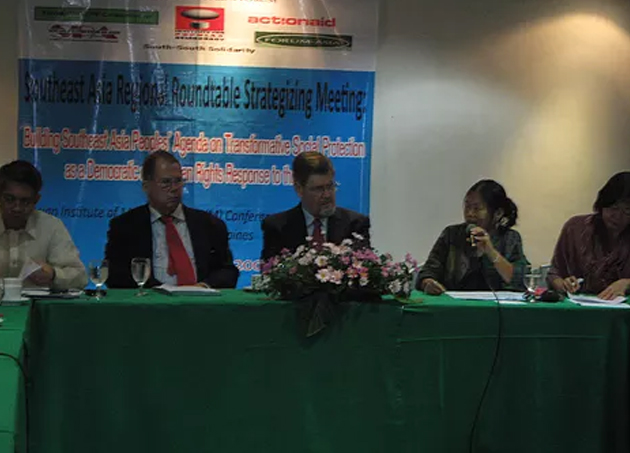
On 12-13 October 2009, the Asia-Europe People’s Forum (AEPF) is organizing a Southeast Asia Regional Roundtable Strategizing Meeting with the theme “Building Southeast Asia Peoples’ Agenda on Transformative Social Protection as a Democratic and Human Rights Response to the Crisis ” at the Asian Institute of Management (AIM) Conference Center Manila in Makati City, Philippines.

This meeting is a step forward in the “Reclaim People’s Dignity” campaign (campaign on transformative social protection of the poor) that began to take shape at the caucus among Asian poor people’s movements at the Seventh Asia-Europe People’s Forum (parallel to the ASEM Summit) in Beijing. Facilitating this campaign and co-organising the meeting in Manila are: Action Aid Asia, Institute for Popular Democracy, FORUM-Asia, Social Protection Asia, and South-South Solidarity. The Finnish AEPF Committee also sponsors this roundtable.

Some thirty scholar-activists, and representatives from social movements and grassroots people’s organizations from Indonesia, Malaysia, Philippines, Thailand, and Vietnam are coming together for this meeting with the aim of: (a) building a consensus among Southeast Asian campaigners on an agenda on transformative social protection as a democratic and human rights response to the current crisis (see attached manifesto) and on strategies in pursuing this; and (b) activating a dynamic core group on this campaign in the region, working both at national and regional levels.

In the immediate, the output of the meeting (Southeast Asian People’s Agenda to Reclaim People’s Dignity), as well as the manifesto, shall be presented to the officials of the ASEAN during its dialogue with civil society groups at the ASEAN People’s Forum (APF) scheduled on October 18 to 20, and if possible to the ministers and leaders at the ASEAN Summit that follows the APF on October 23 to 25.

Read More

AEPF-7 Opening Speech of Charles Santiago

AEPF-7 Opening Speech of Charles Santiago

October 4, 2009

OPENING SPEECH OF CHARLES SANTIAGO
Member of Parliament, Democratic Action Party. Malaysia
Monitoring Sustainability of Globalisation (MSN, Malaysia)
October 13, 2008
Beijing, China

Chairperson
His Excellency Yang Jiechi, Foreign Minister of China
Honorable Heidi Hautala, Member of Parliament, Finland
Members of the IOC and NOC
Friends

I bring you greetings of peace and solidarity from the civil society in Malaysia.

It is ten years since many of us met in London in one of the earliest Asia Europe People’s Forums. Our solemn mood then was shaped very much by the fall-out of what was called the Asian economic crisis. In that context, one economy after another – Thailand, Indonesia, South Korea, the Philippines – went belly-up. And the once-praised developmental model fell into disrepute.

Ten years fast forward – the high priest of free market ideology Alan Greenspan, the former Chairman of the US Federal Reserve of 18 years, in his book Age of Turbulence heaped praise on the magic of financial markets and criticized as foolishness those who called for greater regulation of the financial markets. In fact he asked “why do we wish to inhibit the pollinating bees of Wall Street”.

One year into the publication of the book world financial markets have been gripped with panic. Financial uncertainty and fragility have become buzz words. Global stock markets have hit rock bottom and are in a free fall. Wall Street lost its top five investments banks. Fearing that the financial system might collapse, the US congress passed a USD 700 billion rescue package, the biggest US government intervention in history.

Similarly the British government announced a 500 billion pounds bail-out package to save its financial institutions. Workers lost their life savings. Fears of a global recession or depression are being predicted, one worse than in the 1930’s. The present Chairman of the Federal Reserve Ben Bernanke admitted: “We have no control any more.” The world changed in September 2008.

Just as in 1997, the cause of the financial crisis was unfettered liberalization of financial markets. Just as in 1997, the governments subsidized the rich, including their plunder and recklessness through bail out and rescue packages.

The Chairmen of the failed Lehman Brothers is reported to have received about USD 484 million in various kinds of compensation even when the company was in trouble. In fact, the captains of industry continue to cheat and plunder because they do not pay for the crisis. The victims are workers who might be out of a job and who might have lost all savings. This is your classic socialism for the rich and free market poverty for the poor.

What is peculiar about the 2008 financial crisis is that it is taking place along-side a food, energy and an ecological crisis. Furthermore, it humbled the world’s economic super powers. They are asking developing countries like China to help solve the credit crisis through coordinated interest rate cuts.

Back in 1998, it was already clear to activists from the social movements and civil societies of both Asia and Europe that far-reaching, progressive responses were needed to address both the causes of the crises and their bitter consequences. The writing was on the wall.

We in the AEPF called for a radical new policy agenda – one which addressed the impact of economic policies on ordinary people, human rights and the environment. In short, we demanded that ASEM should broaden its agenda to include governance and human rights issues, environmental sustainability and people-centred development.

***

Did the governments of Asia and Europe listen to the calls for a different model of development? Did they put into place the kinds of responsive and accountable governance mechanisms that could anticipate and deal effectively with periodic crises?

The answer should be clear enough. In their collective wisdom, the political leaders, policymakers, corporate captains, and media and academic supporters ignored in almost every detail what had gone so drastically wrong in 1997 and 1998. Instead of reflecting critically on the dangers of rapid liberalization, deregulation and privatization, these neoliberal ideologues actually launched an even more intensive and extensive assault, driven by the motor of market-led politics.

One important outcome of the assault is that transnational finance increased its control over all the major circuits of the global economy. The result has been an unprecedented concentration and centralization of economic power, dominated more and more by giant conglomerates working hand in hand with a hidden banking system.

The results are clear for all to see. Today, a decade hence, we can feel the aftershocks of yet another capitalist crisis. The masters of the market have been forced to eat humble pie for their own recklessness. They are consumed by fear.

At the same time, ordinary people around the world – working people, marginalised groups, developing countries – brace themselves to pay the price – already running into trillions of dollars – not only for the greed of the super-rich but the structural failings of an economic system based explicitly on exploitation and injustice.

This time round, the scope of the crisis is truly global. Its epicentre is the very heart of the neoliberal capitalist order: in Wall Street, in London, in Tokyo’s Nihonbashi district. And its seismic shockwaves reach to every part of the world where the logic of the market prevails. As has become abundantly clear, there is no hiding place from the markets’ ring of fire.

While today everyone is obsessed with the sickness of the banks and other financial institutions, only a few months ago the world’s attention turned (at least for a while) to the most acute food crisis in decades – with “routine” hunger transforming into what has been called “the great hunger of 2008”.

And of course the circuits of finance capital and the food crisis including the energy crisis are intimately related. The rapid and simultaneous rise in the world prices for all basic food crops – corn, wheat, rice, soybeans and cooking oils – has not been because of a lack of production. Rather it lies in the way that food has become just another item in global commodity chains, subjected to the same irrationalities of the markets as other commodities.

In fact, there is something wrong with our food system. Agri-business has transformed food into a speculative commodity as opposed to ensuring people right to food and livelihood. In fact at the heart of the food crisis are neoliberal policies that focus on free trade as opposed to self sufficiency.

It appears that agricultural policy has been detached from the aim of feeding people. Thus it comes as no surprise that the UN World Food Programme warns that about 100 million people will go hungry as a result of the recent price hikes.

Speculation in the futures market has become endemic as the massive food conglomerates and financiers make common cause. Hedge Funds and other speculative and investment funds control about 50-60 per cent of the wheat traded on the global commodity markets.

One estimate shows that the amount of speculative money in commodities futures – markets where investors do not buy or sell a physical commodity, like rice or soya or wheat, but merely bet on price changes – has ballooned from US$5 billion in 2000 to US$175 billion in 2007. This is the new face of profit amidst hunger.

And then there is speculation in oil. Goldman Sachs speculative money in oil amounts to USD 80 billion. Since 2005 Morgan Stanley has been accumulating warehouse space in the Netherlands to store its hottest property–oil. At present the investment bank supplies fuel to United Airlines.
In fact speculative investment demand in commodities increased from USD 70 billion in 2006 to $215 billion in 2008, about a 300 percent increase in a short two year period. Much of the trading by hedge funds is driven by sophisticated computer-trading models. The models, known as black boxes, use complicated formulas to determine trades for a hedge fund.

Since the advent of oil futures trading and the two major London and New York oil futures contracts, control of oil prices has left OPEC and gone to Wall Street, Nymex in New York and the ICE (Intercontinental Exchange) Futures in London.

In addition, there is the longer term horizon of the ecological catastrophe – in a year when leading scientists have predicted the environmental problems facing humanity have reached an irrevocable “tipping point”.

The global ecological crisis, deepening remorselessly, threatens the world as never before. It is an outgrowth of unrestrained corporate power that today colonizes every realm of human life. Neoliberal capitalism’s overexploitation of nature’s resources is based on its pursuit of growth at any cost.

Once again, we can point to the inner logic of a system in which the unceasing drive for expansion in the name of profits and accumulation destroys our planet’s very survival.

***

So, once again we stand at an historical moment in a somber mood – surveying the wreckage of crises that have both long-term and immediate consequence; of crises that are both structural and conjuncture; of crises that demand not cosmetic reforms but a deep-rooted and sustainable transformation of how we shape the global order.

What is certain is that supporters of neoliberal capitalism went onto a major offensive towards economic restructuring. In reality, this was nothing less than a comprehensive project for market-led capitalist development.

Of course, over the past decade financial liberalization has been accompanied by a deepening of trade liberalization. We are all too conscious of the programmatic assault by the transnational corporations – working through the World Trade Organisation and a bewildering array of regional and bilateral arrangements – to pry open markets not just in goods and services, but in every conceivable area of social life. “Free trade imperialism”, the project of the British Empire in the nineteenth century, today finds its modern equivalent in the unfettered empire of corporate capital.

Thus, the architects of post-crisis restructuring ten years ago took seriously the task of re-making the world as they saw fit – a world fit for business to operate with impunity.

The overwhelming majority of governments in both Asia and Europe came to accede in the project of capitalist transformation – a project that placed the logic of market competition, corporate profits and commodification at the very centre of its policy regime.

The work of the official ASEM process must be seen in this light. It, too, embeds formal intergovernmental institutions as well as informal networks of private actors to persuade us all that the business of ASEM really is business.

A new spirit is abroad in the world – and it is a spirit driven by the imperatives of the global market and dependent development.

***

Chairperson and friends –If we are to seriously combat the current system, if we are to offer comprehensive and not piecemeal alternatives, then it is also vital to look below the surface – beyond even today’s pressing financial, food and ecological crises – and understand the deeper processes that are at work.

I think this deeper structure can best be understood by reference to three key aspects of the current crisis-ridden system, conveniently the three Cs:

  1. The politics of competitiveness
  2. The politics of regulatory convergence
  3. The politics of new constitutionalism

Let me begin, then, with the politics of competitiveness. With many of the instruments of deregulated market politics in place in most countries of the world, the dynamics of economic and political change are increasingly being shaped by the pursuit and promotion of capitalist competitiveness.

Crucially, the governments of the leading capitalist economies—such as those in the EU – are not pursuing competitiveness for themselves alone. They are actively promoting it too in other countries and regions of the global economy – notably in the “emerging markets” and low and middle income countries of Southeast Asia.

The draft recommendations from the European Commission on how to set about negotiating the EU-ASEAN Free Trade Area are absolutely explicit on this:

New competitiveness-driven FTAs would need to be comprehensive and ambitious in coverage, aiming at the highest possible degree of trade liberalization, including far-reaching liberalization of services and investment.

The Commission goes to stress “the need to ensure that we share similar ambitions with our prospective partners at the outset”. This, then, is the real meaning of a so-called “partnership of equals” between Europe and Asia.

Second, together with the huge political effort to promote competitiveness and entrepreneurship in Europe’s so-called business and trading partners, the project has been driven by nothing less than a new “politics of convergence”.

This effectively means four things:

  1. The first is the development, largely among international institutions, of a set of ‘appropriate policy choices’ seen as generating of capitalist competitiveness.
  2. The second is the use of systematic surveillance, international benchmarking and peer review as the means of promoting the policies concerned to those national governments—the EU calls this “regulatory transparency” and “conformity assessment” in its ASEAN directive.
  3. The third, and as I highlighted earlier, is the identification of national governments as the agents responsible for implementing change.
  4. And the fourth is the insistence that a key part of the task of national governments is to shape public opinion to the logic of global competitiveness.

This would create “the right kind of competitive pressures”: competitiveness is to be promoted, on as wide a scale as possible, for the disciplines it imposes upon the national economies of all countries.

Both ASEM and the proposed EU-ASEAN FTA can thus be seen as part of this wider process of regulatory convergence around a whole cluster of competitiveness and liberalization policies.

And lastly, in order to be successful in its own terms, the competitiveness and convergence dynamics need also to be re-shaped by long-term frameworks designed to “lock in” commitments to a neoliberal path of development.

The proliferation of international trade agreements such as the EU-ASEAN FTA type is precisely such frameworks. We can call this development the emergence of a “new constitutionalism”.

New constitutionalism is the political-juridical counterpart to the disciplinary neo-liberalism associated with the deepening of the logic of liberalization, market values and competitiveness.

New constitutionalism involves a whole array of political and legal reforms to redefine the political via a series of mechanisms. These include constitutions, laws, property rights and various institutional arrangements, designed to have quasi-permanent status.

A central objective of new constitutionalism, then, is to prevent future governments from undoing commitments to a disciplinary neoliberal pattern of development. And it entails efforts to contain and deflect challenges to its competitiveness and liberalization agenda on behalf of large-scale corporate capital.

***

This, then, is where we have come in the decade in which the world economy has lurched from crisis to crisis. The neoliberal ideologues pretend that economics can be separated from politics. They pretend that the market is best left to develop on its own terms unfettered by governmental regulation. But as we have seen, the project of capitalist reconstruction in our era is a deeply political project. The politics of competition, the politics of convergence and the politics of constitutionalism are all part of a concerted political project to guarantee the rights of capital at the expense of working people and at the expense of a degraded environment.

It should be clear to all of us that the very developments that are supposed to reinvigorate capital are actually the sources of catastrophic crises. And it is at the very moment of crisis that the artificial separation of economics and politics collapses before our eyes. Governments, regional organisations, international institutions like the IMF and World Bank this past weekend – all scramble in unseemly haste to bail out their benefactors through subsidies for the rich. How ironic that the “free markets” are today totally dependent on state intervention. The capitalist state is fulfilling its historic task of providing all the necessary guarantees for the survival of property.

Meanwhile, it is clear that the social costs of stabilization are being borne largely by working people. For most of us, an ever-sharper attack on working-class standards of living will be the main consequence of the current crisis. We can only hope that the scale of hardship and the depth of popular resentment will also encourage the rejuvenation of popular struggles.

It seems to me that the scale of the crisis and the popular outrage today provide an historic opening for the renewal of the kind of radical politics that advances a genuine alternative to capitalism.

This is the task that we should set ourselves – not only here in this Asia Europe People’s Forum but also when we return to our countries and recommence the long-term task of popular mobilisation.

And absolutely vital to this rebuilding is to get people to think ambitiously again and to strategize more robustly about what is possible. We all know that however deep the crisis and however widespread the outrage, the renewal of a radical politics in an age of crisis will require hard and committed work by a great many activists.

Let us recommit ourselves here in Beijing to re-making the world in another image.

Lastly, I want to dedicate this keynote presentation at the Asia-Europe Peoples Forum in Beijing to Malaysian political prisoners detained under the Internal Security Act. They include my friends – Raja Petra Kamaruddin, Hindraf Five and detainees who are languishing in Malaysian jails without trial for more than six years.

Thank You.

Read More

Manifesto: Reclaim People’s Dignity

Manifesto: Reclaim People's Dignity

October 4, 2009

RECLAIM PEOPLE’S DIGNITY
Transformative Social Protection:
A Democratic and Human Rights Response to the Crisis

WHEREAS the current financial and economic crisis is the worst that could be experienced in systemic boom-and-bust cycles since the Great Depression of the 1930s, occurring alongside crises in food security, energy, and climate change, causing 230 million to lose their jobs by the end of the year (ILO estimates) and pushing millions of workers and peasants back to hunger, poverty, and deprivation;

WHEREAS this multiplicity of interlocking crises and its social costs are unfolding into a human rights crisis of global proportion;

Contrary to international laws, to which individual states have committed, millions of people are denied (not accorded) their rights to guaranteed jobs and livelihood, adequate food, and access to quality and affordable essential services like housing, education, health services, water, electricity, and even clean air—preconditions to living a life with dignity. With massive job losses created by these crises, these basic human rights are being violated in an enormous scale. Read More

WHEREAS the present corporate-driven socio-economic paradigm that puts profit and market over people, society, and nature violates these human rights, and caused these multiple crises;

Even before the crises, profit- and market-oriented states were already negligent in their duty to provide their constituents these rights because the system serves not people, not society, not nature. Instead of creating a humane society conducive to living a life with dignity, this system (in policies such as deregulation of the economy, liberalisation of trade, and privatisation of essential services) has unleashed market forces that have allowed poverty with increased inequality dramatically. The public sector becomes smaller; the private sector becomes more dominant and more greedy. More and more people become marginalised, falling into deeper misery. This system robs the poor of the ability to return to traditional livelihoods because natural resources such as forests, fresh water sources, and marine life have been destroyed. This system disintegrates communities and families, turning more and more people into migrants and refugees. This system not only creates a huge mass of people who live outside the real economy in a grey zone of informalisation, but also provides glimpses of an alternative to the present turmoil.

The global economic crisis poses a severe threat to economic and social rights, but it is also a challenge to rethink how we hold states accountable for their fulfillment. Now more than ever, people’s movements need to articulate vigorously the fundamental principles that cannot be rescinded even in times of recession and show how these should guide policy responses to the crisis. This involves intensifying efforts to identify new methods and venues through which to scrutinise governments’ compliance with their obligations to fulfill economic and social rights.

WHEREAS the old neo-liberal paradigm is discredited by the multiple crises that we are experiencing, putting us at a critical juncture of being able to offer an alternative paradigm that prioritises people, society, and nature above corporate greed;

Although the crises demand a major system overhaul, states can only offer token and palliative welfare measures that are inadequate, minimalist, and charity/safety-net type. In contrast to the billions of dollars in bailouts of corporations whose profits are not socialised, this kind of state response is sheer mockery of the poor. The emergency solutions of the world’s decision makers to the crises are confined within the present dominant framework, addressing the needs of the capitalists, subverting real alternatives that advance the values of equity, justice, and sustainability.

An opportunity now opens up for pushing alternatives where people are empowered and the global socio-economic order is transformed inside out—through more democratic access to resources and greater public participation in decision-making.

The crisis is also an opportunity to rethink the role of the state in regulating the creation of wealth and redistributing its benefits towards the universal realisation of economic and social rights. The transnational impacts of the crisis highlight the need to frame accountability in global terms, and to assert more vigorously the notion that states’ responsibilities to respect, protect, and fulfill economic and social rights do not stop at their national borders.

WHEREAS people are not merely productive instruments of growth, but are more importantly agents of change who possess intrinsic worth and inalienable rights and are able to empower selves and others, and to transform societies.

THEREFORE, understanding that the current crisis that has kept hundreds of millions of people from exercising their basic human rights is not an aberration but an inherent outcome of a profit-driven paradigm; and recognising the need to assert an alternative paradigm that protects, promotes, and fulfills these rights,

We, the people, assert that everyone is entitled to institutional transformative social protection as a means to a life with dignity.

We contend that transformative social protection addresses power imbalances in the society, creating a policy environment conducive to pro-poor growth, accountable and responsive governance systems, and a social equity-grounded development approach. Transformative social protection goes beyond targeted resource transfers; it extends to such arenas as equity, empowerment, as well as economic, social, and cultural rights. It requires legislation, financial commitment, and accountability.

We, the poor and vulnerable groups, empowered by collective action and resolved to organise ourselves, proactively claim what are rightfully ours.

We overcome our sense of helplessness and powerlessness by building on small successes at the local level as an organised force with a common voice, engaging states and other power holders, seizing opportunities to participate in decisions concerning our lives, and expanding our right to self-determination.

We, the progressive sectors of society—the civil society groups, social movements, and parliamentarians, advancing the demands of the poor, engage governments and international institutions at all levels (national, regional, and global), and compel them to create with us a socio-economic order with human rights at its core.

The multiplicity, interconnectedness, and global nature of the crises necessitate a corresponding multiplicity, interconnectedness, and global approach to solving them. The solutions are beyond the ability of one state, making it imperative that we work together.

As responses to the crisis have shown, the progress made in advancing the legal justiciability of economic and social rights has not been matched in the arena of politics and public policy. Bridging this gap will involve releasing the still-latent potential of economic, social, and cultural rights advocacy as a powerful tool for social mobilisation and transformation.

We, all, hold those responsible for the crisis accountable, and contend that they abandon the skewed paradigm that brought us these crises and enable participation and solidarity of the majority.

The task is not only to keep off or lift out of poverty millions of people, but more importantly to redesign the global socio-economic architecture that would guarantee dignified life for all. And this gargantuan task cannot be accomplished without the participation or involvement of the rural and urban poor and other vulnerable groups such as migrants, informal workers, women and children, peasants, senior citizens, indigenous peoples. We push for the pursuit of this strategy: Address the ills of society by empowering the most vulnerable.

In reclaiming people’s rights and control in basic social services such as housing, health, education, water and electricity, looking to assuring universal provision,

WE DEMAND from our respective states and multilateral formations what are rightfully ours!

  • Guaranteed jobs and livelihood with wages and working conditions that are in accordance with ILO standards;
  • Adequate and affordable food for all where no one goes hungry;
  • Universal health service;
  • Free and quality education;
  • Socialised decent housing;
  • Universal access to water and electricity, giving subsidised water and electricity for the poor; and
  • Better quality of life that is environmentally sustainable.
Read More

Establishing an AEPF Climate Justice Working Group

Establishing an AEPF Climate Justice Working Group

July 1, 2009 | Dorothy Guerrero

Why a Working Group on Climate Justice in AEPF?

This year’s G8 Summit, which was held in L’Aquila, Italy from July 8 to 10 offered one more opportunity for leaders from major economies to break the climate deadlock by demonstrating their political will in solving the climate crisis and produce something substantial on the table on key issues of technology cooperation and financing. Unfortunately, that opportunity was once more missed. For those following the negotiations in the UN Framework Convention on Climate Change (UNFCCC), this is not surprising for the divide between the interests of developed and developing countries are huge and the contradictions related to offered solutions are getting bigger.

The key issues in the climate negotiations are: a). the long-term goals for emission reductions and avoiding dangerous climate-change impacts, b). adaptation, and c). the introduction of a technology-transfer mechanism and the connected issue of financing that process to allow developing countries to move towards low-carbon economies. Many developing countries still consider the key negotiating texts favorable to developed nations.

The problem with the ongoing UNFCCC negotiations is that the principle of justice is glaringly absent. The basic and undeniable truth in the climate change issue is that the wealthy minority of the world’s countries and corporations, many of them based in the EU, are the principal cause of climate change while the adverse effects are being felt first and foremost by the poor majority. However, this is the big elephant in the room that is being ignored in the talks. The common view among climate campaigners is that the Copenhagen Summit will not deliver just solutions to the climate crisis considering the current state of the negotiations

Climate debt of the developed countries

According to the 2007 study produced by the International Panel on Climate Change, the atmospheric concentration of greenhouse gasses started to increase since the industrial revolution, but the most dramatic increase can be seen from the period 1970 to the present. The atmospheric space is humanity’s commons where we share equal rights and equal responsibilities. However the past, present and the proposed future share between rich and poor countries of this commons shows a grave inequality.

Since 1850, the per person emission of the population of developed countries (or historical emissions), already reached 70%. With 20% of the total world population it is clear that they already used up more than their fair share. This disproportionate share means the denial of space to poor countries and communities. Now the negotiations about targets for decreasing per country emissions until 2050 is about how much can everyone still get from the remaining atmospheric space. The North’s pressure for developing countries, especially China and India to take mandatory reduction targets can be seen as the North’s attempt to deny the opportunity for development to these countries. Some of the developing countries (ex. Bolivia, Honduras, Nicaragua and Venezuela), already presented a position about the historical responsibilities of the rich countries to global warming and this is gaining support from the G77 and China formation.

Many rich member countries of the EU are avoiding their responsibilities

All scientific studies shows that a more than two degrees increase in global temperature is the tipping point for the ecosystems. In the UNFCCC, Southern countries argued that Annex 1 countries (those that have promised to limit their greenhouse gases by 2012 in the UNFCCC) should commit first to a 40% reductions below 1990 levels by 2020 to avoid that. This is still a bottleneck in the UN negotiations. The EU, which regards itself as the vanguard of climate policy, is offering a unilateral 20 percent reduction below 1990 levels by 2020 while India, with 1.2 billion people and currently emitting 4.6% of the total global emissions, is being forced to agree to a 7-15% cut.

The G8 adopted last week that developed countries should reduce their greenhouse gases by 80% by 2050 to prevent the more than two degrees increase in global temperature. This cut will not prevent temperature increase, as the 2007 IPCC study already shows that the required global cut should be 85% by 2050. It also hides a lot of contradictions. If we look at the policies of many EU countries, it includes buying up an average of 50% of the reduction from abroad. The UK for example, will offset half of its emissions to other countries. This automatically means paying other countries to take in their emission and avoid pollution within its territory, which is a mockery of the principle of common responsibilities. Emission rights now costs trillions of dollars (Financial Times estimate is $1 T/year).

According to the US Energy Information Administration, the 39 Annex 1 countries produce 51% of global emissions now. Most will likely do what the UK is planning to do, which is to buy reductions of about 20% of the world’s total carbon production. By selling their right to emission by means of absorbing developed countries’ carbon offset, poor countries would need to cut their own emissions. The outcome: the rich will continue to pollute while the poor must cut their emissions. This means locking the South in poverty as this will arrest their capacity to produce goods, improve livelihoods and living conditions of people.

Meanwhile the adverse effects of the historical and continuing high per person emissions of rich countries on poor communities and countries continue. In Asia the current and future impacts of climate change are:

  • Glacier melt in the Himalayas is projected to increase flooding, rock avalanches from destabilized slopes, and affect water resources within two to three decades. River flows will decrease as the glaciers recede. Decreased Freshwater availability in Central, South, East and Southeast Asia – along with population growth and increasing demand, could adversely affect up to 1.2 billion people by 2020.
  • 30% yield reduction in agriculture in Central and South Asia by 2050. Rain-fed agriculture is expected to drop by up to 50% by 2020 leaving millions without food.
  • Indigenous and local communities are affected by changing ecosystems and threats to traditional livelihoods.
  • The poor communities in concentrated coastal and river flood plains risk flood.
  • Expected rise of diarrheal disease in East, South and Southeast Asia. Increased coastal water temperature would exacerbate the abundance and/or toxicity of cholera in South Asia. 220 to 400 million more people could be exposed to malaria (UNDP).

Another block in the negotiations is about financing for adaptation and mitigation measures and access to technology by developing countries. Developed countries argue that in the WTO regime the intellectual property rights related to such technologies must be respected. Developing countries argue that they should have easy access to such technologies since they are not the ones which created the climate crisis in the first place.

Those affected by climate change must be heard Short-term economic interests are driving the negotiations. Climate change is happening now and will continue to produce grave impacts to poor people in Asia and Europe. If we are to achieve long-term effective and equitable solutions to the climate crisis, it is vital that those calling for genuine climate justice look at the Europe-Asia dimension of the debate. The EU must not continue to steal the skies from Asia. The communities and movements affected by climate change in the two regions, have much to contribute in terms of mobilizing public opinion, and providing analysis and policy alternatives.

Draft made by:
Dorothy Guerrero
Focus on the Global South July 2009

Read More

AEPF Governance and Structure

AEPF Governance and Structure

September 27, 2008

The AEPF Governance and Structures provide the framework how we strengthen the AEPF and enable greater clarity and transparency in decision making.

The Charter of the Asia Europe People’s Forum provides our reference point and the fundamental basis for how we work and what we aim to do.

Structure

The International Organising Committee (IOC) coordinates the activities of the AEPF. It initially consisted of civil society organisations and social movements that organised the first AEPF in Bangkok in 1996. Since then, members have been added, mainly coming from countries where succeeding forums were held.

The IOC works with a National Organising Committee (NOC), which is also composed of people’s organisations, in the host country. The IOC and NOC, in cooperation with interested organisations in Asia and Europe, decide on the direction and content of the biennial forum. The AEPF has coordinating organizations in each region — in Asia, this is Indonesia for Global Justice (IGJ) in Jakarta, and Monitoring Sustainability of Globalisation (Malaysia); in Europe, it is Stiftung Asienhaus (Germany). In-between the biennial People’s Forums, AEPF is active through geographical and thematic circles. At this time, the Philippines and Indonesia have active geographical circles.

Thematic circles are organised around issues relating to:

  • Water justice and public-public partnerships
  • Free Trade Agreements between the EU and Asia
  • Participatory democracy and local governance
  • Alternative Regionalisms

The AEPF structure is aimed at enabling places and spaces for all who wish to be part of the AEPF. The AEPF should be a space for open and democratic debate and exchange providing the possibility for networking of people’s movements in Asia and Europe for joint actions which include lobbying the ASEM and related institutions and the European Union’s agenda in Asia.

The AEPF is not only ASEM-related but focuses on broader Asia-Europe relations. Therefore we are not the ASEM Peoples Forum but the Asia Europe People’s Forum.

We believe that the AEPF is inclusive and transparent, democratic and open. We are working towards a series of linked circles of two types:

  1. Geographical Circles at national and regional levels.
  2. Thematic Circles for areas of work and activities of the AEPF.

FACILITATING STRUCTURES OF THE AEPF

Principles

We aim to strengthen solidarity between peoples of Asia and Europe.

  • Inclusive. We will enable people and organisations with different and diverse backgrounds to be part of the AEPF. However we will ensure that a pro-people orientation remains fundamental.
  • Work is based on and builds on the AEPF Charter and our People’s Visions including their fundamental principles. This is our fundamental common ground. A commitment to the principles agreed and stated in our Charter is fundamental to participation in and collaboration with the Asia Europe People’s Forum.
  • We work on Asia-Europe relations but not exclusively those located in the ASEM process.
  • Transparent, democratic and open
  • We need to celebrate diversity and encourage and recognize that there are multiple solutions.
  • We recognize that Women’s access to rights and resources is often still unequal and inappropriate and that this needs to be challenged and changed.
  • Linking with networks and movements, being complimentary to the work of others and providing a space for others. The AEPF places importance on membership organisations, networks and movements with democratic decision making processes. This is key.
  • Build on collective energies and actions

We note that:

  1. There is a need for an inter-regional structure and that this has to be founded, informed and inspired by people’s experiences, strategies and visions.
  2. The base should be geographical and thematic, building on our strengths and the Asian and European regions.
  3. Our structure should bring together organizations and movements and facilitate exchanges of experiences, information, strategies and actions between them.
  4. The type of organizational structure most appropriate to the development and strengthening of the AEPF is not pyramid shaped but circular.
  5. We do not have the resources for one permanent secretariat.

THE STRUCTURE

Circles

The Circles are the foundation of our structures.

  • Circles are created and made up of people who are representatives and activists from organizations and are people committed to working on the issue or activity that is the focus of the circle.
  • Circles are open and not closed.
  • Circles can agree on their most appropriate ways of working.
  • Circles should develop and agree plans for their work and share these as appropriate.
  • Circles will intersect.
  • Circles, when formed, will elect a link person(s) to link to other appropriate circles.

Types of circles

There are two types of Circles envisaged

  • Geographical and
  • Thematic Circles.

Geographical Circles are envisaged at a minimum of three levels

  1. The AEPF International Organising Committee (IOC)
  2. Regional AEPF Circles (Asia and Europe)
  3. National AEPF Circles

Different areas of work can generate different Thematic Circles. These can also exist at the three geographical levels if appropriate. They are likely to be established first at the international and regional levels. As activity and interest is developed then connected national circles might be developed.

A member of a Thematic circle would be elected to be the link person for that area of work or activity from their circle to national/regional circles and/or the IOC.

Members of Thematic circles have the obligation and responsibility to share their work with other members of their national or regional circle.

Linking of Circles

One of the most important parts of the structure is the way in which circles link together. Each circle will elect a member to be the link person to other appropriate circles. This could be between two different thematic circles or between a thematic and geographical circle. The linking has many roles and responsibilities. It is key to enabling the AEPF to be more comprehensive and to making sure that the geographic and thematic circles share their ideas and activities. The links can also enable us to join and co-operate with other movements and networks.

Many individuals and organisations involved in the AEPF across the world are already involved in specific advocacy work. The AEPF aims not only to generate credible people centred alternatives but also to recognise, collate and endorse such alternatives that emerged before and after the Asia Europe People’s Forums and that will emerge in the future. Some are linked to the AEPF and others are independent. The structure ensures that they have a place for this to continue, to be able to share this better with other activists and to link with other people and organisations engaged in complementary activity.

Geographical Circles

The Geographical Circles are based on joining regional and eventually national circles.

The initial regions are

  1. Asia
  2. Europe

Through discussion, consultation and evolution we will be able to evolve a regionalization which reflects what each region feels is a viable and a positive contribution to the AEPF.

National Circles

The IOC should encourage where feasible the development of national circles and for them to link with regional circles. National circles can be established by organisations and movements working on Asia-Europe issues coming together. A national circle will need to apply to the Regional circle for recognition. The Regional circle will then forward this application to the IOC which needs to agree the recognition of a national circle. They can develop their own specific ways of working. These should recognise the principles stated earlier. A national circle should also

  • nominate a focal or contact person for the National Circle
  • nominate a link person(s) with the appropriate AEPF Regional Circle and the IOC.

Focal Points

There are two Focal Points for the AEPF International Organising Committee, one in Europe and one in Asia. They play an important role in catalysing and facilitating the different circles and their inter-relationships. The Focal Points can rotate after an agreed period if this was felt to be desirable and feasible. The role and functions of the Focal Points are outlined below.

AEPF International Organising Committee

The AEPF International Organising Committee (AEPF IOC) is the reference body for the AEPF.

Membership Criteria

The IOC has up to sixteen members – six from Asia based organizations and six from Europe based organizations and up to two regional networks per region.
The size and composition of the IOC is reviewed every two years.
In principle there is an aim to have a balance of members from Asia and Europe.
Membership is for organizations and networks supporting the Charter. It is not for individuals. There is no more than one national organization per country on the IOC. Regional organizations like Forum Asia and Focus on the Global South can be IOC members as regional networks.
In each region there should be no more than two regional networks who are members of the IOC. This means that the maximum number of members of the IOC is at present 16.
The IOC was initially constituted by organisations and networks that were committed to develop and strengthen the People’s Forum process since it began in 1996. They formalised this commitment and have subsequently enlarged the IOC.

Current members are

Asia

  • Institute for Popular Democracy (The Philippines)
  • Focus on the Global South (Asia Regional)
  • FORUM Asia (Asia Regional)
  • Monitoring Sustainability of Globalisatio (MSN, Malaysia)
  • Vietnam Peace and Development Foundation (VPDF, Vietnam)
  • Indonesia for Global Justice (IGJ, Indonesia)

Europe

  • Transnational Institute (The Netherlands)
  • Stiftung Asienhaus (Germany)
  • Fresh Eyes – People to People (United Kingdom)
  • French AEPF Committee (France)
  • Finnish AEPF Committee (Finland)
  • Ecologistas en Accion (Spain)

The membership and composition of the IOC is decided by the IOC

The Composition of the IOC, including the organisational memberships and names of representatives on the IOC should be reviewed at an IOC meeting which should be held immediately after the bi-annual People’s Forum. This IOC meeting should also consider new applications for membership.

Criteria for application for IOC membership

Each prospective IOC member must

  • support and be committed to the AEPF Charter
  • have a proven commitment to bringing Asia Europe relations and issues to wider audiences in their country and /or regionally;
  • have a proven commitment to positive working with the IOC and existing member organisations and networks. This can include within Thematic Circles;
  • have a recommendation from their respective regional circle;

Membership of countries hosting People’s Forums

Every two years there shall be a People’s Forum held just before the Asia Europe Meeting (ASEM) in the town or city which is hosting the ASEM summit. The IOC has co-organized this with a National Organizing Committee (NOC) formed in the hosting country. The individual People’s Forums are organized jointly by the IOC and the NOC with decision making between the IOC and NOC taking place on the basis of consensus and where necessary negotiated consensus. There will be an IOC meeting that inaugurates the preparations for the People’s Forum. From then up to and including the Forum the NOC will nominate one representative to be a member of the IOC. They will be member of the IOC until the IOC that is held after the People’s Forum. This representative will be the formal link between the IOC and the NOC. After the People’s Forum an organisation or network from the hosting country can, if they wish, apply to be a member of the IOC. Like all applicants any applicant from the People’s Forum hosting country must fulfil the pre-requisites for becoming a member of the IOC. The IOC will assess and decide on this application in the context of the IOC’s criteria.

Responsibilities of the IOC

The main responsibilities of the IOC are:

  1. To take forward commitments made in the AEPF Charter, The People’s Vision and the Declarations made at the People’s Forum.
  2. Taking forward the Charter
  3. Strategic planning, assessment of progress and reviewing the direction of the work of the AEPF
  4. Coordination, supporting and facilitating the work of the Regional and National Circles, Regional Focal Points and Thematic Circles
  5. Organising, with a National Organising Committee from the host country, a People’s Forum held just before the Asia Europe Meeting (ASEM)
  6. Overall responsibility for the finances, fundraising and related reporting whilst delegation agreed activities to the Finance and Fundraising Transparency Committee
  7. To discuss and agree or reject requests to establish National and Thematic Circles.
  8. Liaise with ASEM and related institutions

Frequency of Meetings

IOC meetings are convened by the focal points.
IOC meetings should take place at least once a year. At least one meeting a year should be a ‘face-to face’ meeting. Additional meetings can, where feasible, be by phone conference.
Regional Circle meetings should take place at least twice a year. One meeting a year should be a ‘face-to face’ meeting. Additional meetings can, where feasible, be by phone conference
One IOC meeting should be held immediately after a People’s Forum.

Decision Making

Quorum for an IOC meeting is 50% of both Asia and Europe members
This will be rounded up if there is an uneven number of regional members. Currently three members from each region will be considered as quorum.
There are no nominated/proxy votes.
The fundamental aim is decision making by consensus. This is a working principle of the AEPF IOC.
If consensus cannot be reached then an open vote will be taken on a proposed recommendation. This would be accepted if there is at least a two thirds majority voting for it. To be accepted the vote in favour must be at least two thirds of both Asia and Europe members present. If requested objections to a decision can be minuted.
Meetings, including skype meetings, will be minuted.
Minutes will be circulated within two weeks of day of or closing day of the IOC meeting. They will be agreed by participants within a subsequent four weeks with any written amendments being submitted within this time frame. If no comments are received within the four weeks from when the minutes have been circulated, they will be considered accepted. Final minutes will then be circulated to all IOC members. If requested reservations or objections to a decision can be included in the minutes.
An IOC Meeting should be called with at least six weeks notice to members for a physical meeting.
Meetings are in principle open for observers to attend on a case by case basis to be agreed by the IOC.
Urgent actions can require a telephone conference which requires one weeks notice.

Legal Status

The AEPF and the AEPF IOC do not have a legal identity in itself.
Delegation of Responsibilities
IOC can agree the delegation of responsibilities
in consultation with the funding circle/group, to delegate authority to raise funds for AEPF supportive and related activities
for contracts to support AEPF supportive and related activities

It is stressed that the organisation that has responsibility delegated to it and has signed the contract is wholly responsible for the terms and conditions of the contract and the risks and liabilities related activities undertaken.
The AEPF IOC cannot accept liabilities for financial short falls or breaches of contract as it has no legal identity or own/core funds.
It may be desirable for the AEPF IOC Circle to elect a smaller group who would be a reference group for the Focal Points on certain agreed issues. This could consist of six representatives of which three will always be from Asia and three from Europe.
Links to Thematic and Geographical Circles
The IOC can create and agree circles/working groups for specific activities. Each circle should elect/nominate a link person. The link person has the responsibility to report to the IOC on the plans and progress of the circle.

Focal Points

In principle there are two focal points, one in Asia and one in Europe. These are recommended by regional circles and the recommendation must be approved by the IOC. The Focal points are accountable to the IOC and National Circles.

At present Stiftung Asienhaus (Germany) is the Europe Focal Point and, following a recommendation and agreement by the Asia IOC members, IGJ are currently co-sharing the focal point responsibility with MSN

The Focal Points have the responsibility for

  • facilitating and coordinating agendas for regional discussions and meetings
  • setting meetings
  • co-ordinating within the respective regions
  • ordinating between the regionsco
  • fundraising
  • lobbying and advocacy coordination in region and between regions
  • receiving requests to establish a National Circle and, – after assessing them against the AEPF criteria, submitting them to the IOC

Thematic Circles

There are two main types of Thematic circles

a) Working Circles- to enable the development and strengthening of the AEPF

Thematic Circles could be developed for activities that are key to the development and strengthening of the AEPF itself. These will generally begin as International Thematic Circles.

Initially these are

  • Planning and organisation of the currently bi-annual People’s Forums
  • Peoples Vision– popularizing, translating and promoting
  • Funding, fundraising and Budget
  • Relationship with and lobbying of ASEM meetings

b) Thematic Circles – for policy and lobbying work

Thematic circles could also be developed for specific areas of policy and lobbying work. Some of these might be of a short duration and related to an activity others may be on-going. This is an open ended list. If there is the commitment and energy to establish and contribute to a circle then its establishment should be considered.

It is proposed to build these around the four themes of activity

  • Participatory democracy and human rights
  • Peace and security
  • Social and economic rights
  • Environmental justice and sustainability

Current work already covers

  • Local and participatory democracy and government
  • Water and alternatives to water privatization
  • Security and Peace
  • EU Free Trade agreements with ASEAN, Korea and India

These are not exclusive themes. This list will be organic and based on people and organizations ability and commitment to do things.

Thematic Circles are not necessarily fixed or with a fixed membership. They should work respecting the AEPF Principles stated earlier and respect the AEPF Charter.

To establish a circle, a group, organisation or network should elect a focal link person/organization as outlined above. The Thematic Circle will need to apply to the IOC for recognition. Share who the focal link person/organization is and agree to report regularly to the IOC.

Some Thematic Circles might be first established at the International level

In some regions for some Thematic circles, regional or even national circles may be appropriate and desirable.

The AEPF IOC will decide on the most appropriate ways of relating to and linking with both the Thematic Circles- to enable the development and strengthening of the AEPF and the Thematic Circles – for policy and lobbying work.

Specific attention will be given to the ways that the circles work and interact and outlining the principles they can work with in more detail. It may be appropriate to develop briefings on possible ways to establish and work in circles.

Developing AEPF positions and responses

Position papers and documents supported by the AEPF should be backed by a process of collective endorsement. Though individuals and organisations are encouraged to take public positions under their own names, an AEPF position should evolve more collectively.

Accountability and Responsibility

As stated above, a key concept in the Thematic circles and the geographical circles is accountability back to a constituency. This may also be important for members of National AEPF Circles as they may be there from and on behalf of certain constituencies.

AEPF National Organising Committee (NOC)

AEPF National Organising Committee (NOC) should be established by the host country of a People’s Forum.

The NOC has the responsibility to work in partnership by consensus with the IOC to host the People’s Forum.

The People’s Forum must respect the AEPF Charter and contribute to the fulfilment of its principles and respect its stated ways of working.

The NOC should be constituted by a range of organisations and networks that can ensure that the People’s Forum takes place on the basis of the principles and ways of working agreed in the AEPF Charter. The NOC should be open to cooperating and collaborating with local organisations that support the AEPF Charter.

The NOC is required to

  1. Nominate a representative to be a member of the IOC in the preparation of and during the People’s Forum.
  2. Nominate four representatives to be members of a People’s Forum core group to work with four representatives of the IOC. (The IOC representatives will normally include a representatives from each of the Focal Point organisations)
  3. Agree an appropriate basis for the secretariat for the organisation of the People’s Forum
  4. Work in partnership and through decisions made by consensus with the IOC to agree the process in the preparation for and building up to an AEPF which includes the respective roles for the IOC and NOC in

– Drawing up the thematic statement about the aims and focus of the forum, including a working name;

– Agreeing timing, location, venue(s), accommodation;

– Agreeing processes for developing a programme including its structure (Plenaries/workshops/public events etc.), number of days and main content;

  1. Agreeing a process for Workshop subjects and then, who proceeds to organize them and how and with what accountability to both the IOC and NOC;
  2. Agreeing a working budget and related fundraising strategy and division of labour to raise funds;
  3. Invitation of participants both national and international, relation to resources. This will include process for agreeing a timetable to ensure visas for international speakers and participants.

The IOC and NOC will agree lines of communication and decision making, including levels of decision making, between the NOC and IOC;

The People’s Forum

Every two years we organise a People’s Forum as an Alternative Summit to the ASEM. Based on shared struggles, work and experiences, priority issues have been:

  • Participatory democracy and human rights
  • Peace and security
  • Social and economic rights
  • Environmental justice and sustainability

Although organising People’s Forums held in parallel to official Summits is neither the beginning nor the end of the network’s activities and agenda, the holding of these alternative summits does provide key opportunities for strengthening and consolidating the work of the network and for making it visible.

The People’s Forum is

  • An event that precedes the Asia Europe Meeting (ASEM)
  • It will be held in the ASEM town/city of the host country as close in time to the ASEM as possible
  • It focuses on Asia-Europe relations but does not limit itself to either the ASEM agenda or ASEM member countries
  • It is open to social movements, organisations, networks and individuals who support the AEPF Charter and who are committed in taking it forward
  • It welcomes participants from ASEM member countries and non-ASEM member countries in Asia and Europe
  • It can invite speakers to contribute to discussions and reflections on the themes of the Forum from anywhere.

Governance and Structures of the Asia Europe People’s Forum
Agreed by IOC

Read More

Human Face : Surging like ‘The Oceanides’

Human Face : Surging like 'The Oceanides'

September 14, 2006

First posted 01:21am (Mla time) Sept 14, 2006
By Ma. Ceres P. Doyo
Inquirer

Editor’s Note: Published on Page A13 of the September 14, 2006 issue of the Philippine Daily Inquirer

HELSINKI — After days of Nordic food, bottomless coffee, workshops, talk shops, civil society networking and so-called “open space” discussions (throw in a few films), the 450 participants of the Asia-Europe People’s Forum 6 (AEPF 6) held in Helsinki called it a day.

There was no evidence of rice-and-spice-deprivation withdrawal among the Asians as they were very vocal, as victims and potential victims of neo-liberalism should be. Asians and Europeans of the G&D (grim and determined) grassroots variety have, once again, found their collective voice. On the fourth day, they let it all hang out at a city square through songs, dance, mime and a “people’s soup kitchen,” courtesy of the Finns.

Here in the land of a thousand lakes, the land of the revered composer Sibelius, (for “cellphonephiles,” the land of Nokia), Asian and European voices swirled and rose, like the ocean’s roiling surge in Sibelius’ symphonic poem “The Oceanides.” (Finland is just a wee bit larger in area than the Philippines but has a population of only five million. Compare that to our 80 million plus, or just Metro Manila’s 10 million.)

As AEPF ended, the object of its trajectory, the Asia Europe Meeting (Asem) was about to begin, with government leaders in attendance, Gloria Macapagal-Arroyo among them. These Asian and European leaders forge political and economic links that could spell the race to the top for some or the race to the bottom of the ocean (the Pacific, particularly) for many. Together, the Asem member-states have influence over half the world’s GDP.

AEPF, the vibrant people’s forum that it was, ended on a high note, clamoring to push the people’s alternative agenda to the attention of Asian and European heads at Asem. AEPF 6 holds its big assembly parallel to Asem that meets every two years alternately in Asia and Europe. Asem 2008 will be held in China and already, AEPF is wondering whether it could also hold its own there. At the plenary, the distinguished Susan George, fellow of the Netherlands-based Transnational Institute, described China with foreboding as the worst example of communism and capitalism.

Well, Chinese “NGOs” (read: government-supported) at AEPF got it on the chin. And why not, they came with propaganda installations that showed Tibet as a happy place, (no)thanks to China. But that is another story.

George warned that unbridled competition between Asia and Europe is destroying the European social model. “European leaders who tell us that the European Union needs to accept open markets, labor flexibility and deregulation are pretending we can do the impossible — compete with China and other low-wage but high-skill, high-tech countries.”

Asia-Europe relations, she stressed, must be based on cooperation rather than competition if a race to the bottom on wages and social welfare standards is to be avoided. George was also concerned that the European Commission is using trade negotiations to undermine the development of public services and greater equality within Asia.

Charles Santiago, director of Malaysia-based Monitoring Sustainability of Globalization and member of the AEPF organizing committee, agreed. “With the WTO discussions stuck somewhere between the intensive care unit and the crematorium, there is fear and concern from the Asian side that the EU will aggressively pursue its trade and investment objectives through bilateral agreements,” he said.

AEPF 6 hoped to provide ways for Europeans and Asians to cooperate rather than accept competition as a way of life.

Neo-liberalism, the evil that AEPF has bashed to a pulp, remains a global threat. I asked delegate Dr. Alfredo Robles of De la Salle University for a layman’s definition and he called it “a night watchman’s concept of the state, it means privatization, deregulation, liberalization, with minimal state intervention in the economy.”

But AEPF, he said, could provide strategies for exchange and an articulation of alternative views. It can also influence official processes, say, in Asem. Well, the Asia-Europe Business Forum (AEBF) has a voice within Asem while AEPF, the people’s voice, has to cry out loud in order to be heard up there. AEPF seeks to be recognized as an independent forum that has a legitimate role in the Asem process.

“Asem has a continuing democratic deficit,” AEPF’s closing statement said. “Asem has concentrated on promoting cooperation between governments and representatives of business interests, and its agenda has been geared towards trade, investment and political issues. The economic pillar has promoted pro-market policies as opposed to alternative people-centered policies.”

In other words, AEPF said, there has been no attention to learning from those who have felt the effects of the imposed development patterns — the farmers and workers in both continents, for example.

The groups within AEPF must go beyond constantly talking to one another and project the AEPF’s socially oriented agenda more forcefully through concrete moves. They should make use of the different forms of media. But first, they must speak simply and carry a big picture, give their concerns a human face. What does it look like down there? For example, Finland’s reindeer herders are a threatened lot because of too much logging in prime forests — an issue brought up at AEPF through film. Tapio, the God of the forest in Finnish mythology, must be angry. Also, the issue of Asian labor and migration in Europe was among the hotly discussed topics at AEPF. And so, before flying home, I made sure I picked up some related stories — the Filipino au pair problem in Europe, for example — for a special feature.

I also picked up some smoked reindeer cold cuts from the Finnish deli.

Read More