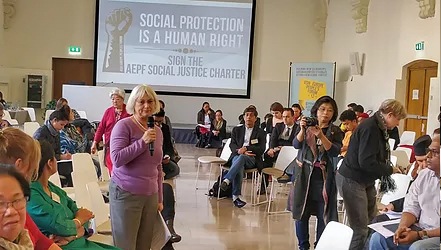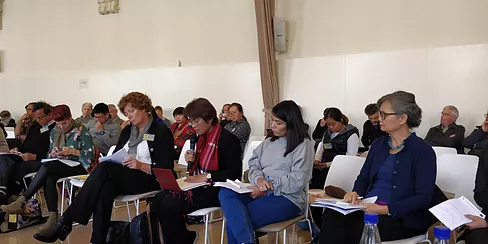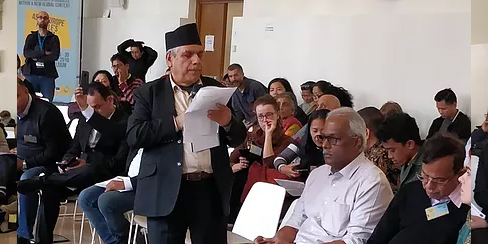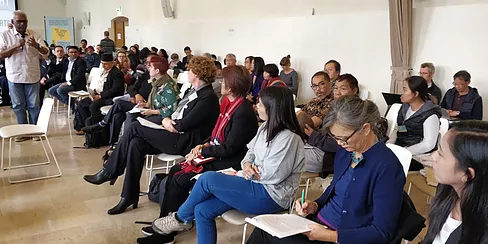
International Conference on Universal Social Protection and Labour
March 20, 2019
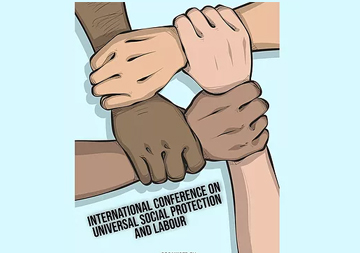
International Conference on Universal Social Protection and Labour 2019 - Kathmandu (4-6 April 2019)
March 20, 2019
INTRODUCTION, CONCEPT NOTE AND FULL PROGRAMME

On AEPF:The Asia-Europe Peoples’ Forum (AEPF) is a broad and dynamic network of progressive and major civil society organisations and trade unions, including people’s movements, non-government organisations, and issue-based campaign networks across Asia and Europe. For the past 20 years, the AEPF has remained the only continuing civil society inter-regional network connecting people’s movements and advancing their voices in ASEM (Asia Europe Meeting). It has facilitated the immediate and future collaborations among civil society groups in Asia a n d w it h E u ro p e – b a se d organisations to promote people-centred alternatives being built from below.
Since its formation in 1996, it has organised people’s forums parallel to the Asia Europe Meeting (ASEM) summits. The AEPF has made a substantive contribution to putting the imperatives of a people-centred regional integration on the agenda of civil society in Asia and in Europe – addressing issues of regional democratisation, especially on the centrality of citizens’ participation.
On AEPF’s Social Justice Cluster:
AEPF’s Social Justice Cluster works on an extensive and comprehensive concept of social justice with, at its core, an emancipatory and transformative perspective on social protection. The aim is to identify and clarify the many links from social justice to other topics AEPF is working on, such as peace and security, climate and environmental policies, trade, economics, etc. In our view, social protection is not a corrective mechanism of a failed economic system, but a crucial element contributing to systemic change. At the last AEPF in Ghent, October 2018, a Global Charter for Social Protection Rights was adopted. It serves as a guideline for social movements developing their own social agenda with their own priorities.
The Social Justice cluster has organised in 2018 a conference on public services in Manila and a conference on social commons in Barcelona. The third conference we are now preparing will focus on labour, linked to problems of democracy, migration, ecology and the rise of right-wing populism. This conference is organised in Nepal because of the new opportunities offered by the progressive government and the interesting developments at the level of the left and social movements.
Prior to our conference, on April 4th, 2019, we will have a joint session with the Peace and Security Cluster of AEPF, celebrating the 100th anniversary of the International Labour Organisation which states in its Constitution that ‘lasting peace is not possible without social justice’.
Concept note
Universal Social Protection is a condition for human survival which must be prioritized by governments in all countries.
- Article 22 of the Universal Declaration of Human Rights states “Everyone, as a member of society, has the right to social security.”
- The Sustainable Development Goals, particularly SDG 1.3, aims to “ Implement nationally appropriate social protection systems and measures for all, including floors, and by 2030 achieve substantial coverage of the poor and the vulnerable”.
- The ILO has a slew of instruments, starting with the Social Security (Minimum Standards) Convention, 1952 (No. 102) and encompasses health insurance, medical care and sickness benefits, unemployment benefits, labour accident insurance and benefits, pensions, family and maternity benefits, invalidity allowances, survivors’ benefits.
- The ILO adopted in 2012 a Recommendation on Social Protection Floors (202) with the basic elements of social protection to be available for all. The reality in most of the developing world is still very far from the realization of these goals. In fact, less than 30 % of the world population is covered by social security systems. In Asia, one of the world’s most dynamic regions, working conditions remain poor, they do not lead to stable incomes and cannot lift workers out of poverty.
Universal social protection means that everyone must have access to all services: besides basic social security, labour rights, access to universal benefits of health, education, civic services like water, energy, sanitation, public transport, clean air and environment, and basic human needs like shelter, food, clothing. Access to all these needs is integral to the survival and well-being of human existence. It must therefore be treated as part of a commons which must be preserved and extended by the national state, to make it accessible for all.
What is the Global Social Protection Charter?
“social protection is a commons, emerging from the democratic and participatory actions of citizens with demands for public authorities. Social protection is not a correction mechanism for the economic system, but should be transformative, that is, contribute to a better productive system and to the sustainability of life. We see social protection as a collective and democratic endeavour for achieving a life in dignity for all. Considering that social protection is justified by a social justice imperative, by aiming at sustainable human development and security, providing all people with an opportunity for a life in dignity.” (From the Global Social Protection Charter)
The Global Social Protection Charter initiated by the Social Justice Cluster of the AEPF is an aspirational document which has been in circulation for two years, and has been signed by organisations in many countries. Its aim is to build a perspective around and support campaigns and projects towards the provision of universal and comprehensive social protection in different parts of the world.
The GSPC sees social protection as being part of a social process of structural social solidarity and not as charity. Social protection goes beyond pover ty reduction, social security and social assistance, and is aimed at eradicating and preventing pover ty, reducing inequalities and ensuring decent livelihoods for all. Social protection is also part of a reproduction process that cannot be de-linked from a production process. Both should be aimed at the sustainability of life It must consist of material and immaterial elements, monetary allowances and additional inkind support where appropriate. Most elements of social protection must and can be realized immediately, though other parts will necessarily be realized in a progressive way, depending on available resources. Social protection is a primary responsibility of States, while some responsibilities are to be taken by subnational authorities and social organisations, and a substantial contribution is to be provided by international solidarity. The Charter is not a binding text but a reference document which can be used by movements aiming at an emancipatory and transformative social protection, avoiding the traps of neoliberalism and right-wing populism.
Just as in previous meetings, we want to look at the European as well as on the Asian situation. We very well know the circumstances and the level of wealth and development are very different, as well between as within our respective regions. Nevertheless, what we want to show is the fact that it is one logic at work, neoliberal globalisation, worsened by right-wing populism, with similar consequences in both regions. In this specific conference, we want to focus on the dismantlement of economic and social rights in general, and labour rights in particular, the weakening of trade unions, the shrinking space for social movements. We want to reflect on possible solutions, the role of social movements, the future of work and the possibilities offered by our Global Charter.
What we want to achieve is
Stocktaking of the situation in Europe and Asia with unemployment, poverty and inequality, migration and climate crisis, as well as its consequences for democracy with the emergence of rightwing populism;
- Overview of the (new) geopolitical actors at the national and global level;
- Insights in new productive models and the identification of the crucial elements for the future of work in an era of new technologies with their consequences on labour markets;
- Insights in the crisis of reproduction, the gender and care problems as well as the worsening situation of peasants, both with the potential of being a crucial part of the solution to our social and economic problems;
- Clarification on the philosophy of our Global Charter and identification of the concrete possibilities it offers for the work of social movements on social justice;
- The development of a common narrative on social problems and social justice, linked to other sectors of AEPF campaigns, such as peace, democracy, ecology, trade and food sovereignty, and, more in general, shaping new politics.
- To popularize the AEPF Peoples Agenda and other documents adopted by the AEPF like the Global Social Protection Charter. To make concrete proposals for their advocacy and adoption by governments and organizations.
International Conference on Universal Social Protection, Labour, Security and Peace
Organised by
Asia Europe People’s Forum, Social Justice and Peace and Security Clusters and
Nepal Partners Kathmandu, 4-6 April 2019
Thursday, 4 April 2019
Opening Plenary and Joint session
Thursday, 4 April, 2-6 pm 1:30-2:00 pm: Registration
2:00 – 3:30 pm: The journey to peace, security and social justice: collective experiences, challenges, opportunities and way forward
Dr Sarba Khadka, IDS Nepal
Chief Guest/ High Representative, Nepal
Narayankaji Shrestha, Spokesperson of CPN and Former Deputy PM, Nepal (TBC) Xavier
Benito Ziluaga, MEP, GUE Podemos, Spain
Julie Ward, MEP, S & D Labour, U.K.
Pryanca Radhakrishnan, MP, Labour Party, New Zealand
Chairs/Facilitation: Dr Dinesh C. Devkota, Nepal and Dr Francine Mestrum, Belgium
Tea/Coffee Break
4:00 – 6:00 pm: ‘Universal and lasting peace can be established only if it is based upon social justice’ (ILO Constitution, Preamble)
Keynote speaker:
Dagmar Walter, ILO South Asia
Speakers:
Anuradha Chenoy (retired), Professor Jawaharlal Nehru University, India
Nimalka Fernando, Human Rights Activist, Sri Lanka
Daman Nath Dhungana, Former Speaker of House of Representatives, Nepal (TBC)
Dr. Rajan Bhattarai, Foreign Affairs Advisor to the PM of Nepal (TBC)
Chairs/Facilitation: Meena Menon, India and Dong Huy Cuong, Vietnam
Friday, 5 April 2019
Session One: 9:00 am to 1:00 pm
Stocktaking: Labor markets in Europe and Asia, informal sector, precariousness, platform economy, wages, and geo-politics of labor rights, democracy and representation
Speakers:
Christophe Aguiton (Attac, France), Chris King Chi CHAN (AMRC, Hong Kong), Rene Ofreneo (University of the Philippines), Dr Shiva Sharma (National Labor Academy, Nepal), David Adler (Diem25, Greece), AU Loong Yu (Borderless Movement, Hong Kong)
Chairs/Facilitators: Dharmendra Kumar (India) and Tina Ebro (Philippines)
Session Two: 2:00 pm to 6:00 pm
Productive Transformation and the creation of value (1): The crisis of production and the future of work. How to link productive issues to the social and ecological agenda and how to identify the desirable changes on labour markets? What are the solutions in the age of robotization and the age of artificial intelligence? How to integrate social issues in order to guarantee security for all? How to develop productive commons?
Speakers:
Roland Kulke (Transform, Germany), Anita Gurumurthi (IT for Change, India), Thomas Coutrot (Attac, France), Mikyung Ryu (KCTU, South Korea), Bishnu Prasad Rimal (Principal Advisor to the PM & former President of GEFONT, Nepal), Farooq Tariq (Awami Workers Party, Pakistan).
Chairs/Facilitators: Pampha Busal (MP, Nepal) and Bruno Deceukelier (WSM, B)
Saturday, 6 April 2010
Session Three: 9:00 am to 1:00 pm
Productive transformation and the creation of value (2): The crisis of reproduction. The issues of care, gender and agriculture – at the crossroads between production and reproduction – as well as public services are at the heart of the current crisis for people’s livelihoods, with dramatic consequences in terms of poverty, suicides, violence and migration. How to valorize these sectors in order to improve people’s livelihoods? Speakers:
Federica Giardini (University of Rome, Italy), Prabha Pokhrel (Home Based Workers Concern Society, Nepal), Kiran Moghe (AIDWA, India), Ganesh BK (Rastriya Dalit Network), Eric Villanueva (Institute for Popular Democracy, Philippines). Chairs/Facilitators: Dr Renu Adhikari (Nepal) and Sandeep Chachra (India)
Session Four: 2:00 pm to 4:30 pm
Global Charter for Social Protection Rights
Look at the philosophy of our Charter and identify the concrete possibilities it offers for enforcing concrete priorities of local/national social movements.
Speakers:
Francine Mestrum (Global Social Justice, Belgium), Rayyan Hassan (NGO Forum on ADB), Chandan Kumar (Working People’s Charter, India), Ravi Srivastava (Institute for Human Development, India), Mahesh Dahal (Secy, Ministry of MoLESS) or Ram Prasad Gyawali (Social Security Fund, Nepal), Bismo Sanyoto (Asia network on the Right to Social protection (ANRSP), Arbind Singh (StreetNet, India) Followed by discussion with politicians Dr Binda Pandey (GEFONT, MP Nepal), Charles Santiago (MP, Malaysia), Julie Ward (MEP, UK), Xavier Benito Ziluaga (MEP, Spain), Eleftheria Angeli (Syriza Youth, Greece), Balram Baskota (MP & All Nepal Peasants’ Federation, Nepal), and other Nepalese politicians.
Chairs/Facilitators: Prof. Dr. Sharad Onta (Nepal) and Kris Vanslambrouck (B)
4:30 pm to 6:00 pm: Closing Session Chaired/facilitated by Dr. Sarba
- Summary presentation from Social Justice Cluster
- Summary presentation from Peace and Security Cluster
- Press release
- Vote of thanks by the organizers
6:00 pm to 8:00 pm
Political discussion with representatives of the different AEPF thematic clusters and politicians: Former PM of Nepal Madhav Kumar Nepal and his team, Head of International Department of CPN, Pryanca Radhakrishnan (New Zealand), Dr Binda Pandey (GEFONT, MP Nepal), Charles Santiago (MP, Malaysia), Julie Ward (MEP, UK), Xavier Benito Ziluaga (MEP, Spain), Eleftheria Angeli (Syriza Youth, Greece) and Nepali politicians.
Chairs/ Facilitators: Dr. Dinesh C. Devkota, and Meena Menon (TBC)
Closing Dinner