Honoring the Legacy of Sombath Somphone
November 29, 2022
Honoring the Legacy of Sombath Somphone
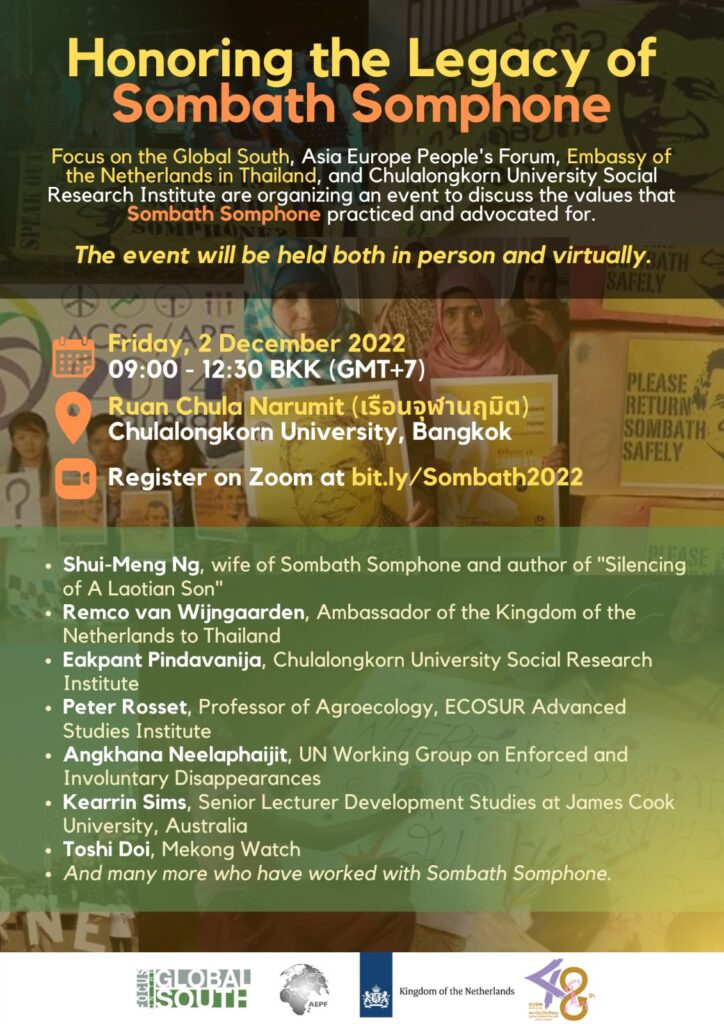
On International human rights day, we ask the Laos Government: where is the missing civil society activist Sombath Somphone.

November 29, 2022
On International human rights day, we ask the Laos Government: where is the missing civil society activist Sombath Somphone.
September 19, 2022
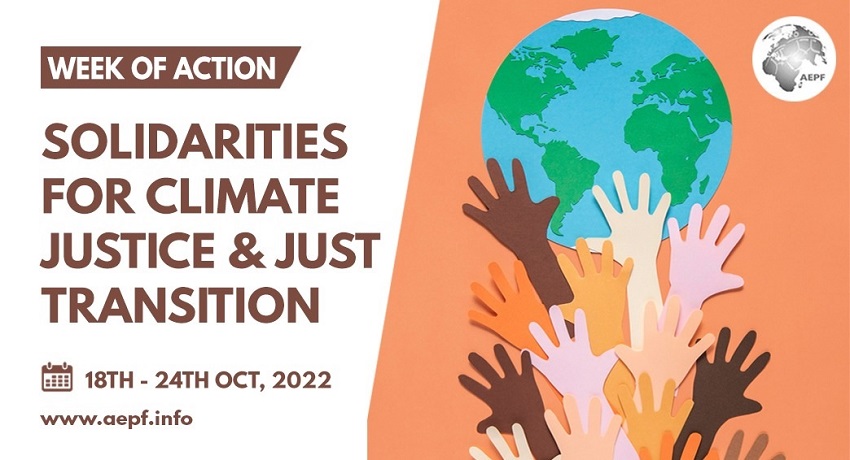
Focussing on the urgency of climate change and the need for a just energy transition, AEPF will have a week of events with expert webinars and collective actions to link solidarities on climate justice.
August 21, 2022
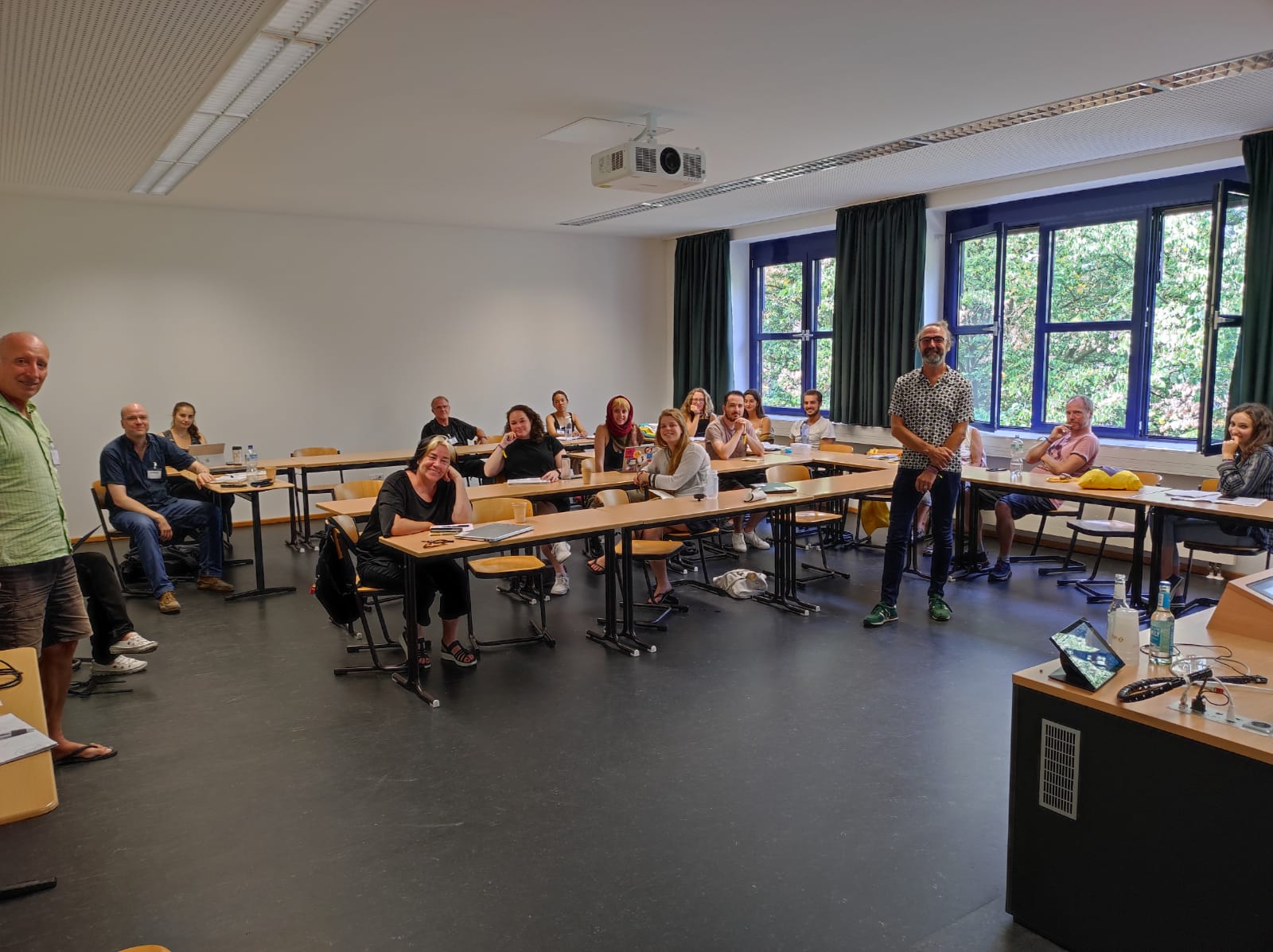
European Summer University
Mönchengladbach, August 17-20, 2022
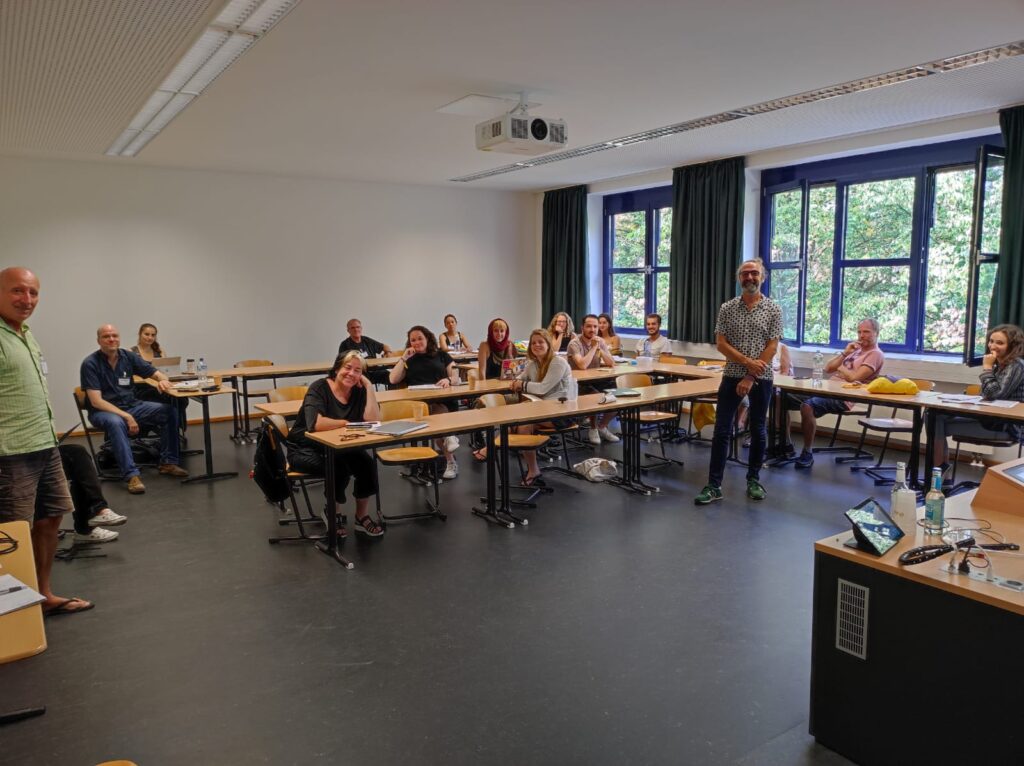
The workshop was organised by the AEPF on the 19th August, 2022. It was facilitated by Kris Vanslambrouk (11.11.11).
Dorothy Guerrero, Global Justice Now – What are the challenges for a just transition in Europe and Asia ?
Felix Anderl, Asian House – What are the ideas and obstacles for just transition of agriculture?
Marga Ferre (Transform Europe) – How does Europe look at a just transition? What are the challenges?
Christophe Aguiton (Attac France) – An analysis of a geo-political context in turmoil.
Dorothy Guerrero discusses the interconnected energy, food and climate crises and suggests how these can be addressed in a just and equitable way.

March 10, 2021
The discussion on the TRIPS Waiver at the WTO TRIPS Council has yet to find a bright spot. Rich countries still hold back on their support for the proposal considering that they have traditionally been supporters of the interests of pharmaceutical companies through the IP monopoly system. The third path offered by DG WTO, Okonjo Iweala, is also not a viable solution.
For this reason, the push for #TRIPSWaiverNow for #PeoplesVaccines must be carried out widely and massively by all people around the world.
Let’s join in this global call by posting your Picture Profile using this Twibbon, as a form of our global action to put pressure on the WTO TRIPS Council meeting which will take place March 11, 2021, including to push #TRIPSWaiver to all governments around the world.
Here is the step:
1. klick https://www.twibbonize.com/tripswaiver
2. upload your photo
3. share it!
With Solidarity,
Indonesia for Global Justice
Global Justice Now UK
Focus on The Global South
Transnational Institute
Asia-Europe People’s Forum (AEPF)
February 05, 2020
1. Roundtable: ‘Towards a just transition: Struggles for food sovereignty, post-extractivism, and climate justice’
A global consensus exists on the need to transition to a post-fossil fuel future in light of the overwhelming evidence of human-induced climate change manifest in global warming, extreme weather events, catastrophic biodiversity loss, and natural resource degradation. The term just transition is often used to describe what this transition should be, but it can mean different things to different people. There can be no just transition that is not based on the principles of food sovereignty, economic democracy, and post-extractivism. Across the world, peasants, pastoralists, fishers, indigenous peoples, agricultural and food system workers, trade unionists and labour activists are leading the way, showing how a just transition can be put into practice. Many of these groups are mobilising in the form of national and transnational social movements in a call for systemic change.
Objectives:
1. To unpack the concept of a just transition and what this means for agriculture, food systems, and natural resource use
2. To hear from diverse experiences on the ground on how strategies for a just transition are being pursued
3. To examine the challenges and opportunities in moving towards a just transition
4. To consider a number of policy proposals for how a just transition can be enabled and supported
Key input: Draft AEPF framing paper on just transition
2. Belt and Road Initiative (BRI): Understanding its implications for food sovereignty and rural resistance
Since the launch of the Belt and Road Initiative (BRI) in 2013, 136 countries and 30 international organizations have signed BRI cooperation documents, received US$90 billion in Chinese Foreign Direct Investment (FDI) and exchanged US$6 trillion in trade with China. President Xi Jinping has described the BRI as the ‘Project of the Century’, yet the motivations, aims and scope of the BRI have been continuously debated and the Chinese Government has struggled to put forward a clear narrative for the initiative. At the same time, social movements, affected communities and civil society organisations across the globe have criticized BRI projects for harmful environmental, social and economic impacts, and resisted their implementation. In 2018 at AEPF12 in Ghent, Belgium, the AEPF began analysing the BRI and sharing experiences relating to the BRI, continuing with a workshop in Amsterdam in June 2019. A framing paper to guide future AEPF work in relation to the BRI was published in November 2019.
Objectives:
Key input: AEPF framing paper on the BRI
3. Agroecology and climate justice: Pathways for transforming food systems
For peasants, agroecology is the way in which we practice our way of life and produce an abundance of healthy and affordable food for all of humanity. Agroecological solutions are not delivered top down. They are developed by peasants, building on peoples’ local knowledges. As the creators of peasant agriculture, and as an expression of our ancestrality, agroecological peasant agriculture is a common element in our diverse cosmovisions, and element that has been created through a dynamic historical process involving cultural encounters among endogenous processes of ‘dialogue of knowledges’.
Contrary to what its detractors often claim, agroecology has been spread and applied by many farming communities worldwide. The challenge remains how to bring agroecology to scale supported by enabling policy and governance frameworks so that it is practiced by even more families over larger territories. Scaling combines vertical (scaling up) and horizontal (scaling out) processes.
The transition to agroecology will entail a real transformation, not only of farming practices, but also in terms of markets, policies, land and other natural sources. The transition to agroecology entails the process of a real societal transformation towards a society based on the concept of Food Sovereignty as stated in the 2015 Declaration of the International Forum on Agroecology.
The claim for food sovereignty means claiming the autonomy and the self-organization of people and the direct and democratic control by people over policies and natural resources, especially over core elements such as food and agriculture policies. In this sense the concept of agroecology – being more than a mere economic model but a way of life – supports this transformation towards a society based on local knowledge, promoting social justice, nurturing identity and culture, and strengthening the economic viability of rural areas.
By advocating for agroecology the current power structure will be challenged by putting forward a model of cooperation and solidarity between people rather than individualism, competition and economic profit, and claiming control of resources by communities based on a fair peasant economy rather than by the private sector.
The work on agroecology globally will strengthen peasant agroecology and seed diverse activities region-wide by linking existing initiatives, by networking between peasant organisations and networks and by facilitating horizontal farmer-to-farmer learning processes. This would also substantially increase farmers’ voices and participation in regional and international debates and policy fora resulting in policy environments that favour peasant agroecology. Through those, we would challenge the industrial food chain by documenting its
inefficiencies, lack of diversity, and incapacity to address the climate crisis and food insecurity, and by showing how the corporate controlled food system undermines agroecology and biodiversity.
While the industrial food system is one of the main drivers of global heating, peasant agroecology and food sovereignty offer huge potentials for reducing emissions – including by keeping fossil fuels underground, adapting to climatic changes and realizing social justice. Peasant agroecology and food sovereignty are social, political, and ecological visions that unite multiple sectors within a single movement to challenge business-as-usual and create systems of shared control over the requirements of life.
Objectives
In this workshop, we would like to focus on the challenges we are facing today globally:
4. Implementation strategies for the Declaration on the Rights of Peasants
In December 2018, the 73rd Session of the United Nations (UN) General Assembly in New York adopted the UN Declaration on the Rights of Peasants and Other People Working in Rural Areas (UNDROP). Following this, the declaration is an official voluntary international legal instrument. The UNDROP is a declaration that touches transversally on many different issues concerning peasants. In that sense the UNDROP can be used to strengthen peoples movements (peasants and other people working in rural areas) demands in different fields (seeds, land, fair prices, etc.) and at different levels (local,national, European, Asian and international). The adoption of the UNDROP is the result of almost 20 years of mobilisation by La Via Campesina and its allies, and of 6 years of negotiation at the UN Human Rights Council. It aims to respond to the multiple forms of discrimination faced by peasants and other people working in rural areas, who are the first victims of extreme poverty and hunger, and to protect and promote their rights and dignity.
The implementation of the UNDROP represents a unique opportunity to re-balance power relations in rural areas, and to guarantee that states will respect, protect and fulfil the rights of peasants and other people working in rural areas, who have too often been marginalised within international, regional and national laws and policies. The process of adoption ended and we are about to start the process of implementation which is different in many ways. The adoption process was fast and we have not got the time and resources to share and consult on every aspect of the work done neither at global level nor at regional level. The implementation process needs to be strongly rooted in a process that is inclusive, transparent, gender and regionally balanced.
Key input: Declaration on the Rights of Peasants and Other People Working in Rural Areas
5. Plenary discussion: Policy recommendations and way forward
The Asia Europe People’s Forum (AEPF) is an interregional network of progressive civil society organisations from across Asia and Europe. Since 1996, the AEPF has consistently been a network linking Asian and European NGOs and social movements. It is committed to fostering people’s solidarity for a socially and economically just, inclusive, peaceful, sustainable and ecologically sensitive development, within and across the two regions. The AEPF’s vision and practice are to advance people’s voices and visions within Asia-Europe relations.
In this plenary session, we would like to have an exchange on how we can strengthen the AEPF network and commons struggles for food sovereignty and natural resource justice throughout Asia and Europe. This can take into account the opportunity to convene again for another AEPF gathering scheduled to take place in the latter half of 2020 in Asia. It would build on the political manifesto agreed during the previous AEPF event held in Ghent, Belgium in October 2018.

September 24, 2019
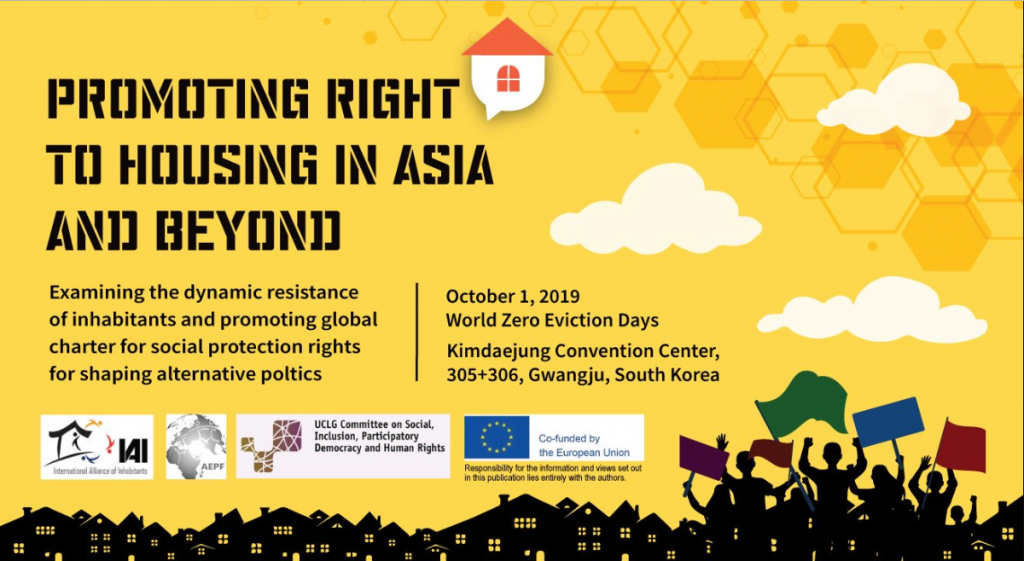
Session name: “Promoting the Right to Adequate Housing in Asia and beyond”
Theme: Exploring ways by which local governments – in cooperation with other
stakeholders and following innovative methodologies – can promote the right to
adequate housing and the human rights based-approach (HRBA) in habitat policies. The
session will focus on the Asian context, and propose tools such as the “Cities for
Adequate Housing” Declaration as concrete roadmaps for local governments to advance
the right to housing. It will welcome inputs from civil society organizations.
Preferred Date: October 1st, 12:00 am to 15:30 pm
Time: 3 hours
Organizers: UCLG Committee on Social Inclusion, Participatory Democracy and
Human Rights, the Asia Europe People’s Forum and the International Alliance of
Inhabitants.
September 18, 2019
The “Peace and Security” Circle of the Asia- Europe People Forum (AEPF) is a critical
part of the Forum that collectively understands, analyses, interprets and formulates
alternative responses and actions on issues of peace, security, conflicts, threats and
opportunities in Asia and Europe as envisioned by the people’s movements of this region.
Since 2016, the world has experienced major events which are likely to greatly affect the
world’s order as well as peace and security. These events include: Brexit; Trump
becoming the US President; the rise of aggressive xenophobic leaderships in many
countries that advocate and overlook violence in order to endorse their agendas; wars,
conflicts and tension in regions as diverse as Ukraine, Libya, Syria, Palestine, the Korean
Peninsula, South China Sea/West Philippine Sea/East Sea; the non-Resolution of many
low intensity and frozen conflicts and the potential rise of ethnic and identity conflicts; etc.
Besides, increasing military spending, foreign military bases, terrorism, internal conflicts,
territorial disputes, militarization and the nuclear arms race, neo-racism, refugee crisis,
oppression of minorities and xenophobic nationalism have been threatening people’s
lives and peace and security.
A policy of confrontation, especially between NATO and Russia has increasingly
prevailed in Europe. The nuclear weapons of all nations are being modernized.
On the other hand we can also observe positive steps towards peace, such as the
incidents on the Korean Peninsula both between the US and North Korea as well as
between both Korean nations.
But we should not forget: the continuous force and spread of the terror group calling itself
the Islamic State (IS) and other terrorist movements have used violence as a way of
threatening the world’s security.
In such a context, the Peace and Security Circle of the AEPF plans to coordinate with
peace movements and people’s organizations; research and scholars in academic
communities and institutions in Asia and Europe to organize various activities/ campaigns
to create effective synergies in the struggle for peace and to find the better way to
respond. The emergence of social movements that seek to find alternative solutions to
recurring as well as new problems should be encouraged.
Currently, Southeast Asia faces continued difficulties in peace and human security in the
effort of the world’s super powers to maintain economic and political hegemony
over our countries
New alternatives for a common security policy and –architecture in Europe and Asia are
urgently needed. Those alternatives should take into account the positive experiences of
the policy of détente from the 1970s and 80s. A Common Security Policy (also known as
Collective Security Policy) should serve as the basis of this new security architecture.
The term originates from the title of the Palme-report “Common Security: A Blueprint for
Survival“, which was the conclusion of the Independent Commission on Disarmament
and Security Issues (“Palme Commission”, 1980-1982) presided by Sweden’s Prime
Minister Olof Palme.
The key message of the study reads: “In the present time security cannot be achieved
one-sided. We live in a world, which economic, political, cultural and in particular military
structures are increasingly dependent of each other. The public safety of a nation cannot
be bought at the expense of other nations.”
This security philosophy developed by Willi Brandt, Bruno Kreisky, Olaf Palme and others
US based upon the principle: the security of a state can only be guaranteed if the security
of the other (the opponent) is guaranteed as well. The key principles that define this term
of common security are “interdependence”, “joint responsibility” and “security for” instead
of “security against.”
10:00 – 14:00: Introductory Speeches
Opening and Moderation by Lisa Clark (IPB, Italy) and Dong Huy Cuong (Peace
and Development Foundation/AEPF, Vietnam)
Formal welcome: Introduction of AEPF, IPB, and the thematic cluster of Peace &
Security; Background and Rationale of this workshop on Common Security
1) What are the basic elements of a Common Security Policy?
by Joseph Gerson (IPB, Campaign for Peace, Disarmament & Common Security, USA);
Ingar Solty (Speaker Peace & Security Policy, Rosa-Luxemburg Stiftung, Germany);
Anuradha Chenoy (Jawaharlal University, India)
2) How is the current security situation in Europe?
by Claudia Haydt (Board of the European Left, Germany) and Jordi Calvo (GCOMS,
Spain)
3) How is the current Security Situation in Asia?
by Walden Bello (Focus on the Global South and Senior research fellow for Southeast
Asian Studies of Kyoto University, Japan)
4) What are the current mechanisms to deal with peace and security?
by Mark Christopher Batac (Global Partnership for the prevention of Armed Conflict)
14:00 – 15:00: Lunch break
15:00 – 18:00: Is the Common Security Policy a realistic/useful basis for the security
architecture in Eurasia?
Europe: Claudia Haydt, Erhard Crome (WeltTrends Institute for International Politics,
Germany), Tom Unterrainer (Russell Peace Foundation & CND, Great Britain) Jenny
Cegg (CND Great Britain) Jordi Calvo (Justicia i Pau, Spain)
Asia: Moon Ah-Young (Peace Educ. Policy, Peace MOMO, Korea); Suvrat Raju
(Campaign for Nuclear Disarmament & Peace, India); Yayoi Tsuchida (Japan Council
Against Atomic & Hydrogen Bombs, Japan); Rabindra Adhikari (Nepal Peace & Security
Council, Nepal); Ke Jung (Indigenous Peoples Partnership, Myanmar)
Central-Asia: Eldor Aripov (Director of the Institute for Strategic and Interregional Studies
under the President, Uzbekistan) Marc Batac (Global Campaign for the Prevention of
Armed Conflict and IID, Philippines) Salman Akran Raja (Pakistan Peoples’ Party, and
Pakistan India Forum for Peace and Democracy, Pakistan) Kamal Chenoy (India)
Anastasia Lavrina (International Eurasia Press Fund, Azerbaijan), (TBC, Kazakhstan)
USA: Joseph Gerson
18:00 – 18:30: Break
18:30 – 20:00: Discussion
Moderation: Amela Skiljan (IPB, Germany)
Discussion with Wolfgang Gehrcke (Former MP die Linke, Germany)
20:00 onwards
Dinner on a boat & evening programme
Facilitator: Theresa Kresse (IPB, Germany)
10:00 – 12:00: Introduction – What could be the core components of a common security policy
for Eurasia?
Asian perspective: Lee Junkyu (Center for Peace Research, Korea); Au Loong (Borderless
HK, China) & Suzuyo Takazato (All Okinawa Coalition to Prevent Construction of a New Base
in Henoko, Japan)
European perspective: Reiner Braun (IPB, Germany)
US perspective: Joseph Gerson
12:00 – 13:00: Break
13:00 – 14:45 Continuation of commentaries from different countries
14:45 – 15:35 Working Group Session – Question/issues to be discussed in 3 separate groups:
1. What could be the core components of a Common Security Policy for Eurasia?
2. How does the process toward achieving a Common Security Policy look like?
3. What is the role and responsibility of big and small countries?
4. Implementation and reaching of agreements
5. Developing Conflict Solutions – Case Studies (Conflict India/Pakistan and China/Vietnam)
Report back of working group sessions (one facilitator and moderator per group)
16:00 – 18:00: Panel Discussion
Europe: Kathrin Vogler (MP die Linke, Germany), Joseph Gerson, Michael Müller (Former
state secretary of the ministry of environment, SPD, Germany), Jenny Clegg (CND, UK) &
Roland Kulke (Transform! Europe, Belgium)
Asia: Anuradha Chenoy, Au Loong & Cristine Ebro (AEPF, Philippines)
Corazon Fabrios (AEPF, IPB, Philippines), Reiner Braun & Dong Huy Coung
18:00 onwards: Dinner and evening program
September 10, 2019
12 – 19 October 2019
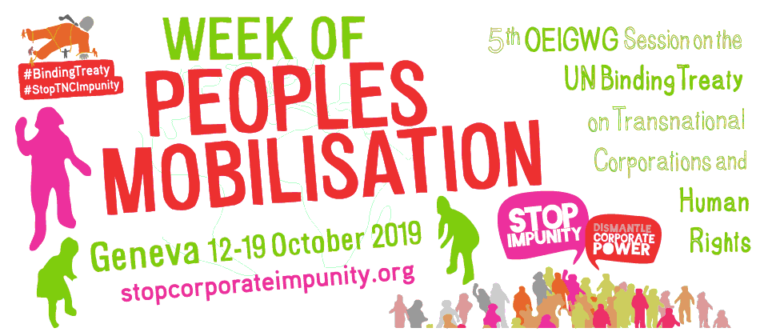
2019 WILL BE A DECISIVE YEAR FOR THE BINDING TREATY ON TRANSNATIONAL CORPORATIONS AND HUMAN RIGHTS!
We call to mobilise worldwide on 12th October to denounce Corporate impunity, on the occasion of the Week of Peoples Mobilisation in Geneva
JOIN IN TO RECLAIM PEOPLES RIGHTS OVER INVESTORS AND CORPORATE PROFITS AND IMPUNITY
Neoliberal globalization has opened the doors for the savage exploitation of the world by the big economic powers. Megaprojects, agribusiness and militarization, among other processes, express a patriarchal, neoliberal and racist system that amounts to an assault on life as such. As a result, peoples’ rights have been systematically violated, the Earth and its resources destroyed, pillaged and contaminated, while corporations continue committing economic and ecological crimes with total impunity. They also throw us into an environmental and climate crisis of unknown proportions, for which they do not take responsibility.
Driven by their imperative to maximize profits, transnational corporations (TNCs) seek to pit workers from different regions against one another throughout the entire supply chain. The systematic violations of human rights that affect millions of people, who were forcibly expelled by extractive industries, free trade or the business of war and forced to long migratory routes, constitute new markets and profits for civilian and military companies.
Communities and peoples are resisting the advance of this offensive that implies, in most cases, the combination of the institutional action of far-right governments with actions that violate the collective rights of peoples driven by actors such as transnational corporations. The evidence on the violation of human rights at the hands of these companies is widely documented and on the ground translates into environmental disasters, the death of activists, leaders of communities and peoples.
The signing of new international trade and investment treaties gives more rights to “the investors” than to the affected people and communities. Worse, through the investor-state dispute settlement mechanism (known as ISDS), corporate interests are shielded to the detriment of the public interest.
In order to challenge corporate power and the system that protects and benefits it, it is necessary and urgent to give a systematic response. We must unite our experiences, struggles, collectively learn from our victories and our failures, share strategies and analysis in order to curb the impunity of the transnationals. The United Nations Binding Treaty process on transnational corporations and human rights constitutes a space, within the framework of the Human Rights Council of the United Nations, from where we can force corporations to respect human rights, creating a mechanism so that affected states and peoples can sue transnational corporations.
The 5th Session of the Open-ended Intergovernmental Working Group (OEIGWG) in Geneva will take place from October 14 to 18. The Global Campaign to Reclaim Peoples Sovereignty, Dismantle Corporate Power and Stop Impunity will be there again, as every year since 2014, to continue to pressure governments and prevent them from derailing the process.
In that context:
Who we are
The Global Campaign to Reclaim Peoples Sovereignty, Dismantle Corporate Power and Stop Impunity (Global Campaign) is a network of over 250 social movements, civil society organisations (CSOs), trade unions and communities affected by the activities of TNCs. These groups resist land grabs, extractive mining, exploitative wages and environmental destruction caused by TNCs globally but particularly in Africa, Asia, Europe and Latin America. The Global Campaign is a peoples global structural response to unaccountable corporate power. It provides facilitation for dialogue, strategizing, exchanging information and experiences and acts as a space to make resistance visible and deepen solidarity and support for struggles against TNCs.
The programme of the Week of Peoples Mobilisation will be published soon.

July 22, 2019
July 22, 2019
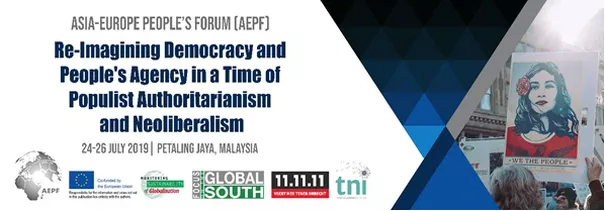
The Asia Europe Peoples Forum, supported by a number of civil society organizations from Asia and Europe, will be hosting a Conference on one of the most challenging issues of our times, “Re-imagining Democracy and Peoples’ Agency in a Time of Populist Authoritarianism and Neoliberalism”, on July 25th to 26th, 2019.
This conference will be attended by 50 delegates, including parliamentarians from seven countries, civil society activists, independent experts and public figures from several Asian and European countries.
On 24th July, there will be a strategic interface between Asian and European Parliamentarians and AEPF, where parliamentarians will share experiences of their region, their strategic tactics, parliamentary processes and ways of working in the very difficult situations that mark current times.
March 22, 2019
March 22, 2019 | Dario Azzelini
Concept Note
Two major challenges confront peoples and peace movements in contemporary times. One: All kinds of right wing populisms (RWP) and fundamentalisms (from religious, identity to market fundamentalisms). Two: The consequent rise of xenophobic nationalisms, centralized power, increased inequality, authoritarian governance. Country after country in Asia and Europe have elected right wing populist leaders, while xenophobic nationalist parties emerge stronger and more influential in the opposition. In most cases these RWPs have an under belly of vigilante groups that target different minorities and ‘others’. (Hungary, Italy, Turkey, South Asia, Philippines, US, Brazil, etc).
These ideologies and practices are based essentially on increasing inequality, opposing multiculturalism and see human rights, workers and civil society organizations as a threat.
They do not believe in climate change and are bent on increasing state power and authority over all institutions. These fundamentalisms and RWPs are a threat to the peace, security and social cohesion. They increase inter-state and intra-state conflicts; promote phobias about migrants or other religions. These damage democratization, universal progressive values and challenge social justice. It is important to understand the variations, and differences between these forces across Asia and Europe, so civil society, peoples and peace movements can effectively challenge them.
Peoples’ movements need to use the collective methodologies and experience to address concerns from these movements. They need to strategize how activism can challenge this dangerous discourse and practice.
Objectives of the Conference:
This conference will address concerns that include:
Outputs
The Expected Results include:
AEPF Peace and Security Conference will enable an exchange of ideas and increase our networks in Nepal beyond. This will support in advocating the importance of peace and peoples security and its linkages with justice and democracy.
For any advocacy, we need clarity and vision. The issues of populism and fundamentalisms are linked to phobias and existential anxieties. This conference intends to produce and articulate the dangers of these issues to both civil society and to states.
We would develop an appeal to ASEM States to be vary of populism, authoritarianism and not to use religion in politics.
We would like to use communication methods to propagate the idea of secular and objective state institutions.
We would like to take the ideas of this conference further and request all participants to give us some form of written presentation (this can be sent to us after the discussion in the conference). We will advocate these on our website and social media.
The inputs of the conference will go into documents for parliamentarians, policy makers, students and all those interested.
Communications and Visibility
We will do brief 1-2 minutes video recordings of experts as part of ‘Peoples Voices’ and link these to our website and make them available widely including to policy makers and governments who wish to access them.
We will try and make a common document and statements that coincide with the AEPF goals on peace and security.
We will edit all written presentations and use these for advocacy on social media, website, etc.
Programme: Thursday, 4th, 5th 6th April
Day 1: COMMON PLENARY
Facilitators: Social Justice + Peace & Security
Opening Plenary and Joint session
Thursday, 4 April, 2-6 pm 1:30-2:00 pm: Registration
2:00 – 3:30 pm: The journey to peace, security and social justice: collective experiences, challenges, opportunities and way forward
Dr Sarba Khadka, IDS Nepal
Chief Guest/ High Representative, Nepal
Narayankaji Shrestha, Spokesperson of CPN and Former Deputy PM, Nepal (TBC) Xavier
Benito Ziluaga, MEP, GUE Podemos, Spain
Julie Ward, MEP, S & D Labour, U.K.
Pryanca Radhakrishnan, MP, Labour Party, New Zealand
Chairs/Facilitation: Dr Dinesh C. Devkota, Nepal and Dr Francine Mestrum, Belgium
Tea/Coffee Break
4:00 – 6:00 pm: ‘Universal and lasting peace can be established only if it is based upon social justice’ (ILO Constitution, Preamble)
Keynote speaker:
Dagmar Walter, ILO South Asia
Speakers:
Anuradha Chenoy (retired), Professor Jawaharlal Nehru University, India
Nimalka Fernando, Human Rights Activist, Sri Lanka
Daman Nath Dhungana, Former Speaker of House of Representatives, Nepal (TBC)
Dr. Rajan Bhattarai, Foreign Affairs Advisor to the PM of Nepal (TBC)
Chairs/Facilitation: Meena Menon, India and Dong Huy Cuong, Vietnam
DAY 2. April 5, PARALLEL SESSIONS
Morning
Session 1: 9:00 AM to 1:00 PM
Discussion on Populisms, Right Wing Populisms (RWP), impact on peace and Security:
Speakers:
Facilitators: Dorothy Guererro and Milan Dharel
Afternoon
Session 2: 2:00 to 6:00 PM
Discussion on different fundamentalisms and Institutions:
Facilitators: Andy Rutherford and Tina Ebro
Afternoon
Session 4: 2:00 PM to 4:30 PM
Discussion on Future programmes, Discussion on advocacy and communications: Resolutions drafted and passed.
Corazon Fabros will facilitate;
Bui Lien Huong – Resolutions
4:30 to 6:00 PM
Closing Session Chaired/facilitated by Charles Santiago and Milan Dharel
Summary from Social Justice Cluster
Summary from Peace and Security Cluster
Press Release
Vote of thanks to organizers.
DAY 3. Saturday 6 April 2010
Morning
Session 3: 9:00 AM to 1:00 PM
Linkages and Impacts of RWP and fundamentalisms: Migration on peace and security