Sandeep Chachra | 30 Years of AEPF | Voices That Shaped the Journey

Sandeep Chachra | 30 Years of AEPF | Voices That Shaped the Journey

Since its first gathering in Bangkok in 1996, the Asia Europe People’s Forum (AEPF) has brought social movements across Asia and Europe together to shape relations between the two regions. Its campaigns for fairer trade, food sovereignty and corporate accountability show what sustained cooperation across borders can achieve for people and communities.

Tina Ebro and Francine Mestrum first invited me to the Forum in 2007–08, alongside with Tran Dac Loi, through our South South Solidarity Forum. I worked with several comrades of Asia and Europe on Food Sovereignty, climate justice, Informal Workers and social protection, staying involved through ActionAid Association and as managing editor of Agrarian South.

Over the last nineteen years, I have taken part in local and international gatherings to build peoples involvement in AEPF. In Brussels in 2010, fellow delegates from India and I brought questions of land, peasant workers’ rights and food sovereignty into public debate while co-shaping the agrarian question of Global South in Ghent and presented on informal work and social protection in Kathmandu.

As co-convenor of the Food Sovereignty Cluster during the pandemic, my organisations helped carry those conversations online, including by organising and co-moderating the AEPF13 plenary on lessons from the Indian farmers’ movement. In 2024, I returned to Kathmandu to speak at the Peasants’ Assembly on food sovereignty, agrarian reform and peasants’ rights.

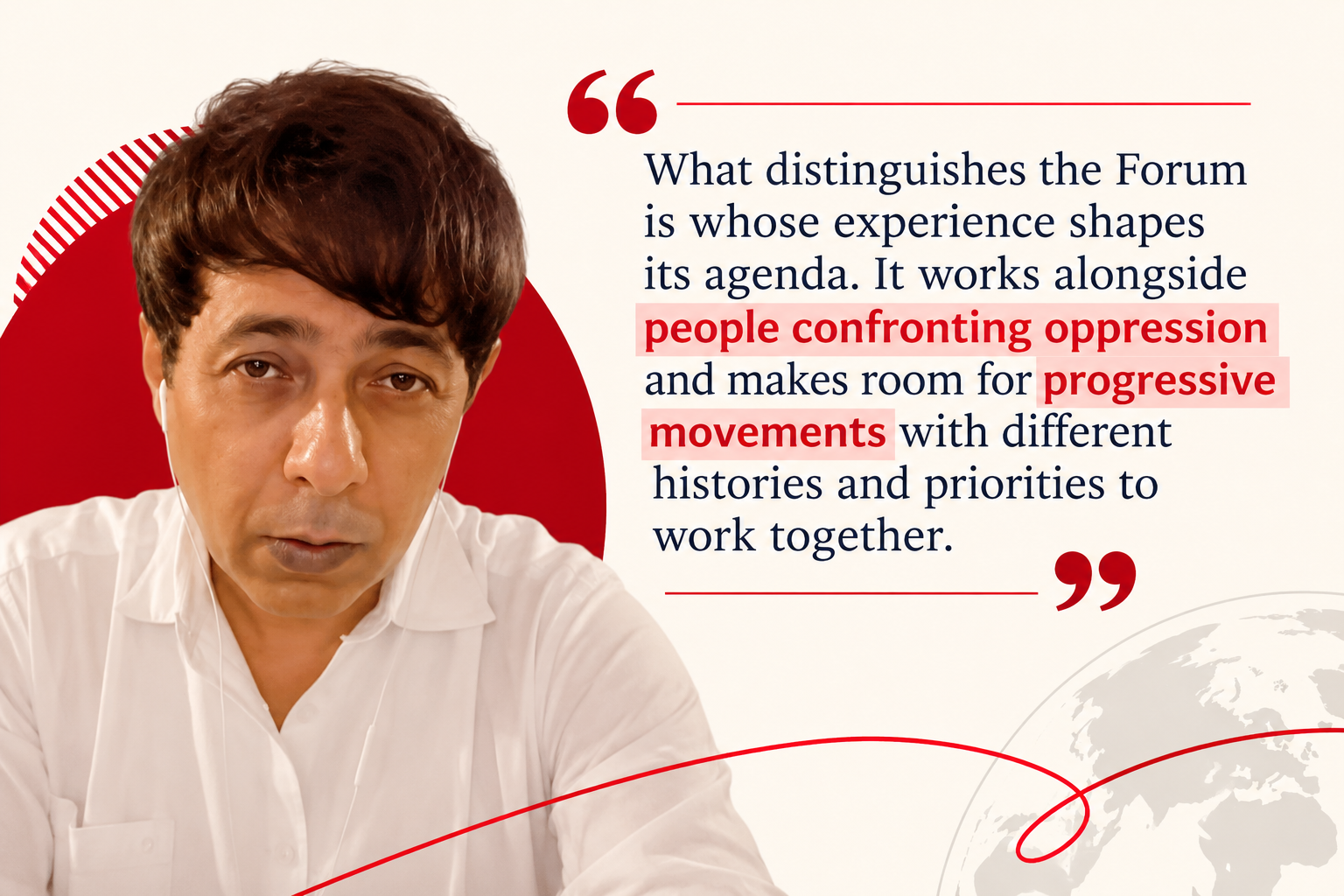
What distinguishes the Forum is whose experience shapes its agenda. It works alongside people confronting oppression and makes room for progressive movements with different histories and priorities to work together. It has the courage to challenge entrenched interests and the practical commitment to develop policy proposals that movements can advance nationally.

Looking ahead, I hope younger organisers will help shape the Forum’s campaigns for food sovereignty, universal social protection and a just climate transition. Deeper alliances with movements in the global South – Africa, Latin America and the Middle East could strengthen that work, while the People’s Charter gives us a basis for holding elected representatives accountable.

Sandeep Chachra
Executive Director, ActionAid Association and Managing Editor, Agrarian South


Read More

Felix Anderl | 30 Years of AEPF | Voices That Shaped the Journey

Felix Anderl | 30 Years of AEPF | Voices That Shaped the Journey

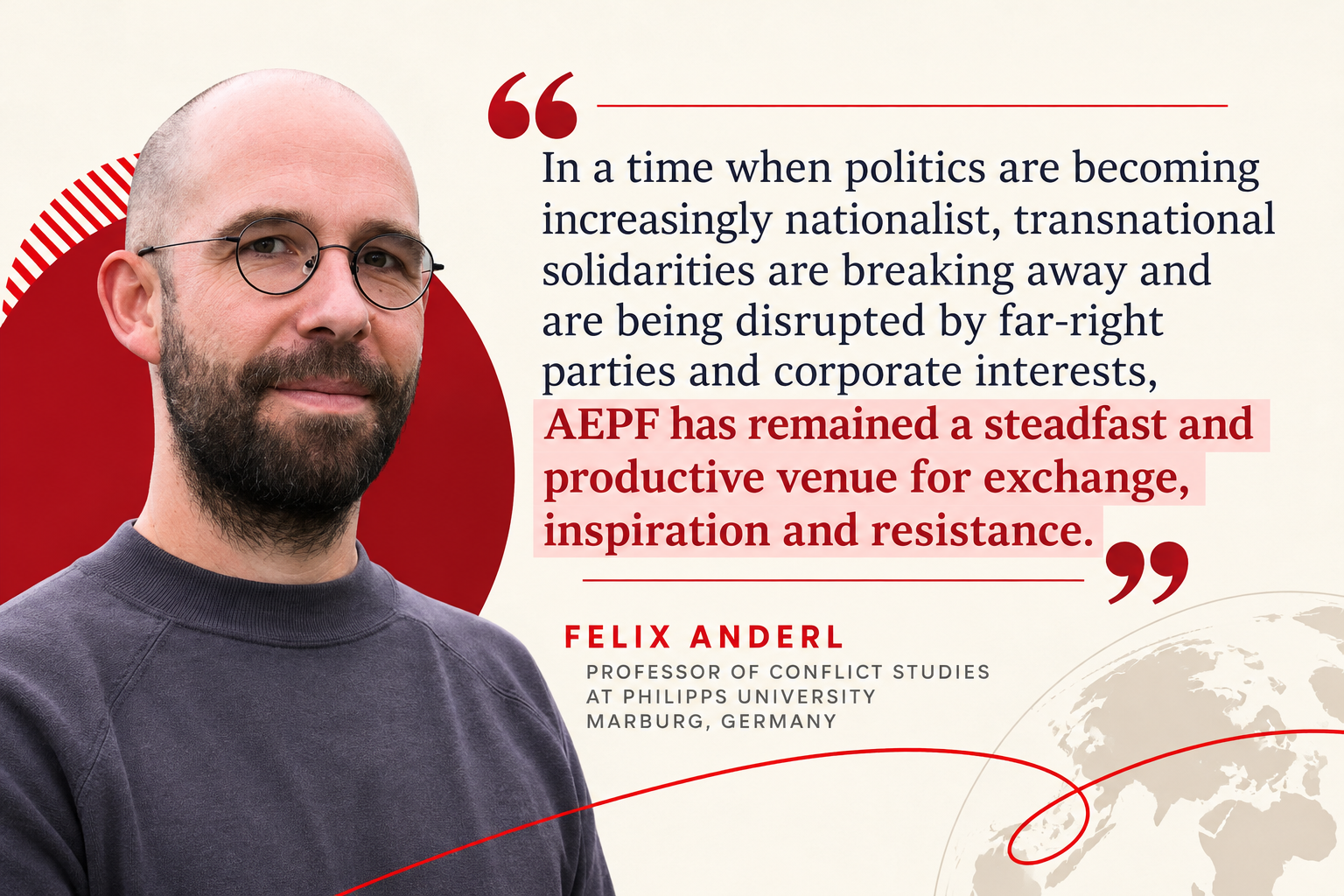
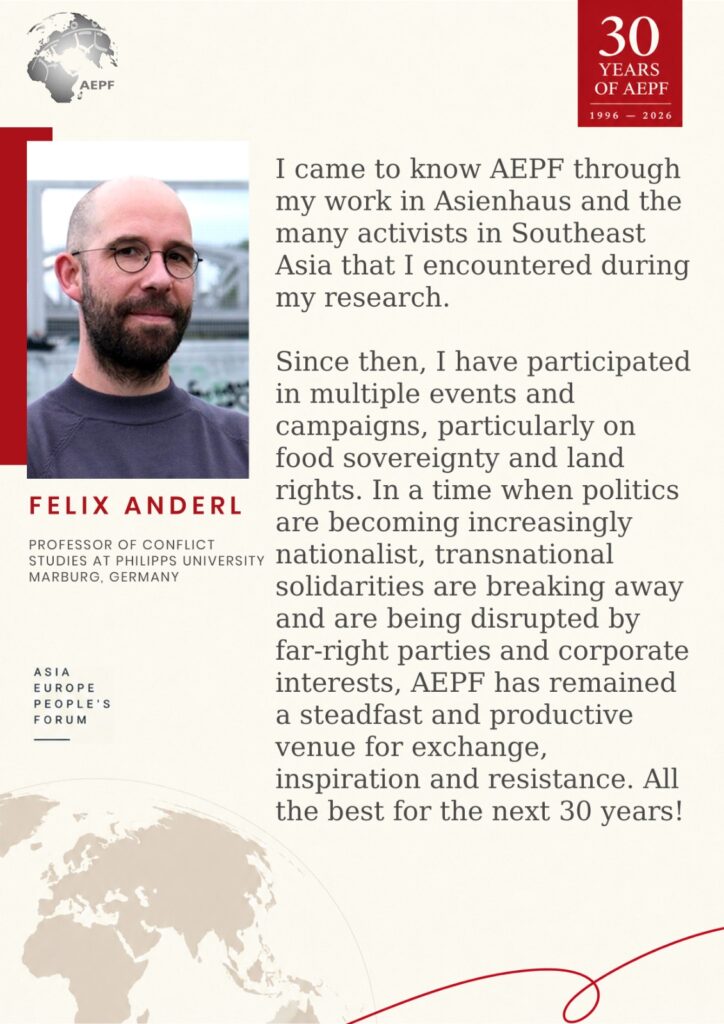
Felix Anderl, Professor of Conflict Studies at Philipps University Marburg, Germany, reflects on how his work with Asienhaus and encounters with activists in Southeast Asia introduced him to AEPF.

From campaigns on food sovereignty and land rights to building transnational solidarity, he highlights AEPF’s enduring role as a space for exchange, inspiration and resistance amid rising nationalism and far-right politics.

Here’s to strengthening these connections and carrying the spirit of solidarity into the next 30 years!

#AEPFAt30 #30YearsOfAEPF #AsiaEuropePeoplesForum #PeoplesSolidarity


Read More

Farooq Tariq | 30 Years of AEPF | Voices That Shaped the Journey

Farooq Tariq | 30 Years of AEPF | Voices That Shaped the Journey

I was first introduced to the Asia Europe People’s Forum (AEPF) by Tina Ebro and Charles Santiago at a conference in Bangkok. They asked me to join AEPF, and when I asked how I could become a member, they simply told me, “You have already joined!” That was my first introduction to this remarkable platform.

Since then, almost 21 years have passed, and I have maintained a consistent association with AEPF. To a great honour, I am now the head of AEPF Asia chapter. Throughout these years, I have contributed, to the best of my abilities, to the development, growth, and sustainability of this important social movement, which brings together social movements, activists, and progressive voices from Asia and Europe. Over these two decades, I have attended numerous AEPF gatherings across Asia and Europe. One of the most memorable gatherings was held in Gent Belgium, where 12 delegates from Pakistan travelled to participate in this important event. Following that gathering, and shortly before the outbreak of COVID-19, we organized an international event in Lahore on the theme of Just Transition. That gathering was particularly significant because it brought together international delegates and Pakistani social movement representatives for the first time to discuss and introduce the concept of Just Transition in our context.

During the difficult COVID period, AEPF continued its work through a series of webinars and online discussions. I must acknowledge that it was through some of our friends and colleagues in AEPF that I became familiar with the effective use of digital technology for international engagement. These online platforms opened up new possibilities for us. For a long time, many of our struggles and initiatives in Pakistan remained isolated from wider international discussions. AEPF provided us with an opportunity not only to share our experiences and introduce our work to an international audience but also to learn from prominent scholars, academics, activists, and parliamentarians who were discussing some of the most pressing challenges confronting humanity.

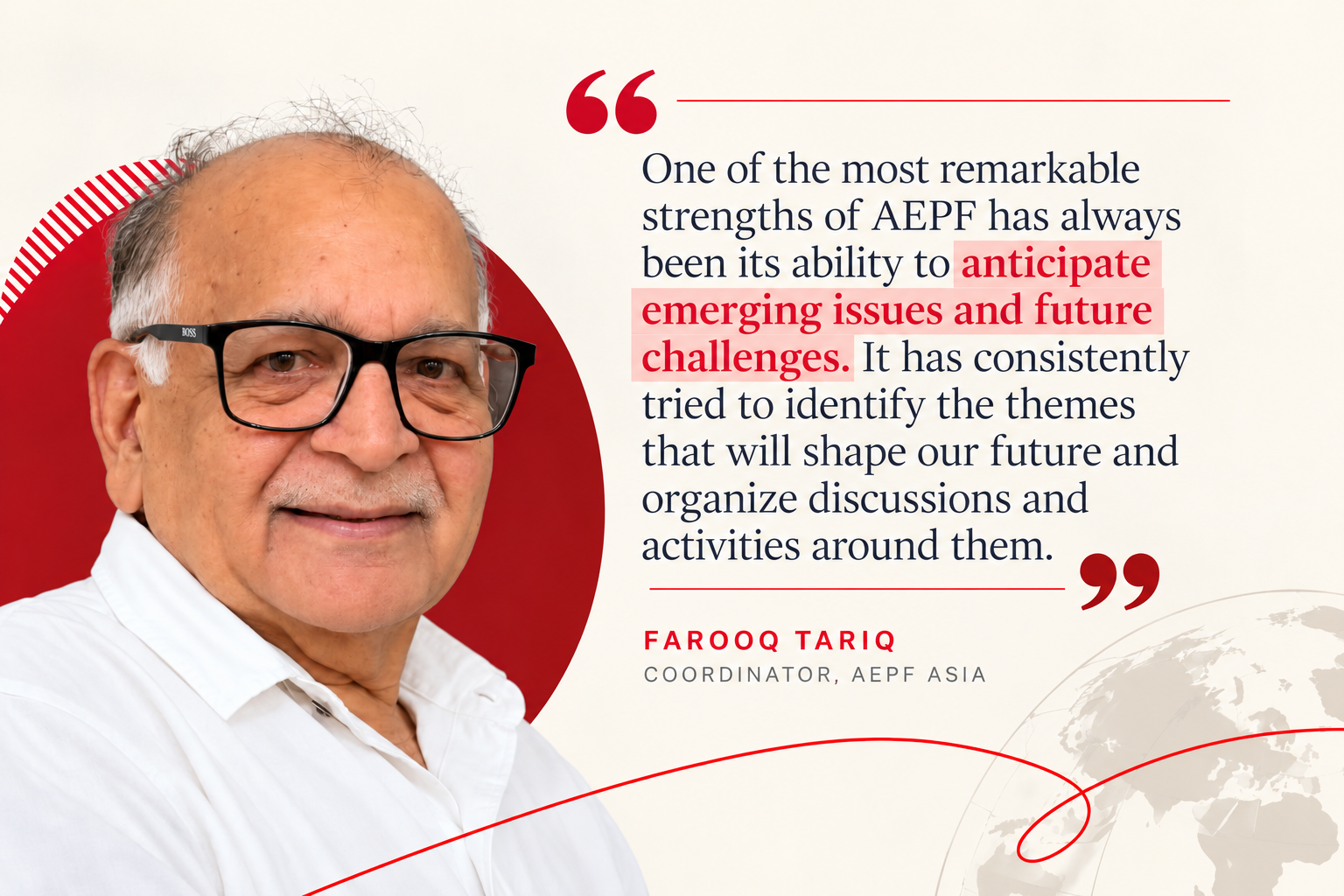
One of the most remarkable strengths of AEPF has always been its ability to anticipate emerging issues and future challenges. It has consistently tried to identify the themes that will shape our future and organize discussions and activities around them. Issues such as climate justice, food sovereignty, the right to freedom of expression, and many other social, political, and economic concerns have been central to its work.

Even in the most difficult circumstances, AEPF has remained a vocal platform for bringing together people and movements whose voices often remain unheard beyond their immediate communities and countries. It has provided an important space for solidarity, exchange, learning, and collective action across continents.

What makes AEPF particularly remarkable is not only the work it has done but also its ability to sustain itself over the years. It is quite extraordinary that this platform has continued to function, organize regular meetings, and bring people together without relying on regular financial support or donations from international funding agencies. Its survival and continuity demonstrate the commitment, dedication, and collective ownership of the people and movements associated with it. Very few international platforms have managed to sustain such a spirit of solidarity and cooperation.

I would also like to acknowledge and thank the organizations and individuals who have played an important role in building and sustaining this Forum. My special thanks go to 11.11 11 and, particularly, the Transnational Institute (TNI) in Amsterdam, which has made significant contributions to the development of AEPF and its work. I deeply appreciate our dear friend Anuradha Chenoy, whose academic insights, intellectual contributions, and perspectives from the Asian region have enriched our discussions and strengthened the Forum. And, finally, I would like to express my deepest gratitude to my mentor, leader, and dear friend, Tina Ebro. She has always been at the forefront of motivating, encouraging, and bringing people together to remain active in the Asia Europe People’s Forum.

After almost 21 years, I remain grateful to be part of this journey. AEPF is much more than a forum or a series of international gatherings. It is a space built on solidarity, collective learning, mutual support, and the shared belief that people and social movements across continents can come together to create a more just and democratic world.

Farooq Tariq
Coordinator AEPF Asia

Read More

Husnain Jamil Faridi | 30 Years of AEPF | Voices That Shaped the Journey

Husnain Jamil Faridi | 30 Years of AEPF | Voices That Shaped the Journey

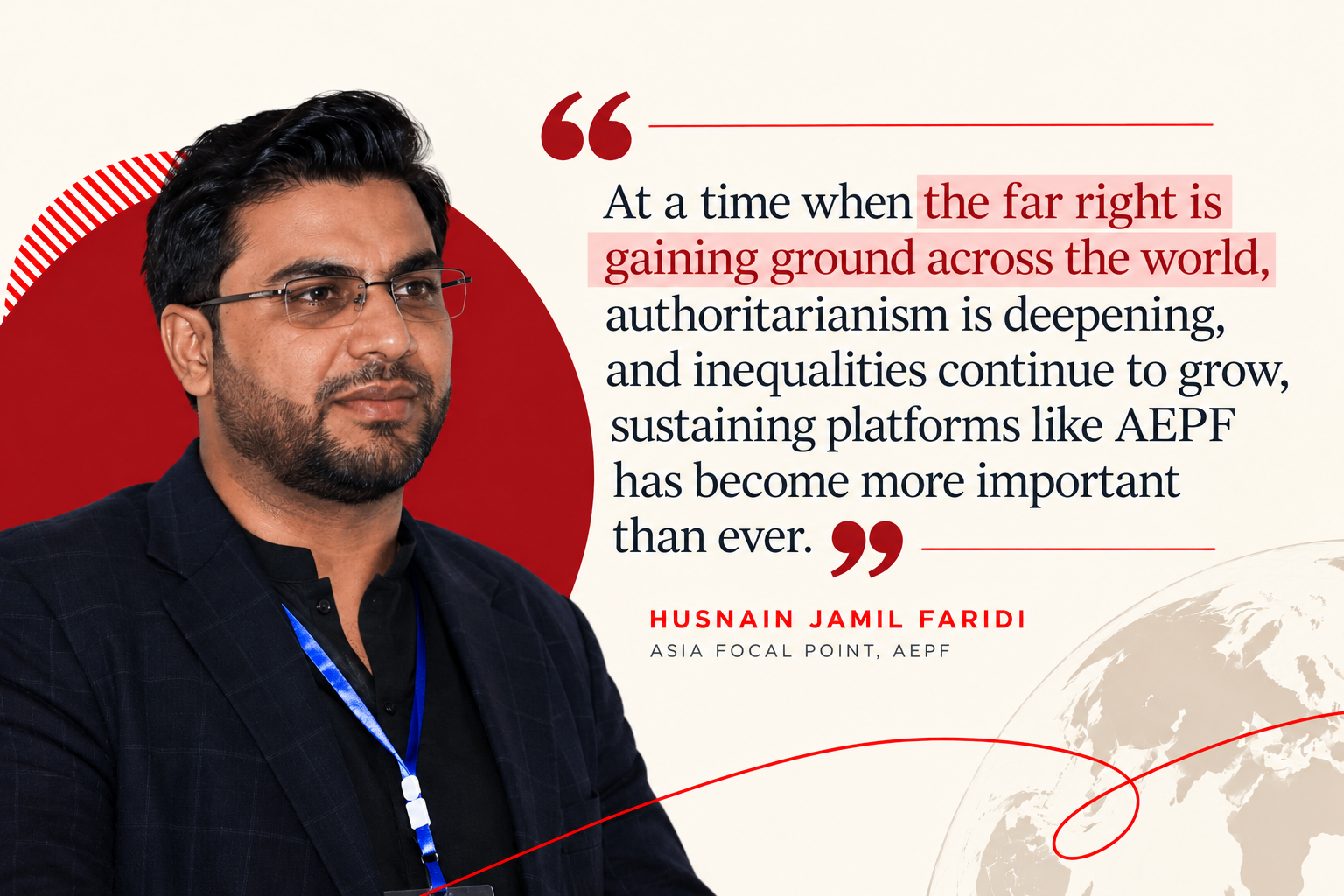
As AEPF marks 30 years, Husnain Jamil Faridi, Asia Focal Point at AEPF, reflects on his journey with the Forum since 2022. From coordinating webinars, campaigns and working groups to building connections with activists, academics and movements across Asia and Europe, Husnain shares how AEPF has been a space for learning, collaboration and solidarity.

He also highlights the importance of sustaining platforms like AEPF in challenging times, bringing people together across borders and rebuilding the collective momentum that shaped the Forum.

Read More

Bishnu N Singh | 30 Years of AEPF | Voices That Shaped the Journey

Bishnu N Singh | 30 Years of AEPF | Voices That Shaped the Journey

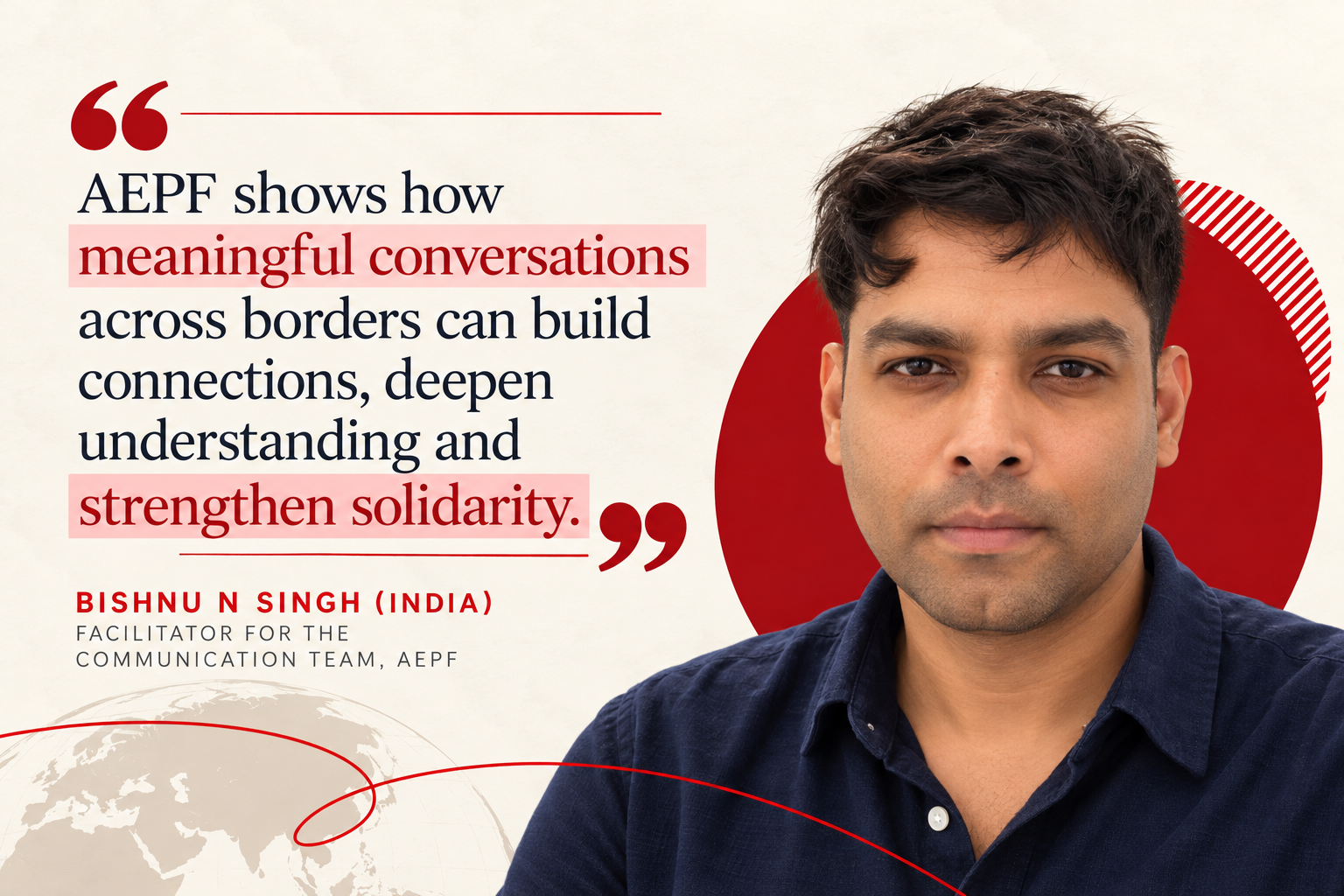
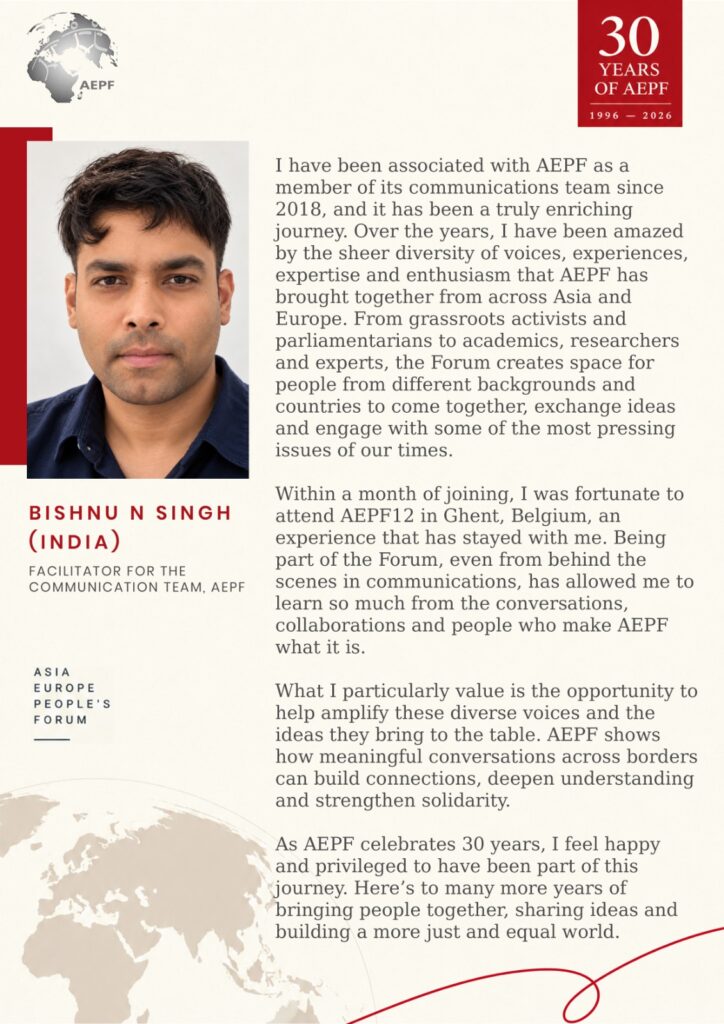
AEPF communications team member Bishnu N Singh reflects on the diversity of voices, expertise and movements that AEPF brings together across Asia and Europe. From his experience at AEPF12 in Ghent to amplifying ideas and stories through communications, he celebrates AEPF as a space for shared learning, collaboration and solidarity.

#AEPFAt30 #30YearsOfAEPF #AsiaEuropePeoplesForum #PeoplesSolidarity

Read More

AEPF 30 Years Journey – Forging the Future | Transnational Institute (TNI)

AEPF 30 Years Journey – Forging the Future | Transnational Institute (TNI)

When it comes to celebrating the Asia-Europe People’s Forum (AEPF) @30, we find ourselves between a rock and a hard place – the “rock” of the mid 90s geopolitics and the rise of neoliberalism and the ‘hard place’ of 2026 – with ongoing genocide, war and a collapsing multilateralism.

While major changes were taking place in 1996 within Europe and Asia – European elites were in the process of shaping the European Union (EU) and keen to forge trade and investment relations with the Asian juggernaut of economic markets that could rival the US hegemony in APEC. It was also an era that had its ‘monsters’ as Gramsci would see it: The dictatorship of Suharto still ruled in Indonesia, (and he used his long reach to derail the holding of the AEPF on the side of the ASEM 1 Summit) and France was nuclear testing in the Pacific. However, the emerging dynamic of a strong civil society and multi-sectoral movement in Thailand ensured that the AEPF 1 was held in Bangkok and ASEM 1 and was greeted by big street rallies of workers, peasants and students.

The Asian and European movements which converged in Bangkok on the eve of the ASEM 1, while engaging on the wide ranging challenges on the impacts of neoliberal globalisation on peoples’ rights in Asia and Europe, were also driven by a very ambitious cross regional focus. AEPF 1 was determined to open the road on ‘untouchable’ geo-political issues: the independence of East Timor, the military dictatorship in Myanmar and the British occupation of Northern Ireland. Bangkok was a groundbreaking moment on these agendas – in terms of strengthening cross regional solidarity, but also in terms of inserting substantive issues on the ASEM 1 government agenda. The global media assembled in Bangkok gave ample coverage to AEPF 1 agendas – from the recently established WTO  (1995) and the ASEM 1 narrow focus on trade and investment – to the AEPF 1 insistence on peoples rights (workers, farmers, women, indigenous peoples) and the right to self-determination.

The agenda  of AEPF 1 was also re-enforced and reverberated in the “Parliament of the Streets” when workers, farmers, students and buddhist monks held parallel rallies. These were expressions of an emerging  dynamic participatory democracy movement which was preparing the ground breaking 1997 Constitution of Thailand.

Bangkok 1996: a new step in building a people-to-people cross regional agenda

The AEPF was ahead of the World Social Forum (WSF) –but also contributed to the WSF – while maintaining its unique character of constantly walking on bi-regional joint campaigns. During these years, the AEPF has provided key spaces for progressive movements, civil society organisations as well as parliamentarians in Asia and Europe to connect their struggles and AEPF Work Groups have marked up quite some achievements:

  • the fight against the Multilateral Agreement on Investment that started at AEPF 1 and led to the collapse of the MAI in 1998.
  • the solidarities and struggles in Asia and Europe for an independent East-Timor and against the military dictatorships in Indonesia and in Myanmar
  • the campaigns against corporate driven unequal neoliberal trade and investments agreements and investment protection and unjust and crippling debt
  • The establishment of the Asean Parliamentarians for Human Rights
  • the response of the ‘Beijing Nights’  to the global financial crisis which led to a concrete programme for a systemic overhaul of the global financial architecture and system
  • the proactive role of the organisations of the AEPF in the launch and ongoing Global Campaign against the power of transnational corporations and for a Binding Treaty at the UN
  • the exploration of the framework and parameters of an alternative regionalism – and how to advance programmes for social transformation – food sovereignty, decent wages, peoples health, education and housing

Throughout the past 30 years the AEPF has also:

  • carried a multi-dimensional Peace agenda – from the Campaign for a Nuclear Free Pacific to addressing the Cold War at the DMZ on the Korean  Peninsula – to peace building in Myanmar
  • maintained a permanent protest vigil on the violations of human rights and peoples’ rights throughout the period – whether social leaders, community activists ‘disappeared or salvaged – including in the case of the extra judicial killing (EJKs) in the drug war in the Philippines; political prisoners or the forced displacement of migrant and refugee people in both continents, including and above all  the forced disappearance of Lao civil society leader Sombath Somphone, the co-host of the AEPF in Laos.

AEPF organisations have converged in the common struggle to renew and strengthen the process of democratisation – whether against dictatorship or the rise of authoritarianism in both Asia and Europe.

The AEPF: An Unfinished Agenda & the Challenges of the current conjuncture

However, when we look back we see many unfinished or de-railed agendas. And as we look forward we are challenged with the major shifts in contemporary geo-economics, geopolitics and climate crisis. Across the scope of Asia and Europe. We see an agenda of empire, neo-colonialism, and aggressive capitalist extractivism re-inventing itself.

In AEPF – the search for a new vision and strategy has already started in the planned webinars on @AEPF30 and is being debated in on-going initiatives of campaign work. We need to test these insights in new alliances with peoples of other regions – Middle East, Africa and Latin America.

The answers to What Europe do we want? And What Asia do we want? will need to be contested and built within the framework of a global people-planet centered agenda for action in the next decades.

As AEPF, we are deepening the lessons of the past 30 years – and in some exchanges and encounters – the inspiration of the Bandung Conference of 70 years ago brings key elements of such a future agenda. But now it will be towards a Bandung de los Pueblos – towards a Global South Front – a Bandung of the Peoples.

AEPF brought TNI to many spaces in Asia and Europe, from Bangkok to Korea, to Vietnam, China, Laos, Mongolia, and Indonesia and from the UK to Finland, Denmark, Italy to Belgium. We can not express how these journeys – always in the partnership with so many movements, organisations and individuals –  have enriched our understanding, built connections and created communities of joint struggle for a better world.

Now in retrospect it is both daunting and inspiring to read the concluding sentence of the Bangkok AEPF 1 statement – as it seems very resonant for these times – an era of new ‘monsters’  and yet it is a call for new strategies and a search for a common agenda that can unite not only the movements of Asia and Europe – but also contribute to forge a global agenda for people and planet.

“…The Conference calls on European and Asia governments to reaffirm the overarching principles of decolonisation and the rights of peoples and nations to self-determination.”

Asia-Europe Conference, Bangkok, February 27-29, 1996
@2026

Transnational Institute (TNI)
Pietje Vervest
Brid Brennan

Read More

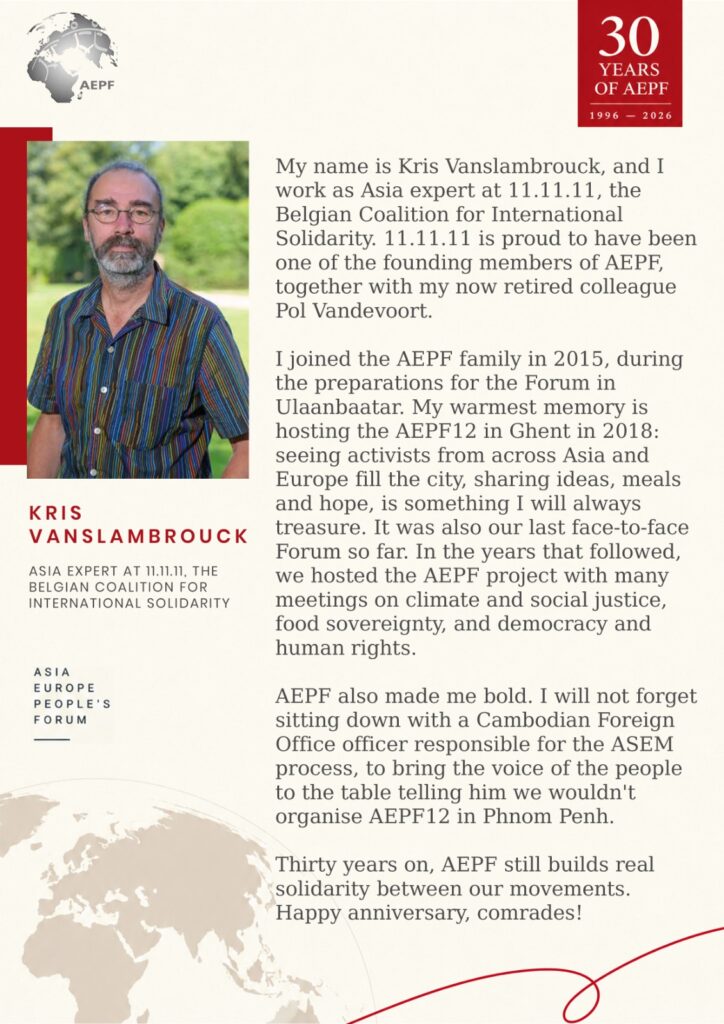
Kris Vanslambrouck | 30 Years of AEPF | Voices That Shaped the Journey

Kris Vanslambrouck | 30 Years of AEPF | Voices That Shaped the Journey

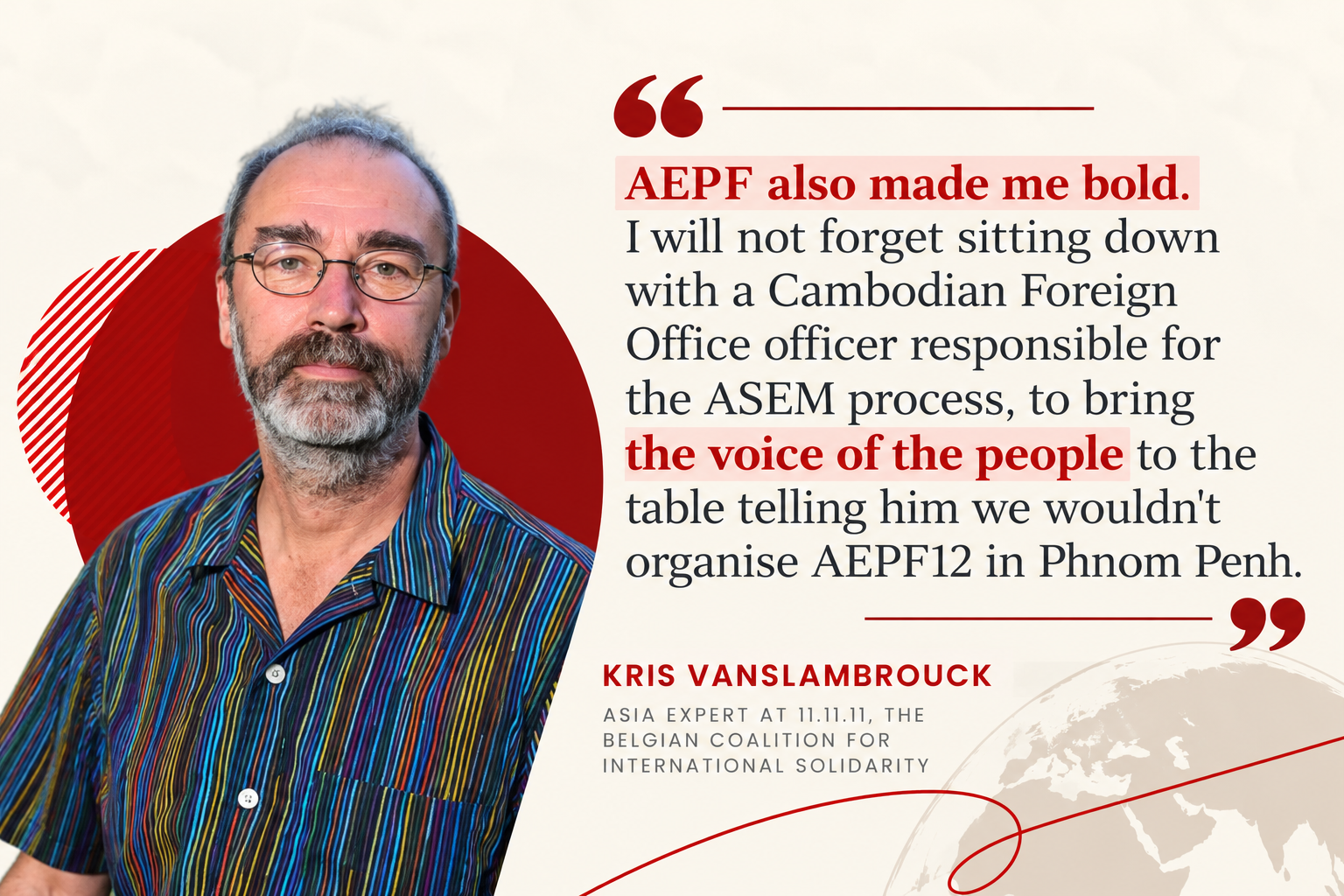
As AEPF marks 30 years, Kris Vanslambrouck, Asia expert at 11.11.11, the Belgian Coalition for International Solidarity, reflects on the friendships, collective struggles and lasting solidarity that have shaped the Forum.

From hosting AEPF12 in Ghent in 2018 to working together on climate and social justice, food sovereignty, democracy and human rights, Kris shares memories of a movement that brings people across Asia and Europe together. He also recalls AEPF’s commitment to ensuring people’s voices are heard in political decision-making.

Thirty years on, AEPF continues to build real solidarity between movements.

#AEPFAt30 #30YearsOfAEPF #AsiaEuropePeoplesForum #PeoplesSolidarity #SocialJustice #ClimateJustice

Read More

Tina Ebro | 30 Years of AEPF | Voices That Shaped the Journey

Tina Ebro | 30 Years of AEPF | Voices That Shaped the Journey

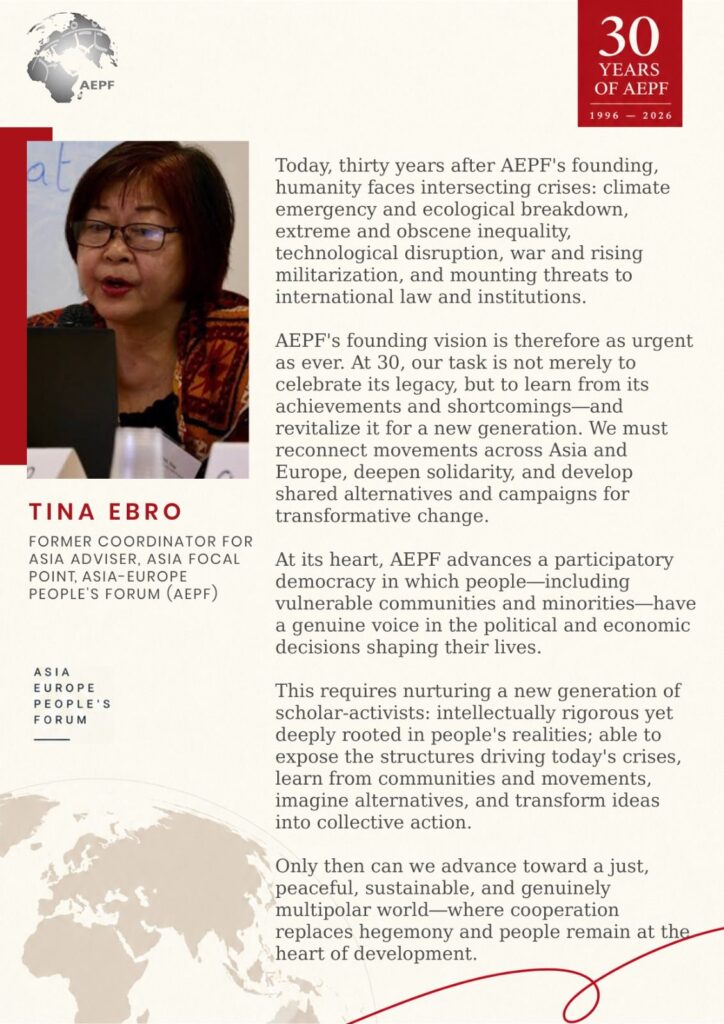
By Tina Ebro, Former Coordinator for Asia Adviser, Asia Focal Point  – Asia-Europe People’s Forum (AEPF)

The Asia–Europe People’s Forum (AEPF) was born at a pivotal moment in world history. The collapse of the Soviet Union ushered in a proclaimed unipolar era, dominated by the United States and its European allies. The prevailing mantra was: “There Is No Alternative” to neoliberal capitalist globalization.

Across the Global South, development was increasingly shaped by corporate interests, the World Bank, and the International Monetary Fund. Privatization, deregulation, and market liberalization eroded the state’s responsibility to provide essential public services. As David Harvey argued, this transferred wealth and power to private interests while deepening inequality and poverty.

Against this backdrop, progressive forces from Asia and Europe—social movements, NGOs, parliamentarians, and public intellectuals—gathered in Bangkok in 1996, on the eve of the first Asia–Europe Meeting, to establish AEPF.

AEPF was founded on a compelling conviction: regional cooperation must place people—not markets—at the center of development. It envisioned a just, peaceful, sustainable, and multipolar world—free from hegemonic domination and guided by dialogue, cooperation, mutual respect, and solidarity among peoples.

AEPF is thus a dynamic interregional network of progressive civil society organizations across Asia and Europe. It provides an independent space for dialogue, critical reflection, solidarity-building, and the development of alternatives and common campaigns for transformative change.

Ahead of ASEM Summits, AEPF organized People’s Forums in Bangkok, London, Seoul, Copenhagen, Hanoi, Helsinki, Beijing, Brussels, Vientiane, Milan, Ulaanbaatar, and Ghent. These vibrant gatherings united social movements, NGOs, parliamentarians, academics, trade unions, women and youth, farmers, urban poor communities, environmental advocates, and regional networks.

By connecting grassroots struggles across continents, AEPF amplified voices often excluded from official policymaking and strengthened local, national, and regional campaigns.

This collaboration continued through AEPF’s thematic clusters on Peace and Security, Social Justice and a Life of Dignity, Food Sovereignty, Just Trade and Corporate Accountability, and Climate Justice and Just Transitions. Through conferences and seminars—from Yangon, Manila, Barcelona, Nepal, and Lahore to Kuala Lumpur, Berlin, Hanoi, Bangkok, and Jakarta—the clusters deepened solidarity, sharpened alternatives, and advanced collective action for a peaceful, just, democratic, and sustainable world.

Years later, AEPF coordinators Andy Rutherford, Uwe Hoering, and I presented AEPF’s mission and vision to the ASEM Secretariat in Brussels. Our engagement was supported by Alistair MacDonald, former EU Ambassador to the Philippines and later head of the EU’s ASEM Unit.

The Secretariat recognized the value of an independent civil society space alongside ASEM and shared our aspiration for a peaceful, just, and multipolar world free from hegemonic domination. This recognition culminated at the 2016 ASEM Summit in Ulaanbaatar.

The Summit drew leaders from 53 Asian and European partners—among them German Chancellor Angela Merkel, Japanese Prime Minister Shinzo Abe, Russian Prime Minister Dmitry Medvedev, Chinese Premier Li Keqiang, and the Presidents of the European Council and the European Commission. Their presence marked a remarkable moment of dialogue among major powers—a form of engagement increasingly absent in today’s divided and militarized world.

On the Summit’s opening day, AEPF addressed the official gathering and presented its Final Declaration, shaped by some 750 civil society participants from 42 countries. It was a significant achievement: AEPF carried people’s voices, demands, and alternatives directly before Asian and European leaders—while preserving its independence and critical perspective.  We also acknowledge the efforts of Tur-Od Lkhagvajav and President Elbegdorj of Mongolia.

Today, thirty years after AEPF’s founding, humanity faces intersecting crises: climate emergency and ecological breakdown, extreme and obscene inequality, technological disruption, war and rising militarization, and mounting threats to international law and institutions.

AEPF’s founding vision is therefore as urgent as ever. At 30, our task is not merely to celebrate its legacy, but to learn from its achievements and shortcomings—and revitalize it for a new generation. We must reconnect movements across Asia and Europe, deepen solidarity, and develop shared alternatives and campaigns for transformative change.

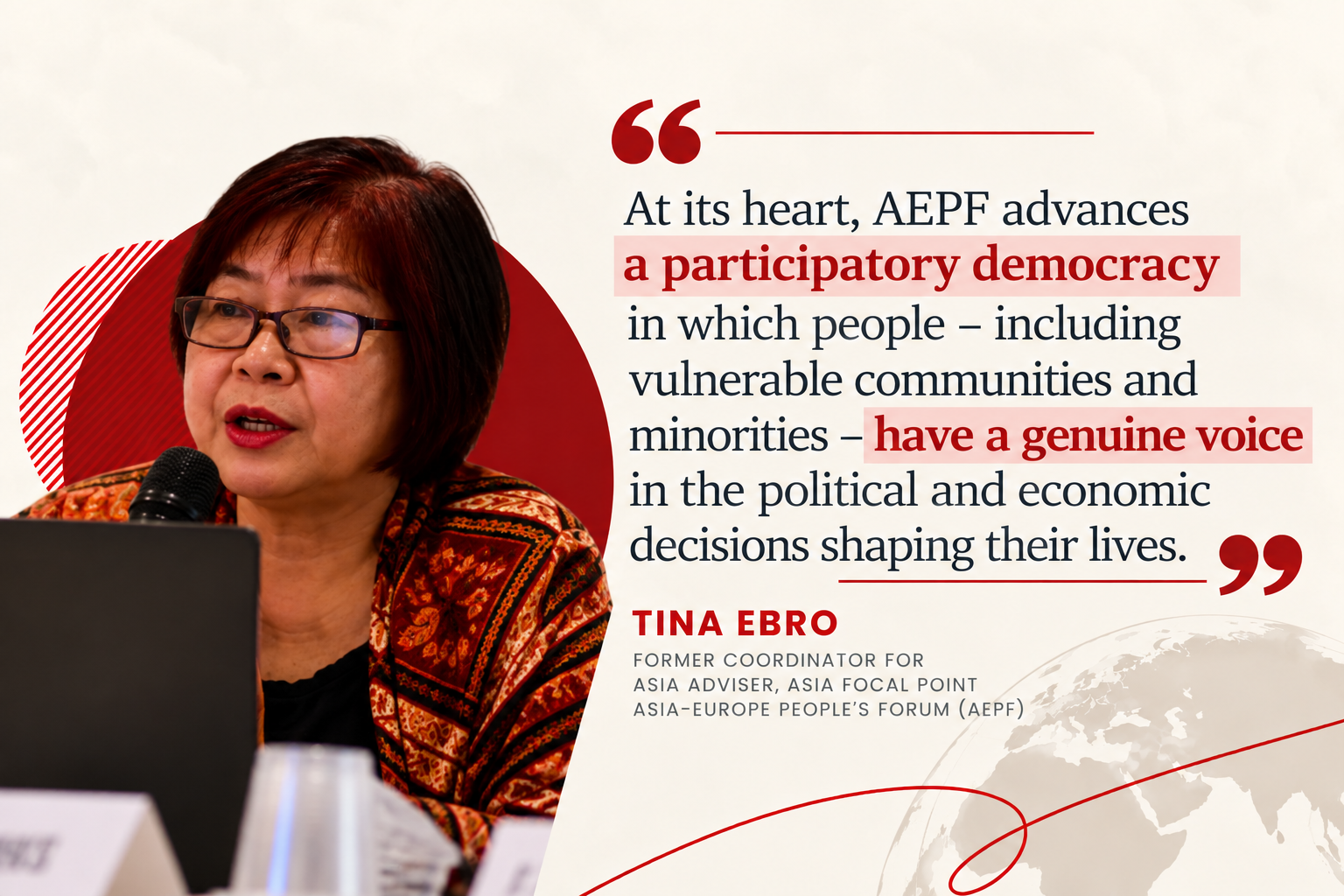
At its heart, AEPF advances a participatory democracy in which people—including vulnerable communities and minorities—have a genuine voice in the political and economic decisions shaping their lives.

This requires nurturing a new generation of scholar-activists: intellectually rigorous yet deeply rooted in people’s realities; able to expose the structures driving today’s crises, learn from communities and movements, imagine alternatives, and transform ideas into collective action.

Only then can we advance toward a just, peaceful, sustainable, and genuinely multipolar world—where cooperation replaces hegemony and people remain at the heart of development.

Read More

Andy Rutherford | 30 Years of AEPF | Voices That Shaped the Journey

Andy Rutherford | 30 Years of AEPF | Voices That Shaped the Journey

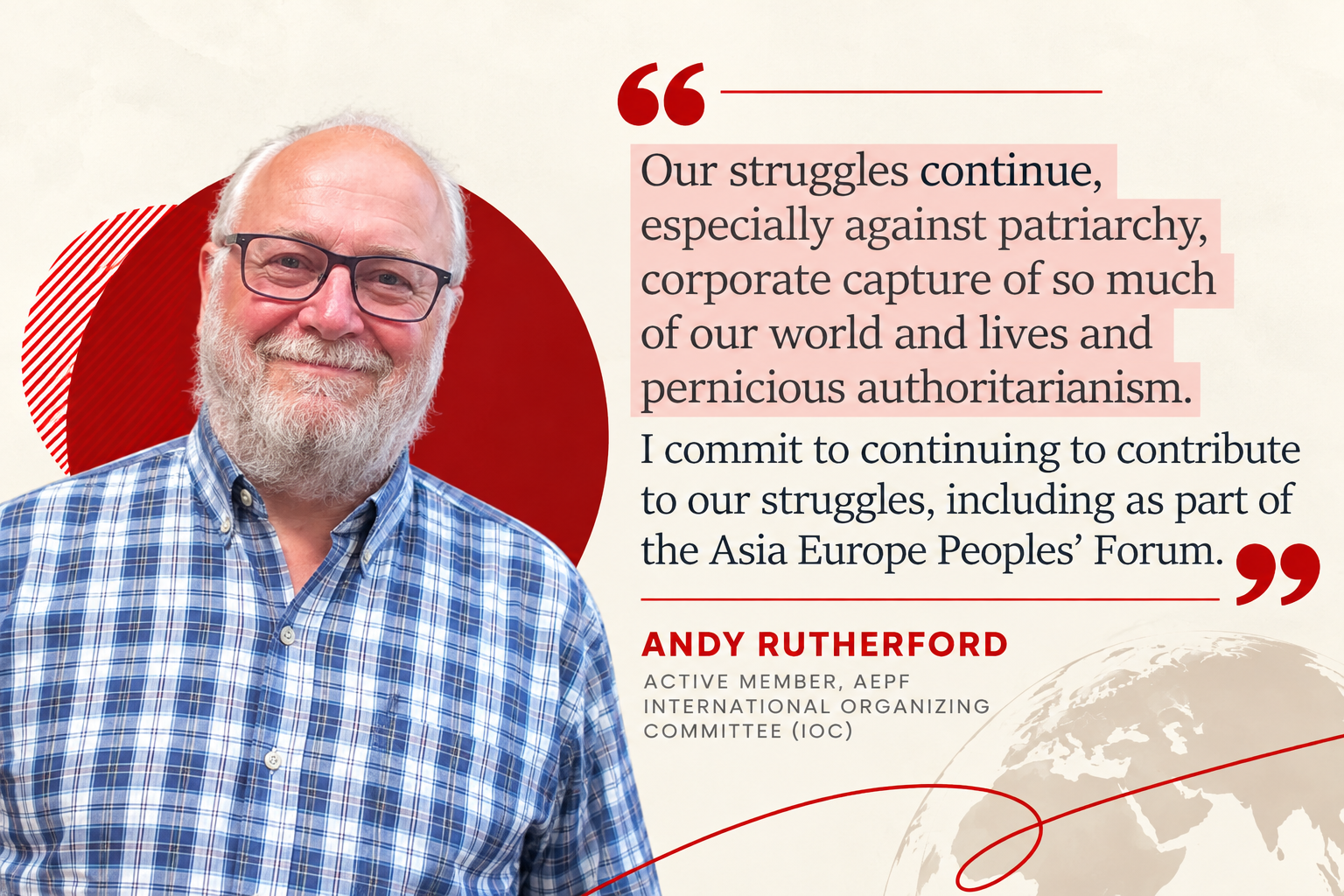
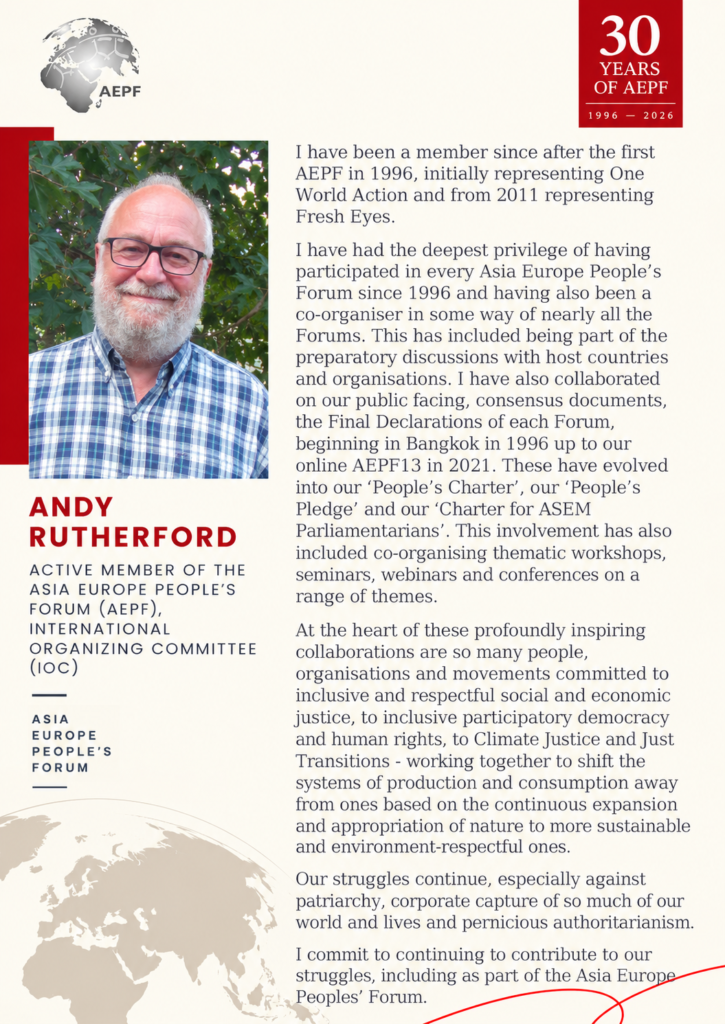
Andy Rutherford, active member of the Asia Europe People’s Forum (AEPF), International Organizing Committee (IOC) reflects on nearly three decades of participation, collaboration, and collective action across Asia and Europe.

Having participated in every AEPF since 1996, Andy shares his experiences of bringing together civil society organisations and movements to advance social and economic justice, participatory democracy, human rights, climate justice, and just transitions. He also reminds us that the struggles against patriarchy, corporate capture, and authoritarianism continue – and reaffirms his commitment to these struggles through AEPF.

As we celebrate this milestone, we look ahead to strengthening solidarity and working together for a more just, democratic, peaceful, and sustainable world.

#AEPF30 #AsiaEuropePeoplesForum #PeoplesSolidarity #SocialJustice #ClimateJustice

Read More

Tran Dac Loi | 30 Years of AEPF | Voices That Shaped the Journey

Tran Dac Loi | 30 Years of AEPF | Voices That Shaped the Journey

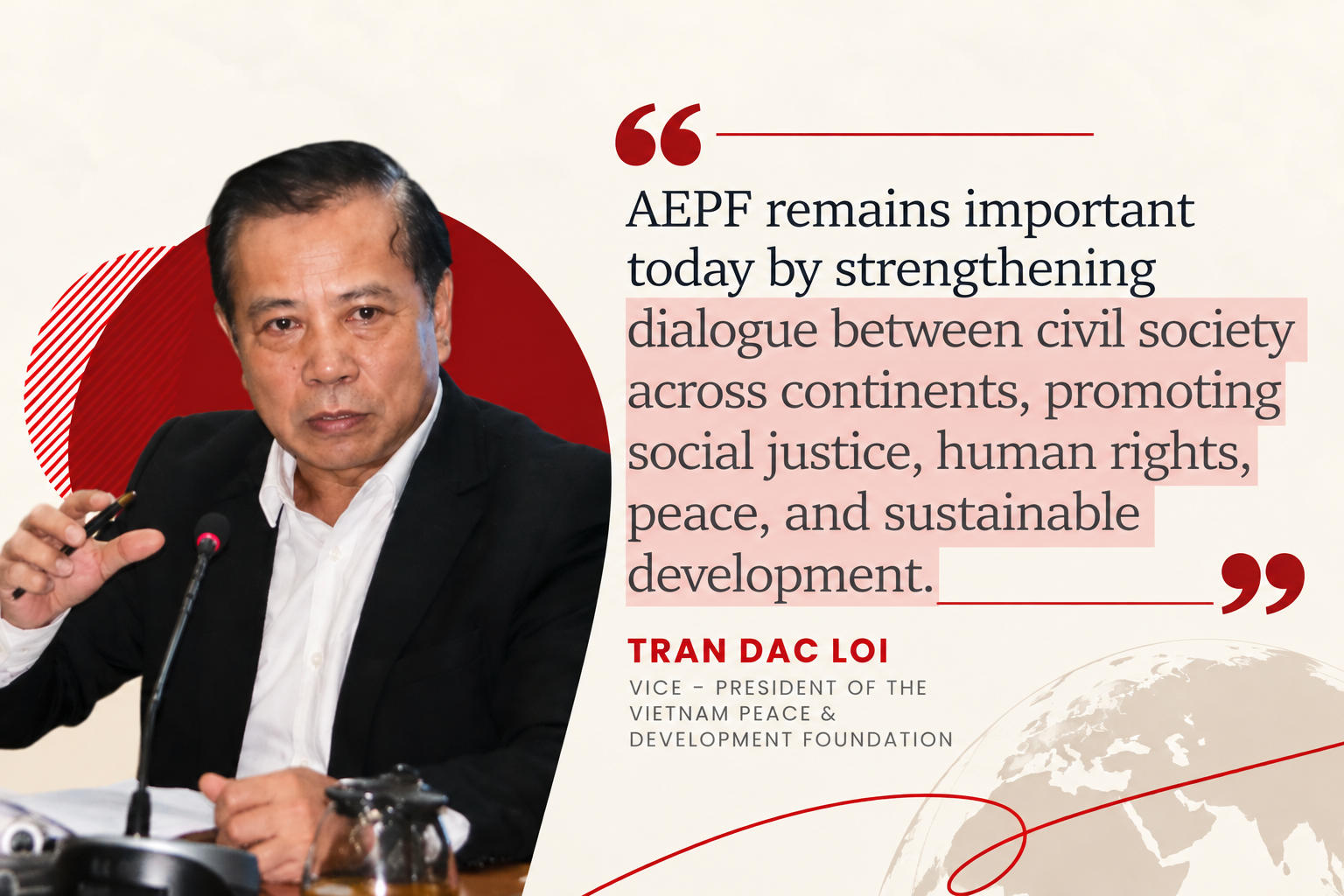
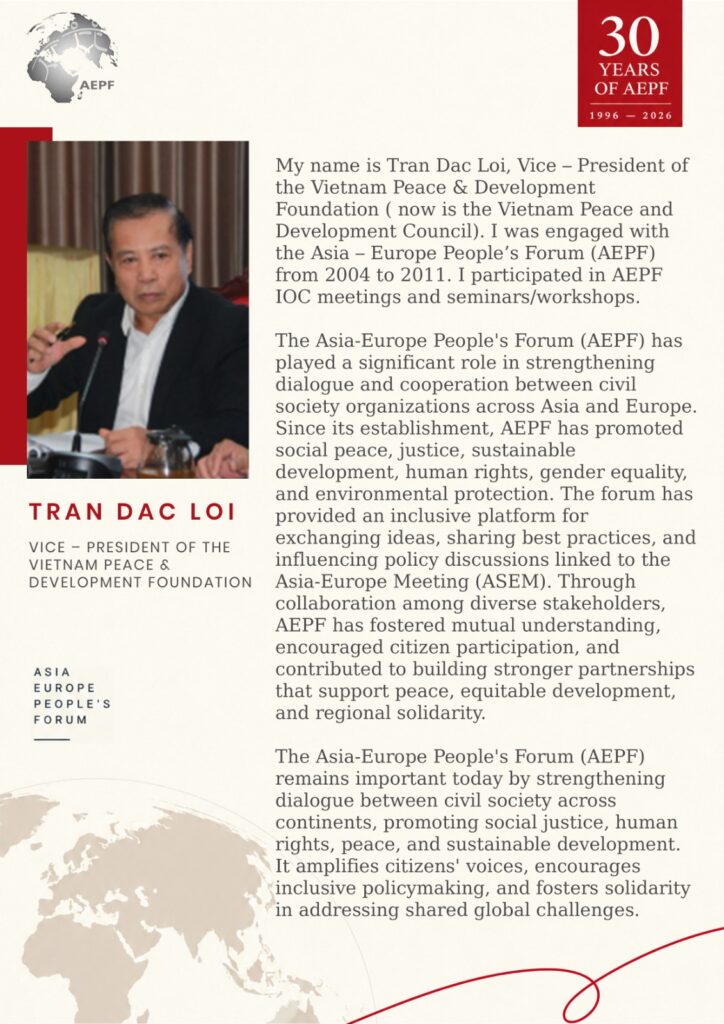
In this testimonial, Tran Dac Loi, Vice-President of the Vietnam Peace & Development Foundation, reflects on his engagement with AEPF from 2004 to 2011 and its contribution to dialogue and cooperation between civil society organisations across Asia and Europe.

He highlights AEPF’s role in advancing peace, social justice, human rights and sustainable development, while amplifying citizens’ voices and fostering regional solidarity.

30 years of dialogue, cooperation and people-powered solidarity.

#AEPFAt30 #30YearsOfAEPF #AsiaEuropePeoplesForum #PeaceAndJustice #PeoplePower

Read More