Tina Ebro | 30 Years of AEPF | Voices That Shaped the Journey
By Tina Ebro, Former Coordinator for Asia Adviser, Asia Focal Point – Asia-Europe People’s Forum (AEPF)
The Asia–Europe People’s Forum (AEPF) was born at a pivotal moment in world history. The collapse of the Soviet Union ushered in a proclaimed unipolar era, dominated by the United States and its European allies. The prevailing mantra was: “There Is No Alternative” to neoliberal capitalist globalization.
Across the Global South, development was increasingly shaped by corporate interests, the World Bank, and the International Monetary Fund. Privatization, deregulation, and market liberalization eroded the state’s responsibility to provide essential public services. As David Harvey argued, this transferred wealth and power to private interests while deepening inequality and poverty.
Against this backdrop, progressive forces from Asia and Europe—social movements, NGOs, parliamentarians, and public intellectuals—gathered in Bangkok in 1996, on the eve of the first Asia–Europe Meeting, to establish AEPF.
AEPF was founded on a compelling conviction: regional cooperation must place people—not markets—at the center of development. It envisioned a just, peaceful, sustainable, and multipolar world—free from hegemonic domination and guided by dialogue, cooperation, mutual respect, and solidarity among peoples.
AEPF is thus a dynamic interregional network of progressive civil society organizations across Asia and Europe. It provides an independent space for dialogue, critical reflection, solidarity-building, and the development of alternatives and common campaigns for transformative change.
Ahead of ASEM Summits, AEPF organized People’s Forums in Bangkok, London, Seoul, Copenhagen, Hanoi, Helsinki, Beijing, Brussels, Vientiane, Milan, Ulaanbaatar, and Ghent. These vibrant gatherings united social movements, NGOs, parliamentarians, academics, trade unions, women and youth, farmers, urban poor communities, environmental advocates, and regional networks.
By connecting grassroots struggles across continents, AEPF amplified voices often excluded from official policymaking and strengthened local, national, and regional campaigns.
This collaboration continued through AEPF’s thematic clusters on Peace and Security, Social Justice and a Life of Dignity, Food Sovereignty, Just Trade and Corporate Accountability, and Climate Justice and Just Transitions. Through conferences and seminars—from Yangon, Manila, Barcelona, Nepal, and Lahore to Kuala Lumpur, Berlin, Hanoi, Bangkok, and Jakarta—the clusters deepened solidarity, sharpened alternatives, and advanced collective action for a peaceful, just, democratic, and sustainable world.
Years later, AEPF coordinators Andy Rutherford, Uwe Hoering, and I presented AEPF’s mission and vision to the ASEM Secretariat in Brussels. Our engagement was supported by Alistair MacDonald, former EU Ambassador to the Philippines and later head of the EU’s ASEM Unit.
The Secretariat recognized the value of an independent civil society space alongside ASEM and shared our aspiration for a peaceful, just, and multipolar world free from hegemonic domination. This recognition culminated at the 2016 ASEM Summit in Ulaanbaatar.
The Summit drew leaders from 53 Asian and European partners—among them German Chancellor Angela Merkel, Japanese Prime Minister Shinzo Abe, Russian Prime Minister Dmitry Medvedev, Chinese Premier Li Keqiang, and the Presidents of the European Council and the European Commission. Their presence marked a remarkable moment of dialogue among major powers—a form of engagement increasingly absent in today’s divided and militarized world.
On the Summit’s opening day, AEPF addressed the official gathering and presented its Final Declaration, shaped by some 750 civil society participants from 42 countries. It was a significant achievement: AEPF carried people’s voices, demands, and alternatives directly before Asian and European leaders—while preserving its independence and critical perspective. We also acknowledge the efforts of Tur-Od Lkhagvajav and President Elbegdorj of Mongolia.
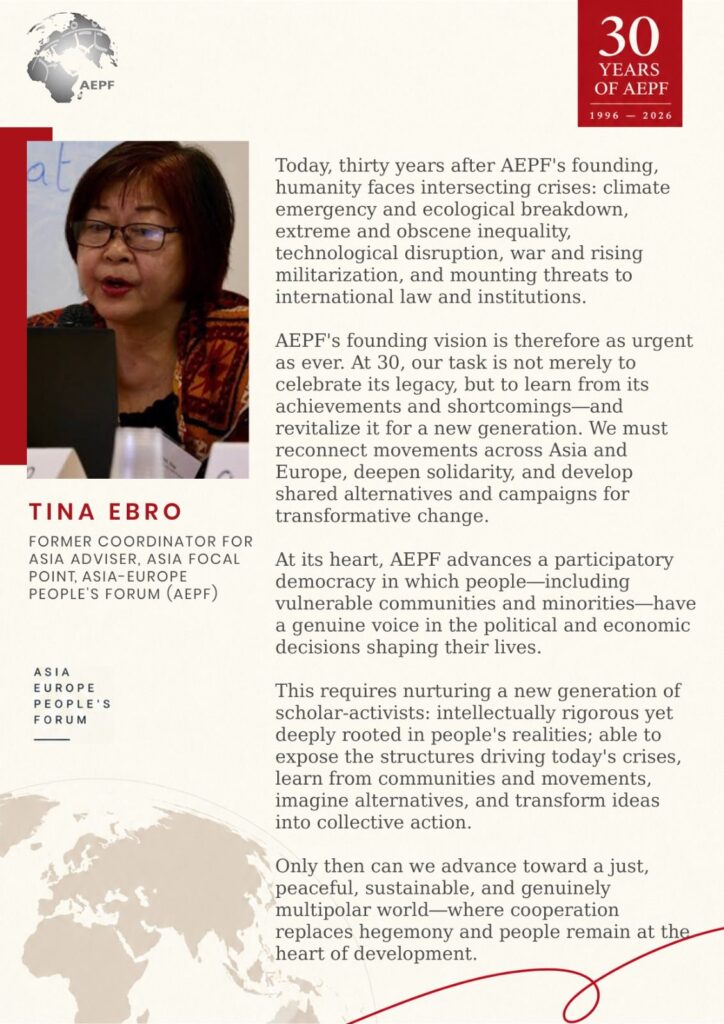
Today, thirty years after AEPF’s founding, humanity faces intersecting crises: climate emergency and ecological breakdown, extreme and obscene inequality, technological disruption, war and rising militarization, and mounting threats to international law and institutions.
AEPF’s founding vision is therefore as urgent as ever. At 30, our task is not merely to celebrate its legacy, but to learn from its achievements and shortcomings—and revitalize it for a new generation. We must reconnect movements across Asia and Europe, deepen solidarity, and develop shared alternatives and campaigns for transformative change.
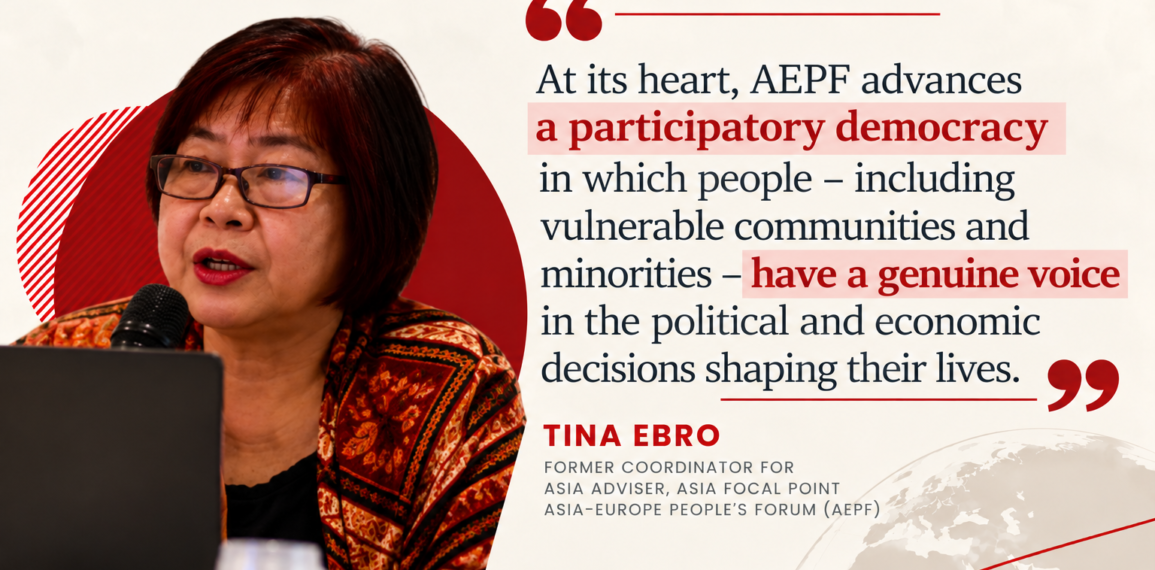
At its heart, AEPF advances a participatory democracy in which people—including vulnerable communities and minorities—have a genuine voice in the political and economic decisions shaping their lives.
This requires nurturing a new generation of scholar-activists: intellectually rigorous yet deeply rooted in people’s realities; able to expose the structures driving today’s crises, learn from communities and movements, imagine alternatives, and transform ideas into collective action.
Only then can we advance toward a just, peaceful, sustainable, and genuinely multipolar world—where cooperation replaces hegemony and people remain at the heart of development.