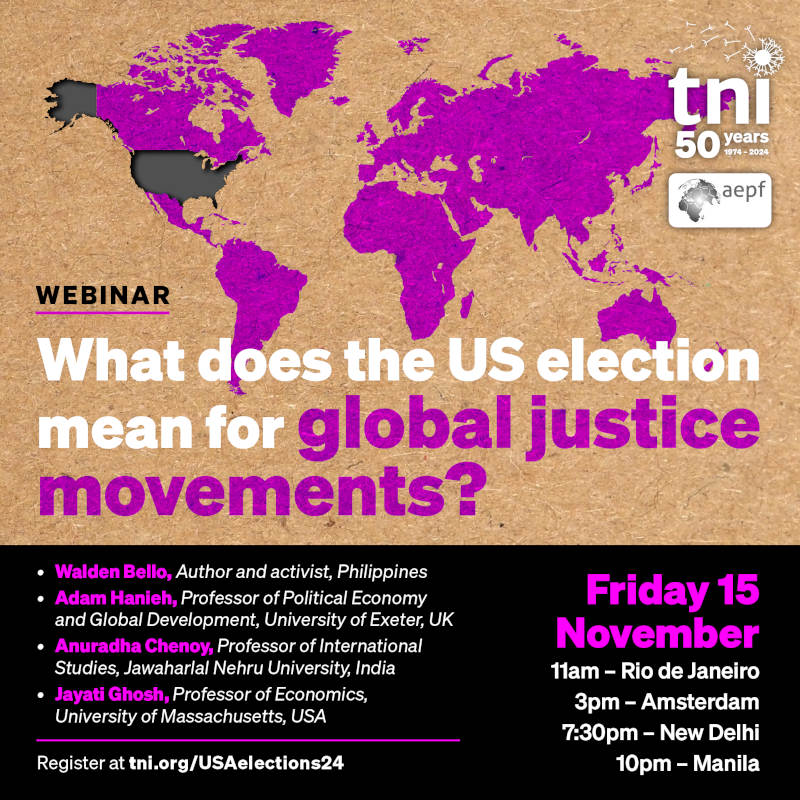
Webinar: What does the US election mean for global justice movements?
Four leading global activists and scholars assess the implications of Trump’s victory for US foreign policy and for social movements worldwide.
Speakers:
– Walden Bello, Author and activist, Professor of Sociology, Philippines
– Anuradha Chenoy, Professor of International Studies (Retd.), Jawaharlal Nehru University, India
– Adam Hanieh, Professor of Political Economy and Global Development, University of Exeter, UK
– Jayati Ghosh, Professor of Economics, University of Massachusetts at Amherst, USA
Watch the Webinar ‘What does the US election mean for global justice movements?’ by Transnational Institute and Asia Europe People’s Forum
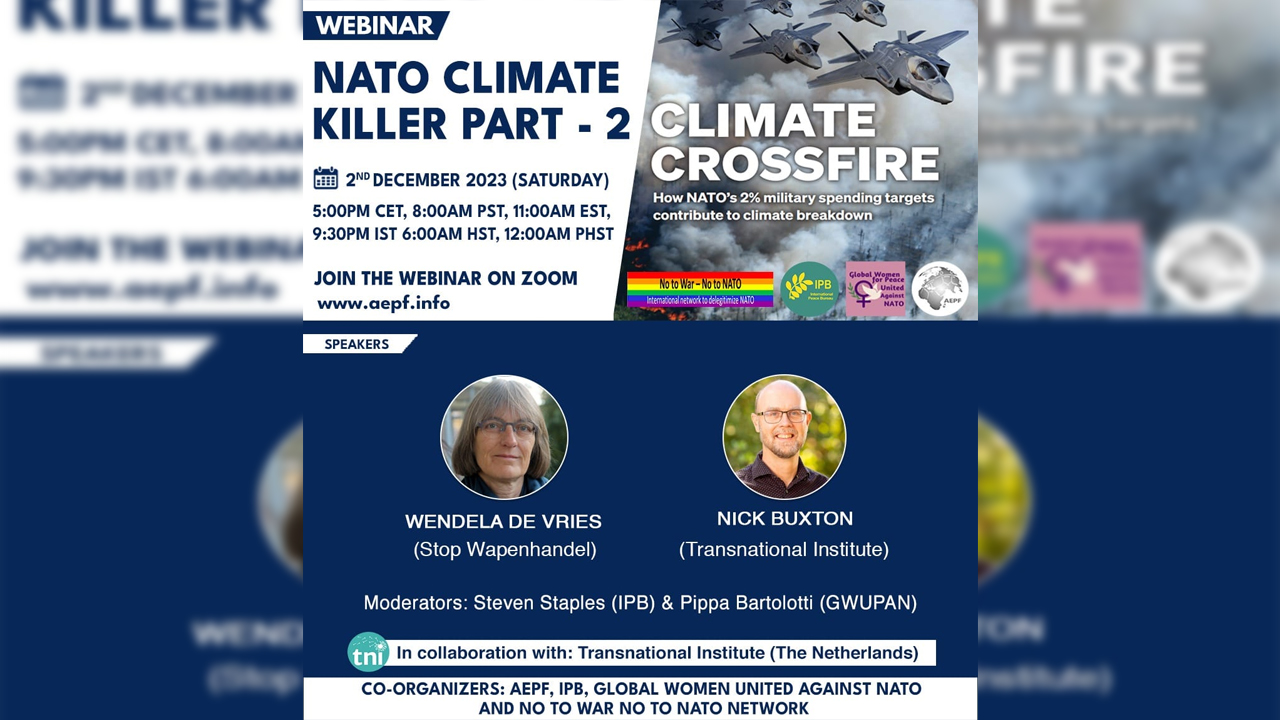
NATO Climate Killer Part 2: Climate Crossfire webinar (Dec. 2)
The impact of defense and militarisation on climate: listen to the authors and experts of this pathbreaking report.
Watch the Webinar
Post-review of NATO Climate Killer Part 2: Climate Crossfire Webinar, recorded on December 2nd, 2023, during COP 28
Author: Pippa Bartolotti
As we navigate COP 28, this webinar addressed the pertinent issues of military spending and its environmental ramifications.
Ably introduced by the Canadian policy analyst IPB Vice President Steven Staples, this important webinar discussed in detail the links between the military and environmental degradation. Taking place on Day 4 of the COP 28 summit in Dubai, it was a thorough reality check.
The first speaker was Nick Buxton, Transnational Institute, who had some superb graphics and data to support his call to shrink the military, boost renewables and fund poorer nations in their efforts to combat the climate change they did not cause.
He explained that, in view of global emissions significantly exceeding the pledges to stay within 1.5 degrees of warming, (Paris Agreement 2015) we now only have a tiny window in which to take radical action. Shrinking the military was now critical is we are to deliver climate justice.
The gap between policy and action has increased. Those countries promising to make adjustments by 2050 were basically not planning to make any changes at all. In other words, 2050 pledges are the ‘do nothing’ option.
Nick pointed out that holding this COP in a petro-state such as the UAE was rather like asking the head of a tobacco company to launch an anti-smoking campaign – ludicrous. His research showed clearly that those countries with the highest military spending created the most emissions, and that fossil fuel expansion had been the real aim since the end of WW1 when the Ottoman Empire was carved up to reflect the places where oil pipelines were going. The US backed Israeli onslaught on Gaza in order to claim the gasfields off that coast are an ongoing example of this policy.
The global military spend in 2022 was $2.24 trillion. In 2028 it is expected to be $11.8 trillion. The richest countries spend 30 times more on their military than on supporting a survivable climate.
In 2015 £100 billion was promised to help poorer countries. Only half of that has been delivered to date, and that came late.
Russia spends $158b on the military, China $578b, NATO spends $2,327b – that is 55% of global military spending. Of the 2% of GDP spending goal expected from NATO countries, 20% is targeted to be spent on military equipment, thus enriching the military industrial complex.
Nick showed us a map pinpointing the 750+ US military bases across the world, most of which correlate closely with the infrastructure of resource extraction.
Every country now has Climate Security Plans. The trend is to see climate change as a security issue where the victims are seen as threats, where borders become militarised, where exploitation of the vulnerable is increased, and where any form of peaceful response is denied. Spending on borders alone is now twice the spend on climate finance. NATO is now in place to deal with the consequences of the unstable conditions they themselves have created.
The second speaker was Wendela de Vries of Stop Wapenhandle, has been looking at the lack of transparency and accountability of the military across the globe.
She spoke of hardliners evading the subject of emissions, of the NATO Arctic Command established in order to protect deep sea mining in the Arctic. Of how current discussion is fuelling a new cold war and how closely correlated military spending was to a rise in emissions.
Most military spending is now in equipment not personnel. There is not expected to be a rise in numbers of personnel. But expenditure on ships, tanks and weapons would increase.
The military carbon footprint as of 2021 was bigger than the worlds footprint from civil aviation.
Th US emissions are more than all other NATO countries combined. More than 70% of all military emissions come from the US. 50% is from the military and more than 20% is on weapons manufacture.
Future member contributions to NATO are scheduled to rise to 3% of GDP. This is important for the arms industry who want to consolidate long term contracts, but labor and environmental rights are being damaged in the upscaling of weapons production – largely being driven by the Ukraine war.
Wendela spoke of the greenwashing of military products, such as the fallacious term ‘sustainable defence’ being used to greenwash biofuels and synthetic fuels, both of which still require burning for energy, and which will not reduce emissions at all. In the case of biofuels, enormous amounts of land would be required to grow the feedstock, damaging ecosystems and compromising biodiversity. The military are not going to change their energy systems to electricity as that would make all their ships, tanks etc obsolete. Electric propulsion would require a full redesign, and as military hardware is expected to last 40 years, such a proposal is not entertained.
Nuclear, particularly the plethora of small reactors, will make it much more difficult to control the toxic waste, and is no solution at all.
The arms industry still has huge support, many people still believe that the military make the world a safer place, and that thinking has to change. We have to de-militarize to be more safe.
Some interesting points came out of the question and answer session at the end. There was discussion about health being at the heart of peace, that a peaceful world would enable a healthy and dignified life for all. Others were looking for some way out of our current trajectory of everlasting war where every problem looked like a nail, and needed a hammer to solve it.
There was concern that rich countries did not look after poor countries. On the whole the speakers were not optimistic for the future as we sink into dark circumstances in this crisis of all crises.
The real challenge is to put collaboration before competition, to find a different pathway, and to make war illegal. Hope remains with social movements and in the streets.
Co-organized by four esteemed organizations—the International Peace Bureau, Global Women’s United Against NATO, No to War, No to NATO, and the Asia-Europe People’s Forum—this series of webinars seek to provoke thoughtful dialogue and foster a deeper understanding of the complex interplay between militarism and the environment.
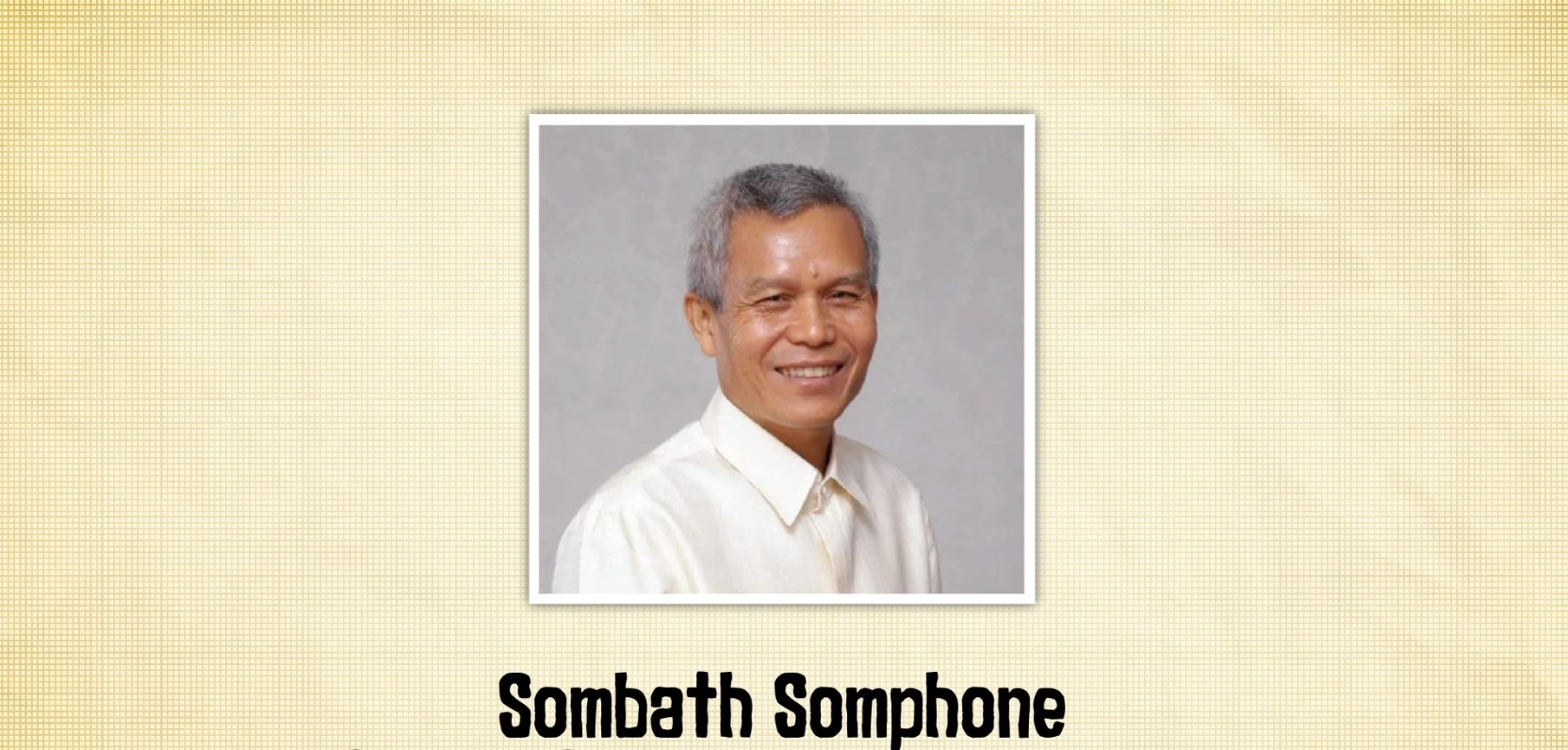
For 8 years, I am asking my government: Where is Sombath?
The Asia Europe People’s Forum wants to express solidarity with Human Rights Defenders worldwide, who risk their lives daily when they speak out and stand up for the rights of people in precarious situations.
For 8 years, Shui Meng is asking her government “Where is Sombath?”.
Her husband, who dissapeared in 2012, is a symbol of ten thousands of people who disappeared while raising their voice.
The Asia Europe People’s Forum released a statement and a video to demand international organizations, governments, parliaments, institutions, civil society organisations and others to end enforced disappearances and deliver justice to the victims.
Towns and cities stand at the heart of the new public future. Between 2000 and 2019, there were over 1400 new cases of “municipalisation” or “remunicipalisation”, the creation of new public enterprises run by local governments or the return of privatised enterprises to municipal hands. This trend occurred across 2400 locales in 58 countries.
In the grip of an increasingly emboldened right-wing nationalism, our world is in turmoil. From India to Turkey, Brazil to the US, a series of dangerous populists have come to power on a racist, climate-denying and crony-capitalist agenda.
The timing could not be worse. Ecological breakdown looms imminent. Global inequalities are sharper than ever. Decades of neoliberalism have torn apart our social fabric, leaving countless people across global North and South struggling to access the basics of survival amidst widespread privatisation and the marketisation of everything under the sun. Indeed, it is these crises of capitalism that have empowered the far right, who have turned desperation into division to perpetuate the position of the wealthy and powerful.
Yet, in spite of all this, something else is happening. Simultaneously, social movements and governments across the world have begun to quietly build a different future: a public future grounded in solidarity, equality, sustainability and radical democracy.
At the heart of this new public future stand towns and cities. New research from TNI and international partners shows that between 2000 and 2019, globally, there were over 1400 new cases of “municipalisation” or “remunicipalisation” — the creation of new public enterprises run by the local governments or the return of privatised enterprises to municipal hands. This trend has occurred across 2400 locales in 58 countries. Workers and their unions have often been at the heart of these remunicipalisation efforts, striving to improve workplace conditions while endeavouring to place their valuable knowledge and experience at the centre of public services.
This “new municipalism” has not emerged in isolation. Rather, it arises in a broader agenda of economic democracy pursued across a range of scales including but not limited to the city. From the workers co-operative that has taken over cleaning services in Recoleta, Chile through to the suite of nationalisations recently proposed by the British Labour Party, new forms of public and collective ownership are being developed in our workplaces, our neighbourhoods, our towns, our cities, our countries, our world.
Why now? Why, after years of being told that there is no alternative to capitalism, is public ownership back on the table? What changed to make this possible? While there are surely many factors at play here, perhaps the most clear-cut is that privatisation now stands more discredited than ever before.
While we were initially sold privatisation on the basis of its “efficiency”, study after study has found little evidence that private ownership is inherently more efficient than public ownership. What we have seen, instead, are increasing costs and declining quality for service users, worsening conditions for workers and a total breakdown of democratic accountability, transparency and control. The myth that “private is better and cheaper” can no longer be sustained. It’s little wonder, then, that people are demanding change and that especially local governments are starting to act.
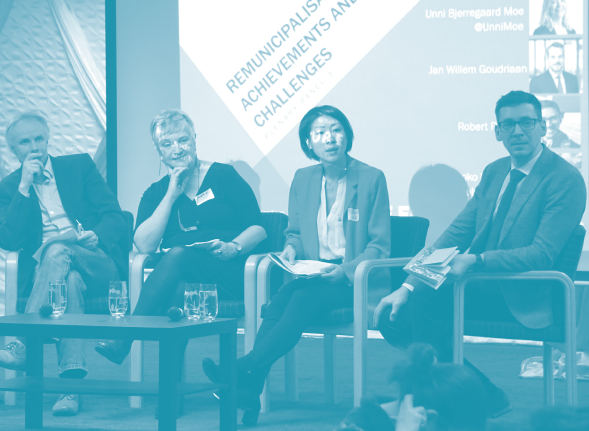
If the future is public, what will this look like and how will it be built? This was the question animating the international conference on 4-5 December 2019 convened by The Transnational Institute, De 99 Van Amsterdam (the city’s new think and do- thank) and international partner organisations. For two days, activists, researchers, trade unionists, politicians and policymakers from across the world gathered to share experiences, build solidarity and further plans for economic democracy. This report provides a brief snapshot into some of the discussions that took place. While unfortunately not everything could be captured, the hope is that a number of the key questions, tensions and ideas are recorded here, as a basis for further debate. The report identifies 7 steps that are vital to build a democratic economy, which emerged out of the discussions in Amsterdam. Each of these is addressed in the pages that follow.
The conference was hosted in the vibrant and diverse Bijlmermeer neighbourhood of Southeast Amsterdam, a place with an important history of struggle that resonated throughout our discussions. As a neighbourhood rich in a multitude of different migrant communities, subject to ongoing racist criminalisation and chronic underinvestment, Bijlmermeer is on the frontline of the processes of gentrification and racial injustice that any new public future must resist. Defending the right to housing and education is a particular challenge for the people of Bijlmermeer, who over the past ten years have organised collectively to win significant improvements in this regard. From an opening welcome from Tanja Jadnanansing, the Chairperson of the Executive Board of Amsterdam’s Southeast borough, to a crucial intervention on the history of black struggle in the Netherlands and beyond from Mitchell Esajas of the Amsterdam-based Black Archives, our international gathering endeavoured to remain rooted in the specific struggles of the place in which we met.
Labour Markets in Asia: Reforming the Informal Sector and the Platform economy
— Bishnu Upreti* International conference on Universal Social Protection and Labour
For stocktaking, as a researcher I am sharing 5 issues that are needed to achieve social protection as defined in the Global Social Protection Charter (GSPC):
1. Governance issues
Increase in security budget in South Asia (e.g., WMD, nuclear weapons, arms trading, etc.) directly affects social protection:,
For example:
a) Increased defense budget: in 2016 India: $ 55.9 billion, China $ 215.7 billion and Pakistan: $ 9.9 billion (SIPRI 2017)
b) India increased defense budget by 9.46% in FY 2015-16 to Rs 2,46,727 crore, which is Rs 23,357 crore more than FY 2014-15 (Kanwal, Indian Defense Review., 28 Feb , 2015)
c) investment in space/satellite technology (e.g., in espionage, missiles (Brahmas, Agni, grand plans to build) in India
d) Nuclear power expansion: India invests $8 Billion for six nuclear-powered submarines and seven stealth frigates (Diplomat 19 Feb 2015).
Many Asian countries (both labour exporting and importing) are facing armed conflicts or civil unrests, political tensions, ethnic and religious radicalization and youth militarization.
Governance in some labour recipient countries in Asia are not conducive to achieve social security according to universal social protection framework.
Violence against women, poor service delivery and elite capture of state resources are common in the South Asian countries.
2. Demographic issues/challenges will alter the current labour market sphere:
a. Increasing ageing workforce in many countries (e.g., Nepal)
b. Growth of world’s population: 1.6 bn at the beginning of the 20th century will reach 8 billion by 2030, and more than 9 billion in 2050
c. Demographic changes in Islamic countries: dramatic population increase in: Bangladesh, Egypt, Indonesia, Nigeria, Pakistan, and Turkey.
d. Negative population growth in developed countries.
e. SA regional demographic changes: Pakistan may grow to 349 million, up 134 percent in 2050. In Afghans close to 75 million in 2050; India’s population will reach 1.6 billion by 2050): all of them affect labour markets.
3. Asian labour market issues: labour market dynamics is affected by:
a. Political situation of the labour exporting and importing countries: political stability/instability, conflict or peace and government policies, leadership (e.g., emergence of far rightist politicians intolerant to foreign labour force, migrants, etc.)
b. Economic dynamics: big companies moving to cheap labour countries, e.g., Vietnam, China to other SE-Asia countries.
c. Natural calamities (e.g., tsunami of 2004, earthquakes) alter labour market.
d. Challenge for balancing employers’ conditions (higher efficiency and flexibility) and labour’s needs e.g., secure employment, better wage, ensuring social protection).
e. Skills and employability: Skills enhances employability (e.g., nursing or driving) but many Asian labour producing countries have not prioritized this issue. Skill development is shaped by rapid process of globalization, advancement of new technology and changing patterns of work. It takes time for skill development and global markets needs are immediate, there is often a mismatch between skills of available labour force and labour demands for new jobs.
4. Social protection issues/challenges (tension between provisions and actual implementation)
On one side, there is debate of ensuring universal social protection (means everyone must have access to all services: basic social security, labour rights, access to universal benefits of health, education, civic services like water, energy, sanitation, public transport, clean air and environment, and basic human needs like shelter, food, clothing. On the other side actual translation of these provisions to action is quite a challenge for many developing countries to guarantee access to all these needs of all labour demands. Nepal’s new Constitution has very ambitious fundamental rights (articles 31 to 48 = 18 articles) but it is quite a challenge to implement)
Such a mismatch in the case of Nepal creates tensions and conflict and adds complications in the labour market.
Cooperation of private sector: common expectation is that guaranteeing access to these services is a responsibility of the state, but the state alone cannot do much if private sector does not cooperate (e.g., Nepal Government launched a historical contribution-based (by workers and the employers) Social Security Scheme on 27 November 2018 with specific deadline of 18 February 2019 and asked all companies to join but. But out of 900000 companies only 1,620 from the formal private sector have registered (KTM Post of 19 Feb 2019).
5. Geopolitical issues
Indo-Pack tension and its effect on regional labour dynamics.
Open border between Nepal and India and flow of migrant labour.
BRI (OBOR) and China’s strategy of labour mobilization in the region.
Europe faces a ‘migration crisis’ (research findings of Allen William and team 2018) and consequent impact on mobility.
2015 Indian blockade and crisis in Nepal led to severe economic crises in Nepal.
6. Conclusions a. High time for labour market reforms and a need to formalize labour market governance with fair working conditions (decent wages, defined period, working hours, rest and leave, standard social security, freedom of association, right to collective bargaining, preventing labour discrimination, forced labour and child labour, sexual harassment) in each country. Otherwise, conflict and tension in societies is inevitable leading to political instability.
b. Labour reform need to focus on making cooperatives a) owned by employers and employees b) efficient, equitable and fair work conditions requires i) functional regulatory and institutional frameworks, ii) strong and fair labour administration systems, iii) collective interests are framed in transparent agreement;
c. Addressing to achieve the social protection of labour, with well elaborated agreement between the countries exporting and importing labour forces under the framework of Universal Social Protection Charter as a necessary condition,
d. Promoting social protection as per the provisions of the USPC requires governments’ commitments, conducive policies, laws and intuitional arrangements. The following actions will help to achieve social protection:
i. Collaboration between global, regional and national networks for sharing learning and exert positive pressure.
ii. Closely working with national governments and providing them evidence based options and making regular follow up.
iii. Concerted action among academics, researchers, advocacy groups, civil society organizations/actors and political parties.
iv. Regular sharing of experiences, success stories and good practices between all stakeholders including governments.
v. Strengthen research to generate evidence and to address new issues.
e. Developing Countries cannot be developed by supplying labour to other countries because:
i. developing countries require labour force for their own development,
ii. international labour market in Asia (mainly middle-east) is volatile (example is the Arab Spring of Tunisia in late 2010 with a self-immolation of a street vendor and spread almost all over the Arab world);
iii. Among the 4.5 million migrant works of Nepal most of them are in the Arab world and Malaysia but they are not getting standard social protection, not even basic social security, labour rights, access to benefits of health, education, public transport etc.)
iv. European risk assessment about migration is not supportive.
*Bishnu Upreti is a researcher at the Nepal Centre for Contemporary Research
AEPF Peace and Security Conference Narrative Report - Kathmandu 2019
May 28, 2019
The “Asia Europe Peoples Forum (AEPF) conference on Universal Social Protection, Labour, Security and Peace” was inaugurated on the 4th of April 2019. The conference held two-day parallel sessions of the ‘Social Justice Cluster’ and ‘Peace and Security Cluster’. The conference addressed concerns including 1) the major political shifts that are a consequence of the inequality and joblessness on account of the neo liberal agenda; 2) Backlash against progressive agendas, against women, minorities; (3) Anxiety about cultural invasion and disruption of traditional values; and (4) Resistances and challenges to fundamentalism and populisms.
Opening Plenary: The chief guest in the opening plenary was Rt. Honorable Pushpa Kamal Dahal “Prachanda”, former Prime Minister of Nepal, chairman of Nepal Communist Party (NCP). Addressing 130 Nepali delegates and 46 foreign delegates, Hon. Dahal shared his experience of political change, democratic transformation and people’s liberation in Nepal.
Narayankaji Shrestha, the spokesperson of NCP and former Deputy Prime Minister of Nepal highlighted the Maoist struggle against the monarchy and parliamentary government/system to make a sovereign federal secular country and to create social justice in the state. Guest speaker and Member of European Parliament Hon. Julie Ward, Dr. Rajan Bhattarai, Foreign Affairs Advisor to the PM of Nepal, Ms. Dagmar Walter, Prof. Anuradha Chenoy, Professor of Jawaharlal Nehru, Ms. Nimalka Fernando, Human Right Activist, Sri Lanka, and Hon. Daman Nath Dhungana also addressed the opening session.
Working Sessions: The four working sessions were about peace and security. The delegates discussed extensively on topics like “Populisms, Right Wing Populisms (RWP), Impact on Peace and Security”, “Different Fundamentalism and Institutions”, “Linkages and impacts of RWP and Fundamentalisms: Migration on Peace and Security”, “Future Programmes, Advocacy, Communications and Resolution”.
Closing Session: The closing session was chaired by Dr. Dinesh C. Devkota, Hon. Julie Ward. Ms. Meena Menon, Mr. Milan Dharel, Mr. Ronald Kulke, Dr. Sharad Onta and Mr. Amaar Ali Jan. The declarations from both clusters were read out and the conference was officially closed following the speeches by the chairs.
Assuring affordable, accessible and quality public services for all
March 12, 2018
Asia Europe People’s Forum
Social Justice Cluster
Manila Conference, 13 to 15 February 2018
Political Declaration
One very clear message came out of this conference: public services should be in the hands of public authorities and citizens and be fully and exclusively committed to serve the society as a whole. Some speakers put emphasis on the role of the state, others on municipalities and still others on citizens and their self-organisations. But they all agree public services must not be made into profit-making mechanisms, such as international institutions and too many governments now tend to do.
The privatisation efforts of the past decades have failed. Many essential services are not affordable for the majority of poor people, quality is substandard, employment and wages are undermined. Research shows that privatisation leads to excess profits for corporations and high costs for the public. Whether we speak of water, health care, education, public transport, energy, in each and every sector the same problems arise.
Moreover, transnational corporations, the drivers of privatisations, do not hesitate to push for free-trade agreements with private arbitration clauses, so that they can sue governments whenever laws or regulations are proposed in the interest of citizens but possibly affecting their profits.
As a consequence of failed privatisations, the conference shared many examples of reclaimed public services that resulted in significant public benefits, including lower costs. 835 examples of services taken back under municipal ownership and control have been documented, demonstrating that the title of the conference ‘Reclaiming public services’ is becoming an exciting reality.
Movements of citizens and residents are getting stronger to reclaim what is theirs: universal quality of fundamental infrastructures and services in the public interest. To make this possible, governments will have to seriously question, in a participatory process, their macro-economic framework and their tax and public spending policies, as well as their unjust laws, so as to make financial resources available. Public services will also have to contribute to the reduction of the disastrous inequalities and to the sustainability of the environment.
Whether these services are provided by States, municipalities or people’s organisations, the way they are conceptualized, regulated and monitored is crucial for their success. Real participatory democracy is therefore an essential and common characteristic of the public services this conference wants to promote, based on the successful best practices.
Public services go beyond public ownership to embrace dynamic forms of democratic participation and accountability. The conference gave examples of democratic planning of inclusive public services, such as for transport, renewable energy and housing.
It means that in this new era with a new awareness of what is necessary for a life in dignity for all, and with a better understanding of the fundamental differences between progressive policies and a neoliberal and conservative ideology, we can overcome the simple divisions between state and market, private and public.
This conference has been a major contribution to the alliance of all progressive forces, working in the framework of the commons, our collective ownership of our common nature and built infrastructure. We worked to re-define strategies, to renew its thinking on production, markets, nature and the State, to create a new narrative to better organize our resistance to neoliberal and conservative forces.
New forms of cooperation are required, between public authorities at different levels, trade unions and other social movements, academics and legal experts. In the same way as this conference was built, progressive forces can make real progress once they understand their common interest. Victory is possible.
Destroying public services is destroying the very society that makes us what we are, social relationships, solidarity and collective values. Preserving and promoting public services is promoting citizenship and the sovereignty of the people.
[This paper was presented at the Sub-regional Conference of the ASIA-EUROPE PEOPLE’S FORUM in Jakarta last 28-29 June 2012, co-organized by a Joint Committee composed of IGJ, SPI, API, PRP, Inkrispena, KIARA, WUSKI and KPRI.]
Achin Vanaik retired as Professor of International Relations and Global Politics at the University of Delhi. He is a Fellow of the Transnational Institute, Amsterdam and is a founding member of the Coalition for Nuclear Disarmament and Peace (CNDP), India.]
Crisis for whom? Why after all this is it business more or less as usual? Because those who benefit think they can get away with it. Where there is greater ground level resistance – for example in Greece, significant political forces have put forward specific alternatives of a fundamentally anti-austerity kind – debt renegotiation, partial cancellation, progressive taxation and redistribution, employment generating policies, reversal of privatization, moving towards public control of finance. What the elites of Europe fear is that this kind of upsurge from below can spread from Greece to other European countries hence their support to the conservative parties. The crucial lesson – whether at the national or at the transnational regional level is that it is politics, i.e., the changes in the political relationship of forces or, if you like, in the balance of class forces that will decide what kind of alternative economic and social policies will emerge. Why is it that in Europe there are greater prospects of a series of struggles from below erupting in different European countries and seeking to solidarise with each other but that this is largely missing when it comes to the countries of South, Southeast and East Asia? This is something to be taken up later but for now I wish to take up another matter of great import, namely that capitalism by its very nature necessarily causes crises.
Its fundamental propulsive force, the source of its world transforming dynamic of ever expanding capital accumulation, is competition between capitals. This capitalist accumulation process is always uneven and combined guaranteeing that there will be geographical and social divergences as well as convergences, and that there will be social, political and cultural hybridities (combinations of the old and new) of all kinds in the paths taken towards capitalist modernity by different countries and in different parts of the world. But capitalist functioning cannot be stable or cumulative unless there is also the operation of a principle that is not intrinsic to it but must be supplied from outside the accumulation process itself – that is to say, the principle of regulation /coordination. Only this can hope to ensure that a competition between capitals that does also translate in various ways into a competition between states, and therefore becomes all the more potentially dangerous and de-stabilizing, is not allowed to get so out of hand as to seriously threaten the overall capitalist system itself. It is, of course, states that provide at the national level the absolutely vital legal, regulatory, institutional, fiduciary and infrastructural frameworks. It is states that police capital-labour relations in favour of the former. They manage the macro-economy. They are the medium (especially if they are electoral democracies) that provide the popular legitimacy for elite rule. At the international level it is in turn the system of states, above all the sub-set of the most powerful states, that must similarly somehow provide the necessary stabilizing mechanisms. This is precisely what is meant by the requirement that there must be the striving to establish a hegemonic stability for the system as a whole if it is to properly function. But who will stabilize the stabilizing mechanism – the system of states?
In this neoliberal phase of capitalist globalization which has existed now for some 30 odd years, and which is marked as never before by the domination of finance capital, the most important stabilizing mechanism has been the US. For all its relative (but not necessarily absolute) decline economically, it continues to be the consumer of first and last resort for the world economy; the world’s banker with the dollar playing an indispensable role as the global currency which fact, to the annoyance of a number of emerging powers like China, gives distinct advantages to the US; and of course the US plays the role of the world’s sheriff usually getting various deputies to help it whenever it undertakes its global policing actions. The simple point is this: if we are to create a more just world order than this one, we will have to oppose the role of the US as the global hegemon. This is the necessary but not sufficient condition for creating a more humane and just world order.
This will not be easy. For the first time ever capitalism bestrides the globe and has created a scale and depth of inequalities never before seen. These are inequalities of income, wealth and therefore of power which has eroded the substantive character of democracy everywhere even as in its procedural form it has spread. These very inequalities have created a global elite of different nationalities whose absolute and relative weight is greater than ever before and which have a strong common vested interest in maintaining the existing neoliberal order conceding at best that it should be somewhat humanized to placate the masses, as it were. This current order is incapable of bringing to a halt let alone of forcing the dismount of what can be called the four horsemen of the apocalypse. These are (i) the scale and persistence of poverty globally as well as the accelerated growth and spread of the inequalities of income and wealth and therefore of power between both social classes and nations. (ii) The issue of ecological imbalances of various types. (iii) The rise and spread of the politics of cultural exclusivisms of all kinds in all parts of the world. These have generally been connected to the rise of ethnic hatreds, religious intolerances, nationalist irredentisms. (iv) The spread of militarism and nuclearism. Over the last 30 odd years – the era of neoliberalism — these four horsemen have been galloping at a faster pace and covering more and newer ground.
More than ever then do we need to have a vision of a new kind of world order and some kind of a roadmap to show us the broad direction we must take even if the location of that final destination point cannot yet be precisely charted. That is as it should be. It is in the course of the journey itself that we will discover new problems, new resources and capacities to deal with them, newer pathways to take. The main thing is to embark on that journey and for that we need to a) have some idea of the kind of society we want as our long term goal; b) an agenda of more immediate demands and policy perspectives whose achievements will create an ever stronger momentum towards reaching the longer term goals; c) to develop and unify a range of progressive political and social forces that can push states to pursue the desired policy alternatives and even themselves achieve state power, for let us not fool ourselves the ultimate terrain at which there will be resolution of social and class struggles is the state, just as collectively dealing with global problems will require us to operate through states as well as across, beyond and besides them.
So what alternatives, shorter-term and longer-term are we talking about? Let me make my own position clear. In the longer term we have to transcend capitalism. It cannot ensure a decent livelihood for all – this is the incontrovertible evidence of the last 30 years and more. Its existence is not compatible with preserving necessary ecological balances, a task that goes beyond simply the issue of preventing global warming. There cannot be a stationary state capitalism. Its driving force is the never-ending search for profits which in turn demands the never-ending pursuit of growth. Kenneth Boulding, one of the earliest ecologically sensitive economists put it neatly – to believe that you can have unlimited growth in a finite world you have to be either a fool or an economist! Moreover, enduring ecological sustainability does not simply require energy generation based overwhelming on renewable sources, it requires a fundamental change in economic goals – a shift everywhere but particularly in the North from the pursuit of growth to that of equity. But such a change is inconceivable without a profound transformation in the nature of political and social life within and across nations.
There is, in fact, an already rich existing literature about such possible ‘structural reforms’ or measures that can and should be adopted. There are the more theoretical discussions pivoted around three possible post-capitalist economic organizational models – market socialism; an electronic socialism using modern information technology to carry out ex ante coordination of production and distribution; participatory planning with prior coordination of the scale and pattern of major investments including inter-industry linkages through a negotiated process involving social owners at all levels. Market exchanges would then take care of other economic transactions. All three approaches would have a range of forms of social and public ownership. Then there are the more empirically grounded studies based on actual experiences the world over from the stunted promise and potential of former Yugoslavia’s self-management workers’ councils to the insights gained by Cuba’s organically based urban farming experiments to the lessons learnt in participatory democracy from participatory budgeting in Brazil, communities of peace in Colombia, panchayat-based resource planning in Kerala, India, the tradition of democratic unionism and base-level organizations forged in the struggle against apartheid in South Africa. There are further lessons to be garnered from the rich and diverse history of various efforts to establish industrial and workplace democracy, the opening up and complete transparency of employer’s books and accounts, of the experiences, successful and failed, of worker and peasant cooperatives and the creative activities of radicalised local government bodies such as the once upon a time ‘municipal socialisms’ of Manchester and London, the historical experiences in institutionalizing direct forms of democracy alongside traditional forms of indirect representative democracy.
At the extra-national level, the existing Constitutional order of neoliberal capitalist globalization must be replaced by agencies motivated by the same socialist values and thus deeply committed to equitable and sustainable distribution of wealth. There could be a Global Asset and Investment Agency, a Fair Trade Organization, an International Clearing Union with its own international currency along the lines first envisioned by Keynes and then further developed by other experts deeply concerned about matters of global justice. Of course, there would also be the cancellation of debt of poor countries and the elimination of tax havens. The problem then is not that we lack ideas or reasonably worked out models of institutional alternatives for constructing a more just world order. Of course we realize that how workable these are or how much more we would have to rework and modify them to make them stable and effective, would depend on their actual practice and our experiences of their functioning. We cannot anticipate all or even most of the answers and solutions. It is in the process of pursuing our goal that we will get many answers as to what and what is not workable. What this means is that though we need an inspiring vision of a possible future to generate support for our quest, our most important challenge is a strategic-political one – to recognize, confront and politically overcome our opponents. These are those social layers who have most to lose from the collapse of the American Empire and thereby the great weakening of the powerful pillar it provides to supporting the current edifice of a neoliberal capitalist world order.
For this purpose we also need immediate demands and short term policy perspectives capable of attracting the support of the large majority of peoples everywhere. Here we need to start out with basic social democratic demands and needs whose fulfillment the peoples of Europe once took for granted and those in Asia continue to aspire to – food security, free universal public provision of quality health care and education up to and even including tertiary levels, cheap and efficient mass transport systems, low cost and decent public housing on a massive scale, assured pensions, full employment through shorter working weeks, assured pensions, clean environment, etc. In our times given the primacy of finance capital the demand for nationalizing banks and making them a public utility is crucial. By doing this a) you take away the institutional ballast of the most powerful section of capitalist classes in this neoliberal phase of global capitalism causing thereby a shift in the balance of social forces towards the large majority of working people. b) You can renegotiate debt, even cancel much of it, and transform the uses of finance by redirecting it away from speculation and the obsession with money making money from money as quickly as possible for the few, to promoting investment, production, employment and demand in the real economy and to do this in a much more green way. c) You can establish capital controls not just at the border but within the country as the precondition for moving towards a truly democratic and participative form of reorganization of the economy through developing new forms of social ownership and democratic decision-making at different spatial levels for production, consumption and investment.
What about the efforts to forge stronger coalitions of progressive forces to pursue such actions? Do not underestimate the importance of defensive struggles which at the moment are the kind of struggles most of us are engaging in given the existing unfavourable relationship of forces between the rich and the poor, the included and the excluded, the oppressed and the oppressors. There is always a dialectic that exists between defensive and offensive struggles. If there is one lesson from Latin America in particular, it is that if there is a broad enough coalition of forces engaged in even a defensive struggle e.g. Cochabamba, then victory on that front can very rapidly create the momentum for going on to the offensive to give a much more holistic political challenge to dominant classes and groups. The key is not so much the particular issue fought over as in the enthusiasm, energy and self-confidence that is created in that collective agent of change as it grows and unites and struggles.
To come finally to the question of why struggles in civil societies in South, Southeast and East Asia have not reached the same levels as yet as in Europe. One important reason is that for all the travails of the EU today it is not vitiated to anywhere near the same degree by various nationalist tensions and hostilities as is the case in different parts of Asia and which therefore allow the US in particular to insert itself as a geopolitical balancer against for example the presumed threats of a Chinese expansionism even as the economies of East and Southeast Asia including those of China and Japan are getting ever more closely integrated in the same way as in the case of the member countries of the EU itself. The fear of a much more unlikely future possibility of Chinese hegemonism in the region becomes the justification for accepting the reality of US dominance in the present with every indication of it continuing well into the future as well.
Is it possible to put forward certain perspectives that are also compatible with the drive of contemporary governments to enhance their strategic autonomy from the West and which would also promote greater pan-Asian cooperation of a modest yet progressive kind? Three issues come to mind.
We need to oppose US attempts to set up, in effect, an Asian NATO aimed at containing China based on its string of military bases and various forms of military-naval cooperation. Here the key nodes are the US, India, Australia and Japan with supplementary roles being offered to Indonesia, Singapore, Malaysia, Thailand, the Philippines and Vietnam. Alongside sustained campaigning in opposition to this US strategy there can also be new thinking on what a more cooperative and peace promoting alternative security architecture involving Asian powers themselves to the exclusion of the US could look like.
Even as we pursue the promotion of renewable energy sources over the next several decades, there will nonetheless continue to be reliance on oil and gas (the latter is a much cleaner energy source) and here the idea of building an Asian Collective Energy Security Grid with oil and gas pipelines running horizontally and vertically across Asia from Iran via Central Asia across Russia and Siberia to the eastern coast of China is an idea whose time as come. Not only would such a network once built be much more beneficial cost wise to both producers and consumers, it would necessarily transform the geopolitics of the region in the very process of its construction. It would deny the US the leverage it enjoys currently over India, Southeast Asian countries, China, Japan and even Europe by its control over the Middle East (and its efforts to do the same in Central Asia) and over the key sea routes for tanker transportation. As for land routes, the US currently wants to help construct and control oil and gas pipelines from Central Asia that will bypass Iran and Russia via Afghanistan, Pakistan and Turkey and run to ports in allied countries.
The time has also come to push for an Asian Monetary Fund run much more democratically by its member governments to replace the role of the dollar and current neoliberal institutions like the IMF and WB in this part of the world. Such a body could become a regional clearing house with its own regional currency (in addition to existing national currencies) whose purpose would be to smooth out trade imbalances in ways that would ensure that there are no permanent debtor and creditor nations, thereby creating a much more powerful foundation for permanent cooperation among Asian countries of a kind that would also be greatly conducive to resolving conflicts and tensions of a more political-territorial kind.
Situations of crises are invariably also situations where opportunities of various kinds present themselves. The question is do we have the political will and can we generate the political momentum to take advantage of such opportunities? The task then for us and coming generations of progressives is to help generate that political will and momentum. There is a world to fight for.