Indo-Pak Joint Statement of Peace Activist: On and aftermath of Pahalgam tragedy

Indo-Pak Joint Statement of Peace Activist: On and aftermath of Pahalgam tragedy

Islamabad-New Delhi:

While condemning terrorists’ killing of innocent Indian citizens in Pahalgam, some of the leading journalists, intellectuals and peace activists from the subcontinent have called for fair and credible investigation to fix the responsibility and called for de-escalation of a dangerous war-like situation.

The joint statement issued by the peace activists as follows:

“We the concerned neighbouring citizens of the subcontinent unequivocally condemn terrorism against the innocent tourists in the Pahalgam valley, and at any place on whatever pretext.

We demand a thorough and fair investigation into Pahalgam terrorism to uncover the terrorists and the perpetrators of crime in order to bring culprits to justice.

We express our deepest concern over the aggravation of ongoing dangerous tension between India and Pakistan and call for cessation of hostilities and war mongering.

We are of the considered view that fanning war hysteria and perpetuating ongoing tension into any kind of military conflict would be extremely destructive for our countries and peace-loving people.

We are of the view that the current tension needs to be diffused to initiate negotiations for a peaceful resolution of inter-state disputes.

We appeal to the governments of India and Pakistan to save the situation from going out of their hands. The logic of dialogue must prevail over the madness of the weapons of destruction.”

The leading peace activists who issued the above call for De-escalation of tension and peaceful resolution of inter-state conflicts include:

Pakistan:

Imtiaz Alam, Secretary General SAFMA
Tariq Khsa, Former IG Police Punjab
Mujeeb ur Rehman Shami, Editor Pakistan
Hussain Naqi, Human Rights Commission of Pakistan (HRCP)
Afrasian Jhatak, National Democratic Movement, KP
Rashid Rehman, Senior Editor
Saleema Hashmi, leading artist
Khawar Mumtaz, Woman Action Forum
Farooq Tariq, President Haqooq I Khalq Party, Gen Sec Kissan Rabita Committee
Dr Abdul Maalik, President National Party
Ayub Malik, NP Punjab
Sheema Kirmani, Tehreek I Niswan
Khawar Mumtaz. Woman Action Forum
Mohammed Tehseen, Convener Pakistan India Peoples Forum for Peace and Democracy
Syed Akhtar Ali Shah, Former IGP KP
Tasneem Rizvi, architect
Imtiaz ul Haq, MKP
Beena Sarwar, peace activist, SAPAN
Khalid Farooqi, Editor Awaz (Jang Group)
Dr Jabbar Khattak, Editor Awani Awaz Sindh
Senator Buledi, National Party (Baluchistan)
Mahesh Kumar, Editor Daily Sindh
Kamran Chaudhary, peace activist
Allama Siddique Azhar, Anjuman Taraqi Pasand Musanafeen
(List is longer)

India:

O. P. Shah, leading peace activist
Tarun Basu, peace Activist
John Dayal, Senior journalist and peace activist
Satish Jacob, Gen Secretary Safma India
Kumar Ketkar, MP, leading editor
Satnam Singh Manak, Editor Ajeet, Hind-Pak Dosti Manch
Rumesh Yadev, Amritsar Lok Academy
Prof Anand Kumar, academic
Nizamuddin Bhat, peace activist
M Y Tarigami, political activist
Sunil wattal, peace activist
Anita Katyal, Senior Journalist, Safma India
Rita Manchanda, author, peace activist
Qurban Ali, peace activist
D Khajuria, peace activist
Rana Siddiqui Zaman, peace activist
(List is longer)

Issued By Central Secretariat of Safma, Lahore.
(Imtiaz Alam, Sec Gen SAFMA)
Read More

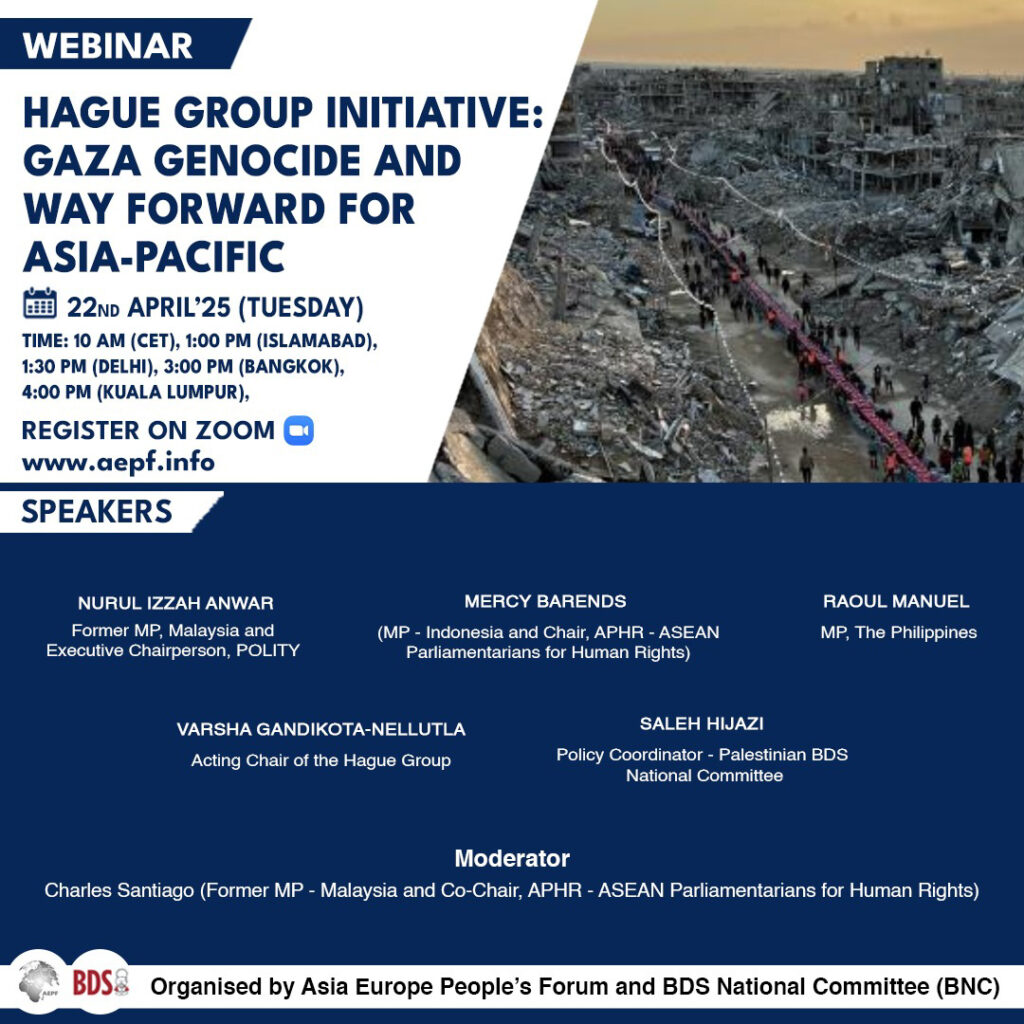
Webinar: Hague Group Initiative – Gaza Genocide and way forward for Asia-Pacific

Webinar: Hague Group Initiative: Gaza Genocide and way forward for Asia-Pacific

Watch the Webinar 

Speakers: 

– Nurul Izzah Anwar (Former MP, Malaysia and Executive Chairperson, POLITY)
– Mercy Barends (MP, Indonesia & Chair, ASEAN Parliamentarians for Human Rights (APHR))
– Raoul Manuel (MP, The Philippines)
– Varsha Gandikota-Nellutla (Acting Chair of the Hague Group)
– Saleh Hijazi (Policy Coordinator, Palestinian BDS National Committee

Moderator: Charles Santiago, Former MP Malaysia and Co-Chair, APHR

Organised by TNI, Asia Europe People’s Forum and BDS Narional Committee (BNC)

Read More

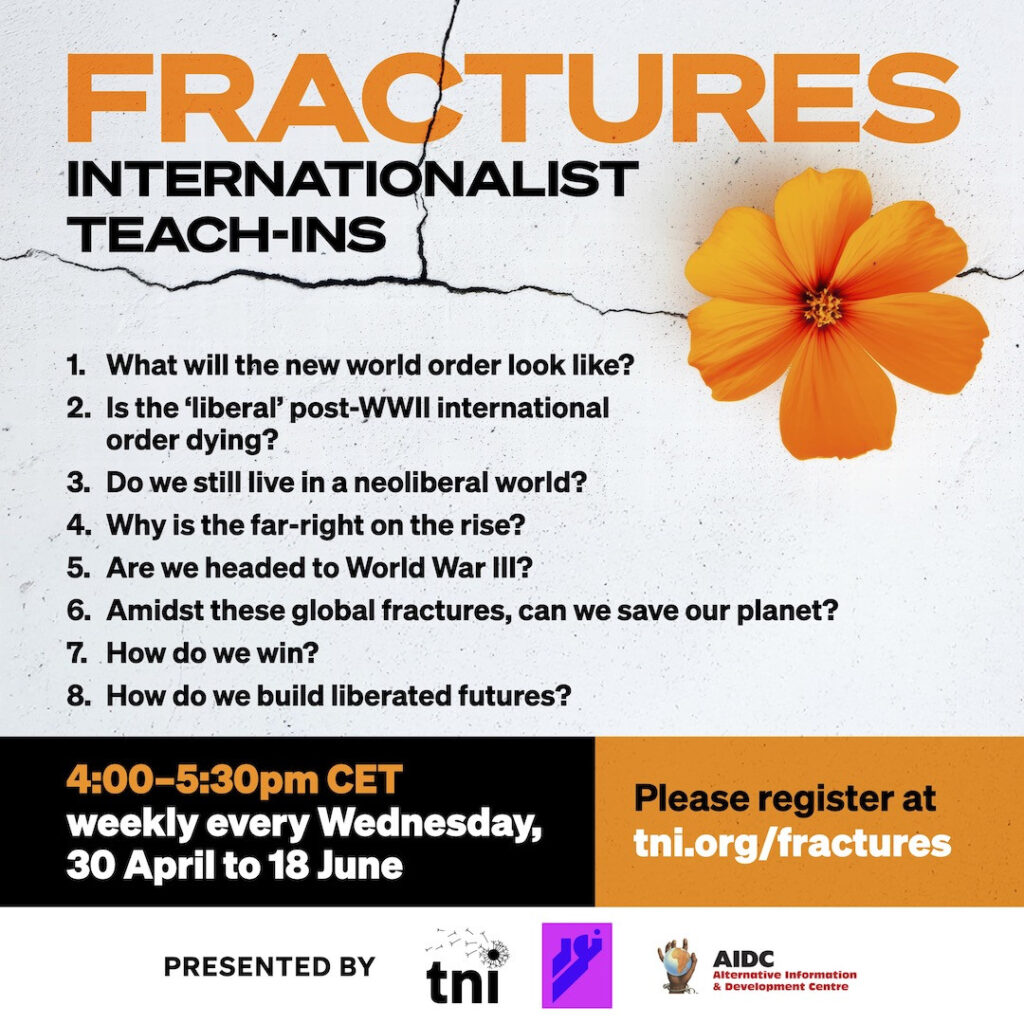
Fractures: Internationalist teach-ins

Fractures: Internationalist teach-ins

Date:  – 
Location: ZOOM

Organisers: Transnational Institute,  Alternative Information Development Centre, NOOR, Asia-Europe People’s Forum & Global Network of Movement Lawyers

Join our eight-week teach-in series to go beyond the headlines and uncover the deeper forces shaping our world. Leading thinkers and activists from across the globe will analyze the challenges we face and explore the strategies needed to resist injustice and build a just, sustainable future.

Register for Online Event 


We are in a fractured world – and we need to understand it to change it. Neoliberalism is cracking apart, age-old alliances are being abandoned, fascist leaders are coming to power, repression of activists is escalating, and marginalised communities are being targeted with ever more brutal force. Social justice movements face a new reality and need new strategies, tactics, and a renewed internationalism to resist. Fractures may cause chaos and division, but they also open up new possibilities—especially if we work strategically, concertedly, and globally.

This eight-week teach-in series will take a step back from the frenzy of news and dig beneath the surface to the long-term global trends that underpin this moment. It will bring together leading progressive and critical thinkers and activists from around the world to reflect on key global dynamics, the challenges and opportunities they pose for all those committed to social and environmental justice, and the tactics and strategies we need to move forward.

Programme

30 April:What will the new world order look like?
What is the future for US imperialism? What are China’s global aspirations? Can the global South be a collective agent for progressive change?

7 May: Is the ‘liberal’ post-WWII international order dying?
What was the promise and reality of the liberal order? Did it deserve to die? What is the future for international law and multilateralism? What will replace it? What should we demand in its place?

14 May: Do we still live in a neoliberal world?
How are the dynamics of capital and class changing? How is Big Tech reshaping capitalism? How does muscular state capitalism and trade wars reshape neoliberalism? How should we articulate public democratic economic alternatives? Can we re-create a democratic state, which has been so delegitimised by corporate take-over, cronyism and corruption?

21 May: Why is the far-right on the rise?
What is the agenda of the far-right? How has the far-right secured the support of anti-elite anger – and appeased by the traditional right? Where did the left go wrong? How can we survive authoritarian rule and best resist misogyny and racism? Where are the fractures in the Right that need to be broken open?

28 May: Are we headed to World War III?
How did global rearmament become hegemonic? What are the intentions of global powers? How do we stop the arms race? How will tech change warfare? How can we rebuild the global peace movement?

4 June: Amidst these global fractures, can we save our planet?
Why has the existential threat of climate crisis been cast aside by so many centrist and far-right political leaders? Why is climate denialism on the rise? What are the paths today towards ecological and climate justice?

11 June: How do we win?
What will social movements look like in the newly emerging era? What does global resistance look like? How do we build a new common sense in an age of internet eco-chambers? What can we learn from recent and past uprisings and movements to sustain them and take power?

18 June: How do we build liberated futures?
What are our imagined liberated futures? How can we build these within and beyond a fractured world? What are the alternatives that social movements are investing time, energy, resources and solidarity into building and sustaining?

Read More

Pakistan against Inequalities on the Eve of the World Economic Forum

Pakistan against Inequalities on the Eve of the World Economic Forum

A Report by Murddabir Ali (Coordinator – Fight Inequality Alliance Pakistan) 

 Ahead of the World Economic Forum in Davos (2024) a people’s movement ‘Fight Inequality Alliance Pakistan’ responded to  the call of the Global Secretariat and put up an incredible resistance against the top 1% rich class by protesting in sixteen cities across Pakistan. A Report on this resistance follows:

 Lahore: 

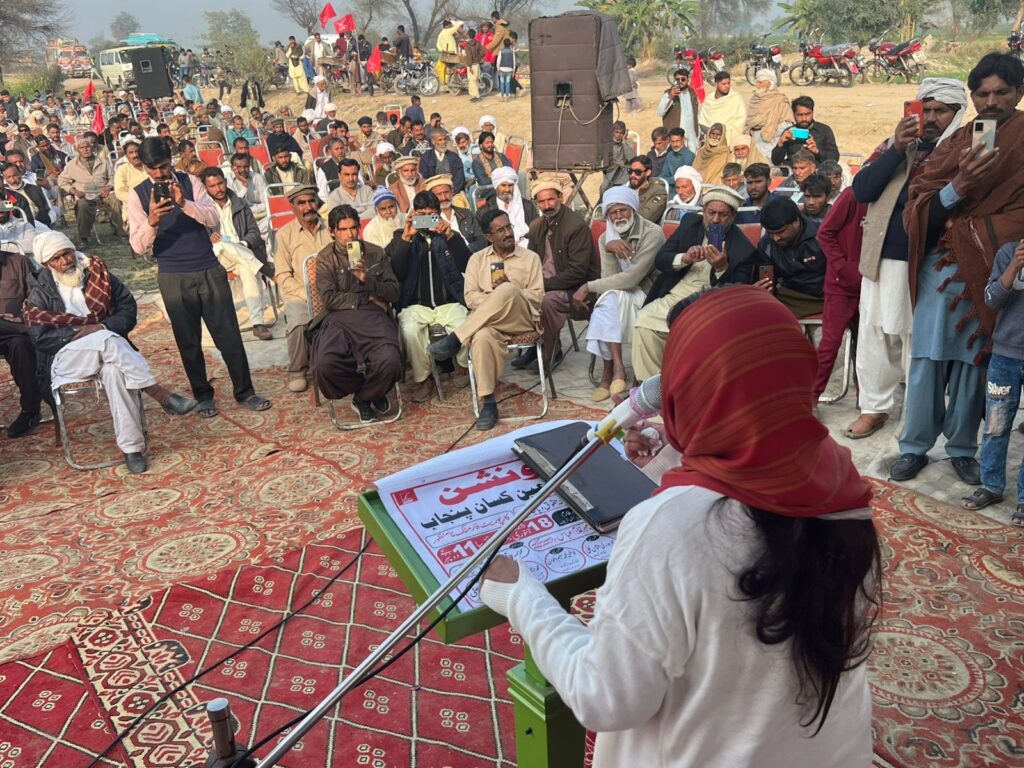
A large number of women from Chungi Amar Sidhu, a low income neighbourhood in the vicinity of Lahore showed up under the leadership of comrade Riffat Maqsood. The protest was joined by people of all ages, groups, young, old and children. Slogans were raised against the top1% of corporate profiteers. 

A street theatre group of team Umer Zamran performed. Their performances showed how the SYSTEM is inherently disadvantageous for the majority living under the poverty line and if the current structure of exploitation are not stopped it would create problems for our planet as a whole. 

 Jhang: 

 Factory workers and farmers gathered outside the Pakistan Kissan Rabita Committee office on Chiniot Road. Khalq Youth Front member Ali Syed and Fahad had travelled from Islamabad to participate in the protest. =

 The protest was covered by the local print and social media. Akbar Jutt who is the lead organizer of PKRX and a Council member of FIA Pakistan led the protests in this region.

 Faisalabad: 

 Faisalabad witnessed one of the biggest demonstrations of this season.  The majority of the protesters were labourers. Under the leadership of Baba Latif Ansari (Council Member FIA) the factory workers demanded implementation of minimum wage and issuance of social security cards. They held placards that showed a redline warning to the Billionaires. 

The protesters blocked the main Jhang road of Faisalabad for an hour. Rajanpur: The protest in Rajanpur took place in Jampor village. Farmers protested against the unfair prices fixed by the government on cash crops like sugarcane. They demanded that farmers should be taken on board while finalizing the minimum support price the government announces to facilitate the farmers. 

 Kasur: 

Kasur is a city adjacent to Lahore. Here, mainly activist groups came out to protest against the exploitation by the super rich. Gujranwala: The protest took place in Aimenabad area where mostly factory workers live. 

The protest demanded  rights due to the workers including old age benefits, implementation of minimum wages and issuance of social security cards. 

 Sahiwal: 

The main issue raised by the farmers of Sahiwal was land grabbing by big corporates in the name of corporate farming. Arifwala: Today’s biggest protest was held in Arifwala Pakpattan.  

Comrade Farooq Tariq joined the protest and reinforced the demands of local farmers about their land and dignified livelihoods. In his speech comrade Farooq raised the issue of corporate farming and building of six new canals on the River Indus to irrigate the Cholistan desert where the land is distributed amongst  1% of the super rich class of the country. 

 Larkana: 

Senior comrade Mujeeb Peerzado (Council Member) led the protest in Mohenjodaro. Mohenjodaro is the symbol of the Indus Valley civilization and one of the oldest cities in the Subcontinent. The people demanded basic necessities for  the poor people fulfilled as a priority and that is possible by taxing the super rich elite class. 

 Mardan: 

The Mardan protest was organized by Kissan Kerkela Organization headed by Gulzar Khan (Council Member). This is one of the prominent farmer organizations in KP province of Pakistan. 

The farmers in the protest demanded that they should be given fair prices for their produce and less taxes should be imposed. 

Qila  Abdullah: 

 Qila Abdullah is one of the remote areas in Balochistan Province. Despite the very harsh weather people came out and protested against the policies of the elite who have made the situation for the vast middle-class unbearable.  

Islamabad: 

Conveyor of the Fight Inequality Alliance Pakistan, Nisar Shah led the protest in the capital Territory Islamabad. The protest was held outside the National Press Club.

 Human rights activists and progressive political workers joined the protest and demanded imposition of strict taxes on the elite who earn their profit by exploiting the labour of the working class. 

 Toba Tek Singh: 

Toba Tek Singh is the historical city of Punjab where Comrade Shabbir organised the Bhatta Mazdoor (Kiln Workers) Union workers to protest against the capture of resources by the Global elite and the economic policies that they decide in international forums like World Economic Forum. 

Shikarpur: 

Shikarpur had the third largest protest today. Alongside RedLine To the Billionaires the protest locally carried the name Darya Bachao (Save the River). The protest was led by Comrade Ali Khoso (Council Member FIA Sindh). 

A large number of farmers and workers joined the protest and reverberated the highly important issue of water shortage to the lower riparian Sindh area. Farmers called upon the government to take adequate action to save Sindh land from becoming barren. 

In Punjab the core issue highlighted in the protest was condemning corporate farming, including the Kissan Card scheme and retaining the landownership rights of small landholders. 

In Sindh the unequal distribution of water was the predominant issues, the protesters demanded that making six new canals on the Indus river should be halted immediately. 

Due to harsh weather protests in Balochistan could not take place properly. We wrote a brief pamphlet about Global Action and sent it to the respective cities but it could not reach some cities because of the long distance. Next time we will send the relevant material at least three days before the activity.

Murddabir Ali
Coordinator
Fight Inequality Alliance Pakistan


Read More

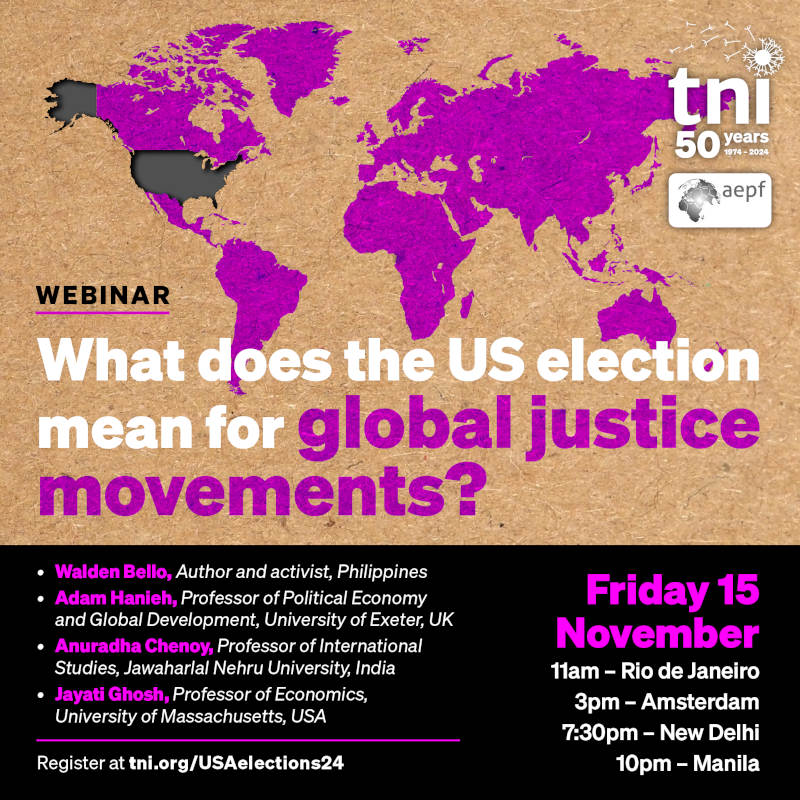
Webinar: What does the US election mean for global justice movements?

Webinar: What does the US election mean for global justice movements?

Four leading global activists and scholars assess the implications of Trump’s victory for US foreign policy and for social movements worldwide.

Speakers:

 – Walden Bello, Author and activist, Professor of Sociology, Philippines
Anuradha Chenoy, Professor of International Studies (Retd.), Jawaharlal Nehru University, India
Adam Hanieh, Professor of Political Economy and Global Development, University of Exeter, UK
Jayati Ghosh, Professor of Economics, University of Massachusetts at Amherst, USA

Watch the Webinar ‘What does the US election mean for global justice movements?’ by Transnational Institute and Asia Europe People’s Forum

Read More

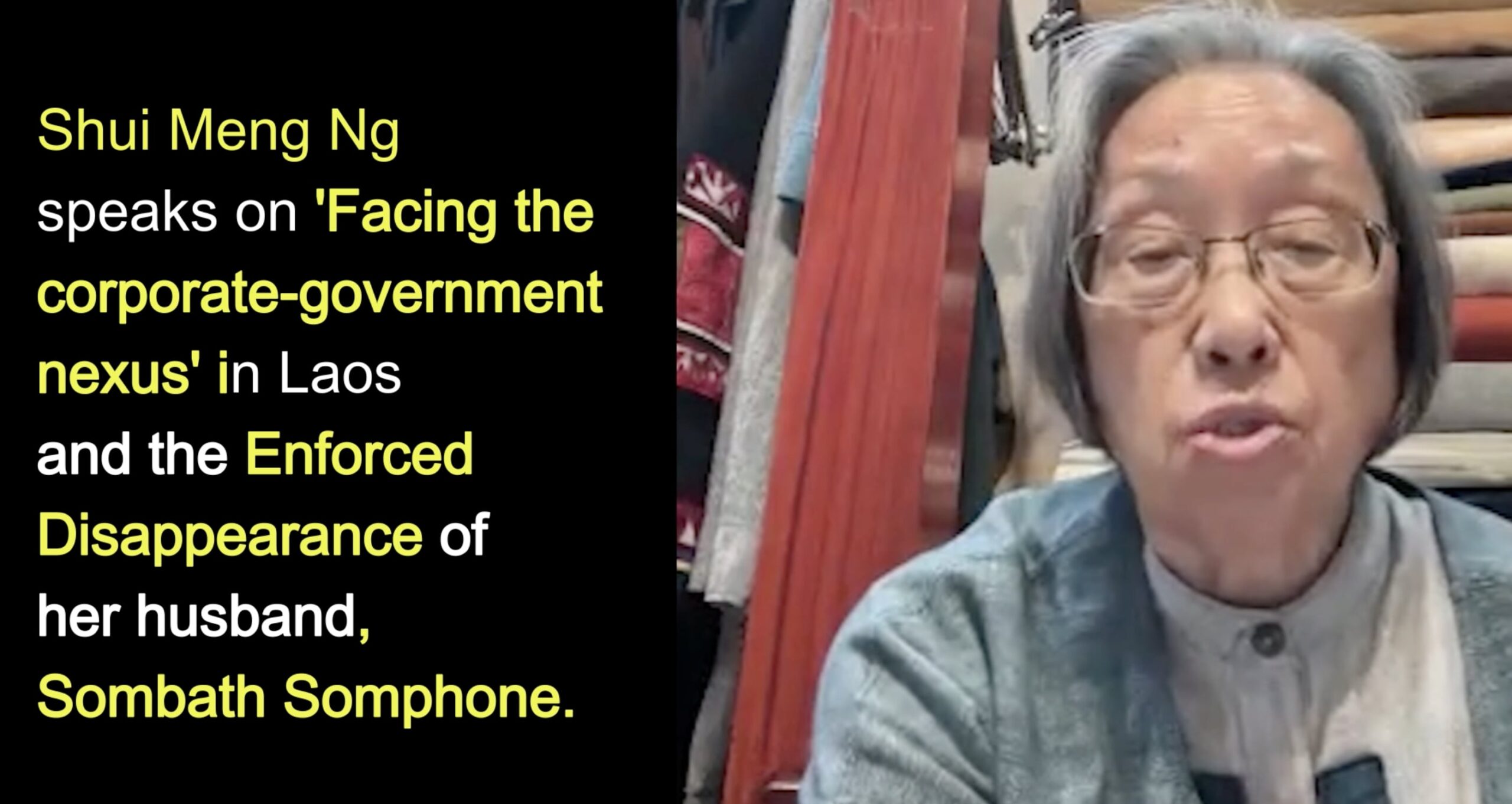
Facing the corporate-government nexus: Defending peoples’ and community rights

Facing the corporate-government nexus: Defending peoples’ and community rights

AEPF Remembers Sombath Somphone. Webinar on defending people’s rights in the face of the corporate-government nexus.

12 years since the enforced disappearance of Sombath Somphone

Watch the Webinar

Speakers:

– Ng Shui Meng: Wife of Sombath Somphone
– Charles Santiago: Co-Chair ASEAN Parliamentarians for Human Rights
– Ana Lorena Delgadillo Pérez: UN Working Group on Enforced or Involuntary Disappearances
– Haider Butt: Progressive Democratic Lawyers Forum, Pakistan

Read More

Martial law, Militarisation and Peoples’ Opposition in South Korea

Martial law, Militarisation and Peoples’ Opposition in South Korea

The resistance from the South Korean people and opposition led to the quick end of martial law. However major challenges to the democratic forces remain. This webinar analyses the events and forces at play.

Watch the Webinar

Speakers:
1. Francis Daehoon Lee (ROK, Peace Momo)
2. Lee Jun Kyu (ROK)
3. Kaia Vereide (St. Francis Peace Centre, ROK)

Moderators: Kris Vanslambrouk (AEPF and 11.11.11) & Corazon Fabros (IPB &AEPF)


Read More